It is said, by their works shall we know them. And increasingly, we do.
They rise among us, predominantly—but by no means exclusively—white, male, overweight, bewhiskered, rural, racist, ostensibly-straight, conservative, angry, and occasionally violent. They are frequently accompanied by others who don’t fit this profile exactly, but who express the same rage, the same fear, the same desire to take Canada back.
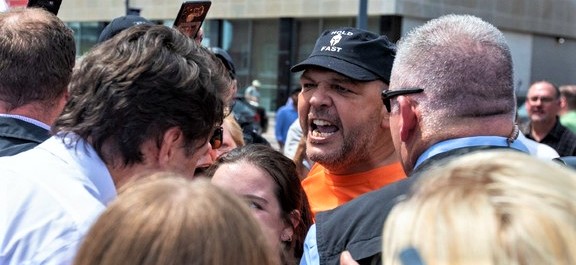
It’s unclear where they want to take us back to, but I suspect it might be back to the ‘50s—a decade most of them are too young to have lived through—a time when, in their fevered imaginations, men were men, women knew their place, children spoke only when spoken to, and nobody—including elected governments—told anybody else what to do.
Redneck heaven, to borrow a phrase.
According to the messages these folks spew unrelentingly on social media, marriage back then was between one man and one woman—born male and female, respectively. Every child lived in a nuclear family. Racialized and Indigenous people were not part of the established fabric, nor for the longest time were women, the poor, Jews, immigrants, or differently-abled people.
And it goes without saying, the LGBTQIA+ community was non-existent.
Previous decades have seen lots of protests in support of many causes—the ‘60s and ‘70s come to mind for this old-timer, but every era has known them. Most of those were peaceful, yet often effective; some involved civil disobedience; still others degenerated into violence, with consequences visited upon those who violated the law. The majority were mounted in the name of advancing more liberal, progressive movements—universal suffrage, socialized medicine, civil rights, end-the-war, the women’s-lib movement, and Indigenous reconciliation, to name but a few.
And that marks a major difference with today’s oft-inchoate protests, striving noisily to take us back to ‘the good old days’. Today’s aggrieved zealots behave as if our country always belonged exclusively to them—more accurately, their predecessors—and not to everyone who inhabited it then, and does so to this day.
Populists, bigots, and white-supremacists have ever been part of Canada’s demographic, of course, and many of us, I suspect, knew some of them back in the day. As a child born in the ‘40s, growing up in the ‘50s, I well remember the use of such loathsome slurs as kike, wop, dyke, fag, nigger, Paki, d-p, and others even more vile. As I was part of the white middle-class, they were never used against me, but more than a few of my white schoolmates hurled them—perhaps unwittingly, parroting their elders, but hurtfully, nonetheless—at those on the receiving end.
Another difference between those long-ago times and today is the opportunity the bigots now have to spread their hateful rhetoric. Social media, for all the benefit it has brought to much of society, has enabled the haters and ragers to amplify their message across the internet. In their posts, we find no trace of the civility that once characterized public discourse, even among those whose political ideologies and points of view conflicted.
When did it start to be okay, I wonder, to ignore the fundamental tenets of good manners? Of respect for other people? Of common sense? Perhaps it’s cantankerous of me to bewail their passing, or maybe I’m being overly pernickety in complaining about it. After all, as I’ve previously written, some folks consider me an unrepentant curmudgeon. Perchance, I am. Still, was respectful consideration for others not always a hallmark of civilized behaviour?

Today’s unruly mob weeps and wails loudly, profanely, about their loss of freedom, even as they enjoy the freedom to assemble and protest it. To me, it’s as though they believe this coveted freedom means unfettered license to do whatever they wish, unencumbered by the rule of law. Thus arises anarchy.
In Canada, citizens elect a federal Parliament every four years or so; then, with the ritual approval of the Governor-General, that Parliament chooses a government based on votes of confidence among elected members. The Prime Minister is the elected leader of the party chosen by Parliament to govern. Occasionally, one party wins a majority of seats in a given election, and thereby becomes the governing party by default.
For citizens either enamored of, or disappointed by, the actions of the PM and governing party, there is a means of re-electing or turfing the incumbents—the next election. Responsible civil engagement and voting are the tools. Increasingly, however, today’s fervid protesters crowding the nation’s public venues revert to intimidation, bullying, and threats of violence to overturn the will of the majority, to impose their values and beliefs on everyone.
If they win, democracy—imperfect though it may be—loses.
By their works, we shall know them.
 tallandtruetales