Who Counts?

[ ED. NOTE: If you are an official FOLLOWER of this blog, you are receiving my posts fully displayed in the body of the email notifying you of each new post. To read the post in my actual blog-site format, click on the title at the top of the story in your email, and you will find it a much more enjoyable experience.]

Like many of you, I suspect, I was raised by a mother generous in the love she gave, and wise in her ways.  My four siblings and I benefited greatly from her counsel, and agree to this day that she was right about almost everything.

Whenever I was angry with my brother or one of my sisters, for example, she would caution me, If you have nothing good to say, don’t say anything at all.

Many of our relatives in my mother’s large, extended family were gregarious, well-informed on most subjects, opinionated, and frequently argumentative, so holiday gatherings occasionally became loud and disputatious.  At such moments, my mother would advise me, Sometimes it’s better to say nothing, even if they might think you don’t understand, than to open your mouth and prove it.

Occasionally, I would arrive home from school with some juicy bit of gossip, and she would say, If your friends are talking about other people behind their backs, you can be sure they talk about you when you aren’t there.  And when I would nod as if I understood, she would add, It’s always best to stick up for people who aren’t there.

Decades later, I encountered that last advice again in a landmark book by Stephen Covey, who exhorted his readers: Defend those who are absent—one of my mantras to this day.

A good number of my mother’s admonitions were homespun, she having been raised by descendants of  Scots/Irish farming-stock who had emigrated to eastern Ontario in the mid-nineteenth century.  It’s a long road that has no turning, she would tell me when I’d recount a tale of woe, feeling sorry for myself.  If I’d had a quarrel with a schoolmate, she would say, The road to a friend’s house is never long.  Or if I was sad and blue when things weren’t going well, she’d tell me, When things are dark, try to be the light that someone else can turn on.

I think of my mother often these days, and I miss her wisdom.  I wonder what she’d have to say about this world we live in now, with all its strife and turmoil. 

No one in our family was ever subjugated by an invading people, exploited and dispossessed of our native land.  None of us has ever been despised and disenfranchised because of our nationality, our ethnicity, our skin-colour, our religious beliefs, our gender orientation, our political preferences, our wealth or lack of it, our age, or any perceived disability.  Throughout our lives, in fact, we have been among the privileged of the earth.

Such is not the case for the human species as a whole, however.  Worldwide, a huge number of people are victimized by war, famine, drought, disease, and genocide, some to the point of death.  And for many of those who survive, barely, there is scant relief offered by others of our species.

The product of a random, evolutionary progression over millennia, we human beings at our most primal level are forever a tribally-oriented species.  We seek to be with our own, and are suspicious of any who are different.  We are intelligent, yes, but also egocentric, selfish, aggressive, predatory, manipulative, superstitious, and too often unforgiving.  And because these character traits often override the intelligence factor, is it any wonder we currently find ourselves in such a mess?

Many of the several wars consuming the planet right now, for instance, are the result of clashes among opposing superstitious beliefs—what we sanctimoniously call religion—where each protagonist claims there is no god but our own.  And as if that doesn’t constitute folly enough, consider that many historic wars were waged by our predecessors who claimed allegiance to the same god, even as they prayed to that deity by different names. 

Such foolishness, when earthly power was truly the false god they all desired!

We humans have allowed ourselves—perhaps through a callous disregard for our collective well-being, or maybe due gross ignorance of the consequences we soon shall face—to approach a point of no return.  We seem not to realize that the civilization we profess to admire is but the thinnest of veneers, perched precariously atop the baser instincts of our species.

My mother used to say, The circle is not complete until everybody is inside.  We should always try to make the circle wider, so that everyone can come in.

Decades later, I chanced upon remarkably similar advice, this time in one of Michael Connelly’s crime-novels, spoken by one of his fictional characters, Harry Bosch:  Everybody counts, or nobody counts.

Would our current state of world-affairs be better, I wonder, if we humans could ever adopt that premise?  If we could set aside our preoccupation with the many issues differentiating and separating us, and instead take up the humanistic character-traits we share that might bring us together?

I mean, who counts?

From This Moment On

Some folks worry about getting old.  And they bemoan the passage of time.

But once upon a very long time ago, nobody kept track of the years.  People in their nomadic, tribal clusters got up when the day dawned and went to sleep when it got dark.  They did it every day, over and over again, until, inevitably, they didn’t awaken from their final sleep.  Nobody ever worried about getting old; they just lived until they died, and the tribe moved on without them.

Even today in this wide world of ours, there are still countless numbers of people who don’t worry about aging.  They live in unforgiving climes where their every effort is bent toward eking out a subsistence-level existence.  Or they’re driven from their homes by ravaging armies—persecuted for their beliefs, their skin colour, their ethnic origins, and often enslaved by their captors.  They, too, live only until death frees them, far too burdened to worry about the realities associated with getting old.

Yet here are we, inured from such extreme conditions—secure, some of us, in our developed, civilized world, inundated by the availability of all the essentials and luxuries we might desire—and what do we do?  We worry about getting old.

Not all of us, of course.  Many young people appear to have the same nonchalant, carefree attitude I probably had at their age—back when immortality was a given.  The halcyon days of youth seemed destined to last forever.  Only old people were old. 

Others of us, the more elderly, have learned a sterner truth.  Youth lasts only until it’s over, only until our bodies begin to betray us.  The rosy morning of youth gives way, grudgingly, to a more austere noontime of life, and then, inexorably, to a deepening dusk we all are destined to enter. 

Some folks accept that truth more gracefully than others, some more stoically, some more fatalistically.

But some, of course, do not accept it at all.  In the words of the poet, they rage, rage against the dying of the light.  Nips and tucks; silicone, botox, collagen, and dye; enhancements and reductions; diets and purging; even exercise—all undertaken by men and women in a fruitless pursuit of everlasting youth.

Why is this so, I wonder, here in our world of plenitude?  Well, perhaps it’s because we have become obsessed with measuring time.  After all, time’s passing itself is neither our friend nor our enemy.  It’s just there, it’s always been there, and it will forever be there.  So, I’ve come to believe it’s the keeping track of time that plagues us, wreaking havoc on our youth, eventually forcing us to an acceptance of the stark reality that we are going to get old.  And we are going to die.

But remember, we are the first cohort of people since the dawn of time who has ever had the luxury of worrying about that.

From this moment on, perhaps we shouldn’t.

Versions of History

Historians play a significant role in describing the thin veneer of civilization under which we live, in that their stories of our past colour the perception of our present and shape the direction of our future.  But the history of which they write—that is, the actual unfolding of events—comes to us in three broad forms: 1) the unvarnished facts, the scarcest type; 2) the more palatable account-of-record, the most frequent type; and 3) the revisionist version, the most recent and pernicious type.

Take this example of the first type, the actual events.  A young boy, often bullied at school, brings his new yo-yo to the schoolyard.  While showing it off proudly to his friends, he is accosted by a bigger boy who takes the yo-yo, dazzles the assembled kids with a flourish of tricks, then claims it for his own.  To forestall any backlash, the bigger boy gives the smaller boy his old yo-yo, along with a threat that he will be beaten if he complains.  The smaller boy, unhappily accepting his lot, would likely write the history of events like this.

The second type, a more palatable account if the bigger boy writes the story, might read like this.  A young boy, often bullied at school, brings a new yo-yo to the schoolyard as a gift for the bigger boy who, he hopes, will protect him from his tormentors in exchange for the gift.  The bigger boy graciously accepts the new yo-yo, agrees to defend the smaller boy, and in a spirit of generosity, presents him with his old yo-yo.  The smaller boy gratefully accepts his lot.

Both these versions take on added import if I mention that the smaller lad is an Indigenous boy from the rez, or a Black boy from the wrong side of the tracks, while the bigger boy is the scion of an influential White family from the better part of town.

The third type of history-writing, the revisionist version, might present the incident like this.  A White boy who brings his new yo-yo to school to show it off to his friends notices an Indigenous boy, or perhaps a Black boy, eyeing the yo-yo enviously.  Being a compassionate soul, the bigger boy generously gives his old yo-yo to the smaller kid, who is overjoyed to accept it from his munificent benefactor.

These made-up examples are just that, intended to illustrate the differences among the three versions of history we encounter.  But only the first example is a true account of what actually transpired.

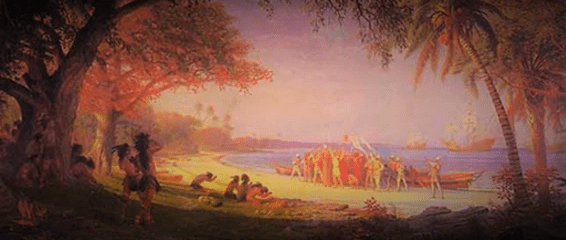
I—like most of you, I suspect—grew up being taught the second type of history at school, the palatable account-of-record.  I learned, for instance, that Columbus discovered the Americas in 1492, and that great European nations such as England, France, and Spain undertook to spread the Christian gospel to the heathens who inhabited those vast, new lands.  I was taught that Christian evangelizers, in their zeal to spread their religion and culture, gathered Indigenous children in schools far from family and home to provide them an education. 

I did not learn in school that the original inhabitants had lived on those lands for millennia before the arrival of the White colonizers, nor did I learn that the invaders brought disease and death to the original peoples whose gold and furs they coveted.  I did not learn in school about the horrors of residential schools for Indigenous children, nor about the treaties our government agreed to and then broke.  Those learnings came much later.

That more palatable version of history also taught me in school that anti-Semitism was an integral part of the Kulturelle Überzeugungen of the wicked Nazi regime during WW II, and that the Japanese devils waging unprovoked war in the Pacific were spawned by an evil, expansionist empire that had to be destroyed.  Both these facts were undoubtedly true.

But I did not learn in school that my own country, in a burst of anti-Semitic fervor, turned away a boatload of Jewish refugees in 1939, people fleeing the Nazis.  Nor did I learn of the internment camps in my country to which Japanese-Canadian citizens were exiled during the years 1942-1949, their homes and possessions stripped from them.  Those learnings, too, came later.

The revanchistes among us, those who would revise our history, try to tell us now that things like this did not happen—or if they did, it was for the best of reasons.  They tell us the people making the decisions in such matters were ‘men of their times’ acting under the moral imperatives of the day, and should not be caviled or condemned by woke commentators holding them to account under today’s standards, standards which have changed radically over the intervening years.  These revisionists, it seems, don’t want our children to learn unsavoury truths from our history, lest that knowledge corrupt the pristine past they prefer to present.

The problem is, although neither the palatable or revisionist versions of history accurately reflect what actually transpired, they can and do obscure or even alter the truth, affecting our perception and understanding of past events—and thus, perhaps, shaping our future actions.

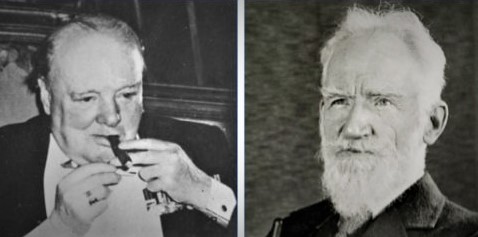
As Winston Churchill famously wrote, Those who fail to learn from history, are doomed to repeat it.  His countryman and frequent foil, George Bernard Shaw, wrote, We learn from history that we learn nothing from history.

Regardless of which of these men is closest to the truth, what I have learned is that our history-of-record is, for the most part, what the powers-that-be in our society want it to be.  Moreover, that record can change to accommodate the whims and needs of the present realities as perceived by those powerful influencers.  We are not, for the most part, presented with the unvarnished facts from our history.  And that being so, it is not possible that our present and future behaviours can be shaped for the better by learning from our past.  

We fool ourselves by thinking otherwise.

We save ourselves by seeking the truth.