
The Lonely, Silvery Rain

Otter & Osprey Press, a mainstream, Canadian publishing house (a division of Northern Forest Publishing), has released a second edition of my novel, The Lonely, Silvery Rain, to bookstores and online retailers. It’s available in both print and e-book formats, including Kindle.
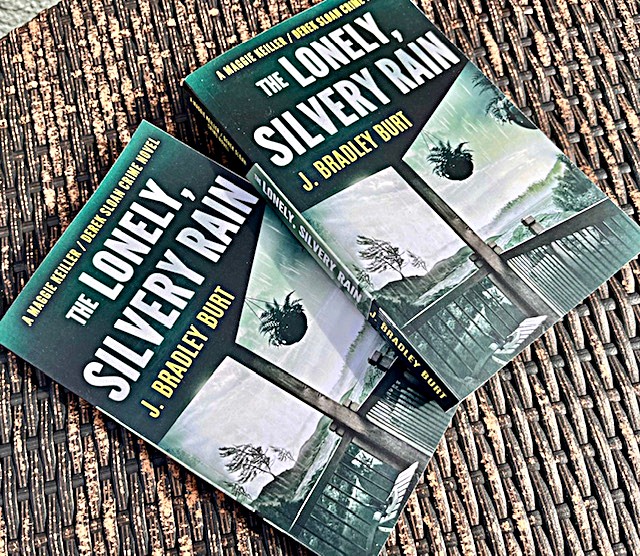
This book is the thirteenth in my Maggie Keiller/Derek Sloan crime series, and the first to be offered by a Canadian publisher. As a crime-fiction novel, some of the portrayed events and language are intended for an adult audience…..but the story, as one editor commented, is kickass!

Set against a background of reconciliation efforts between government and the fictional Odishkwaagamii First Nation, a gripping story of betrayal and murder unfolds in Port Huntington, a small resort town on Georgian Bay. Vandalism, extortion, and violence are unleashed in the community as a number of personal grievances boil to the surface. 

In 2018, the Ontario Superior Court of Justice awarded ten billion dollars to twenty-one First Nations in a vast area along the north shore of Lake Huron, to be paid equally by Canadian and Ontario governments. The settlement is compensation for unpaid annuities to those affected First Nations, annuities that were mandatory under the still-valid 1850 Robinson-Huron Treaty, whose terms committed the government to paying the affected First Nations annual stipends tied to actual resource revenues on their sovereign lands.

Over the years, billions of dollars in profits were extracted from First Nations lands for mining, timber, and fishing enterprises in Ontario, but the obligatory annual payments to First Nations were adjusted only once, thus depriving generations of First Nations people of revenues to which they were entitled.

Under the terms of the settlement, the Robinson Huron Treaty Litigation Committee, composed of Indigenous representatives, was tasked with determining how, and in what amounts, the funds would be distributed to the affected First Nations. While this story is a work of fiction, it is rooted in the very real question of how that money ought to be used. For the Odishkwaagamii, these debates boil over into deception and bloodshed.

Maggie Keiller and Derek Sloan are inextricably caught up in the turmoil, and it is only through their personal integrity and courage that they navigate the chaos.  Determined as always to defend their Port Huntington community, and themselves, they work to ensure justice will prevail.

This safe, universal link will afford you a preview of the story, and direct access to your preferred online retailer—

https://geni.us/thelonelysilveryrain

After publishing my books through Lulu Press since 2007, an American print-on-demand firm, I’m thrilled that a Canadian publisher has picked up my work, and I encourage you to take a look at their website—

https://www.northernforestpublishing.com/homepage

I hope you’ll explore the link to my book, which I believe you will enjoy. Other titles in the Maggie Keiller/Derek Sloan series may be found at this safe link—
https://www.lulu.com/spotlight/precept

Another Excellent Read!

TEN BILLION DOLLARS AWARDED BY COURTS TO TWENTY-ONE ONTARIO FIRST NATIONS!

In the latest novel in my acclaimed Maggie Keiller/Derek Sloan crime series, the dramatic consequences of this actual treaty settlement unfold in Port Huntington, a small resort town on the shores of Georgian Bay.  And once again, Maggie and Derek become inextricably involved in personal grievances boiling to the surface among various interests, involving vandalism, extortion, violence, and murder.

Be sure to read this exciting story, available now for purchase at—

https://www.lulu.com/spotlight/precept

You will find complete information on my published books by pressing the My Books tab at the top of this page.

As always, thanks for reading my blog, and for your interest in my writing!

The Cannabis Murders

I’m excited to announce that The Cannabis Murders, my eleventh novel in the Maggie Keiller/Derek Sloan crime series, will be released early in February!

The riveting story unfolding in this book is set against a backdrop of rising public concern over the extent of covert Chinese interference in political and corporate affairs in Canada, and across North America.

The story itself is tied to the legal production and distribution of cannabis products, as a global producer with Chinese connections attempts to establish a manufacturing facility near the resort town of Port Huntington on Georgian Bay.  In so doing, the company encounters community opposition, and runs up against Indigenous land-claims to the property in question, both of which throw up major stumbling-blocks to its plans.

To everyone’s dismay, repeated vandalism, threatened extortion, violence, and eventually murder soon follow.  Maggie and Derek become caught up in events through her support of a young, Indigenous woman trapped in the turmoil that follows, and through his involvement as a negotiator for the First Nation land-claims.  And both are drawn further into the mayhem because of their connection to the government’s pending inquiry into the secretive operations of Chinese interests in the area.

Resolute as always to protect their community, and themselves, Maggie and Derek work closely with police to bring the evil perpetrators to justice.

I know you will enjoy this story, and I’ll post notice here when the book becomes available.  In the meantime, the ten earlier novels in this series, together with my eight anthologies of tales, can be found for a free preview or purchase at this safe link—https://www.lulu.com/spotlight/precept

Thanks to all of you who read my blog-posts. If you enjoy them, you are sure to love my books!

Too Late Smart

Too Late Smart

I once had a large beer stein, embossed with this statement in a mock German/English hybrid: Ve grow too soon oldt, und too late schmart!  Many a lager or ale was quaffed from that stein with not much thought to the import of those words.

beer stein 4

Predictably, I have grown old too soon, at least for my liking.  And that particular stein has long since vanished.  But strangely, the significance of the inscription has stayed with me.  In my wry moments, I apply it to the world at large, our planet, and to how we humans both inhabit and desecrate it.

There are various theories as to when the so-called new world was discovered by the Norse and European peoples; consensus has it somewhere between 500 and 1100 years ago—a not inconsiderable difference of 600 years, during which the indigenous new world inhabitants must have had scarce premonition of what was to befall them.

If I were to sum up the future they faced in one word, it would be exploitation.  If I added a word, it would be extinction, at least for many of them.  I’m reminded of the famous boast attributed to Julius Caesar:  I came; I saw; I conquered!  Just imagine that from your perspective if you were one of the indigenous new world peoples: they are coming, they see us, and they will conquer us!

Victor venit ad spolia!  To the victor went the spoils.

When one contemplates the imperial expansion of the old world into the new, there are several ex- words that come to mind:  exploitation and extinction, the two already referenced; extermination; expulsion; extraction; excision; expurgation; extortion; extrusion; exclusion; execution; exporting; expunging; extradition.  And exile, of course, for many who resisted.

Imperialism and all it entails seems to have been the motivation for such unbridled acquisition of new world territories.  In life, nothing is in stasis; organisms are either growing or dying.  And the great European colonizer-nations were most definitely organisms of a particular sort:  social, political, economic, and militaristic.  They either competed against each other for dominance or faded into irrelevance.

From today’s perspective, we can look back on all that has unfolded as a result of the aggressive outreach of those nations.  Depending upon our viewpoint, we can praise it or decry it.  Descendants of indigenous peoples displaced and overthrown might be forgiven if their outlook differs from that of the progeny of the invaders.

Wars among nations have been fought almost endlessly over the millennium, many in the name of the same acquisitional drive:  the Thirty Years War, the Seven Years’ War, the Anglo-Spanish War, the Napoleonic Wars, and of course WW I and WW II, to name but a few in the European sphere.  What have they resolved?  And what have we learned?

Are nation-states still expansionist?  Are militant religious factions still agitating?  Are the world’s peoples better off for all the strife?  Are we any smarter, or are we just older?

If only we could embrace different ex- words to drive international discourse over the next decades:  expiation; examination; exculpation; exemplary; exponent; excellence; exhortation; extolling.  Surely then, exaltation would arise among all of us, forever freed from conquest and suppression by others.

But sadly, we are likely too late smart.