
Of, By, and For

From my Canadian vantage point, the longstanding myth of American exceptionalism appears to have been exposed.  The Benighted States of America has signalled it is no exception after all, as it falls into line behind nations like Brazil, Hungary, and Russia on the slippery path to corporate, fascist oligarchy.

Those citizens who lament this turn might blame the result of the recent election on an ill-informed electorate, but the truth is the voters were not uninformed, misinformed, or disinformed.  Well in advance of voting day, the winning party composed and published its agenda, Project 2025, hanging it out there for all to see.  So, any lamentations might more aptly be directed toward apathy or hubris on the part of too many Americans.

And of course, there’s the fact that more voters are celebrating the result than bemoaning it, at least according to the popular vote count.  In that sense, the will of the people prevailed, just as it’s supposed to.

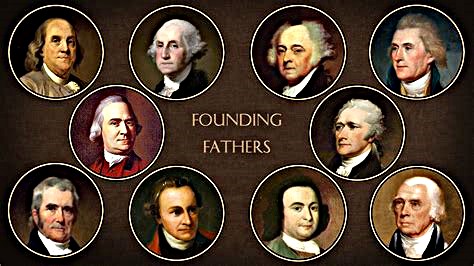
It appears so far that the election process unfolded as designed, with no accusations or evidence of widespread glitches or fraud, despite the plethora of different voting procedures across the fifty states.  That process—which, by deliberate decision on the part of the landed gentry known as the Founding Fathers—leaves the final choosing of the chief executive in the hands, not of the people, but a select group of electors from each state.  America is still exceptional in this, I suppose, given it’s the only nation in the world to rely on an Electoral College.
Simplistically stated, democracy implies that majority rules, no matter how slim that majority.  In a tri-cameral system—executive, legislative, and judicial—it is rare that one party will capture the Presidency and both branches of the legislature.  But at the time of writing, the Presidency, the House of Representatives, and the Senate have apparently fallen to one party in this recent election.  The popular vote count, although not overwhelmingly one-sided, was decisive.

It’s worth remembering that democracy is not ordained, merely proposed and tried.  Churchill called it “the worst form of government, except for all the others.”  Still, it endures for now, and should certainly not be dismissed because it yields an electoral result not satisfactory to a segment of the population.

Whether this recent result is good or bad is based upon one’s point of view.  My own opinion is that it bodes ill for the future of the nation, and perhaps the world, but my opinion matters little.  American politicians are fond of proclaiming, “This is who we are as Americans!”, or conversely, “This is not who the American people are!”  Although neither statement is accurate, both can be apt in any given instance, depending on how Americans’ behaviour matches or clashes with those politicians’ ideological leanings.  For example, public demonstrations or protests are often acclaimed and disparaged simultaneously by opposing political factions.  At the very least, any occasion represents only who some Americans are and who other Americans are not.

One thing for sure is true, however: the entire population of 346-million+ cannot rightly be dubbed ‘the American people’.  Across all spectra—political, social, economic, religious, ethnic, gender, rural/urban—Americans, like other nations’ citizens, comprise a distinct array of diversity, not a homogeneous collective.  Americans, unsurprisingly, do not all think alike or cherish the same values. 

Nevertheless, it is clear the recent election was decided by the American people who were eligible to vote—those who exercised their right and those who did not, those who swung one way and those who went the other.  Democracy in action.

Like it or not, people’s understanding as to whether something is right or wrong, good or bad, is inevitably shaped by the outcome of any election.  Perhaps there is a true right and a true wrong in the moral universe, but it’s how those concepts are filtered through an ideological lens that matters most.  Did America decide wisely on its future this time, or foolishly?  Is liberal democracy the judicious choice, or corporate fascism?  Is an imperial Presidency the better model, or a checks-and-balances structure?  And does the worm always turn?
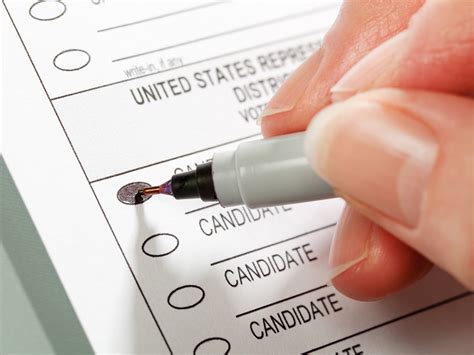
To paraphrase a timeworn sports adage, any nation is what its voters say it is, and it remains so until its voters say it’s something else.  That, I submit, is governance by and of the people.  Whether or not America’s recent election results prove to be for the people will likely become apparent over the next couple of years.

Ultimately, we all get the government we deserve.  America is no exception.
The Right to Be Wrong

Among the inalienable rights we enjoy in democratic societies is the right to be wrong.  We have an unfettered right to make a choice about our fundamental values, our publicly-stated opinions, and our actions—and to express these choices.

We bear a burden for holding this right, however, in that we are expected to (and can often be made to) accept responsibility for the consequences of our choices.

This notion has become more significant for me recently, as I watch in horrified fascination the shenanigans of the so-called ‘leader of the free world’, and his enablers, in the great republic to the south of us.

The circumstance of being wrong is a subjective concept.  How do we know, how can we determine absolutely, when someone is wrong?  Is there a conclusive test?  Do we always know right away, or does it sometimes take a long time to figure it out?

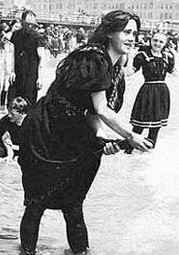
In fact, there are societal norms in place to govern our interactions and behaviours; but most of them evolve over time, as each succeeding generation shapes the world to its liking.  An action considered wrong for my Victorian grandmother (like appearing on the beach in a two-piece bathing suit) would certainly not be condemned today.

bather

The norms come into existence in one of two ways.  They are legislated for our common good by duly-elected representatives, or they are adopted by people at large as benchmarks for social intercourse.  Regardless of their source, they become truly effective only when they enjoy a high degree of acceptance among those for whom they are intended.  It has been called governance with the consent of the governed.

An example of the legislative method is the imposition of speed limits for vehicles on publicly-owned roadways; it is clearly wrong to exceed the posted limits.  An example of the adoptive method is the attitude towards smoking, particularly around other people; even in jurisdictions where smoking is not yet illegal, it is definitely frowned-upon to subject others to second-hand smoke.

Of course, in neither form, legislated or adopted, do our societal norms enjoy universal approval.  There are countless scofflaws in the general population who pay only lip-service at best to those they consider trivial.  Have you, for instance, ever exceeded a posted speed limit?  I confess I have.  And there are people who, despite both the social opprobrium and scientific evidence attesting to the effects of smoking, who still choose to light up.

More importantly, and more dangerously, we have fringe groups among us who vigorously, sometimes violently, oppose those norms they disagree with.  If that were not the case, abortion clinics would not be bombed; temples, mosques, and churches would not be defaced with hateful graffiti; and people would not be denigrated and harassed because of skin-colour, gender, sexual orientation, age, or disability.

Thankfully, such violent actions are widely considered wrong in a democratic society.  And, wherever possible, punished.

In the distant past, Isaac Newton famously hypothesized that for every action, there is an equal and opposite reaction.  Known as Newton’s Third Law of Motion, it pertained to the physics of interactions between two opposing forces.

We might think of the relationship between behaviour and consequences in a similar, though not identical, manner.  The first begets the second.  If I drop a crystal goblet on a tile floor, for instance, the goblet shatters; if I stroll through an afternoon shower sans umbrella, my clothing becomes soaked; if I bite down on my tongue while chewing, I experience pain.  Such natural consequences are the result of the behaviours immediately preceding them.

Logical consequences are different, but no less substantial.  If I drop that crystal goblet while examining it in the store, I will almost certainly have to pay for it.  If I speed through a residential neighbourhood (even if I am fortunate not to strike a pedestrian), I may be cited by a traffic cop, leading to the payment of a substantial fine.  Logical consequences are imposed as a result of our behaviours by outside authorities empowered to do so.

All of which brings me back to my dismay at the disarray I witness almost daily in the USA.  People elected to govern on behalf of the people who elected them behave, instead, in their own selfish interests.  They make decisions, not on the basis of how a particular matter might benefit their constituents or their country, but on whether it will improve their chances for re-election.  They take positions, not representing those who voted for them, but the moneyed interests who finance their pursuits.

washington-d-1607774_960_720

They spend their time, not enacting legislation to benefit all citizens, but fighting their partisan, internecine battles in a sadly-ritualistic dance to the death.

And at the forefront, a bombastic, narcissistic showman, ignorant in the ways of leadership, determined above all to have his way.  To win!

Can the great republic be wrong in the fateful choice it made just six months ago?  And if so, what will be the consequences for the nation, and for the rest of the world?

We have an inalienable right to be wrong, it is true.  But never in my memory have the potential consequences of being wrong been so enormous.  I want to cry out—

How can you be so stupid?  Fix this!  More important than your right to be wrong is your duty to be right!

And, helpless to affect matters, I continue to watch.