Past, Present, Future

In 1905, George Santayana famously wrote, Those who cannot remember the past are condemned to repeat it. The statement is from his five-volume book, The Life of Reason: The Phases of Human Progress.

In 1943, Eugene O’Neill wrote, There is no present or future—only the past happening over and over again—now. That declaration is from his stage play, A Moon For the Misbegotten.

In his 1950 novel, Requiem For A Nun, William Faulkner echoed the notion when he wrote, The past is never dead. It’s not even past.
Although I could never be confused with those three literary giants, I too wrote on the same theme, more poetically: What’s past is the past—so quickly it passed—But it’s not where I want to stay. Those are the last two lines in the third stanza of my seven-stanza poem entitled, I Haven’t the Time

https://ppens1blog.wordpress.com/2025/07/01/i-havent-the-time/

But I also wrote of the future in that same poem: When all has been said, I still look ahead /To life’s next opening curtain. The premises of the poem are that life marches resolutely forward, that I haven’t the time to concern myself with its past, that I eagerly embrace its future.

Nevertheless, I’ve often wondered if there even exists a past or a future. Perhaps, as James Joyce stated in a 1935 interview with Jacques Mercanton, There is not past, no future; everything flows in an eternal present.

It may be, perhaps, that my poetic curtain is opening, not on some ephemeral future, but only on more of the ever-morphing present. I’ve long appreciated the analogy that life’s progress is akin to riding a train from one’s point of embarkation to one’s final destination, with innumerable stops along the way. People get on, share the ride with me, and every now and then, some get off—perhaps because their journey has ended, perhaps to continue their journey on another train. Indeed, I change trains from time to time myself, although my journey still continues.
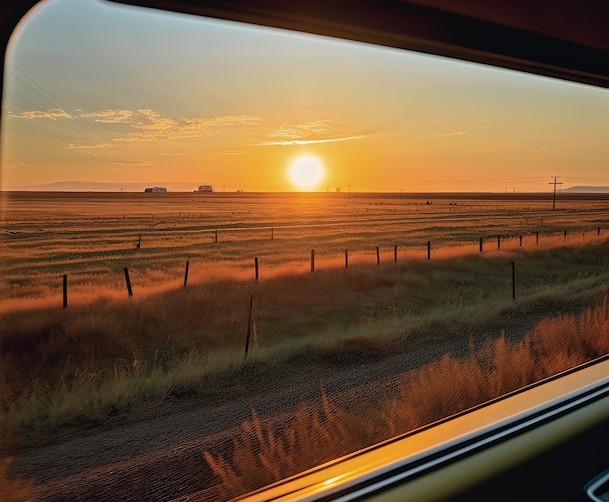
My train moves from whence to hence, but I, gazing through its windows at the passing parade, remain aboard in my encapsulated present. The views change constantly, but my surroundings on the train remain, for the most part, constant and familiar. Locales no sooner flash by the window into the past in one direction, than future ones appear from the other. Riding the train is like being everywhere at once while never leaving the same place—Joyce’s eternal present.

Despite these musings, however, I find myself reflecting on the past more often these days—because of my age, maybe, now that my tomorrows are vastly outnumbered by my yesterdays. Although memory is an increasingly unreliable tool, it’s still easier to remember what’s transpired than it is to predict what’s yet to come.

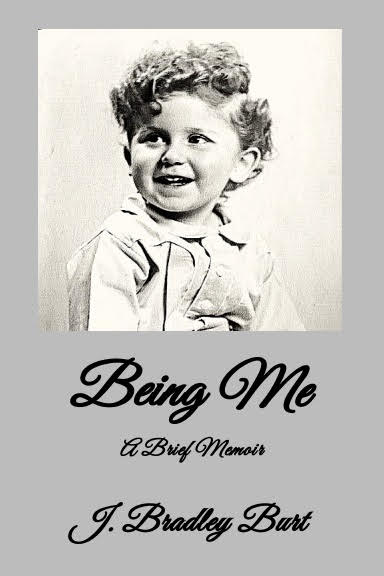
I recently published a short memoir for family and close friends, Being Me, and the exercise both surprised and cheered me. For instance, I re-affirmed that I have lived a blessed and privileged life to this point, surrounded by people who love me. And happily, I discovered I have almost no regrets about events from the past. The few I do have are less the consequence of my own actions and more the result of external forces acting on me, forces I could not control. With the exception of those, I realized there’s virtually nothing I would seek to change, had I the power to do so.
Writing the memoir took me back to places I’d been along the way, and I grasped anew how much I had enjoyed being there—my parents’ hearth, my own homes with my wife and daughters, our trips to foreign lands, my various career stops. I have no wish to return to any of them, to be sure, for I enjoy where I am right now too much. But I greatly appreciate that I had those experiences and opportunities—even if I see them now as only images flying past the windows of my train.

The future holds no fear for me. Curiosity? Anticipation? Of course! Those next opening curtains still claim my attention. I have no idea when my train will drop me at my final destination, but the present journey continues to be enjoyable and fulfilling. I have no clear understanding of what awaits when I shall disembark for the last time, although I do suspect the past, present, and future all will end at once. After all, Einstein held that the distinction between the past, present and future is only a stubbornly persistent illusion.

I imagine there to be an entirely different matrix awaiting after my consciousness has ceased, where time has no meaning, where eternity reigns…well, eternally. In the meantime, I hearken to this advice from St. Luke: …live for today, because yesterday is gone and tomorrow may never come.

My journey’s end will come, however, and I look to it in this fashion—

When that day is nigh, as ‘twill be by and by,
I hope it will be widely said,
That as man and boy, I strove for the joy
Of living until I was dead.

Keep On Keepin’ On

[NOTE: IF THIS COMPLETE BLOG-POST LIES IN THE BODY OF THIS EMAIL MESSAGE, CLICK ON THE TITLE TO READ THE PIECE IN ITS NATURAL ENVIRONMENT ON MY BLOG- SITE. IF ONLY A LINK TO THE PIECE IS PROVIDED IN THE EMAIL, CLICK ON THAT TO TAKE YOU TO THE SITE.]

It has been postulated by persons wiser than I that time does not exist, neither past, present, nor future.  If our lives were a metaphorical hourglass—the top bulb representing the past, the middle stricture the present, the bottom bulb the future—we would find ourselves at the middle, living in the moment.  That moment, however, would be but the instant it takes for one grain of sand to pass through the stricture, followed by the next, and the next, ad infinitum, each gone too rapidly for us to grasp.  And therefore, the theory goes, the present cannot actually exist.  Similarly, because we have no conception of the bulb above us or the one below, no way to perceive them, the past and future also do not exist.

Perplexing, no?  But not a theory I agree with, and I would urge those who espouse it not to tell me time doesn’t exist. 

Given my longtime fascination with and study of history, I’ve always believed there to be a past.  Mind you, I’m able to consciously recall it only from the late 1940s onward; everything that happened before that, I must accept as it’s been told to me. 

I’ve always believed in the present, too, perceiving it not as a mere instant in time, but as a continuous progression or sequence of events in which I play a part—at least while I’m awake.  While sleeping, of course, I have no awareness of the present.

The existence of a future is something I’ve always taken for granted, as well, though I have more yesterdays behind me now than tomorrows ahead of me.

My parents, whose lives spanned parts of ten decades, nonagenarians when they died, are part of the past I remember.  My wife and two children are part of the present I inhabit.  And my grandchildren represent the future, most of which, alas, I shall never see.  But it’s my comprehension of these three elements—past, present, and future—that allows me to carry on.

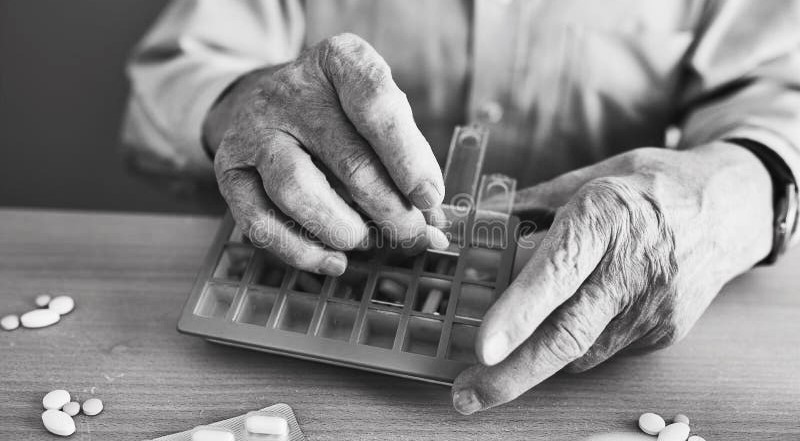
I remember visiting my father as he neared the end of his life, and hearing him complain (for the zillionth time) about the number of prescribed medications he was taking.  He had a small, plastic pillbox to keep them organized on a weekly basis, a device I silently laughed at, so cocksure and smug in my late forties.

“I saw the doc last week,” my father said, “and I told him to take me off some of these damn pills.”

“What did he say?” I asked.

“Said he’d do that if I told him which ones to cut out.  Said he wasn’t sure which might be the ones keeping me alive.”

“So, what did you say?”

“I told him, in that case, forget it.  I’ll carry on with all of ‘em.”

“Good move, Dad!” I said.  “Keep on keepin’ on.”

We had that conversation thirty-five years ago, and my father’s been gone for more than twenty of those, a part of my past forever.  To my everlasting astonishment, I’ve now entered my own ninth decade, the octogenarian I never contemplated becoming, and my present looks more and more to me like his did to him back then.

I, too, have a plastic pillbox now to organize the eight medications I take daily, five of which are prescribed to control cholesterol, regulate blood pressure, promote prostate function, and bolster bone density.  The other three are over-the-counter supplements I like to think will help me compensate for my lost and lamented youth.

Oh, how the mighty have fallen!  I imagine my father, wherever he is, must be chuckling knowingly at my plight—my past making fun of my present.

I have a friend whose espoused goal in life is to live more years retired than he spent working.  It’s a noble goal, one I share, and that moment will arrive for me seven years from now.  Another of my goals is to accomplish what my parents did, living into a tenth decade, which will happen when I hit ninety, a mere nine years off in the future.  Both my folks remained mentally acute and physically viable almost to the end, a state I devoutly wish for myself. 

A third goal is to live life fully right up until I die—a sentiment I wrote a poem about, I Haven’t the Time, which you will find and enjoy at this safe link—

https://tallandtruetales.blog/2020/01/08/i-havent-the-time/.

Our two daughters visited us for a week in Florida recently, without their husbands and children.  Although we love being with them all, this annual visit from our girls is part of a future we look forward to every year, our ‘core four’ together again.  But the realities of past and present do have a way of inserting themselves. 

I encountered both of them on their first morning with us as I lurched into the kitchen—unshaven, hair askew, eyes still half-shut.  They offered a cheery good morning and warm kisses as I plugged in the kettle for my green tea—decaffeinated, of course—and watched me spill my pills into my hand from the pillbox.

“How many pills do you take every day, Dad?” the eldest asked.

I told her, explaining what each was for in more detail than she probably wanted to hear.

“Do you really need to take that many?” her sister asked.

“Maybe, maybe not,” I said, an unbidden image of my father flashing before my eyes.  “But I don’t know which might be the one I need to keep me alive, so I just carry on with all of ‘em, y’know?”

“Good decision, Dad!” the eldest said.

“Yeah,” her sister echoed.  “Just keep on keepin’ on!”

And so I shall—proud of the past, relishing the present, anticipating the future. Given what I know to be true, no one can tell me they don’t exist!