
By Their Works

It is said, by their works shall we know them.  And increasingly, we do.

They rise among us, predominantly—but by no means exclusively—white, male, overweight, bewhiskered, rural, racist, ostensibly-straight, conservative, angry, and occasionally violent.  They are frequently accompanied by others who don’t fit this profile exactly, but who express the same rage, the same fear, the same desire to take Canada back.
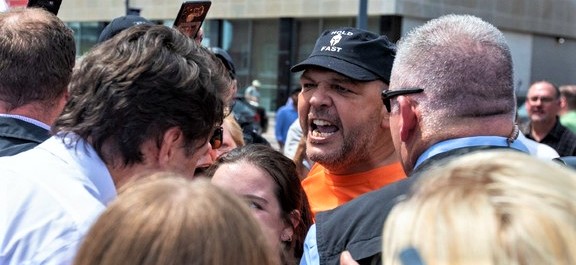
It’s unclear where they want to take us back to, but I suspect it might be back to the ‘50s—a decade most of them are too young to have lived through—a time when, in their fevered imaginations, men were men, women knew their place, children spoke only when spoken to, and nobody—including elected governments—told anybody else what to do.

Redneck heaven, to borrow a phrase.

According to the messages these folks spew unrelentingly on social media, marriage back then was between one man and one woman—born male and female, respectively.  Every child lived in a nuclear family.  Racialized and Indigenous people were not part of the established fabric, nor for the longest time were women, the poor, Jews, immigrants, or differently-abled people.

And it goes without saying, the LGBTQIA+ community was non-existent.

Previous decades have seen lots of protests in support of many causes—the ‘60s and ‘70s come to mind for this old-timer, but every era has known them.  Most of those were peaceful, yet often effective; some involved civil disobedience; still others degenerated into violence, with consequences visited upon those who violated the law.  The majority were mounted in the name of advancing more liberal, progressive movements—universal suffrage, socialized medicine, civil rights, end-the-war, the women’s-lib movement, and Indigenous reconciliation, to name but a few.

And that marks a major difference with today’s oft-inchoate protests, striving noisily to take us back to ‘the good old days’.  Today’s aggrieved zealots behave as if our country always belonged exclusively to them—more accurately, their predecessors—and not to everyone who inhabited it then, and does so to this day.

Populists, bigots, and white-supremacists have ever been part of Canada’s demographic, of course, and many of us, I suspect, knew some of them back in the day.  As a child born in the ‘40s, growing up in the ‘50s, I well remember the use of such loathsome slurs as kike, wop, dyke, fag, nigger, Paki, d-p, and others even more vile.  As I was part of the white middle-class, they were never used against me, but more than a few of my white schoolmates hurled them—perhaps unwittingly, parroting their elders, but hurtfully, nonetheless—at those on the receiving end.

Another difference between those long-ago times and today is the opportunity the bigots now have to spread their hateful rhetoric.  Social media, for all the benefit it has brought to much of society, has enabled the haters and ragers to amplify their message across the internet.  In their posts, we find no trace of the civility that once characterized public discourse, even among those whose political ideologies and points of view conflicted.

When did it start to be okay, I wonder, to ignore the fundamental tenets of good manners?  Of respect for other people?  Of common sense?  Perhaps it’s cantankerous of me to bewail their passing, or maybe I’m being overly pernickety in complaining about it.  After all, as I’ve previously written, some folks consider me an unrepentant curmudgeon.  Perchance, I am.  Still, was respectful consideration for others not always a hallmark of civilized behaviour? 

Today’s unruly mob weeps and wails loudly, profanely, about their loss of freedom, even as they enjoy the freedom to assemble and protest it.  To me, it’s as though they believe this coveted freedom means unfettered license to do whatever they wish, unencumbered by the rule of law.  Thus arises anarchy.

In Canada, citizens elect a federal Parliament every four years or so; then, with the ritual approval of the Governor-General, that Parliament chooses a government based on votes of confidence among elected members.  The Prime Minister is the elected leader of the party chosen by Parliament to govern.  Occasionally, one party wins a majority of seats in a given election, and thereby becomes the governing party by default.

For citizens either enamored of, or disappointed by, the actions of the PM and governing party, there is a means of re-electing or turfing the incumbents—the next election.  Responsible civil engagement and voting are the tools.  Increasingly, however, today’s fervid protesters crowding the nation’s public venues revert to intimidation, bullying, and threats of violence to overturn the will of the majority, to impose their values and beliefs on everyone.

If they win, democracy—imperfect though it may be—loses.

By their works, we shall know them.

I Dreamed…

A recent prompt from my Florida writers’ group was to use the phrase, “I dreamed last night…”. This was my submission—

A reminder to those who receive my complete posts in your email, rather than just a link—if you click on the title, you’ll be able to read the post in its proper format on my actual website, rather than in the body of your email.

I dreamed last night of a universe vast,
Extending the future from some unknown past,
Throbbing, emitting, exploding in heat,
Its energy vibrant, its fate incomplete
As onward it rushed, this dream in my head
Rendering me rapturous, there in my bed.

I dreamed last night.  And I wondered if I
Might perhaps be a part of that darkened sky,
From genesis unto eternity,
Unceasing, undying, the infinite me---
My spirit indwelled with life, and a mind
Pushing e’er forward from a past left behind,
Seeking out answers as questions unfold,
Traversing the nothingness, fearless and bold.
I dreamed last night I was mounted astride
A life-force impelling its own suicide.
For how could I, a mere mortal, defend
A beginning without eventual end?
How could we persons, predestined to die
Believe in a universe beyond the sky?

I dreamed last night.  When I wakened again
To face the day’s dawning, the truth appeared plain.
There’s no need for proof of life after death,
For we do not die after our final breath.
We’re integral to that miasmic cloud,
That cosmos of energy, bursting and loud.
We’ll live evermore, just not in this state--- 
We need but to trust, let our faith not abate.

Yes, I dreamed last night of a universe vast,
Informing our future through present and past,
Accepting us gladly, just as we are,
Propelling us forward from near and afar.
Mortality ends, but life still goes on,
And we shall be part of it, unto anon.

But He Didn’t!

The Gulf Coast Writers Association in southwest Florida recently announced the winners of their 2023 writing contest. I’m pleased to say I won First Place in the fiction section with this piece, But He Didn’t!

The GCWA provides a forum for fellowship, education, and information for writers, and its well-regarded contest draws a wide-range of authors.   Based in Fort Myers, the organization attracts members from throughout Southwest Florida, including published as well as unpublished writers, and professional editors, agents, and publicists.  The literary genres run the gamut from poetry, adult fiction and nonfiction, to children’s and young adult, historical fiction, romance, mystery/thriller, memoir, essays, and screenplay.  Members include full-time writers, as well as corporate professionals, teachers, and business owners, all still working or retired. GCWA’s website is https://gulfwriters.org/ 

I hope you’ll enjoy But He Didn’t!

* * * * * * * * *

After the wife died, I started talkin’ to myself.  Not ‘cause I’m some crazy coot who’s lost the cream-fillin’ outta his Twinkie, but just so’s the house wouldn’t be so quiet.

I got in the habit when I’d hike myself onto the barstool in the rec room downstairs an’ see myself in the mirror.  I’d pour a shot, raise it high, an’ say, “Here’s lookin’ at you, kid!”

Not that I was a kid.  I was in my early-sixties when the wife died, an’ my reflection looked every bit of that.  For the longest time, I was the only one doin’ the talkin’, but at some point the guy in the mirror joined in. Lookin’ back, I think it was when I told him the wife had always been a nagger, but now I sorta missed her constant yammerin’.  “She’d rattle on an’ on,” I said, “but that was okay ‘cause if I got mad, she’d know to shut up.”

Mine, too.  Had a nasty mouth when she set her mind to it, but every now an’ then, I’d drop the hammer.

His voice sounded like mine, maybe flatter on account of it was bouncin’ offa the mirror.  The more we talked, the better we got to know each other; an’ the better we got to know each other, the more we talked.  Turns out, he was retired, like me, an’ we told each other funny stories ‘bout the jobs we worked, an’ the jerk-off bosses we had.

“I sometimes miss the job,” I said after a long swallow.  “But not the bosses!”

Me, too!  I actually punched one out after he got on my case for somethin’.  Got fired, but it was worth it!

He told me his name was Michael—which is my name, too, what the wife used to yell in capital letters every time she got teed off.  I told him I’d call him Mike.

Both of us enjoyed our drinkin’ time, which started around four in the afternoons.  Mike was left-handed, which I noticed when we poured our shots, an’ whenever we raised our glasses. 

He always arrived when I did, an’ got up to leave every time I headed back upstairs.  I always turned at the stairs for one final glance in the mirror, an’ we’d wave.  Mike was real good company, an’ I didn’t feel so alone anymore.

“I got two kids,” I told him one day.  “But I ain’t seen neither of ‘em since the wife died.  It’s like they blame me for her dyin’.”

That’s exac’ly like my kids!  You think I ever hear from ‘em?  Not a freakin’ word!  I used to call ‘em, but never once heard anythin’ back!

Sometimes we’d sit quiet for the longest time, nursin’ our drinks, thinkin’ our own thoughts.  Neither of us ever offered to buy a round ‘cause we always had our own bottle. 

We had other stuff in common, too.  He was fightin’ with the IRS, like me, over back taxes.  He liked the Rollin’ Stones, an’ we both thought the Beatles were fairies.  He loved the Red Sox, but neither of us could afford tickets to Fenway.  We both still saluted the flag an’ stood up for the anthem, but neither of us went to church anymore.

“I gave that crap up after the wife died,” I said.  “Between the church an’ the undertaker, I shelled out more’n a thousand bucks for her funeral!  Nothin’ but bloodsuckers, all of ‘em!”

You got that right!  I had the wife cremated, an’ I still hadda fork out for a casket.  An’ all’s I got at the end of the whole thing was a little cardboard box, sealed up tight, s’posed to have her ashes inside.  How do I know if it does or not?  I sure as hell ain’t gonna open it!

“I got the same thing,” I said.  “Plus, my kids got twisted in a knot over the whole cremation thing.  Said their mother should be buried whole, like she wanted.  I hung tough, though, an’ still got stiffed for the dough.”

The only thing I regret is the wife an’ me had a fight the day she died.  Real shame!

“What were you fightin’ ‘bout?”

Nothin’ really.  When I came into the kitchen, she started yappin’ at me, so I told her to stifle herself.  She said somethin’ back, wavin’ her wooden spoon in my face, an’ a piece of whatever she was cookin’ landed on my cheek.  Hurt like hell!  So, without thinkin’, I hit her.  Not hard, but she staggered back, caught her foot in the floor-mat, an’ fell backwards.  Hit her head on the countertop when she went down.  I heard the crunch, an’ then she just lay there.

“Holy crap!  Was she dead?” I asked.

Stone dead, just that quick.

“So…you killed her?” I said.

No, don’t be stupid!  Wasn’t me that killed her, it was the granite countertop. 

“Yeah, but you hit her…”

I know, but by mistake.  She tripped on the floor-mat! 

“So, what’d you do?” I asked.  I was completely…memorized, or whatever the word is.

 I called 9-1-1, told ‘em my wife was on the kitchen floor, said I couldn’t wake her up.  I started bawlin’ my eyes out, was still doin’ that when the ambulance arrived.

“What’d you tell ‘em?” I asked.

Told ‘em I’d been sleepin’ while she was cookin’ dinner, woke up when I could smell the food burnin’, found her on the floor.

“An’ they believed you?”

Yeah, no reason not to.  I hadda talk to the cops a coupla times, but everythin’ I told ‘em added up, so they called it…death by missed adventure…somethin’ like that.

I poured myself another shot, as did Mike.  “Yeah, but still…”

The whole house stunk like burnt food, an’ that’s what I said woke me up, so that prob’ly helped.

“Lucky you,” I said, takin’ another swallow, watchin’ him do the same.  Like I said, we both liked our drink.

Yeah, but I never could get those pots clean.  Hadda throw ‘em all out. 

I didn’t sleep much that night, thinkin’ ‘bout what Mike had told me.  I ‘preciated that he trusted me, but I couldn’t shake the idea that what he did was wrong.  I mean, it’s one thing to do somethin’ bad, even like an accident, but it’s a whole other thing to cover it up.  I think they call that rationin’…some word like that.

Anyways, I didn’t go downstairs for a drink the next day, but while I was gettin’ my supper ready—baked beans on toast an’ a slice of fried ham—I thought some more ‘bout what he’d said.  An’ because I wasn’t payin’ attention, my toast got burnt an’ the beans stuck to the bottom of the pot.  I pictured myself in Mike’s kitchen on account of the smell, got sick to my stomach, an’ couldn’t finish my supper.  Couldn’t get the burnt beans offa the bottom of the pot, neither, so the whole thing went in the trash.

I was on my barstool the next afternoon, though, got there just as Mike did.  We poured ourselves a shot, like usual, an’ raised our glasses.  After a good, long sip, I said, “You’re gonna hate me, Mike, but before I came downstairs, I called the cops, told ‘em what you told me ‘bout how your wife died.  They’ll prob’ly be gettin’ here soon.”

Why’d you do that?  I thought I could trust you.

“Yeah, I’m real sorry,” I said, takin’ another sip.  “But after you told me what you did, I figured I couldn’t live with knowin’ what really happened.  You shoulda kept it buried inside your head, y’know?  But once it was out there, I figured I hadda do somethin’, right?  So, I told the cops everythin’.”

We stared at each other without talkin’ for awhile, an’ then I saw two policemen enter the rec room, move up behind Mike, put his hands in cuffs behind his back.  I got up to leave when he did, feelin’ like they were leadin’ me away, too.

Like always, I paused at the bottom of the stairs, peered over my shoulder at the mirror, saw my friend lookin’ back at me, a cop on each side of him.  “Sorry, Mike,” I said sadly.  “I enjoyed knowin’ you.”

I’m not Mike, you poor sod!  You are!  I’m just your reflection!  You’re the one who killed your wife!

“Don’t be crazy!” I cried.  “You’re the killer!”  But even as I spoke,  my wrists were chafin’ from the cuffs, my shoulders hurtin’ under the grasp of the two big cops.  As they manhandled me out of view of Mike, I shouted desperately, vainly, “You’re not my reflection!  You killed your wife!”

But he didn’t.