The mind is its own place, and in itself can make
a heaven of hell, a hell of heaven.
– John Milton, Paradise Lost
The great writers and minstrels have always known these things about humankind. Although there are individual exceptions, as a species, we are inherently selfish, alarmingly short-sighted, determinedly destructive, and staggeringly—perhaps wilfully—oblivious to the effects we have on our environs.
Hearken to tales of yore if you want proof—from the painful struggles of Sisyphus, to the incessant wars of Imperial Rome and her successor empires, to the colonial pursuit of material wealth and power, to the latter-day struggles for freedom and autonomy—all undertaken in the belief that we can overcome every obstacle because we are superior beings. We rule.

But for what? As Schopenhauer declared, “…the most perfect manifestation of the will to live represented by the human organism, with its incomparably ingenious and complicated machinery, must crumble to dust and its whole essence and all its striving be palpably given over at last to annihilation—this is nature’s unambiguous declaration that all the striving of this will is essentially vain.”
Although not yet eighty years of age, I have been alive in nine decades, the 1940s to the 2020s. Incredibly privileged to have been born in North America to white middle-class parents, one of five children, I have witnessed wars, epidemics, economic booms, financial crises, social inequities, scientific breakthroughs, racism and misogyny, space exploration, and (for better or worse) rock ‘n’ roll.
Throughout history, the prevailing norm among the successful has been that through it all, we are making progress, that things are getting better. And I suppose they are, for some.
But at what cost? There are approximately 7.8 billion people inhabiting our planet Earth today, about ten percent of whom live in extreme poverty. More alarmingly, almost eighty-five percent of the world’s population lives in regions currently affected detrimentally by climate change, the most serious threat to our future.
Science tells us that the planet has existed in its orbit around the sun for close to 4.54 billion years, and that the first forms of primitive life likely appeared around 4.1 billion years ago. The earliest examples of hominins (human-like creatures), our homo habilis, homo rudolfensis, and homo erectus ancestors, have been around for an astonishingly small period of only two million years. The species to which we belong, homo sapiens, arose perhaps 300,000 years ago, descended from those earlier creatures, but took a huge intellectual leap forward approximately 65,000 years ago with the creation of projectile weapons, fishhooks, ceramic vessels, sewing implements, cave-paintings, even musical instruments.
So, in fewer than 70,000 years, a tiny fraction of the 4+ billion years of Earth’s existence, humankind with all its strivings has brought this ancient planet to the point where our own continued existence on it may well be in doubt.
Since 1947, the Bulletin of the Atomic Scientists has maintained a Doomsday Clock, whereby they metaphorically measure threats to humanity from unchecked scientific and technical advances. In the ensuing years, the clock has wavered between seventeen minutes to midnight and its present setting of 100 seconds to midnight. If it were ever to reach actual midnight, it would mean there has been an extraterrestrial collision, a nuclear exchange, or a catastrophic climate change that has wiped out humanity.
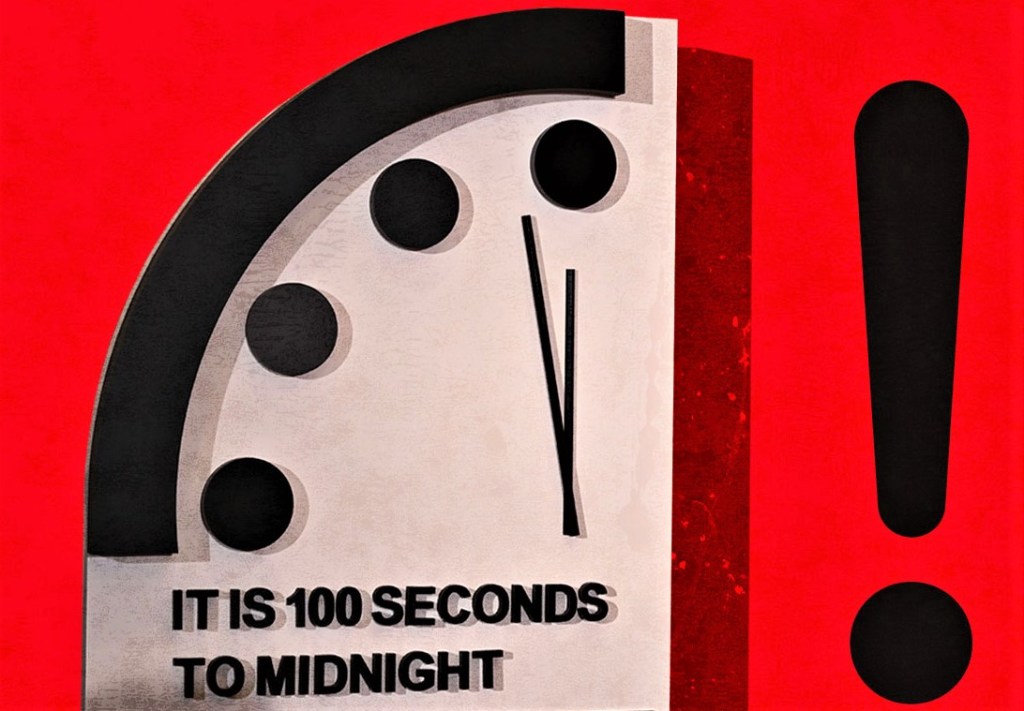
Which would you choose, the extraterrestrial or nuclear option, or the climate alternative? And which do you think is most likely?
Of the three, I worry most about climate change. At my age, I’ll not likely see the worst effects, those that will change life irrevocably for Earth’s inhabitants, but I liken their inevitable depredations to the fate of a rabbit warren, whose denizens over time despoil it. The result is zoonotic disease and plague, which will kill many of the rabbits, severely afflict others, and force survivors to find a new home.
We are already seeing examples of death and forced migration of people from their homelands because of the effects of environmental damage. We are befouling our oceans, deforesting our woodlands, polluting our freshwater lakes, strip-mining our highlands, and poisoning our rivers with our mountains of garbage and toxic pollutants.
We are pumping untold amounts of carbon-rich contaminants into the atmosphere, resulting in a dramatic warming of Earth’s temperatures, to the point where polar ice-caps are melting and sea-levels are rising.
The strangest thing of all is that we are perpetrating these transgressions, even while knowing of their deleterious effects. We know about the Doomsday Clock. We know about the Paris Agreement on climate change, we know we must restrict global temperature rise to less than 2C by 2050, and that we are perilously close already to missing that target. We know regional and seasonal temperature extremes are reducing snow cover, melting sea ice, intensifying heavy rainfall, producing once-in-a-lifetime droughts, and changing habitat ranges for animal and plant life.
But we are a self-engrossed species, intent on our own pursuits with scant regard for the long-term consequences. A superior species? I wonder.

Of course, the planet Earth soldiers on, evolving as she has since time immemorial, herself oblivious to the life-forms who call her home—the most advanced of whom think perhaps they, not she, will determine the future.
But we seem unable to stop the clock.
They paved paradise and put up a parking lot
-Joni Mitchell, Big Yellow Taxi


 tallandtruetales