[NOTE: IF THIS COMPLETE BLOG-POST LIES IN THE BODY OF THIS EMAIL MESSAGE, CLICK ON THE TITLE TO READ THE PIECE IN ITS NATURAL ENVIRONMENT ON MY BLOG- SITE. IF ONLY A LINK TO THE PIECE IS PROVIDED IN THE EMAIL, CLICK ON THAT TO TAKE YOU TO THE SITE.]
It has been postulated by persons wiser than I that time does not exist, neither past, present, nor future. If our lives were a metaphorical hourglass—the top bulb representing the past, the middle stricture the present, the bottom bulb the future—we would find ourselves at the middle, living in the moment. That moment, however, would be but the instant it takes for one grain of sand to pass through the stricture, followed by the next, and the next, ad infinitum, each gone too rapidly for us to grasp. And therefore, the theory goes, the present cannot actually exist. Similarly, because we have no conception of the bulb above us or the one below, no way to perceive them, the past and future also do not exist.
Perplexing, no? But not a theory I agree with, and I would urge those who espouse it not to tell me time doesn’t exist.
Given my longtime fascination with and study of history, I’ve always believed there to be a past. Mind you, I’m able to consciously recall it only from the late 1940s onward; everything that happened before that, I must accept as it’s been told to me.
I’ve always believed in the present, too, perceiving it not as a mere instant in time, but as a continuous progression or sequence of events in which I play a part—at least while I’m awake. While sleeping, of course, I have no awareness of the present.
The existence of a future is something I’ve always taken for granted, as well, though I have more yesterdays behind me now than tomorrows ahead of me.
My parents, whose lives spanned parts of ten decades, nonagenarians when they died, are part of the past I remember. My wife and two children are part of the present I inhabit. And my grandchildren represent the future, most of which, alas, I shall never see. But it’s my comprehension of these three elements—past, present, and future—that allows me to carry on.
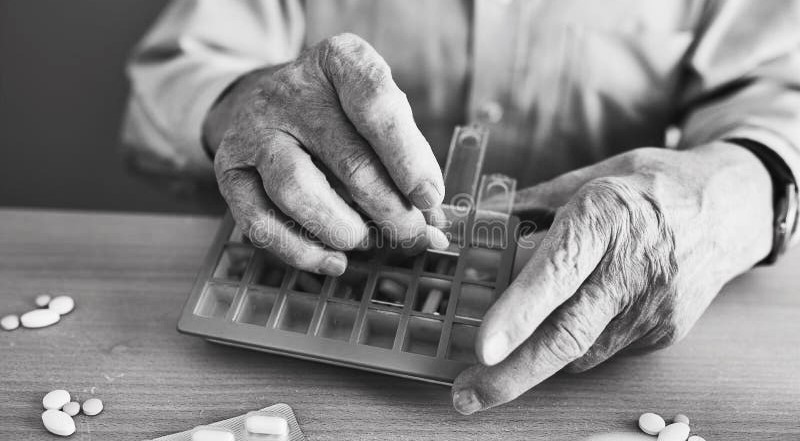
I remember visiting my father as he neared the end of his life, and hearing him complain (for the zillionth time) about the number of prescribed medications he was taking. He had a small, plastic pillbox to keep them organized on a weekly basis, a device I silently laughed at, so cocksure and smug in my late forties.
“I saw the doc last week,” my father said, “and I told him to take me off some of these damn pills.”
“What did he say?” I asked.
“Said he’d do that if I told him which ones to cut out. Said he wasn’t sure which might be the ones keeping me alive.”
“So, what did you say?”
“I told him, in that case, forget it. I’ll carry on with all of ‘em.”
“Good move, Dad!” I said. “Keep on keepin’ on.”
We had that conversation thirty-five years ago, and my father’s been gone for more than twenty of those, a part of my past forever. To my everlasting astonishment, I’ve now entered my own ninth decade, the octogenarian I never contemplated becoming, and my present looks more and more to me like his did to him back then.
I, too, have a plastic pillbox now to organize the eight medications I take daily, five of which are prescribed to control cholesterol, regulate blood pressure, promote prostate function, and bolster bone density. The other three are over-the-counter supplements I like to think will help me compensate for my lost and lamented youth.
Oh, how the mighty have fallen! I imagine my father, wherever he is, must be chuckling knowingly at my plight—my past making fun of my present.
I have a friend whose espoused goal in life is to live more years retired than he spent working. It’s a noble goal, one I share, and that moment will arrive for me seven years from now. Another of my goals is to accomplish what my parents did, living into a tenth decade, which will happen when I hit ninety, a mere nine years off in the future. Both my folks remained mentally acute and physically viable almost to the end, a state I devoutly wish for myself.
A third goal is to live life fully right up until I die—a sentiment I wrote a poem about, I Haven’t the Time, which you will find and enjoy at this safe link—
https://tallandtruetales.blog/2020/01/08/i-havent-the-time/.
Our two daughters visited us for a week in Florida recently, without their husbands and children. Although we love being with them all, this annual visit from our girls is part of a future we look forward to every year, our ‘core four’ together again. But the realities of past and present do have a way of inserting themselves.
I encountered both of them on their first morning with us as I lurched into the kitchen—unshaven, hair askew, eyes still half-shut. They offered a cheery good morning and warm kisses as I plugged in the kettle for my green tea—decaffeinated, of course—and watched me spill my pills into my hand from the pillbox.
“How many pills do you take every day, Dad?” the eldest asked.
I told her, explaining what each was for in more detail than she probably wanted to hear.
“Do you really need to take that many?” her sister asked.
“Maybe, maybe not,” I said, an unbidden image of my father flashing before my eyes. “But I don’t know which might be the one I need to keep me alive, so I just carry on with all of ‘em, y’know?”
“Good decision, Dad!” the eldest said.
“Yeah,” her sister echoed. “Just keep on keepin’ on!”
And so I shall—proud of the past, relishing the present, anticipating the future. Given what I know to be true, no one can tell me they don’t exist!






 tallandtruetales