
Singin’ the Songs

Regular readers here will know of my love for music in my life, whether performed by professional musicians in a concert hall or robust amateurs at a party.  I have genres I prefer, of course, as do most people, and I generally fancy instrumental versions of favourite songs to vocal renditions.  I find them more soothing, more conducive to creative thought and activity.

Most of my listening time occurs when I’m writing, as is the case right now, penning this essay, my head clad in earphones.  My first and abiding love is classical music—likely due the influence of my father, who often fell asleep with me on my bed at night as we listened to radio broadcasts of the great symphonies.  He frequently had stories to accompany the music, too, which made it all the more special.

When I started school, one of my favourite activities was song-time, when the teacher would teach me and my classmates a new song.  Not all of us were thrilled, of course, but I was ever enthralled.  To this day, I love to join in the enthusiastic chorusing of the old songs with a group of friends.
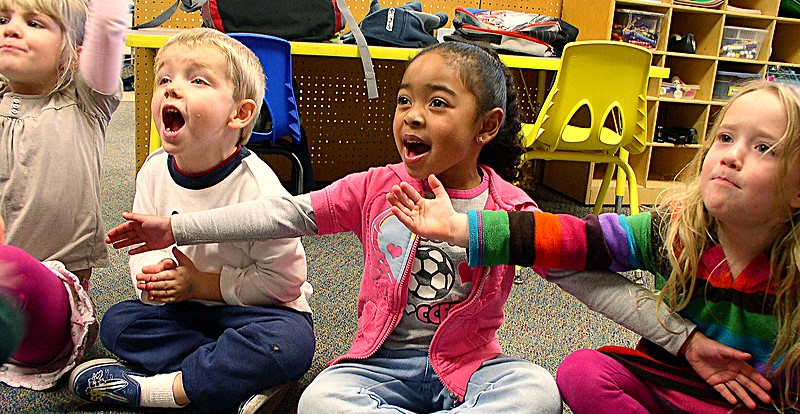
And I can still remember (and occasionally sing to myself) some of those silly, little ditties we were taught in kindergarten and grade 1—

Your pail and shovel and wheelbarrow bring,
Let’s plant us a garden this morning in spring.
Dig little trenches, pull out all the weeds,
Pour in some water, and drop in the seeds.

Or this one—

Little yellow bird, little yellow bird,
Come flying with me.
We will build us a cozy corner
In the old apple tree.

There was one I particularly liked, although the lyrics saddened me—

“Come away,” sang the river to the leaves on the trees.
“Let me take you on a journey, and the world you will see.”
So, the leaves gently falling from the trees on the shore
Float away on the river, to come home nevermore.

It might have been the final phrase that bothered me, that they would never find their way home.  But the melody was lovely.

Making friends was very important to one just starting school, so this song had special meaning—

Make new friends, but keep the old.
One is silver, and the other gold.

At my advanced age now, the inherent truth of that sentiment has been borne out countless times.

Our earliest foray into the magic of the French language began with this song about a skylark, Alouette—

Alouette, gentille alouette,
Alouette, je te plumerai.
Je te plumerai la tête,
Et la tête, et la tête,
Alouette, Alouette
Oh-h-h-h-h...
Alouette, gentille alouette,
Alouette, je te plumerai.

There were several verses to this one, substituting le bec, le cou, les ailes, le dos, les pattes, and la queue for la tête, and the chorus had to include every one of them as they were introduced.  But we loved the challenge!

As little ones, we were always encouraged to be active and happy, and to let people know how we felt.  This song allowed us a way to do just that—

If you’re happy and you know it, clap your hands!
If you’re happy and you know it, and you really want to show it,
If you’re happy and you know it, clap your hands!

There were many variations on clapping your hands as we sang that one, and all of them caused much joy and laughter.

One of the songs I especially liked was this one, seeking love and happiness—

You are my sunshine, my only sunshine,
You make me happy when skies are gray.
You’ll never know, dear, how much I love you.
Please don’t take my sunshine away.

Over these past few years, I’ve been fortunate enough to spend many happy hours singing with a men’s chorus, and a fuller version of this is still one of our staples.  I’ve included a video clip that you will surely enjoy—

It’s seventy years and more since I learned many of these songs, and I’m amazed by the joy they still bring me.  After all this time, there are fewer things more fun than singin’ the songs.

Teaching and Learning

Almost sixty years ago, a brand-new teacher, hired by a brand-new principal, entered his brand-new school for the first time.  Earning what he considered a princely, annual salary of $4100 per year, he could scarcely believe he was being paid to do this job he loved from the very get-go.

Even today—a grandfather now, and long-retired—I can still feel the sense of wonderment and awe that seized me as I awaited my first group of elementary school students.  The mix of opportunity and responsibility confronting me was both frightening and exhilarating.

Over the next thirty-plus years, in three different school districts, I served as teacher, vice-principal, principal, superintendent, and director of education.  Of those postings, the first and last were my two favourites.

Along the way, I met and married a brilliant teacher, and in time, both our daughters grew up to be wonderful teachers, too.

Two of my four granddaughters are currently working towards university degrees in education, one in music, the other in maths and science.  They haven’t asked for my advice—perhaps blissfully unaware of the import of my experience, its scope and depth; or more likely, because I’m bound to be out-of-date now, hopelessly so, after such a long hiatus.

I’ve slowed down, no doubt, but the pace of change has not!

I’ve never been one to proffer advice unsolicited, anyway—although I have been known to hold forth if encouraged.  But if I were to be asked, there are a few bon mots I would probably pass along.

First, teaching—that is, the handing-down of all wisdom from the teacher—is far less significant to students’ growth than learning—namely, opportunities for them to ask pertinent questions, test a variety of possible answers, and settle upon evidence-based conclusions.  Effective learning is a highly-personal pursuit, and happens in a plethora of ways connected to each student’s personality and neural development.  It is the teacher’s job to provide sufficient and varied, open-ended learning opportunities within the prescribed curricula.  Show them, don’t just tell them; involve them, don’t merely lecture them.

Second, the teaching/learning relationship between teacher and student, if it is to yield good results, must be founded on mutual respect for one another—with the emphasis on mutual.  As a pundit posited some time ago, “I don’t care what you know until I know you care.”  The same applies to relationships among students, each of whom will more likely prosper in a caring and secure classroom environment.

Third, it’s far more important that the teacher constantly catch students doing something good, rather than something bad.  It’s not that the bad should be overlooked, but there are effective procedures to deal with it—not simply to end it, but to work proactively to prevent its repeat.  Catching students doing the good things they do is critical, though—letting them know, not just that their accomplishments are noticed, but explaining why those achievements are positive.  When students understand the underpinnings of effective performance, they’ll be more likely to roll it back and expand their repertoire.  So, tell them when their work is good…then explain why.

Over the years, whether engaged as teacher, principal, or CEO of a school district, I forever encountered encumbrances threatening to get in the way of doing the job effectively—budget-cuts; staffing-cuts; overcrowded classrooms; reductions in essential support-services for special-needs students; aging buildings and facilities; changing parental expectations; increasing political demands; the intrusion of pervasive, social-media technology; rising violence in our society; and on and on.  There seems no end to the reasons to decry the state of education.

But that is the reality of the workplace my granddaughters will face.

The most effective strategy to combat the ennui and despair that might imperil what they will try to do in their own classrooms is the fourth piece of advice I would offer them.  Win your people over!  Be they students, co-workers, employees who report to you, the same is true: more often than not, they will respond positively to the learning and growth opportunities provided for them when they feel you hold them in high regard; when they believe they are important pieces of the whole, not mere cogs in someone else’s wheel; when they know you have asked for and valued their opinion; when they believe the ends you are seeking are righteous, and the means to those ends honourable.  And for that to happen—for them to believe you are honest, trustworthy, consistent, and invitational—you must be those things.

And therein lies the final piece of advice I’d offer my granddaughters.  Be visible to your students, be available, be present.  I think of it as management, or leadership, by walking around—and it works.  The best teacher, or leader, is the one who is not just inspiring, but vulnerable, receptive, nurturing, validating—in short, transparent.

Anyway, those are the things I would tell my granddaughters now, almost sixty years since I first stepped foot in that brand-new classroom, wide-eyed and bushy-tailed!  

You know, I sometimes allow myself to imagine I’m heading back in there right now, and waiting just inside the door for me is a fresh-faced kid—Alan, Sylvia, Tony, Mary—so many others whose faces I still see.

“Hey, Mr. Burt!  I was thinkin’ ‘bout what you told us before recess, an’ I’m not sure you’re right.  You wanta know what I think?”

“Yes!” I say, a smile splitting my face.  “Tell me what you think!”

I wanted to know then, and I’d want to know now.  For that’s the essence of teaching and learning.

Making Sense of It All

Do you ever wonder at the chaos and disruption going on all around us during these tumultuous times, and wonder what to make of it all?

I certainly do, and the only way I seem able to make sense of it is to examine things through a very simple example.  A long, long time ago, I attended elementary school in a big city where everybody looked like me.  And as every Christmas season rolled around, the entire school was festooned in merry decoration—more of the Santa Claus variety than church décor, mind you.

Gaily-festooned trees inhabited every classroom, and carols of the season played before and after class on the public address system.  Every pupil in the school understood everything about the rituals and the reasons for marking the occasion because, almost without exception, we were a middle-class, white, Christian community.

Years later, I found myself employed as a teacher, then principal and superintendent, in the same school system.  But oh, how things had changed.  The schools were populated still by Christians, but in ever-diminishing numbers, as the city grew to include people from all over the world.  They were of all colours, from a multitude of nations, speaking different languages, practicing different religions.

By the late 1980’s, the school jurisdiction included not just Christians and Jews, but students who were Muslim, Hindu, Sikh, Buddhist, and more.  We welcomed them, of course; they were all children, all happy to be in Canada, all eager to learn, all wanting to belong.  We made a point to celebrate our differences, even as we rejoiced in our togetherness.

Our mission was to empower every student to learn, to achieve success, and to participate responsibly in a pluralistic, global society.

Christmas was still important, naturally, to our Christian families, but equally important to the newcomer families were the religious celebrations of their different faiths.  And because there were many of those, the schools gradually moved from their previously-universal focus on only one to smaller-scale acknowledgements of them all.

In short, we changed.  We encouraged coexistence and tolerance.  And to me, immersed in the evolving culture, the change seemed both natural and justified.  But to some, particularly among those heretofore part of the WASP establishment, the transformation was abhorrent.

Those people are taking our country away from us!  If they come here, they should follow our ways!  If they don’t like it, they should go back where they came from!

Racism and bigotry—which had always existed, if not always visibly—became ever more prevalent.

In the 1990’s, I moved to a smaller, rural jurisdiction well north of the city.  To my astonishment, I found the schools under my aegis there to be almost identical to those I had attended in the 1950’s.  As I visited the schools at Christmas, I felt as if I had stepped backwards in time.  Almost everyone was white; almost everyone, including the Indigenous families, was Christian.  As opposed to the seventy-six languages spoken by the families of students at the high school where my wife had worked in the city, the entire community spoke only three—English, French, and Ojibwe.

To my dismay, however, I found the same racism and bigotry among some (although by no means all) of the local populace.

Why do the Frenchies get their own schools?  They should go to Quebec if they want to speak French!

How come the Indians get a free education?  Us taxpayers are paying for it!

Today, more than twenty years later, as I look at events going on in the larger world around us, I hear and see many of the same sorts of things, most often from those who have always enjoyed the privilege and advantage that come from having been part of the establishment.  Racism, misogyny, homophobia, transphobia, xenophobia—expressed in all manner of vile ways across social media, particularly.  And too often voiced, or encouraged, by people who purport to be leaders.

The reason such things happen, I believe, is fear.  It is our fear of change—the fear of being displaced, overtaken, cast aside.  Collectively, we seem unable to recognize that there is enough here for all of us, that hoarding what we have from others diminishes, not only the hoard, but the hoarders, as well.

 So, I try to remember how, back in those long-gone, halcyon school-days, we tried to accommodate each other—people of all races, all religions, all genders, all socio-economic circumstances.  I try to remind those of my cohort from that era of the same thing.  And I try to convince the younger generations, those who have grown up in a meaner, less-tolerant, get-it-while-you-can society, how it could be so much better if we put ourselves in the shoes of the other.

That really is the only way I can make sense of it all.