Round Tables

It is no mean feat for writers to create an imaginary world that readers will come to see as true and historically accurate.  Fashioning something from one’s imagination that resonates with readers, a tale that merges with their perception of reality, is not easily done.

Two relatively recent examples of such efforts are Tolkien’s Lord of the Rings and Martin’s Game of Thrones, both of which have convinced many an avid reader of their legitimacy.

As a young boy at the dawn of the 1950s, it was the magical tales of King Arthur and the Knights of the Round Table that captured my fancy.  I first read them in The Boy’s King Arthur, a version of Malory’s Le Morte d’Arthur, which abridged and bowdlerized items from the original text, sexual and otherwise, that were deemed unsuitable for children.

I was completely captivated by the legends of the Lady of the Lake, Arthur’s conception at Tintagel, his seizing of the sword Excalibur, his alliance with the magician Merlin, his ultimate battle with Mordred, and his laying to rest in Avalon.  Most intriguing of all was the notion that he had not died, that he was merely sleeping, that he would rise again, the ‘once and future king’.

I eventually graduated to the reading of unexpurgated versions, but in the beginning I fancied myself as many of those brave warriors:  Lancelot, until I learned of his treachery with Arthur’s queen, Guinevere; Gawain, who bravely faced the Green Knight in a chivalric romance told in Middle-English alliterative verse; Perceval and Tristram, whose feats of derring-do enthralled me; and of course, Galahad, whose sacred quest for the Holy Grail seemed the most inspired.

I subsequently read about that storied quest in other works, and learned from more than one that two phrases in French—san graal and sang royale, pronounced almost identically—translate to two different things: Holy Grail and royal blood.  This assertion expostulated the theory that following Christ’s death, his wife and children fled to France, where his bloodline continued anonymously, eventually merging with the Merovingian dynasty, then the Carolingian dynasty, all the way to William the Conqueror—who, in a tidy completing of the loop, came to rule over Arthur’s ancient kingdom.

True or not, the story affirmed for me that the greatest Arthurian quest came to fruition in the merging of these two fanciful tales, one religious, the other mythical.  And for a long time in my youth, I believed.

The lasting impression I took from this childhood reading, however, was the concept of the Round Table.  In its simplest form, I thought it presented an ideal way of governing or managing a kingdom, an empire…or any enterprise.  Everyone sat around the circular table, each facing everyone else, and all had an equal say in the decisions that were made—all but one, of course.  The King, by virtue of his position, reserved the right of veto.

In such a setting, the objective of any group’s deliberations is always to achieve consensus on matters discussed, the theory being that everyone will have a greater commitment to decisions made when they feel they’ve contributed to them.  The process involves give and take, it usually means no one gets all of what they want, but it allows everyone to get some of what they hoped for.  Some might call that win/win.

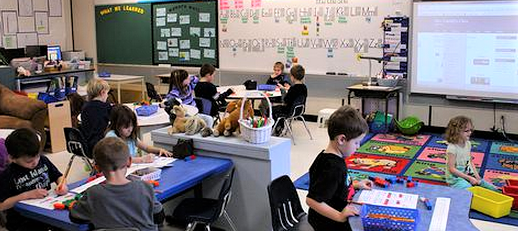
As a young teacher in the mid-1960s, chock-full of enthusiasm for and faith in the teaching/learning paradigm, I furnished my classroom with circular tables, not individual desks.  My thirty-plus students sat in groups of five or six around these tables, groups whose membership rotated periodically, based on their accomplishments and interests. 
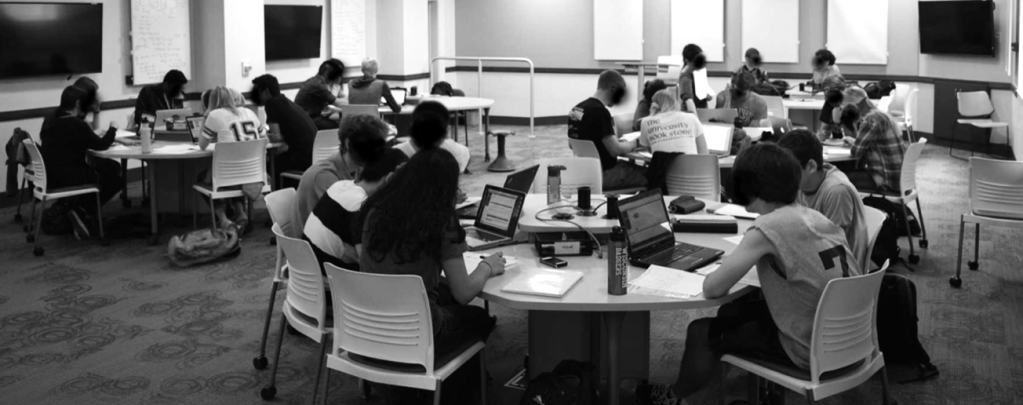
Our interactions, the teachings and learnings we shared, usually (but not always) were conducted with me sitting around a table with them.  To this day, I find it remarkable how much self-discipline, cooperation, and independent learning took place among the young people at those tables.  Only rarely did I ever have to exercise my right of veto.

Twenty years after leaving the classroom, installed as the CEO of a school board district, I still favoured round tables.  In my office, senior staff met weekly around a large, circular oak table, where everyone had a valued voice.  We didn’t always agree on how best to proceed with certain matters, but when we concluded our discussions, each of us felt we’d had the opportunity to make known our views.  And all of us acted on the consensus decisions with total commitment.  And again, I almost never had to decide arbitrarily on a course of action.

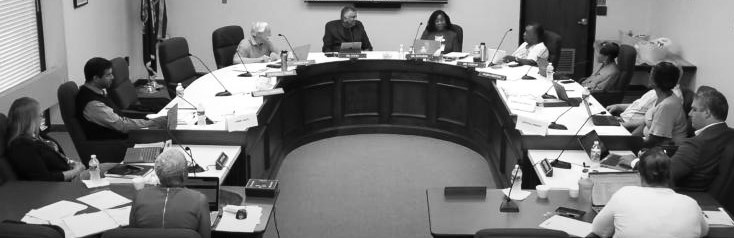
In the boardroom, where elected trustees met weekly to discuss and make policy, they sat at desks arranged in a circular shape, each of the fourteen with a direct view of the others.  The chairperson of the board managed the meetings according to established rules of order, and only occasionally overruled a colleague.  Decisions were made by voting, as required by the Education Act, but only rarely were those votes disputatious…and never acrimonious.  I believe there was something about sitting in the circle formation that elevated the level and tone of discussion, that enabled consensus decision-making.
As a young father, I sat with my wife and two daughters around a circular kitchen table, virtually every night, for dinner together.  Any of us might miss now and then, given our respective work and school commitments, but sitting down around that table was the established custom, one we all honoured until the girls headed off to university.  Our discussions centred on what all of us were doing at any given moment, and everyone contributed freely.  No topic was off-limits (although when the girls were very young, some issues were covered only cursorily, appropriate to their age).  Looking back now, I consider the learnings we all experienced with each other as indispensable to our family’s enduring ties.

And to think, it all began for me with my fascination for the Arthurian legends I first read as a boy, stories of the Knights of the Round Table that imbued me with a sense of romanticism and chivalry that I still value today.

I remain eternally grateful to all writers who have managed to create a world that I and other readers consider enjoyable and aspirational…even if imaginary.

 And I still wonder, even at this great age, if Arthur is merely sleeping at Glastonbury Tor, as the legends maintain, and if we shall ever see his like again, holding forth at his great Round Table.
Teaching and Learning

Almost sixty years ago, a brand-new teacher, hired by a brand-new principal, entered his brand-new school for the first time.  Earning what he considered a princely, annual salary of $4100 per year, he could scarcely believe he was being paid to do this job he loved from the very get-go.

Even today—a grandfather now, and long-retired—I can still feel the sense of wonderment and awe that seized me as I awaited my first group of elementary school students.  The mix of opportunity and responsibility confronting me was both frightening and exhilarating.

Over the next thirty-plus years, in three different school districts, I served as teacher, vice-principal, principal, superintendent, and director of education.  Of those postings, the first and last were my two favourites.

Along the way, I met and married a brilliant teacher, and in time, both our daughters grew up to be wonderful teachers, too.

Two of my four granddaughters are currently working towards university degrees in education, one in music, the other in maths and science.  They haven’t asked for my advice—perhaps blissfully unaware of the import of my experience, its scope and depth; or more likely, because I’m bound to be out-of-date now, hopelessly so, after such a long hiatus.

I’ve slowed down, no doubt, but the pace of change has not!

I’ve never been one to proffer advice unsolicited, anyway—although I have been known to hold forth if encouraged.  But if I were to be asked, there are a few bon mots I would probably pass along.

First, teaching—that is, the handing-down of all wisdom from the teacher—is far less significant to students’ growth than learning—namely, opportunities for them to ask pertinent questions, test a variety of possible answers, and settle upon evidence-based conclusions.  Effective learning is a highly-personal pursuit, and happens in a plethora of ways connected to each student’s personality and neural development.  It is the teacher’s job to provide sufficient and varied, open-ended learning opportunities within the prescribed curricula.  Show them, don’t just tell them; involve them, don’t merely lecture them.

Second, the teaching/learning relationship between teacher and student, if it is to yield good results, must be founded on mutual respect for one another—with the emphasis on mutual.  As a pundit posited some time ago, “I don’t care what you know until I know you care.”  The same applies to relationships among students, each of whom will more likely prosper in a caring and secure classroom environment.

Third, it’s far more important that the teacher constantly catch students doing something good, rather than something bad.  It’s not that the bad should be overlooked, but there are effective procedures to deal with it—not simply to end it, but to work proactively to prevent its repeat.  Catching students doing the good things they do is critical, though—letting them know, not just that their accomplishments are noticed, but explaining why those achievements are positive.  When students understand the underpinnings of effective performance, they’ll be more likely to roll it back and expand their repertoire.  So, tell them when their work is good…then explain why.

Over the years, whether engaged as teacher, principal, or CEO of a school district, I forever encountered encumbrances threatening to get in the way of doing the job effectively—budget-cuts; staffing-cuts; overcrowded classrooms; reductions in essential support-services for special-needs students; aging buildings and facilities; changing parental expectations; increasing political demands; the intrusion of pervasive, social-media technology; rising violence in our society; and on and on.  There seems no end to the reasons to decry the state of education.

But that is the reality of the workplace my granddaughters will face.

The most effective strategy to combat the ennui and despair that might imperil what they will try to do in their own classrooms is the fourth piece of advice I would offer them.  Win your people over!  Be they students, co-workers, employees who report to you, the same is true: more often than not, they will respond positively to the learning and growth opportunities provided for them when they feel you hold them in high regard; when they believe they are important pieces of the whole, not mere cogs in someone else’s wheel; when they know you have asked for and valued their opinion; when they believe the ends you are seeking are righteous, and the means to those ends honourable.  And for that to happen—for them to believe you are honest, trustworthy, consistent, and invitational—you must be those things.

And therein lies the final piece of advice I’d offer my granddaughters.  Be visible to your students, be available, be present.  I think of it as management, or leadership, by walking around—and it works.  The best teacher, or leader, is the one who is not just inspiring, but vulnerable, receptive, nurturing, validating—in short, transparent.

Anyway, those are the things I would tell my granddaughters now, almost sixty years since I first stepped foot in that brand-new classroom, wide-eyed and bushy-tailed!  

You know, I sometimes allow myself to imagine I’m heading back in there right now, and waiting just inside the door for me is a fresh-faced kid—Alan, Sylvia, Tony, Mary—so many others whose faces I still see.

“Hey, Mr. Burt!  I was thinkin’ ‘bout what you told us before recess, an’ I’m not sure you’re right.  You wanta know what I think?”

“Yes!” I say, a smile splitting my face.  “Tell me what you think!”

I wanted to know then, and I’d want to know now.  For that’s the essence of teaching and learning.

Ready For The Fall

The prompt from my Florida writers’ group this week was to write a piece about fall. Here is what I came up with, and I hope it will conjure memories for you, too—

A middle-aged woman I didn’t know smiled as she entered the elevator with me one day last week.  “Are you ready for the fall?”

I cringed, steeling myself for an unwanted mini-sermon from a dogged do-gooder, a holy-roller.  “I…I guess so,” I stammered.  “I mean, I pray, I try to do good…”

A look of bewilderment creased the woman’s face, followed quickly by one of amused pity.  “No, no,” she corrected me patronizingly, “you misunderstand me.  I meant the autumn, not the apocalypse!”

“Ah…of course,” I sighed, embarrassed by my mistake.  “Sorry…”

As the elevator doors opened on the eighteenth floor, the woman stepped out, still amused by my obtuseness.  “No need to apologize,” she said.  “At your age, I imagine it’s best to be ready for both!” The doors slid closed behind her before I could think of a suitably nasty retort.

Back in my apartment on the twentieth floor, I reflected on our conversation as I unpacked the groceries I’d been carrying.  It seemed to me an honest mistake to make, an understandable one, and the woman’s parting shot was likely good advice.  But why did she have to be so rude?

Later, relaxing with my wife over a cup of tea, I talked about what had happened, and about getting ready for the fall.  “Remember when we were kids, it seemed summers would never end?” I said.  “From the day school let out until the first fall-fair arrived, our days were blissful, carefree, limitless.  Eat breakfast and head outside to play; dash inside for lunch, then back outside; trudge home for supper, then out again ‘til the streetlights came on.”

“I remember,” my wife said.  “But things sure changed when we grew up, in spite of our best intentions.  We got married, started working, became parents.  Those summers suddenly became  a lot more finite.”

I nodded agreement.  The calendar tells us summer ends with the autumnal equinox in late September, but the end always came much sooner for us.  It was marked, not by an arbitrary calendar, but by the requirement to go back to school.  Both of us were teachers in those long-ago days, and felt we had to get back ahead of our students if we had any hope of being ready for their return after Labour Day.

For many folks, I guess—like the woman on the elevator—the coming of fall is a time of new beginnings, of anticipation.  They think in terms of flaming fall-colours, brisk autumn days, evenings spent curled up with a book in front of a cozy hearth.  They look forward to the change of seasons.

Not I, though!  I’ve always thought of it as a gloomy time—the conclusion of summer, and the close of so many pleasurable things that vanish with the coming of September.

For example, with the end of warm, sunny weather, there came an end to my carefree habits of dress.  No more swimsuits or running shorts; no more open sandals or ancient running shoes; no more tank-tops or faded team sweaters.  Instead, it meant a return to the straitjacketing drill of collars and ties, pressed slacks, knee-high socks, and polished dress shoes.

The end of summer put a stop to the treasured luxury of shaving every two or three days, depending upon what activities were planned.  And it called a halt to the wearing of old ball caps as an alternative to brushing my hair.

The inevitable onset of fall wrote fini to three or four leisurely cups of coffee with the morning paper, and an end to mid-morning breakfasts on the back porch.  It heralded, in their stead, the beginning of hurried showers and breakfasts-on-the-run.  It marked the re-entry into the exciting world of daily traffic reports, as I attempted to find the shortest, quickest route into and out of the city.

In short, summer’s end brought to a close the lazy, drifting vagaries of summer living I tried so vainly to hang on to.  Coming back to the real world always provided a jolt to my entire system.  It was like going from childhood to adulthood all over again!  Once was enough!

“You know, I never wanted to be the type of person who wishes his life away,” I commented to my wife, “always wishing for something to be different than it is.  But, in a sense, I guess I used to do just that.”

“Me, too,” my wife said wistfully.  “For me, the year was divided into two seasons, summer and not-summer. And not-summer was not good!”

“Remember we’d take the girls on one last camping trip up north?” I said.  “My cutoffs and hat would be in my bag, my shaving-kit left behind.  It was always one final fling in the glorious realm of summer.”

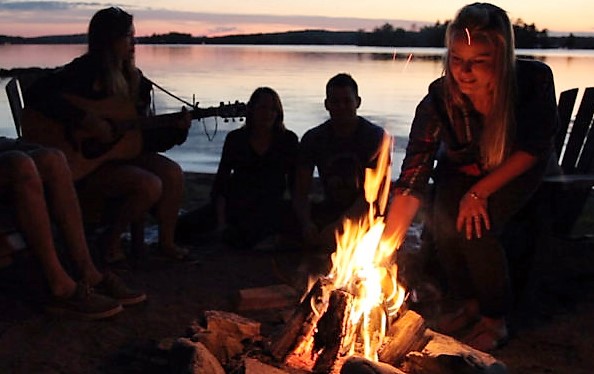
“I loved it,” my wife said, staring into the past.  “Hiking, swimming, paddling, exploring, picking berries, roasting marshmallows, singing our hearts out by the campfire, sleeping the sleep of the innocent in those old sleeping-bags—it was like being children all over again.”

“Even now,” I said, “when every day is like a Saturday, I still pretend summer will never end, that I’ll never have to grow up and give it up.  It still seems there’s always so much left to do.”

“At least we have Florida now,” my wife smiled.  “Year-round summer! Before the fall ever arrives, I’m already planning what I’ll pack.”

During the course of our happy reminiscing, I managed to forget my annoyance with the supercilious woman in the elevator.  But by chance, we happened to ride the elevator again yesterday, going down this time.  As she stepped aboard, I could tell she recognized me as the confused old fart from a week ago—but this time, it was I who spoke first.

“Before you ask, I’m ready for Ar’geddon!” I smiled.

“Our what?” she said, head cocked.

“Ar’geddon!” I repeated.  “I’m ready to go!”

The same pitying look as last time spread across her face, the same condescending smile.  “Sir, you mean Arma-geddon.  You’re mispronouncing the word.” She shook her head disdainfully, appalled by my lack of acuity. 

Waiting a beat to spring the trap I’d plotted, I said very quietly, “Whatever!  It’s not the end of the world!”

We rode the rest of the way in icy stillness, a long, silent fall from the eighteenth floor to the parking garage.

Remembering a Friend

A good friend of mine died earlier this year, and I was asked to speak at a gathering of family and friends to celebrate his life.

This is what I had to say.

Every memory I have of my friend brings a smile to my face.  Every one.  It was fifty years ago that we first met, as young teachers.  We clicked right away, and spent many hours playing tennis, going on ski-holidays with our wives, and spending many New Year’s Eves together.  During all those occasions, we enjoyed a lot of delicious food washed down with cheap wine.

And although it might be hard to believe these many years later, legend has it that he and I were a lethal pass-and-catch combination on the flag-football field.  Or so we told our wives.

team formulating a plan

Early on in our teaching careers, my friend and I contemplated applying for promotion to vice-principal.  As the deadline grew near, however, he seemed somewhat hesitant about taking the step—having second thoughts because he really enjoyed working in the classroom.  Many of his colleagues—and I for sure—encouraged him to go for it.  We all thought he was more than ready, and I was sure we’d both be successful.

After much consideration, despite his reservations, he did apply.  And guess what?  My friend, the reluctant one, got that coveted promotion!

While I, the gung-ho guy, did not!  Go figure!

But two good things immediately came out of that experience.  The first was when my friend took me aside—I assumed to console me over my disappointment.  Not so.  He had an urgent, almost breathless tone to his voice when he was excited, and here’s what he said.

“Brad!  Brad!  Listen!  Just because I’m a VP now, you don’t have to call me Sir!”

Of course, he said it with that mischievous, little smile I was so familiar with when he was having me on.  I miss his sly, Irish sense of humour.

The second good thing from his promotion was that his first VP assignment was with the same principal who had hired me out of teachers’ college a few years earlier.  That man showed my friend and me more about child-centred education than anyone else we ever worked for.  He believed children came to school, not to be taught, but to learn; it was our job, therefore, not to teach them, but to guide them in their learning.

classroom1

My friend took that philosophy to heart, as did I.

Our mutual mentor could be somewhat unpredictable, though.  On the very first day of school that September, just before my friend’s very first staff meeting at the very first school where he was VP, where he knew almost no one on the staff, his new principal told him he would have to chair the meeting because something unexpected had come up that couldn’t wait.

Now, my friend was never, by nature, a cannonball-into-the-deep-end-of-the-pool sort of guy.  He much preferred to examine every situation six ways from Sunday before committing himself to any course of action.  He might eventually jump into that very pool, but not until he’d scoped it out thoroughly.

In this situation, however, the principal dropped the news on him at the very last moment, so you can imagine his reaction.  He must have told me the story at least a dozen times over the years.

“Brad!  Can you imagine?  Just before the meeting was supposed to start!  I was petrified!  I had no idea what I was doing!”

But, as with everything he did, my friend carried it off with aplomb.

Over the years, he and I enjoyed professional-development opportunities together as our careers advanced, almost in parallel.  Many of these were at annual conferences we attended, where we always roomed together.  There were three reasons for that:  one, we trusted each other not to drink too much and stumble back to our room in the wee, small hours; two, back in those days, neither one of us snored; and three, most important, we really liked each other’s company.

The two of us spent a lot of time at those retreats, walking the trails, talking about the challenges we faced as principals, about strategies for coping with those challenges, and about how we could make our schools into true centres for learning—for students and staff.  We both benefited greatly from our professional affiliation, as well as from our friendship.

Our most influential professional development excursion was a real eye-opener for both of us.  We had applied to visit four inner-city schools in a large American city, knowing we would probably be assigned at some point to similar special-needs schools in our own jurisdiction.  I still remember stopping at a gas-station to ask directions to the first school—in those days, there was no GPS, but there were still service-station attendants.

The attendant said, “You two are going to that school?”

When we nodded eagerly, he pointed the way and said, “Keep your doors locked and your windows rolled-up!”

My friend and I looked at each other, wide-eyed, wondering what we might be getting into.

inner city2

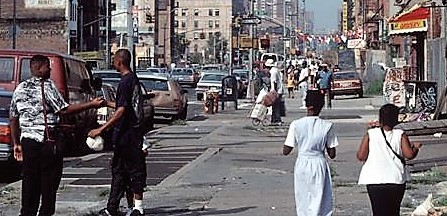
Within minutes, we found ourselves—two naïve waifs, far from home—driving through a neighbourhood in our bright-yellow rental car, hard to miss, where the only faces we saw around us belonged to people of colour.  Nobody looked like us!  Nobody!  But a lot of them seemed to be looking at us.

We were never in any danger, but it was the first time in our lives, I think, that we both understood, at a gut-level, how it felt to be outside the mainstream—to be a person of colour in our predominantly white society—to be different, to be the other.  It was a visceral awakening.  Neither of us had ever experienced what it was like to be a visible-minority person until that day, when we realized we were.

The people in the schools were very gracious to these two trusting wayfarers who tried to absorb everything we were hearing and seeing.  It was an experience that forever-after shaped our approach to children in our own schools who came from different backgrounds, different cultures, who had different skin-colour and strange names—all of whom wanted nothing more than to live and learn together in their adopted homeland.

I’m so glad I shared that experience and learned those lessons with my friend.

Part of his DNA, I think, was a natural empathy for the underdog in any situation; he always rooted for the little guy.  Our experience in those inner-city schools certainly underscored and reinforced that quality.

Because of this empathy, it was no surprise that, later in his career, he became supervising principal for special education in our school board.  In that role, he saw it as his mission to find the best learning environment for every child with special needs, sometimes with individualized instruction, where she or he could most closely realize their potential.

i on 1 2

Finding placements for them was never just a numbers game.  Like every principal worth their salt, my friend took these decisions personally.  He took them to heart.

He was a good teacher, a good principal, and a good man.

It has been said that no one has ever truly died until the last person who remembers them has passed on.  If that is so, then my friend will live a long time in the minds and hearts of his family and friends.

In fact, there are countless other people out there, people I shall never meet, people who remember my friend as their principal, or as their teacher.  And I think many of them, when they sent their own children off to their first day of school, might have had this thought in mind.

“I hope they get a teacher like I had.  I hope they get a teacher like him.”

And that is perhaps the greatest tribute.

I mentioned at the beginning that memories of my friend make me smile.  And I’m smiling still because I knew him for fifty years, and was honoured that he counted me his friend.

walking9

Godspeed!