Ciao For Now

A recent prompt from my Florida writers’ group asked us to make up a story about a person whose time is running out. This is my make-believe offering—

In all the years I knew him, I never heard my father use the word goodbye.  Not to anyone, not ever.  At every point of farewell, he’d offer up a substitute or synonym for the word—Pip-pip!  So long!  Good night! Cheerio!  ‘Til next time!  Toodle-oo!  See you later!  Take care!

Occasionally, he’d venture a foreign language—Adieu!  Auf Wiedersehen!  Adios!  Sayonara!  Towards the end of his life, he came to favour Ciao for now!  But he’d never use the word goodbye, and I used to wonder why.

He tried to explain it once to a mildly-curious, teenaged son.  “The word is too permanent, that’s all.  It implies the end, the finish, that there’ll be nothing to follow.  I prefer to think I’ll be meeting the other person again.”  But I confess, I didn’t really see the difference, callow as I was.

Although born and raised in Canada, my father was an Oxonian—a graduate of Oxford University, Balliol College, class of 1932, a member of the rowing club—and among his lecturers were C.S. Lewis and the great J.R.R. Tolkien.  Gainfully employed back in Canada with a PhD in Literature, he was one of the earliest to enlist after Canada went to war in 1939.  He served as a medical orderly until demobbed in 1943, when he returned home in time for my birth.

“Despite our best efforts to save them, we lost a lot of good fellows,” he would reflect from time to time in his later years.  “We knew their time was running out, but I never said goodbye to any of them.  I wanted them to believe there was still more to come.”

Somewhere over there, with his comrades at Oxford or in the obscene battlefields, he learned a nonsensical, British ditty about farewells, not goodbyes, and he used to sing it to me and my siblings from time to time, usually when we balked at having to go to bed.  He was an enthusiastic, if somewhat undisciplined, singer, but we came to love that song.

Eventually, of course, the fateful day arrived, as it does for all of us, that my father’s own time was running out.  Home from hospital for the last time in the deep mid-winter, he was with my mother and their five children and our spouses—the ‘dirty dozen’, as we had long styled ourselves.  We all knew the end was nigh, though none acknowledged it, and small talk prevailed until my father raised a frail hand.  We waited, breath bated, and in a faltering voice between short gasps for breath, he sang that song one final time—his way of letting us know this was not goodbye.

Most of us, I suspect, did not believe that, but no one let on.

A few months later, when the frost had left the ground, we gathered again at the family’s burial plot for my father’s interment, joined this time by his grandchildren, his sister, his nieces and nephews, and a few cousins.  In keeping with his wishes, it was a simple ceremony, and two of us spoke on behalf of the group before his ashes were lowered into the grave by his eldest grandchildren.  And then we all stood around, staring awkwardly at the ground, as if reluctant to leave.

At that point, with an exquisite sense of timing, my younger brother stepped forward and began to sing our father’s farewell nonsense-song, his voice soft but firm.  Before he could finish the first line, all of us who knew it had joined in—a sad farewell, yet a joyous acknowledgment that this was not goodbye.

Pip! Pip! Toot-toot, Godspeed,
Toodle-oo, toodle-oo, toodle-oo,
Ta-ta, old bean, Ting-ting, old thing,
Chuckeroo, Chuckeroo, Chuckeroo!
This parting brings us sorrow,
We hate to say adieu,
So, we’ll say Ting-a-ling, old tin of fruit,
Cheerio, cheerio to you!

Now, within hailing-distance myself of the age at which he died, I think of my father often, and I hear that little ditty echoing in my mind, just as he sang it so many years ago.

Cheerio, Dad,” I murmur each time.  “Ciao for now!”

The Cannabis Murders

I’m excited to announce that The Cannabis Murders, my eleventh novel in the Maggie Keiller/Derek Sloan crime series, will be released early in February!

The riveting story unfolding in this book is set against a backdrop of rising public concern over the extent of covert Chinese interference in political and corporate affairs in Canada, and across North America.

The story itself is tied to the legal production and distribution of cannabis products, as a global producer with Chinese connections attempts to establish a manufacturing facility near the resort town of Port Huntington on Georgian Bay.  In so doing, the company encounters community opposition, and runs up against Indigenous land-claims to the property in question, both of which throw up major stumbling-blocks to its plans.

To everyone’s dismay, repeated vandalism, threatened extortion, violence, and eventually murder soon follow.  Maggie and Derek become caught up in events through her support of a young, Indigenous woman trapped in the turmoil that follows, and through his involvement as a negotiator for the First Nation land-claims.  And both are drawn further into the mayhem because of their connection to the government’s pending inquiry into the secretive operations of Chinese interests in the area.

Resolute as always to protect their community, and themselves, Maggie and Derek work closely with police to bring the evil perpetrators to justice.

I know you will enjoy this story, and I’ll post notice here when the book becomes available.  In the meantime, the ten earlier novels in this series, together with my eight anthologies of tales, can be found for a free preview or purchase at this safe link—https://www.lulu.com/spotlight/precept

Thanks to all of you who read my blog-posts. If you enjoy them, you are sure to love my books!

Brown Paper Bag

This poem was written in response to a prompt from my Florida writers’ group. It can be best enjoyed by reading it to the tune of the old, Irish ballad, ‘Black Velvet Band’.

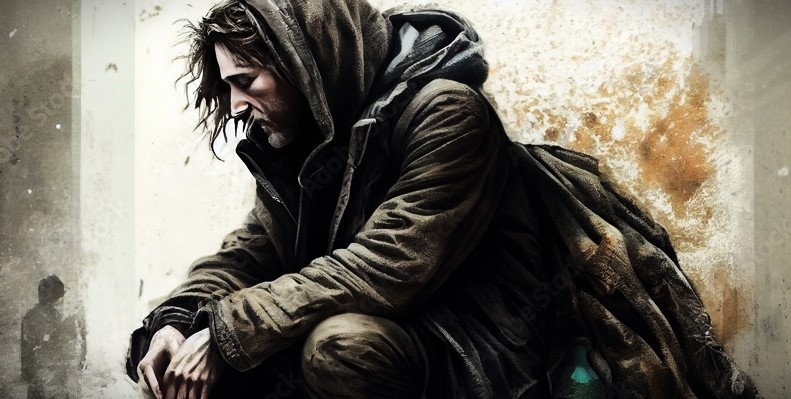
His hair hung down to his shoulders,
His shirt was a tattered old rag.
Faded chevrons adorned both his worn, torn sleeves,
And his hands clutched a brown paper bag.

Gunny was the name we all called him,
A veteran, ‘though he never did brag.
He'd wander the streets of the neighborhood,
Snatching sips from his brown paper bag.

His only true friend was old Jarhead,
A mongrel with no leash or tag.
When he died, he left Gunny alone again,
Alone with his brown paper bag.

We never saw Gunny get angry,
He was never a scold or a nag.
When we passed him by, he would nod a sad smile,
And drink from his brown paper bag.

In the summers we often would see him,
With the kit-bag that held all his swag,
On a park bench alone in the warm sunshine,
Holding tight to his brown paper bag.

Then last winter with snowstorms a-swirling,
And temperatures starting to sag,
Gunny died forlorn in the homeless camp,
He’d drunk his last brown paper bag.

When they opened his kit, they discovered
A folded American flag,
And a Congressional Medal of Honor,
Sealed tight in a brown paper bag.

When they tried to find Gunny’s family,
Their best efforts all hit a snag.
But they buried him with full honors,
With his Medal from that brown paper bag.

Gunny rests now with his fallen comrades
‘Neath a cross in a field filled with flags.
UNKNOWN BUT TO GOD and those warriors---
Free at last from those brown paper bags.

Semper Fi, Gunny!

A Better Story

Can bad decisions lead to better stories?

Let us suppose for the purpose of crafting an entertaining story that your lead character’s dotty, old Aunt Hilda—whom he hasn’t seen in forty years, and who recently died at the impossibly-old age of 103—left him, her only heir, the sum of twenty-five million dollars, all in bearer-bonds, and twenty-five cats who shared her last abode.

Your protagonist is elated, of course, and only mildly sorry he hadn’t taken time to visit the old gal from time to time.  After placing the cats out for adoption and depositing one million of those dollars in his personal chequing account to cover immediate lifestyle changes, he now needs to decide how to properly invest and grow the remaining twenty-four million.

To whom does he turn for advice?

He could enlist the help of reliable, established bankers, investment counsellors, financial gurus, and market analysts, all of whom would be eager to serve.  He knows he could safely rely upon these learned and experienced people, whose profession it is to help other people make money—being handsomely reimbursed for their efforts, naturally.  Let us call this the elite option.

But if he has never considered himself an elite, he might decide to call on twenty-five of his closest friends who—in return for the chance to celebrate (and perhaps share in) his great, good fortune—tell him they will devise a sure-fire strategy to determine how he will invest the bulk of his new-found wealth.  That strategy, in order to be enacted, need only be approved by a simple, majority vote of 13–12, swayed perhaps by the most voluble, the most persuasive of the group, rather than by the most knowledgeable.  

Let us call this the populist option, and if your protagonist deems himself a man of the people, he might well choose this second course.

Or, let us suppose for the purpose of creating another entertaining story that your lead character has been recently diagnosed with a life-threatening illness, out of the blue, and that she has very little time to decide on the best medical option that might save her life—although there are no guarantees, of course, from any of them.

To whom does she turn for advice?

She could, in addition to talking with her loved ones, consult with her physician and the specialists to whom the physician refers her, all experts in their field.  Before choosing her treatment plan, she might seek second, third, even fourth opinions from people who have studied their entire lives to deal with critical situations such as hers.  Let us call this, again, the elite option.

But let us suppose again, if she does not reckon herself among the elite, she might gather together concerned family members and friends, all of whom love her and wish her only the best, to ask, by majority vote, which treatment plan they believe she should follow—the established medical option, a naturopathic or homeopathic approach, or maybe an experimental route (which might require travel to a foreign country for procedures not approved in her home and native land). 

Let us call this, again, the populist option, and if she fancies herself of the people, she might choose this second course.

In these examples (deliberately simplistic, I know), there are dilemmas confronting these two characters and the decisions they would have to make.  To whom would they turn in such critical situations, the elites or the populists?

The authors of such stories, too, face these same dilemmas, these same decisions.  Which path should they choose for their protagonists to follow in order to compel their readers to stay locked in to the story?  And will those decisions prove good or bad?

In one telling of the first example, the lucky heir to the twenty-five million dollars might turn to the wise counsel of the investment community, prosper as his fortune grows, and live in a cloistered castle to a ripe, old age.  End of story.

But in another telling, he might seek the advice of his friends, invest and lose his entire inheritance based on their advice, realize belatedly the error of his ways, embark on a driven quest to recoup his lost fortune, clash and joust with pillars of the financial community, rise and fall again and again, only to triumph at the end—a true Horatio Alger story.  Or perhaps, in a cruel twist of fate, he might lose it all yet again and die miserably in an abject state of poverty.

Only the author can decide.

In one telling of the second example, the stricken person might rely upon the medical establishment and, after a period of treatment and rehabilitation, survive to live a long and happy life.  End of story.

But in another telling, the person might turn to family and friends for a decision, choose unwisely, see her condition worsen unto the point of death, only to be miraculously saved by the last-minute intervention of a handsome, dedicated doctor who refuses to be rebuffed by quackery.  The patient’s health improves dramatically, she marries her saviour, and goes on to live well into her nineties.  Or perhaps, in a cruel twist of fate, she is assailed by a recurrence of her disease, against which she vies valiantly, time and again, only to succumb in the end—a true Shakespearian tragedy.

Only the author can decide.

In either example, which do you suppose might offer the more entertaining story, the first version or the second?  The authors make their decisions in the initial writing, of course, but in the end, it is the readers who decide if those decisions are good or bad.

So, can bad decisions lead to better stories?

You tell me.