Java Jive

The weekly prompt from my Florida writers’ group was ‘coffee’, and this is my submission. I hope you’ll enjoy reading and listening to it.

Among the disappointments in life for me, one of the greatest is the vast difference between the aroma and taste of coffee. I find the first mouth-watering, the second lip-puckering.

My parents were never true coffee-drinkers, so I didn’t grow up with the aroma of percolating coffee every morning. At one time, however, both drank instant coffee, made by pouring boiling water over powder in a mug.

Yecchhh!

A friend of mine back then was an only child, so his parents would invite me to their cottage frequently as a playmate for him. Both those parents enjoyed real coffee, and I still remember waking on cool, autumn mornings to the delicious fragrance of coffee wafting to our bedroom from the kitchen. It mingled deliciously with the smell of woodsmoke from the pot-bellied stove they used to warm the cottage. To this day, when my nostrils catch either of those sweet scents, I’m immediately transported back to those halcyon days.

Ahhhhh!

It was several years before I was allowed to drink coffee, of course. And just as I remember its delightful aroma, so, too, do I remember how devastated I was to actually taste the foul brew. I wondered then, and do to this day, how something that promised so much could deliver so little!

I mean, bacon smells delicious, right? And it tastes wonderful!

Fried onions and mushrooms tickle the olfactory senses, do they not? And they, too, fulfil their promise in the eating.

Alas, not coffee!

Mind you, I did try to make it sweeter for me, but sugar made it worse! The closest I ever got to enjoying a cuppa (and the word enjoying is employed generously here) is when I doused it with triple shots of flavoured creamer—hazelnut, French vanilla, even Baileys’ liqueur. But more often than not, most of the vile concoction grew cold in the mug.

I even tried fooling myself by referring to coffee with many a favourable sobriquet, such as java, brew, jamocha, or joe. But invariably, I ended up using more unflattering terms—ink, mud, battery acid, varnish remover.

Several years ago, I toured a coffee plantation in Guatemala in the company of family and friends, all of whom enjoy a cuppa. I happened to mention to one of our hosts that, although I didn’t really like drinking it, I loved the aroma of coffee.

To my surprise, he told me aroma is not the best way to judge coffee. Other factors—bean origin, processing methods, roast level, quality grading, brewing technique, and freshness—are more critical.

“You Americans are addicted to fragrance,” he told me, “so it is to you we export our most aromatic beans. But it is to Asia our most flavourful beans are shipped.”

When I quickly let him know I was Canadian, he merely shrugged and said, “¡Es lo mismo!” It is the same!

My aversion to coffee may be partially explained by the fact that I suffer uncomfortable symptoms after consuming caffeine, including palpitations. At one point, I considered trying decaffeinated versions of the brew, but as another aficionado once told me, “If it ain’t got caffeine, mate, it ain’t coffee!”

The closest I ever came to liking the stuff was during the years I sang in the bass section of a men’s barbershop chorus, Harbourtown Sound. One of our favourite songs was Java Jive, written by Ben Oakland and Milton Drake in 1940, recorded by both The Ink Spots and Manhattan Transfer, and by many barbershop choruses. The combination of melody, tempo, lyrics, and humour cheers me to this day.

I include a YouTube clip of the song here for your enjoyment, sung not by my chorus, but by the marvellous Westminster Chorus: Westminster Chorus – Java Jive | 2026 BinG!

For me, and I hope for you, that little ditty, unlike a real mug of coffee, is good to the last drop!
Diamond Jubilee

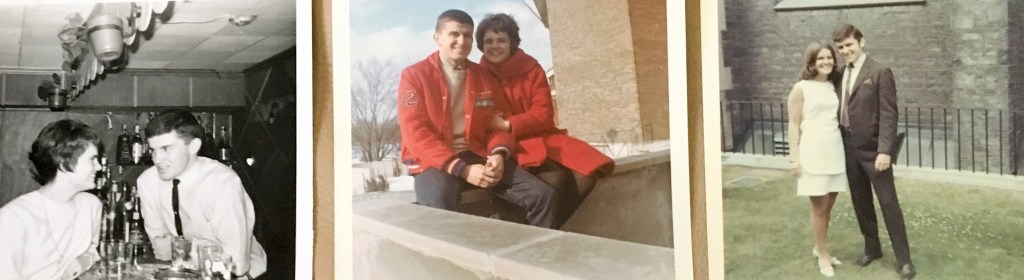
In 1967, Canada’s 100th birthday, it seemed everyone had a centennial project. I was no exception, but mine was intensely personal. I married the young gal who had captured my heart four years earlier.

We’ve been married now in parts of seven decades, and recently celebrated our 59th anniversary—happily embarked upon our 60th year together, looking ahead to our diamond jubilee.

The celebration was dinner at a fine restaurant in the company of our two daughters and their husbands, and we were marking their anniversaries, as well—twenty-eight and twenty-six years, respectively.

The in-laws of one of our daughters celebrated their own 60th a week or so ago, having wed a year-less-a-day before we did. During the festivities, someone asked them if they could identify one essential factor that had enabled the longevity of their union.

And that question got me to thinking.

I first met the girl I would marry a few months before she turned seventeen, shortly after I had turned twenty. She served me an extra dollop of chocolate on my ice cream cone at the DQ window where she worked, and our attraction to each other was born in that moment.

This is how I described it in Being Me, a memoir I wrote for family members:

It wasn’t long before I brought Donna home to meet my family, and every one of them fell in love with her.  Graced with a beautiful smile and sparkling eyes to match, she captured their hearts as easily as she had mine.  My mother was particularly enamoured of her, and not-so-subtly let me know this lissome lass was a keeper.

I recognized her beauty right away, of course, and soon learned she was also intelligent, vivacious, and athletic. But it was her composure that first captured me—her poise, her self-assurance, her confidence. I discovered she had a high moral standard for herself and for those around her, a standard I made sure to embrace. We dated steadily for four years (except during an interminably-long year when she was living hundreds of kilometres away with her family in northern Ontario).

In my memoir, I described that period:

During the long, forced separation, we talked to the extent we could afford the long-distance phone charges, and exchanged frequent letters.  I went north to visit on Thanksgiving and Christmas…It was an excruciatingly lonely period for both of us, although we continued to enjoy a robust (if celibate) social life. 

Throughout, we remained true to each other, and we married in our fifth summer after that fateful meeting.

So, what has held us in wedlock over the years since? What is that one essential factor, the glue, the tie that binds?

An easy answer would be enduring love for one another. But what exactly is love? And why might it endure?

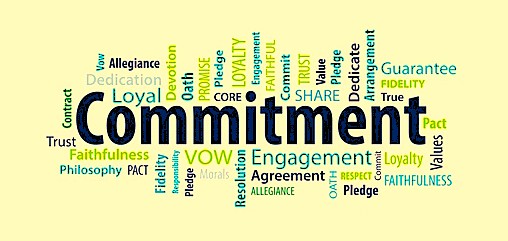
A brief survey of the literature on the subject yields a list, far from complete, but including: vulnerability, the willingness to open oneself up to the other; compassion, the ability to de-centre and examine issues from the other’s viewpoint; curiosity, an enthusiasm for moving forward to discover and share life’s journey with the other; service, the willingness to sublimate one’s own desires to serve the other’s; intimacy, the encompassing of both friendship and sexual communion; connection, the ability to compromise when necessary and give more when needed; and commitment, the will to hold fast to the other, trusting in the other to return that devotion in the face of life’s unfolding.

Of these—all important, to be sure—the most significant to me is the last, commitment. And that would be my answer to the question asked of my daughter’s in-laws. Devotion and faithfulness are needed as we wend our way along the paths and roads we choose, and those chosen for us.

Life does not stand still, after all. The poet Kahlil Gibran phrased it beautifully this way:

…life goes not backward nor tarries with yesterday.

Our paths and roads have changed, circumstances have changed, people around us have changed. And of course we, too, have changed, the more so as we age. That lass I met sixty-four summers ago is an old woman now, and finds herself married to an old man. But our love, though different from the ardour of youth, remains steadfast. I cherish the way the poet W.B. Yeats wrote of his love for Maud Gonne:

…But one man loved the pilgrim Soul in you, And loved the sorrows of your changing face…

We are both more vulnerable now; more in need of compassion; still curious, but less able to pursue our quests; wanting to serve, but more needing of service; intimate still, but without the urgency of bygone youth; desiring still to connect, but aware of our shrinking circle.

Our commitment to each other, however, is as deep-seated as ever it was.

In this beginning of our diamond jubilee year, we consider our meeting at that long-ago ice cream stand as the seminal moment in our lives. There was the time before; and ever since, there has been the time after.

Did I know how it would be when I accepted that double-dipped cone so many years ago? Did she? Who can say?

But here we are.

My Vote Goes Elsewhere!

If this entire post appears in the body of your email, click the title to read it in its tallandtruetales blog setting.

In the sixty-plus years since I attained voting age, I have never run for public office. Nor, at my age, am I about to do so.

Folks who know me well are likely heaving a sigh of relief at that.

To the best of my recollection, however, I have voted in every election affecting me—federal, provincial, municipal, even neighbourhood. And I always voted for the candidate who had persuaded me her or his position on the issues I deemed important was superior to the others.

Unlike my parents, lifelong conservatives both personally and politically, I was never an habitual devotee of any particular political party. Early in my teaching career, exposed to a wide variety of familial and economic conditions under which children had to live, increasingly cognizant of the privileged status I had enjoyed in my own childhood, I became a much more liberal, progressive thinker than earlier generations of my family.

I never held or professed extreme views, though. My stance was, and is, centrist, leaning more left than right. Politically, I would describe myself as socially and culturally liberal, fiscally conservative—which is to say, I favour social programmes that benefit the less fortunate, but without running up unsustainable deficits.

That is easier said than done. But then, anyone with nary a thought as to how it might be accomplished should probably not be standing for office.

As a teacher, my approach with students was to appear less as one teaching them what I thought they should know, and more as one helping them learn what they wanted and needed to know. In my classrooms, there was always more discovery than lecture happening. I strove to be a guide on the side, rather than the sage on the stage, as one aphorism had it.

My objective was to win my students’ trust in the pursuit of their studies, rather than to instruct them as to what they must do simply because I said so.

Later on, as a principal and eventually CEO of two school districts, I tried to use the same approach. Explaining issues to the people whose work I was overseeing proved to be much more effective than issuing fiats from my office. My belief was that, once folks understood why I was planning to do something, and after they had an opportunity to discuss it and have their questions answered, they would more likely be convinced of its wisdom.

In practice, some of those discussions and question/answer sessions convinced me to switch directions, having seen the wisdom of others’ arguments. They won me over in such cases, and we all benefitted.

Alas, such is not the case in politics—not in my experience. Only rarely have I felt a politician seeking my vote wanted me to truly understand why (s)he deserved it. In almost every case, I feel as if I’m being told to vote for that person, told to agree with her or his position, told why other candidates are not worthy.

Increasingly over the past few years, I’ve been told by so-called leaders on the world stage that the truth doesn’t matter; that caring for and assisting one’s less fortunate fellow-citizens is socialism, and must be avoided; that women must be prevented from making decisions concerning their own health; that trans people are lesser citizens than the rest of us; that immigrants, especially people of colour or of different faiths, are a threat to national well-being; that trickle-down economics works for everyone; that LGBTQ+ people are somehow aberrant; that taxing lower-income folks makes more sense than taxing billionaires; that certain books, many heretofore considered classics, must be banned; and on and on.

And for most of my voting life, most of the people telling me such things have been white men—wealthy white men more often now. Men who, it seems, wish only to preserve their own standing, their own influence and power, while the less fortunate must submit and accept their fate.

I’m a white man myself—comfortable in my retirement, not wealthy when compared to these would-be demagogues—but I have never ascribed to the idea of telling people what they must do, what they must believe.

It’s better, I believe, to try to explain. Seek questions and answer them. Win people over. And be open to being won over in turn.

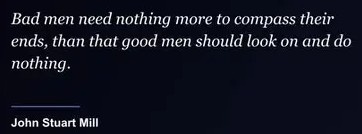
John Stuart Mill wrote this among his many published works: So long as we do not harm others we should be free to think, speak, act, and live as we see fit, without molestation from individuals, law, or government.

Mankind are greater gainers by suffering each other to live as seems good to themselves, than by compelling each to live as seems good to the rest.

He believed actions are right and good if they produce the greatest happiness for the greatest number of people.

And, of course, he acknowledged that such utopian ideals may not always be attainable, and that breaches of a common moral standard must be dealt with: The only purpose for which power can be rightfully exercised over any member of a civilized community, against his will, is to prevent harm to others.

I am no expert on Mill, but the little I do know resonates with me. And so, when I vote, I favour the person who has best managed to explain herself or himself to me. I never vote for the one who demands I do so.

And I never choose the candidate who disparages the idea of helping others, lifting them up—basic humanity—by calling it socialism.

My vote goes elsewhere.