Making Friends

Almost a half-century ago, an older colleague advised me to surround myself with friends who were, not only my age, but younger and older, as well. “With friends your age and younger, you’ll be sharing memories you’ve made together while still able to create new ones. And when you make friends with older people, you’ll learn a lot from their sharing with you the experiences they’ve had.” He didn’t tell me one is silver, the other gold, but I got the drift.

His advice made a lot of sense to me, and to this day, my wife and I can claim friends who are in their nineties and others in their twenties. “You never want to see older friends die,” my colleague said, “but they will. And when that happens, you’ll find solace in the company of the younger ones.”

 That same colleague also told me, tongue-in-cheek, “I don’t need to make more friends. I have trouble keeping up with the friends I already have!”

I didn’t get it at the time, but nearly fifty years on, I better understand what he was saying. We have many friends we barely get to see anymore, given the obligations we all have, the distance we live away from each other, and the vicissitudes of getting older. If it weren’t for social media, I doubt we’d even be in touch with some of them. It’s not that we don’t consider them friends anymore; rather, it’s an inability to keep up.

I first met the friend I’ve known longest when we were fifteen, and sixty-seven years later, that friendship endures. But we see each other in person only two or three times a year now, and even those few meetings seem to require a good deal of advance planning. Moreover, there’s always the chance that one or other of us will have to cancel because of unexpected illness.

I remember my mother in her later years, living longer than my father and most of her friends. Near the end, there was but one longtime friend left, and their children would drive them to an afternoon get-together. Eventually, though, even that proved impossible, and they were reduced to talking by phone—a poor substitute. I dread that day’s arrival for me and my friend.

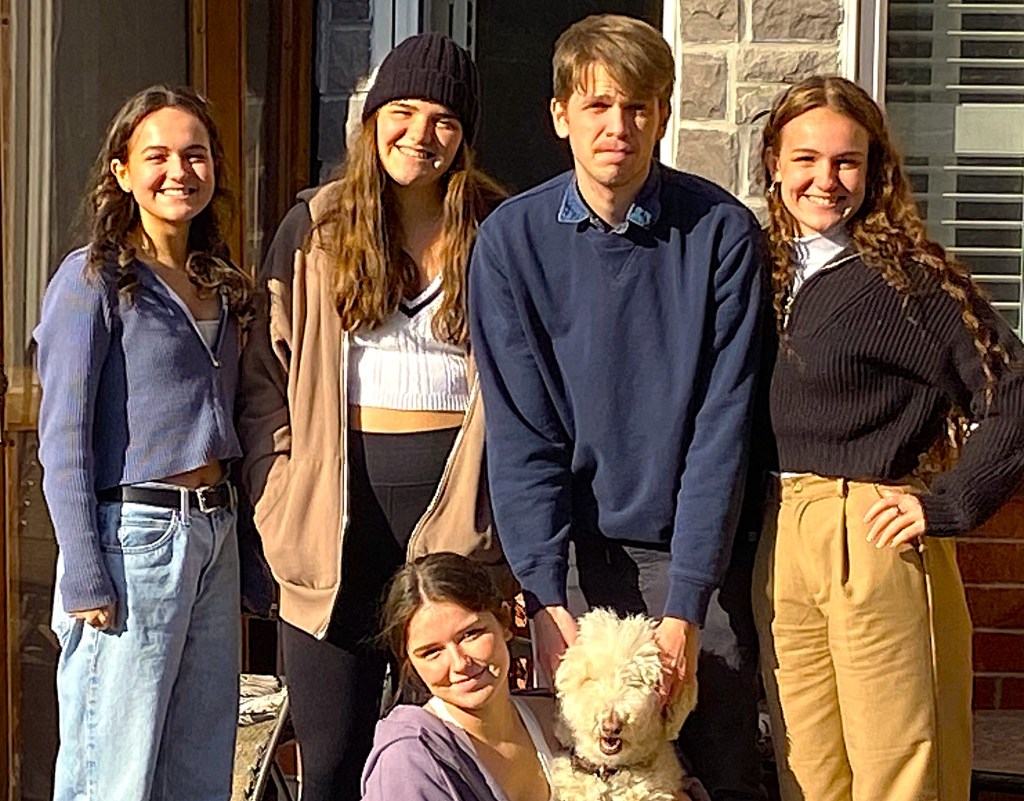
On a brighter note, my wife and I have acquired five new adult friends over the past half-dozen years. Our five grandchildren have all attained the age of majority now, and are attending university or, having graduated, are working full-time. They all live away from home—two from our eldest daughter and her husband, three from our youngest and hers—but close enough to us that we see them frequently on holidays and family occasions.

When they were children, we interacted with them lovingly, but with the slightly patronizing manner typical of conversations between elders who’ve seen and done it all and youngsters who are still finding their way. We never spoke to them in ‘baby-talk’, always recognized their unique intellect and agency, and considered them, not friends, but beloved grandchildren. And they regarded us, I think, as loving grandparents.

It’s different now, though. They’re still beloved by us, of course, and we by them; nothing could change that. But as they’ve grown into adulthood, they’ve become friends, not just grandkids. They’ve developed their own sets of values—thankfully, not identical to ours, nor to each other’s, but not in contradiction, either. They have their own viewpoints on issues facing them, and feel free to discuss those with us. They no longer accept everything we say as gospel, but they’re polite in their disagreements. And they back up their points of view with rational thought.

No longer are they participants in our world; instead, we have become participants in theirs.

As a young teacher, I remember cautioning parents of my students that, by helping children learn to think critically, we must accept the likelihood that they’ll think differently than we do about many things. It’s a delight now to find that is the case with our grandchildren. And a greater delight that it’s given us so much to talk about.

Three of them have come to visit us in Florida during the past year or so, all with boyfriends. So, we’ve been included in their conversations with each other, heard what they think about goings-on in the world, which has opened up new avenues of perspective for us. We’ve listened to their music, and they to ours. We’ve gone with them to the beach, to the mall, to restaurants, to the pool—all things we used to do with our older friends in years gone by.

When my colleague first told me the wisdom of cultivating friends of all ages, I confess I never anticipated some of those would be our grandchildren. But so it has turned out, and we are blessed.

As the familiar ditty advises, Make new friends, but keep the old…

Past, Present, Future

In 1905, George Santayana famously wrote, Those who cannot remember the past are condemned to repeat it. The statement is from his five-volume book, The Life of Reason: The Phases of Human Progress.

In 1943, Eugene O’Neill wrote, There is no present or future—only the past happening over and over again—now. That declaration is from his stage play, A Moon For the Misbegotten.

In his 1950 novel, Requiem For A Nun, William Faulkner echoed the notion when he wrote, The past is never dead. It’s not even past.

Although I could never be confused with those three literary giants, I too wrote on the same theme, more poetically: What’s past is the past—so quickly it passed—But it’s not where I want to stay. Those are the last two lines in the third stanza of my seven-stanza poem entitled, I Haven’t the Time

https://ppens1blog.wordpress.com/2025/07/01/i-havent-the-time/

But I also wrote of the future in that same poem: When all has been said, I still look ahead /To life’s next opening curtain. The premises of the poem are that life marches resolutely forward, that I haven’t the time to concern myself with its past, that I eagerly embrace its future.

Nevertheless, I’ve often wondered if there even exists a past or a future. Perhaps, as James Joyce stated in a 1935 interview with Jacques Mercanton, There is not past, no future; everything flows in an eternal present.

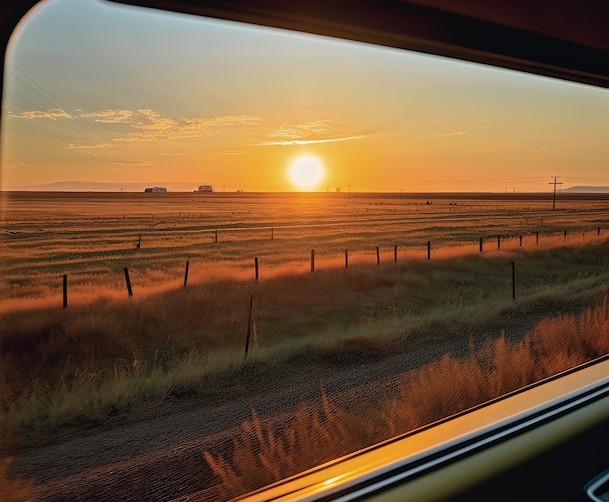
It may be, perhaps, that my poetic curtain is opening, not on some ephemeral future, but only on more of the ever-morphing present. I’ve long appreciated the analogy that life’s progress is akin to riding a train from one’s point of embarkation to one’s final destination, with innumerable stops along the way. People get on, share the ride with me, and every now and then, some get off—perhaps because their journey has ended, perhaps to continue their journey on another train. Indeed, I change trains from time to time myself, although my journey still continues.

My train moves from whence to hence, but I, gazing through its windows at the passing parade, remain aboard in my encapsulated present. The views change constantly, but my surroundings on the train remain, for the most part, constant and familiar. Locales no sooner flash by the window into the past in one direction, than future ones appear from the other. Riding the train is like being everywhere at once while never leaving the same place—Joyce’s eternal present.

Despite these musings, however, I find myself reflecting on the past more often these days—because of my age, maybe, now that my tomorrows are vastly outnumbered by my yesterdays. Although memory is an increasingly unreliable tool, it’s still easier to remember what’s transpired than it is to predict what’s yet to come.

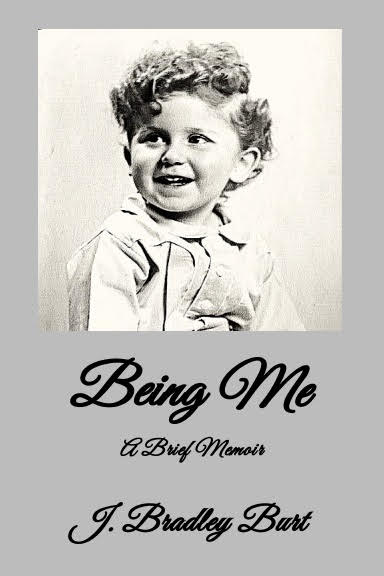
I recently published a short memoir for family and close friends, Being Me, and the exercise both surprised and cheered me. For instance, I re-affirmed that I have lived a blessed and privileged life to this point, surrounded by people who love me. And happily, I discovered I have almost no regrets about events from the past. The few I do have are less the consequence of my own actions and more the result of external forces acting on me, forces I could not control. With the exception of those, I realized there’s virtually nothing I would seek to change, had I the power to do so.

Writing the memoir took me back to places I’d been along the way, and I grasped anew how much I had enjoyed being there—my parents’ hearth, my own homes with my wife and daughters, our trips to foreign lands, my various career stops. I have no wish to return to any of them, to be sure, for I enjoy where I am right now too much. But I greatly appreciate that I had those experiences and opportunities—even if I see them now as only images flying past the windows of my train.

The future holds no fear for me. Curiosity? Anticipation? Of course! Those next opening curtains still claim my attention. I have no idea when my train will drop me at my final destination, but the present journey continues to be enjoyable and fulfilling. I have no clear understanding of what awaits when I shall disembark for the last time, although I do suspect the past, present, and future all will end at once. After all, Einstein held that the distinction between the past, present and future is only a stubbornly persistent illusion.

I imagine there to be an entirely different matrix awaiting after my consciousness has ceased, where time has no meaning, where eternity reigns…well, eternally. In the meantime, I hearken to this advice from St. Luke: …live for today, because yesterday is gone and tomorrow may never come.

My journey’s end will come, however, and I look to it in this fashion—

When that day is nigh, as ‘twill be by and by,
I hope it will be widely said,
That as man and boy, I strove for the joy
Of living until I was dead.

The Lonely, Silvery Rain

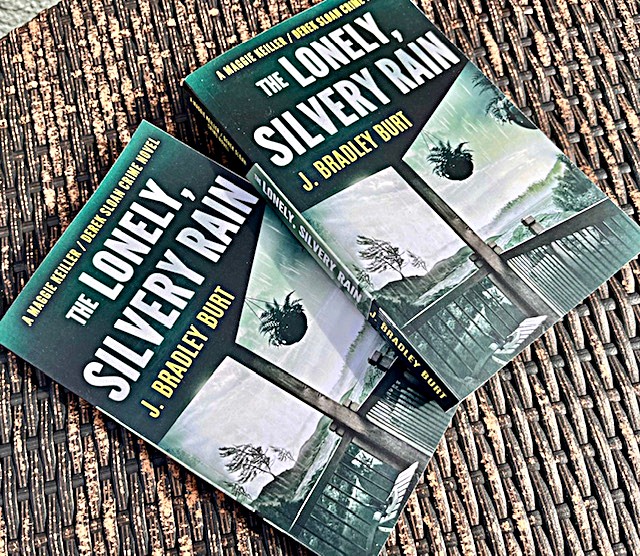
Otter & Osprey Press, a mainstream, Canadian publishing house (a division of Northern Forest Publishing), has released a second edition of my novel, The Lonely, Silvery Rain, to bookstores and online retailers. It’s available in both print and e-book formats, including Kindle.

This book is the thirteenth in my Maggie Keiller/Derek Sloan crime series, and the first to be offered by a Canadian publisher. As a crime-fiction novel, some of the portrayed events and language are intended for an adult audience…..but the story, as one editor commented, is kickass!

Set against a background of reconciliation efforts between government and the fictional Odishkwaagamii First Nation, a gripping story of betrayal and murder unfolds in Port Huntington, a small resort town on Georgian Bay. Vandalism, extortion, and violence are unleashed in the community as a number of personal grievances boil to the surface. 

In 2018, the Ontario Superior Court of Justice awarded ten billion dollars to twenty-one First Nations in a vast area along the north shore of Lake Huron, to be paid equally by Canadian and Ontario governments. The settlement is compensation for unpaid annuities to those affected First Nations, annuities that were mandatory under the still-valid 1850 Robinson-Huron Treaty, whose terms committed the government to paying the affected First Nations annual stipends tied to actual resource revenues on their sovereign lands.

Over the years, billions of dollars in profits were extracted from First Nations lands for mining, timber, and fishing enterprises in Ontario, but the obligatory annual payments to First Nations were adjusted only once, thus depriving generations of First Nations people of revenues to which they were entitled.

Under the terms of the settlement, the Robinson Huron Treaty Litigation Committee, composed of Indigenous representatives, was tasked with determining how, and in what amounts, the funds would be distributed to the affected First Nations. While this story is a work of fiction, it is rooted in the very real question of how that money ought to be used. For the Odishkwaagamii, these debates boil over into deception and bloodshed.

Maggie Keiller and Derek Sloan are inextricably caught up in the turmoil, and it is only through their personal integrity and courage that they navigate the chaos.  Determined as always to defend their Port Huntington community, and themselves, they work to ensure justice will prevail.

This safe, universal link will afford you a preview of the story, and direct access to your preferred online retailer—

https://geni.us/thelonelysilveryrain

After publishing my books through Lulu Press since 2007, an American print-on-demand firm, I’m thrilled that a Canadian publisher has picked up my work, and I encourage you to take a look at their website—

https://www.northernforestpublishing.com/homepage

I hope you’ll explore the link to my book, which I believe you will enjoy. Other titles in the Maggie Keiller/Derek Sloan series may be found at this safe link—

https://www.lulu.com/spotlight/precept

Them and Us, They and We

It’s always them, it’s never us
We like to blame for all the fuss
We must contend with on our way---
It’s never We, it’s always They.

It’s always They, it’s never We
Who take us out on stormy sea,
Into weather, harsh and grim---
It’s never us, it’s always them.

It’s always them, it’s never us
Who make us swear, who make us cuss
The sea on which we sail each day---
It’s never We, it’s always They.

It’s always They, it’s never We
Who cause our pain and tragedy,
Shake our wee boat, gudgeon to stem---
It’s never us, it’s always them.

It’s always them and never us?
That’s what we claim. Why is it thus?
Is there a chance the truth would say
It’s mostly We, not always They?

It’s not just They, it’s mostly We!
When will we learn, when will we see
Who rigs our sails, adjusts our trim?
The captain’s us, it’s never them.

Brown Paper Bags

My wife and I will soon be off for our annual, six-month sojourn in Florida, where we will join with our American friends on Veterans Day, 11 November, to honor the women and men who have sacrificed themselves in defence of freedom. This poem, published here once before, is intended as an homage to those brave souls. It can be read silently, read aloud, or sung to the chorus of the old, Irish ballad, ‘Black Velvet Band’.

His hair hung down to his shoulders,
His shirt was a tattered old rag.
Faded chevrons adorned both his worn, torn sleeves,
And his hands clutched a brown paper bag.

Gunny was the name we all called him,
A veteran, ‘though he never did brag.
He’d wander the streets of the neighborhood,
Snatching sips from his brown paper bag.

His only true friend was old Jarhead,
A mongrel with no leash or tag.
When he died, he left Gunny alone again,
Alone with his brown paper bag.

We never saw Gunny get angry,
He was never a scold or a nag.
When we passed him by, he would nod a sad smile,
And drink from his brown paper bag.


In the summers we often would see him,
With the kit-bag that held all his swag,
On a park bench alone in the warm sunshine,
Holding tight to his brown paper bag.

Then last winter with snowstorms a-swirling,
And temperatures starting to sag,
Gunny died forlorn in the homeless camp,
He’d drunk his last brown paper bag.

When they opened his kit, they discovered
A folded American flag,
And a Congressional Medal of Honor,
Sealed tight in a brown paper bag.

They tried hard to find Gunny’s family,
But their efforts all hit a snag.
So, they buried him with full honors,
With his Medal and brown paper bag.

Gunny rests now with his fallen comrades
‘Neath a cross in a field filled with flags.
UNKNOWN BUT TO GOD and those warriors—
Free at last from those brown paper bags.

Semper Fi, Gunny!

Speaking Shakespeare

For some readers, this post will appear in its entirety as an email in your inbox. To access the post in its true blog-setting, click on the title to read it.

The challenge in this piece was to have the story’s characters speak only the words of Shakespeare.

The three academics had been droning on in their usual fashion for more than an hour. Annabelle Fotheringham, widowed Professor Emeritus of the Classics, was still sipping daintily at her first glass of single-vintage Madeira. Her brother and colleague, Yorick Entwhistle, Dean of the College, was already on his third, yet mostly lucid. Arthur Wellesley, a great-great-great-grandson of the Duke of Wellington, and the College’s Distinguished Professor of English Literature for more than forty years, was savouring his second glass. All three friends appreciated the wine’s characteristic nuttiness, and its hints of caramel, toffee, marmalade, and raisins.

They were alone in the vaulted faculty lounge, each in a leather wingback chair in front of the stone fireplace that dominated the room. A dozen portraits of tweedy, long-since-departed faculty members gazed down austerely from musty portraits mounted on the walls between the leaded-glass windows that sheltered the lounge from a grey, drizzly, winter afternoon. Not one of the portraits was of a woman.

After packing his pipe with the fine Virginia tobacco he preferred, Wellesley struck a sulfurous match and puffed deeply, releasing plumes of bluish smoke into the cloistered air. Neither of his colleagues smoked, but they did enjoy the aroma that seemed to be soaked into the polished wooden walls of their surroundings.

“As flies to wanton boys are we to the gods,” Wellesley opined, replying to something Fotheringham had just said. “Lord, what fools these mortals be.”

“Misery acquaints a man with strange bedfellows,” Fotheringham said, nodding sagely. “Some are born great, some achieve greatness, and some have greatness thrust upon them.”

“Yes, but the devil can cite scripture for his purpose,” Entwhistle ventured. He lifted the decanter as he spoke, refilled his goblet. “There is a tide in the affairs of men, and we are such stuff as dreams are made on.”

The crackling fire was the only reply to that until Wellesley said, “We have seen better days, alas, but what’s done is done. When sorrows come, they come not as single spies, but in battalions.”

“For goodness’ sake, what a piece of work is a man!” Fotheringham scoffed. “To be or not to be, that is the question. All the world’s a stage, and all the men and women merely players.”

“Ay, there’s the rub,” Entwhistle replied. “But come what may, good men and true must give the devil his due.”

A blast of rain lashed the windows just then, followed by a thunderclap, as if the very devil he spoke of were seeking entry.  

“Knock knock! Who’s there?” Wellesley chuckled, tapping the dottle from his pipe into the burnished, brass ashtray-stand beside his chair. “Blow, winds, and crack your cheeks…full of sound and fury! Come what may, even at the turning of the tide, the lark at heaven’s gate sings.”

“Alas and alack,” Fotheringham cried, “indeed, you set my teeth on edge. Misery acquaints a man with strange bedfellows, ‘tis true, and now is the winter of our discontent. But this is much ado about nothing.”

Busily repacking his pipe, Wellesley had no reply to that. The rain continued to pelt the windows, but the contrapuntal crackle of the fire served as a soothing counterpoint to its bluster.

“As good luck would have it, we bear a charmed life,” Entwhistle murmured, his words slightly slurred from the effects of the wine. “We are more honoured in the breach than in the observance, more sinned against than sinning. But the short and the long of it is that we shall shuffle off this mortal coil, so we must stiffen the sinews.” Gesturing around the room with one arm, he finished, “Here is not the be-all and the end-all.”   

“’Tis neither here nor there,” Wellesley intoned, yellowed teeth clamped around his pipe-stem. “We have seen better days, but though this be madness, yet there is method in it.”

“A plague on both your houses!” Fotheringham declared, finishing her wine. “Come what may, ‘tis a foregone conclusion, cold comfort, a fool’s paradise. In my heart of hearts, I know all our yesterdays, filled with the milk of human kindness, will stand like greyhounds in the slips.”

Neither of her companions was entirely sure what she meant, and in truth, neither was she.

“The lady doth protest too much, methinks,” Entwhistle muttered as he added more Madeira to his goblet.

“Yorick, the better part of valour is discretion,” Wellesley cautioned him, afraid his friend might offend the lady. “The smallest worm will turn, being trodden on. Best you throw cold water on it.”

Entwhistle merely grumbled to himself, and his chin sagged onto his chest.

“Too much of a good thing!” Fotheringham said, pointing to Entwhistle’s goblet as he began to snore softly.

“Alas, poor Yorick! No more cakes and ale?” Wellesley smiled at his sleeping friend.

“And thereby hangs a tale, Arthur!” Fotheringham said archly as she rose to depart. “Such a sorry sight, my own flesh and blood!”

Wellesley got up, as well, and the two of them struggled to pull their inebriated colleague to his feet, his arms over their shoulders. “Once more unto the breach, dear friends, once more,” Wellesley sighed as they staggered with him to the door. “We cannot allow this to sully his spotless reputation.”

“Mum’s the word!” Fotheringham said. “The quality of mercy is not strained.”

“A ministering angel shall my sister be,” Entwhistle mumbled as they assisted him from the lounge.

Moments later, all that could be heard in the empty, cavernous room was the crackle of the fire and the relentless rain against the mullions.

All’s well that ends well, indeed.

What to Believe?

For all readers, this post will first appear as an email in your inbox.

For those whose email contains a link, click on it to access the post in its true blog setting.

For those whose email simply shows the post in its entirety, click the title to read it in its true setting.

I was raised a Christian lad, not by proselytizing parents, but by a father and mother who passively practised the religion they’d been taught by their own parents.  As an infant, I was baptized in the Church of England; as a boy, I attended Sunday School, where I learned the Anglican liturgy. In my early teens, I publicly professed my learned faith in a confirmation ceremony; as a young man, I married my bride in a Christian church.

Growing up, I was enamoured of the tales of derring-do by British adventurers who set out to dominate the world—Richard the Lionheart and the Crusader knights; Sir Francis Drake and other explorers and privateers; Sir Cecil Rhodes and the rapacious conquerors of Africa and Asia. All of them ventured forth under the cross of St. George, ostensibly to bring Christianity to the heathen masses. Or so I was taught.

I wasn’t dissuaded by the troubling outcomes that sometimes occurred to me, arising from those teachings. For example, had I died before being baptized, I was taught I would not have gone to heaven; I was told that children of other faiths, unless they converted to Christianity, would not go to heaven; I believed none of us, being sinners, would go to heaven if we did not sincerely repent and swear never to repeat our sinful actions; and it was ingrained in me that those who did not go to heaven would be damned to eternal hellfire.

It didn’t dawn on me until much later how ludicrous it was that the God of love held dominion over me through fear. Still, I’ve never had doubts about the essential teachings of Jesus, as I understand them from the several writers of the Bible who have reported them—love; forgiveness; humility and service; empathy and trust; repentance and redemption; compassion and mercy. It seems to me that if everyone, Christian or not, practiced those teachings, the issues that plague our world would disappear.

From earliest times, my favourite part of being in church was listening to and singing the glorious hymns, accompanied by the mighty strains of a pipe organ. Because of the early, emotional indoctrination I experienced through my parents, they prickle my skin to this day when I hear them rendered—to name a few: Abide With Me; Blessed Assurance; Guide Me, O Thou Great Redeemer; Jerusalem; Joyful, Joyful, We Adore Thee; Nearer My God to Thee; O God, Our Help In Ages Past; and Rock of Ages.

A good number of hymns, I discovered later, were written by British lyricists and set to the melodies of classical composers, many of them Germanic. One of those, Glorious Things of Thee Are Spoken (by John Newton, who also wrote Amazing Grace), is sung to the same Joseph Haydn melody that graces the German national anthem, Deutschlandlied (formerly Deutschland über Alles).

Given the 20th century history of conflict between those two nations, I always found it strange that they shared a love for such glorious music. Even more so, I found it preposterous that soldiers of both Christian countries were killing each other on battlefields, in direct contravention of their shared God’s commandment.

Yes, God is with us! Nein, Gott ist mit uns!

But perhaps that isn’t so strange, given the militaristic character of many of those hymns. Take these lyrics for example—

Stand up, stand up for Jesus! ye soldiers of the cross;
Lift high His royal banner, it must not suffer loss:
From vict’ry unto vict’ry, His army shall He lead,
Till every foe is vanquished, and Christ is Lord indeed.

Implicit in those words is the instruction that good Christians must overthrow those who do not believe. I found that to be in contravention of the Christly teachings mentioned earlier, which always struck me as invitational rather than compulsory. I was taught, after all, that God had gifted us with free choice.

Mind you, George Duffield, Jr., the American clergyman who wrote the lyrics in 1858 and set them to an original melody by Franz Schubert, may not have intended them to sound militant or jingoistic. But that is how they ring in my ear. And it is such sentiments that crusaders and conquerors of the past cited to justify their conquests.

If you doubt it, consider also the lyrics of such hymns as Onward, Christian Soldiers, We’ll Go Out and Take the Land, or The World Must Be Taken For Jesus.

In fact, many Christian buccaneers and swashbucklers set out to plunder the world for reasons far more crass than what they professed. Bringing Christianity to the heathen masses was, at best, a by-product of their colonialist ravages, and at worst, an excuse for them. As for those Indigenous peoples subjected to the messianic zeal of 19th century Christian missionaries, I’ve always wondered how their forced conversions could be deemed proper when similar depredations imposed on Christian victims during the 8th century Moorish invasion of Europe were considered barbaric. Did both aggressions not have the same effects on those who suffered and died? Were they not the same thing, save for the religious faith driving them?

Might makes right, some say. To the victors go the spoils. And history—the history I grew up learning—was written by those victors. The synoptic gospels have Jesus saying, “Render unto Caesar the things that are Caesar’s…” A venerable phrase translated from the Latin has Caesar claiming, “I came, I saw, I conquered!” The emphasis, of course, is on that final word.

So now, with more yesterdays accumulated than tomorrows to anticipate, I find I am no longer the Christian lad I once was…not with how Christianity, particularly the degraded, evangelical sort, has come to be defined in this 21st century. I do believe in free choice, and I choose not to believe Jesus was all about conquest and subjugation.

Further, I do believe in the wisdom of the aforementioned teachings of Christ, although I do not need the backing of a supernatural mythology to support my belief. I regard those as universal truths shared by Christianity, Islam, Hinduism, Buddhism, and Judaism, among other religions…and indeed, by many folk who profess no religion. Those teachings promote adherence to the Golden Rule, compassion for and kindness to others, the valuing of family and community, and the pursuit of a moral life.

I’ve long believed that the evils of this world are caused, for the most part, by extremism—unbridled nationalism, greedy capitalism, and apocalyptic religions. How might it be if only we gave those universal truths a chance to show what they could do instead?

In closing, lest this screed be mistaken for apostasy or advocacy, let me assure you it is no more than a statement of personal belief, refined over many years of observation and experience. Despite the sage admonition not to believe everything I think, I have always felt that believing in something is important, so as not to fall for anything.

The question, of course, is knowing what to believe. And for me, seeking that knowledge will be an ongoing journey until, inevitably, the road comes to an end.

More and More Every Day

Earlier this week, I celebrated my wedding anniversary—fifty-eight years, all married to the same woman, the lissome lass I first dated when she was but sixteen.  We married four years later, embarked upon fulfilling careers, raised two lovely daughters, and retired to the life we now enjoy together…sixty-three years gone in the blink of an eye, it now seems. Egad!

Friends probably view the longevity and success of our union from my wife’s point of view as a triumph of iron will over probability. From my viewpoint, however, it’s unquestionably a victory of blessed good fortune over whatever random fate I would otherwise have encountered.

Recently, at the behest of our daughters, we each decided to write a short memoir of our lives, intended only for family and close friends.  Mine, titled Being Me, is finished and in the hands of those I care most about; hers, titled My Story, is nearing completion. The trick, as we discovered in the writing, lay in knowing, not what to include, but what to leave out.

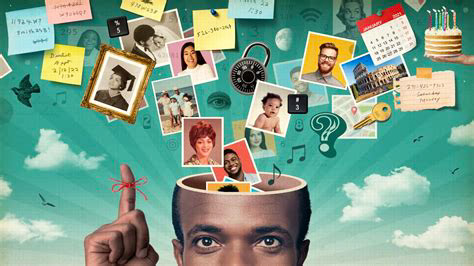
As we wrote, we shared memories sparked by old photos, slides, and home-movies produced through the years.  We were amazed by how much we had forgotten over time, and by how different our fuzzy memories sometimes were as we discussed the same events.

“That’s not how it happened!” I found myself declaring more than once, only to have my wife show me a faded snapshot that proved otherwise.  Admittedly, I’ve always had trouble remembering dates, so casting back to those bygone years wasn’t child’s play for me.

By the way, that trouble with dates persists even now, alas.  I recently showed up for a colonoscopy procedure after enduring the requisite purging prior to the visit, only to find I had the right day, the right time, but the wrong year! I was a whole year early! I’m still living that one down.

Through most of our marriage, my wife and I were enthusiastic participants in sports—baseball, curling, golf, hockey, tennis, skiing, swimming, to name but a few—both competitively and recreationally.  As we eased our way through middle age, entering inevitably into our senior years, many of those began to fall away. We found we could no longer glide across the arena or playing field with the same visions of grace and glory we’d previously enjoyed.  Father Time vanquishes everyone, we discovered, no matter how skilled or practised we might be.

An example for me was falling down in my follow-through a few times on the tee-boxes while smoking drives I’d always hit routinely…well, maybe not always, but occasionally.  My playing partners advised me to start wearing a bicycle helmet if I wanted to continue playing.

My exercise today consists of activities where I can’t fall down or off something. I favour the rowing machine, the treadmill (if I hang on), the stationary bike, or exercises conducted while lying on the floor.  Although not a Latin scholar, I find myself chanting under my breath as I work out: sic transit gloria mundi!

As with many things in a long marriage, my wife and I found we had to adjust and change to meet these new demands.  She spends the bulk of her time now, when she’s not reading or doing jigsaw puzzles, making gifts for family and friends out of clay, dichroic glass, and wood, an accomplished artisan.  I call her my boon companion in the arts.

Much of my time, of course, is spent writing—novels, anthologies of tales and poems, and posts on my blog—and listening to classical music.  I’m a prolific reader, as well, and give thanks constantly for online libraries.

Perhaps the biggest change for us is that we no longer find our children and grandchildren to be part of our lives, sharing our experiences; rather, we have become part of their lives, eagerly sharing their accomplishments and happenings. It is we who are the supporting actors now, and they the stars in the unfolding movies of their lives.  We’ve also discovered that this change is very comforting, to be loved and cared for by these essential people in our lives, even as ours wind down.

We still look ahead, however, to each new adventure that might come our way. One of my haiku poems illustrates that philosophy quite clearly—

more yesterdays now
than tomorrows, but it’s the
tomorrows that count


the sails of our youth,
once hoist, are mostly furled now---
though the winds still blow

Back in 1964, when we were still dating prior to marrying, a popular singer, Al Martino, released one of his biggest hits, I Love You More and More Every Day. We adopted that as ‘our song’, and we used to sing snatches of it to each other.  Over the years, it faded for some reason from our minds, although we never abandoned its premise.  But I thought of that song on my recent anniversary day, and began to sing it to myself.  I had to look up the lyrics, of course, after all this time, but the melody was etched in my memory.

On a whim, I decided to record myself singing it on a karaoke track to present to my wife. Although I used to sing bass in a men’s a cappella barbershop chorus, my octogenarian voice is a tad quavery and shrill now, and my range is somewhat limited.  Nevertheless, the sincerity of my singing has not abated, and she at least recognized the song. Sort of.

As I think back to when she and I first met, as I try to remember all that has happened since, as I marvel at the lasting of our union, I find myself overwhelmingly grateful that we celebrated this latest anniversary together, and I offer this haiku to her to reflect those sentiments—

impossible dream!
many might have thought so, but
you made it come true

trusting all that’s passed,
moving forward in good faith,
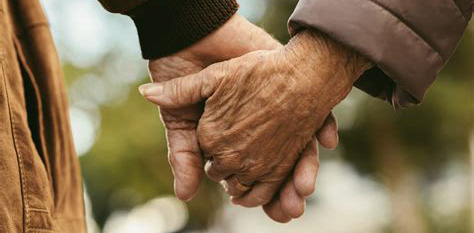
hands clasped as always

I Can Help With That!

Well into middle-age, I would often ask my parents questions about our family’s history.  Most of the time, those questions were based on simple curiosity, but occasionally they’d be prompted by something more important, like the medical history of family members that might impact me or my children.  Aging aunts and uncles were also a source of information, and always seemed happy to reminisce about such things.

Old photo albums were a rich source of material, too, as were scrapbooks and journals, and I remember poring over them as a child, eager to soak up the ethos and culture of my family.  Alas, when I look at some of those monochrome snapshots now, I find I recognize hardly anyone.

But now, of course, there’s no one to ask.  Both my parents and all my aunts and uncles are long departed, and I am the eldest of my family.  My three younger sisters will sometimes remember events from our shared past quite differently than I, but now we have no arbiter to call upon.

My two daughters, in their fifties now (Egad!), have taken to asking me and my wife the same sort of questions about our respective families that I used to ask my elders.  We answer them to the best of our memories, but our memories aren’t the best anymore.  I come away from some of those conversations with the uneasy feeling that I might have made stuff up to fill the gaps.

One of our daughters suggested recently that we sit down for a few interview sessions with her, where she could record our recollections.  We’ll be happy to do that, but the suggestion prompted another idea, one I immediately acted on.

I’ve written a memoir, a brief history of my life intended for family only—my wife, my daughters and their husbands, my five grandchildren, and my three sisters—plus one friend of almost seventy years.  The book, a mere 135 pages in length, is titled Being Me, and is not meant to be an exhaustive examination of my life to date.  Rather, it’s a glimpse at who I was as a boy, who I became as a husband, father, and educator, who I am well into a blissful retirement, and who I strove to be throughout my life. It deals with those events I deem significant, things that might be of interest now or in future to my limited audience.  The challenge I faced was not trying to decide what should be included, but what should be left out.

I’d love to think there’ll be enough yet to come to justify a sequel, but that seems rather unlikely.  Dying holds no fear for me, but I will harbour a sizable amount of regret if that grim reaper lurches in too soon, for I’m having too much fun to want to leave.

It’s been said no one is ever truly dead to the world until the last person who remembers her or him is gone, and I think there’s something to that.  My paternal grandfather died just before Christmas 1948, when I was five years old.  But because I still remember him, vaguely—the only one in my family who does—he’s still alive in a way.  When I finally pass, so, too, will he.

But I’m hopeful I’ll live on, as he has for me, in the memories of those precious ones I leave behind.  And I pray those memories will be fond ones, at least for the most part, and that they’ll evince more laughter than tears.

I have more yesterdays now than tomorrows, but the inevitability of aging is but one aspect of life.  If we so choose, we can relegate aging to a mere physical phenomenon, not one that has to affect our emotional outlook.  The person looking out on the world from behind my eyes today is not the man whose image I see in the bathroom mirror every morning; rather, he is still the boy I always was—

from my aging eyes,
the boy I once was looks out---
hardly changed at all.
the sails of my youth,
once hoist, are often furled now,
‘though the winds still blow.

The winds do still blow, and I welcome them and am inspired by them, even if I can no longer respond as once I did.  My children and grandchildren, thankfully, are caring enough to include me in their lives; my next adventure with Donna is always just over the horizon; my next book is already forming in my febrile  imagination.  These are the winds I speak of, and the physical frailties that age sends to plague me are unable to fully constrain me.

Prompted by our daughter’s interview idea, my wife also decided to write her memoir, titled My Story, and has asked me to help.  As I read her recollections, I find many of the events she deems significant are those I also considered important.  That shouldn’t be surprising, I suppose, considering we’ve been a couple since our first date in 1963, and married for fifty-seven years.

Neither memoir, of course, will answer all the questions our daughters or their families may ask about their heritage.  But with any luck, they’ll go some way to filling in a few of the blanks.  And who knows? Maybe on some far-off day in the future, long after I’ve gone on to my next adventure, one of my grandchildren—or perhaps one of their children—will want to know something about the old-timer who preceded them by a generation or two.  No one will likely remember, but they’ll have my memoir to refer to for the answer.

I like to think it will be as if I’m still there to hear the question.  And to answer by responding, “I can help with that!”

Spring-Breakers Are the Worst!

The challenge from my Florida writers’ group was to begin a story with an unnecessary, declarative sentence, and to focus on a theme. The theme of this story is that actions speak louder than words. The story is an adapted excerpt from a crime novel I’m working on, Unsafe For All Time.

They were right there, staring at each other. 

As he carried two strawberry margaritas back from the Beach Hut bar, Jake saw the guy talking to Jessie.  Dressed in khaki shorts, a faded blue T-shirt, and sandals, he looked to be about Jake’s age, well-built, slightly taller.  

“Can I help you?” Jake asked him, glancing at Jessie in their booth.  She rolled her eyes as if to say the guy was a jerk.

“Don’t think so, Chief!” the guy replied.  “But Jessie here is gonna be joinin’ me an’ my friends over there.  She’s a friggin’ bomb!”  He pointed to a booth on the far side of the beachside patio, where two similarly-dressed guys were watching.  “You might as well run off home.”

Jessie was indeed a prize in her tight-fitting tank-top, cut-offs, and scuffed cowboy boots.  Ten years older than Jake, and divorced, only the fine wrinkles around her eyes kept her from looking like she could be his college classmate.  They’d met when he’d dropped off a form to the Dean’s office at Florida State, where she worked as a file-clerk.  They’d been seeing each other for a month now, and both were still enjoying the novelty and the sex.

“What’s your name, pal?” Jake asked.   

“Name’s Bobby…not that it’s any of your business.”  But before the guy could say anything further, Jake flung the contents of one of the drinks in his face.  The sticky, pink strawberry liquid stung Bobby’s eyes, splattered the front of his shirt.

“Hey!  What the hell!” he spluttered, jumping back in surprise.  Jake tossed the second drink in his face, then stepped to one side and kicked his feet out from under him.  Bobby fell backwards, sandals flying off his feet, and his head bounced hard on the wooden deck when he landed.  Jake set the empty glasses down on the table in front of Jessie.

The guy’s two friends immediately clambered out of their booth, but before they could get to Jake, two beefy bouncers intercepted them.  While one held them at bay, the other told Jake he’d better leave.  “I know why you did it, man,” he said, “but you an’ the lady gotta go.  Now!”

When Jessie slid out of the booth, gathering her long, blonde hair behind her neck, the bouncer gave her a long, appreciative, up-and-down look.  Bobby was trying to sit up, rubbing the back of his head groggily.  Jake took Jessie’s elbow, steered her toward the door.  “You gave that asshole your name?”

“Yeah,” she said, “right before I told him to buzz off.  An’ then you got back with the drinks.”  She chuckled wryly, then added, “What a waste of good booze!”

Minutes later, they were headed for the highway a mile from the restaurant, a plume of dust from the gravel road swirling behind Jakes’s ten-year-old convertible.  “Too bad that hadda happen,” Jessie said, adjusting her makeup in the vanity mirror.  “I never been to the Beach Hut before, was lookin’ forward to dancin’ under the stars.”  Snapping the mirror shut, she leaned back and gazed at the nighttime sky, hands raised above the windshield to feel the onrushing air.

“You hungry?” Jake asked.

“I could eat,” Jessie said.  “An’ y’know what?  I feel like a cheeseburger, so how ‘bout we hit a Steak ‘n’ Shake?”

Jake was watching headlights coming up fast behind him.  “Got trouble, I think,” he said.

Twisting in her seat to look, Jessie asked, “You think it’s them?”

“Most likely,” Jake muttered, coasting to a stop on the side of the road.  Leaving the engine running, he opened his door and climbed out.  “Stay in the car,” he said.

“No friggin’ way,” Jessie declared, reaching into her bag for the small can of Mace she carried everywhere.

The other car pulled over about twenty yards back.  Jake and Jessie had to shield their eyes in the glare of its high-beams, but they heard two car doors slam, saw two vague shapes slowly approaching.  “Hey, Chief!” a voice called out, “you messed up Bobby pretty good back there.  They hadda take him to the hospital.  But what’s worse, you took that sweet-lookin’ babe with you when you ran off.  Now it’s time for a little payback.”

Jake popped his trunk, quickly unrolled a worn blanket cocooning a shotgun, a well-used Mossberg 500.  Racking it loudly, he aimed it at the headlights.  The metallic kascheeek-kaschunk of the slide cut through the night, freezing the two men where they were.

Marvelling at the ease with which Jake handled the gun, Jessie stood to one side, eyes wide, the Mace clutched tightly in one hand.

“Hey, wait, man!” the same man said, his tone suddenly a lot less belligerent.  “No need for that!”

“One!” Jake called out.  Nothing else could be heard for a second or two, save for the eternal serenade of crickets and bullfrogs in the humid darkness, and the surf rolling in to the beach beyond the trees.

“Two!” Jake said.

Without another word, the men scrambled back to their car, and moments later, two doors banged shut again.  The driver immediately cut his wheels into a U-turn, but there wasn’t enough room on the narrow road.

“Three!”

The back-up lights pierced the darkness as the driver reversed to make room for what was now a three-point turn.  And then he stalled the car.

“Four!” Jake yelled.

As the engine roared back to life, the driver spewed gravel from under his wheels and the car leapt into its turn and headed back up the road towards the restaurant.

“Five!” Jake whispered.  When he pulled the trigger, the back window of the fleeing car exploded and one of its tail-lights blinked out.  The vehicle fishtailed violently a couple of times before straightening out and accelerating away, dust rising high in its wake.

“Holy frig, Jake!” Jessie exclaimed.  “You don’t fool around!  You coulda killed ‘em!”

“Don’t think so,” Jake said calmly, returning the shotgun to the trunk.  “Not at that range usin’ coarse birdshot.  I’m surprised it blew out the window.  Woulda messed ‘em up some if they’d kept comin’ for us, though.” 

A half-hour later, they were seated close together in another booth—Jessie with her cheeseburger, Jake with a plate of fries he was sharing, both with a thick, creamy milkshake.

“Chocolate’s my favourite,” Jessie said around a mouthful of burger.  “I tried one like yours once, but the crap they put in it kept gettin’ caught in my straw.”

“That’s why they give you a spoon,” Jake laughed.  He’d ordered a Rocky-Road-cookie-dough-caramel something-or-other, but secretly wished he’d stuck with chocolate.  “You got some mustard on your chin.”

Jessie wiped it off with her napkin.  “You think them guys know who we are?  You think they’ll come after us again?”

“Doubt it,” Jake said.  “They looked like spring-breakers to me.  Gonna have a story to tell when they get home, wherever that is.  Prob’ly Daddy’s car that got shot up.”

“Spring-breakers are the worst!” Jessie said.  “How come you got a gun in your trunk?”

Jake waited several seconds before replying.  “Hey, any guy who goes out with a babe as hot as you is gonna need a gun!  There’s assholes like Bobby all over the place.”

Jessie grinned at the compliment.

“He was right ‘bout one thing, though,” Jake added.  “You are the bomb!”

Swallowing the last of her burger, Jessie said, “Bet your ass I am!  But the only one I’m gonna go off on is you!”

“Can’t wait!” Jake grinned.

”Me neither,” Jessie grinned back.  “But first, are you gonna finish them fries or what? I’m still hungry.”