Grandpa’s Grammar

Your per-nunky-ayshun is her-ibble!

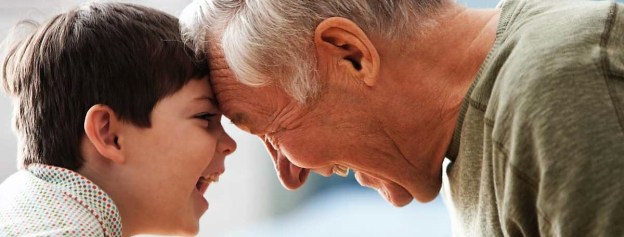
So spake my grandfather once upon a time, admonishing me—perhaps five years old at the time—when I mispronounced a word while talking with him.  I remember dissolving in laughter, delighted by the strange words coming from his mouth.

Language, and its proper usage, were important to him.  An accomplished calligrapher, a voracious reader, and an avocational writer, he was forever dwelling on the importance of speaking and writing correctly.
grandpa 3

Years later, as a young teacher, I carried on that same tradition by including grammar lessons in my pupils’ daily curriculum.  When I became a father, I continued the practice in conversations with our daughters.

Neither my wife nor I favoured the inane baby-talk that was so prevalent among parents back then as they communicated with their children.  Right from the beginning, we resolved to speak to the girls in proper sentences, expressing complete thoughts, using correct terminology, pronouncing words properly.  Most of it probably went over their heads in the beginning, of course, but we definitely set an expectation in their minds that effective communication was important.

Along the way, I made time to tell them of the various quirks and anomalies of the English language.  Making a game of it, or including it in story-times, helped, I think, to convey the lessons.

I’d explain to them about adverbs and adjectives, and how they’re used.  “Adverbs usually, but not always, end in ‘ly’,” I’d say.  “So, you don’t run quick or slow, you run quickly or slowly.  You don’t dress nice, you dress nicely.  Get it?”

“Huh?” their quizzical expressions would seem to say.

“You can feel good,” I might continue, “but you’re never doing good.  You’re doing well.  And, you’re never doing poor, but you could be doing poorly.”

“But, you’re always saying I eat too fast,” the eldest once said.  “Does that mean I’m eating too fastly?”

At that point, I launched into an apology for all the exceptions to the rules in English exposition.

Spelling and vowel-sounds were often challenging, as well, when I’d lead them through the pronunciation of such lookalike words as: through (long u sound), tough (short u sound), although (long o sound), cough (short o sound), and plough (sounds like ow).

For a long time, we enjoyed playing a silly-sounds game, asking each other to correct the mispronounced words in sentences like this: ‘Althoo my meat was toe, I got thruff most of it.’

To many of our friends, parents themselves, my emphasis on grammar and spelling likely seemed fetishist, even obsessive.

“I could care less about that stuff,” they often said to me.

“No,” I’d reply, “I think what you mean is that you couldn’t care less.  If you could care less, it would mean you consider it important.”

Most of them would roll their eyes and drop the subject.
Lesson-01

Pronunciation was always the main issue, though.  In time, the girls would recognize and laugh at obvious mistakes they’d hear on the radio or television, from speakers who ought to have known better.

“That guy said Nagra Falls, Daddy,” one might say.  “It should be Ni-a-ga-ra, right?”

Her sister might pipe up, “I heard someone talk about the nu-cu-lar bomb, instead of nu-cle-ar!”

“How about this one?” the first might say.  “We don’t eye-urn our clothes, we i-ron them.”

“Yeah, and there are no taggers in the zoo; they’re ti-gers.”

I suppose it was Grandpa’s grammar lessons that imprinted on me, and led me to become so insistent on proper language usage.

But, what about the situation today, I wonder, when so much of our verbal and written communication is made up of verbal shortcuts?

abbreviations

Is the proper usage of language still important?

So many times now, I hear people say something like this in conversation: “So, she goes, ‘I like your dress.’  And I go, ‘Thanks!’  Then, she goes, ‘It’s nice.’”

Can they not use the correct word, as in ‘She said…’ and ‘I said…’?

It’s common anymore to hear someone say ‘What?’, not ‘Pardon?’ when they haven’t heard me; ‘Fer Shurr!’, not ‘For sure!’ when they’re certain of something; or, ‘It don’t matter!’, not ‘It doesn’t matter!’ when asked if everything is okay.

To me, it does matter.

Still, in the grand scheme of life, perhaps it no longer counts if our language continues to be used correctly and in its purest form.  It is a living thing, after all, and should, therefore, be expected to evolve over time, adapting to technology and 5G capabilities.

spelling

But, so much of the first impression we convey to others about ourselves is wrapped up in how we speak, and in how we sound to others.  So much about our intellect and learning is tied up in how we write.  I have trouble accepting that grammar, spelling, syntax, diction, and pronunciation may no longer be valuable in our human discourse.

My grandfather told me over and over that our language should always be held in respect, and used in its highest form.  And I, a child at his knee, believed him.

“Otherwise,” he’d say, a mischievous twinkle in his eye, “it will be a true cattas-troffy!

Nine Lives

It’s always been held that cats have nine lives, but a friend of mine, affectionately known as the Cat, must be close to running out.  Just how much longer he’ll be around is beginning to worry me.

He’s been the Cat since well before we both retired, and almost no one calls him by his real name—if they even remember it.  The reasons for the nickname are long-forgotten, although he claims to remember.

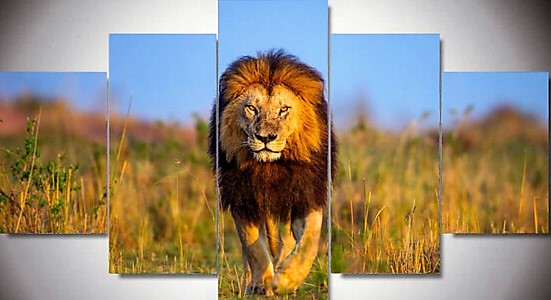
“Just look at how I move,” he says.  “I’ve got the grace and power of a big cat.”

big cat

Sometimes he stumbles as he says this.

I was telling some new friends recently about my old pal, a guy who lurches through life’s little lessons, always landing on his feet.  At least, that’s how he sees it.  He’s always boasting of how he demonstrates the feline reflexes and agility that only the truly-gifted athletes have.

Such claims are usually accompanied by a sheepish grin, following, for example, a frantic scramble to retrieve the food he has just spilled off his plate at the buffet table.

My friends were fascinated by my tales of the Cat’s adventures, if somewhat disbelieving.  They asked if he were still alive, and enquired about the escapades he’s endured.  I obliged them by relating a few—all true, as sure as I’m sitting here now.

After deciding to spend winters in the south with his long-suffering wife, he began to participate again in many of the athletic endeavours he had previously given up.  With wanton disregard for the years that have passed, he threw himself recklessly into everything.

For example, there was the time a group of us were playing in an oldtimers’ slow-pitch tournament.  We were there, more for a good time than to win.  Hence, the Cat was batting fourth in our lineup, rather than last.

When he stepped up for his first turn at the plate, he swung so hard at the pitch lobbed by him that we thought he’d screw himself into the dirt.  But, the Cat wasn’t phased.

“What—a—ripple!” he declared admiringly, unwinding himself awkwardly from the bat.  “Did ya see the power behind that swing?  Panther-power, just like a cat!”  He struck out on the next two pitches, but with a mighty swing both times.

Later in the game, however, the Cat did make it to first base—after being hit by a pitch he couldn’t twist away from.  On his way down the line, he attempted to imitate the pigeon-toed run immortalized by Babe Ruth, but with mixed results.  It looked fine until he tripped on an untied shoelace and fell.

safe

“I was gonna try out my home-run trot,” he explained later, “except I remembered I don’t have one.  But, I hope you guys noticed how gracefully I slid into first base when y’all thought I had tripped.  Every move is planned!”

Following our final game of the day, we adjourned to the community pool for a swim, a few drinks, and a cook-out.  The Cat was thirsty, but he didn’t stay that way for long.  By the time we got around to eating, he had definitely been over-served.

Sitting fully erect on an aluminum lawn chair, the fold-up kind, he was holding a plateful of food in his hands.  With glazed eyes and a fixed smile, he stared straight ahead, lips moving wordlessly.  Then, ever so slowly, he toppled sideways, out of his overturning chair, and on to the grass.  Incredibly, he never tipped his plate!  Didn’t spill a morsel!

“I wish I’d been there to see that,” the Cat said later.  “I’m sure I handled it gracefully, just like a cat!”

His full day ended with a swim in the pool, something else he doesn’t really remember.  He was walking back and forth across the shallow end, bent over with his face in the water, wearing a face-mask and snorkel.  The Cat likes to take great risks like that.

Inevitably, he stepped into the area where the pool-floor slopes down to the deep end.  He sank like a stone.  When he bobbed back to the surface, still face down, he drew a huge, shuddering breath through the snorkel tube.

That marked the onset of a great thrashing and splashing, punctuated by whooping and coughing, and wild flapping of arms.  The tube, of course, had filled up with water.

snorkel

It took six of us to get the Cat out of the pool, still clutching the mask and snorkel when we deposited him on the grass.  After a few moments of laboured breathing, he grinned up at the crowd staring down at him.

“Notice how I managed to grab the snorkel before it sank?” he sputtered.  “Just like a cat-fish!”

On another occasion, when we all went roller-skating (some of us wearing inline skates), the Cat sailed onto the floor with great abandon.  He managed to remain upright as long as he was moving forward, but turning was another matter entirely.  Over the first few minutes, he became intimately acquainted with every corner of the skating arena.

His tour de force happened when he was resting for a few minutes, leaning on a railing that separated the main floor from the rest area.  Suddenly, the roller skates on both feet shot forward from under him, plunging him straight down.  His underarms and chin caught on the rail, and he hung there for a moment, legs outstretched, before dropping to the floor.

When he recovered enough to speak, he croaked, “Did ya see how I caught myself there, before I hit the floor?  Like a cat!”

Unbelievably, these were only some of the escapades from which he’s emerged relatively unscathed.  Several years ago, he went river-rafting with his son and a few other lunatics.  One of their favourite activities as they went careening through the white-water rapids, was to fill the bailing-buckets and toss water at each other.

As it was told to me, the Cat forgot to hold on to the bucket on one toss, and it hit another rafter squarely on the shoulder, toppling him out of the raft.  The Cat was quick, though.  With blinding speed, he lunged for his unfortunate victim, missed him by the slimmest of margins, and followed him over the side.

After much floundering and flailing, punctuated by surges of pure panic, the other rafters managed to pluck the two of them from the river.  The Cat was jubilant.

finishing-the-rafting-adventure

“Notice how I went right in after him?” he crowed.  “There was no time to lose!  Poor guy coulda drowned!  Instant response, no hesitation, quick as a cat!”

My favourite of his adventures, however, happened up north, on a winter weekend several years back.  A group of us had gathered at a friend’s farm to boot about on his snowmobiles.

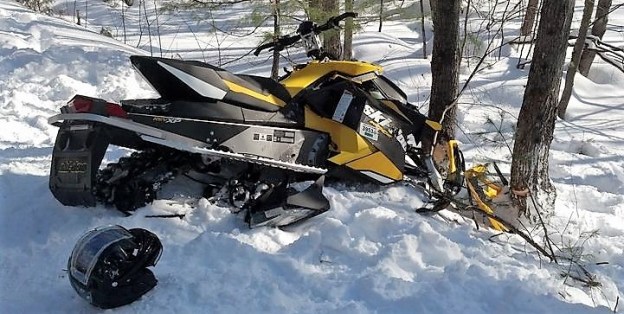
I’m not sure the Cat had driven a snowmobile before, but he approached his designated machine with even more confidence than he usually shows.  Leaping aboard, perhaps assuming it had a neutral gear, he gunned the throttle.  The machine shot forward, the Cat’s head snapped back, and his helmet dropped down over his eyes.  Clawing at it to push it up, he realized he was headed directly for a parked car.

His car!

With his famed, cat-like reflexes, he yanked the handlebars hard to the right, missing the car by a whisker.  As he pulled, however, he fully depressed the throttle under his thumb, and that was his undoing.

Recalling it later, our host said, “He turned away from the car, alright, but then accelerated straight into a tree!  I never saw anything like it!”

snowmobile

The tree put a stop to the brief, wild ride.  The Cat kept moving after the snowmobile stopped, of course, smashing into the cowling and windshield.  Bruises on his chest and a couple of muscle strains were the lasting effects of his thirty-foot expedition.

“Guess I’ve bought a snowmobile,” he observed ruefully, surveying the wreckage later.  He lapsed into rueful silence for awhile, but then brightened considerably.

“Did you guys see how fast I reacted when everybody thought I was gonna hit my car?  I turned that sucker in the nick of time, cool as a big cat!  Every move is planned.”

The Cat’s friends, and they are many, figure he has maybe two of his nine lives left, if that.  We all hope they’re charmed.

Like them, I love the Cat.  But, given his predilection for tempting fate, I make a point of never standing too close to him.

Who Let the Skunk In?

My friend has a house on a large, rural lot on the outskirts of a northern Ontario town.  He spends a good deal of time hunting, trapping, and disposing of the various critters that also inhabit his property. Whenever we visit, it’s comical to watch him stalking his prey, regardless of its size.

Black flies, mosquitoes, deer flies, and assorted other pesky bugs are pursued if they’re inside the house, and swatted if he can catch them.  And he does kill a goodly number; we’ve all seen the splatters left on the window panes.

swatting

He always tells his wife to wash them off, but after a raised-eyebrow glance from her, he ends up doing that job himself.

Mice and chipmunks are trapped or poisoned when they become a nuisance, particularly if they nest in the garage (which adjoins the house) or the workshed (which accommodates tools and lawn equipment).

My friend prefers that his wife empty the traps when some poor critter takes the bait, but she always demurs.  Forcefully, not politely.

Raccoons and groundhogs are fond of burrowing beneath his shed.  They’re live-trapped as a first option, carefully transported some distance away, far on the other side of town, and released.  But, he swears they come back, even claims to recognize them.  We’ve suggested he buy a spray-can of fluorescent paint to mark them, just to check out his theory.

His second option, if the varmints prove too canny to enter the traps, is to shoot them with his .22 calibre rifle.  This sounds to me like a dubious tactic, even though he lives outside the town boundaries; but, apparently, it’s not particularly dangerous.  After all, my friend is a crack-shot—or so he tells us.  We occasionally call him Elmer Fudd, but never to his face.

Elmer Fudd

But, he’s probably right, because once a month or so, usually around dusk, he pops one as it feeds in the garden, contemptuous of the lettuce or bacon bits placed enticingly in one of the traps.  The reason why this killing of nocturnal raiders is the second option is that the carcass has to be disposed of.  Quickly.

My friend prefers that his wife look after that, too, but…well, you can imagine how that works out.

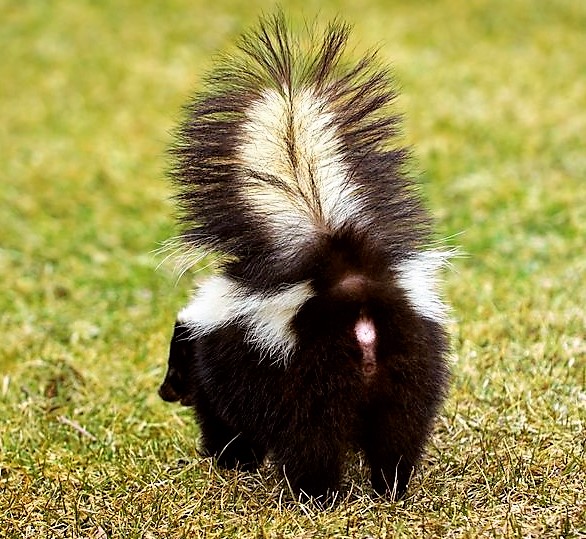
His latest escapade took these hunting adventures to a new low, however—and I swear this is exactly what he told me.  While making himself a sandwich after coming home from the office for lunch a few months ago, he saw a skunk digging grubs out of his back lawn.  Although dressed for work, he was unfazed by the prospect of being dosed by its powerful scent.  Charging out the door, he ran at the skunk, stopped ten feet or so from it, and made loud, shoo-ing noises.

As he tells it, the skunk took up a defensive posture, facing him, and stood its ground.  So, my friend went to his shed, grabbed a short piece of two-by-four, and threw it at the critter.  He missed, but the skunk must have got the drift, because it turned and waddled toward the end of the yard, tail raised disdainfully in the air.

skunk 2

Trying to hurry it along and discourage it from coming back, my friend retrieved the wood and tossed it again in the direction of the retreating animal.  To his everlasting surprise, he hit it squarely and down it went.  As he approached, he could see it was still breathing, but apparently unconscious.  Without further ado, he ran for his long-handled spade, slid it under the skunk, and gingerly carried it at arm’s length to the rear of the yard, where he tossed it unceremoniously over the fence bordering the adjacent woodlot.

There was no mistaking the smell, of course; but, knowing he had avoided being sprayed, he assumed it was the ambient scent of the animal that tainted the air around him.  He savoured his victory all the way back to the kitchen.

By then, his wife had arrived home for lunch.  As he came in, she recoiled in horror at the stench accompanying him.  She told him to take off his shoes, remove his clothes, and get into the shower.  Immediately!

Belatedly realizing he must have walked on grass the skunk had sprayed, he left the offending shoes—shiny brown cordovans that looked just fine—on a bench behind the garage, dumped his clothes into a tubful of cold water in the laundry room, and went to scrub himself clean.

In due time, the clothes were washed and ironed, deemed wearable by his wife, and hung back in his closet.  His shoes remained behind the garage for almost two weeks, airing out—forgotten until his brother-in-law came calling.

My friend tolerates his wife’s brother, but has no great affection for him.  He claims the man is always sponging off the family—a thesis borne out when he asked to borrow my friend’s dress shoes to wear to an upcoming function.

“Sure,” my friend said (stifling a grin).  “They’re on the bench behind the garage.  You can grab ‘em on your way out.”

The occasion was a community pot-luck-supper-and-dance at a local service club.  As told later by another friend in attendance, no one at the table seemed to notice anything amiss during dinner, or at least nobody said anything.  But, when the deejay fired up the turntable, and the brother-in-law got out on the dance floor, it was a different story!

dancing

He’s an enthusiastic dancer, this overweight fellow, not particularly graceful or rhythmic, but all the way into it.  He loves that good ol’ rock ‘n’ roll, and he doggedly boogied his way around the room.  In short order, his face was sweating, his body was sweating, and his feet were sweating.  Those shoes were hot!

Along about then, his wife abruptly clasped her hand over her mouth, broke from his grasp, and ran pell-mell for the ladies’ room.

“Hey!” somebody yelled over the music.  “Who let the skunk in?”
Women screeched and ran for their chairs, climbing in ungainly fashion on top of them.  Men began lifting tablecloths, peering under tables, hoping (or maybe not) to spy the offending rodent.

“Open the doors!” somebody else cried, and several people scrambled to comply.

Although the brother-in-law could smell the varmint, too, he had dutifully followed his wife and stood patiently waiting for her beside the washroom door.  The smell didn’t abate.  When a couple of ladies approached, obviously heading for the same destination, he was about to ask them to check on her.  But they stopped, eyes widening, ten feet away.

“It’s in the ladies’ room!” one of them screamed, pointing past the befuddled oaf.  “It’s in the ladies’ room!”

To give him his due, my friend’s brother-in-law didn’t hesitate.  Thinking his wife in danger, he was through the door in a flash, determined to save her from the elusive skunk.  He found her at the sink, patting her face dry with a paper towel.

She recoiled when she smelled his approach.  “Omigod, you’re the skunk!” she proclaimed.  “It’s you!”

He stopped dead, not understanding.

She approached him tentatively, wrinkling her nose, then identified the source.  “Get those shoes off!” she hissed, pointing at his feet.

“My…shoes?” he repeated, still not comprehending.

You’re the skunk!” she said.  “It’s all over those shoes!”

shoes 2

Which is how my friend’s shiny brown cordovans came to be tossed out the washroom window behind the building, and why his brother-in-law exited the ladies’ room, tugged along by his wife, hoping no one would notice his stocking-clad feet.

My friend did retrieve the shoes, he told me, after several days had passed, but they were never the same.  They’re currently resting at opposite corners under his workshed, where the coons and groundhogs used to burrow.  And he hasn’t had a critter problem since.

Nor a visit from his brother-in-law!

Oh, the Shame of It!

It takes a big man or woman to admit to doing something about which they’re embarrassed.  Nobody enjoys being made to feel uncomfortable for any reason, least of all for their own stupidity.

But it’s an even greater risk for any of us to confess to something about which we are truly ashamed.  Humiliation, mortification, indignity—who among us would open ourselves up to that sort of approbation?

Take the raising of children, for example.  I have never in my life heard anyone confess to being a horrible mother or crummy father.

These kids are driving me crazy!  They talk back, disobey me, refuse to eat what’s in front of them, fight constantly with each other!  But, you know what?  It’s not their fault.  It’s me who’s to blame.  I’m such a lousy parent!

81275-stressed-mom-lg

No one says that.  The shame would be too great.

Another example is driving.  I’ve never had anyone confess to me that they’re a poor driver.

People are always honking their horns at me!  An’ giving me the finger!  One guy even banged on my window at a stoplight, yelling awful things.  But, it’s my fault and I know I deserve it.  I’m such a crappy driver!

Said by no one, ever.  Too humiliating.

Passing gas in a crowded elevator is another prime example.  When it happens, everybody shuffles uncomfortably, casting sidelong glances at everyone else, but no one ever owns up.

Oops…sorry, everyone.  That was me.  Been having GI problems lately…that’s gastro-intestinal, heh-heh-heh.  Shouldn’t have had that Hungarian goulash for lunch, I guess.  With garlic bread.  But, I’m getting off at the next floor, so you’ll be spared any more of ‘em.

elevator2

Small comfort to those left on the elevator, even if the culprits ever did ‘fess up.  But, they never do.

Those examples are trivial, however, compared to this next one.  People have been known to tell bald-faced lies, often in the face of incontrovertible evidence, rather than admit to doing it.  And, though it pains me to admit it, I have long been one of those deniers, people from whom you would never hear these words.

Yeah, that’s right, I snore!  Every night.  Sometimes I actually wake myself up.  Reminds me of my father.  I feel badly for my wife, because it’s hard on her, too. 

Nobody, it seems, wants to admit to snoring.

The switch for me, which occurred recently, was not because I suddenly decided to accept the protestations of my wife.  My change of heart came after I agreed with my doctor’s suggestion to be tested for sleep apnea.  The results staggered me; I stopped breathing, on average, once every three-four minutes during my six-hour sleepover at the clinic, wired stem-to-gudgeon to their monitoring machines.  And, apparently, I snored—loud and long.

sleepapnea.snoring

I remember waking frequently during that night, and sleeping only fitfully—much as I do most nights at home.  The clinician explained why.

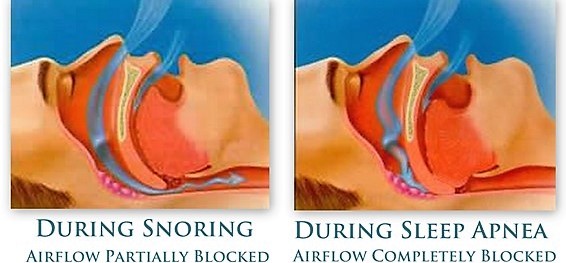
You feel that way because, when the soft tissue at the back of your throat closed off, which is typical for older people, you stopped breathing.  When that happened, your body woke you in order to start the breathing again.  It’s a reflexive, defense mechanism, triggered by your brain.  Without the oxygen your body needs, you could die.

Not the sort of thing I wanted to hear.

Anyway, after a few trial-and-error sessions over a period of weeks on a CPAP (continuous positive airway pressure) machine, my problems seemed to have resolved.  The pressure kept the soft tissue in my throat open while I slept, allowing for a freer flow of air, and the incidence of breathing-stoppage was reduced to less than once per hour—perfectly normal, I’m told.

I’m also told (by my wife) that I reminded her of Darth Vader when I was asleep.

She wasn’t unhappy about that, though, because I didn’t snore while using the machine.  Peace and quiet evidently reigned as I lay dreaming in the bosom of REM (rapid eye movement) sleep.

rem-sleep-word-cloud-concept-260nw-491667529

The very first night I wore the mask, I lasted almost seven hours, removing it around 5:30 in the morning.  My wife reported later that, within ten minutes of doing so, I had begun to snore steadily, after having been quiet all night.  Subsequent nights showed the same pattern.

Both of us agree that dreaming is eminently preferable to snoring!  Numerous studies have shown that people who sleep poorly do not dream, so I am delighted that I now do—as many as three or four different dreams every night.

Excellent fodder for my writing pursuits, I tell myself.

In any case, please be assured that I was always an excellent father to my daughters, I continue to be a very good driver, and I have never passed wind in a crowded elevator.  Honest!

I was, however, an active snorer, a fact to which I now confess.  And, because of that, I am a nightly CPAP user, probably forever—or whatever fraction of forever is left to me.

cpap

Oh, the shame of it?  Maybe a little.

But, ah, the serenity of a good night’s sleep!


Gone Camping

My two intrepid daughters, along with their four daughters, have gone camping.  It’s not their first venture into the wilds of Ontario—safely within the boundaries of one of our beautiful provincial parks, of course—but every time they do it, I’m taken back to my own long-ago camping adventures with my girls.

camping3

The first long weekend of the year would arrive at the end of May, and with it our annual rites of spring, traditions that heralded the soon-to-be-arriving summer holiday season.

On my way home from the city on Friday evening, I would notice the heavy volume of traffic on the highway, as several thousand commuters made their way north to cottage-country.  When I’d drive into town on Saturday morning, I’d see throngs of customers at the local nurseries and hardware stores, stocking up on garden tools and materials to aid in the spring planting.

I’d see friends and neighbours on my street—washing windows, trimming hedges, cleaning cars, and emptying garages of all manner of paraphernalia and junk.  In fact, I’d even manage to do a few of those chores myself!

gardening

But my major task of that first long weekend every year was to open up our camper-trailer—a pop-up hardtop with canvas-covered wings that slid out from each end.  We had picked it up from its previous owner on the weekend before Labour Day one year (right after our final camping-trip-in-a-tent ended in a downpour that washed us away).

We had spent the next week cleaning it out and learning how to pack it most efficiently for its first outing on the final long weekend of the year.  As luck would have it, however, the weather was extremely cold and wet for Labour Day that year, and we never did get away.  So, in early October, I backed the trailer up between the garage and the fence, and locked it for the winter.  And there it sat until the blooming of May.

Mind you, I wasn’t all that keen to open it up again, so early in the spring.  I’d have been quite content to wait for some pleasantly-warm day in July.  I was outvoted, though, by my two daughters, who desperately wanted to get inside it, to explore all the gadgets, perhaps even to have a sleep-out.

sleeping

“A sleep-out at this time of year?” I exclaimed.  “No way!  It gets too cool at night.  Camping is for the summer holidays when it’s warmer.”

“You and Mummy used to go camping on the twenty-fourth of May,” my eldest responded.

“Yeah, you told us about it,” piped in the youngest.  “You said it was a lot of fun.  And all you had was a tent!”

“Yeah, and one sleeping bag!” the eldest added for good measure.

I had to admit, they were right.  It had been fun in that one sleeping bag.

Anyway, despite some futile, token resistance on my part, they got their way.  All that remained was for me to ready the trailer for its first occupancy.  Alas, that proved to be no mean task.

I had parked it tight to the fence so no intruder could jimmy the lock on the door to get inside over the winter.  I had also jacked it up on four lifts.  When I lowered it to the ground again, I discovered both tires had gone soft.  Consequently, I spent about twenty minutes with a hand-pump, inflating the tires to their proper pressure.

Ten minutes later, just after I moved it into the driveway, I found one of the tires had gone soft again.  So, I spent another half-hour removing it and installing the spare.  Of course, it was soft, too, and had to be inflated by what was now an extremely-exasperated father.

When, finally, we were ready to open the door, I couldn’t find the key.  After I wasted a good few minutes rushing to and fro, fussing and fretting—a period punctuated by vile imprecations—my wife remembered I had left it in the glove compartment of the car.  Upon retrieving it, I happily inserted it into the lock (which seemed to have grown somewhat stiff since the fall), and broke it off when I tried to turn it.

At that point, as I recall, the girls diplomatically withdrew into the house while I tried to rearrange the fundamental structure of the trailer by kicking it!

Eventually, of course, I did get it opened up.  And the girls gleefully set up their beds inside, despite my feeble claims that they’d be cold.

camper

“I guess it was worth all the fuss,” I muttered sleepily to my wife, as we lay in bed that night, my bruised toes throbbing.  “At least the girls are happy.  They were determined to have that sleep-out.”

But, as you might have guessed, somewhere around three o’clock in the morning, two very cold little urchins crept into our bed and snuggled up real close.

I expect they’ll be doing that very thing with their own daughters this week, snug in their tents under a starry, summer night.

I, needless to say, shall be at home in my bed!

Perhaps We Need to Think More About That

Perhaps we need to think about this.  And a lot harder than we seem to be thinking at present.

innovation

Do you know what the items in the following list are, and what they have in common: Macrostylis villosa, Galapagos Amaranth, Courtallum Wenlandia, Viola cryana, and Fitchia mangarevensis?

All of them are species of plants that once upon a time thrived in, respectively, Africa, the Americas, Asia, Europe, and Oceania.  Before the dawn of the twenty-first century, all of them had become extinct.

How about the items in this list:  Acipenser naccarii, Coregonus johannae, Cyprinodon arcuatus, Gila crassicauda, and Platytropius siamensis?

These are species of sturgeon, salmon, carp, smelt, and catfish that, likewise, have disappeared from the face of the earth.  It is beyond obvious to say that we shall never see them again.

Here’s an easier list:  Pachycephalosaurus, Dreadnoughtus schrani, velociraptors, Ankylosaurus, and therizinosaurs.  Do you know what these species have in common?

dinos

As you might have guessed, all are dinosaur species that became extinct more than 66 million years ago.

Try this one:  Dromaius minor, Camptorhynchus labradorius, Pinguinus impennis. Sceloglaux albifacies, and Ectopistes migratorius.

These are bird species that have ceased to exist—in order, the King Island emu, the Labrador duck, the Great auk, the Laughing owl, and the iconic passenger pigeon.

And now, perhaps the easiest list of all:  Balaenoptera musculus, Panthera tigris tigris, Elephas maximus sumatranus, Gorilla beringei graueri, and Diceros bicornis.

These are critically endangered animal species, on the cusp of extinction—the Blue Whale, the Bengal Tiger, the Sumatran Elephant, the Eastern Lowland Gorilla, and the Black Rhino.

rhino

Science estimates that approximately 99.9% of all the species of life that have inhabited this planet of ours since its formation are extinct.  In fact, Charles Darwin theorized that evolution and extinction are not mutually exclusive.

Or, as Annie Dillard put it, more poetically, in Pilgrim at Tinker Creek—

                         Evolution loves death more than it loves you or me.  This is easy to write,  easy to read, and hard to believe.

Still, if we can believe our planet has hosted some sort of life for more than 3.5 billion years, it’s staggering to think that less than one-tenth of one percent of all those lifeforms survive today.

Here’s a final list to ponder:  Homo habilis, Homo ergaster, Homo erectus, Homo heidelbergensis, Homo neanderthalensis, and Homo sapiens.

sapiens

These, of course, are all species of human life, the first of which, scientists believe, first appeared around 2.5 million years ago.

Those of us alive today are members of Homo sapiens sapiens, a sub-species of the last one in the list, which is thought to have sprung up almost half-a-million years ago—not too long when compared to the 3,500 million years life has existed on earth.

But here is the critical implication arising from that final list:  of the six species listed, the first five have vanished.  We are the only ones not yet extinct.

Not.  Yet.  Extinct.

Perhaps we need to think more about that.

Don’t Tell Me!

It was only a minor argument between a father and his daughter, one quickly forgotten after the heat of the moment.  But for me, a bemused bystander, it featured one of the funniest rebuttals to an angry demand I’d ever heard.

“Don’t tell me what to think!” one of them declared vehemently after being told what to think.

father-scolds-his-scared-teenage-daughter-vector-18571097

The other, perhaps unable to come up with a suitable riposte right on the spot, retorted, “Don’t tell me, ‘Don’t tell me’!”

I laughed out loud, even as I wondered if there might be a third repetition, and maybe a fourth.  How long might they have gone on telling each other not to tell each other not to tell each other not to tell each other…?

But they didn’t.  And they laugh about it now, too.

I am reminded of the incident every time I survey the pessimistic contents of the various news media to which I subscribe.  Almost every story of national or international import seems to be a variation on that angry theme.  Leaders of the world—the free world, the enslaved world, the first world, the third world, the western world, the eastern world, the wealthy world, the impoverished world (all apparently oblivious to the stark reality that there is truly only one world on which we all must coexist)—shout back and forth across the social media platforms:  Don’t tell me!

And the reply each inevitably receives from the other seems eerily akin to what I heard so many years ago:  Don’t tell me, ‘Don’t tell me’!

Political insults cast on friend or foe alike are answered with retaliatory insults.  Harsh economic sanctions are met with retaliatory sanctions.  Tariffs engender retaliatory tariffs.  Expulsions of a nation’s diplomats are answered with retaliatory expulsions.  Embassy closings are countered by retaliatory embassy closings.  Bombings are met with retaliatory bombings.  Missile attacks are countered with retaliatory missile attacks.

Think of the retaliation if there is ever a full-out, nuclear, pre-emptive strike.

atom bomb3

It’s reminiscent of the excuse I used to hear from children on the playground so many years ago:  It’s not my fault, sir.  The fight started when he hit me back!

Having been the victim of an unprovoked, life-threatening attack myself—years ago, and too complicated to delve into here—I well understand how difficult it can be to turn the other cheek in the face of aggression.  Trying to understand another’s motivation in such circumstances, and perhaps to forgive, is nigh impossible.  I get that.

But, on a global scale, the consequences of not doing so are potentially catastrophic.  During the unlamented Cold War years almost half a century ago—where two nuclear superpowers, the USA and the USSR, faced each other down—the doctrine that prevented an accidental armageddon was the notion of mutually-assured destruction:  You might kill me, but you’ll die doing it!

I always thought the acronym for that misguided doctrine, MAD, seemed a perversely-perfect name.  And history tells us that humankind came terrifyingly close on too many occasions to perishing in its calamitous effects.

Wouldn’t a better approach, I wonder, be MAP—mutually-assured partnerships?  Would it not be better for the nations of the world to listen to one another’s concerns and aspirations, rather than turning a deaf ear?

As I’ve written in this space before, all of humankind—regardless of the power some wield, their wealth, political stripe, skin colour, religion, gender-identity, or ethnicity—all reside on one fragile planet.

coexist.jpg

Is it too hard for us, organized as we are into nation-states, to accept that none of us owns any of this world?  That we are merely borrowing it for our use during our blink-of-an-eye lifetimes?  That, if it belongs to anyone, it is to the future generations we hope will follow us?

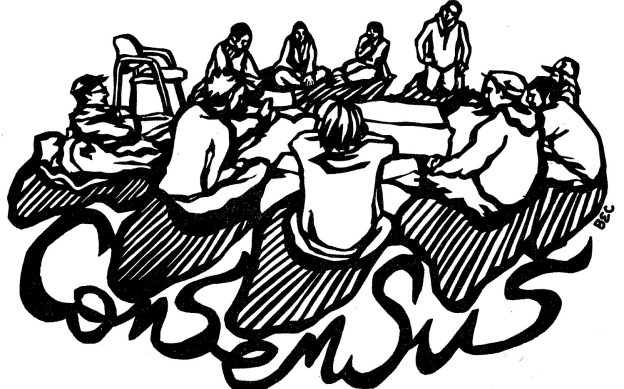
I long, perhaps vainly, for a day where the world’s leaders will open themselves up to each other.  “Tell me,” they could say, inviting the other side to respond, determined to listen.

“Now, let me tell you,” they could then reply, looking for a sharing of viewpoints, rather than a clash.

“Tell me more,” the other side might next say, encouraged by the openness.

15consensus_download1500

Wouldn’t we all be better off if that could ever happen?

Despite the pessimistic news reports of today that dampen my hopes and cause a weary shaking of my head, I force myself to remain optimistic that humankind might yet reach that stage.

“Don’t tell me we can’t all sit down together!” I protest.  “Don’t tell me it’s too late!  Don’t tell me we are doomed by our own stupidity!”

Don’t tell me!

Christening the Boat

As we approach the mid-point of summer, another boating season is in full swing.  My wife and I know several boaters, both power-enthusiasts and sailors, and have long enjoyed many happy hours on the water with them.  Just recently, we spent four days cruising the waters of Lake Memphremagog, a lovely haven in Quebec, with six good friends.

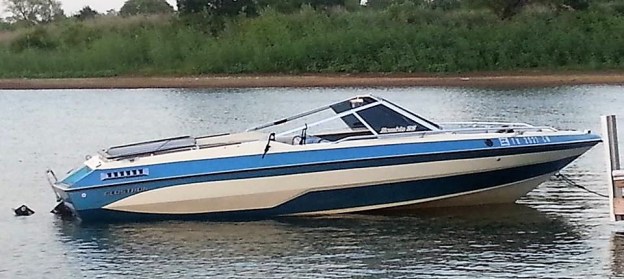
For some period of time we lived on a lake ourselves, and had our own boat, a twenty-foot inboard/outboard that seemed the epitome of Muskoka chic when we were out and about in it.

image_182716

A sleek, blue-and-white fibreglass craft, a bow-rider, it took us on languid cruises in the early evening, and we’d wave casually at neighbours as we passed their docks.  It pulled us across the water on sunny afternoons, slicing and skimming the waves on water skis, at least until we fell.  It even served as a gentle cradle for young grandchildren when tethered to the dock, gently rising and falling in the lapping water.

We had that boat for almost fifteen years.  But never, not in all that time, did we christen it with a name.  As I think about that now, I’m baffled.

You see, the names people give their boats have always intrigued me.  In fact, over the years, whether boating with friends, visiting tropical marinas, or sauntering through boat-shows, I’ve enjoyed a fascination with the names that grace the hulls.  My favourites are those that employ clever plays on words, those with double-meanings, or those that hint at their owners’ occupations.

I’ve seen scores of them over the years, even jotted down some of the more memorable creations.  Ecsta-Sea is one I recall, and IntimaSea, bespeaking a hankering for bliss and solitude on the open water.  Anchors Away, I suppose, implied a desire to be ever on the move.  And there was Log-a-Rhythm, which I thought might belong to a retired math professor who loved the roll and sway of the bounding main.

I saw Squanderlust on a double-masted craft, all shiny teak and gleaming brass, and I thus supposed it cost someone a small fortune.  Miss Behavin’ struck me as a clever name—although everyone aboard seemed to be comporting themselves quite properly, at least while I was watching.  The guy who owned Tokin’ Reward, I was pretty sure, had profited from the illicit drug trade.

One imposing cruiser, with a middle-aged woman at the wheel, bore the name Alimoney, and I silently congratulated her.  Can’t Get Enough, embossed in graceful script across the stern of a large yacht, referred, I assumed, to the owners’ love of sailing.  And I was pretty sure a retired lawyer or judge owned the Legal-Ease.

I liked Slalome, too, conjuring as it did the image of a graceful, veiled dancer atop a single water ski, sending sparkling rooster-tails soaring into the bright sky overhead.  But the owners of Three Sheets to the Wind, I thought, must have altogether too much time for drinking.   Another of my favourites adorned the rear of a garish craft, which either had more than one head aboard, or belonged to a retired con man: Four-Flusher.

There was the Good Ferry, perhaps implying a generous benefactor’s involvement.  Summer Lucky might have spoken to the owners’ belief that some others are not.  And In Limbo could have implied either an irresolute skipper or a love of Caribbean dancing.

Most boaters and sailors, at least in my experience, use feminine pronouns when they speak of their crafts—as in, She’s got a lovely way about her!  I, on the other hand, invariably referred to my boat with the impersonal pronoun—It needs more gas if we’re going to take it out.  Whenever I consciously tried to emulate those real boaters, I felt slightly ridiculous personifying an inanimate object.  It was a boat, not a friend!

Anyway, it’s gone now, that boat, sold along with our home on the lake several years ago.  But if I were to own it still, and if I were to affix a name to it—in keeping with my fascination with boat names—what, I wonder, might I come up with?

Would it be something clever, such as Buoy-O-Buoy, to convey my joy at being at the wheel?  Would Over-Bored be too cynical, implying that I have nothing better to do than race around the lake, burning fuel?  Would PenmanShip be appropriate, given my penchant for writing, or is ship too grandiose a word for a bow-rider?

Perhaps I’d choose something to reflect my rudimentary skills and ignorance of things nautical; Worst Mate could work.  A remote possibility, if my wife would join me on watery excursions, is Miz ‘n’ Masta, except I don’t know what a mizzenmast is.  And I’d hardly be the master!  Maybe, as a retired educator, I might go with School’s Out.

Of course, one’s financial health severely limits one’s boating pursuits, so the notion that I’ll ever again own a boat is far-fetched.  With the rising price of fuel, the soaring costs of docking, storage, and insurance, and the depreciation that swiftly erodes the purchase value, the whole issue is moot.

Pontoon-Boats-r5-Bennington-1920x1080

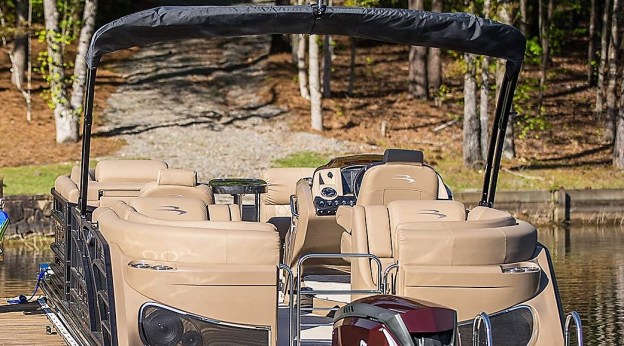
But I did notice that our Quebec friends have not named their boat, either—a large pontoon-boat by Bennington.  It transported eight of us with no strain as we cruised the sparkling waters, its 50 HP Yamaha outboard motor a mere whisper in the summer breezes.  We noshed, drank, and conversed amiably for hours out there, comfortable in the plush leather seats, shaded by the Bimini top.

And so, the question gnaws at my mind—what would I call their boat if I were asked to christen it?  A cynical choice might be Hole in the Water, as in something to pour money into; I do remember that aspect of boat-ownership all too well.  Daddy MoreBucks might be appropriate, too (although I was far too polite to enquire about the financial aspects of our hosts’ lives).

On a cheerier note—because it’s a deck-boat—All Hands on Deck, or perhaps Decked Out, could work.  Or maybe All Agog on Magog, to reflect the enchanting locale.  I might also consider Yamahappy (although only if they keep the Yamaha motor), Boat of Us to reflect their togetherness, Didjabringwine (no explanation needed), or Throttled Back to echo their lifestyle.

Mind you, they haven’t even hinted that I should suggest a moniker, so my ruminating on the matter is likely in vain.  It is their boat, after all.  Still, it does seem a shame not to have a grand name for such a luxurious craft.

So, what would I do if it were mine to own and mine to name?  Unfortunately— despite my love of boating on the open water—my pecuniary circumstances would be likely to influence the selection.  I think I might have to settle on For Sale.

boat sale

And then I’d hope my friends would be the highest bidder.

On the State of My Parents’ Marriage

As the 107th anniversary of my father’s birth approaches, I’ve been reflecting on the state of his marriage to my mother.  Their union was ended after sixty-one years when he passed away in 2003.  They had been temporarily separated several times during their life together, mostly during business trips my dad undertook, but never for more than a few days.  His last trip, at age ninety-two, is the only one from which he never returned.

My mother lived another seven years, until ninety-four, the longest period of her life without him since they married in 1942.

As I look back, they seem to me to have been an unlikely couple.  He was the only boy in his almost-Victorian family, coddled (if not spoiled) by his parents and sisters.  He wasn’t arrogant by any means, but he possessed a certain sense of entitlement, a sense that he was born to live at the centre of his universe.  Understandable, I guess, given that he lived at home until he married, looked after by doting parents.

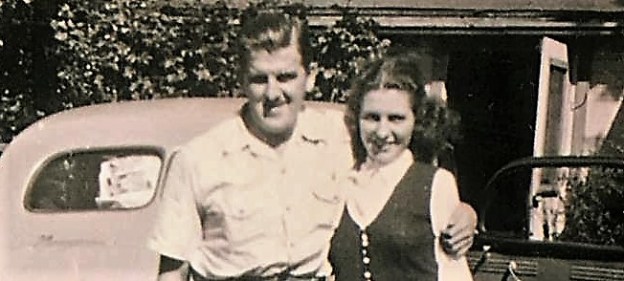
Billy-Boo at 32 2

My mother, who had three sisters and a brother, was raised by a Presbyterian mother and a Roman Catholic father—themselves an unlikely match—who taught her you had to earn what you wanted.  Nobody was about to give you anything for nothing.  Taking the lesson to heart, she became determined to succeed at whatever she did.  My mother had the strongest will of anyone I’ve ever known.

unnamed3

I’m still not sure how two such different people—she a high-powered woman, he a less highly-driven man—could find each other, wed each other, and remain with each other for so many years.

During their marriage, she left him on very few occasions, mostly on excursions with family or friends, and never for long.  She was fearful, I suppose, of leaving him alone to cope with five children.  After all, we could eat only so much oatmeal porridge, grilled-cheese sandwiches, canned spaghetti, and jello.

12509160_10153395824301705_5125226544804302947_n

Not that my father couldn’t cook; he could.  He could also house-clean, do the laundry and ironing, shop for groceries, help with homework, perform small repairs around the house, or do any other chore necessary to sustain a family of seven.  But he preferred not to—not if someone else would.  I was a grown man before I realized he had mastered the art of feigned incompetence.

Mind you, that might have been a reflexive defence-mechanism.  My mother didn’t make it easy for him, being something of a perfectionist.  Although she believed in the adage that it was better to teach people to fish, rather than giving them a fish—trusting they would therefore become self-sufficient and proficient—she also had the annoying habit of checking everything my father did after he did it, to ensure it was done to her exacting standard.  I think he figured it was better most of the time to let her do the various tasks herself, rather than suffering through her re-doing of his attempts.

They were loving parents, although their parenting style evolved over the years between my birth and that of my youngest sister, eleven years later.  My mother never lost her sense of high hopes for all of us, but she became more tolerant, more forgiving of our shortcomings as we, and she, grew older.  It wasn’t easy for her, though, because her expectations of herself never lessened.  I loved her for that.

My father, on the other hand, entered parenthood with a blissful belief that everything would work out fine.  And I think, despite the contrary evidence we five children provided from time to time, he maintained that belief throughout his life.  Of course, he became exasperated on occasion—on dozens, even scores, of occasions, actually.  To this day, I can hear his favourite expression of frustration when I had somehow messed up again.

Crooked cats!” he’d say, shaking his head dolefully.  But he was ever quick to forgive.  I loved him for that.

He usually called my mother Dorothy—never Dote, as her sisters did, and never Dot.  His favourite pet-name for her was just that, Pet.  She called him Bill; if she ever used another form of address, I can’t recall it.  I never heard endearments for each other, such as Sweetheart, Darling, or Honey, from either of them.  Yet I never doubted their love for one another.

Perhaps it was their sense of humour that sustained them through difficult times and enriched the many joyful times.  I remember overhearing my mother’s admonition to my father, whispered from a hospital bed where she was recuperating from a near-fatal heart attack at age eighty-five.

“I guess this means no more wild sex for awhile,” she teased.

Crooked cats, Dorothy!” was all my ninety-year-old father could say, shocked that she would say such a thing in front of me.

Even at the end of his life it was there, that shared, loving camaraderie.  As my father lay moments from death, my mother leaned close to him and said, “Would you like me to sing to you?”

Without opening his eyes—which would have been twinkling if he had—he muttered, “Not particularly!”

It was their final secret joke.

unnamed2

So that’s how I remember them and their life with one another.  And I choose to believe they’re together again, forever, their separation ended.

That’s just how it was with the state of their marriage.

Sex Ed for Kids

HEADLINE:  Ontario government announces return to 1998

sex education curriculum in schools.

*  *  *  *  *  *  *

I’m a thirteen-year-old girl, just finishing grade eight.  I like to send pictures of myself to friends, sometimes without clothes on.  My friends say they like them.  But now I think I’m in trouble.

sexting

I’m a fifteen-year-old boy in grade ten.  At night in my room, I look at porn sites I find online.  Sometimes, I pretend I’m one of the guys fooling around with those girls and I do what they’re doing.  Nobody knows and it feels great.

FACT:  The 1998 sex education curriculum is notably silent on such topics as sexting, masturbation, and online pornography.

I’m a thirteen-year-old girl and I have a boyfriend who wants to make out with me.  He says if I don’t wheel with him, he’ll find somebody else, so that’s what we do.  It would suck to be alone.

I’m a fifteen-year-old boy and I wish I was dead.  Everybody hates me.  They call me names and say awful things about me online.

cyberbullying

FACT:  The current sex education curriculum, which is being scrapped, begins to discuss strategies to deal with peer pressure and bullying as early as grade two.

I’m a thirteen-year-old girl and I nearly freaked when I started bleeding down there the first time.  I thought I was dying.  One of my friends told me get used to it, it’s going to be there for the rest of my life.  I can’t believe it!

embarrass

I’m a fifteen-year-old boy with pimples all over my face, and people tell me I stink all the time.  And I don’t have any hair on my legs like my friends do.

FACT:  The 1998 sex education curriculum is notably silent on such topics as menstruation, the physical changes associated with puberty, and the reproductive system.

I’m a thirteen-year-old girl with a friend whose parents let her drink at home.  When they’re not there, we raid their booze and have a party.  My friend adds water to the bottles so nobody knows.

I’m a fifteen-year-old boy and I can’t wait for the weekend when me and my friends get high.  We know a guy who gets weed for us easy-peasy.

toking

FACT:  The current sex education curriculum, which is being scrapped, begins to deal with substance abuse and healthy living as early as grade one.

I’m a thirteen-year-old girl and I don’t like boys.  Some of my girlfriends feel the same way, so kids call us lesbos or dykes.  What’s that about?

friends1

I’m a fifteen-year-old boy and I can’t stand queers.  Me and my friends laugh at them, call them names, post pictures of them online.  It’s hilarious.

FACT:  The 1998 sex education curriculum is notably silent on such topics as gender identity, sexual orientation, stereotypes and assumptions, and understanding of self.

I’m a thirteen-year-old girl and I think I’m in big trouble.  I can’t tell my boyfriend, and for sure not my parents, but I think I have an infection or something in my privates.

I’m a fifteen-year-old boy and all the guys are making fun of me ‘cause I haven’t done it yet with a girl.

shy

FACT:  The current sex education curriculum, which is being scrapped, begins to discuss sexual health, sexually-transmitted infections, pregnancy prevention, and delaying sexual activity in grade seven.

*  *  *  *  *  *  *

The 1998 sex education curriculum was developed twenty years ago for a previous generation of students.  It is so outdated that, in all its verbiage, there is but one single mention of the internet.  Its defenders appear to believe that all the information young people will need to grow into well-adjusted, healthy, well-informed adults will be imparted to them by their parents.

birds_and_bees_video

If only every child had parents informed enough and willing to doing so.

The current sex education curriculum, which is being scrapped, may not be perfect, but it is far and away superior to what we had before.  But don’t take my word for it; you can examine an overview of it at this safe link—

https://www.ontario.ca/page/sex-education-ontario#section-2

*  *  *  *  *  *  *

Although well beyond the age of having children of my own in our public school system, I am alarmed by what our recently-elected government in Ontario is doing to future generations with this misguided step into the past.

sex ed3

I always thought it was the truth that would make us free.