A Cottage Christmas

Since retiring, my wife and I spend every Christmas at our Florida home.  Usually, one or both of our daughters will come down, with husbands and children in tow, to spend the holiday with us.

Friends often ask us if we miss Christmas in the snowy north.  I offer a vigorous, “No!”, and when they ask why, I tell them the story of our ill-fated Christmas at the cottage.

Our daughters were eleven and ten that year, when friends, who had decided to spend their traditional twelve days on a sunny, southern beach, invited us to use their cottage for our celebration—preparing for Santa’s arrival, skiing and skating in a winter wonderland, and just relaxing.  We jumped at the chance, little realizing what lay in store for us.
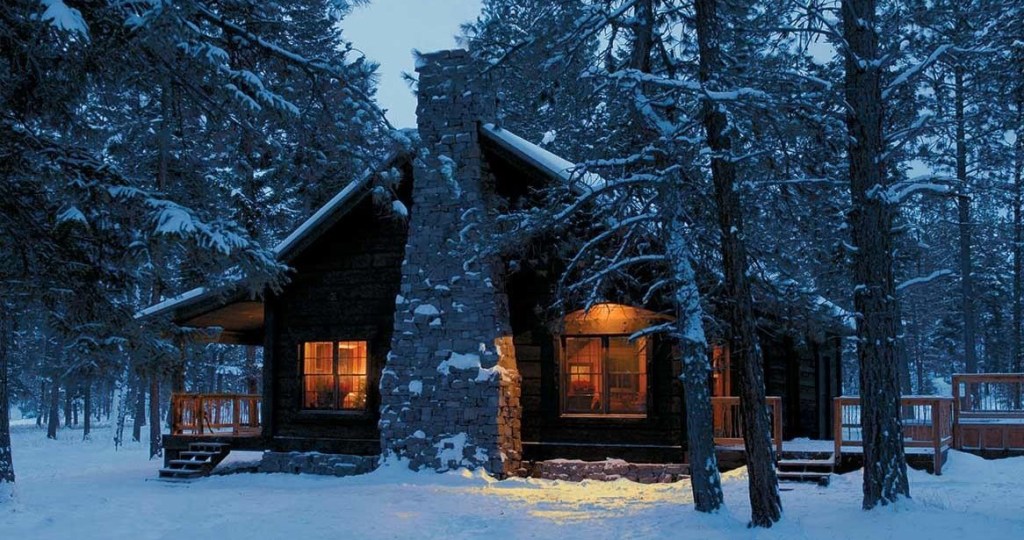
I should have known all would not be idyllic when our friends gave us five pages of notes, detailing what we’d have to do when we arrived at the retreat in the woods.  There were instructions for opening and closing the place, turning on the water system when we arrived, draining it when we left, using the fireplace, enjoying the snowmobile, shoveling snow off the roof, removing the occupied mousetraps—in short, a whole lot of things that could go wrong.

They left us their car to use, much larger than our own, a fully-equipped but much-travelled station wagon that had been around the track more than a few times.  On the day of our departure, I discovered that the rear tailgate, the sort that was supposed to open two ways, down like a truck tailgate or out like a car door, wouldn’t open at all.  Consequently, I had to load all our gear, including skis and poles, through the rear window, which could still be powered down.  As each armload went in, I had to clamber over the rear seat to pull the stuff forward.  I was delighted, as you might imagine, with the challenge.

We took to the road, full of anticipation for our family Christmas at the cottage, on the very day that the first freezing rainstorm of the season hit the area.  That cheered me immensely.

With the six of us aboard—I, my wife and two daughters, plus two dogs in the rear, trampling and drooling on all the packed items—the car windows steamed up almost immediately.  They remained that way for the duration of the four hours it took us to complete the two-hour drive.  Nobody spoke out loud during the final hour!

We arrived, finally, to be greeted by a winter wonderland.  The deep snow, now covered in a slippery mantle by the freezing rain, sparkled and glinted in the twilight.  As promised in our five pages of instructions, the driveway had been plowed just far enough off the township road to allow us to park the car.  The walk from there to the cottage was just what we had expected—arduous, but exhilarating.

The snowmobile was right where the notes said it would be.  But to my chagrin, it wouldn’t start!  In spite of my repeated (and somewhat profane) encouragement, it would not come to life.  Thus, we had to lug in all our gear by hand, twelve trips back and forth between the cottage and the car, dragging the heavy items behind us in a large snow-scoop, toboggan style.

Oh, what fun we had!

Once inside, with everyone unpacking and sorting our supplies, I turned my attention to turning on the water.  The notes our friends had left me were very detailed on this particular chore.  The pumphouse in the basement was a tangle of pipes and faucets—my friend does his own plumbing—all tagged and colour-coded to ensure compliance with the proper way of operating the system.  Without my notes, I’d have been totally lost; with them, I was merely overwhelmed.  Nevertheless, I followed the steps as written, praying fervently all would go as planned.  And it did….at least at first.

Some twenty minutes after our initial rejoicing over running water, the dishwasher sprang a raging leak from somewhere underneath.  I was able to turn off its feeder-faucet before too much damage was done, and I even managed to find the source of the problem—a burst pipe.  Because I was unable to fix the leak, the dishwasher remained inoperable for the duration of our stay.

Eventually, everything was done.  The food was safely stored away, our bags were in the proper bedrooms, the deck and walkway were shovelled clear of snow, and the Christmas tree that had journeyed north on the roof of the car was standing, fully decorated, in the living room.  At last, we began to enjoy our Christmas holiday. 

Of course, we couldn’t ski because the rain that accompanied us north continued to fall, washing most of the snow away in one day.  Nor could we go skating on the lake, because the milder temperatures that came with the rain turned the ice to slush.

If it hadn’t been for the decorations strung around the interior of the cottage, and the sound of the old, familiar carols, we wouldn’t have known we were enjoying a Christmas interlude.  With all the mud, it was like a spring holiday—until the last day, that is.  Then, about five hours before we’d planned to pack the car for home, the snows returned with a vengeance.

So again, thanks to the immobile snowmobile, we had to trudge through knee-deep, new-fallen snow, from cottage to car, packing up everything we had to take home.  I cursed every step!

I could hardly wait until the next time our friends offered us the use of their cottage when they weren’t going to be there.  I planned to torch the place.

Powerless

On a warm August afternoon in 2003, as we lazed on the dock at our home on the lake in cottage-country, basking in the sun, chatting amiably, the electric power grid shut down.  Boom!  Just that quickly.

cottage2

We didn’t know, of course, not right away.  Not until one of us headed up to the house to replenish our drinks and shouted the news back down to the rest.  And even then, none of us worried much about it.

Power outages were a fact of life in our rural setting.  Living in the north was a glorious experience, one we enjoyed for fifteen years, but the infrastructure was not nearly so sophisticated as in large, urban areas.

Telephone service was usually reliable, the operative word being usually.  But everything else in the house depended upon electricity—heating, all appliances, lights, the internet (rudimentary as it was back then), and most importantly, running water, which flowed through an elaborate purification system in our basement, powered by a pump submerged in the lake.

On the many occasions we had lost power in the past, it never lasted long.  Thinking back on it now, I realize how naïve we were, how foolish not to have a generator on stand-by.  But we didn’t.  The need had never arisen.

As this latest outage dragged into the early evening hours, we decided to ‘rough it’, which meant cooking everything but the meat (which we always did on the barbecue) on an old propane camping-stove I hauled down from its shelf in the garage.  Afterwards, we stowed the dirty dishes in the dishwasher for cleaning, fully expecting the power to come back on momentarily.

The-Best-Propane-Camping-Stoves-of-2019-Ranked

Before dusk gave way to the almost-total blackness of night, when the forest seemed to creep closer around us and the stars winked on by the thousands in the sky overhead, I lit our two propane lanterns, complaining, I’m sure, about how long the outage had lasted.

And then we went to bed.

By morning, the power was still not up and running.  I trundled large pails of water from the lake to the house, placing one in each bathroom to refill toilet tanks after flushing.  We resurrected the old cottage credo, When it’s yellow, let it mellow; when it’s brown, flush it down.

Another large pail went to the kitchen for boiling in a pot on the camping-stove.  We opened the refrigerator as little as possible, the freezer not at all.  And we washed our dishes in the sink.

Both our daughters were home from school for the summer, working at a resort restaurant some distance from the house.  The phone was working, and they found out after calling that the place was also affected, and would stay closed until power was restored.

Absent electricity, we had no way, short of phoning neighbours and family in the city, to ascertain what was happening.  The news we got from them described a huge power blackout encompassing much of the eastern seaboard, both in Canada and the U.S.

blackout2

Resigned to that, we enjoyed another lovely summer day, boating, swimming, sunbathing, all the time expecting the power back at any moment.  Around mid-afternoon, we began to plan for another camp-style dinner, just in case.  I had begun to feel like the pioneers, I think, hardy souls who could manage off-the-grid.  I remember remarking to my wife that we could probably survive like this indefinitely, thanks to a ready, natural food supply.

She had long been cultivating a large truck-garden behind the house, full of asparagus, lettuce, peas, beans, radishes, beets, tomatoes, and a variety of herbs.  Poppies had been strategically planted, too, to keep the deer from harvesting the crop before we could.  Eating that fresh produce was a season-long delight, and one which we now gave renewed thanks for.

The lake was stocked with fish, as well, and we had enjoyed many a fine feast of bass and pickerel over the years.

Nevertheless, my wife was not enamoured of my clueless remark.

On the following morning, day 3, we were still powerless.  Our early-morning swims were taken with soap, something we normally did not do for fear of fouling the water, but which was proving necessary, given the lack of hot water for baths and showers.  That was especially important for the girls, who were called into work that day when the power came back on in the sector where the restaurant was located.  We rejoiced at the news, fully anticipating the same thing for our neighbourhood.  Alas, it was not to be.

Following their shift, the girls drove home in the dark to find us huddled around the propane lanterns in the living-room—sunk in a funk, to be honest, in contrast to our usual sunny, optimistic natures.  The initial excitement of roughing it had given way to resentment at our plight, still engulfed in blackness when everyone around us (we had begun to imagine) had been restored to the light.

Day 4, another wondrous late-summer morning, brought more of the same.  By now, we had emptied the freezer, either cooking the items before they thawed and spoiled, or throwing out those we could not get to.  The girls had brought bags of ice home after work, and we had packed perishable goods from the refrigerator into two large coolers.  We were still wonderfully self-sufficient and in control, or so I tried to assure myself.

cooler

Except, we no longer cared about that!  The bloom was long off the rose by then, and all we wanted was our old lives back.  By mid-afternoon, when the girls were readying to leave for work, my wife and I decided enough was enough.  After a hasty phone call to book a room at the resort where the restaurant was located, we threw a few things in our overnight bags and jumped in the car with the girls.

I could tell you that we never went back, but that would be untrue.  In fact, we returned the next day after electricity was finally and fully restored in our area, and resumed our enjoyment of the summer.  Powerless no longer.

I’ve been thinking a lot lately about that experience back in 2003, as I sit now in our condo home in the city, older and wiser (I hope), confined by the pandemic sweeping the globe.  And as much as I like to think we can survive this indefinitely, I know from experience that just isn’t so.

We are so dependent upon so many others to maintain the supply-chains for our food and medications, our communications, our hospitals and other essential services.  And every one of those is reliant upon that one indispensable need: electricity.

power

I pray we will not become powerless again.

The Reach of a Father’s Love

Friends of ours lost their only child several years ago, the victim of a relentless disease.  He left behind a grieving wife, two young children, and a sparkling future.

In the years since, our friends have doted on their grandchildren, taking great delight in watching them grow from infants to toddlers, and onward to adolescence.  They’ve invested time with them, knowing they can never make up for the loss of a father, but determined to keep his memory alive.

A while after their son’s death, I wrote a piece to commemorate his life and the legacy he left behind.  I post it here now, adapted somewhat, to mark the advent of another Fathers’ Day

The little boy is eight-years-old, and loves to visit his grandparents at the family cottage.  For him, every day is an adventure, a surprise, a delight, as he wanders the woods, swims in the lake, and fishes the waters in the old, wooden skiff.

For the older folks, these activities hearken to an earlier time with another fair-haired lad, and they treasure the memories, even as they create new ones.

A while back, the little boy was in the musty basement of the cottage with his grandpa, when he made a great discovery.  “Grampy, what’s this?” he cried, pointing to a bright-yellow model boat.

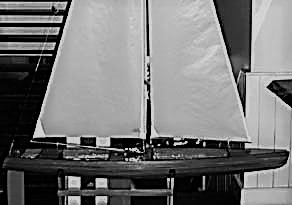
Sitting astride its pedestal on top of an old workbench, the craft was almost three feet long—a racing boat, bred for speed, its tall sails still unfurled.  Three small passengers huddled in the cockpit, as if awaiting the starting gun for an impending race.

sailboat5

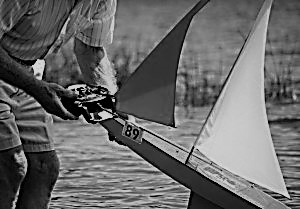
“Oh, that?” his grandpa replied.  “That’s a boat your daddy built a long time ago.  He used to race her on the lake with his remote control.”  He lifted a dusty metal box down from an overhead shelf.  Two toggle switches protruded from the top, and a long antenna jiggled slightly as he set it down.  “This is how you make the boat go where you want it to.”

“Can I make it go, Grampy?”

“Mmm, I don’t think so, l’il guy.  I don’t think she works anymore.”  Together they lifted the cowling off the boat, behind the drivers, and peered at the mysteries of the small motor inside.

“It smells funny,” the little boy said.

“That’s oil you smell,” his grandpa replied.  “Your daddy always made sure he kept her cleaned and oiled.  He really liked this boat.”

“What’s her name?”

“Your daddy called her The Yellow Flash.  Here’s her name on the back, just the way he painted it.”

“Can I make her go, Grampy?” the little boy asked again.

The old man shook his head.  “The batteries are probably dead,” he said, “and look at these wires.  They’re corroded at the junction plates.  The sails are pretty ratty, too.”

“Well, can we fix her?” the little boy said.

His grandpa stared at him for a few moments, a faraway look in his eye.  “Y’know,” he said finally, “maybe we can.  Shall we give it a try?”

sailboat

Over the next couple of weeks, the two of them dismantled the boat in order to clean every part, separating the batteries and wires that would need replacing.  They opened the remote box and cleaned it out as best they could, removed the sails for a gentle cleaning.  On his next trip to the city, the old man took the hull and box to a hobby-shop, where the owner walked him through the steps needed to restore the boat to operation.

On the little boy’s next visit to the cottage, they began the rebuilding process.  As they soldered new wires in place, the little boy was fascinated.  His grandpa let him set the new batteries in their proper slots, showing him how to ensure the contacts were touching.  He watched as the little boy lovingly polished the hull, restoring it to its original gleaming glory.

Together, they replaced the sails, and tested the remote box, working the toggles to control the boat’s tiny propeller and rudder while it still sat on its dry-dock pedestal.

“She works, Grampy!  She works!”

“I think she does, l’il guy.  Shall we put her in the water?”

And so they did.  Carrying her gingerly down the slope to the dock, they lowered her carefully into the lake.  From a silent vantage point on the rocks, I watched them—a grandfather and his son’s son, with his son’s boat, launching their labour of love.

“Which one is the driver?” the little boy asked, pointing to the three small figures in the cockpit.

“Well, this one is you,” his grandpa said, indicating the figure in the middle.  “You’re the skipper.”

“Okay,” said the little boy.  “Then this one on the right will be you, and this can be my daddy over here.”

The old man had to look away for a moment to collect himself.

“What if the waves tip her over?” the little boy asked, suddenly apprehensive.

“Well, it’s pretty calm right now, l’il guy.  I think she’ll be okay.”

“But what if she goes way out there and we can’t bring her back?”

“She’ll come back,” his grandpa said.  “She’ll come back.”

sailboat3

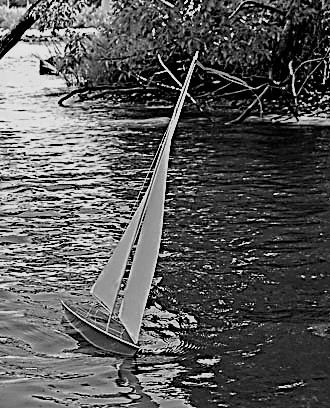
As they perched on the dock, legs dangling over the water, the old man gave the boat a push away from shore.  The little boy, the remote box between his knees, began to steer her—hesitantly at first, with fitful starts and stops, over-correcting erratically.  But in moments he was sure, and the boat skimmed atop the surface, speeding and curving gracefully, immediately responsive to his commands.

I watched the boat for awhile, then turned my attention to the old man and the boy.  Their faces were split with grins, happily alight, as they raced The Yellow Flash to and fro along the shoreline.

“Take a turn, Grampy,” the little boy yelled, handing the remote box to his grandpa.  And he squealed with delight when the old man almost capsized her, righting her just in time.

“Grampy?” the little boy said after a while.

“Mmm?” his grandpa replied, seeming lost in reverie.

“I love my daddy’s boat!”

“I love her, too,” the old man said, leaning in close to his grandson.  “And I love you, l’il guy, very much.”

I left them on the dock, locked in silent communion.  And it may only have been my imagination, but when I stole a glance back, I could swear I saw a third person there—ephemeral but real, lovingly watching them both.

At once apart from, yet a part of, the old man and the boy.

And I marveled at the reach of a father’s love.

father-son-and-grandfather-fishing