Past, Present, Future

In 1905, George Santayana famously wrote, Those who cannot remember the past are condemned to repeat it. The statement is from his five-volume book, The Life of Reason: The Phases of Human Progress.

In 1943, Eugene O’Neill wrote, There is no present or future—only the past happening over and over again—now. That declaration is from his stage play, A Moon For the Misbegotten.

In his 1950 novel, Requiem For A Nun, William Faulkner echoed the notion when he wrote, The past is never dead. It’s not even past.

Although I could never be confused with those three literary giants, I too wrote on the same theme, more poetically: What’s past is the past—so quickly it passed—But it’s not where I want to stay. Those are the last two lines in the third stanza of my seven-stanza poem entitled, I Haven’t the Time

https://ppens1blog.wordpress.com/2025/07/01/i-havent-the-time/

But I also wrote of the future in that same poem: When all has been said, I still look ahead /To life’s next opening curtain. The premises of the poem are that life marches resolutely forward, that I haven’t the time to concern myself with its past, that I eagerly embrace its future.

Nevertheless, I’ve often wondered if there even exists a past or a future. Perhaps, as James Joyce stated in a 1935 interview with Jacques Mercanton, There is not past, no future; everything flows in an eternal present.

It may be, perhaps, that my poetic curtain is opening, not on some ephemeral future, but only on more of the ever-morphing present. I’ve long appreciated the analogy that life’s progress is akin to riding a train from one’s point of embarkation to one’s final destination, with innumerable stops along the way. People get on, share the ride with me, and every now and then, some get off—perhaps because their journey has ended, perhaps to continue their journey on another train. Indeed, I change trains from time to time myself, although my journey still continues.
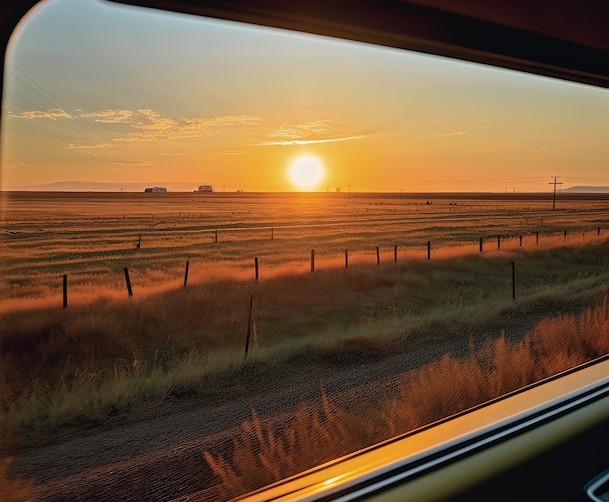
My train moves from whence to hence, but I, gazing through its windows at the passing parade, remain aboard in my encapsulated present. The views change constantly, but my surroundings on the train remain, for the most part, constant and familiar. Locales no sooner flash by the window into the past in one direction, than future ones appear from the other. Riding the train is like being everywhere at once while never leaving the same place—Joyce’s eternal present.

Despite these musings, however, I find myself reflecting on the past more often these days—because of my age, maybe, now that my tomorrows are vastly outnumbered by my yesterdays. Although memory is an increasingly unreliable tool, it’s still easier to remember what’s transpired than it is to predict what’s yet to come.

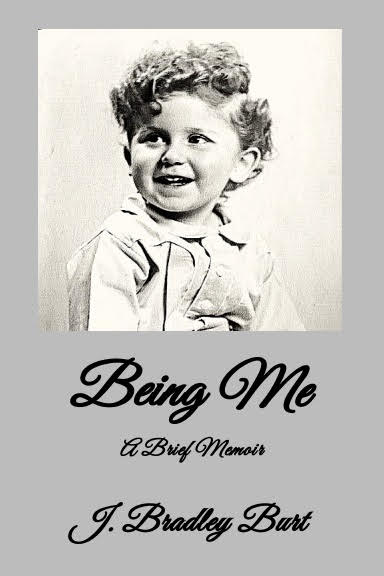
I recently published a short memoir for family and close friends, Being Me, and the exercise both surprised and cheered me. For instance, I re-affirmed that I have lived a blessed and privileged life to this point, surrounded by people who love me. And happily, I discovered I have almost no regrets about events from the past. The few I do have are less the consequence of my own actions and more the result of external forces acting on me, forces I could not control. With the exception of those, I realized there’s virtually nothing I would seek to change, had I the power to do so.
Writing the memoir took me back to places I’d been along the way, and I grasped anew how much I had enjoyed being there—my parents’ hearth, my own homes with my wife and daughters, our trips to foreign lands, my various career stops. I have no wish to return to any of them, to be sure, for I enjoy where I am right now too much. But I greatly appreciate that I had those experiences and opportunities—even if I see them now as only images flying past the windows of my train.

The future holds no fear for me. Curiosity? Anticipation? Of course! Those next opening curtains still claim my attention. I have no idea when my train will drop me at my final destination, but the present journey continues to be enjoyable and fulfilling. I have no clear understanding of what awaits when I shall disembark for the last time, although I do suspect the past, present, and future all will end at once. After all, Einstein held that the distinction between the past, present and future is only a stubbornly persistent illusion.

I imagine there to be an entirely different matrix awaiting after my consciousness has ceased, where time has no meaning, where eternity reigns…well, eternally. In the meantime, I hearken to this advice from St. Luke: …live for today, because yesterday is gone and tomorrow may never come.

My journey’s end will come, however, and I look to it in this fashion—

When that day is nigh, as ‘twill be by and by,
I hope it will be widely said,
That as man and boy, I strove for the joy
Of living until I was dead.
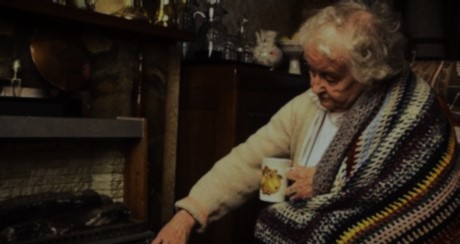

Love, Through Their Eyes

The weekly prompt from my Florida writers group was to write a piece about seeing things ‘through their eyes’, and this is my offering—

Two short poems, each exquisitely written, capture exactly—exactly—how I feel about this brief moment in time I know as my life, about the relationship I have with the love of my life, and about what will happen when I am gone.

The first, When You Are Old, by William Butler Yeats, the greatest of the Irish poets, portrays a woman through the eyes of her departed husband, as he speaks of his love for her, even beyond death, and where she might find him—

When you are old and gray and full of sleep
And nodding by the fire, take down this book
And slowly read, and dream, of the soft look
Your eyes had once, and of their shadows deep.

How many loved your moments of glad grace,
And loved your beauty with love false or true,
But one man loved the pilgrim soul in you,
And loved the sorrows of your changing face.

And bending down beside the glowing bars,
Murmur, a little sadly, how love fled
And paced atop the mountains overhead,
And hid his face amid a crowd of stars
.

I find that sentiment so uplifting, so reassuring, that love, triumphant over death, is waiting ‘midst a crowd of stars.

I no longer believe, as I did as a child, in life eternal, in the idea of earth and heaven, the now and hereafter.  Rather, I believe the life-force presently empowering me—what I might call a soul—is but a fragment of the energy that fuels our expanding universe, a spark of light presently encased in my mortal being.  And when I, the shell that hosts the spark, will have finished my course, when I have expired, that life-force animating me will simply rejoin the universe.  It will be as if I am carrying on beyond death, but with no memory of my life—just as I have no memory now of what came before my birth.

The mortal I shall die, but my life-force will not, for if it did, the universe would shrink at the loss of that fragment of energy.  Science tells us, however, the universe is expanding, not shrinking, so it must be that no energy is ever lost.

But where will my immortal life-force go, and in what form, I wonder?  And what of my love whom I will have left behind?  Happily, I find an answer to these questions in the second of the poems I number among my favourites.  Written by David Jones, a Liverpool poet, from his collection titled Love and Space Dust, I find it moving and profound—

And in the end
I will seek you
Out amongst the stars.

The space dust
Of me will
Whisper ”I love you”
Into the infinity
Of the universe.

So, no life eternal, but something better—love eternal.  According to these two poets, as seen through their eyes, the pilgrim soul who shares this life with me will find my spark of energy—my soul—waiting somewhere in the stars for her, calling I love you into the void until she hears me.

And I choose to believe she will hear me.

David Jones: https://www.goodreads.com/author/quotes/5241391.David_Jones

W. B. Yeats: https://www.poetryfoundation.org/poets/william-butler-yeats

Good News…and a Preview

As many of you know, I recently published my ninth collection of stories and poems, something I’m very pleased about.

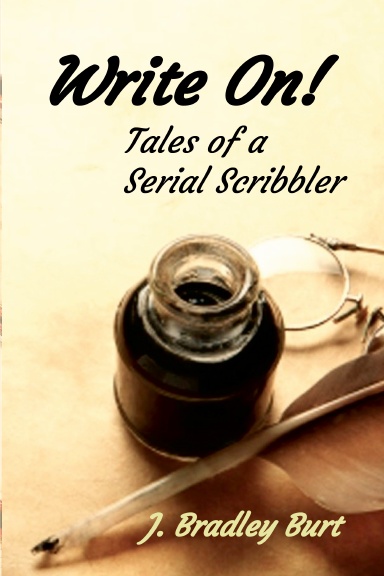
Titled Write On! Tales of a Serial Scribbler, it holds a trove of more than forty pieces I’ve written for the Pelican Pens, a group of enthusiastic writers here in southwest Florida. Each week, we meet to read our work to each other, to offer friendly encouragement, and to devise prompts to guide our creative juices for the following week.

After sending out my announcement the other day, it occurred to me that readers of this blog might like to read one of the short tales included in the book.  Titled And Off We Go, it’s founded on the prompt—embarking on a fateful journey.

I’ve entered this tale in the Gulf Coast Writers Association 2024 writing contest, a competition where I was fortunate enough to take home first-place a year ago with a piece titled But He Didn’t!

I hope you’ll enjoy this preview of what lies in store for you in Write On! Tales of a Serial Scribbler. You can see more of the book, and my other published books, at this safe link—https://lulu.com/spotlight/precept

And Off We Go

“Shall we go?”  The sepulchral voice is solemn, portentous, and it reverberates ominously in my ears.

Not yet…not yet!  I’m not ready…

I hear other voices, too, softer voices…my daughters, named for our favourite flowers so many years ago.  They’re talking quietly over me as I lie in a bed I cannot feel in a hospital room I cannot see, unable to speak or move.

“He can’t open his eyes,” Veronica says, “but I can see them moving behind his eyelids.”

“Yeah, I see that,” Jasmine agrees.  “I think he can hear us.”

“Can you, Dad?” Veronica asks softly.  “Can you hear us?”

Yes, yes, yes!  I’m right here…

“He can’t answer you, Vee,” Jasmine says sorrowfully.

She’s right, I can’t.  Everything was fine until…until…whatever day it was, I can’t remember…and that red wave washed over me, collapsing me on the floor for I don’t know how long.  And now here I am, wherever this is.

“Shall we go?” the voice resounds in my ears again, a honeyed basso-profundo, not at all impatient, yet determined nonetheless.

No, not yet!  It’s too soon…

“Keep stroking his hair, Jazz,” Veronica says.  “He always liked that.”

I did always like it, but I can’t feel a thing now.  I can only imagine how it feels, and the thought warms my heart.  I laugh inwardly, knowing my hair must be all askew.

“I love you, Daddy,” Jasmine whispers.  “I hope you know that.”

“He knows we love him, he knows,” Veronica says, and I imagine she is holding my arthritic hands in hers, gently massaging them, terribly weakened now when once they were so strong.  But I can feel nothing.

I lifted you high in these hands, Vee, high up over my head.  And Jazz, too!  And now…and now…

“Shall we go?”  The voice asks again, persistent though not offensive.

Not yet!  No!

“You don’t have to worry about us, Dad,” Veronica whispers.  “We’ll be fine.”

“She’s right, Daddy,” Jasmine adds.  “You and Mummy were the best, and we’ll be just fine.”

I know, I know…but I don’t want to go…

They’re right, of course, they will be fine, both with their own wee families now.  The little ones were here earlier with their daddies…at least I think they were…maybe not…but I’m sure I heard those four tiny voices telling me they love me.  I wanted to say it back to them, to wrap my arms around them, but…

“And don’t forget, Dad,” Veronica continues, “Mum said she’d be waiting for you to find her, remember?  She’ll be watching for you.”

Ah, their mother, my wife, my lifelong love…how I’ve missed her.  Despite a valiant struggle against the disease that wasted her, she left us a few years ago.  And yet, she never truly left us, you know?  I wonder if Vee is right, if she really will be waiting there, wherever there is…my darling Clementine…

“Shall we go?”  The voice is insistent, though not unkind.

No, please!  Not yet…

“I’m sure Mummy’s been missing you, Daddy,” Jasmine murmurs, and I can hear the sob catching in her throat.  “You were meant to be together for all time.”

“Exactly!” Veronica says, trying to lighten the mood.  “Like apple pie and cheese!  Like mustard and relish!”  She laughs softly as she gropes for more examples.

Jasmine joins in her sister’s laughter, and my heart dances to the sounds of their lilting voices.  “Yeah, or like Abbott and Costello!” she says.  “Like Jack and Jill!”

“Lady and the Tramp!” Veronica offers, and the laughter grows louder.  “Romeo and Juliet!”

“Omigod!” Jasmine gasps, their laughter rolling freely now.  “Tweedledum and Tweedledee!  Lancelot and Guinevere!  Sweet and sour!”

“Yin and yang,” Veronica says, and they stop on that one, as if it’s the perfect one to describe me and Clemmie.

“Shall we go?” a voice asks again…but it’s a different voice this time.  Frozen inside my immobile body, I cannot move, but I feel as if I’m turning around and there is Clemmie…as young and as fair as the first rose of summer.  She’s standing in the midway at the State Fair, pointing at the Tunnel of Love attraction, the one where we had our first, tentative kiss, where the sense we’d found something special first dawned on us.

“Shall we go?” she asks again, and her eyes are sparkling, her smile warm and welcoming.

“It’s okay, Dad,” Veronica whispers, “it’s okay to go.”

“Goodbye, Daddy,” Jasmine breathes.  “We love you.”

Goodbye, goodbye…I love you both…

And I reach for Clemmie’s hand, and off we go.

Paulie

A friend of mine from our teenage years died recently, after a long, slow decline, taken from us before his time.  For more than fifty years, Paulie and I celebrated our friendship in the company of our wives, themselves close friends since high school, and our children.

We journeyed through many stages of life together—boyhood teammates and opponents in the sports we loved to play; young men starting out, full of hope and sure of success; new fathers, surprised at how quickly we got to that point; fellow-travellers far and wide, our growing families in tow; and eventually grandfathers, proud all over again of a new generation.  Through it all, we played our games and remained steadfast friends.

Our boyhoods were spent in the suburbs, where every community had its own park, and we spent hours there after school and on weekends.  We were from different neighbourhoods, but connected on those playing fields during the endless summers and wondrous winters, eager warriors on the ball-diamonds and hockey-rinks.  Especially the hockey-rinks.

In every park there was an outdoor ice pad or two, where neighbourhood fathers (and a few intrepid mothers) would stand every night, alone in the dark, flooding water on the rinks to provide fresh ice for the following day.  I’m not sure we thanked them enough back then, but we sure benefited from their dedication.

By the time we’d arrive at the rink, skates dangling from the hockey sticks propped on our shoulders, fresh snow had often fallen.  So the first kid to get there would take one of the shovels propped in the surrounding snowbanks, and start clearing the ice.  As more of us arrived, we’d take turns until the ice was cleaned off.  And then we’d lace up and the game would begin.

Paulie and I were habitués of those parks.

As adults, our careers took us in different directions, and to different cities.  But we talked frequently by phone—mostly about business, our families, and, of course, sports.  Especially hockey.  We never talked about dying and the hereafter, and what it might hold, not even near the end.  We weren’t afraid of it, I don’t think;  it was just too abstract to be contemplated.

But now it’s happened.  My friend has gone.

But where?  Where is he now, I wonder?  Or, more precisely, where is the essence of who he was?  His soul, some might call it.  In my sorrow, I’ve concocted a scenario that consoles me, regardless that it may sound far-fetched to others.  Paulie would understand.

There’s a celestial park somewhere, complete with a neighbourhood ice pad.  It’s covered with the whitest snow any of us has ever seen, and my friend is the first one there.  He’s grabbed a shovel, and he’s busy scraping the ice.

Sooner or later, I like to imagine, I’ll be joining him.  He knows that, so he’s not troubled.  And when that day arrives, when he sees me coming, he’ll stop for a minute, lean on his shovel, and shout in my direction.

“’Bout time ya got here!  Where ya been?”

I’ll shrug and wave a greeting, my wide smile letting him know how happy I am to see him again.

“Grab a shovel,” he’ll yell, as I stuff cold feet into my skates.  “This is hard work!”

But it won’t be, not really.  It will be joyous work—legs pumping, hearts pounding, breath forming around our heads, skate-blades cutting their cold, choppy sound in the ice.  Just like always…just like always.

In no time at all, the snow will be cleared, the ice will be ready.  And when it is, I choose to believe, we’ll toss a puck out on the ice, take up our sticks yet one more time, and play our game together, the game we always loved.  The way we loved each other.

Paulie and I2

Teammates again, friends forever.

Paul Joseph Boyer

26 July 1942 – 16 March 2017