Singin’ the Songs

Regular readers here will know of my love for music in my life, whether performed by professional musicians in a concert hall or robust amateurs at a party.  I have genres I prefer, of course, as do most people, and I generally fancy instrumental versions of favourite songs to vocal renditions.  I find them more soothing, more conducive to creative thought and activity.

Most of my listening time occurs when I’m writing, as is the case right now, penning this essay, my head clad in earphones.  My first and abiding love is classical music—likely due the influence of my father, who often fell asleep with me on my bed at night as we listened to radio broadcasts of the great symphonies.  He frequently had stories to accompany the music, too, which made it all the more special.

When I started school, one of my favourite activities was song-time, when the teacher would teach me and my classmates a new song.  Not all of us were thrilled, of course, but I was ever enthralled.  To this day, I love to join in the enthusiastic chorusing of the old songs with a group of friends.

And I can still remember (and occasionally sing to myself) some of those silly, little ditties we were taught in kindergarten and grade 1—

Your pail and shovel and wheelbarrow bring,
Let’s plant us a garden this morning in spring.
Dig little trenches, pull out all the weeds,
Pour in some water, and drop in the seeds.

Or this one—

Little yellow bird, little yellow bird,
Come flying with me.
We will build us a cozy corner
In the old apple tree.

There was one I particularly liked, although the lyrics saddened me—

“Come away,” sang the river to the leaves on the trees.
“Let me take you on a journey, and the world you will see.”
So, the leaves gently falling from the trees on the shore
Float away on the river, to come home nevermore.

It might have been the final phrase that bothered me, that they would never find their way home.  But the melody was lovely.

Making friends was very important to one just starting school, so this song had special meaning—

Make new friends, but keep the old.
One is silver, and the other gold.

At my advanced age now, the inherent truth of that sentiment has been borne out countless times.

Our earliest foray into the magic of the French language began with this song about a skylark, Alouette—

Alouette, gentille alouette,
Alouette, je te plumerai.
Je te plumerai la tête,
Et la tête, et la tête,
Alouette, Alouette
Oh-h-h-h-h...
Alouette, gentille alouette,
Alouette, je te plumerai.

There were several verses to this one, substituting le bec, le cou, les ailes, le dos, les pattes, and la queue for la tête, and the chorus had to include every one of them as they were introduced.  But we loved the challenge!

As little ones, we were always encouraged to be active and happy, and to let people know how we felt.  This song allowed us a way to do just that—

If you’re happy and you know it, clap your hands!
If you’re happy and you know it, and you really want to show it,
If you’re happy and you know it, clap your hands!

There were many variations on clapping your hands as we sang that one, and all of them caused much joy and laughter.

One of the songs I especially liked was this one, seeking love and happiness—

You are my sunshine, my only sunshine,
You make me happy when skies are gray.
You’ll never know, dear, how much I love you.
Please don’t take my sunshine away.

Over these past few years, I’ve been fortunate enough to spend many happy hours singing with a men’s chorus, and a fuller version of this is still one of our staples.  I’ve included a video clip that you will surely enjoy—

It’s seventy years and more since I learned many of these songs, and I’m amazed by the joy they still bring me.  After all this time, there are fewer things more fun than singin’ the songs.
Songs I Remember

For as long as I can remember, songs have been a major part of my life.  Even before memory, my mother was singing to me in the cradle.  And during my boyhood years, my dad constantly shared his love of music.

To this day, I remember many of the songs my mother sang: I Wonder Who’s Kissing Her Now, Sweet Little Alice Blue Gown, Always, What’ll I Do, and too many more to mention.

And I remember the classical music my dad and I would listen to on the radio as he tucked me in at bedtime: Prelude to Act III of Lohengrin, William Tell Overture, Light Cavalry Overture, Rhapsody In Blue, and so many others.  To this day, it’s my favourite genre, playing in my earbuds whenever I write.

When I started school, I discovered to my delight that learning new songs was a part of my curriculum, and I still remember the words and tunes to many of them—

Oats and beans and barley grow, oats and beans and barley grow,

You and I and everyone know how oats and beans and barley grow.

I didn’t actually know how those crops grew, of course, not then, but I learned the song and sang it endlessly.

Your rake and shovel and wheelbarrow bring,

Let’s plant us a garden this morning in spring,

Dig little trenches, pull out all the weeds,

Pour in some water and drop in the seeds.

I’ve never really liked gardening, but I did like singing that song.

While strolling through the park one day

In the merry, merry month of May,

I was taken by surprise by a pair of roguish eyes

While strolling through the park one day.

As a youngster, I had no idea what ‘roguish eyes’ were, but the lilting tune and the idea of being in the park instead of the classroom were appealing.  I even performed a tap-dance recital to that song.

“Come away,” sang the river to the leaves on a tree,

“Let me take you on a journey, and the world you will see.”

So, the leaves gently falling from the tree on the shore

Float away on the river to come home nevermore.

This one made me sad, and does even now, at the thought that those leaves would never come home again.  I couldn’t wrap my head around that.  Home, it seemed to me back then, was forever.

And so was singing, and music in general.  And thus it was that, sixty-plus years after starting school, I joined the bass section of a men’s barbershop chorus, eighty voices strong, where I found I could chime in on so many other songs I remembered from my youth: All Of Me, You Belong To Me, Let Me Call You Sweetheart, Loch Lomond, Peg O’ My Heart, Sentimental Journey, You Are My Sunshine, Me And My Shadow, and more just like those.

Singing with the chorus had become a bucket-list item for me by then, something I wish I’d done years before.  The harmonies and chords rippling down over the risers brought goosepimples every time, and once in a while I would even stop singing, the better to listen…surreptitiously, of course.

I’ve had to step down now, but here’s an audio clip of a recent performance, which I trust you’ll enjoy (best with earphones)—

I hope the last sound I ever hear, whenever that time may come, will be songs in my ear—sung by my mother, perhaps, or shared by my dad.  I’d be happy to hear any of these: Fare Thee Well, I’ll Be Seeing You, or even Beethoven’s Emperor Concerto.

As Edward Bulwer-Lytton wrote, Music, once admitted to the soul, becomes a sort of spirit, and never dies.

Karao-kay!

So, here’s the thing—you don’t have to be a good singer!  You don’t even have to be a mediocre singer!  All you need is that you like to sing.

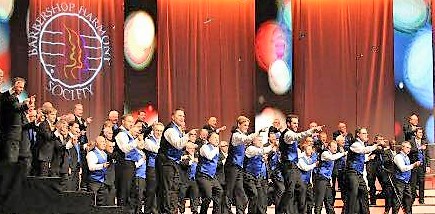
For some time now, as some of you know, I’ve blended my bass voice with mates on the risers of a large men’s chorus, the mighty Harbourtown Sound.  And it’s been a comfort to me to know that no one listening would actually be able to pick my voice out of the throng.  I mean, I do contribute to the wondrous wall of sound we produce collectively, but my solo voice is anonymous, much to my liking.

However, on my last birthday, which took me past my mid-mid-seventies, my wife and two daughters gifted me with a karaoke machine.  Never in my wildest imaginings would I have thought to ask for such a thing—although, in my younger years, I did take part in more than one karaoke session, usually after a few beers in the company of good friends whose critical faculties were undoubtedly somewhat impaired.  In fact, I think I remember stepping up in one or two open-mic sessions, as well.

As I recall, I was never asked back to the same venue twice.

Still, I’ve discovered I love my new machine.  The internet is chock-full of karaoke versions of popular songs, arranged exactly as the original artists sang them, with the correct lyrics scrolling on the screen.  Copyright restrictions apply only if one intends to use them for commercial purposes, which I most assuredly do not.  After all, if it were my intent to sell any of the songs I record, I’d need a buyer, right? 

‘Nuff said.

Ballads are my preferred genre, some of them even older than I.  A partial list of artists whose songs I have attempted includes Pat Boone, Johnny Cash, Patsy Cline, Kris Kristofferson, Johnny Mathis, Willie Nelson, Jim Reeves, and Frank Sinatra.

Still to come, I hope:  Perry Como, Tennessee Ernie Ford, John Gary, perhaps even Pavarotti!  After all, I’m singing for an audience of one!

I’ve also essayed solo versions of songs by several different groups, including Abba, Simon & Garfunkel, The Beach Boys, The Irish Rovers, and The Platters.  Still on the horizon: The Everly Brothers, The Lettermen, The Seekers, and probably others I haven’t yet contemplated.

If you have assumed by now that my wife and daughters have inadvertently created a monster, I could hardly gainsay you.  But I’m benign, I assure you.

My process is to sit with the machine, which is connected by Bluetooth to a song dialled up on my laptop.  I sing it through a couple of times, adjusting the volume of the instrumentals as needed, boosting the mic volume up or down accordingly.  There is a reverb feature, too, which enhances my voice on most of the songs.

If I manage at some point to sound okay to my own ears, I record the song and add it to my little library.  Some of the songs, as you might imagine, are never recorded!

I quickly discover which of the songs will take me beyond my somewhat limited vocal range, and discard them.  Even with my bass singing voice, I can manage a falsetto if not too high, so that helps a little.  Breath control is the biggest single problem I encounter—running out of air before a phrase ends is never good, resulting in a cracked whimper that brings no joy to anyone ever.

Pitch problems are a concern, too, and I sometimes hear myself landing just short of the intended note—what a layperson might call singing flat.  That’s also associated with running short of breath, and can be corrected with proper breathing intervals.  I have yet to record even one song, however, without at least one pitchy problem.

But who cares!

I mentioned earlier that I sing for an audience of one.  That’s not entirely true, though, because I do send along those songs I’ve recorded to my wife and daughters—it’s they, after all, who unleashed the monster.  I also forward the recordings to my three long-suffering sisters, together with a plea that they resist the urge to tell me to stop.  I suggest to them they have three choices—

  1. enjoy the song,
  2. endure the song, or
  3. DELETE.

I implore them not to laugh as they listen (though I’ll never know if they do), nor compare me to the original artist.  Rather, I ask that they think of this as one, perhaps forlorn, attempt to make music with only a modicum of talent, for no other reason than the sheer joy of making music. 

And you, dear reader, might even try it yourself—in the shower, in your car—or, if you’re lucky, on your very own karaoke machine.

Karao-kay!

Odes of Joy

I would wager the family farm (if I owned one) that not one in ten of you, dear readers, will know the meaning of this acronym:  SPEBSQSA.

It stands for the original, and still official, name of the Barbershop Harmony Society (BHS), founded eighty-one years ago, in 1938.  Since that time, loads of odes of joy have rung out across the world as men and women of all persuasions have come together in harmony.

quartet

The acronym translates as: Society for the Preservation and Encouragement of Barbershop Quartet Singing in America.  Quartets still flourish, but barbershop singing has since expanded to include large choruses.

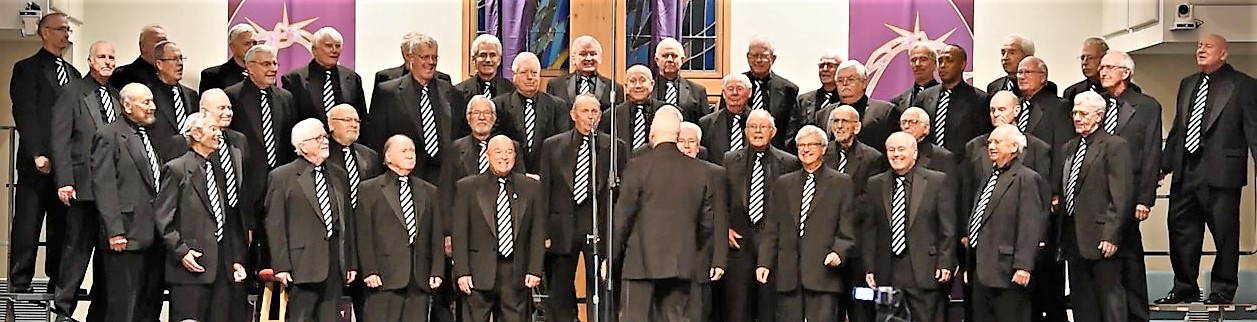
I mention this because a few years ago, a friend introduced me to the joys of singing in a men’s chorus—Harbourtown Sound, of Hamilton, Ontario.  Eighty-five men strong, HTS is a competition chorus that was ranked twenty-fourth in the world in 2018, out of more than a thousand barbershop choruses worldwide.

Harbourtown_2nd_Half Cropped(1)

The jubilant music the chorus produces can make the listener shiver with delight.

Just this past winter, that same friend invited me to join a second chorus—the Suncoast Statesmen, of Punta Gorda, Florida.  This great group, comprised almost equally of American stalwarts and Canadian snowbirds, is a performance chorus, eschewing the competitive experience in favour of a more relaxed approach.

snapshot2

Nevertheless, the music the chorus creates is both joyous and memorable.

I’ve written before in these pages about Harbourtown Sound, and one of those posts may be found at this safe link—

If you missed it, or even if you’d like to enjoy a reprise, check it out.  You’ll hear some wonderful music selections within the post.

The chorus, which this year is celebrating its fifteenth anniversary, will present its annual spring show, Making Great Music and Great Friends, on 12 May at the Burlington Performing Arts Centre.

The Suncoast Statesmen recently performed their annual spring show, Harmony Showcase, held in a large church in the area, before a sell-out crowd.  The chorus sang nine songs altogether, five in the first act, four in the second.  Between sets, a number of quartets and local high school student ensembles performed.

If you’re in the mood to hear some brilliant harmony, have a listen to these five songs, which may be found at this safe link—

Much has been written about the joys and benefits of singing, either alone or in an ensemble.  For me, it’s a little bit like rainfall—once it starts, it’s hard to stop.

choir2