Who Counts?

[ ED. NOTE: If you are an official FOLLOWER of this blog, you are receiving my posts fully displayed in the body of the email notifying you of each new post. To read the post in my actual blog-site format, click on the title at the top of the story in your email, and you will find it a much more enjoyable experience.]

Like many of you, I suspect, I was raised by a mother generous in the love she gave, and wise in her ways.  My four siblings and I benefited greatly from her counsel, and agree to this day that she was right about almost everything.

Whenever I was angry with my brother or one of my sisters, for example, she would caution me, If you have nothing good to say, don’t say anything at all.

Many of our relatives in my mother’s large, extended family were gregarious, well-informed on most subjects, opinionated, and frequently argumentative, so holiday gatherings occasionally became loud and disputatious.  At such moments, my mother would advise me, Sometimes it’s better to say nothing, even if they might think you don’t understand, than to open your mouth and prove it.

Occasionally, I would arrive home from school with some juicy bit of gossip, and she would say, If your friends are talking about other people behind their backs, you can be sure they talk about you when you aren’t there.  And when I would nod as if I understood, she would add, It’s always best to stick up for people who aren’t there.

Decades later, I encountered that last advice again in a landmark book by Stephen Covey, who exhorted his readers: Defend those who are absent—one of my mantras to this day.

A good number of my mother’s admonitions were homespun, she having been raised by descendants of  Scots/Irish farming-stock who had emigrated to eastern Ontario in the mid-nineteenth century.  It’s a long road that has no turning, she would tell me when I’d recount a tale of woe, feeling sorry for myself.  If I’d had a quarrel with a schoolmate, she would say, The road to a friend’s house is never long.  Or if I was sad and blue when things weren’t going well, she’d tell me, When things are dark, try to be the light that someone else can turn on.

I think of my mother often these days, and I miss her wisdom.  I wonder what she’d have to say about this world we live in now, with all its strife and turmoil. 

No one in our family was ever subjugated by an invading people, exploited and dispossessed of our native land.  None of us has ever been despised and disenfranchised because of our nationality, our ethnicity, our skin-colour, our religious beliefs, our gender orientation, our political preferences, our wealth or lack of it, our age, or any perceived disability.  Throughout our lives, in fact, we have been among the privileged of the earth.

Such is not the case for the human species as a whole, however.  Worldwide, a huge number of people are victimized by war, famine, drought, disease, and genocide, some to the point of death.  And for many of those who survive, barely, there is scant relief offered by others of our species.

The product of a random, evolutionary progression over millennia, we human beings at our most primal level are forever a tribally-oriented species.  We seek to be with our own, and are suspicious of any who are different.  We are intelligent, yes, but also egocentric, selfish, aggressive, predatory, manipulative, superstitious, and too often unforgiving.  And because these character traits often override the intelligence factor, is it any wonder we currently find ourselves in such a mess?

Many of the several wars consuming the planet right now, for instance, are the result of clashes among opposing superstitious beliefs—what we sanctimoniously call religion—where each protagonist claims there is no god but our own.  And as if that doesn’t constitute folly enough, consider that many historic wars were waged by our predecessors who claimed allegiance to the same god, even as they prayed to that deity by different names. 

Such foolishness, when earthly power was truly the false god they all desired!

We humans have allowed ourselves—perhaps through a callous disregard for our collective well-being, or maybe due gross ignorance of the consequences we soon shall face—to approach a point of no return.  We seem not to realize that the civilization we profess to admire is but the thinnest of veneers, perched precariously atop the baser instincts of our species.

My mother used to say, The circle is not complete until everybody is inside.  We should always try to make the circle wider, so that everyone can come in.

Decades later, I chanced upon remarkably similar advice, this time in one of Michael Connelly’s crime-novels, spoken by one of his fictional characters, Harry Bosch:  Everybody counts, or nobody counts.

Would our current state of world-affairs be better, I wonder, if we humans could ever adopt that premise?  If we could set aside our preoccupation with the many issues differentiating and separating us, and instead take up the humanistic character-traits we share that might bring us together?

I mean, who counts?
Ponderings

A friend recently sent me a list of ponder-isms he’d found somewhere on the internet, some of which I found funny, but none of which I felt were truly worth pondering.  For example—

  • Why do we feel we have to put our two cents in, yet offer only a penny for the thoughts of others?  Where does that extra penny go?
  • How is it that we put men on the moon before we figured out it would be a good idea to put wheels on luggage?
  • After a good night’s sleep, why do people say they slept like a baby when babies wake up every two hours?
  • If electricity comes from electrons, does morality come from morons?
  • Why do doctors leave the room while you change?  They’re going to see you naked anyway.
  • How did the person who made the first clock know what time it was?

I confess I have no answers at the ready to any of these questions, humourous or otherwise.  But they remind me of the queries I used to get from my grandchildren when they were quite young, back when they still thought their grandpa knew everything. 

Three of them are in university now, and the other two not far off, so our current conversations tend to be more an exchange of ideas than they once were, and less a Q&A.  I’ve found to my delight (and sometimes chagrin) that they’ve developed their own problem-solving skills and are far less likely to turn to me for answers.

Mind you, they still query things they don’t understand, for the root of any problem-solving system I’ve ever heard of—indeed, the very root of learning itself—is the ability to ask questions.  And not just the right questions, mind you, but any questions.  And not just the wherewithal to ask, but the inclination, as well.

As adults, many folks have lost that inclination to ask questions.  Perhaps some of us get hung up on the notion that we’re supposed to know it all; asking questions would display our ignorance.  And perhaps we’re not secure enough to risk showing that to others.  Whatever the reason, the result is the same.  Many of us have forgotten how to go about solving our problems without a lot of false starts, needless aggravations, and wasted time.

But I remember listening to my grandchildren, and they were the best problem-solvers around because they asked questions ceaselessly.  At their tender age, they seemed unconcerned about the effect on others of the questions they asked.  No question was too silly, no question too embarrassing, if it elicited an answer that helped to unlock the unknown.

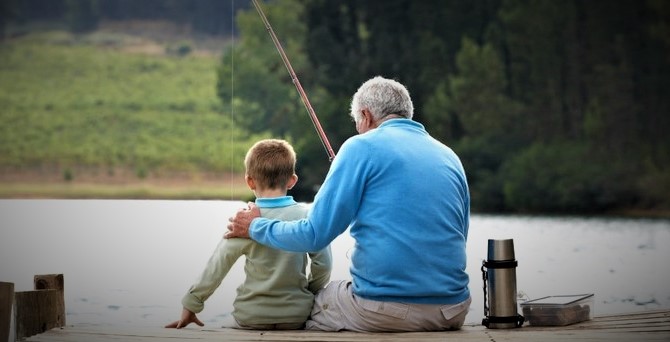
For instance, on one occasion the problem had to do with learning to fish, and I got these questions from two of my granddaughters.

“Gramps, do worms feel the hook?”

“Hmm, that’s a good question, l’il guy.  I’m not sure.”

“If it doesn’t hurt them, why do they wiggle around so much?”

“Ah, well, worms are pretty wiggly all the time, right?”

Her younger sister, inspired, chimed in, too.  “Why don’t the worms drown, Gramps?  Do they know how to swim?  How can they swim with a hook in them?  Can they hold their breath?”

I couldn’t keep up with the barrage.

“What do worms taste like, Gramps?  Are they good?  Do fish like them?  What else do fish eat?  What happens if the fish aren’t hungry?”

Had I been able to answer with any authority, as confident in my answers as they were in the questions, much of the mystery of fishing would have been solved for my young interrogators.

In another situation, I had to consider these questions from my grandson, who was grappling with the existence of Santa Claus.

“Is there really a Santa Claus, Grandpa?  I mean really?  Who is he?  How does he get into our house?  How can he go to everybody’s house in the whole world?  He doesn’t make all the toys by himself, does he?”

Before I could reply, more questions spilled forth.

“And if he’s real, how come not everyone believes in him?  Do you believe in him, Grandpa?  Really?”

It was a very long time since I’d been the one asking questions like that—confidently and without inhibition.  But I suppose I did once, when I was the same naïve child.  Of course, back then I believed whatever my mother and father told me; and what they told me was that things would be just so if I wanted them to be just so.  It was really up to me.  As long as I was willing to believe in Santa, they told me, then there really was a Santa.  And if I believed the hook hurt the worm, then it did and I should act accordingly.

As a grandfather now, I’m not sure that’s always true, but I know I rarely if ever ask those sorts of questions of anyone.  Instead, I turn to the internet, which is, in itself, a problem.

Perhaps my best course would be to start asking questions again, even if I think I can’t.  And I should probably pose those questions to my grandchildren, see what advice they’d have to offer.

After all, as someone wiser than I once said, The final stage of wisdom is becoming a kid again.

And after all this pondering, that’s what I think, too.

Just a Cliché?

Many people think of clichés as timeworn, too-oft-repeated banalities, devoid of meaning because of their ubiquitous presence.  Too self-evident to be of any use; to wit—

It is what it is.  Well, yeah…almost assuredly…duh!

What will be, will be.  You think?

As I approach the three-quarter century mark, however (in fluctuating moods of disbelief and resignation), I find I have begun to pay closer attention to many of them, discerning nuggets of truth that, heretofore, I paid scant attention to.  Whether this is on account of acquired wisdom or wishful thinking, I cannot tell.

cropped-cropped-monkeys.us_

Either way, I am becoming increasingly aware of the boundaries of life—that there is, not just a beginning that was, but an ending to come—a fact I tried to ignore in those halcyon days of my youth.  And many of the so-called clichés are resonating clearly now for me, rather than ringing hollow.

The times, they are a-changin’, right in front of my eyes, falling by the wayside as we continue to poison our planet, wage war on our fellow humans, and trample on the rights of others in a mad scramble to make our selfish way.  I’m beginning to understand more fully now that time and tide wait for no one, and it will soon be too late to reverse the flow.

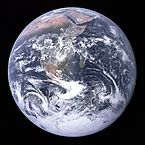
Actions speak louder than words, undoubtedly; yet increasingly, we scoff at the science of climate change, and the inevitable—and irreversible—consequences of global warming.  The planet is home to all of us, the only home we have, and I fear we will not defend it, so focused are we on wealth-acquisition and a penchant to wield power.  We need to remember that a house divided against itself cannot stand.

the_earth_seen_from_apollo_17-1

We shall reap what we sow.  Or, if not us, those who come after us—those for whom we have tainted the future they will inherit.

It has been said it is better to remain silent and be thought a fool, than to speak and remove all doubt.  Nevertheless, if we do not speak out while yet we have the chance, our children and grandchildren may experience a fate worse than death—living on a planet that will be hell.

Too many of those to whom we look for leadership and vision, alas, fail us with their short-term thinking.  And as I enter this last quarter of my life, it occurs to me that neither they nor I will be around to reap the whirlwind that is being seeded by our collective short-sightedness.  Too many of them are yesterday’s men, when what we need are tomorrow’s dreamers—men and women who think beyond the constraints of the present.

Hindsight is better than foresight, by a damn sight, it is true.  But foresight is what will save us from ourselves.  If we don’t stand for something, we’ll fall for anything, and we’ll fall very hard.

snakeoil

So, these clichés—are they just empty aphorisms, bereft of significance?  Or do they, perhaps, constitute a wake-up call, wisdom from those who have gone before us, that might help preserve our bounty for those who will follow?

And, if they are true, will we pay heed?  Will we listen to the ones that caution us, each a voice of one crying in the wilderness?

Or will we ignore their message as nothing more than a tale told by an idiot, full of sound and fury, signifying nothing?

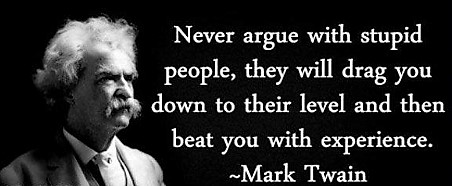
When I hear false promises from so many of our leaders, I am reminded that every man has stupid thoughts, but wise men keep them quiet.  I am reminded that when you talk sense to a fool…he calls you foolish.  I wonder whether the world is being run by smart people who are putting us on, or by imbeciles who really mean it.

twain

Worst of all, I am in fear of those who believe everything they think. 

If we are to change the current course of human folly, we must refute the notion that everyone is entitled to an opinion, and substitute instead: everyone is entitled to [an] informed opinion.  No one is entitled to be ignorant.

Napoleon famously said (in French, I imagine), In politics, stupidity is not a handicap.  Woe that he was right!  So many of our leaders persist in pissing on our legs, while telling us it’s raining, and have the gall to pretend not to notice that we notice!

And that is our fault.  Far too many of us demand freedom of speech as a compensation for the freedom of thought which [we] seldom use.

My mortal coil is unwinding, more quickly now, it seems, than ever before; and too soon for my liking, I will shuffle off to who knows where.  In the meantime, I try to heed the old advice—Don’t look back; something may be gaining.

dark-night-wallpaper-80

But looking forward is difficult, too, given the problems we seem not to be facing up to.  I yearn for a generation of leaders who will step to the tiller, place firm hands on the wheel, and chart a steady course, one we all might confidently follow.  We need captains who are principled, intelligent, unwavering, and above reproach—like the north star, [so we can] set our compass by them.

Will we find them?  Will they find us?  Or is such conjecture nothing more than a fanciful wish on my part?  The world ends when you die, or so some believe.  But for those left behind, it goes on, whether for better or worse.  Will that world flourish—a renewal, a blossoming?  Or will entropy prevail—a gradual decline into chaos and disorder?

Will the future confirm what Robert Browning once wrote—the best is yet to be…?  Or will it be what Porky Pig proclaimed—Th-th-that’s all, folks!?

porky

Just a cliché?  Maybe.  But it matters to me.