I Can Help With That!

Well into middle-age, I would often ask my parents questions about our family’s history.  Most of the time, those questions were based on simple curiosity, but occasionally they’d be prompted by something more important, like the medical history of family members that might impact me or my children.  Aging aunts and uncles were also a source of information, and always seemed happy to reminisce about such things.

Old photo albums were a rich source of material, too, as were scrapbooks and journals, and I remember poring over them as a child, eager to soak up the ethos and culture of my family.  Alas, when I look at some of those monochrome snapshots now, I find I recognize hardly anyone.

But now, of course, there’s no one to ask.  Both my parents and all my aunts and uncles are long departed, and I am the eldest of my family.  My three younger sisters will sometimes remember events from our shared past quite differently than I, but now we have no arbiter to call upon.

My two daughters, in their fifties now (Egad!), have taken to asking me and my wife the same sort of questions about our respective families that I used to ask my elders.  We answer them to the best of our memories, but our memories aren’t the best anymore.  I come away from some of those conversations with the uneasy feeling that I might have made stuff up to fill the gaps.

One of our daughters suggested recently that we sit down for a few interview sessions with her, where she could record our recollections.  We’ll be happy to do that, but the suggestion prompted another idea, one I immediately acted on.
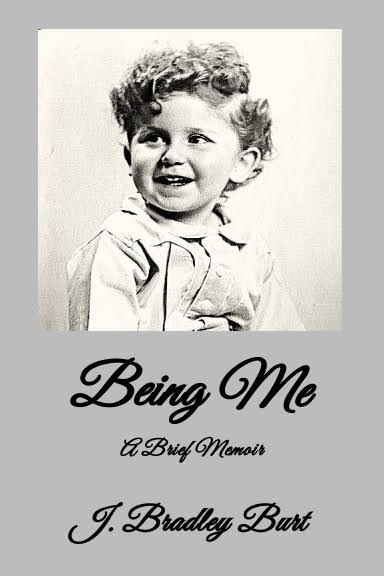
I’ve written a memoir, a brief history of my life intended for family only—my wife, my daughters and their husbands, my five grandchildren, and my three sisters—plus one friend of almost seventy years.  The book, a mere 135 pages in length, is titled Being Me, and is not meant to be an exhaustive examination of my life to date.  Rather, it’s a glimpse at who I was as a boy, who I became as a husband, father, and educator, who I am well into a blissful retirement, and who I strove to be throughout my life. It deals with those events I deem significant, things that might be of interest now or in future to my limited audience.  The challenge I faced was not trying to decide what should be included, but what should be left out.

I’d love to think there’ll be enough yet to come to justify a sequel, but that seems rather unlikely.  Dying holds no fear for me, but I will harbour a sizable amount of regret if that grim reaper lurches in too soon, for I’m having too much fun to want to leave.

It’s been said no one is ever truly dead to the world until the last person who remembers her or him is gone, and I think there’s something to that.  My paternal grandfather died just before Christmas 1948, when I was five years old.  But because I still remember him, vaguely—the only one in my family who does—he’s still alive in a way.  When I finally pass, so, too, will he.

But I’m hopeful I’ll live on, as he has for me, in the memories of those precious ones I leave behind.  And I pray those memories will be fond ones, at least for the most part, and that they’ll evince more laughter than tears.

I have more yesterdays now than tomorrows, but the inevitability of aging is but one aspect of life.  If we so choose, we can relegate aging to a mere physical phenomenon, not one that has to affect our emotional outlook.  The person looking out on the world from behind my eyes today is not the man whose image I see in the bathroom mirror every morning; rather, he is still the boy I always was—

from my aging eyes,
the boy I once was looks out---
hardly changed at all.
the sails of my youth,
once hoist, are often furled now,
‘though the winds still blow.

The winds do still blow, and I welcome them and am inspired by them, even if I can no longer respond as once I did.  My children and grandchildren, thankfully, are caring enough to include me in their lives; my next adventure with Donna is always just over the horizon; my next book is already forming in my febrile  imagination.  These are the winds I speak of, and the physical frailties that age sends to plague me are unable to fully constrain me.

Prompted by our daughter’s interview idea, my wife also decided to write her memoir, titled My Story, and has asked me to help.  As I read her recollections, I find many of the events she deems significant are those I also considered important.  That shouldn’t be surprising, I suppose, considering we’ve been a couple since our first date in 1963, and married for fifty-seven years.

Neither memoir, of course, will answer all the questions our daughters or their families may ask about their heritage.  But with any luck, they’ll go some way to filling in a few of the blanks.  And who knows? Maybe on some far-off day in the future, long after I’ve gone on to my next adventure, one of my grandchildren—or perhaps one of their children—will want to know something about the old-timer who preceded them by a generation or two.  No one will likely remember, but they’ll have my memoir to refer to for the answer.

I like to think it will be as if I’m still there to hear the question.  And to answer by responding, “I can help with that!”
Spring-Breakers Are the Worst!

The challenge from my Florida writers’ group was to begin a story with an unnecessary, declarative sentence, and to focus on a theme. The theme of this story is that actions speak louder than words. The story is an adapted excerpt from a crime novel I’m working on, Unsafe For All Time.

They were right there, staring at each other. 

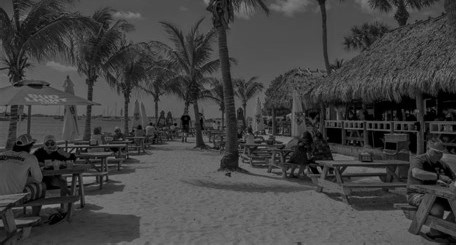
As he carried two strawberry margaritas back from the Beach Hut bar, Jake saw the guy talking to Jessie.  Dressed in khaki shorts, a faded blue T-shirt, and sandals, he looked to be about Jake’s age, well-built, slightly taller.  

“Can I help you?” Jake asked him, glancing at Jessie in their booth.  She rolled her eyes as if to say the guy was a jerk.

“Don’t think so, Chief!” the guy replied.  “But Jessie here is gonna be joinin’ me an’ my friends over there.  She’s a friggin’ bomb!”  He pointed to a booth on the far side of the beachside patio, where two similarly-dressed guys were watching.  “You might as well run off home.”

Jessie was indeed a prize in her tight-fitting tank-top, cut-offs, and scuffed cowboy boots.  Ten years older than Jake, and divorced, only the fine wrinkles around her eyes kept her from looking like she could be his college classmate.  They’d met when he’d dropped off a form to the Dean’s office at Florida State, where she worked as a file-clerk.  They’d been seeing each other for a month now, and both were still enjoying the novelty and the sex.

“What’s your name, pal?” Jake asked.   

“Name’s Bobby…not that it’s any of your business.”  But before the guy could say anything further, Jake flung the contents of one of the drinks in his face.  The sticky, pink strawberry liquid stung Bobby’s eyes, splattered the front of his shirt.

“Hey!  What the hell!” he spluttered, jumping back in surprise.  Jake tossed the second drink in his face, then stepped to one side and kicked his feet out from under him.  Bobby fell backwards, sandals flying off his feet, and his head bounced hard on the wooden deck when he landed.  Jake set the empty glasses down on the table in front of Jessie.

The guy’s two friends immediately clambered out of their booth, but before they could get to Jake, two beefy bouncers intercepted them.  While one held them at bay, the other told Jake he’d better leave.  “I know why you did it, man,” he said, “but you an’ the lady gotta go.  Now!”

When Jessie slid out of the booth, gathering her long, blonde hair behind her neck, the bouncer gave her a long, appreciative, up-and-down look.  Bobby was trying to sit up, rubbing the back of his head groggily.  Jake took Jessie’s elbow, steered her toward the door.  “You gave that asshole your name?”

“Yeah,” she said, “right before I told him to buzz off.  An’ then you got back with the drinks.”  She chuckled wryly, then added, “What a waste of good booze!”

Minutes later, they were headed for the highway a mile from the restaurant, a plume of dust from the gravel road swirling behind Jakes’s ten-year-old convertible.  “Too bad that hadda happen,” Jessie said, adjusting her makeup in the vanity mirror.  “I never been to the Beach Hut before, was lookin’ forward to dancin’ under the stars.”  Snapping the mirror shut, she leaned back and gazed at the nighttime sky, hands raised above the windshield to feel the onrushing air.

“You hungry?” Jake asked.

“I could eat,” Jessie said.  “An’ y’know what?  I feel like a cheeseburger, so how ‘bout we hit a Steak ‘n’ Shake?”

Jake was watching headlights coming up fast behind him.  “Got trouble, I think,” he said.

Twisting in her seat to look, Jessie asked, “You think it’s them?”

“Most likely,” Jake muttered, coasting to a stop on the side of the road.  Leaving the engine running, he opened his door and climbed out.  “Stay in the car,” he said.

“No friggin’ way,” Jessie declared, reaching into her bag for the small can of Mace she carried everywhere.

The other car pulled over about twenty yards back.  Jake and Jessie had to shield their eyes in the glare of its high-beams, but they heard two car doors slam, saw two vague shapes slowly approaching.  “Hey, Chief!” a voice called out, “you messed up Bobby pretty good back there.  They hadda take him to the hospital.  But what’s worse, you took that sweet-lookin’ babe with you when you ran off.  Now it’s time for a little payback.”

Jake popped his trunk, quickly unrolled a worn blanket cocooning a shotgun, a well-used Mossberg 500.  Racking it loudly, he aimed it at the headlights.  The metallic kascheeek-kaschunk of the slide cut through the night, freezing the two men where they were.

Marvelling at the ease with which Jake handled the gun, Jessie stood to one side, eyes wide, the Mace clutched tightly in one hand.

“Hey, wait, man!” the same man said, his tone suddenly a lot less belligerent.  “No need for that!”

“One!” Jake called out.  Nothing else could be heard for a second or two, save for the eternal serenade of crickets and bullfrogs in the humid darkness, and the surf rolling in to the beach beyond the trees.

“Two!” Jake said.

Without another word, the men scrambled back to their car, and moments later, two doors banged shut again.  The driver immediately cut his wheels into a U-turn, but there wasn’t enough room on the narrow road.

“Three!”

The back-up lights pierced the darkness as the driver reversed to make room for what was now a three-point turn.  And then he stalled the car.

“Four!” Jake yelled.

As the engine roared back to life, the driver spewed gravel from under his wheels and the car leapt into its turn and headed back up the road towards the restaurant.

“Five!” Jake whispered.  When he pulled the trigger, the back window of the fleeing car exploded and one of its tail-lights blinked out.  The vehicle fishtailed violently a couple of times before straightening out and accelerating away, dust rising high in its wake.

“Holy frig, Jake!” Jessie exclaimed.  “You don’t fool around!  You coulda killed ‘em!”

“Don’t think so,” Jake said calmly, returning the shotgun to the trunk.  “Not at that range usin’ coarse birdshot.  I’m surprised it blew out the window.  Woulda messed ‘em up some if they’d kept comin’ for us, though.” 

A half-hour later, they were seated close together in another booth—Jessie with her cheeseburger, Jake with a plate of fries he was sharing, both with a thick, creamy milkshake.

“Chocolate’s my favourite,” Jessie said around a mouthful of burger.  “I tried one like yours once, but the crap they put in it kept gettin’ caught in my straw.”

“That’s why they give you a spoon,” Jake laughed.  He’d ordered a Rocky-Road-cookie-dough-caramel something-or-other, but secretly wished he’d stuck with chocolate.  “You got some mustard on your chin.”

Jessie wiped it off with her napkin.  “You think them guys know who we are?  You think they’ll come after us again?”

“Doubt it,” Jake said.  “They looked like spring-breakers to me.  Gonna have a story to tell when they get home, wherever that is.  Prob’ly Daddy’s car that got shot up.”

“Spring-breakers are the worst!” Jessie said.  “How come you got a gun in your trunk?”

Jake waited several seconds before replying.  “Hey, any guy who goes out with a babe as hot as you is gonna need a gun!  There’s assholes like Bobby all over the place.”

Jessie grinned at the compliment.

“He was right ‘bout one thing, though,” Jake added.  “You are the bomb!”

Swallowing the last of her burger, Jessie said, “Bet your ass I am!  But the only one I’m gonna go off on is you!”

“Can’t wait!” Jake grinned.

”Me neither,” Jessie grinned back.  “But first, are you gonna finish them fries or what? I’m still hungry.”

The Susiephone

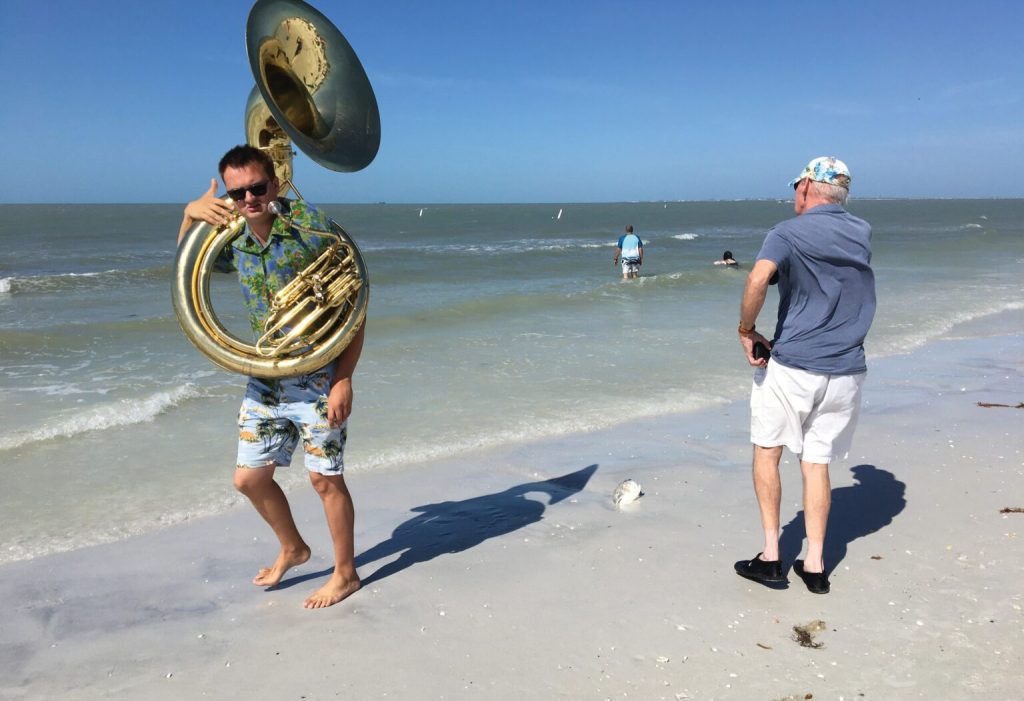
This is a story I’ve entered in the Florida Weekly 2025 Writing Contest, based on the first picture below, supplied by the newspaper.

“Where’s the parade, young feller?” the old man asked.

“No parade,” the young man replied, stopping for a moment.  “I’m on my way to my music lesson.”

“On the beach?” the old man chuckled, eyeing the younger man quizzically from under the bill of his cap.

“Just takin’ a shortcut to my teacher’s place.  He lives in a beach house down a-ways.”

“You in one o’ them there marchin’ bands?”

“Not yet,” the young man said, “but I hope to be.  Auditions start Monday.”

“Ain’t you a mite old to be in school?” the old man asked.  “No offence, but…”

The young man laughed.  “It’s a military band, not a school band.  I’m a Marine, and I’m tryin’ out for The President’s Own.”

“The president’s own what?” the old man asked.

“United States Marine Band,” the young man explained.  “America’s oldest, professional musical organization.”

“Old as me?” the old man chortled.  “I’m old as dirt!”

“Well, the band formed in 1798, when John Adams was President.  I’m pretty sure you’re not that old!”

The old man paused, as if adding up the numbers.  Then, scuffing the sand with his black loafers, he said, “Since when do Marines dress in swim-trunks an’ walk ‘round barefoot?”

“Never when I’m on duty,” the Marine replied.  “But when I’m walkin’ down the beach, I like to blend in with everybody.”

“Blend in?” the old man snorted.  “No way you blend in, young feller.  Not with that there thing you’re wearin’ ‘round your neck!”

The young man patted the instrument he was carrying.  “You noticed her, eh?  She’s a Sousaphone.  Weighs a ton, but she makes a lotta noise when I get ‘er goin’.”

“Who’s Susie?” the old man asked, eyebrows knitted, not sure he’d heard right.

“Who’s who?” the Marine asked.

“Susie!  The one you said owns that there phone thingy.”

After puzzling a moment, the Marine said, “There’s no Susie, sir.  This here’s a Sousaphone, named after John Philip Sousa, one of the Leaders of the Band.”

The old man gave that some thought.  “I thought the leader of the band was McNamara.”

“Sir?” the Marine said, confused again.

“Like in that old-timey song,” the old man said.  “You musta heard of it.”  And without further ado, he began to sing in a cracked falsetto, “Oh, me name is McNamara, I’m the leader of the band…”

The Marine waited politely ‘til the song was finished, then applauded the effort.  “You know, The President’s Own doesn’t feature vocalists, which is too bad, ‘cause I woulda recommended you.”

“Yeah, I used to be a pretty fair tenor,” the old man nodded.  “Still ‘member a lotta the old songs.”  After a moment, he added, “Used to be in the service, too.”

“Marine?”

“Army, 7th Cavalry, served in Korea.  Took a bullet in ‘53, hurt like a bugger, so they hadda ship me home.”  As he spoke, he lifted his shirt to show a scar on his left side, pink and ragged against his pale skin.  “Got me one o’ them there Purple Hearts, but I lost a few good pals over there, guys who never made it back.  If I coulda chose, I prob’ly woulda sooner played that there Susiephone in a band.”

The Marine studied the old man with renewed interest.  “So, how old are you now, sir?”

“Lemme see,” the old man said, gazing skyward.  “This here’s two-thousan’-an’-twenty-five, so that makes me ninety-one, I s’pose.”  He danced a little jig in the sand as if to contradict the truth.

“So, you were wounded in combat when you were only nineteen?” the Marine said, shifting the weight of the Sousaphone on his shoulder.

“Yessir,” the old man replied.  “Hurt like a bugger, like I said, an’ when I got home, I still hadda wait two more years to vote!  Wasn’t old enough to drink, neither, but I never let that stop me!”  He mimed chugging a beer as he said it.

The Marine gazed at the old man for a moment.  “Sir, do you know Rusty’s Crab Shack, just down the beach a-ways?”

“Sure, I know it!”

“Sir, if you meet me there after my lesson’s done, it would be my honour to stand you to a drink.  Can we do that?”

The old man’s face lit up.  “Young feller, there’s no way an old grunt like me is gonna turn down a free drink from a Marine.  I’ll see ya there!”

And as it turned out, it was more than one drink.