Cogito, Ergo Sum

Cogito, ergo sum—I think, therefore I am. 

So opined René Descartes in 1637, in his famous work, Discourse on Method, demonstrating what he regarded as the first step in the acquisition of knowledge.

Of course, we don’t know that he was right, but because enough of us have come to believe his posit, it is almost universally accepted.  Left unanswered is the question as to whether other living organisms are sentient, whether they also can think.

Some people believe they can—that creatures such as elephants, whales, and dogs are capable of thought—and they cite observed actions by these animals as proof of their belief.  But what of other animals, or fish, and what of plants and rocks?  To my knowledge, no one has as yet been able to prove (or disprove) the thesis that any lifeform other than human is capable of thought.

Regardless, it does seem likely that no form of life on our planet has attained the same level of high-order thinking that the human species has.  And if any have, they have hidden it from us remarkably well.  With physical brains somewhere between the largest and smallest in size among all living creatures, we humans appear to have outstripped them all in our capacity to think rationally.

The capacity to think is what allows many of us to read widely, listen to diverse sources of information, and weigh the relative merits of differing schools of thought before deciding on a course of action—critical thinking.  Alas, it is also what allows us to read narrowly (if at all), listen carelessly, and reject schools of thought that do not reflect our own preconceived notions.

Either way, thinking broadly or narrowly allows us to form opinions.  And those opinions, whether supported by evidence or not, often morph into staunch beliefs if we don’t continue to think about them, to test them against emerging information.  And inference plays a big role in that.

For example, if I waken one morning to the sound of thunder, and if I see flashes of lightning illuminating the drawn curtains of my bedroom, I might well infer that it’s raining outside.  But I have no proof of that until I actually see (or feel, or smell, or taste) the tangible rain.  I might throw open the curtains to discover there is no rain falling, despite the harbingers of storm; merely hearing and seeing those from inside my room would have drawn me into a false conclusion, yet one I believed until faced with proof of the opposite.

It points out the danger of choosing to believe everything we think, at least before we have evidence to support (or deny) our premises.  As sentient beings, we are compelled to seek answers to the baffling phenomena we observe around us, to find reasons why situations unfold as they do, to explain the arcane mysteries that bedevil us—like where we came from and where we’re going.

Our world is replete with examples of how we have gone about this—in religion, science, engineering, medicine, music, literature, and so many other fields.  The list of human accomplishments over the millennia is long and laudable.  Errors have been made along the way, and corrections applied, but the steady march of knowledge-acquisition has been relentless.

Many of our ancestors, for instance, once believed (and some still do) that the earth was flat, that any who got too close to the edge would topple off the edge, fall into the void, and be lost forever.  We know now, of course, that belief was untrue.  As an amusing aside, the Flat Earth Society still boasts today in its brochures of having chapters of believers around the globe!

Still other folks believed once upon a time that our planet was at the centre of the known universe, that the moon and sun revolved around us; those people’s skills of observation, primitive by today’s standards, and their earnest thinking about those observations, led them to that conclusion. Yet, it was also not true.

Nevertheless, despite our many errors and missteps along the way, our capacity to think rationally—and to forever question our thinking—has allowed us to advance our collective knowledge.  A key factor in continuing that progress is to avoid investing complete faith in any one thesis, regardless of its appeal at any given time; we must retain an appropriate level of skepticism in order to keep from falling into the acceptance of rigid dogma and blind ideology. 

As George Carlin is reputed to have said, “Question everything!”

Another key is to continue testing theses to reinforce their viability, to find evidence of their truth (or falsity).  But at the same time, we must remember that an absence of evidence of truth in the moment does not mean the same thing as evidence of an absence of truth.  In other words, just because we don’t have the facts to prove the legitimacy of a thesis right now does not mean that thesis is untrue; it may mean simply that we haven’t as yet discovered the facts to validate it.

The advance of knowledge is, to paraphrase Hemingway, a movable feast.

An exception to prove the truth of any thesis can always be found, of course—something that demonstrates the general truth of a thing by seeming to contradict it.  For instance: most of the teachers in that elementary school are female, and the one male teacher on staff is the exception that proves the rule.  The thesis is factual.

We also know the true merit of any pudding is put to the test in the eating.  But with one person’s taste being different from another’s, whose opinion is to be accepted as the truth?  Any decision there must be regarded as opinion, not fact.

It is interesting to note that Descartes did not write, Cogito, credo quod cogitare, ergo non est recta—I think, I believe what I think, therefore it is right.  Apparently, he understood that because we think something, even to the point of believing it, that does not necessarily make it true.

He also wrote, Non satis est habere bonum mentem; Pelagus res est ut bene—It is not enough to have a good mind; the main thing is to use it well.

Quaestio, semper quaestioquestion, always question!

Platitudes and Attitudes

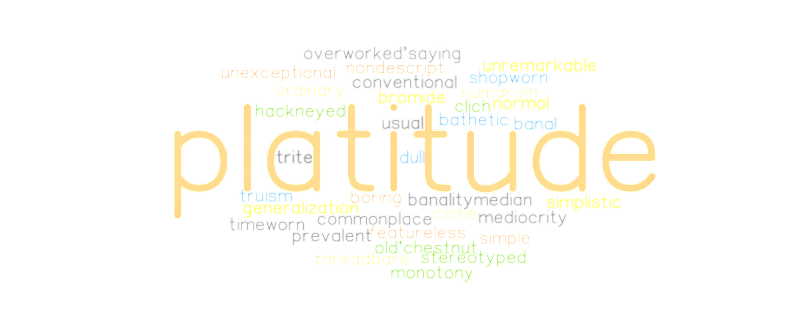
Platitudes are trite, banal, or hackneyed statements, timeworn clichés people use because they allow us to sound like we know what we’re talking about, sometimes providing us a polite way to avoid difficult conversations.

Most of them are overused phrases or expressions that have lost their originality and power.  But because they’re expressed in a formulaic manner, their meaning is usually recognizable instantly.

While all of us probably resort to using clichés at one time or another, there are those among us for whom platitudes are the standard form of conversation.  We would be likely to hear phrases such as the following when we encounter these folks: it is what it is; it’s a no-brainer; it ain’t rocket science; time will tell; that’s life; or everything happens for a reason.

Such glib folks might themselves be described in cliché-form: all hat, no cattle; the blind leading the blind; or ignorance is bliss.

Beyond the simplistic ones, I find some platitudes to be downright cringy: all you need is love; love makes the world go round; if it’s meant to happen, it will; patience is a virtue; no pain, no gain; or good things come to those who wait.

I do enjoy many platitudes, though, if for no other reason than they give me the opportunity to counter them with snappy, little rejoinders of my own, reflecting attitudes perhaps better left undisturbed.  For example—

God helps those who help themselves; okay, but I hope God also helps those who get caught helping themselves!

Practice makes perfect; yeah, but only if it’s perfect practice!

Don’t criticize a man ‘til you’ve walked a mile in his shoes; right, because by then you’ll be a mile away and have his shoes!

What doesn’t kill you makes you stronger; except if it doesn’t!

You’ll find love when you’re not looking for it; maybe, but good luck with that if love isn’t also looking for you!

Absence makes the heart grow fond; perhaps, but fond of whom?

Stop and smell the roses; great idea, unless bees are gathering rose-pollen where you stick your nose in!

Better late than never; unless, that is, you weren’t invited in the first place!

One person’s trash is another person’s treasure; sure it is, if it’s not already a rotting pile of garbage!

He’s at his wit’s end; or on the other hand, he may just be halfway there!

It’s not what you know that matters, it’s who you know; perhaps, unless you don’t know anyone important!

Curiosity killed the cat; true, but satisfaction brought…well, you know!

There’s always light at the end of the tunnel; there is, but it might be an oncoming freight-train!

Beauty is only skin-deep; that’s alright, I’m thick-skinned!

Two heads are better than one; fine, as long as they aren’t attached to the same torso!

There’s someone for everyone; and you would know this…how?

It is better to be by yourself than engaged in bad company; in that case, please excuse me!

Ah, those last two are a tad unkind, I must admit, but they tickle my funny-bone, anyway.  It has been said by someone far wiser than I that an idle mind is the devil’s workshop.  So, to foil that maleficent demon, I often occupy my idle mind with such trivial pursuits as this, and then write them down. 

I hope you have enjoyed some of the results.   

The Railwayman

Again this year, I know I’ll receive warm hugs and kisses from my daughters in recognition of yet another Father’s Day, the fifty-first such occasion.  It never grows old.

We fathers grow old, however, despite our best efforts.  And in so doing, we lose our own fathers as they board the last train to glory, to borrow from Arlo Guthrie.  My dad departed the station twenty years ago, but he remains with me almost daily in my reveries.  And never more so than on Father’s Day.

When I was a young boy, he would take me to local railroad crossings to watch the big steam locomotives and their endless caravans go storming by.  I treasured those occasions because I would have his undivided attention, a not-so-frequent circumstance in a family that eventually numbered five children. I’ve often wondered if, during those times with me, he might have been fondly remembering standing by the rails with his own father. 

He enjoyed the time with me, too, I’m sure; but he loved those trains even more than I did, a boyhood fascination he never lost.  If he could have been anything else in life but an insurance executive, I believe he’d have been an engineer on one of those behemoths. He was truly a railwayman, if only in his dreams.

https://s-media-cache-ak0.pinimg.com/736x/23/67/c0/2367c020ad92968a83fc8070d32a375d.jpg

At the time of his passing, I wrote these lines to commemorate what he meant to me, to express my love for him, and they comfort me still—

The Railwayman

You’d take me down beside the rails to watch the trains go storming by,

And tell me all those wond’rous tales of engineers who sat on high,

In cabs of steel, and steam, and smoke; of firemen in their floppy hats,

The coal they’d move, the fires they’d stoke, as o’er the hills and ‘cross the flats

The locomotives huffed and steamed, their whistles blowing long and loud.

And one small boy, he stood and dreamed beside his daddy, tall and proud.

Terrifying monsters were they, bearing down upon us two, who

Felt their force on that steel highway, hearts a-racing---loving, true.

I’d almost flinch as on they came toward us, with their dragon-face

A-belching, spewing, throwing flame and steam and smoke o’er ev’ry place.

But you’d stand fast beside the track, and, oh! the spectacle was grand.

So, unafraid, I’d not step back, ‘cause you were there holding my hand.

Oh, Railwayman, oh, Railwayman, I’m glad you knew when you grew old,

How much I loved you---Dad, my friend---who shared with me your dreams untold.

Oh, Railwayman, oh, Railwayman, if I, beside you once again,

Could only stand safe in your hand, awaiting with you our next train.

All aboard, Dad…all aboard!

And Happy Father’s Day to all who, like me, are both fathers and sons.  We are blessed.

[Slightly different versions of this tale have been published here twice before.]

The Sandbox

Over a period of years a long time ago, on my daily walks to and from work through a local community park, I used to watch groups of pre-schoolers playing in a very large sandbox.  I was always struck by their singular focus on the primitive sculptures and projects they were building.  Oblivious to events going on around them in the park, they directed all their energy towards the activities in the sandbox.

A few of the kids looked to be cooperating with each other, working diligently in pursuit of whatever objective they had settled on.  Their interactions were punctuated by short bursts of conversation, lots of smiles, and the occasional whoop of glee when something came to fruition.

Most of the others in the group played alone, apparently unconcerned with the endeavours of their companions—typical of that age and stage of development.  Quick flares of temper occasionally gushed forth, and angry exchanges, when one person’s endeavours somehow impinged upon another’s, but on the whole, the mass of children in the sandbox managed to coexist.

Their mothers—no fathers, alas—watched with a mix of pride and bemusement as their offspring played, secure and happy in the park.

As time passed, those children got older and left the sandbox, but they were replaced by a seemingly inexhaustible supply of similar youngsters, and the pattern remained the same.  And everyone in the sandbox was concerned only with what was happening within its confines, no one with the goings-on in the rest of the park.

I noticed changes in the park at large, however.  In the early years, it had been a sylvan haven for children and families—a place to gather with friends, to cool off under the trees on mid-summer weekends, to escape the pressures of the daily grind.  As time passed, though, I began to miss the family gatherings, as many of those parents, some of them working two jobs, were no longer able to come.  And at the same time, more and more older children began to frequent the area, not playing the sorts of games I was familiar with from my own childhood, but just hanging out.  Loud music could often be heard, smoke hung over many of the conclaves, and occasional fist-fights would erupt between different groups.  In time, the park became, not so much a family destination, as a place for the neighbourhood’s teenage kingpins to gather.

The children in the sandbox were affected by these changes, of course.  Now, they had to avoid issues with the older kids if they hoped to play their games.  But, for the most part, they were able to do that, and in their exuberance and innocence, they continued their childish pursuits, interacting with one another as their predecessors always had.  None of them cared that the de facto ownership of the park had been co-opted.

To be sure, it never became a dangerous place, one to be avoided.  I continued my daily walks with no fear, but I was aware of the changed dynamic, even if the sandbox urchins were not.

Today, long-since retired and no longer walking in that park, I think of it as an allegory of sorts to the present situation with our government.  When I watch Question Period, for example, whether federal or provincial, the elected denizens of Parliament focus so much of their energies and time on what seems to me nothing more than spurious activities, full of sound and fury, signifying nothing, as Shakespeare wrote.  As I watch and listen, I see again those pre-schoolers in their sandbox, engrossed in the small world they are occupying.

To be sure, legislation does get passed, much of it to the benefit of the country or province as a whole, even if never fully satisfying everybody.  And that’s good.  But I find it akin to the completion of those sandbox projects and sculptures that so pleased their creators—not insignificant, beneficial to their future growth and development, but accomplished only with such fuss and foofaraw as to be laughable.

A more serious situation, however, has developed outside the sandbox—the Parliament—in terms of who is really in control.  While elected officials busy themselves with their daily perambulations, much as those pre-schoolers did, private-sector interests are busy trying to take over the park, so to speak.  Be it wealthy, corporate entities, land-developers and real-estate companies, foreign-based media ownership, legal, banking, and financial firms, or myriad other lobbyist organizations, the environment around Parliament has undergone a radical change.

The ownership and culture of a local park are things to be gained or lost by the residents of the community in which it sits, according to their wishes and level of activism.  Depending upon how a community responds, their sandbox may be lost.

But the ownership and culture of our provincial and federal Parliaments are embedded in our constitutional rights—they belong to us, the citizens of this country.  Do we want to lose them?  Have we entrusted them to the finest possible stewards, our best and brightest?  Is there a fix for the encroaching, pernicious influence of the big-moneyed interests? What are we to make of foreign influence on our government?

More of us need to pay more attention to these questions, or all of us may end up losing our sandbox altogether.

Another New Book!

I’m really excited to announce the publication of my eighth anthology of tales—My Relentless Muse: Tales of a Vagabond Storyteller—a collection of more than fifty essays I’ve written as a member of the Pelican Pens writers’ group in southwest Florida.

I have long regarded myself as a storyteller, and the collection here is selected from more than one-hundred-and-fifty pieces I’ve shared with this group of talented writers.  Once a week, Pelican Pens members get together to read our stories aloud, and to offer helpful suggestions to one another.  At the end of each gathering, we go away with a prompt or two to guide us for the following week’s articles.   At the beginning of each story in this collection, just beneath the title, you’ll see the prompt that suggested the tale you’ll be reading. 

The relentless muse referenced in the title remains a mystery to me, even after a lifetime of writing.  I still find myself wandering like a vagabond, hither and yon, seeking after the story-ideas she holds out to me.  Yet most of the time, I never leave the chair in front of my computer because my elusive muse is so firmly embedded in my imagination.  

This newest book may be previewed and purchased at the publisher’s safe site— https://www.lulu.com/spotlight/precept   I hope you will take a few minutes to visit the site, where you will see all my books…..including my most recent crime novel, published just one month ago, Delayed Penalty.

The site is well worth visiting, even if I do say so myself!

Happy reading!

Simple?

There are most likely no simple answers to the myriad questions our world faces today, nor simple solutions to the plethora of problems confronting us.

Think of such issues as: sanctity of life, including abortion, cloning, and assisted-death; religious liberty; traditional vs. non-traditional gender roles, and how they affect such institutions as marriage and parenting; education, which determines what and how young people learn about their history; human rights, especially for the millions of displaced persons worldwide; or our right to free speech, and whether or not it includes hate-speech, pornography, and incitements to violence.

Being a somewhat simple person, I do wonder if there is a basic reason that might account for the rising discord and rancor all around us.  Would it be too simplistic of me to attribute the cause of such trials and tribulations to one fundamental factor—namely, the reluctance of so many of us to abandon the comfortable past we long for, to embrace the changes that imbue the inexorable forward march of history?

I was born in North America shortly before the end of WWII, too early to be considered a baby-boomer, too late to be thought a part of the greatest generation.  I was raised from boyhood to adolescence during a period from the late-40s to the early-60s, a time when all the so-called truths seemed self-evident.  Either that, or no one took the time to question them.

Such broadly-accepted truths have been encapsulated in Moral Foundations Theory1, which postulates five ethical categories, each with its own set of prized qualities and traits.  These are:

  • purity-based morality, anchored in sanctity and piety;
  • authority-based morality, valuing duty, deference, and social order;
  • fairness-based morality, the flip-side of authority-based, embracing equality, impartiality, and tolerance;
  • in-group-based morality, founded on loyalty to family, community, and nation; and
  • harm-based morality, embracing care, compassion, and safety.

For the purpose of my search for a simple answer in this essay, let’s assume that these categories encompass the range of behavioural virtues we live by.  Scholarly examinations of the Google Books database have shown that morality in general was a much more frequently-discussed issue of concern at the dawn of the twentieth century than it was by 1980, although that trend has slowly reversed since.

The purity-based category followed almost the same trajectory during that interval, and there was a noticeable increase in individualism-based values that placed greater emphasis on me than on us, reducing the impact of collectivism-based values.

Authority-based morality declined during the first half of that same century, rebounded dramatically when the established order was threatened in the late 60s, then resumed its decline during the 70s before levelling off.

In-group-morality charted upward throughout the twentieth century as people tended to cluster in like-minded groups, a trend that continues to this day, and is exacerbated when people feel threatened or challenged by new ideologies and practices, or by outsiders.

Harm-based morality, sometimes labelled the ‘bleeding-heart’ syndrome, has risen steeply since the 80s as moderation and tolerance have become more pronounced in daily life and, in many areas, in political ideologies.

Alone among the five categories, fairness-based morality with its egalitarian emphasis, demonstrated no significant increase or decrease during the same time period.

In my simple terms, this would indicate that, despite a general shift of viewpoint from the collective to the individual (the me-firsters), society in general has moved from routinely accepting authority to challenging it, and by so doing, has come to view the notion of wrongness in terms of suffering, maltreatment, and deprivation. There is a greater acceptance of ‘others’ among the majority, a more rational, irreligious, and scientific approach to how we confront matters of right and wrong.

In short, an evolving approach to communal society and those who populate it is underway.

There is, however, a contrary narrative embracing what has been called re-moralisation, a wish to go back to what many think of as a golden age, the ‘good-old days’.  Elements of our communal society are becoming increasingly censorious and defensive, more outraged by the changes confronting them, which is evidenced by the growing polarisation of political debate that highlights their oft-excessive self-righteous approach.

In short, the liberalizing changes to society are jeopardizing the inherent values and beliefs such people hold dear.  Hearken to the call we hear from many of them—You shall not replace us!

Simply speaking, then, fear of change is the greatest impediment to finding solutions to our problems—solutions that will satisfy the moral foundations of all of us, at least to the greatest extent possible.

Alas, despite my reading and thinking on the subject, my simple brain has yet to come up with an idea that might work.  How do we convince and reassure change-resistant people that moving with the times does not require them to bend their moral codes.  After all, in a free society, we are all at liberty to choose what to believe.

We are not, of course, free to impose our choices on those who believe otherwise, but surely there is room for all of us to co-exist.

Simple?  No, but, let us hope, not impossible.

Tick-tock!

  1. Haslam, McGrath, & Wheeler, University of Melbourne, 2007

Lest We All Die

Like most of us, I suppose, I have a set of values and principles to which I try to adhere.  Perhaps the most important of these is the belief that we should all treat each other with the same respect and dignity with which we hope to be treated.

But there are others I profess, too; among them—

  • love is better than hate;
  • honesty is better than mendacity;
  • tolerance is better than small-mindedness;
  • civility is better than rudeness;
  • rational thought is better than baseless opinion;
  • equity in race, gender, and economic security is better than inequity;
  • freedom is better than enslavement;
  • peaceful coexistence is better than open warfare;
  • rule of law in our collective society is better than anarchy; and
  • majority rule in our collective society, however flawed, is better than the tyranny of a minority.

Like many of us, I imagine, I try to inject the values I espouse into my daily doings.  At my age, alas, the range of those doings is growing increasingly smaller, my influence is shrinking among my social circle, and the spectre of irrelevance is looming ever larger.  Where once my thinking was valued and reflected upon by those around me, it is less entreated as the years slide by.

My greatest impact is felt now through the writing I do—or so I choose to convince myself.  In the almost three-hundred essays I have posted to this blog since its inception in January 2016, I have touched on a multitude of subjects influenced by my value-set, some of them repeatedly.  A partial list includes—

  • parenthood; children and grandchildren; family and friends; education of the young;
  • racial and gender inequality; socio-economic issues and child poverty; wealth inequity; discrimination and prejudice; women’s reproductive rights; aging; civility and respect; pandemic unpreparedness; the future of work; artificial intelligence; right-wing Christian nationalism; peaceful coexistence;
  • famine and food scarcity; freshwater scarcity; forced migration; climate change; biodiversity loss; water and air pollution; global warming; ecological collapse; overpopulation; species extinction;
  • government overreach; politics and authoritarianism; corruption; warfare and nuclear threats;
  • freedom of speech; media and a free press; big tech; alternative facts and disinformation; and  
  • humour and whimsy; reminiscences; childhood; life eternal.

I also believe that certainty is the enemy of an open mind, and that we should not believe everything we think.  Therefore, I remain quite prepared to hear about and learn from contrary viewpoints.

Unlike a few people who persist in doing so, I have never tried to impose my values on anyone through my writing.  I believe in persuasion, not mandate or fiat.  Everyone is free to read my blog-posts if they so choose; they are also, and importantly, free to agree or disagree with what I’ve written; and they are free to offer comment.  There is no pressure on anyone, explicit or implied, to come over to my way of thinking.

I accept other people’s right to believe as they do, to say what they wish, and to act as they will, but with one critical proviso—they are not free to harm anyone else in so doing, or to foist their beliefs on unwilling others.  

I know this view is not popular with the social, political, and religious zealots, partisans, and proselytizers who brook no dissent.  Nevertheless, I believe it is in keeping with my aforementioned values and principles, and I continue to espouse them.

To ensure our continued coexistence, my only plea is that we live and let live.

Lest we all die.

Delayed Penalty

I’m excited to let you know that my brand-new novel has just been released—Delayed Penalty. It joins nine previous novels, along with eight collections of tales, in my published portfolio.

The gripping story unfolding in Delayed Penalty, the tenth book in my acclaimed Maggie Keiller/Derek Sloan crime series, is set against the backdrop of allegations of sexual assault against players from junior hockey teams who have represented Canada in international competitions.

Since 1989, an unspecified number of players have been the subject of sexual assault investigations, and more than twenty such incidents have been brought to the attention of Hockey Canada.  In many cases, the organization settled matters by paying millions of dollars to the victims, in exchange for signed, non-disclosure agreements, the effect of which kept the public at large from hearing about the scandalous behaviours.  In 2022, the federal government announced an inquiry into the affairs of Hockey Canada, and froze its funding, pending the outcome of the investigation.

The fictional story in this book, intended for mature audiences, begins with the sexual assault of a female student by three members of the provincial champion Port Huntington High School TimberKings.  Today—four years after that assault—the victim, now a young woman intent on seeking justice, launches a civil suit against the perpetrators—and against a number of prominent people who aided and abetted them—which unleashes a firestorm of retribution and turmoil in the community.

Maggie and Derek become inextricably involved in the events that follow—she by supporting the young victim in a dangerous quest for justice, he by taking a hand in the provincial government’s inquiry into the secretive operations of OPHSHA, the Ontario Public High School Hockey Association.

As you might expect, further turmoil and violence explode to the surface, while Maggie and Derek, drawn into a perilous sequence of events, remain determined to ensure the wrongdoers are finally held accountable—in hockey parlance, a delayed penalty.

The book is available for preview and purchase at this safe link— https://www.lulu.com/spotlight/precept

If you have enjoyed previous books in the series, or if you are a regular reader of my blog, you will surely relish this latest story.  As one beta-reader reported, “I couldn’t put it down, couldn’t wait to finish it…and then was sorry when it was over.  More like this, please!”

FUBAR

A recent prompt from my Florida writers’ group was to write a story about a screw-up—either a situation gone haywire, or a person who just didn’t seem able to manage. This was my submission—

“Son, you’re ‘bout two steps short of the finish-line, an’ three bricks shy of a load.”

So said the foreman, minutes before handing me my walking papers.  I tried arguing with him, saying it wasn’t my fault the wooden cartons of glassware fell off the fork-lift, smashing all the contents.  The stupid machine lurched forward as I started the motor. 

“C’mon, gimme a break,” I whined.  “Whoever drove it last left it in gear.”

You drove it last, dummy!”

On the bright side, that wasn’t the first job I ever got fired from, and I managed to survive.  On the dark side, it wasn’t the last, either.

For example, take that job driving a taxi.  I got canned after my first shift, when I inadvertently drove my cab out of the service station with the gas nozzle still in the fuel door.  Pulled the pump right off its moorings, flooded the whole area with gas, shut down the whole block for hours.

“You musta already donated your brain to medical science!” the dispatcher growled.  “You’re livin’ proof of the theory of de-volution!”

He wasn’t happy that I asked for a free cab-ride home.  Turns out, I had to walk.

Keeping jobs isn’t the only thing I’ve messed up, though.  I’ve also had issues with landlords from time to time, all of whom seemed quite unreasonable.  On one occasion, I answered my phone in the kitchen, forgetting I’d left the taps running to fill the bathtub.  I realized the problem immediately when I saw water pooling around my feet, and quickly rushed to shut off the taps.  The landlord began pounding on my door as I was cleaning up the mess, summoned by the tenants on the floor below whose ceiling had caved in on them.

“Your elevator don’t go all the way to the top floor, y’know that!” he yelled.  “Your antenna’s not pickin’ up all the channels!”

In retrospect, that probably wasn’t the best time to remind him the building was a five-floor walk-up—no elevators, no TV service.  I got an eviction notice the next day.

Thank goodness it didn’t take long to find temporary digs, but I was only there a couple of days when my new landlord—my surly sister-in-law, never my biggest fan—told me to get out.  Screamed it, actually. She’d reluctantly agreed to let my brother set me up in their spare room in the basement, but apparently she wasn’t a fan of Black Sabbath or Iron Maiden cranked to a hundred decibels ‘til well past midnight.

“But Tish, they only sound good if you listen with the volume way up,” I griped.

She looked at me pityingly.  “Well then, you’re deaf as a stump.  An’ about that smart!”

“What?” I said, trying to be funny.  She didn’t laugh. Didn’t change her mind, either.

In addition to mistakes with jobs and landlords, I’ve also had issues now and again with the demon-rum.  I vaguely recall the time, after knocking back a few pints, I knelt down in front of the first woman I wanted to marry—Mary-Ann something, or maybe Mary-Lou.  Astonished, she asked me what I was doing on my knees in the middle of the pub, and sadly, right at that moment, I couldn’t remember.  And then, according to what I heard later from the police, I toppled over on the floor.  The love of my life was long-gone when I awoke in the drunk-tank.

In court the next morning, I told the judge I’d be representing myself.  “Not a good idea, son,” he intoned.  “In your condition, you’d lose a debate with a doorknob!  I’m surprised you managed to hit the floor when you fell on it!”

Even the therapist the judge sent me to was unimpressed a month or so into our sessions.  “When you were assigned to me,” he said, “I didn’t realize you had a drinking problem.  Not ’til you showed up sober once.”

“Not to worry, Doc,” I told him amiably.  “I’ve always been a coupla beers short of a six-pack!”  Not surprisingly, I don’t see that therapist anymore.  Never saw Mary-Sue (Mary-Jean?) again, either.  Never had our second date.

I suppose I’ve always walked a bit of a crooked line, even when not under the influence.  My mother, God bless her, once said, “It’s like you’re half a bubble off plumb!  Like you’re one saucer short of a tea-set.”

That might have been what got me started on the hard-stuff, come to think of it, because I never did drink tea again after she said that.

Probably the biggest mistake I ever made in my life—although I still have years left to change that—was when I decided to join the Marines.  I was unemployed, nowhere to live, without a girlfriend, banned from my favourite pubs, and hungry.  In desperation, I signed up for a pre-boot-camp, where a former Drill-Sergeant set out to weed out the wannabes from the wunderkinds.  You can probably guess which I was.

“You hafta be the poster-child for birth-control, gomer!” he screamed at me on the first day.  “You give inbreeding a bad rap!” 

“I was adopted!” I said, as if that would make any difference.

“Yeah?  Well either way, you musta fell outta the family tree an’ hit every branch on the way down.  Too much chorine in your gene pool!”

He never let up on me, and by the fifth day, I’m sure I’d heard every description of screw-up ever invented.  They just kept coming.

Day 1: “You’re not pullin’ a full wagon, boy!  You’re a few mules short of a team!”

Day 2: “You’re ‘bout as sharp as a marble, son!  You don’t know whether to scratch your watch or wind your butt!”

Day 3: “The gates are down, the lights are flashin’, but the train ain’t comin’, bucko!  You’re deprivin’ some village somewhere of its idjit!”

Day 4: “Your driveway don’t reach all the way to the road, boyo!  The wheel is spinnin’, but the hamster is dead!”

I flunked out on the fifth day, and for the first time the sarge seemed to take pity on me.  “Sorry, son, but bein’ a Marine means you gotta be burnin’ on all thrusters, roger that?”

I didn’t know what thrusters were, nor did I know anyone named Roger, so I just nodded meekly, no smart wisecrack this time.

“You got a good heart, kid, but it’s like your boat don’t have all the oars in the water.  Like you don’t got all your soldiers marchin’ in line.  So, here’s what you oughta do.  Go join the navy.  Or join the army.  They need guys like you!”  He ended that last sentence with a mocking laugh.

So, shortly thereafter, I found myself on my way to the nearest army recruiter, filled with hope after such a rousing send-off.  I chose the army over the navy because someone once told me they’d invented the acronym FUBAR!

Which, as I’d come to understand by then, is what I was!

The Smartest Guy

During my working career, sometimes I was the smartest guy in the room.  But only sometimes.  Fortunately for me, in many of the situations where I wasn’t, I was the highest-ranking guy in the room, so the smartest folks, if they wanted corporate decisions and actions to go their way, had to convince me of the merits of their positions.

On occasion, that was relatively easy for them, because the evidence in favour of their arguments was plentiful and conclusive, and I’d have had to be the dumbest guy in the room not to understand that.  But I was never the dumbest guy, so in matters where there seemed only one reasonable course of action, not much convincing was needed. 

Other times, though, those smarter folks in the room would present conflicting data to me, sufficient to rule out an obvious choice, and that’s where the need to be convincing became paramount.  Whenever I was presented with two or more sets of factual data, each suggesting plausible courses of action, the art of persuasion became more significant.  And in such cases, I could always be persuaded by logic and passion.

Early on in my career, before I‘d reached the point where I was the arbiter in such scenarios, I watched as other smart folks made their pitches—sometimes in concert with me, sometimes in opposition—to those who would ultimately decide the matters in question.  And I learned that, absent overwhelming evidence in favour of one option or another, the most effective presentation of the differing bodies of evidence usually won the day.

Most of the folks to whom I reported along the way—men and women both—considered themselves the smartest guys in the room.  But just in case they might be wrong, all of them surrounded themselves with subordinates who might be—and who often were, in fact.  More importantly, the most effective of my bosses listened closely to their people, allowing themselves to be swayed by facts, logic, and passion—usually in that order.

I soon learned that passion alone would rarely, if ever, win the day with the smartest guys in the room.  For them, facts and logic were essential; they were, after all, rational beings.  But whenever reams of facts and heaps of logic offered divergent paths that might plausibly be followed, emotion entered the arena—enthusiasm, zeal, fervour, each of which is an essential part of the art of persuasion. 

Over time, I noticed the people who had the most success at winning over the decision-makers embodied similar characteristics, employed similar methods.  They were open and transparent about themselves, for example, and allowed others a chance to know them on a personal level, to learn what they stood for, what they valued.  When talking with someone, they focused exclusively on that person in the moment—leaning in, making eye contact, smiling and nodding when appropriate—all of which had the effect of making the person feel singularly important—even the boss.

The effective influencers were highly-visible in the workplace, too, and always asked pertinent questions of others in conversations and meetings to solicit their viewpoints.  They listened actively to the responses they received, sometimes saying them back, perhaps in their own words—not just to indicate understanding, but often to reframe the discussion in their direction.  They tried to establish links between colleagues’ ideas and their own, seeking to achieve synthesis—and eventually, consensus.

All of them were consensus-builders, but the consensus they strove for invariably skewed toward their own desired outcomes.  They would acknowledge and commend the results suggested by others’ proposals, then meld them with their own to offer higher-order outcomes, often coupled with a variety of strategies and tactics to achieve them.

One of the most effective of these tactics was their engaging habit of beginning their responses to others’ ideas with a phrase like, “Yeah, I agree…” or, “Yeah, I like that…”.  And then they’d segue to their own proposal by adding something like, “And if we were to combine that concept with this one…”, the point of which was to move the needle on the consensus-meter in their direction.

Without exception, all these folks who were successful at winning others over had a keen sense of anticipation, a nose to the wind for what might be coming, perhaps unexpectedly, and they made sure they were prepared with contingency plans.  I took notice of how they always had responses at the ready for questions that might never get asked, for objections that may never be raised.  They radiated readiness and competence, and as a result encouraged confidence in their abilities on the part of those around them.

With few exceptions, these smart folks with whom I worked were well-intentioned, not self-serving or conniving.  Almost all of us had the best interests of the organization at heart, and each of us believed the option we were advancing in a particular circumstance, even where it differed from colleagues’ proposals, was the best alternative for the organization.  We competed, yes, but for the overall good.

After I eventually ascended to the arbiter’s chair, the critical factor for me in favouring one proposed course of action over another was integrity—each person’s integrity, definitely, but also the underlying validity and foundation of her or his proposal.  The credibility of both the person and the proposal were paramount.  When those were in place, when the data and logic were clear, I was ready to be convinced, to be persuaded.

Even today, long-since retired, I consider the importance of having to be the smartest guy in the room over-rated.  One could be merely a shade above average in a roomful of average—hence, the smartest in the room—yet not particularly well-equipped to make critical decisions.

Far more important for decision-makers, I have always thought, is to encircle themselves with folks with the potential to be the smartest guy, and then encourage them, listen to them, take direction from them, and earn their commitment to a final consensus—a consensus that may ultimately combine elements of several proposals.

Now, if you’ve read this far, it’s possible that you disagree with me about some or all of my thinking, so feel free to persuade me otherwise.

I can be reached.