The High C

front

As a famous Paul Anka lyric has it, …Regrets, I’ve had a few/But then again, too few to mention…

I do frequently mention one regret, however, an abiding sorrow that I didn’t study music when I was in high school.  Having been raised in a family where music was an ever-present part of our daily lives—to the point where I and my siblings to this day get a sing-song going whenever we’re together—it’s almost incomprehensible to me that I eschewed the opportunity to acquire formal training.

All the more so when I remember that the lead music teacher at our high school would go on to become one of Canada’s leading choral directors—Elmer Iseler, conductor of the Toronto Mendelssohn Choir, founder of the Festival Singers of Canada and the Elmer Iseler Singers.  What a doofus I was!

With a stunningly callow arrogance, I suppose I dismissed the music students, some of whom were good friends, as too effete for the teenage machismo I was probably trying to cultivate.

I regret that.

As a youngster, I often found myself surreptitiously curled up, late at night, on the landing of the stairs in our home, listening to the singing of my parents and their friends from the parlor where the piano sat.  One of our neighbours was a gifted pianist, and he knew all the oldies—Frivola Sal, After You’ve Gone, What’ll I Do, Rose of Tralee, Sweet Georgia Brown, Rockabye Your Baby, Danny Boy, Sonny Boy, For Me and My Gal—and so many more.  Even fifty-plus years on, I know all the lyrics to dozens of their repertoire (sometimes now with a little prompting), and my favourite singer is still Al Jolson.

My mother loved the torch songs, and she’d vamp a little when she sang, a woman born to be a headliner.  My father favoured the oldies, and was very good with the harmonies (although he occasionally had to be reminded of the decibel level).  He absolutely loved barbershop quartets.

So many times there were that he would find me fast asleep on the landing after the last chorus had been sung.  For a long time, I never knew how I drifted off on the stairs and awakened in my bed.  I only knew that I loved the singing of the songs, and the singers who sang them.

The only singing I have done since those childhood days (other than alone in the shower) is at family gatherings, or occasionally at karaoke parties (with beer).  But the music gene was definitely passed along to my two daughters, both of whom have been singing, together and on their own, since their pre-school days.  They’ve even written songs together, ballads mostly, which I hum along to.

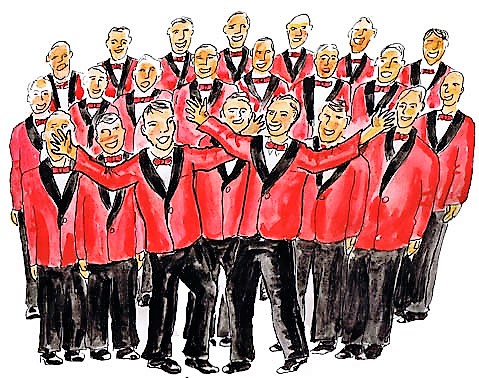
Recently, my wife and I attended a concert mounted by a local men’s chorus, a 108-man, traditional barbershop harmony group, but one that branches out into a cappella jazz, swing, soft rock, pop, traditional, and inspirational music.  The concert was superb, and we were fortunate to be invited to an after-party by one of the members (not-so-coincidentally, a golfing friend).
choir

And guess what!  Some of the choristers at that party gathered ‘round each other to sing some of the oldies, an impromptu concert.  And guess what else!  I sidled over, inched close to their circle, and joined my voice to theirs.  Tentatively at first, not wanting to spoil the beauty of their chorus, but then more confidently when two of them parted to make room for me.

I knew all the words, of course, and we belted out a few classics—When You Wore a Tulip, Daddy’s Little Girl (a personal favourite), Oh! You Beautiful Doll, and That Old Gang of Mine.  I could almost hear my father joining in beside me.

My wife told me later that I fit right in.  In fact, she said, some of the others at the party told her they assumed I was part of the chorus.  I stared at her, sure she was having me on, but she was apparently telling the truth.  And that was music to my ears (if you’ll pardon the pun).

Even better, however, was an invitation from several of the chorus members to try out for the group.  I would be assessed to find my voice part placement, followed by an audition performance with three of the established singers as part of a quartet.  And then I’d either be in, or out.

I’ve never been part of a quartet in the shower, where my best solos have been rendered, so this public audition will be somewhat intimidating.  Plus, I have never been much of a joiner in groups of any sort, so making a commitment to this will be quite a change.

Still, I do regret passing up my first chance those many years ago.  All those yesterdays when I could have been singing joyously with like-minded choristers are gone forever.  But I do have a few tomorrows ahead of me.  And I do like to belt them out.  So, we shall see.

More than three hundred years ago, in his comedy of manners, The Mourning Bride, William Congreve wrote this—Musick has charms to soothe the savage breast…

Well, I am no savage, but it may well be that music could soothe the sadness I have carried with me since high school.

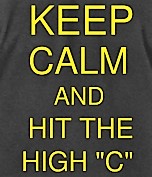
I’ll have to warn them, though, that I cannot hit the high C!

Anticipation and Response

The annals of human endeavour are replete with tales of glorious heroism and gallantry in the face of death.  In some cases, those involved were victorious in their struggle; in other cases, they were not.

As an example of the first, one might cite the conflict at Bannockburn in 1314 when an army of Scots led by Robert the Bruce defeated the army of England’s Edward II in a bid for Scottish independence—a battle where the flower of Scotland…stood against them, proud Edward’s army, and sent them homeward tae think again.

An example of the second is immortalized in Tennyson’s poem, The Charge of the Light Brigade, describing the failure of a British attack at Baclava in 1854, in the face of superior Russian forces—theirs not to reason why, theirs but to do and die…into the valley of Death rode the six hundred.

light brigade

Of course, one’s determination of the outcome, whether victory or defeat, depends to a great extent upon which side one was on.  But in all such confrontations with an enemy, whether military or civil, whether in war or peace, there are at least two key factors that determine success or failure.  The first is anticipation of and preparation for eventualities that might lie ahead; the second is mounting an effectual response to a threat if it materializes.

The efficacy of the second is, to a great extent, dependent upon the effectiveness of the first.  Robert the Bruce was successful on both counts, prepared and ready to win; the British high command at Baclava not so much.

If both factors—anticipation of future threats and successful response when they occur—are to be significant, leaders are needed who embody a number of qualities; for example, a perceptive and analytical mind, a willingness to trust authoritative sources, a capacity to look beyond short-term outcomes, and the ability to act decisively.

Absent those qualities—if we are cursed with leaders who are inferior thinkers, mistrustful of others, focused on short-term gains, indecisive or erratic when called to action—the chance of a positive outcome at the end of a struggle is much reduced.

When we look at the battle currently embroiling us, combatting the Covid-19 virus overrunning the world, there are four broad scenarios we might identify:  i) nations that were ill-prepared for a pandemic and are unsuccessfully battling it; ii) nations that, although likewise ill-prepared, are responding more effectively than might have been feared; iii) nations that seemed well-prepared, but for a variety of reasons are failing in the struggle; and iv) nations that were well-prepared and are successfully dealing with the scourge.

As you read and listen to news-reporting about the surge of the disease, you may be able to determine which nations fall into which category.  Those in category iv), alas, are the fewest in number.

We might have expected that the poorest, least-developed countries would have been among those most likely to be ill-prepared and, therefore, least successful in contending with the virus.  And that seems to be borne out as the virus spreads into the South American and African continents.

What we might not have expected, however, is that a nation purported to be among the most powerful the world has ever seen would have been so ill-prepared, and would have mounted such a dismal effort initially, that it currently has more fatalities than any other nation, ranking in the top four worldwide per 1 million population.  And climbing.

covid 4

One could be forgiven for thinking that the rally-cry to make that nation great again might now be recast as a prayer to make it whole again.

Anticipation requires foresight on the part of government; preparation requires a willingness on the part of elected leaders to spend what is needed to build bulwarks against a potential calamity.  And both require courage on the part of those leaders—Churchillian courage, Rooseveltian courage.

But preparation cannot be accomplished, unfortunately, without educating a populace clamoring for lower taxes, to help them learn that protecting our future comes with a cost.  The time to build the dike, and pay for it, is not when the flood is raging.

Effective response to a threat likewise requires courage, plus an ability to recognize that threat in a timely manner, and a willingness to act decisively to combat it.  Denial delays effective action; vacillation aids and abets the enemy; inaction too often proves fatal.

We are reassured by many experts in their field that we shall survive this plague and come successfully out the other side.  But we are warned by many of those same people that the worst is yet to come, that the other side is a good way off.  I pray the first is true, and fear the second is, too.

Increasingly, my thoughts turn to the future, if we are to have one.  There are harsh lessons to be learned from this pandemic, but I wonder if we will pay them heed.  From my layman’s perspective, it seems inevitable that we shall face a similar situation again—not necessarily a plague, but perhaps a massive crop-failure brought on by prolonged drought, perhaps a critical freshwater shortage, perhaps a worldwide collapse of the fiat currencies we have come to rely on, or an unmanageable debt-crisis.

crisis

Whatever the predicament may be, will we have leaders in place who will have anticipated it and prepared us to deal with it—perhaps soon enough to prevent its occurrence?  Will they be ready to respond to it in a timely manner, and to plan for an effective recovery?

Those questions will be in the forefront of my mind when I next journey to the ballot-box.

Lighten Up

As you may know, dear reader, being snuggled away in self-isolation, even in comfortable conditions, can become something of a drag after awhile.  So, I’ve taken to searching the web for uplifting and humourous utterances from famous people to lighten my mood.

It works most of the time, except for when I stumble upon something truly brilliant—at which point I fall into a funk, wishing it had been I who had said it first.

Nevertheless, here are a number of my favourites, sure to brighten the dullest day, lighten the heaviest melancholy, restore the most forlorn soul.

Lincoln

To make reading them a tad more fun, and to afford readers a chance to guess who the speaker of each might have been, I’ve appended the speakers’ names at the end of this post, listed in alpha order by surname. Some of the speakers are no longer with us, alas, but their joie de vivre lives on after them in their humour.

The three items with a double-asterisk indicate which of the speakers might have been (but were not) offering comments about books I have written.

*  *  *  *  *  *  *

a) I like long walks, especially when they are taken by people who annoy me.
b) Never interrupt your enemy when he is making a mistake.
c) You can get much farther with a kind word and a gun than you can with a kind word alone. 
d) They told me that Gladstone read Homer for fun, which I thought served him right.
e) The difference between fiction and reality is that fiction has to make sense.**
f) There is only one difference between a madman and me. I am not mad.
g) Fill what’s empty, empty what’s full, and scratch where it itches.
h) Remember, when you are dead, you do not know you are dead. It is only painful for others. The same applies when you are stupid. 
i) My mother’s menu consisted of two choices: Take it or leave it.
j) No man has a good enough memory to be a successful liar.
k) My doctor gave me six months to live, but when I couldn’t pay the bill, he gave me six months more. 
l) To succeed in life, you need three things: a wishbone, a backbone and a funny bone.
m) When did I realize I was God? Well, I was praying and I suddenly realized I was talking to myself. 
n) This is not a novel to be tossed aside lightly. It should be thrown with great force.**
o) Everything is changing. People are taking the comedians seriously and the politicians as a joke. 
p) I’m the only man in the world with a marriage licence made out to whom it may concern. 
q) Only I can fix it.
r) Once you’ve put one of his books down, you simply can’t pick it up again.**
s) When choosing between two evils, I always like to try the one I’ve never tried before.
t) The only way to get rid of a temptation is to yield to it.

*  *  *  *  *  *  *

If you have your own favourite quotation from a famous person, please feel free to add it in the Comment section below.

ANSWERS: a) Fred Allen; b) Napoleon Bonaparte; c) Al Capone; d) Winston Churchill; e) Tom Clancy; f) Salvador Dali; g) Duchess of Windsor; h) Ricky Gervais; i) Buddy Hackett; j) Abraham Lincoln; k) Walter Matthau; l) Reba McEntire; m) Peter O’Toole; n) Dorothy Parker; o) Will Rogers; p) Mickey Rooney; q) Donald Trump; r) Mark Twain; s) Mae West; t) Oscar Wilde

Cassandra

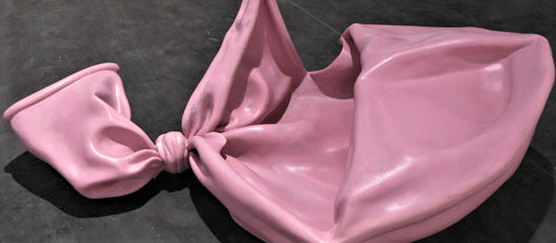
My crystal ball, alas, is not actually crystal.  What it is, in fact, is an ordinary rubber balloon—clear, transparent-pink in colour, filled, not with the swirling, necromantic vapours of true crystal balls, but with hot air.  My hot air.

I call my crystal ball Cassandra, named for the woman in Greek mythology who was granted the power of prophecy by the god Apollo, one of the twelve Olympians.  But because she, a mere mortal, spurned his romantic overtures, Apollo cursed her; although her prophecies were always correct, she was never believed.  At least not in advance.

kassandra-1

And so it is with my crystal ball, my Cassandra.

She sits in the centre of my dining-room table, nestled in a shallow bowl, a lovely piece of raku pottery made by my wife.  One might be excused for supposing that her colour (Cassandra’s, not my wife’s), should portend rose-coloured forecasts, but that is rarely the case.  In truth, she is more prone to proffering pessimistic, even alarming, predictions.

These are offered in a comforting contralto from somewhere deep inside my head—a voice only I hear, apparently.  I do know that people who claim to hear voices are generally looked upon by others with skepticism, even alarm, so for that reason, I consult Cassandra only in the privacy of my home.  But I always pay heed.

I ask her, for example, “Cassandra, can you assure me that, during this terrible pandemic, we have nothing to fear but fear itself?”

I wait, sometimes quite a while, for her response.  “Foolish man, you have everything to fear—except fear itself.  Your fear is the only thing that might save you, although that, too, is uncertain.  Fear, even when harnessed to blind faith, is often insufficient.”

On another occasion, I say, “Cassandra, I want to believe humankind will come safely through this horrid ordeal and get our lives back to normal.  Will it be so?”

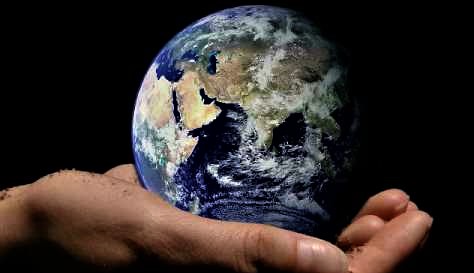
“And what is normal?” Cassandra replies.  “A planet quickly being denuded of its forest canopy, wracked by fire and flood, ravaged by earthquake and hurricane, its polar ice-caps melting, millions of its inhabitants dispossessed and starving to the point of extinction, its vast oceans no longer pristine?  Even I, Cassandra, am unsure as to why you would want to go back to that.  But I assure you that you most likely will.”

earth

That’s not the normal I had in mind, of course, so I persevere.  “Can we not overcome those problems if we put aside our selfish, nationalistic interests, if we all work together, if we mount a global effort, if we put into practice our stated belief in equity for all humankind?  Can we not establish a new normal?”

Cassandra is brutal in her honesty.  “Do you know how many times you used the word if in your question?  The issue is not whether you can work as one to overcome these problems, but whether you will.  Your history to date does not suggest a favourable prognosis.”

This is not encouraging at all.  But being a simple soul, not vested with any special powers or authority, in need of a beacon-light during times of trouble, I ask Cassandra, “Can our leaders not bring us safely through?”

Cassandra never snickers at my questions (although I imagine she might have this time).  But I listen, anyway, as she says, “And who are your leaders?  Those who are ordained and enrich themselves by preaching from their pulpits to frightened congregants?  Those who are elected and enrich themselves by talking down from their bully-pulpits to fearful constituents?  Those who are self-proclaimed prophets, charlatans, who promise only they can solve your problems for you?  Are these the leaders to whom you refer?  If so, the answer is No, they will not lead you home.”

voice2

I despair.  Just as the mythological Cassandra was correct in her soothsaying every time—to no avail because no one believed her—I fear that my own Cassandra is a victim of that same fate.  She is the voice of one crying in the wilderness, a source of harsh truths nobody wants to hear.

Mind you, I have to remind myself, I am the only one who claims to hear her, which is a shame.

“Is there no room for hope, then?” I cry.  “Are we all going to die?  Is our planet beyond saving?”

“Ah, foolish man,” Cassandra says, “perhaps enlightenment dawns.  The answer to your first question, as you well know, is Yes.  You all are going to die.  Everything dies, sooner or later.  There is a time for every purpose.”

I nod in agreement.  I do know that.

“But the answer to your second question is No,” Cassandra continues.  “The planet you humans profess to love but refuse to nurture was here for millennia before your arrival.  And it will be here long after you are gone.”

And then, as if to prove her thesis that everything dies, and before I can fully appreciate the true import of her final prophecy, Cassandra suddenly bursts.  With stunning speed, like any run-of-the-mill balloon, she is irretrievably gone.  Spontaneous self-destruction.  A big bang!

burst-balloon

And I am left with her voice no longer speaking in my head.  In its place, only the mournful sound of a sonorous bell, tolling for whomever might choose to hear.

Metaphysically

During this pandemic lockdown in which we all are bound, it is all too easy to surrender to despair.  But, always, there are pathways to freedom we can find if we look hard enough.  Here are a few of mine, in haiku form—

physically bound,

but metaphysically

I wander freely

metaphysical 1

on wings of sweet song,

I rise above the earthbound

shackles of my life

singing 2b

my literary

scribblings whisk me to a world

that I alone know

writing 2

phantasmical dreams—

delights from which I awake

most reluctantly

dreams 2

omnipresent, too,

the love, which for sixty years

has sustained my soul

love 1

physically bound,

yes; metaphysically,

I am ever free

waiting-and-watching-a-sunset


Intelligence and Change (2)

Three-and-a-half years ago, I published a post expressing concern about our human resistance to change, and our ignoring of evidence presaging a calamity—an event which is, perhaps, now upon us with the covid-19 pandemic.

You may not have read the post at the time, but I recommend you do so now, for two reasons.  First, it may help to explain just how we have arrived in this situation, particularly the paragraphs highlighted in blue.  And second, it may point the way to a correction in our future behaviours—assuming, of course, our species survives.

– 0 – 0 – 0 – 0 –

If the history of our planet and the existence of life upon it were to be displayed as a clock-face, with its beginning at twelve o’clock, the appearance of the first humanoid beings—our distant, distant precursors—would not occur until the hands had swept around to the merest sliver of time before twelve again.

clock-681645_960_720

Life itself, however, in its earliest, most basic form, would have begun much earlier, when the hands were approaching two o’clock.  The difference in real time is about four billion years, based on the fossil record so far uncovered.  Bacteria, for example, are a subset of prokaryotes, the earliest type of life on earth.

Life existed, in other words, for four billion years before the first hominim stood up on hind-legs, discovered oppositional thumbs, and (possibly) wondered who or what (s)he was.

All this time later, modern humans claim supremacy over the planet and everything living in its embrace.  Such foolhardiness, as we shall see.

We do so, I suppose, out of a belief that we are the most highly-intelligent life-form yet evolved.  Our basic intelligence—distinct from other species because of our imagination and curiosity, which allow us to ask such questions as Why?, How?, and What if…?—varies widely among individual humans, but is demonstrably more advanced than that of other species.

If the specie-specific intelligences of all life-forms, as we measure them, were arrayed on a graph, the human sort would be a tiny triangle at the very top of a much larger triangle, the lower intelligences of inferior life-forms spreading out below ours.

But that ranking may be misleading because of the definition of intelligence we apply in order to do the grading.  If the essential purpose of every known life-form is to perpetuate the species, to survive, and if each group’s success at doing so is the ultimate measure of intelligence, then our ranking would certainly be much different on the graph.

Very recently, a study undertaken at Indiana University posited that the earth might presently host almost one trillion distinct species, of which less than one-thousandth of one percent have been identified.  We might imagine that we are one of the very few species among them to possess an awareness of the others’ existence, but that awareness may not matter much.

A parasite life-form, firmly attached to a host, may not be cognitively aware of its host, but it thrives and reproduces because of their symbiotic relationship—even as the host dies.  The trillions of bacteria that live on our bodies, most of them in the intestinal tract, may have no cognitive awareness of us, but they are essential to our survival, and they reproduce exponentially.

In fact, it has been argued that our human bodies are nothing more than carrying-cases for our microbiome, a coalition of genes from several different species, only one of which is human.

Most bacteria are beneficial to us, but certain types, pathogenic or disease-carrying, can be harmful.  They exist in three main forms—cocci, bacilli, and spirilla—and reproduce so quickly that they can overrun an otherwise-healthy organism, causing illness and even death.

covid-19

Another species posing a threat to us, perhaps the smallest and simplest life-form of any on earth, is the virus.  By themselves, viruses are inanimate, requiring a host in which to multiply and grow—which they do by invading a host-cell, causing it to produce infected cells that attack other cells, and eventually killing the host.

The drive to survive among bacteria and viruses is relentless.  Human intelligence has inspired the development of methods to combat them—antibiotics, such as penicillin, amoxicillin, and tetracycline for bacteria; vaccinations and antiviral drugs, among them acyclovir and interferon, for viruses.  For a long time, these have been effective.

There is some evidence, however, that pathogenic bacteria and viruses are evolving into organisms with an immunity to the drugs we administer.  This comes as no surprise, really, because all living things evolve over time through a process of random mutation and selection.  The alarming thing is that these ‘superbugs’ may be outstripping our ability to develop new drugs to combat them.

Imagine, for instance, if all our defenses against bacterial infections and viral illnesses were to be rendered useless.  Which species would survive, the highly-intelligent one of which we are a part, or the simple, ruthless ones that have existed for the better part of four billion years?

In that context, which of the species is truly the most intelligent?  The human one that spawned Newton and Marie Curie, Mozart and Dylan, Indira Gandhi and Mother Teresa?  Or the simple ones that have ensured their survival over billions of years on the planet?

Einstein once wrote, “The measure of intelligence is the ability to change.”

But history tells us that, although humans are not naturally resistant to every bacterial and viral infection that might assail us, we are naturally resistant to change.

That is a problem.

Listening to My Mother

As a young boy, lo, those many years ago, I listened to my mother—not because I always wanted to, but because I quickly learned that not doing so could have severe consequences.  She’s been gone ten years and more, and yet I find I’m still listening, especially now, living in this pandemic world in which we find ourselves.

“Wash and brush your teeth first thing,” she’d say, “and brush your hair.  Make your bed before you get dressed, then come down for breakfast.”

bedroom

She didn’t tell me to shave, of course, my being but a stripling who had no need to do so.  But I was told to put my pyjamas away and drop my dirty clothes into the hamper on my way to the kitchen.

I didn’t need telling every day, but the reminders were frequent enough.  And woe betide me if I neglected any of the tasks.

Fast forward to today, and you’d see this past-mid-seventies man I have become still making my bed right after returning from my first visit of the day to the bathroom (where, of course, I wash and brush my teeth).  I still don’t shave, at least not every day, but I do brush my hair assiduously.

After slipping my PJ’s under the pillow, I get dressed (always neatly, if not stylishly), gather up any laundry, and head for the kitchen.

My mother always had breakfast ready when I got there, sometimes preceded by my brother and sisters, and she watched closely to ensure we ate everything—juice, oatmeal porridge, toast, and milk.

eating

“Sit up tall,” she’d say.  “Lift your spoon to your mouth.  Lean over your bowl.  Hold your spoon properly.”

My remembering it like this might make her sound like a martinet, but she was not.  Neither was she a nag.  She simply wanted each of us to be the best we could be, and she had strong opinions as to what the best looked like.

Today, my breakfast might consist of cottage cheese with fresh fruit mixed in, and a couple of oat biscuits; or granola with fresh fruit and yogurt.  Green tea has replaced the glass of milk, but juice is still a staple.  And while I am eating, I sit straight, careful not to lower my chin to the bowl.

“Don’t leave your dishes on the counter,” my mother would say when we’d get up to leave the table.  “Put them in the sink.  And make sure you fold your napkin and push your chair back in.”

To this day, my napkin is rolled carefully into the napkin ring, the chairs in my kitchen sit squarely around the table, pushed in just so.  And no dirty dishes adorn the countertop (although a dishwasher has replaced the sink to receive them).

I Love School

Our reward back then, as we tumbled out the door to school, was a smiling kiss from our taskmaster.  We expected it, looked forward to it, and remembered it often throughout the day.

Looking back, I think these instructions from my mother helped prepare us to face the world in front of us.  The subtle sense of accomplishment we gained from completing such simple chores, even if we weren’t consciously aware of it, instilled a sense of confidence in us that we were more than up to the task of dealing with whatever might befall us.

Of course, we were uncomplicated souls back then, my siblings and I.  As a senior citizen today, I would have expected myself to be much more jaded by now, much less naïve, not so likely to be swayed or influenced by simple rewards for elementary tasks.

Yet, here I am, confined to home because of the dreaded pandemic swirling around us, unsure as to what might lie ahead, needing that jolt of confidence more than ever.  I’m making my bed first thing every day, brushing my teeth, sitting up straight at the table.  I’m doing the dishes, the laundry, the numerous other household chores that keep my shrunken world from toppling over the edge into chaos.

And why?  Well, the answer to that is simple.

Mum

I’m still listening to my mother.

Can We Coexist? Will We Survive?

Some time back, well before the pandemic era we find ourselves in just now, I wrote a short piece on the importance of coexistence if we are to survive the challenges facing us as a species.  As we face the hardships wrought by the need for physical distancing and social behaviours that will ensure the greatest chance of survival for the greatest number of us, I am re-posting it in the severely-altered context of our world today.

– 0 – 0 – 0 – 0 – 0 –

There’s a bumper sticker out there that neatly sums up the means to solving the world’s problems, including war, famine, pandemic, pollution, drought, overpopulation, greed—

Coexistence sounds so simple, yet over the millennia it has proven impossible to attain.

An old joke goes like this:  “You don’t know when you’re dead; only other people notice.  It’s the same when you’re stupid.”

Never having been dead, I can’t vouch for the first premise; for all I know, the world will scarce notice when I’m gone.  But the second part might well be true.  Why else, other than stupidity,  do so many of us ignore the certainty that humankind’s current practices are dooming our planet?

Nation against nation, race against race, religion against religion; ignorance and denial of the potential rise of drug-resistant bacteria and viruses; endless resource extraction; massive defoliation and over-fishing; reckless despoliation of our environment, including the very air we breathe—all in the name of what?  Geo-political supremacy?  Last one standing wins?  It’s sheer, rampant stupidity.

In his poem, Ozymandias, Shelley wrote these lines—

“…on the [shatter’d] pedestal these words appear:
“My name is Ozymandias, king of kings:
Look on my works, ye Mighty, and despair!”
Nothing beside remains: round the decay
Of that colossal wreck, boundless and bare,
The lone and level sands stretch far away.”

Where the glory, where the triumph?  Nothing is left in a vast wasteland but a smashed relic of one man’s vainglorious attempt to take control of his world.

Think of two anthills in a garden, one bustling with industrious black ants, the other alive with equally busy red ants.  Everything is peaceful in the garden until, one sad day, the two colonies discover each other.  And then madness, folly, turmoil, mayhem, as each tries to subjugate the other.  Warfare unto the death, until the gardener brings his stomping boots and smashing shovel down on them.  And they are all annihilated, indistinguishable in their lifeless remains.

Is there a celestial gardener, I wonder, who looks upon our planet, this earthly garden, and despairs?  Do we appear as nothing more than those foolish ants, scurrying hysterically to and fro, intent upon the destruction of any who are not like us?  And will we avoid the gardener’s heavy boot?  Or is it already too late?

Coexistence has many synonyms: reconciliation, harmony, accord, synchronicity, collaboration.  All are needed if we are, indeed, to live together on our fragile planet.

Coexistence also has one supremely important result—

Survival!

Golfing Legends

In the long-ago summer of ’67, I went with a couple of friends to a day-long golf match at the Toronto Golf Club, the third-oldest course in North America.  We were there to watch two of the game’s leading players go head-to-head for Shell’s Wonderful World of Golf, a very popular TV program of the time.

Screenshot_2020-03-17 Home - Toronto Golf Club

American Mickey Wright, a winner of 82 LPGA championships and 13 majors, was matched against a young Canadian amateur, Marlene Stewart, who went on to become the only person ever to win the Australian, British, Canadian, and U.S. Amateur Championships.  Both women have since been elected into the World Golf Hall of Fame in St. Augustine, Florida.

My friends and I were rooting for the Canadian, of course, and after nine holes, she was up by one.  We had rushed ahead and strategically placed ourselves behind the ninth green, by the path the players would use on their way to the tenth tee.

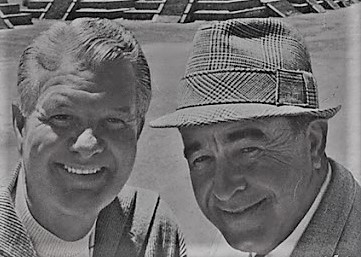
As they left the green, the women stopped to be interviewed by the co-hosts of the program, two revered PGA golfers, Jimmy Demaret and Gene Sarazen, by then both retired from the game.  Demaret had won 31 tour events during his career, and was the first three-time winner of the Masters.  Sarazen, known as ‘The Squire’, had won seven major championships, and is one of five golfers to have won a career grand slam—a U.S. Open (twice), a PGA Championship (three times), the British Open, and the Masters.  Both of them are also in the Golf Hall of Fame.

sarazen and demaret

These four people were, indeed, superstars, and there they were, standing right in front of me as the camera rolled, taping proceedings for the hour-long telecast scheduled for later in the season.

I don’t remember what was asked and answered during the interview; it took place, after all, fifty-three years ago.  Nor do I remember being conscious at the time that I might be captured on film directly behind the celebrity foursome.  And I do not remember ever seeing the program when it was eventually broadcast.

–  0  –  0  –  0  –

Many years later, my eldest daughter, Tara, had married a young CPGA golfer, head professional at one of Ontario’s premier golf courses.  We went with them on a week-long golfing holiday to Myrtle Beach, where we played several of the outstanding courses in the area.  At the end of one particular day, after enjoying a lovely dinner, the two couples withdrew to our separate bedrooms to read, watch TV, or, in my case, fall asleep.

Sometime shortly after I had done just that, my daughter burst into our room, face alight with excitement.

“Dad!  Dad!” she cried.

I wakened immediately, alarmed, worried something was wrong.

“Dad!” she said, plopping herself on the bed beside me.  “Did you ever go see a golf match at the old Toronto Golf Club?”

“Huh?” I managed.

“Dad, years ago, Marlene Stewart played a match with Mickey Wright, and it was taped for Shell’s Wonderful World of Golf.  Were you there?”

shell

Sitting up now, I tried to remember.  “Yeah, I think maybe I was.  I would’ve been in my early twenties, before I got married.  Why are you asking me now?”

“I knew it!” my daughter said, clapping her hands.  By now, our son-in-law, Adam, had joined her in our room.

“This is unbelievable,” he said.  “I was fooling with the remote and stopped on the Golf Channel.  By chance, there was an old black-and-white program showing a game in Toronto, so we watched it for a bit.  The guys hosting it were interviewing the two women playing the match, and there was a young guy standing behind them, right in the middle of the screen.”

My daughter cut in.  “I thought, ‘Holy cow!  That guy looks a lot like my dad, but younger.’  And just as I was thinking that, Adam said, ‘I think that might be your dad standing there.  How old is this program?’  So, it was you?”

The memories were slowly creeping back.  “I guess so, yeah,” I said.  “I was standing really close to them after the front nine, and I think you’re right.  They did stop to be interviewed.”

“Did you get an autograph from any of them?” Tara asked.

“Nope,” I said, seeing it again through the mists of time.  “As I recall, Marlene Stewart wasn’t much older than I was, and kinda cute.  I’d have been more likely to ask for a date.”

They laughed at that, even my wife, and then my son-in-law said, “I’ve seen you play.  You should have asked for a lesson!”

lessons2

We all laughed at the truth of that, but honestly, I’d been much too shy at the time to ask for any of those things—an autograph, a date, or a lesson.

To this day, I have never seen that program.  And I know my memories of being there at the match have been warped by the intervening years.  But I do remember those  people—Demaret, Sarazen, Wright, and Stewart—just as they were then, frozen in time.  Golfing legends.

I was certainly starstruck in the moment.  And I could never have imagined reliving the experience through the eyes of a grown daughter half a century later.

Wonderful world of golf, indeed!

Teenage Angst

The writers’ group I meet with regularly issues ‘prompts’ for us to generate story ideas, for presentation at our gatherings.  One of the most recent asked us to write about ‘oceans’—whatever that word might bring to mind.

I hit upon teenage angst as the setting for my piece, which I entitled By the Ocean.  Here it is for readers of this blog who might remember the heartbreak of summer love—

*  *  *  *  *  *  *

Despite my repeated efforts to block them out, the mocking words and melody keep running through my head—

On a day like today, we passed the time away,

Writing love-letters in the sand…

Not love-letters exactly; just a big heart drawn on the beach with a stick, an I on the left, a YOU on the right.  We’d spread a blanket inside the heart and lie beside each other, resting, oblivious to the comings and goings of the other surfers.  There was only us and our boards.

i luv u 2

Sometimes we’d just stare at the ocean, watching it crash ashore, pointing at the big waves others were carving.  Abby would say she could see charging white stallions in the surf, like a painting she once saw, but I could never see them.  All I ever saw was yellowish foam, flecked with flotsam, washing up on the beach.

As each afternoon wore on, the water would creep ever closer to us on the incoming surge, until finally it would lap at the very edge of the blanket.  We’d pack up then and head for higher ground.  She’d laugh each time we saw the tide take our love-letters in the sand, washing them away as if they’d never existed.

Those were my favorite times, those late afternoons, both of us exhausted from surfing the breaks and bombs, when the sun hovered precariously above the horizon before plunging into the ocean.  The tips of the waves were almost pink as they rose and fell pell-mell on the sand.  The water behind them had a slick, green sheen on either side of the wide, diamond-dancing path across the surface that led from us to the sun.

The ocean’s power was immense, like the love we had for each other.

–  0  –

I’m alone on the blanket now, though, and that cursed song keeps playing in my ears—

You made a vow that you would always be true,

But somehow that vow meant nothing to you…

I’m not sure when things changed, or why.  All I know is that, by the end of the summer, Abby was no longer surfing.  Not with me, and not with anyone else as far as I knew.  She quit returning my calls, and finally her mother told me to stop phoning.

I must have sounded pretty low because, even though she’d never approved of me—that beach-bum, I overheard her call me once—she explained that Abby had gone away to school.  Wellesley, I think she said, somewhere back east.  Not even a goodbye.

“What about you, Bode?” she asked, as if she cared.  “Where will you be going?”

I didn’t bother to answer.  Back to the beach is where I was going.  I’d grown up by the ocean, following my father from competition to competition up and down the state.  Even got to Hawaii once.  He won lots of trophies, not much money, and now, in his early-forties, he’s desperately clinging to that surfer-boy persona, the only thing he knows.

surfer

They’re still together, though, him and my mother.  She cleans house for the rich-bitches on the cliffs overlooking the ocean, earns enough to keep us in the old double-wide on the outskirts of Surfside Acres, a patch of scrubland north of the beach.

I worked part-time all through high school at the Hang-Ten Board Shoppe, which is as tacky as its name.  Paid enough to suit me, though, and I got to try all the latest equipment.  Now that I’ve graduated, finally, I’m hoping to pick up a few more hours, maybe earn enough to buy a set of wheels.

“Bode?  Did you hear me?  What school are you off to?”  Abby’s mother, still on the line.

I hung up without replying.  She didn’t care, and, apparently, neither did Abby.

–  0  –

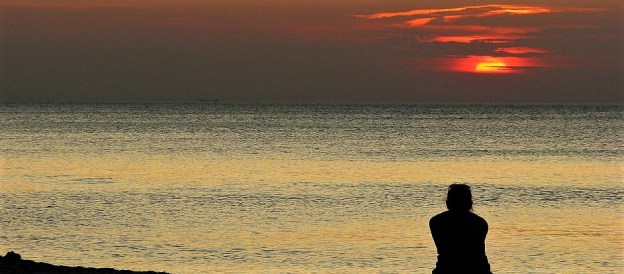
The surf is up today, the orange sun falling slowly behind scattered clouds to its rendezvous with the edge of the world.  Only a few people lie scattered on the sand, a few more out on the water.  I watch the waves creeping ever closer to the blanket, wishing Abby were here, knowing she never would be again.

I can imagine her friends talking about us.  Abby?  She’s at Wellesley.  Bode?  Still at the Hang-Ten.

Yeah, that’s me alright.  Despondent now, I resign myself to what I’m about to do.  Leaving my board by the blanket, I’ll wade out to waist-level, and begin the final journey from there.  I know the incoming waves are strong, but they won’t be a problem for someone who’s been surfing since he was eight years old.

sunset swim 2

I’ll follow that familiar, sun-dappled path on the surface toward the horizon—swimming freestyle, breathing easy, arms reaching, legs kicking.  I’ll harbor no second thoughts as the distance between me and the beach increases, stroke by stroke by stroke.  If someone on shore sees me, it won’t matter.

Pretty soon, I’ll feel myself tiring, but I won’t pause to look back.  Once I’m out beyond where the waves form, still swimming toward the sun—wondering if I’ll reach it before it’s extinguished by the ocean—it’ll be too late.

When my arms turn leaden, and my legs hang uselessly behind me, I’ll realize I’ve stopped for the last time.  And the damn song will start up again—

Now my broken heart aches with every wave that breaks

Over love-letters in the sand…

And as the song dies, so will I, swallowed by the unfeeling ocean.

–  0  –

I’m ready to do it now, but as I clamber to my feet, I spy Mary-Lou, Abby’s friend—the tiny one who always had a shy smile for me, the one Abby never let me get too close to.  She’s by herself at the water’s edge, holding her board, apparently unsure about going out alone.  Despite the heartsick funk I’m in, she looks mighty fine in her two-piece.  Rad!

When she sees me standing there, she waves and smiles, beckons me over.  I hesitate a moment—conflicted, my emotions chaotic—and then impulsively, I grab my board and trot towards her.  I feel a huge grin spreading across my face.  And as I get closer, another song breaks out in my head—

sufer girl

Little surfer, little one, makin’ my heart come undone,

Would you love me, love me, surfer girl…surfer girl,

My little surfer girl…