Don’t Tell Me!

It was only a minor argument between a father and his daughter, one quickly forgotten after the heat of the moment.  But for me, a bemused bystander, it featured one of the funniest rebuttals to an angry demand I’d ever heard.

“Don’t tell me what to think!” one of them declared vehemently after being told what to think.

father-scolds-his-scared-teenage-daughter-vector-18571097

The other, perhaps unable to come up with a suitable riposte right on the spot, retorted, “Don’t tell me, ‘Don’t tell me’!”

I laughed out loud, even as I wondered if there might be a third repetition, and maybe a fourth.  How long might they have gone on telling each other not to tell each other not to tell each other not to tell each other…?

But they didn’t.  And they laugh about it now, too.

I am reminded of the incident every time I survey the pessimistic contents of the various news media to which I subscribe.  Almost every story of national or international import seems to be a variation on that angry theme.  Leaders of the world—the free world, the enslaved world, the first world, the third world, the western world, the eastern world, the wealthy world, the impoverished world (all apparently oblivious to the stark reality that there is truly only one world on which we all must coexist)—shout back and forth across the social media platforms:  Don’t tell me!

And the reply each inevitably receives from the other seems eerily akin to what I heard so many years ago:  Don’t tell me, ‘Don’t tell me’!

Political insults cast on friend or foe alike are answered with retaliatory insults.  Harsh economic sanctions are met with retaliatory sanctions.  Tariffs engender retaliatory tariffs.  Expulsions of a nation’s diplomats are answered with retaliatory expulsions.  Embassy closings are countered by retaliatory embassy closings.  Bombings are met with retaliatory bombings.  Missile attacks are countered with retaliatory missile attacks.

Think of the retaliation if there is ever a full-out, nuclear, pre-emptive strike.

atom bomb3

It’s reminiscent of the excuse I used to hear from children on the playground so many years ago:  It’s not my fault, sir.  The fight started when he hit me back!

Having been the victim of an unprovoked, life-threatening attack myself—years ago, and too complicated to delve into here—I well understand how difficult it can be to turn the other cheek in the face of aggression.  Trying to understand another’s motivation in such circumstances, and perhaps to forgive, is nigh impossible.  I get that.

But, on a global scale, the consequences of not doing so are potentially catastrophic.  During the unlamented Cold War years almost half a century ago—where two nuclear superpowers, the USA and the USSR, faced each other down—the doctrine that prevented an accidental armageddon was the notion of mutually-assured destruction:  You might kill me, but you’ll die doing it!

I always thought the acronym for that misguided doctrine, MAD, seemed a perversely-perfect name.  And history tells us that humankind came terrifyingly close on too many occasions to perishing in its calamitous effects.

Wouldn’t a better approach, I wonder, be MAP—mutually-assured partnerships?  Would it not be better for the nations of the world to listen to one another’s concerns and aspirations, rather than turning a deaf ear?

As I’ve written in this space before, all of humankind—regardless of the power some wield, their wealth, political stripe, skin colour, religion, gender-identity, or ethnicity—all reside on one fragile planet.

coexist.jpg

Is it too hard for us, organized as we are into nation-states, to accept that none of us owns any of this world?  That we are merely borrowing it for our use during our blink-of-an-eye lifetimes?  That, if it belongs to anyone, it is to the future generations we hope will follow us?

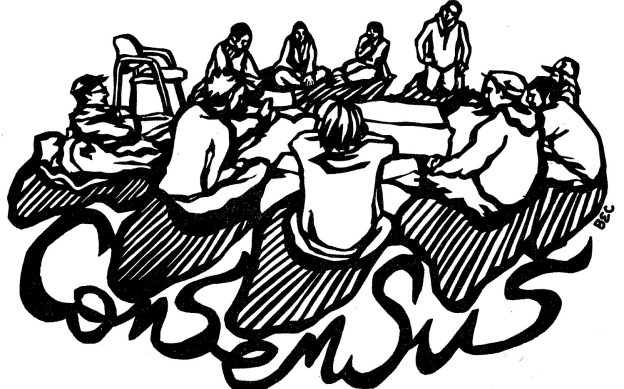
I long, perhaps vainly, for a day where the world’s leaders will open themselves up to each other.  “Tell me,” they could say, inviting the other side to respond, determined to listen.

“Now, let me tell you,” they could then reply, looking for a sharing of viewpoints, rather than a clash.

“Tell me more,” the other side might next say, encouraged by the openness.
15consensus_download1500

Wouldn’t we all be better off if that could ever happen?

Despite the pessimistic news reports of today that dampen my hopes and cause a weary shaking of my head, I force myself to remain optimistic that humankind might yet reach that stage.

“Don’t tell me we can’t all sit down together!” I protest.  “Don’t tell me it’s too late!  Don’t tell me we are doomed by our own stupidity!”

Don’t tell me!

Sex Ed for Kids

HEADLINE:  Ontario government announces return to 1998

sex education curriculum in schools.

*  *  *  *  *  *  *

I’m a thirteen-year-old girl, just finishing grade eight.  I like to send pictures of myself to friends, sometimes without clothes on.  My friends say they like them.  But now I think I’m in trouble.

sexting

I’m a fifteen-year-old boy in grade ten.  At night in my room, I look at porn sites I find online.  Sometimes, I pretend I’m one of the guys fooling around with those girls and I do what they’re doing.  Nobody knows and it feels great.

FACT:  The 1998 sex education curriculum is notably silent on such topics as sexting, masturbation, and online pornography.

I’m a thirteen-year-old girl and I have a boyfriend who wants to make out with me.  He says if I don’t wheel with him, he’ll find somebody else, so that’s what we do.  It would suck to be alone.

I’m a fifteen-year-old boy and I wish I was dead.  Everybody hates me.  They call me names and say awful things about me online.

cyberbullying

FACT:  The current sex education curriculum, which is being scrapped, begins to discuss strategies to deal with peer pressure and bullying as early as grade two.

I’m a thirteen-year-old girl and I nearly freaked when I started bleeding down there the first time.  I thought I was dying.  One of my friends told me get used to it, it’s going to be there for the rest of my life.  I can’t believe it!

embarrass

I’m a fifteen-year-old boy with pimples all over my face, and people tell me I stink all the time.  And I don’t have any hair on my legs like my friends do.

FACT:  The 1998 sex education curriculum is notably silent on such topics as menstruation, the physical changes associated with puberty, and the reproductive system.

I’m a thirteen-year-old girl with a friend whose parents let her drink at home.  When they’re not there, we raid their booze and have a party.  My friend adds water to the bottles so nobody knows.

I’m a fifteen-year-old boy and I can’t wait for the weekend when me and my friends get high.  We know a guy who gets weed for us easy-peasy.

toking

FACT:  The current sex education curriculum, which is being scrapped, begins to deal with substance abuse and healthy living as early as grade one.

I’m a thirteen-year-old girl and I don’t like boys.  Some of my girlfriends feel the same way, so kids call us lesbos or dykes.  What’s that about?

friends1

I’m a fifteen-year-old boy and I can’t stand queers.  Me and my friends laugh at them, call them names, post pictures of them online.  It’s hilarious.

FACT:  The 1998 sex education curriculum is notably silent on such topics as gender identity, sexual orientation, stereotypes and assumptions, and understanding of self.

I’m a thirteen-year-old girl and I think I’m in big trouble.  I can’t tell my boyfriend, and for sure not my parents, but I think I have an infection or something in my privates.

I’m a fifteen-year-old boy and all the guys are making fun of me ‘cause I haven’t done it yet with a girl.

shy

FACT:  The current sex education curriculum, which is being scrapped, begins to discuss sexual health, sexually-transmitted infections, pregnancy prevention, and delaying sexual activity in grade seven.

*  *  *  *  *  *  *

The 1998 sex education curriculum was developed twenty years ago for a previous generation of students.  It is so outdated that, in all its verbiage, there is but one single mention of the internet.  Its defenders appear to believe that all the information young people will need to grow into well-adjusted, healthy, well-informed adults will be imparted to them by their parents.

birds_and_bees_video

If only every child had parents informed enough and willing to doing so.

The current sex education curriculum, which is being scrapped, may not be perfect, but it is far and away superior to what we had before.  But don’t take my word for it; you can examine an overview of it at this safe link—

https://www.ontario.ca/page/sex-education-ontario#section-2

*  *  *  *  *  *  *

Although well beyond the age of having children of my own in our public school system, I am alarmed by what our recently-elected government in Ontario is doing to future generations with this misguided step into the past.

sex ed3

I always thought it was the truth that would make us free.

Top 24!

The men’s barbershop chorus I sing with, Harbourtown Sound, competed recently in Orlando FL, at the 2018 International Convention of the Barbershop Harmony Society.  The BHS boasts more than a thousand active men’s choruses, most of them in North America.

on stage

Member choruses also hail from such faraway places as Australia, Finland, Germany, Ireland, Netherlands, New Zealand, the UK, South Africa, Spain, and Sweden.  Barbershop quartets are included in the society, as well, bringing the total number of active singers to more than 80,000 worldwide.

The BHS was formally established in 1938 as the Society for the Preservation and Encouragement of Barber Shop Quartet Singing in America (SPEBSQSA).  The current name was adopted in 2004.

quartet

Membership in the society is open to everyone—people of every age, background, gender-identity, race, sexual orientation, political opinion, or spiritual belief. Every person who loves to harmonize has a place in the society.  The BHS vision is to bring people together in fellowship to enrich lives through singing.

It has certainly enriched mine.  Raised in a family that loved to gather ‘round the old upright piano for sing-songs at every gathering, I learned the words to so many songs from the 40’s, the ‘30’s, and even earlier before I was ten years old.  For a long time, my favourite singer was Al Jolson, for goodness sake!

For reasons that escape me, however, I never pursued a music education.  Not until I was cajoled a couple of years ago to audition for Harbourtown Sound, did I even sing in a choir.  But I was always a singer, mostly in the shower, sometimes in karaoke, and frequently while alone in my car.  And I always the loved the good old harmonies.

Now I get to sing many of them, and more, with a group of brothers on a weekly basis—and in performance in front of live audiences on frequent occasions throughout the year.  What’s not to like!

final rehearsal

Our chorus—almost a hundred men strong, most of us at or beyond the venerable threescore-and-ten—is not of the calibre of the top choruses in the world.  But of all such groups worldwide, we do rank in the top 24, based on the results of our recent competition.  We’re proud of that.

The 2018 champion is a chorus of more than 150 men from Dallas TX, Vocal Majority, a group that has won the title thirteen times dating back to 1975.  Listening to them is an emotional happening.

But so, too, is listening to us.  And you don’t have to just take my word for it.  Many of our songs—including Bridge Over Troubled Water, Five Foot Two, Hallelujah, That’s Life, Your Cheatin’ Heart, You Belong With Me, and You’ll Never Walk Alone—are available on YouTube.  A performance of one of them may be found right here—

I’m sure you’ll agree with my assessment after giving us a listen.  After all, in the whole wide world of barbershop singing, Harbourtown Sound is near the top.

Top 24, in fact!


Only Words?

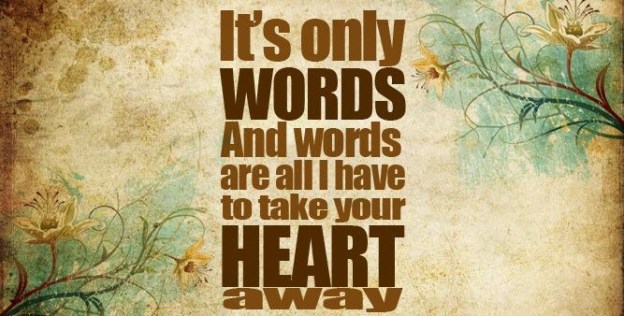
Away back in 1967, the year I was married, an Australian boy band, the Bee Gees, wrote and recorded a song entitled Words.  The chorus of that song became an anthem of sorts for a generation of young people—

words

As an author and blogger, words are my stock and trade.  And the writing of those words can be, of necessity, a lonely endeavour, deliberately shut away from the everyday toil and turmoil that too often consumes us.

Which is why I beg to differ with the sentiment of the Bee Gees’ statement.  Words, in fact, are not all we have.  When music is added to words, the result can provide a tremendous emotional impact for an audience fortunate enough to be part of it.  And when that music is made in the company of others, the loneliness and solitude of the writing process is greatly mitigated.

The men’s chorus to which I belong, Harbourtown Sound, provides teamwork, mutual support, and a sense of purpose to everyone who is a part of it.  And our audiences tell us they experience those same things when they listen to our performances.

See and hear for yourself by listening to a recent rehearsal tape, recorded in the setting in the picture below, punctuated in a couple of places by exhortations from the directors.

HTS Rehearsal

If you aren’t convinced by the blend of words and music here presented, well…..I guess all I can say is that I’m at a loss for words.


Social Contract

For a certain demographic in the province where I live, Ontario, the term social contract has a most unpleasant connotation, based as it is upon political events in the early 1990’s.  For my purposes in this piece, however, the reasons for that are not particularly relevant.

What is important is the need for a collective agreement among people in a society as to how we are going to live, which the maligned term might well describe.  But because of its history, and in order to expand upon the theme, I am using a euphemism, collective courtesy, to discuss that agreement.

Social-Contract

Whenever large numbers of people come together in a communal setting—whether village, town, or city—it quickly becomes necessary to establish and abide by certain rules of order.  Many of these are codified under the law and enforced by the legal authorities.

The scofflaws among us—and the outlaws—must be held to account for their actions if the established social order is not to break down.  It is a cornerstone of our society, dating back to the Magna Carta Libertatum in 1215, that no one is above the law.

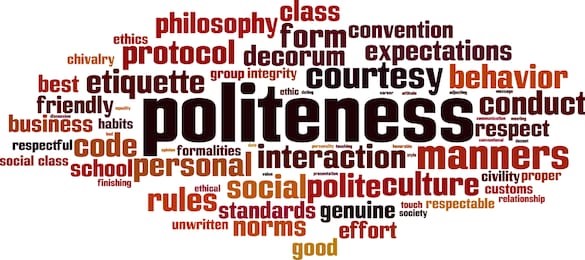
Collective courtesy, however, is not a concept easily enforced by our legal watchdogs.  Nor, in truth, should it have to be.  Rather, it is a set of intrinsic behaviours on the part of all citizens—built-in, second-nature, automatic, good-hearted—designed to enhance the public good.

Examples of such behaviours abound:  returning a friendly greeting; standing to shake someone’s hand; helping to pick up something another person has dropped; holding open a door for another to pass; saying please and thank-you; turning off cellphones in public assemblies; praising publicly, criticizing privately.

politeness

For some time, I’ve been conducting a scientific survey of the prevalence of collective courtesy in my daily life.  [Ed. note: not a scientific survey, more like an anecdotal scrutiny—but revealing].  The results are convincing me that, at least on a micro-scale, the occurrence of socially-helpful behaviours is diminishing.

Perhaps there are reasons for this.  Sigmund Freud believed it is impossible to overlook the extent to which civilization is built upon a renunciation of instinct.  And in large communal settings there is ever a friction between the social niceties and our more basic instincts.  In times of stress and turmoil, we tend to revert to the latter, and I fear the former may be losing out to it.

One of my primary observation areas is the behaviour of other drivers.  A few years ago, while driving in South Africa—where drivers on two-lane highways are expected to pull over on the paved shoulder to allow faster vehicles to pass—I noticed that almost all drivers do so.  Not only that, the other drivers, once they have safely passed, invariably flash their lights in thanks.

Here, on the other hand, I have detected very little of this sort of adherence to collective courtesy on the highway.  I habitually leave more than a car-length between me and the car ahead of me, and when other vehicles attempt to merge from an on-ramp, I slow enough to widen the gap.  And then I take note of whether I get a friendly wave from the drivers.  It hardly ever happens.  The imprecations I toss in their direction would not be suitable if my grandchildren were in the car, but they make me feel better.

merging2

By the same token, when it is I who is attempting to merge, I am constantly amazed by the number of drivers who speed up to narrow the gap I might well have been able to use, thus requiring me to slow precipitously and hope the next driver will be more understanding.  The imprecations I toss in their direction would not be…..well, you know.

Another area of observation is line-ups, whether at the bank, the fast-food joint, the boarding gate, the box office—and especially, the supermarket.  I have long been bothered by people who attempt to butt into line, sometimes while feigning ignorance (Oh, is there a line?  I’m sorry, I didn’t notice.  But hey, now that I’m here…).  Such people, I believe, should be told in no uncertain terms to back away.  They do not have a sacrosanct set of rules for themselves alone, though many seem to feel they do.

Self-entitlement is a bane on us all.

But where is the harm, I wonder, in allowing someone to go ahead in line when it makes eminent sense?  If you have six items at the checkout desk, for example, and are standing behind me with my forty-six items, would it really alter the course of my life if I permitted you to go first?

Or if you have a hungry, fussy toddler flailing about in your shopping cart?  Or if your aged spouse is obviously fighting fatigue, leaning heavily against the counter?  Or if you have a taxi waiting, meter already running?

1_supermarket_lineups

If my connecting flight is leaving an hour earlier than yours, will it really inconvenience you so badly to allow me through passport control ahead of you?  Do you not see the panicky look in my pleading eyes?

Not to present myself as some sort of latter-day saint, but I have done these things on various occasions.  And most of those who benefited (but not all) have thanked me.

Such collective courtesy is a strong glue, and vital to holding our society together.  It runs counter to the concept of zero-sum, where every action and reaction must net out to zero—for me to win, you must lose; and vice-versa.

The selfish among us appear to have no understanding of another important concept, pay-it-forward, which holds that an act of kindness is its own reward, and may prompt the recipient to do the same for someone else—a potential win/win/win.

win win

Rudyard Kipling, in The Jungle Book, wrote one of my favourite captures of this concept—the strength of the Pack is the Wolf, and the strength of the Wolf is the Pack.  It is we, individually, who build a strong society, and it is that same strong society that we depend upon in times of peril.

When we help each other, we all win—the very best kind of social contract.

So why are the results of my scientific survey (sorry, anecdotal scrutiny) so depressing?


Father

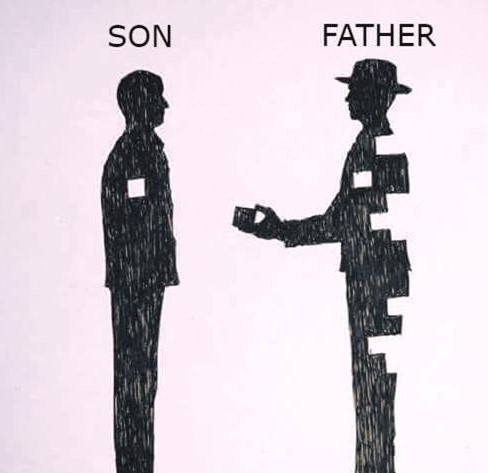
I came across an arresting picture on the internet recently, one that caused me to give some serious thought to what it takes to be a father.

IMG_4137

At first, I didn’t fully understand the symbolism inherent in the picture.  In fact, my first thought was that the son was systematically dismantling his father in order to complete himself.  Selfish, no?

But after a bit, I came to think the artist’s intent was more likely to show how much fathers give of themselves for their sons, even to the point of depleting their very being.  Selfless, right?

Still, I had difficulty coming to terms with either of those representations of fatherhood.  In the first place, I don’t have a son.  For the past forty-six years I’ve been father to two lovely daughters, so the picture didn’t truly portray me.

More importantly, though, I discovered I had a problem with the notion that fathers must become diminished in order that their children might thrive.  It’s true, of course, that any nurturing father will freely give of himself to help his children—so, in that sense, the picture of the fractured father did make some sense.

But it’s been my experience with my daughters that, the more I gave, the more I got in return.  And it wasn’t even an equal exchange!  What came back to me from the girls was infinitely more than I could possibly have given.

IMG_1575

As they progressed from infancy to girlhood, I used to tell them all the time how much I loved them, and I tried to mirror my words through my behaviours.  But with them, it was the reverse.  The loving attention they lavished on me—their hugs and kisses, their squeals of delight when I’d arrive home—made it unnecessary that they say anything.  They filled my heart every time I held them.

It was after each of them was born that I learned I didn’t have to carve out a chunk from my love for my wife in order to find love for them.  Love builds upon itself, I discovered; it multiplies and is unending.  So, each time I passed along one of those chunks of love, I was not depleted like the father in the picture; rather I was made even more complete.

Through their teenage years and into young womanhood, I came to realize the importance of letting them go bit by bit, even as I continued to hug them close.  And when they would come to me for advice, or even just for a sympathetic ear, our conversations were honest, sincere, and loving.  Even when I pretended to be the sage passing along my accumulated wisdom, I found I learned more from them—about their world, about the challenges and opportunities confronting them, and about the persons they were becoming.  Any chunks of insight I gave were repaid tenfold, and I was not at all diminished.

FullSizeRender

As mothers now, their first priority is to their husbands and children.  I don’t see them as often as once I did, but our get-togethers are all the more enjoyable for that.  I’ve tried to let both girls know that, although they long ago stopped being children, I’ve never stopped being a father.  They understand that and still go out of their way to make me feel valued and loved—supplemented even now, not depleted; relevant, not sidelined.

There’s an old saying that we have to give a little to get a little.  Well, when all is said and done, I gave what I could as a father, and I got so much more in return.  With another Fathers’ Day fast upon us, I give thanks anew for the great privilege I’ve had with such children.

If I had a picture similar to the one of that father and his son, there would be two daughters, complete and whole, and a father—double their size, swollen with the love and honour they’ve lavished on me.

Bursting, in fact.

Obsessive?

A friend of mine has long been a far-reaching, outside-the-box thinker, seemingly knowledgeable on any subject, no matter how esoteric or mundane.  If plotted on a graph, conversations with him would not reflect a normal back-and-forth pattern between us, regular and predictable along the spoken axis; rather, his portion would appear as jagged deviations from the anticipated flow of talk, spiking off in all directions from what might be expected.

the-free-thinker

He never tells a lie, so far as I know.  But his conversational pattern reminds me of what one might see on a lie-detector print-out—the lines ordered and sure while I’m speaking, careering wildly up and down on the page when it’s his turn to talk.  His free-thinking tendencies result in tangential observations I sometimes have difficulty understanding in relation to what we’re supposedly talking about.

My pseudo-psychological label for his thinking process is random-hysteric.

By contrast, I am as predictable as the sun at dawn, and as ponderous in my thinking as he is not—my label, perhaps, fixed-stable.  Although I love my friend dearly, it can irritate me when he strays from our conversational path, rather than continuing along what I perceive as the direct route from A to B.

stable

“What’s that got to do with what we’re talking about?” I often cry after one of his rambling excursions.  “Stick to the point!”

More often than not, he’ll simply shake his head at my apparent obtuseness.  But he doesn’t change his approach.  In his wide-ranging mind, everything he says is related to the topic at hand.

Deep down inside, though, I suspect the problem is mine, not his.  I am a plodder in most things.  It’s amazing how many times, as I journey from here to wherever, I am unaware afterwards of almost everything lying between point of origin and destination.  Stop to smell the flowers is not an adage I have ever rigorously adhered to.

When flying, if I know the expected time it should take to get there, I become impatient with deviations to the flight-path that might delay arrival.  When driving, I hate if we pull in at roadside attractions or scenic lookouts because stopping means we’re not actually getting to where we’re going.  When reading, I constantly check how many pages I’ve read and how many are left yet to read—even when I love the story.

When swimming in our pool, I count each lap faithfully, and get annoyed if I feel I’ve lost count.  It was actually a depressing moment when I first learned that a lap is properly measured as two lengths of the pool, not one; I felt cheated, as if I had lost half the number I had accumulated.  And worse, it got harder to keep accurate count!

swim2

Because I alternate strokes after each lap—freestyle, breaststroke, backstroke, sidestroke—I have my own counting pattern: 1-1, 1-2, 2-1, 2-2, 3-1, 3-2, 4-1, 4-2, 5-1, 5-2…until I hit my goal, 20-2.  And then, while showering, I go over it in my head, trying to ensure I didn’t miscount.  Obsessive?

If you look up the word methodical in the dictionary, my picture will be there.

And so it is in conversations with other people.  I absolutely love when they stick to the topic, acknowledge what I’ve said before beginning their reply, listen politely when it’s my turn again, offer their further thoughts when I finish, and (I really must say it again) stick to the topic.

Because I’ve long been aware of this eccentricity of mine, it has occurred to me that it might be one of the reasons why, when I find myself in a social setting with several other people enjoying conversations with each other, I’m often the only one not directly engaged—a gadfly, as it were, flitting from eavesdropping here to overhearing there, nodding and smiling as if I were part of each exchange.

talking3

But never mind.  A plodder I may be in just about everything, but in writing I find my escape.  For some reason, it seems not to disturb me that I can ramble on, hither and yon, from the start of an essay to the end—likely confusing many readers as to my thesis, my conclusions, even my thinking (such as it is).

Granted, there is always a starting point for each piece; but I seldom know at the beginning where the end will be found, or on what grounds I will trespass as I look for it. Most of the time, I just stop writing when it seems best.

There is a lovely peace that steals over me, and a surcease of compulsive demands, when I hie myself off to write.  Perhaps my brain draws respite from its normally-plodding behaviours as I lay down on paper the thoughts jostling each other for escape.

writing3

Once there, however, those thoughts are fixed.  As Omar Khayyam wrote (according to Edward Fitzgerald’s 1859 translation)—

The Moving Finger writes; and, having writ,
Moves on: nor all thy Piety nor Wit
Shall lure it back to cancel half a Line,
Nor all thy Tears wash out a Word of it.

And so, here I shall stop for now.

The Child We Were

We cannot know where we are headed, only whence we have come.  It behooves us, then, to help those coming along behind us.

*  *  *  *  *

we’re never so tall

as when we bend down to help

a child who needs us

comfort3

*  *  *  *  *

the child is father

of the man, as wordsworth wrote—

so nurture the child

images

*  *  *  *  *

to free your children,

hug them close, then let them go—

they’ll e’er be with you

hugs

*  *  *  *  *

those wee girls we raised—

grown now, married, mothers both—

never left our hearts

sisters

*  *  *  *  *

grandchildren, our hope

for the future—as we were

once upon a time

grandchildren

*  *  *  *  *

Learning the Game

As young parents so many years ago, my wife and I loved to watch our daughters play soccer with their local house-league teammates.  It was their first involvement with team sports of any sort, except for pickup-games at school, and we hoped they’d like it because the concepts of teamwork and sportsmanship are so important in later life.

Now, all this time later, it’s our grandchildren we get to watch—wondering how on earth the time passed so quickly.  Soccer and volleyball are their sports of choice, and they’ve embraced the team approach essential to both.

Having been involved with children’s sports in the past—not just as parents, but as teachers and coaches—my wife and I are still keen to see the atmosphere in which they play.  How competitive is it?  How do their coaches approach the playing of the sport—as games to win at all costs, or as opportunities for the kids to learn the skills of the games?  How encouraging or critical are the parents (and grandparents) on the sidelines?

Well, as it turns out, we’ve had no cause for worry.  The kids are playing for coaches who believe it’s as important to treat opponents with respect as it is to show them how to kick the ball accurately with either foot.  It’s just as important to teach them to shake hands with opposing players at the end of a match as it is to spike a ball past them.  For that we’re very grateful.

web1_GoodGame_PS

However, we were witnesses recently to two situations that point out the difference between how it should be, and how it all-too-often is.

After a soccer game on an adjoining pitch, two parents were walking their son, perhaps seven years old, toward the parking lot.  The father was particularly vocal as he verbally assailed the boy, and we, watching our granddaughters play, couldn’t help but overhear him.

“What’re you supposed to do when the whistle blows, eh?” was the first question.

The boy’s reply was delivered with head down, inaudible to us.

“You know?” the father said next.  “You know?  Well, it sure didn’t look like you know.  You’re supposed to stop when the whistle blows!”

The boy plodded on, chin on his chest.

“And why were you chasing the ball all over the field, anyway?  What is it about staying in position that you don’t get?  You ever heard of passing the ball?”

By then, they were adjacent to the field where the girls were playing.

“Look!” the father directed his son.  “Look there.  These kids know what to do when the ball goes out of play.  They don’t need their coaches yelling at them to get in position.  And they’re only girls!”

The boy didn’t look, of course.  He just kept going—trailed by his irate father and embarrassed mother—head down, a picture of dejection and simmering shame.

No-Bad-Kids

A number of us on the sidelines glanced at each other, eyebrows raised, silently shaking our heads.

On another occasion, by way of contrast, a friend of our daughter—out to watch her seven-year-old play volleyball—was shocked to see him refuse to shake hands at the end of a losing effort.  Rather than lining up at the net, he stomped to the bench, sulking at the score, and refused to mingle.  Despite her chagrin, she refrained from forcing him into the line-up, and she didn’t chastise him in front of the other boys.  But, as she later told our daughter, she spoke to him about his behaviour after they arrived home.

She asked him a number of questions, including, “How do you think the other kids felt when you wouldn’t shake hands with them?  How would you feel if they didn’t congratulate you if your team won?”

He resisted at first, naturally enough.  But she encouraged him, helping him to place himself in their shoes, a difficult task for a youngster that age.  He eventually acknowledged that being a good sport was important, whether his team won or lost the game.

mom3

Together, they agreed—he somewhat more reluctantly than she, as she reflected later with a rueful smile—that if he couldn’t lose gracefully, he shouldn’t be playing at all.  Next, she had him talk to his coach on the phone, to tell him he must miss the upcoming game because of what he’d done.  The coach commended him for owning up to his mistake.

When that next game was played, the boy was sitting in uniform with his parents on the bleachers, watching and learning.  He didn’t play, but at game’s end, he joined his teammates in the line at the net.  Since then, there’s been no problem with his attitude, and he’s played in every game.  He’s often first in line now, I’m told, to shake hands with the other side, win or lose.

When I think about these two episodes, there seems no doubt as to which boy learned the most—the one who was accosted out of anger and frustration, or the one who was encouraged to talk about, and face, the consequences of his actions.  The one who was humiliated, or the one who was left with his dignity intact.

What was it that each boy learned from the exchanges?  And which boy has the best chance to grow into a mature, respectful young man?  A devoted husband?  A nurturing father?

Next to caring teachers and coaches, good parents are every child’s best friends.  Good parents lift their children high, hug them close, then let them go.

mom2

Of course, I have to add that wise grandparents are pretty awesome, too!

Paragons of Truth

It is beyond difficult to be a paragon of virtue, one free of sin and avarice, a human being to be admired and emulated, a soul who rises far above the rest of poor mortals who can only watch in awe and wonder.

Or so I imagine it must be, for (as my friends will readily attest) that description does not fit me.

There are many who have been thus esteemed, however.  A partial list from my own lifetime might include Leyhma Gbowee, Mahatmas Gandhi, Martin Luther King, Jr., Aung San Suu Kyi, Nelson Mandela, Shimon Peres, Albert Schweitzer, Mother Teresa, Lech Walesa, and Malala Yousafzai.  All but one of these worthies were awarded a Nobel Peace Prize in recognition of their character and accomplishments.

portraits-images-eyes-famous-leader-260nw-418601185

There are others who could be added, as well—people who, for reasons varying by nationality, culture, religion, or political necessity, had bestowed upon them (even if only for a time) an aura of goodness and purity to which we might all have aspired.  They include Churchill (but not Chamberlain), Chang Kai-Shek (but not Mao Zedong), Ben-Gurion (but not Netanyahu), de Gaulle (but not Pétain), Graham (but not Bakker), Kennedy (but not Nixon), and Mulroney (but not Turner).

In truth, however, were all those so proclaimed really paragons of righteousness?  Or were they mere mortals like the rest of us—caught up in events largely beyond their control—but whose endeavours as they grappled with those events were in sync with our western-world point of view?

A close reading today of the historical record of those who have passed away, and of the contemporaneous reporting about those still with us, tells us that, in fact, all these heroes and heroines fall short of the near-mythical status granted them.

keys

The key to understanding history is knowing it was written by the victors.  But it is pretty much accepted that not everyone who reads that official history will agree with it.  We tend, as human beings, to see truth in accounts that reflect our pre-conceived opinions, and to disagree with reports that run counter to those.

One’s assessment of such historical figures as Columbus, Napoleon, Bismarck, Rhodes, Cochise, Lenin, Roosevelt, Castro, or Thatcher clearly depends upon one’s viewpoint with respect to their accomplishments.  Who among them was good?  Who was bad?

The history of our times that will one day be written will depend to a large extent upon contemporary reporting—by the press, the broadcast media, the social media, and the special interest groups—of the events now occurring in the world around us.  And many of the people who will read that history will have no first-hand knowledge of where the truth really lies—if there even is one truth.

news1

news2

As a boy, I became an avid reader of the two daily newspapers that came into our home, especially the comics, the sports, and the weather forecasts.  Then, marking the example of my parents, I soon branched out into current events, and became able to identify the important people of the day, those gracing the pages I devoured.  I thought they were above us, those newsmakers, guiding the fate of the world on our behalf.  And I believed what I read about them.

Only later did I come to learn that many of my friends’ homes subscribed to other papers, and that their editorial biases were different from those we favoured.  I was shocked, truly, to realize that not everyone revered the same newsmakers I did—that, in fact, some people actually reviled them.  In an attempt to reconcile the discrepancies, I began to explore those other perspectives with a view to discerning what was true and what was misinformation.  With the advent of television newscasts, the sheer volume soon made that impossible.

But I did discover one thing, at least.  No one—not the most famous person found in the newspaper, nor the lowly paperboy delivering it (my status at the time)—was an unblemished paragon of purity.  All of us, no matter our station in life, had warts, even if those were not always readily seen.

paperboy

My mother used to encourage us to look for good in everyone—on the theory, I suppose, that if we didn’t at least look, we’d never find it.  She would remind us of the biblical admonition to mind the mote in our own eyes (I didn’t know for a long time what a mote was, but I dutifully tried to oblige), and the other about not casting stones, literally or figuratively, given our own shortcomings.  Good advice, if not always easy to follow.

So here I am, at the age of three-score-and-fifteen now, no longer believing there are any paragons of virtue in the world, but desperately wanting to believe there could be.  Here I am, not knowing what the real truth is, but desperately hoping there is one, still believing it will set us free.

As Abhijit Naskar has written, “It is a tragedy of modern life that the light of truth scares the society much more than the darkness of ignorance.”

So here I am, still reading, still listening, still exploring—still trying to figure it all out before my own time runs out.