
[NOTE: IF THIS COMPLETE BLOG-POST LIES IN THE BODY OF AN EMAIL, CLICK ON THE TITLE TO READ IT IN ITS NATURAL ENVIRONMENT ON MY BLOG-SITE. IF ONLY A LINK IS PROVIDED IN THE EMAIL, CLICK ON THAT.]
Have you ever found yourself absolutely alone in a crowded room—at a family gathering, perhaps, or a business function, a party with friends, a community meeting? It would seem hard to accomplish that when one is surrounded by so many people, but I manage it all the time.
At a recent Mothers Day gathering with my two daughters, their husbands, my five grandchildren, two of their boyfriends, and my wife all in attendance, conversations were animated, exuberant, and loud. I know, because there I was, perched on a stool around the large island in the middle of the kitchen (always our family’s favourite gathering place), surrounded by this multitude, yet strangely not involved in any of the conversations. Nursing a glass of wine, I found myself eavesdropping on each different group in turn, quite interested in the latest news they all were sharing with one another about their work and school activities, yet not contributing a word myself.
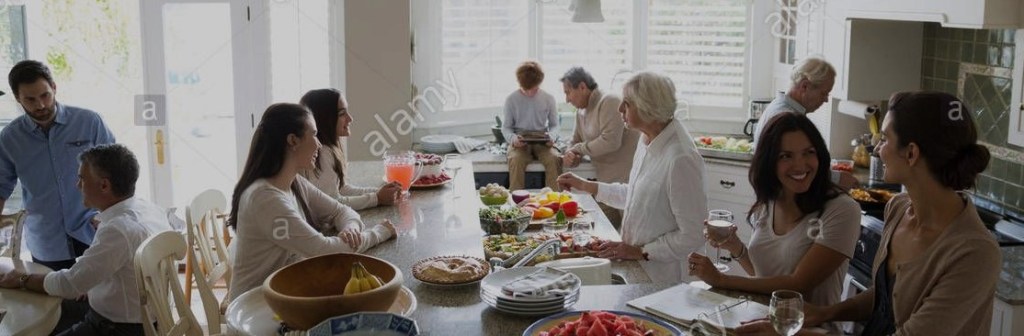
But this is not a new phenomenon. In fact, having become almost invisible on so many such occasions, I’m rarely even asked to contribute.
Over the years, I’ve often wondered if I’m naturally introverted, or maybe anti-social by nature. From time to time, I’ve questioned my conversational skills or lack thereof. I’ve even fallen prey every now and then to doubting my innate charm and charisma, and I’ve worried that perhaps no one holds me in high esteem.
Too many times, it seems, I’m at a restaurant with three or four couples, and I look up from my soup to find myself alone at our table. I wonder if the others might be at the salad bar or in the washroom, perhaps—but all of them? At the same time?
Or I might be at a dance, ten of us sharing a table, and I suddenly realize I’m sitting by myself again, while the others are up dancing or table-hopping.
The tedious jokes flow at these moments, naturally. Seeing me alone, someone will ask in a loud voice if I’m dining tonight with all my friends. Or someone will wonder if I said something to offend everyone in my party.

The problem is, I’ve never had an answer.
What I do know, however, is that I’m not one to blithely accept blame for my own perceived shortcomings. I am a loving and capable person, after all—or so I want to believe—and I have choices. For example, if people are ignoring me—or worse, don’t even realize I’m present—I can choose to consider it a flaw on their part, not mine. The problem with that approach, however, is that many of them are people I love and admire, so it’s difficult to malign them, even secretly.
A better choice, I’ve discovered, is to adopt the stance that I am freely choosing to be alone in these various situations. I’m doing it on purpose. And why? Well, because I’m a writer of fiction, and it’s a well-established fact that, to be effective, writers like me, who make stuff up, have to be keen observers of human nature. After all, if we’re going to create believable characters out of whole cloth in our stories, we absolutely must possess a keen sense of what makes people tick in real life. And the best way to do that, I’ve convinced myself, is by observing those around me, listening to them, getting a feel for them through what they do and what they say.
Interacting with people, I believe, is not good because I will inevitably corrupt the essence of who they are through my own conversational filters. But by choosing to stand back, remaining aloof, I am better able to ascertain who they really are in their daily interactions. They remain unblemished by any preconceived notions I might apply to them, and it is those untarnished attributes I will then bring to the creation of my own fictional characters, thereby improving the quality of my writing.
Or so I tell myself.
Nevertheless, I confess to a lingering and puzzling disappointment whenever I find myself alone again in large groups. Recently, on the advice of someone I trust, I arranged to see a therapist renowned for helping folks like me. My first appointment was yesterday, but to my surprise, it was a group-session—not something I had counted on. After fetching the obligatory coffee, I took a seat in the circle and listened as each person in turn explained why he or she was there, what their last week had been like, how the others in their lives continued to let them down…and so forth and so on. I found it fascinating, and was soon busy tapping notes surreptitiously into my phone. I wasn’t sure that was allowed, but happily, no one seemed to notice what I was doing.

After an hour or so, I was fully-engrossed in reading over these notes, optimistic that I’d uncovered a gold-mine of observations I could use back at my writing-desk. I looked up, eager to listen to whoever was next, and…well, you can probably imagine my shock when I discovered I was alone in the room. The session had ended, the circle was broken, and no one had asked to hear from me.
Not knowing whether to laugh or cry, I chose the former. These therapy sessions, I told myself, were going to prove a treasure-trove of inspiration for my writing. And best of all, I was going to be able to gather whatever information I wanted with no one even knowing. As in so many other instances, I was virtually invisible in the group.
No wonder I’m such a good writer!
Alone again!



 tallandtruetales