A Loss For Words

[NOTE: IF THIS COMPLETE BLOG-POST LIES IN THE BODY OF AN EMAIL, CLICK ON THE TITLE TO READ IT IN ITS NATURAL ENVIRONMENT ON MY BLOG-SITE. IF ONLY A LINK IS PROVIDED IN THE EMAIL, CLICK ON THAT.]

Most people who know me would likely tell you I am rarely, if ever, at a loss for words.  But they would also assure you, I trust, that I am far from being a blabbermouth.  My own opinion is that in most social situations, I can hold my own in conversation without becoming annoying or overbearing.

Most of the time, I listen; when appropriate, I ask questions.  If prompted, I will hold forth on a subject (if I know something about it), but not to the point of boring my friends to tears…I hope.

There is one situation, however, where all of the above is not true, perhaps the only circumstance where I find myself virtually unable to get a word in edgewise.  This unfortunate state of affairs occurs every time I find myself on a FaceTime call with my wife and daughters.  I hustle into the den with my iPad, leaving my wife with her screen in the living-room, so we won’t get feedback during the call.

When I say ‘unfortunate’, I mean for me, of course; for all I know, the ladies find it delightful when I sit, practically mute, at my end of the line.

The problem arises, not because my wife and daughters ramble endlessly on and on, not because they’re rude or inconsiderate, not because they delight in ignoring me, even politely.  Nothing could be farther from the truth.  In fact, they are all among the most considerate of creatures on the face of the earth, and they love me dearly.
No, the problem occurs almost every time we’re on a call because they appear to react faster than I do.  And to think faster, too, I suppose.  Regardless of the subject, I’m usually listening attentively as they express their various points of view, waiting for my brain to kick into gear as I consider an appropriate response.  The sad fact is that, by the time I have a response, one of them has already jumped back into the conversation ahead of me.

Another issue causing me a problem is their propensity to change subjects at the drop of a hat.  We might have spent five minutes batting a particular topic back and forth—the three of them talking while I listen—and Boom!  Without warning, one of them will introduce a brand-new thread, or ask about something entirely different from what we’ve been discussing. 

Even as my brain registers the change, a part of it is crying, silently and forlornly, that I haven’t yet kicked in my two cents’ worth on the first topic.

But they aren’t rude, as I have said, so at some point (perhaps noticing my silence), one of the girls might say, “What do you think, Dad?” 

“Ah…let’s see,” I reply, “can we go back to that first thing we were talking about?  I had a thought about that, but I couldn’t get in.”

The three of them laugh and roll their eyes at this, chide me to ‘keep with the tour’, then blithely resume their three-way conversation.  It’s probably just as well, I guess, because by the time I’m asked to chime in, I’ve often forgotten the point I wanted to make, anyway.

I must admit, though, all modesty aside, that I generally look surprisingly good on those FaceTime calls.  I sit up straight, look right into the camera (with an occasional peek at my own image), and keep myself centred in the screen.  They, by contrast, let the screen wobble all over the place as they walk from room to room tending flowers, picking up dirty clothes, starting early prep for supper, training their camera on their dogs.  It drives me crazy, but I can never worm my way into the conversation to ask them to stop.

I’ve explored various strategies to help, but none seems to.  I’ve tried holding up my hand, for example, when I want to cut in, but all I get is a return wave, as if they think I’m leaving the conversation.  “Bye, Dad!”

On more than one occasion, I’ve cut my video feed for a few seconds, hoping they’ll wonder if I’m okay, but all I hear is, “Looks like Dad has left the conversation!  Was it something we said?”

“No!” I want to shout, as I turn the video back on.  “It’s because I haven’t said anything!”  But they’re already talking about something else, so once again I can’t get in.

I recognize that the limitations of the FaceTime technology, marvellous though it is, play a part in exacerbating my dilemma.  The offset between audio and video transmission makes it difficult for me to pick the right moment to jump in—like watching a TV commentator interviewing someone far away, each of them experiencing a delay in hearing the other, resulting in dead air.  If I speak up too soon, while one of the girls is still talking, no one hears me; if I wait ‘til she’s finished, someone else has already started.

Still, I persist in taking part in these FaceTime calls, not only to hear what the girls have to say, but to look at them as they’re saying it.  And I console myself that, if ever I had anything pertinent and crucial to share with them, I probably did it years ago.  Whatever I might add now is probably just more of the same.

The ironic part of the whole thing, though, is after we’ve ended the call, I’ll wander back into the living-room and my wife will say, “Are you okay?  You didn’t have much to say today.”

And that always leaves me at a loss for words.
Alone Again!

[NOTE: IF THIS COMPLETE BLOG-POST LIES IN THE BODY OF AN EMAIL, CLICK ON THE TITLE TO READ IT IN ITS NATURAL ENVIRONMENT ON MY BLOG-SITE. IF ONLY A LINK IS PROVIDED IN THE EMAIL, CLICK ON THAT.]

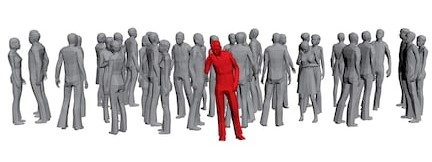
Have you ever found yourself absolutely alone in a crowded room—at a family gathering, perhaps, or a business function, a party with friends, a community meeting?  It would seem hard to accomplish that when one is surrounded by so many people, but I manage it all the time.

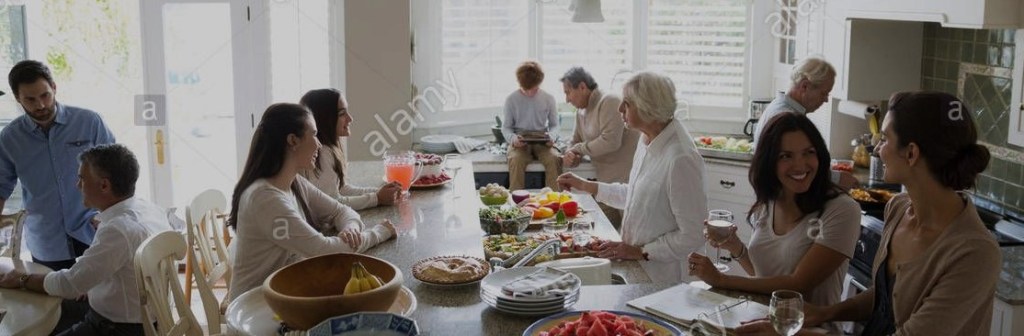
At a recent Mothers Day gathering with my two daughters, their husbands, my five grandchildren, two of their boyfriends, and my wife all in attendance, conversations were animated, exuberant, and loud.  I know, because there I was, perched on a stool around the large island in the middle of the kitchen (always our family’s favourite gathering place), surrounded by this multitude, yet strangely not involved in any of the conversations.  Nursing a glass of wine, I found myself eavesdropping on each different group in turn, quite interested in the latest news they all were sharing with one another about their work and school activities, yet not contributing a word myself.

But this is not a new phenomenon.  In fact, having become almost invisible on so many such occasions, I’m rarely even asked to contribute.

Over the years, I’ve often wondered if I’m naturally introverted, or maybe anti-social by nature.  From time to time, I’ve questioned my conversational skills or lack thereof.  I’ve even fallen prey every now and then to doubting my innate charm and charisma, and I’ve worried that perhaps no one holds me in high esteem.

Too many times, it seems, I’m at a restaurant with three or four couples, and I look up from my soup to find myself alone at our table.  I wonder if the others might be at the salad bar or in the washroom, perhaps—but all of them?  At the same time?

Or I might be at a dance, ten of us sharing a table, and I suddenly realize I’m sitting by myself again, while the others are up dancing or table-hopping.

The tedious jokes flow at these moments, naturally.  Seeing me alone, someone will ask in a loud voice if I’m dining tonight with all my friends.  Or someone will wonder if I said something to offend everyone in my party.

The problem is, I’ve never had an answer.

What I do know, however, is that I’m not one to blithely accept blame for my own perceived shortcomings.  I am a loving and capable person, after all—or so I want to believe—and I have choices.  For example, if people are ignoring me—or worse, don’t even realize I’m present—I can choose to consider it a flaw on their part, not mine.  The problem with that approach, however, is that many of them are people I love and admire, so it’s difficult to malign them, even secretly.

A better choice, I’ve discovered, is to adopt the stance that I am freely choosing to be alone in these various situations.  I’m doing it on purpose.  And why?  Well, because I’m a writer of fiction, and it’s a well-established fact that, to be effective, writers like me, who make stuff up, have to be keen observers of human nature.  After all, if we’re going to create believable characters out of whole cloth in our stories, we absolutely must possess a keen sense of what makes people tick in real life.  And the best way to do that, I’ve convinced myself, is by observing those around me, listening to them, getting a feel for them through what they do and what they say.

Interacting with people, I believe, is not good because I will inevitably corrupt the essence of who they are through my own conversational filters.  But by choosing to stand back, remaining aloof, I am better able to ascertain who they really are in their daily interactions.  They remain unblemished by any preconceived notions I might apply to them, and it is those untarnished attributes I will then bring to the creation of my own fictional characters, thereby improving the quality of my writing.

Or so I tell myself.

Nevertheless, I confess to a lingering and puzzling disappointment whenever I find myself alone again in large groups.  Recently, on the advice of someone I trust, I arranged to see a therapist renowned for helping folks like me.  My first appointment was yesterday, but to my surprise, it was a group-session—not something I had counted on.  After fetching the obligatory coffee, I took a seat in the circle and listened as each person in turn explained why he or she was there, what their last week had been like, how the others in their lives continued to let them down…and so forth and so on.  I found it fascinating, and was soon busy tapping notes surreptitiously into my phone.  I wasn’t sure that was allowed, but happily, no one seemed to notice what I was doing.

After an hour or so, I was fully-engrossed in reading over these notes, optimistic that I’d uncovered a gold-mine of observations I could use back at my writing-desk.  I looked up, eager to listen to whoever was next, and…well, you can probably imagine my shock when I discovered I was alone in the room.  The session had ended, the circle was broken, and no one had asked to hear from me.

Not knowing whether to laugh or cry, I chose the former.  These therapy sessions, I told myself, were going to prove a treasure-trove of inspiration for my writing.  And best of all, I was going to be able to gather whatever information I wanted with no one even knowing.  As in so many other instances, I was virtually invisible in the group.

No wonder I’m such a good writer!

Alone again! 

Platitudes and Attitudes

Platitudes are trite, banal, or hackneyed statements, timeworn clichés people use because they allow us to sound like we know what we’re talking about, sometimes providing us a polite way to avoid difficult conversations.

Most of them are overused phrases or expressions that have lost their originality and power.  But because they’re expressed in a formulaic manner, their meaning is usually recognizable instantly.

While all of us probably resort to using clichés at one time or another, there are those among us for whom platitudes are the standard form of conversation.  We would be likely to hear phrases such as the following when we encounter these folks: it is what it is; it’s a no-brainer; it ain’t rocket science; time will tell; that’s life; or everything happens for a reason.

Such glib folks might themselves be described in cliché-form: all hat, no cattle; the blind leading the blind; or ignorance is bliss.

Beyond the simplistic ones, I find some platitudes to be downright cringy: all you need is love; love makes the world go round; if it’s meant to happen, it will; patience is a virtue; no pain, no gain; or good things come to those who wait.

I do enjoy many platitudes, though, if for no other reason than they give me the opportunity to counter them with snappy, little rejoinders of my own, reflecting attitudes perhaps better left undisturbed.  For example—

God helps those who help themselves; okay, but I hope God also helps those who get caught helping themselves!

Practice makes perfect; yeah, but only if it’s perfect practice!

Don’t criticize a man ‘til you’ve walked a mile in his shoes; right, because by then you’ll be a mile away and have his shoes!

What doesn’t kill you makes you stronger; except if it doesn’t!

You’ll find love when you’re not looking for it; maybe, but good luck with that if love isn’t also looking for you!

Absence makes the heart grow fond; perhaps, but fond of whom?

Stop and smell the roses; great idea, unless bees are gathering rose-pollen where you stick your nose in!

Better late than never; unless, that is, you weren’t invited in the first place!

One person’s trash is another person’s treasure; sure it is, if it’s not already a rotting pile of garbage!

He’s at his wit’s end; or on the other hand, he may just be halfway there!

It’s not what you know that matters, it’s who you know; perhaps, unless you don’t know anyone important!

Curiosity killed the cat; true, but satisfaction brought…well, you know!

There’s always light at the end of the tunnel; there is, but it might be an oncoming freight-train!

Beauty is only skin-deep; that’s alright, I’m thick-skinned!

Two heads are better than one; fine, as long as they aren’t attached to the same torso!

There’s someone for everyone; and you would know this…how?

It is better to be by yourself than engaged in bad company; in that case, please excuse me!

Ah, those last two are a tad unkind, I must admit, but they tickle my funny-bone, anyway.  It has been said by someone far wiser than I that an idle mind is the devil’s workshop.  So, to foil that maleficent demon, I often occupy my idle mind with such trivial pursuits as this, and then write them down. 

I hope you have enjoyed some of the results.   

Repeat Again!

In my personal opinion, it was an unexpected surprise to each individual person to see an armed gunman circling around the fenced-in enclosure where the invited guests had gathered together.  The uninvited intruder, although separated off from them, was in their close proximity, which presented a difficult dilemma as to how they possibly might escape to freedom.

Did the two sentences above capture your interest, alarm you, perhaps?  Or did they bog you down with verbosity?

If the latter, how would you rewrite it?

One of the outcomes desired by most writers is clarity through brevity.  Do not use ten words to say what might be said more effectively with fewer.  As an example, read the same two sentences, revised to eliminate redundancy.

In my opinion, it was a surprise to each person to see a gunman circling the enclosure where the guests had gathered.  The intruder, although separated from them, was in their proximity, which presented a dilemma as to how they might escape.

In conversation, it’s easy (and forgivable) to utter redundancies because talking is generally spontaneous.  Writing, however—particularly if it is to be published—is subject to editing.  Whereas speech is heard at the moment it is uttered, affording no chance to amend it, published writing is seen only after it has been scrutinized for errors.

editing2

How often have you heard people say things like: I’m absolutely certain…or here’s an added bonus…or the consensus of opinion…?

How many times have you caught yourself saying: past history…or they were few in number…or those are basic fundamentals…?

I say things like that all the time.

Occasionally, I allow them in my writing, as well, but only for style purposes—that’s my official explanation, anyway.  Truth be told, there are times when unplanned redundancies find their way into a finished essay, even after the application of a rigorous editing.

Here is an example of both, taken from a recent post on this blog—

tallandtruetales

Hot air, flights of fancy, and roads not taken…

Over the past twenty years, the political landscape in many of the so-called free, democratic countries of the world has become more contentious, more rancorous, more partisan than I can ever remember it.

The word free is unnecessary as a modifier for democratic; of the world is unnecessary after countries; ever is not needed ahead of remember; all were unintended.  However, my use of contentious, rancorous, and partisan in the same sentence was deliberate for emphasis.

Here’s another example from a different post—

When music is added to words, the result can provide a tremendous, emotional impact for an audience fortunate enough to be part of it. 

The word tremendous is not needed to modify impact; the phrase fortunate enough to be part of it is unnecessary to clarify audience.

And here is one more example from my blog—

I’d be well offshore when the sun brought the forest alight in greens, bouncing and careening its way through the translucent leaves.  Dark shade-spots would climb the stretching tree-trunks, dance across leaves turned to face the morning light, and then suddenly vanish.

The words bouncing and careening were deliberately used to convey the sense of helter-skelter as the sunrise broke through the forest; the word suddenly, although not needed to modify vanish, was likewise used purposely to emphasize the quickness of the change.  The word dark, redundant in describing shade-spots, snuck in unintended, although I confess to liking it descriptively.

There are times when I write clinically, as a reporter might, describing only the bones of the subject.  On other occasions, I write descriptively, as a water-colourist might paint, portraying imagery above facts.  Both have their place.  It is in the second mode, however, that redundancies are more likely to intrude.

Still, the best writers are able to craft beautiful descriptions without a plethora of words, and that remains a worthwhile objective for lesser ones such as I.

writing2

Compare these two examples, one from a writing workshop, the other from the Bible, describing a man’s grief.  The first reads—

The middle-aged, forty-five-year-old man was sobbing and crying. Wet tears streamed down his cheeks, his whole face was red, and he screamed loudly at the very top of his lungs. His upper body and shoulders wracked and contorted with every sob that forced its way out, chest rising and falling as he gasped for breath.  He closed his eyes shut, balling his hands into clenched fists each time he threw his head back to let out a blood-curdling scream.

The second reads—

Jesus wept.

Each reader may decide which of the two is more powerful.  But the first could be rendered less verbose by eliminating a few redundant words and phrases; read the passage without the parts underlined in bold—

The middle-aged, forty-five-year-old man was sobbing and crying. Wet tears streamed down his cheeks, his whole face was red, and he screamed loudly at the very top of his lungs. His upper body and shoulders wracked and contorted with every sob that forced its way out, chest rising and falling as he gasped for breath.  He closed his eyes shut, balling his hands into clenched fists each time he threw his head back to let out a blood-curdling scream.

Of course, none of this is of import to people uninterested in writing.  But even if you are one of those, you might enjoy listening for redundant phrases in the conversations going on around you—

free-english-conversation-books-900x380

actual experience; advance notice; ask a question; completely filled; end result; enter in; false pretense; first began; free gift; plan ahead; postpone until later; revert back; still remains; usual custom.

And don’t forget the title of this post—

Repeat Again!

Obsessive?

A friend of mine has long been a far-reaching, outside-the-box thinker, seemingly knowledgeable on any subject, no matter how esoteric or mundane.  If plotted on a graph, conversations with him would not reflect a normal back-and-forth pattern between us, regular and predictable along the spoken axis; rather, his portion would appear as jagged deviations from the anticipated flow of talk, spiking off in all directions from what might be expected.

the-free-thinker

He never tells a lie, so far as I know.  But his conversational pattern reminds me of what one might see on a lie-detector print-out—the lines ordered and sure while I’m speaking, careering wildly up and down on the page when it’s his turn to talk.  His free-thinking tendencies result in tangential observations I sometimes have difficulty understanding in relation to what we’re supposedly talking about.

My pseudo-psychological label for his thinking process is random-hysteric.

By contrast, I am as predictable as the sun at dawn, and as ponderous in my thinking as he is not—my label, perhaps, fixed-stable.  Although I love my friend dearly, it can irritate me when he strays from our conversational path, rather than continuing along what I perceive as the direct route from A to B.

stable

“What’s that got to do with what we’re talking about?” I often cry after one of his rambling excursions.  “Stick to the point!”

More often than not, he’ll simply shake his head at my apparent obtuseness.  But he doesn’t change his approach.  In his wide-ranging mind, everything he says is related to the topic at hand.

Deep down inside, though, I suspect the problem is mine, not his.  I am a plodder in most things.  It’s amazing how many times, as I journey from here to wherever, I am unaware afterwards of almost everything lying between point of origin and destination.  Stop to smell the flowers is not an adage I have ever rigorously adhered to.

When flying, if I know the expected time it should take to get there, I become impatient with deviations to the flight-path that might delay arrival.  When driving, I hate if we pull in at roadside attractions or scenic lookouts because stopping means we’re not actually getting to where we’re going.  When reading, I constantly check how many pages I’ve read and how many are left yet to read—even when I love the story.

When swimming in our pool, I count each lap faithfully, and get annoyed if I feel I’ve lost count.  It was actually a depressing moment when I first learned that a lap is properly measured as two lengths of the pool, not one; I felt cheated, as if I had lost half the number I had accumulated.  And worse, it got harder to keep accurate count!

swim2

Because I alternate strokes after each lap—freestyle, breaststroke, backstroke, sidestroke—I have my own counting pattern: 1-1, 1-2, 2-1, 2-2, 3-1, 3-2, 4-1, 4-2, 5-1, 5-2…until I hit my goal, 20-2.  And then, while showering, I go over it in my head, trying to ensure I didn’t miscount.  Obsessive?

If you look up the word methodical in the dictionary, my picture will be there.

And so it is in conversations with other people.  I absolutely love when they stick to the topic, acknowledge what I’ve said before beginning their reply, listen politely when it’s my turn again, offer their further thoughts when I finish, and (I really must say it again) stick to the topic.

Because I’ve long been aware of this eccentricity of mine, it has occurred to me that it might be one of the reasons why, when I find myself in a social setting with several other people enjoying conversations with each other, I’m often the only one not directly engaged—a gadfly, as it were, flitting from eavesdropping here to overhearing there, nodding and smiling as if I were part of each exchange.

talking3

But never mind.  A plodder I may be in just about everything, but in writing I find my escape.  For some reason, it seems not to disturb me that I can ramble on, hither and yon, from the start of an essay to the end—likely confusing many readers as to my thesis, my conclusions, even my thinking (such as it is).

Granted, there is always a starting point for each piece; but I seldom know at the beginning where the end will be found, or on what grounds I will trespass as I look for it. Most of the time, I just stop writing when it seems best.

There is a lovely peace that steals over me, and a surcease of compulsive demands, when I hie myself off to write.  Perhaps my brain draws respite from its normally-plodding behaviours as I lay down on paper the thoughts jostling each other for escape.

writing3

Once there, however, those thoughts are fixed.  As Omar Khayyam wrote (according to Edward Fitzgerald’s 1859 translation)—

The Moving Finger writes; and, having writ,
Moves on: nor all thy Piety nor Wit
Shall lure it back to cancel half a Line,
Nor all thy Tears wash out a Word of it.

And so, here I shall stop for now.