Happy to Be Home

Having just returned from a wonderful trip to South Africa, I am struck, as ever, by how good it feels to be home again.

Our journey through that wonderful country constituted the trip of a lifetime, a celebration of our golden anniversary.  Readers of this blog have already shared in some of our adventures, although my scribblings are no substitute for being there.

Over the years, my family has always loved to go on trips.  Be it winter for skiing, or summer for camping, we really enjoyed going away.

camping

My wife and I worked in the school system, so our holidays tended to come in regularly-spaced chunks, which was especially nice when our daughters still attended elementary school.  We were able to get away several times during the year, usually for short spans of four or five days.  That made us more fortunate than many folks, and we appreciated that—one reason, perhaps, why we enjoyed the opportunities so much.

Due a combination of lack of interest and financial realities, I suppose, we didn’t make elaborate journeys to glamorous vacation spots.  Our most expensive holidays were of the weekend-at-a-ski-lodge variety.  Mostly, we just visited with family members who lived out of town, stayed with friends at their summer cottages, or set up our own digs at one of the myriad provincial campgrounds.

Vagabond vacationers—that’s what we were.

In spite of our love for going away, however, and regardless of the type of trip we’d been on, there was one element common to all our family meanderings.  We loved to come home.  No matter how long we’d been gone, it was a real joy to come in the door, drop our gear, and explore through the house.

This lovely memory of bygone days washed over my wife and me once more, upon our most recent return.

Each of us seemed to have one special thing we liked to do when we arrived back, a self-appointed task that served to herald our homecoming.  Among the several necessary jobs—turning up the temperature in the water heater, plugging in the water-softener, or opening windows to dispel the stuffiness—our special tasks stood out in their importance to each of us, respectively, as our way of saying, I’m home!

My wife would spend fifteen or twenty minutes visiting her plants, watering them, talking to them, grooming them lovingly.  My youngest daughter would head to her bedroom to check on whether everything was just as she left it (though, sometimes, given the disarray, I wasn’t sure how she could tell).  My older daughter would take Cinnamon, our dog, on an inspection tour of the house, the sunroom, and the back yard, generally in that order.

For all of them, it was a renewing of acquaintance with home.

My task was to wind the five clocks.  The time on each face had to be adjusted, the chimes and gongs checked to be sure they were synchronized, and the pendulums re-started.  It wasn’t a difficult job, or a lengthy one, but it could be stretched into a half-hour of time alone, savouring the feeling of being back home again.  And, when the next full hour rolled around, and the clocks began to sound, everything seemed normal once more.

clock2

Perhaps you share my sentiment that, when I’m not in the place I love, I love the place I’m in.  My family certainly looked forward to every succeeding trip or vacation spot we planned to visit, and always seemed to enjoy ourselves wherever we happened to be.  But, when it came time to head for home, we were never unhappy with that prospect, either.

Our daughters have been gone for several years, of course, off raising families of their own.  But they’ve continued the tradition of holidays together as often as possible.

For my wife and me, however, holidays are different now—more sedate, more pampered, and to more exotic destinations than in our earlier years—places like South Africa.  Although we miss the girls, we still love to get away.

Way back when, we had a nice little routine we’d go through as each journey neared its end.  One of us would start by remarking on the terrific time we’d all had, how much fun it was to be on holiday.  Someone else would comment on the wonderful weather, or the exciting activities we had shared.  Another might mention some of the memorable highlights of the trip now ending.

“Yeah, it was a great holiday,” somebody would eventually conclude, “but it sure is nice to be coming home.”

Later, perhaps at the supper table, or maybe when the girls were getting off to bed, one of us would look up and re-affirm it.

“Y’know, it’s good to be home!”

home

So, most recently, when all the plants were tended to, and all the clocks were wound, my wife and I settled in with a glass of wine.  No words were spoken, yet we understood how each other was feeling.  And by the time the clocks chimed ten, we were both fast asleep, exhilarated and exhausted by our wonderful adventures.

And most of all, happy to be home.
Whither Humanity?

The word humanity is a noun, defined thusly:

  • a collective name for all human beings;
  • the state of being human; and
  • the quality of benevolence, kind-heartedness, or magnanimity.

The first may be illustrated by the sentence, That invention will benefit all humanity; the second by, We are united in our common humanity; and the third by, The good Samaritan showed such humanity through his actions.

In the first definition above, humanity—of which you and I as human beings are a part—had its origins in the dim recesses of time past, perhaps 200,000 years ago, when archaeological studies posit the emergence of Homo sapiens.  These studies have demonstrated that several precursors to that species existed, including Homo habilis and Homo erectus, all of which displayed characteristics quite distinct from apelike creatures.  But human beings as we know us today (referred to now as Homo sapiens sapiens) evolved distinctly and irrevocably away from our earliest ancestors, perhaps 50,000 years ago.

It has been estimated by the Population Reference Bureau that more than 108 billion such ‘people’ have lived on our planet since then.  The PRB, founded in 1929, is a non-profit organization that studies issues related to population, health, and the environment.  Its work pegs the number of people living today at something greater than seven billion, which constitutes approximately 6.5% of the total of every human who has ever lived.

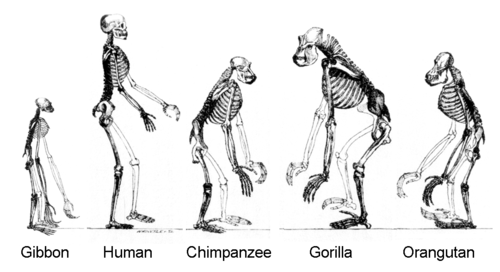
Two major demarcations, among many others, distinguish us from the earlier versions of Homo species.  One is the growth of brain size, the other the shrinking of some physical attributes, including brow prominence, mid-face projection, and skeletal structure.  Both eventually enabled the acquisition and refinement of speech, and thus the possibility of sharing thoughts and feelings among each other—the earliest manifestation of humanity in its second definition.

It would be possible, I imagine, to express affinity, empathy, or insight with respect to the emotional or physical well-being of another, even if we were unable to communicate them verbally.  Possible, too, I think, to convey anger, resentment, or disappointment to someone.  Body language and non-verbal gestures could convey such messages adequately.  But it is through speech that we can most accurately articulate our feelings, be they positive or negative, without resorting to physical demonstrations.

The ability to speak depends on both physical and neural capabilities, which we, alone among animals, possess.  And language, which developed from this unique ability, is what has made possible every significant intellectual accomplishment along the path of our development as a species—including both the ability to save lives and prolong them beyond the wildest expectations of a century ago; and the ability to wage war unto death on those we fear or loathe, to the point of wiping them from the face of the earth.

So, at the dawn of another year, the two-thousand-and-seventeenth of the modern era (and maybe the fifty-two-thousand-and-seventeenth of our existence as a modern species), I ask this question:  Whither humanity?

We have a good idea whence we came, thanks to the innumerable studies of our history and development.  The state of humanity all humanity enjoys is well and truly established.  But where are we going?  And what of our inner humanity—our benevolence, kind-heartedness, magnanimity—toward our co-habitants of the planet?  Could it be that our brains are indeed dualistic—in the sense that we want to create and destroy, build up and tear down, co-exist and dominate—at one and the same time?  If so, that is an horrific equation, one that is perhaps the result of centuries of struggle to survive as a species, in order to perpetuate humanity.

But now, we live in an age where the baser half of that equation can have disastrous results, not just for those we choose to see as our enemies, but for us all.  And if we allow fear to draw us back into protective enclaves of our own kind—those who look, think, and act like us—to the exclusion of those who don’t, we risk diminishing our fundamental humanity.  At a time of great peril to our entire race, surely it is better to reach out, to join hands, than it is to lash out and smash humanity asunder.

We belong to numerous nations inhabiting this long-suffering planet, each of which harbours its own patriotic aspirations.  But every one of those nations depends upon the same planetary host, and all humanity is travelling on the same interstellar vessel.  Will we collectively steer our ship to safe harbour, or scuttle it with all hands on board?

I have long admired these words from the second inaugural address of Abraham Lincoln, which I excerpt here—

          With malice toward none, with charity for all, [let us] achieve and cherish a

just and lasting peace among ourselves and with all nations.

Happy New Year—free of malice, full of charity—to all humanity!