Making Friends

Almost a half-century ago, an older colleague advised me to surround myself with friends who were, not only my age, but younger and older, as well. “With friends your age and younger, you’ll be sharing memories you’ve made together while still able to create new ones. And when you make friends with older people, you’ll learn a lot from their sharing with you the experiences they’ve had.” He didn’t tell me one is silver, the other gold, but I got the drift.

His advice made a lot of sense to me, and to this day, my wife and I can claim friends who are in their nineties and others in their twenties. “You never want to see older friends die,” my colleague said, “but they will. And when that happens, you’ll find solace in the company of the younger ones.”

 That same colleague also told me, tongue-in-cheek, “I don’t need to make more friends. I have trouble keeping up with the friends I already have!”

I didn’t get it at the time, but nearly fifty years on, I better understand what he was saying. We have many friends we barely get to see anymore, given the obligations we all have, the distance we live away from each other, and the vicissitudes of getting older. If it weren’t for social media, I doubt we’d even be in touch with some of them. It’s not that we don’t consider them friends anymore; rather, it’s an inability to keep up.

I first met the friend I’ve known longest when we were fifteen, and sixty-seven years later, that friendship endures. But we see each other in person only two or three times a year now, and even those few meetings seem to require a good deal of advance planning. Moreover, there’s always the chance that one or other of us will have to cancel because of unexpected illness.

I remember my mother in her later years, living longer than my father and most of her friends. Near the end, there was but one longtime friend left, and their children would drive them to an afternoon get-together. Eventually, though, even that proved impossible, and they were reduced to talking by phone—a poor substitute. I dread that day’s arrival for me and my friend.

On a brighter note, my wife and I have acquired five new adult friends over the past half-dozen years. Our five grandchildren have all attained the age of majority now, and are attending university or, having graduated, are working full-time. They all live away from home—two from our eldest daughter and her husband, three from our youngest and hers—but close enough to us that we see them frequently on holidays and family occasions.

When they were children, we interacted with them lovingly, but with the slightly patronizing manner typical of conversations between elders who’ve seen and done it all and youngsters who are still finding their way. We never spoke to them in ‘baby-talk’, always recognized their unique intellect and agency, and considered them, not friends, but beloved grandchildren. And they regarded us, I think, as loving grandparents.

It’s different now, though. They’re still beloved by us, of course, and we by them; nothing could change that. But as they’ve grown into adulthood, they’ve become friends, not just grandkids. They’ve developed their own sets of values—thankfully, not identical to ours, nor to each other’s, but not in contradiction, either. They have their own viewpoints on issues facing them, and feel free to discuss those with us. They no longer accept everything we say as gospel, but they’re polite in their disagreements. And they back up their points of view with rational thought.

No longer are they participants in our world; instead, we have become participants in theirs.

As a young teacher, I remember cautioning parents of my students that, by helping children learn to think critically, we must accept the likelihood that they’ll think differently than we do about many things. It’s a delight now to find that is the case with our grandchildren. And a greater delight that it’s given us so much to talk about.

Three of them have come to visit us in Florida during the past year or so, all with boyfriends. So, we’ve been included in their conversations with each other, heard what they think about goings-on in the world, which has opened up new avenues of perspective for us. We’ve listened to their music, and they to ours. We’ve gone with them to the beach, to the mall, to restaurants, to the pool—all things we used to do with our older friends in years gone by.

When my colleague first told me the wisdom of cultivating friends of all ages, I confess I never anticipated some of those would be our grandchildren. But so it has turned out, and we are blessed.

As the familiar ditty advises, Make new friends, but keep the old…

What to Believe?

For all readers, this post will first appear as an email in your inbox.

For those whose email contains a link, click on it to access the post in its true blog setting.

For those whose email simply shows the post in its entirety, click the title to read it in its true setting.

I was raised a Christian lad, not by proselytizing parents, but by a father and mother who passively practised the religion they’d been taught by their own parents.  As an infant, I was baptized in the Church of England; as a boy, I attended Sunday School, where I learned the Anglican liturgy. In my early teens, I publicly professed my learned faith in a confirmation ceremony; as a young man, I married my bride in a Christian church.

Growing up, I was enamoured of the tales of derring-do by British adventurers who set out to dominate the world—Richard the Lionheart and the Crusader knights; Sir Francis Drake and other explorers and privateers; Sir Cecil Rhodes and the rapacious conquerors of Africa and Asia. All of them ventured forth under the cross of St. George, ostensibly to bring Christianity to the heathen masses. Or so I was taught.

I wasn’t dissuaded by the troubling outcomes that sometimes occurred to me, arising from those teachings. For example, had I died before being baptized, I was taught I would not have gone to heaven; I was told that children of other faiths, unless they converted to Christianity, would not go to heaven; I believed none of us, being sinners, would go to heaven if we did not sincerely repent and swear never to repeat our sinful actions; and it was ingrained in me that those who did not go to heaven would be damned to eternal hellfire.

It didn’t dawn on me until much later how ludicrous it was that the God of love held dominion over me through fear. Still, I’ve never had doubts about the essential teachings of Jesus, as I understand them from the several writers of the Bible who have reported them—love; forgiveness; humility and service; empathy and trust; repentance and redemption; compassion and mercy. It seems to me that if everyone, Christian or not, practiced those teachings, the issues that plague our world would disappear.

From earliest times, my favourite part of being in church was listening to and singing the glorious hymns, accompanied by the mighty strains of a pipe organ. Because of the early, emotional indoctrination I experienced through my parents, they prickle my skin to this day when I hear them rendered—to name a few: Abide With Me; Blessed Assurance; Guide Me, O Thou Great Redeemer; Jerusalem; Joyful, Joyful, We Adore Thee; Nearer My God to Thee; O God, Our Help In Ages Past; and Rock of Ages.

A good number of hymns, I discovered later, were written by British lyricists and set to the melodies of classical composers, many of them Germanic. One of those, Glorious Things of Thee Are Spoken (by John Newton, who also wrote Amazing Grace), is sung to the same Joseph Haydn melody that graces the German national anthem, Deutschlandlied (formerly Deutschland über Alles).

Given the 20th century history of conflict between those two nations, I always found it strange that they shared a love for such glorious music. Even more so, I found it preposterous that soldiers of both Christian countries were killing each other on battlefields, in direct contravention of their shared God’s commandment.

Yes, God is with us! Nein, Gott ist mit uns!

But perhaps that isn’t so strange, given the militaristic character of many of those hymns. Take these lyrics for example—

Stand up, stand up for Jesus! ye soldiers of the cross;
Lift high His royal banner, it must not suffer loss:
From vict’ry unto vict’ry, His army shall He lead,
Till every foe is vanquished, and Christ is Lord indeed.

Implicit in those words is the instruction that good Christians must overthrow those who do not believe. I found that to be in contravention of the Christly teachings mentioned earlier, which always struck me as invitational rather than compulsory. I was taught, after all, that God had gifted us with free choice.

Mind you, George Duffield, Jr., the American clergyman who wrote the lyrics in 1858 and set them to an original melody by Franz Schubert, may not have intended them to sound militant or jingoistic. But that is how they ring in my ear. And it is such sentiments that crusaders and conquerors of the past cited to justify their conquests.

If you doubt it, consider also the lyrics of such hymns as Onward, Christian Soldiers, We’ll Go Out and Take the Land, or The World Must Be Taken For Jesus.

In fact, many Christian buccaneers and swashbucklers set out to plunder the world for reasons far more crass than what they professed. Bringing Christianity to the heathen masses was, at best, a by-product of their colonialist ravages, and at worst, an excuse for them. As for those Indigenous peoples subjected to the messianic zeal of 19th century Christian missionaries, I’ve always wondered how their forced conversions could be deemed proper when similar depredations imposed on Christian victims during the 8th century Moorish invasion of Europe were considered barbaric. Did both aggressions not have the same effects on those who suffered and died? Were they not the same thing, save for the religious faith driving them?

Might makes right, some say. To the victors go the spoils. And history—the history I grew up learning—was written by those victors. The synoptic gospels have Jesus saying, “Render unto Caesar the things that are Caesar’s…” A venerable phrase translated from the Latin has Caesar claiming, “I came, I saw, I conquered!” The emphasis, of course, is on that final word.

So now, with more yesterdays accumulated than tomorrows to anticipate, I find I am no longer the Christian lad I once was…not with how Christianity, particularly the degraded, evangelical sort, has come to be defined in this 21st century. I do believe in free choice, and I choose not to believe Jesus was all about conquest and subjugation.

Further, I do believe in the wisdom of the aforementioned teachings of Christ, although I do not need the backing of a supernatural mythology to support my belief. I regard those as universal truths shared by Christianity, Islam, Hinduism, Buddhism, and Judaism, among other religions…and indeed, by many folk who profess no religion. Those teachings promote adherence to the Golden Rule, compassion for and kindness to others, the valuing of family and community, and the pursuit of a moral life.

I’ve long believed that the evils of this world are caused, for the most part, by extremism—unbridled nationalism, greedy capitalism, and apocalyptic religions. How might it be if only we gave those universal truths a chance to show what they could do instead?

In closing, lest this screed be mistaken for apostasy or advocacy, let me assure you it is no more than a statement of personal belief, refined over many years of observation and experience. Despite the sage admonition not to believe everything I think, I have always felt that believing in something is important, so as not to fall for anything.

The question, of course, is knowing what to believe. And for me, seeking that knowledge will be an ongoing journey until, inevitably, the road comes to an end.

More and More Every Day

Earlier this week, I celebrated my wedding anniversary—fifty-eight years, all married to the same woman, the lissome lass I first dated when she was but sixteen.  We married four years later, embarked upon fulfilling careers, raised two lovely daughters, and retired to the life we now enjoy together…sixty-three years gone in the blink of an eye, it now seems. Egad!

Friends probably view the longevity and success of our union from my wife’s point of view as a triumph of iron will over probability. From my viewpoint, however, it’s unquestionably a victory of blessed good fortune over whatever random fate I would otherwise have encountered.

Recently, at the behest of our daughters, we each decided to write a short memoir of our lives, intended only for family and close friends.  Mine, titled Being Me, is finished and in the hands of those I care most about; hers, titled My Story, is nearing completion. The trick, as we discovered in the writing, lay in knowing, not what to include, but what to leave out.

As we wrote, we shared memories sparked by old photos, slides, and home-movies produced through the years.  We were amazed by how much we had forgotten over time, and by how different our fuzzy memories sometimes were as we discussed the same events.

“That’s not how it happened!” I found myself declaring more than once, only to have my wife show me a faded snapshot that proved otherwise.  Admittedly, I’ve always had trouble remembering dates, so casting back to those bygone years wasn’t child’s play for me.

By the way, that trouble with dates persists even now, alas.  I recently showed up for a colonoscopy procedure after enduring the requisite purging prior to the visit, only to find I had the right day, the right time, but the wrong year! I was a whole year early! I’m still living that one down.

Through most of our marriage, my wife and I were enthusiastic participants in sports—baseball, curling, golf, hockey, tennis, skiing, swimming, to name but a few—both competitively and recreationally.  As we eased our way through middle age, entering inevitably into our senior years, many of those began to fall away. We found we could no longer glide across the arena or playing field with the same visions of grace and glory we’d previously enjoyed.  Father Time vanquishes everyone, we discovered, no matter how skilled or practised we might be.

An example for me was falling down in my follow-through a few times on the tee-boxes while smoking drives I’d always hit routinely…well, maybe not always, but occasionally.  My playing partners advised me to start wearing a bicycle helmet if I wanted to continue playing.

My exercise today consists of activities where I can’t fall down or off something. I favour the rowing machine, the treadmill (if I hang on), the stationary bike, or exercises conducted while lying on the floor.  Although not a Latin scholar, I find myself chanting under my breath as I work out: sic transit gloria mundi!

As with many things in a long marriage, my wife and I found we had to adjust and change to meet these new demands.  She spends the bulk of her time now, when she’s not reading or doing jigsaw puzzles, making gifts for family and friends out of clay, dichroic glass, and wood, an accomplished artisan.  I call her my boon companion in the arts.

Much of my time, of course, is spent writing—novels, anthologies of tales and poems, and posts on my blog—and listening to classical music.  I’m a prolific reader, as well, and give thanks constantly for online libraries.

Perhaps the biggest change for us is that we no longer find our children and grandchildren to be part of our lives, sharing our experiences; rather, we have become part of their lives, eagerly sharing their accomplishments and happenings. It is we who are the supporting actors now, and they the stars in the unfolding movies of their lives.  We’ve also discovered that this change is very comforting, to be loved and cared for by these essential people in our lives, even as ours wind down.

We still look ahead, however, to each new adventure that might come our way. One of my haiku poems illustrates that philosophy quite clearly—

more yesterdays now
than tomorrows, but it’s the
tomorrows that count


the sails of our youth,
once hoist, are mostly furled now---
though the winds still blow

Back in 1964, when we were still dating prior to marrying, a popular singer, Al Martino, released one of his biggest hits, I Love You More and More Every Day. We adopted that as ‘our song’, and we used to sing snatches of it to each other.  Over the years, it faded for some reason from our minds, although we never abandoned its premise.  But I thought of that song on my recent anniversary day, and began to sing it to myself.  I had to look up the lyrics, of course, after all this time, but the melody was etched in my memory.

On a whim, I decided to record myself singing it on a karaoke track to present to my wife. Although I used to sing bass in a men’s a cappella barbershop chorus, my octogenarian voice is a tad quavery and shrill now, and my range is somewhat limited.  Nevertheless, the sincerity of my singing has not abated, and she at least recognized the song. Sort of.

As I think back to when she and I first met, as I try to remember all that has happened since, as I marvel at the lasting of our union, I find myself overwhelmingly grateful that we celebrated this latest anniversary together, and I offer this haiku to her to reflect those sentiments—

impossible dream!
many might have thought so, but
you made it come true

trusting all that’s passed,
moving forward in good faith,
hands clasped as always

Makin’ It Up!

Here is a poem from my latest anthology of prose and poetry, a collection of more than forty whimsical and topical essays and poems I’ve written as a member of the Pelican Pens writers’ group in South Florida.

Just released today, the book is entitled—

Makin’ It Up As I Go! Tales of a Flagrant Fabulist

It Just Isn’t Fair!
[prompt: the unfairness of life]

“It’s not fair!” I declare, disgruntled and mad,
“Why’s everything good now thought to be bad?
I’m angry about it, but what can I do?
How can I hang on to what I once knew?

“Why doesn’t Santa Claus still come to town,
With his reindeer and elves and fat belly round?
What’s wrong with allowing this old man to think
That he’ll bring me my toys, then be gone in a blink?

“And where’s the tooth fairy, who came in the night
To check ‘neath my pillow, but stayed out of sight,
And left a wee gift in exchange for my tooth?
Why doesn’t she come, now that I’m not a youth?

“What’s happened to Cupid, the elf with the bow
And his love-dipped arrows all ready to go?
Oh, where is he now each Valentines Day?
Did someone nefarious take him away?

“And how ‘bout the bunny with powerful legs
Who came every Easter with my favourite eggs?
It’s like he’s been cancelled by somebody vile,
For I haven’t seen him in such a long while.

“And whence the wee people, their shamrocks so green,
Hiding their gold in pots all unseen
At the end of the rainbows, their colours agleam?
Are leprechauns now nothing more than a dream?

“And last but not least, the sandman so wise,
Who came every night to shut down my eyes,
Is no longer part of my oft-sleepless night.
Have they taken him, too, out of sheer spite?

“It’s not fair!” I exclaim, both sad and chagrined,
“That somebody somewhere chose to rescind
My wonderful friends of childhood back there.
I hate it!” I cry. “It just isn’t fair!”

The book is available for purchase at this safe website—

https://www.lulu.com/spotlight/precept

Another Excellent Read!

TEN BILLION DOLLARS AWARDED BY COURTS TO TWENTY-ONE ONTARIO FIRST NATIONS!

In the latest novel in my acclaimed Maggie Keiller/Derek Sloan crime series, the dramatic consequences of this actual treaty settlement unfold in Port Huntington, a small resort town on the shores of Georgian Bay.  And once again, Maggie and Derek become inextricably involved in personal grievances boiling to the surface among various interests, involving vandalism, extortion, violence, and murder.

Be sure to read this exciting story, available now for purchase at—

https://www.lulu.com/spotlight/precept

You will find complete information on my published books by pressing the My Books tab at the top of this page.

As always, thanks for reading my blog, and for your interest in my writing!

A Musical Gift of Love

And here she is, the singing rage, Miss Patti Page, with her latest hit, Tennessee Waltz…

The year was 1951, and my brother and I were home in bed with chickenpox, the longest week we’d ever spent in our young lives.  To help our mother avoid losing her mind as she coped with our whimpering and complaining, Dad had moved the large, Motorola console radio from the living room to our bedroom.  It was heavy, and I still remember his red face, and the huffing and puffing, that accompanied the move down the long hallway to our room.  It took a while to adjust the antenna, too, to ensure we got proper reception.

With the entertainment that radio provided during those seemingly-endless days in bed—together with toys, comics, children’s books, and board games—my brother and I managed to allow Mom some brief periods of respite.

All that week, we fell asleep at night to broadcasts of The Lone Ranger, Mark Trail, Amos ‘n’ Andy, and The Shadow.  Having that radio in our bedroom was almost enough to make us wish the chickenpox would hang around a while longer.  Almost!

The bedroom was small, with one dormer window, and our twin beds were separated by a table whose top was taken up by a small lamp and two coasters, upon which sat our water glasses.  On the two shelves underneath, one for each of us, our respective playthings were stored…my brother’s haphazardly, mine orderly.

The first time we heard Tennessee Waltz on the radio, my brother immediately piped up, “That’s my favourite song!”, thus preventing me from claiming it.  Not to be undone, however, I quickly claimed Patti Page’s other big hit, Mockin’ Bird Hill, as my property.  Every time either song came on the air, our bedroom would become eerily quiet as we listened avidly, singing along silently in our tousled heads.

When we eventually dared to accompany the singer aloud, neither of us was allowed to sing the other’s song.  Singing along in our heads was permitted, but by mutual consent, our live performances were strictly proscribed.

As if to ensure our claim to our song would not be usurped by a treacherous brother, each of us would reiterate our ownership every time our favourite came on.  “Tennessee Waltz is my song!” my brother would insist, and for good measure one day, he added, “An’ Patti Page is my favourite singer!”

He was in love with this woman we had never seen, and truth be told, so was I.

By some unspoken rule, however, we both understood that the singer herself could not be claimed as one’s own, and so the next time Mockin’ Bird Hill came on, I chirped, “That’s my favourite song, an’ Patti Page is my favourite singer!”  And, while our mother was in the room one day, I added, “She’s prob’ly as pretty as Mom!”

Mom smiled at that.

But my brother immediately protested, “No, she’s not!  Mom is prettier!”

Our mother smiled at that, too.

The chickenpox finally ran their course, of course, and life went back to normal.  But to this day, I can still sing the entire Tennessee Waltz, and all three verses and the chorus of Mockin’ Bird Hill.  I’m probably off-key in a few spots here and there, but it’s seventy-five years ago that I learned them, so that’s not too shabby.

My brother is gone now, as is Patti Page, but whenever I sing those two songs, usually just to myself, out of filial loyalty and respect for those childhood rituals, I always kick off Tennessee Waltz with the preface, “my brother’s favourite song”.  And if he were still here to hear me, he’d probably say, “Damn right!”

And I know he’d settle back and listen politely as I announce, “An’ here’s my favourite song, Mockin’ Bird Hill!” before launching into it. I won’t do that here, of course, but here’s the lady herself to sing it.

We were lucky, my brother and I, to have shared that musical gift of love.

The Lonely, Silvery Rain

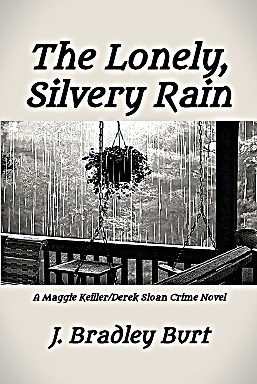
The thirteenth novel in my Maggie Keiller/Derek Sloan crime series will be published later this year, titled The Lonely, Silvery Rain. Here is an excerpted chapter from that book, slightly modified for this blog-post. If you have read previous books in the series, you will recognize the two characters here.

When Old Scratch, as Senator Nicholl disdainfully referred to death, came calling for the final time on a warm, drizzly, late-morning in October, he found Nicholl dozing in his favourite rocking chair on the wide, open-air verandah of his century home.  The rain was thrumming on the shingled roof, dripping off the overhanging eaves, spilling like a shimmering, crystalline waterfall to the gardens below.

Before his spectral visitor crept in, Nicholl had been engrossed in a pleasant dream, delivering a stem-winder of a stump speech on another political campaign trail, surrounded by a throng of friends and constituents in someone’s farmyard.  Balancing on a rickety, upside-down milking-bucket, he stood above everyone, so even those at the far reaches of the crowd could see him.  He felt he’d never been in finer voice until, gearing up for the customary, full-throated culmination to his peroration, he discovered he’d forgotten what he was about to say.  The shock was profound.

Groping vainly in his dream to remember the remarks eluding him, his mouth continued moving, though no sound emerged.  Then, without warning, the bottom abruptly dropped away beneath him, as if someone had kicked the bucket out from under his feet.  The world whirled and spun dizzyingly as he toppled, flinging his arms out in a futile attempt to catch himself.  Despite the confusion and fear engulfing him, however, he still tried to finish, a campaigner to the end.

Wait!  My speech!  I’m purt’ near done…

But the dream turned nightmarish, and a misty, reddish haze descended across his eyes, and then…and then…

Senator Milford Nicholl, the simple, hometown boy-made-good, eased back in his rocking chair, sighed a fare-thee-well, and went to his eternal rest.

The many well-wishers who stopped in later that afternoon found Gloria, his wife of sixty years, shaken but composed, unbelieving but accepting, sad but relieved that her husband’s travails were over.

“He knew he was on borrowed time,” she told them softly, “and I could tell he knew his days were winding down.  A wife always knows these things…”  Her throat filled up, and she stopped to wipe away tears. 

“Just a few days ago,” she whispered after a moment or two, summoning a small smile, “we talked about the possibility of one of us dying.  And you know Milly’s sense of humour.  He said something to the effect that he wasn’t afraid to die, he just didn’t want to be there when it happens.”  

The mourners laughed at that, and a few shared more of the homespun witticisms they remembered flowing from Nicholl’s febrile mind.  Eventually, Gloria told them she really would like time alone.  “I’ll pray a little,” she said, “cry a little, laugh a little.  There’ll be time enough later to reminisce some more.  And I’ll call you if I need to, I promise.”

As everyone took their leave, Gloria waved from the verandah, then sat and rocked slowly in her husband’s favourite chair, his abandoned walker standing forsaken beside it.  The rain was gentler now, but its sibilant pit-a-patting on the roof was still audible, its runoff still dripping off the eaves into the lush gardens below, covered by sodden, autumn-hued leaves.  The unseasonably warm breeze caressed her, enveloping her in a blanket of solace.

She already understood she’d be missing Milly constantly from now on—his irrepressibility, his cornball turns-of-phrase, his devotion to the community—and most of all, his love for her, his very presence.  She counted herself lucky to have been his partner and to have known such happiness.

Her grief over losing him would linger long, of course.  She knew mourning is not something that can be quantified or measured by time.  But at this particular moment, she was at peace with his passing, attuned to the happy memories she would cherish forever, resigned to the loneliness she knew would envelop her from time to time.  They were all part of everyone’s journey through life.

But for right now, she was snuggled in Milly’s chair, at one with the inevitable rhythms of life and death, at one with herself, her soul in harmony with the comforting cadence of the rain.

The lonely, silvery rain.

Love, Through Their Eyes

The weekly prompt from my Florida writers group was to write a piece about seeing things ‘through their eyes’, and this is my offering—

Two short poems, each exquisitely written, capture exactly—exactly—how I feel about this brief moment in time I know as my life, about the relationship I have with the love of my life, and about what will happen when I am gone.

The first, When You Are Old, by William Butler Yeats, the greatest of the Irish poets, portrays a woman through the eyes of her departed husband, as he speaks of his love for her, even beyond death, and where she might find him—

When you are old and gray and full of sleep
And nodding by the fire, take down this book
And slowly read, and dream, of the soft look
Your eyes had once, and of their shadows deep.

How many loved your moments of glad grace,
And loved your beauty with love false or true,
But one man loved the pilgrim soul in you,
And loved the sorrows of your changing face.

And bending down beside the glowing bars,
Murmur, a little sadly, how love fled
And paced atop the mountains overhead,
And hid his face amid a crowd of stars
.

I find that sentiment so uplifting, so reassuring, that love, triumphant over death, is waiting ‘midst a crowd of stars.

I no longer believe, as I did as a child, in life eternal, in the idea of earth and heaven, the now and hereafter.  Rather, I believe the life-force presently empowering me—what I might call a soul—is but a fragment of the energy that fuels our expanding universe, a spark of light presently encased in my mortal being.  And when I, the shell that hosts the spark, will have finished my course, when I have expired, that life-force animating me will simply rejoin the universe.  It will be as if I am carrying on beyond death, but with no memory of my life—just as I have no memory now of what came before my birth.

The mortal I shall die, but my life-force will not, for if it did, the universe would shrink at the loss of that fragment of energy.  Science tells us, however, the universe is expanding, not shrinking, so it must be that no energy is ever lost.

But where will my immortal life-force go, and in what form, I wonder?  And what of my love whom I will have left behind?  Happily, I find an answer to these questions in the second of the poems I number among my favourites.  Written by David Jones, a Liverpool poet, from his collection titled Love and Space Dust, I find it moving and profound—

And in the end
I will seek you
Out amongst the stars.

The space dust
Of me will
Whisper ”I love you”
Into the infinity
Of the universe.

So, no life eternal, but something better—love eternal.  According to these two poets, as seen through their eyes, the pilgrim soul who shares this life with me will find my spark of energy—my soul—waiting somewhere in the stars for her, calling I love you into the void until she hears me.

And I choose to believe she will hear me.

David Jones: https://www.goodreads.com/author/quotes/5241391.David_Jones

W. B. Yeats: https://www.poetryfoundation.org/poets/william-butler-yeats

On the Horizon

Two new books are on the horizon that you, as a regular (or even occasional) reader of this blog, are sure to enjoy.  The first is the twelfth novel in my crime-fiction series featuring two engaging, dynamic characters—Maggie Keiller and Derek Sloan.

Trafficking In Murder is set for release this coming fall, and it will take you on a similar tension-filled, as-it-happens journey that readers of the previous books in this mystery-thriller series have experienced.

The story is set against an all-too-true backdrop of human-trafficking—the smuggling and exploitation of vulnerable asylum-seekers hoping for a new life in Canada.

It all begins when an immigration Judge is attacked by an illegal refugee in her courtroom, and the violence spreads quickly into the community with assaults on innocent bystanders, a kidnapping scheme, and finally murder.

Because of their support for two innocent asylum-seekers embroiled in the turmoil that follows, Maggie and Derek become involved.   As events threaten to spiral out of control, they are drawn further into the local police investigation, which is tied into a broader investigation at the national level by the RCMP and Canadian Security Intelligence Services (CSIS).

Over a tumultuous two-week period, both Maggie and Derek are physically attacked, which only increases their determination to protect the people depending on them.  Working closely with retired and active police investigators, they work diligently to bring the evildoers to justice.

The second book on the horizon, Makin’ It Up As I Go: Tales of An Incorrigible Fabulist, is my tenth collection of short stories and poetry, all of them whimsical, humourous, or pointed in their outlook.  The book is scheduled to drop later this year or early in 2025.

The forty-plus tales are based on weekly prompts from my Florida writers’ group, the Pelican Pens, an eclectic gang of people who enjoy the creative outlet we share.  Four of our number have won awards from the Gulf Coast Writers Association for our work, and three of my winning pieces are included in this anthology.

If you enjoy reading the selections published here in TallandTrueTales, I know you will like both these books.  Once available, they may be found and purchased with all my other published works at this safe site—

https://www.lulu.com/spotlight/precept

Happy reading!

A Loss For Words

[NOTE: IF THIS COMPLETE BLOG-POST LIES IN THE BODY OF AN EMAIL, CLICK ON THE TITLE TO READ IT IN ITS NATURAL ENVIRONMENT ON MY BLOG-SITE. IF ONLY A LINK IS PROVIDED IN THE EMAIL, CLICK ON THAT.]

Most people who know me would likely tell you I am rarely, if ever, at a loss for words.  But they would also assure you, I trust, that I am far from being a blabbermouth.  My own opinion is that in most social situations, I can hold my own in conversation without becoming annoying or overbearing.

Most of the time, I listen; when appropriate, I ask questions.  If prompted, I will hold forth on a subject (if I know something about it), but not to the point of boring my friends to tears…I hope.

There is one situation, however, where all of the above is not true, perhaps the only circumstance where I find myself virtually unable to get a word in edgewise.  This unfortunate state of affairs occurs every time I find myself on a FaceTime call with my wife and daughters.  I hustle into the den with my iPad, leaving my wife with her screen in the living-room, so we won’t get feedback during the call.

When I say ‘unfortunate’, I mean for me, of course; for all I know, the ladies find it delightful when I sit, practically mute, at my end of the line.

The problem arises, not because my wife and daughters ramble endlessly on and on, not because they’re rude or inconsiderate, not because they delight in ignoring me, even politely.  Nothing could be farther from the truth.  In fact, they are all among the most considerate of creatures on the face of the earth, and they love me dearly.

No, the problem occurs almost every time we’re on a call because they appear to react faster than I do.  And to think faster, too, I suppose.  Regardless of the subject, I’m usually listening attentively as they express their various points of view, waiting for my brain to kick into gear as I consider an appropriate response.  The sad fact is that, by the time I have a response, one of them has already jumped back into the conversation ahead of me.

Another issue causing me a problem is their propensity to change subjects at the drop of a hat.  We might have spent five minutes batting a particular topic back and forth—the three of them talking while I listen—and Boom!  Without warning, one of them will introduce a brand-new thread, or ask about something entirely different from what we’ve been discussing. 

Even as my brain registers the change, a part of it is crying, silently and forlornly, that I haven’t yet kicked in my two cents’ worth on the first topic.

But they aren’t rude, as I have said, so at some point (perhaps noticing my silence), one of the girls might say, “What do you think, Dad?” 

“Ah…let’s see,” I reply, “can we go back to that first thing we were talking about?  I had a thought about that, but I couldn’t get in.”

The three of them laugh and roll their eyes at this, chide me to ‘keep with the tour’, then blithely resume their three-way conversation.  It’s probably just as well, I guess, because by the time I’m asked to chime in, I’ve often forgotten the point I wanted to make, anyway.

I must admit, though, all modesty aside, that I generally look surprisingly good on those FaceTime calls.  I sit up straight, look right into the camera (with an occasional peek at my own image), and keep myself centred in the screen.  They, by contrast, let the screen wobble all over the place as they walk from room to room tending flowers, picking up dirty clothes, starting early prep for supper, training their camera on their dogs.  It drives me crazy, but I can never worm my way into the conversation to ask them to stop.

I’ve explored various strategies to help, but none seems to.  I’ve tried holding up my hand, for example, when I want to cut in, but all I get is a return wave, as if they think I’m leaving the conversation.  “Bye, Dad!”

On more than one occasion, I’ve cut my video feed for a few seconds, hoping they’ll wonder if I’m okay, but all I hear is, “Looks like Dad has left the conversation!  Was it something we said?”

“No!” I want to shout, as I turn the video back on.  “It’s because I haven’t said anything!”  But they’re already talking about something else, so once again I can’t get in.

I recognize that the limitations of the FaceTime technology, marvellous though it is, play a part in exacerbating my dilemma.  The offset between audio and video transmission makes it difficult for me to pick the right moment to jump in—like watching a TV commentator interviewing someone far away, each of them experiencing a delay in hearing the other, resulting in dead air.  If I speak up too soon, while one of the girls is still talking, no one hears me; if I wait ‘til she’s finished, someone else has already started.

Still, I persist in taking part in these FaceTime calls, not only to hear what the girls have to say, but to look at them as they’re saying it.  And I console myself that, if ever I had anything pertinent and crucial to share with them, I probably did it years ago.  Whatever I might add now is probably just more of the same.

The ironic part of the whole thing, though, is after we’ve ended the call, I’ll wander back into the living-room and my wife will say, “Are you okay?  You didn’t have much to say today.”

And that always leaves me at a loss for words.