Makin’ It Up!

Here is a poem from my latest anthology of prose and poetry, a collection of more than forty whimsical and topical essays and poems I’ve written as a member of the Pelican Pens writers’ group in South Florida.

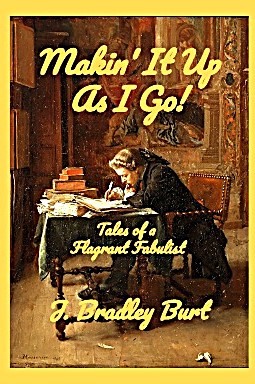
Just released today, the book is entitled—

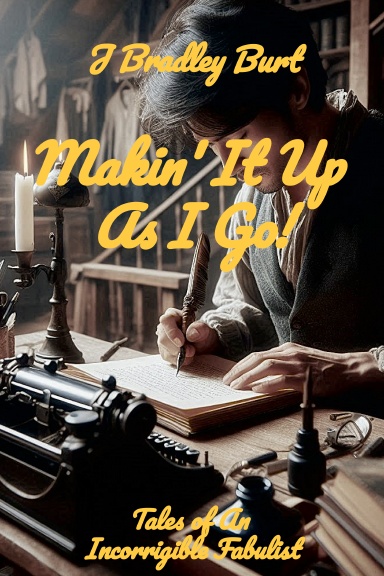
Makin’ It Up As I Go! Tales of a Flagrant Fabulist

It Just Isn’t Fair!
[prompt: the unfairness of life]

“It’s not fair!” I declare, disgruntled and mad,
“Why’s everything good now thought to be bad?
I’m angry about it, but what can I do?
How can I hang on to what I once knew?

“Why doesn’t Santa Claus still come to town,
With his reindeer and elves and fat belly round?
What’s wrong with allowing this old man to think
That he’ll bring me my toys, then be gone in a blink?

“And where’s the tooth fairy, who came in the night
To check ‘neath my pillow, but stayed out of sight,
And left a wee gift in exchange for my tooth?
Why doesn’t she come, now that I’m not a youth?

“What’s happened to Cupid, the elf with the bow
And his love-dipped arrows all ready to go?
Oh, where is he now each Valentines Day?
Did someone nefarious take him away?

“And how ‘bout the bunny with powerful legs
Who came every Easter with my favourite eggs?
It’s like he’s been cancelled by somebody vile,
For I haven’t seen him in such a long while.

“And whence the wee people, their shamrocks so green,
Hiding their gold in pots all unseen
At the end of the rainbows, their colours agleam?
Are leprechauns now nothing more than a dream?

“And last but not least, the sandman so wise,
Who came every night to shut down my eyes,
Is no longer part of my oft-sleepless night.
Have they taken him, too, out of sheer spite?

“It’s not fair!” I exclaim, both sad and chagrined,
“That somebody somewhere chose to rescind
My wonderful friends of childhood back there.
I hate it!” I cry. “It just isn’t fair!”

The book is available for purchase at this safe website—

https://www.lulu.com/spotlight/precept
Love, Through Their Eyes

The weekly prompt from my Florida writers group was to write a piece about seeing things ‘through their eyes’, and this is my offering—

Two short poems, each exquisitely written, capture exactly—exactly—how I feel about this brief moment in time I know as my life, about the relationship I have with the love of my life, and about what will happen when I am gone.

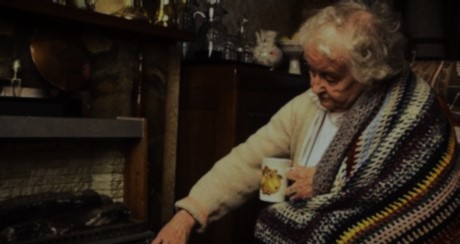
The first, When You Are Old, by William Butler Yeats, the greatest of the Irish poets, portrays a woman through the eyes of her departed husband, as he speaks of his love for her, even beyond death, and where she might find him—

When you are old and gray and full of sleep
And nodding by the fire, take down this book
And slowly read, and dream, of the soft look
Your eyes had once, and of their shadows deep.

How many loved your moments of glad grace,
And loved your beauty with love false or true,
But one man loved the pilgrim soul in you,
And loved the sorrows of your changing face.

And bending down beside the glowing bars,
Murmur, a little sadly, how love fled
And paced atop the mountains overhead,
And hid his face amid a crowd of stars
.

I find that sentiment so uplifting, so reassuring, that love, triumphant over death, is waiting ‘midst a crowd of stars.

I no longer believe, as I did as a child, in life eternal, in the idea of earth and heaven, the now and hereafter.  Rather, I believe the life-force presently empowering me—what I might call a soul—is but a fragment of the energy that fuels our expanding universe, a spark of light presently encased in my mortal being.  And when I, the shell that hosts the spark, will have finished my course, when I have expired, that life-force animating me will simply rejoin the universe.  It will be as if I am carrying on beyond death, but with no memory of my life—just as I have no memory now of what came before my birth.

The mortal I shall die, but my life-force will not, for if it did, the universe would shrink at the loss of that fragment of energy.  Science tells us, however, the universe is expanding, not shrinking, so it must be that no energy is ever lost.

But where will my immortal life-force go, and in what form, I wonder?  And what of my love whom I will have left behind?  Happily, I find an answer to these questions in the second of the poems I number among my favourites.  Written by David Jones, a Liverpool poet, from his collection titled Love and Space Dust, I find it moving and profound—

And in the end
I will seek you
Out amongst the stars.

The space dust
Of me will
Whisper ”I love you”
Into the infinity
Of the universe.

So, no life eternal, but something better—love eternal.  According to these two poets, as seen through their eyes, the pilgrim soul who shares this life with me will find my spark of energy—my soul—waiting somewhere in the stars for her, calling I love you into the void until she hears me.

And I choose to believe she will hear me.

David Jones: https://www.goodreads.com/author/quotes/5241391.David_Jones

W. B. Yeats: https://www.poetryfoundation.org/poets/william-butler-yeats

On the Horizon

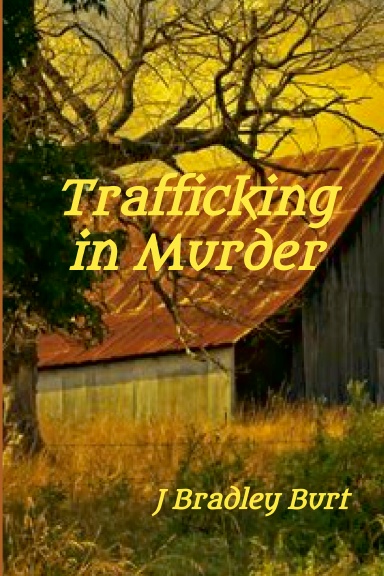
Two new books are on the horizon that you, as a regular (or even occasional) reader of this blog, are sure to enjoy.  The first is the twelfth novel in my crime-fiction series featuring two engaging, dynamic characters—Maggie Keiller and Derek Sloan.

Trafficking In Murder is set for release this coming fall, and it will take you on a similar tension-filled, as-it-happens journey that readers of the previous books in this mystery-thriller series have experienced.

The story is set against an all-too-true backdrop of human-trafficking—the smuggling and exploitation of vulnerable asylum-seekers hoping for a new life in Canada.

It all begins when an immigration Judge is attacked by an illegal refugee in her courtroom, and the violence spreads quickly into the community with assaults on innocent bystanders, a kidnapping scheme, and finally murder.

Because of their support for two innocent asylum-seekers embroiled in the turmoil that follows, Maggie and Derek become involved.   As events threaten to spiral out of control, they are drawn further into the local police investigation, which is tied into a broader investigation at the national level by the RCMP and Canadian Security Intelligence Services (CSIS).

Over a tumultuous two-week period, both Maggie and Derek are physically attacked, which only increases their determination to protect the people depending on them.  Working closely with retired and active police investigators, they work diligently to bring the evildoers to justice.

The second book on the horizon, Makin’ It Up As I Go: Tales of An Incorrigible Fabulist, is my tenth collection of short stories and poetry, all of them whimsical, humourous, or pointed in their outlook.  The book is scheduled to drop later this year or early in 2025.

The forty-plus tales are based on weekly prompts from my Florida writers’ group, the Pelican Pens, an eclectic gang of people who enjoy the creative outlet we share.  Four of our number have won awards from the Gulf Coast Writers Association for our work, and three of my winning pieces are included in this anthology.

If you enjoy reading the selections published here in TallandTrueTales, I know you will like both these books.  Once available, they may be found and purchased with all my other published works at this safe site—

https://www.lulu.com/spotlight/precept
Happy reading!

Happy Pilgrim

The weekly prompt from my Florida writers’ group was “AI and I”, and my offering is these two poems, five stanzas each. One was written by me, the other by AI (Copilot); can you guess which is which?

Happy Pilgrim

I am a happy pilgrim wand’ring down the road of life,
I’m loved by both my daughters and the gal who is my wife.
I first began my journey back in nineteen-forty-three,
And have spent the intervening years seeking to be me.

My travels haven’t been too hard, nor have they all been smooth,
They’re slower now, though, than they were when I was but a youth.
I make more time to look around than I ever used to do,
Far less concerned with making haste than soaking up the view.

My tomorrows---fewer now than my many yesterdays---
Still unfold themselves quite wondrously to my open gaze,
And I’m astonished there’s so much that’s new along the way,
As I continue down my path, loving each new day.

I know for ev’ry journey there will always be an end,
But it would be a long, long road that never takes a bend,
And so, I wend my pilgrim’s way, that end not yet in sight,
Trusting that my steps are sure, and my destination right.

I am a happy pilgrim wand’ring down the road of life,
And my age is not an issue, nor yet a source of strife.
In fact, it is a gift that I’ve been blessed to call my own,
And I give thanks for loved ones dear, for I am not alone.

Happy Pilgrim

I am a happy pilgrim wand'ring down the road of life,
With dreams as my companions, and hope to ease my strife.
Through sun-kissed meadows and moonlit fields I just love to roam,
Guided by the stars above, finding solace far from home.

In fields of laughter, I gather mem’ries like wildflowers,
Each petal a moment, fragrant with love's gentle powers.
The winding path unfolds, a tapestry of joy and tears,
And I dance to the rhythm of life, banishing all fears.

Beneath the silvery moon, I find solace in the night,
Whisp’ring secrets to the stars and their pure, distant light.
The road ahead may wind and twist, but I'm sure to persist,
For ev’ry step’s a story, every moment a sweet kiss.

Beneath the ancient oaks, I uncover wisdom's sweet sway,
Their roots anchored deep in earth, their leaves a verdant display.
The road may lead to distant lands, where mysteries unfold,
And I'll follow its winding path, with heart that's brave and bold.

The road may turn or waver, but my heart remains steadfast,
For ev’ry twist reveals a truth, each bend a chance to last.
So let me be this pilgrim, with wonderment in my eyes,
Embracing life's adventure, under ever-changing skies.

Lilt and Flow

There are few things I find more pleasurable than hearing the lilt and flow of poetry read aloud, especially if read by a skilled orator or by a loving family member.

My father was both, and it was he who read one of my abiding favourites, The Night Before Christmas, a classic tale by Clement Moore, on every one of the sixty Christmas times we shared before his death. Here are the beginning stanzas—

My siblings and I would lie in our beds, literally quivering with anticipation as we listened to that familiar tale, and I miss hearing my Dad read it to this day.

Another favourite poetic tale is The Highwayman by Alfred Noyes, which I first heard read aloud by a high school English teacher who loved her calling.  Here is the first stanza—

The final stanza before the coda sent shivers up and down my spine as I sat listening in the classroom, and so it still does—

That same teacher also introduced me to one of my favourite poets, Robert Service, whose rhythmic cadences entrance me even now, especially The Cremation of Sam McGee.  Here are the first two stanzas

So enamored am I of that rhythm and rhyme scheme that I have even written similar poems of my own, pale comparisons, but still a joy to read aloud.  Here is a stanza from one example, I Haven’t the Time

As a young father, I would often read this excerpt from Kahlil Gibran’s poem, On Children, to my own daughters as I tucked them into bed.  Although too young to grasp its full meaning, they seemed to enjoy the sound of my voice as I pondered the deeper implications of the verse—

I think my all-time favourite poem is When You Are Old, penned by my all-time favourite poet, William Butler Yeats. It speaks of the eternal nature of love and loss, and evokes in me both sadness and an abiding happiness each time I hear it—

I think I shall die before I am finished discovering more and more poetry whose lilt and flow lifts my soul, and I wonder if doing so will still be possible in the afterlife.  What joy I would find meandering the roads of eternity while listening to symphonic music from the maestri, and hearing great poetry from the masters read aloud.

And who knows, perhaps that is the way it will be, as this stanza from J.R.R. Tolkien’s poem, Roads Go Ever On, might imply—

Whether it will be so or not, I have always loved the lilt and flow of the spoken word. I hope you do, too.

Time-Travel Time

As a response to the weekly prompt from my Florida writers’ group, to write about incongruity, I have penned this haiku verse to describe the joys and wonders of the writing process.

Haiku is poetry of Japanese origin, written in English as seventeen syllables in three lines of five, seven, and five. It is unusual to string a number of them together to form one poem as I have done here.

through time I travel 
unrestrained, unimpeded,
here at my keyboard

imagination
carries me from here to there
through tapping fingers

fixed by mortal coil
though I am, my mind runs free
through the universe

in tales tall and true,
from realm to realm I wander,
unfettered, unbound

never knowing where
my next destination is,
or where I shall land

my relentless muse
pushes and pulls me along
the paths she chooses

compelling me to
explore her capricious whims,
to write what she sees

telling her stories
discovered along the way---
prose and poesy

unable to quell
her relentless siren-call,
nor desiring to

I follow my muse---
yet, incongruously, I
never leave my chair

Remembering My Mother

They were fifty-six years apart, the first poem I wrote for my mother and the final one.  I read them both aloud to her, the first as a second-grader when she was thirty-five, the last on her ninety-first birthday.

The first was entitled simply Mother’s Day, and it went like this—

Mother’s Day comes in May,

So here’s a card to make you gay.

I imagine, but cannot remember for sure, that I read it word-by-word—as. early. readers. do.   I like to think—but do not truly remember—that she praised me fulsomely when I presented it to her, and hugged me tightly.  Perhaps it was even taped to the refrigerator door for a time.  That thought pleases me.

For the second one, however, I know I delivered the reading with all the emotion and sentiment she deserved, and again with all the love I felt.  She was more subdued this time, listening carefully and nodding as I read, her glistening eyes fixed on a distant past only she could see.  Her smile when I finished was enough.

The second one was titled My Tree—

For ninety years and more, my tree has spread her boughs across my yard,

Festooned with leaves providing shade, standing tall and proud, on guard.

When I was young, and climbed up high into my tree, carefree and fleet,

Her branches hugged me safe and close, held fast my hands, secured my feet.

As I grew braver, I would stray beyond the fence that kept me in.

But at day’s end, I’d rush back home to settle ‘neath my tree again.

Her boughs would gently bend and blow about my head, and whisper soft,

And tell me of the wide world they had seen from high aloft.

Sometimes she’d bend, tossed by storms that raged around us, blowing fierce,

Yet, ne’er a storm could match her strength, nor past her loving shelter  pierce.

Then, all too quickly, I was gone to seek a new yard, far away.

Yet always I’d return to hug my tree, and feel her gentle sway.

Too big by then to climb once more her branches, high o’erhead,

I still found comfort there, among the fallen leaves my tree had shed.

Past ninety years, yet still she stands, her canopy now drooping low,

Creaking, bending, in the winds that shake her branches, to and fro.

As spring and summer fast have fled, and fall has turned her leaves to gold,

My tree displays a majesty that can be neither bought, nor sold.

And I’ll remember all my days her love, like ripples in a pond,

Because I’m sheltered now by younger trees—the seeds she spawned.

For ninety years and more, my tree has spread her loving boughs each day

Above my head, to nurture me, and gently send me on my way.

My mother has been gone for several years, and as I creep inexorably closer to her venerable age, I scarcely believe the passage of time.  It has been said that a boy’s best friend is his mother, and even now, that adage rings true.  She will be with me ‘til the day I die.

Happy Mother’s Day, Mum!

Five Cousins

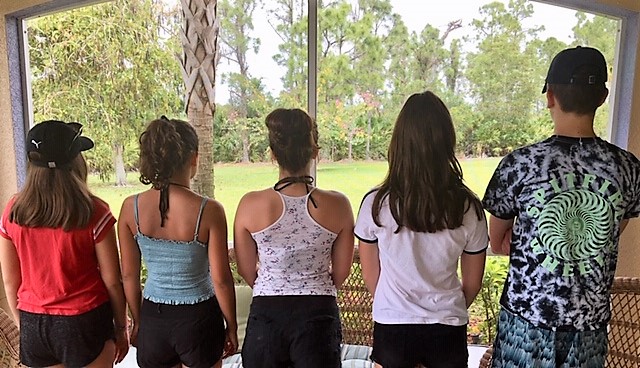
Longer ago than I care to think, the final one of our five grandchildren made her entrance into the family.  She joined an older sister and brother, and two cousins, both girls.  Because the five of them live close to each other in the same town, they’ve spent a lot of time together and have grown quite close.

Ranging in age from seventeen to eleven, Ainsley, David, Alana, Naomi, and Abbey were the subjects of a book I published some years ago, a collection of poetry for and about them.  Titled Five Cousins, the book spun tales of their adventures at the various stages of life they had by then attained.

3 Cousins cover

Each of them received a copy from me one long-ago Christmas—signed, of course, with a suitable inscription.  At the time, the younger ones enjoyed having the poems read to them more than reading them themselves, but either way, their peals of laughter warmed the author’s heart.

Each of them had a section of the book, titled with their name, containing half-a-dozen or so poems with such titles as:  Ainsley Starting School; It’s David’s Day; Alana’s in Florida; Oh, Naomi, You’re the One; and Little Abbey’s Walking Now.

Over the years, these five cousins have seen a good deal of us, their Nana and Grandpa, often at our retirement home in Florida.  In one of life’s everlasting mysteries, they have grown older by leaps and bounds each year, while we elders have hardly aged at all!

[pause for muffled snickers of disbelief from amused grandchildren]

Regardless, it is a fact that three of them are now taller than we are; the eldest is off to university this fall; the second one will join her next year; the next two are halfway through high school; the youngest will soon enter junior high; and every one of them eats gobs more than we do!

As they have grown, their lives have gravitated less toward us and more to their friends; their interests have shifted away from us to their myriad interests and activities; the time we spend with them now is less than it used to be.  They face their futures now, rather than focusing back on what has been.

IMG_3292

Happily for us, they visited us in Florida this year—perhaps for the last time all together, as their lives will increasingly take them along paths diverging from ours.

That is natural, of course, and as it should be.  But their inexorable journey to their own destiny has me thinking I must write another collection of poems about them, and for them, before they leave the sanctuary of childhood for the last time.

I could do it for each of them separately, beginning with the eldest, and follow up for each succeeding one as they reach the age she is now.  Or I could do it as I did the first time, with poems about all of them, suitable to the stage each finds her- or himself at right now.

I think I favour the second option, given my own age.  Time, I increasingly find, is not to be taken for granted.

Anyway, here are five short pieces I have already written about them, collectively rather than individually, in haiku form.  The poems attempt to express my love for these five cousins, my hopes for them, and my unabashed pride in them.

smiling photographs

on the refrigerator—

loving grandchildren

*  *  *  *  *  *  *

grandchildren, our hope

for the future—as we were

once upon a time

*  *  *  *  *  *  *

free your grandchildren,

hug them close, then let them go—

they’ll e’er be with you

*  *  *  *  *  *  *

more yesterdays now

than tomorrows, but it’s the

tomorrows that count

grandchildren

Five Cousins e-book – http://www.lulu.com/spotlight/precept

‘Though the Winds Still Blow

Reflections are imperfect, it’s true, but instructive, nonetheless.  They allow us to look back over those roads we followed in our youth, with a mind to mapping the ones we have yet to encounter.  Here are a few of mine, in haiku form—

from my aging eyes,

the boy I once was looks out—

hardly changed at all

portrait-of-boy1

Or so it can seem.  I know he’s with me, although I encounter him less frequently now in my daily pursuits.  Perhaps he struggles, as do I, against the inexorable weight of the years—

the boy is within

the man, still, but hard to find

as age o’ertakes him

boy 3

Despite that, however, the persistent, exuberant boy I once was still urges me forward on his youthful quests, unfettered as he is by the physical restraints enshrouding the me who is me now—

the sails of my youth,

once hoist, are often furled now,

‘though the winds still blow

sailing-ship

Do I regret that I can no longer join that boy to play as once I did, that I cannot oblige him as he coaxes me onward?  Of course!  But, do I regret the choices I made, whether wise or foolish, when I was him those many years ago?  Well, I have scant time to dwell on that—

regrets?  some, maybe—

but I can’t go back to change

the pathways I’ve trod

two-roads-diverge

It’s the mapping of the road ahead that is most important to me now, however short or long it may prove to be, and the welcoming of each new adventure that awaits—

the uncertainty

of finishing pales next to

the joy of starting

fear 2

So, in spite of my inability now to cavort and engage in those many pursuits I all too often took for granted, I still search out that boy each day—hoping he will not tire of my company, welcoming his encouragement, remembering how I loved being him—

now well beyond my

diamond jubilee, the

man is still the boy

images


Write Lots

write, write, and rewrite—

write until it doesn’t sound

like writing at all

writing

Haiku is a very short form of Japanese poetry, altered over time to fit the demands of the English language.  The essence of haiku is represented by the juxtaposition of two images or ideas and a break between them, a kind of verbal punctuation mark that signals the separation, and colours the manner in which the juxtaposed elements are related.

Traditional haiku consist of seventeen syllables, rendered in English in three phrases of five, seven, and five syllables, respectively.  The lines usually do not rhyme, although many haiku composers try to rhyme the first and last phrases as an additional challenge.

A three-word haiku poem is extremely difficult, but a lot of fun to attempt.

Here are some more samples by me, a keen neophyte, accompanied by pictures for my own pleasure—

nightmares waken me,

phantom fears that something lurks—

banished by the dawn

IMG_1015

comes dawn, the new day,

rising full of hope unspoiled,

banishing the night

IMG_1411

shoulder to shoulder,

a capella voices raised—

united in song

IMG_1449

shore birds by the pond

visible in dawn’s first light—

stalking careless fish

IMG-7850

unrelentingly

under-appreciated—

mediocrity

mediocrity

And a final one—

write lots and often,

share most of it with readers—

prose and poetry

Creative-Writing-Tips-9918