
A Cottage Christmas

Since retiring, my wife and I spend every Christmas at our Florida home.  Usually, one or both of our daughters will come down, with husbands and children in tow, to spend the holiday with us.

Friends often ask us if we miss Christmas in the snowy north.  I offer a vigorous, “No!”, and when they ask why, I tell them the story of our ill-fated Christmas at the cottage.

Our daughters were eleven and ten that year, when friends, who had decided to spend their traditional twelve days on a sunny, southern beach, invited us to use their cottage for our celebration—preparing for Santa’s arrival, skiing and skating in a winter wonderland, and just relaxing.  We jumped at the chance, little realizing what lay in store for us.
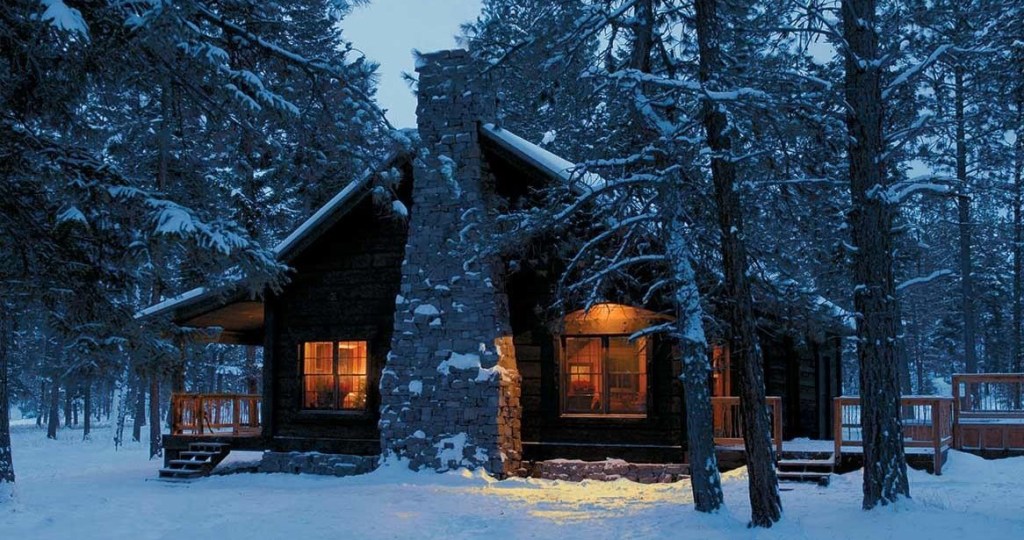
I should have known all would not be idyllic when our friends gave us five pages of notes, detailing what we’d have to do when we arrived at the retreat in the woods.  There were instructions for opening and closing the place, turning on the water system when we arrived, draining it when we left, using the fireplace, enjoying the snowmobile, shoveling snow off the roof, removing the occupied mousetraps—in short, a whole lot of things that could go wrong.

They left us their car to use, much larger than our own, a fully-equipped but much-travelled station wagon that had been around the track more than a few times.  On the day of our departure, I discovered that the rear tailgate, the sort that was supposed to open two ways, down like a truck tailgate or out like a car door, wouldn’t open at all.  Consequently, I had to load all our gear, including skis and poles, through the rear window, which could still be powered down.  As each armload went in, I had to clamber over the rear seat to pull the stuff forward.  I was delighted, as you might imagine, with the challenge.

We took to the road, full of anticipation for our family Christmas at the cottage, on the very day that the first freezing rainstorm of the season hit the area.  That cheered me immensely.

With the six of us aboard—I, my wife and two daughters, plus two dogs in the rear, trampling and drooling on all the packed items—the car windows steamed up almost immediately.  They remained that way for the duration of the four hours it took us to complete the two-hour drive.  Nobody spoke out loud during the final hour!

We arrived, finally, to be greeted by a winter wonderland.  The deep snow, now covered in a slippery mantle by the freezing rain, sparkled and glinted in the twilight.  As promised in our five pages of instructions, the driveway had been plowed just far enough off the township road to allow us to park the car.  The walk from there to the cottage was just what we had expected—arduous, but exhilarating.

The snowmobile was right where the notes said it would be.  But to my chagrin, it wouldn’t start!  In spite of my repeated (and somewhat profane) encouragement, it would not come to life.  Thus, we had to lug in all our gear by hand, twelve trips back and forth between the cottage and the car, dragging the heavy items behind us in a large snow-scoop, toboggan style.

Oh, what fun we had!

Once inside, with everyone unpacking and sorting our supplies, I turned my attention to turning on the water.  The notes our friends had left me were very detailed on this particular chore.  The pumphouse in the basement was a tangle of pipes and faucets—my friend does his own plumbing—all tagged and colour-coded to ensure compliance with the proper way of operating the system.  Without my notes, I’d have been totally lost; with them, I was merely overwhelmed.  Nevertheless, I followed the steps as written, praying fervently all would go as planned.  And it did….at least at first.

Some twenty minutes after our initial rejoicing over running water, the dishwasher sprang a raging leak from somewhere underneath.  I was able to turn off its feeder-faucet before too much damage was done, and I even managed to find the source of the problem—a burst pipe.  Because I was unable to fix the leak, the dishwasher remained inoperable for the duration of our stay.

Eventually, everything was done.  The food was safely stored away, our bags were in the proper bedrooms, the deck and walkway were shovelled clear of snow, and the Christmas tree that had journeyed north on the roof of the car was standing, fully decorated, in the living room.  At last, we began to enjoy our Christmas holiday. 

Of course, we couldn’t ski because the rain that accompanied us north continued to fall, washing most of the snow away in one day.  Nor could we go skating on the lake, because the milder temperatures that came with the rain turned the ice to slush.

If it hadn’t been for the decorations strung around the interior of the cottage, and the sound of the old, familiar carols, we wouldn’t have known we were enjoying a Christmas interlude.  With all the mud, it was like a spring holiday—until the last day, that is.  Then, about five hours before we’d planned to pack the car for home, the snows returned with a vengeance.

So again, thanks to the immobile snowmobile, we had to trudge through knee-deep, new-fallen snow, from cottage to car, packing up everything we had to take home.  I cursed every step!

I could hardly wait until the next time our friends offered us the use of their cottage when they weren’t going to be there.  I planned to torch the place.

Fore!

Upon retirement some twenty years ago, I moved with my wife to Florida for six months of the year.  Where once we had been intrepid winter-sportspeople, participating avidly in (and watching) hockey, curling, and skiing, we forsook them all for the warmer climes of the sunny south—and for year-round golf.

Nestled into a cozy villa in a golfing community, we took to the links as many as four or five times a week—foursomes with friends, club leagues, and even occasional tournaments.

My regular men’s foursome was with three friends, and playing with me was pretty much an act of charity on their parts.  Naturally enough, our conversations generally revolved around the state of our respective games.

foursome

These fellows had, for years, recorded better scores than I had.  I was never sure from week to week which single digit represented their handicaps, but I knew what my handicap was—a pronounced lack of ability to hit the ball where I wanted it to go.  Because of this, I had to put up with their wisecracks, clumsily disguised as advice.

“Y’know, you’re usually standing too close to the ball,” Charlie would chortle.  “After you’ve hit it!”

“Maybe it’s how you’re gripping the club,” John would join in.  “Have you tried playing left-handed?”

“Actually,” Bob would blurt, unable to contain himself, “you’re not really playing golf.  The game you’re playing should be called, If Only…!

Mind you, the ball always went where I hit it—although rarely where I intended to hit it.

To tell the truth, I knew my friends were a lot better than I at the game.  But the gap seemed to be widening with each passing year, and I finally had to acknowledge I was the guy who always had the highest scores.

a-golf-scorecard-and-tee-picture_csp0481297

What really bothered me were their claims that they played golf to relax, to shake off the everyday cares that accompany getting older.  When we’d finish a round, they’d be happy, serene, and ready for a self-satisfied nap.

Not so with me!  I generally came in after eighteen holes feeling frustrated with my score, angry about the balls I had lost in several of the ponds, and despondent over my lack of improvement.  My friends would laughingly console me by saying, “Relax already.  You’re not good enough to get mad!”

So, in desperation, I decided to take a lesson from the local pro at our club, who watched me hit a few balls on the practice range.

“Hmmm,” she offered, after witnessing my futile flaying of the club, “I think you need to take a couple of weeks off, get away from it for awhile.”

“Really?” I replied.  “That’s it?”

“Yup.  Then, you should consider giving up the game!”

Undeterred by her flippant attitude (and figuring she’d probably been put up to it by my friends), I decided to persevere—but, I have to say, only after making several minor modifications to the rules.

rules

On one day, for example, I would decide on the score I wanted to shoot before I began each round.  When I reached that number, regardless of which hole I was on, I would simply stop counting my strokes.  And guess what?  I began to feel quite pleased with myself—although, I was a tad concerned about how my friends seemed to feel.

“Seventy-five?” they’d chorus disbelievingly.  “Really?”

On a different day, I’d resort to another of my modifications, this one having to do with visualization.  Because I knew what constituted a good golf shot, even if I had trouble executing it, I’d conjure a mental image of what I wanted each shot to look like.  Then, Zen-like, I’d slash at the ball.  If I liked the result, if it matched my visual image, I’d count the stroke; if not, I didn’t.  And just like magic, my scores improved.

As did my mood.

A third minor change, one I particularly liked, allowed me to stick almost exactly to the rules.  I would play every stroke by the book, not trying to finagle the score on any hole—I’d tee off, hit crisply from the fairway, putt every stroke (no gimmies), and I’d count every penalty stroke (if there were any).  The only deviation from the rules of golf was that I used an imaginary ball, rather than a real one.

For a long time, I really believed this new game of ‘air-golf’ could catch on, and I wouldn’t have to bend over on every hole to retrieve a ball from the cup.

Looking back, there were a host of changes I made to my rules—

  • there was no such thing as a lost ball because the missing ball was on or near the course and would eventually be found and claimed by someone else, thereby making it a stolen ball;
  • when my ball was sliced or hooked into the rough, it could be lifted and placed on the fairway at a point equal to the distance it had carried or rolled into the rough with no penalty, because I should not be penalized for tall grass which grounds-keepers had failed to mow;
  • if my putt passed over a hole without dropping, it would be deemed to have dropped because the Law of Gravity should always supersede the Rules of Golf; and
  • if any of my putts stopped close enough to the cup that they could be blown in, I could blow them in without penalty; this would not apply to balls more than three inches from the hole, however, because I didn’t want to make a mockery of the game.

putt

With these changes in place, my scores began to match those of my friends in short order.  And I can’t say they were pleased about it.  In fact, so petulant did they become that, after only a week, I had to abandon these rule modifications altogether.

It was either that, or I’d have found myself playing alone!

Mind you—not that I want to lose my friends—I do shoot my best scores when I’m playing alone.

Just sayin’!