The Gun

The August prompt from my Florida writers’ group is to use a “hook” within the first few lines to draw readers/listeners in to the story.  This is my offering—

I discovered the gun in the drawer of my husband’s bedside table this morning.  I’d been looking for the bottle of Xanax he’d borrowed from me last night, and I found it lying beside the gun.

To say I was shocked would be an understatement.  I sat down numbly on the bed, staring vacantly at the gun, wondering why on earth my husband would have such a thing.

It looked huge—an ugly, metallic-sheened obscenity lying there like a wide, upper-case L, one arm shorter than the other, a curled stem sticking from between its two arms like an erect, male appendage.  The shorter arm was pebbled with three shallow curves on its inside edge, obviously the arm someone would use to hold the gun and point it.  The longer arm was straight, with a round, black hole at its end.

Loath to touch it at first, I eventually gave in and picked it up between thumb and forefinger.  It was heavy, and oily to the touch, almost reptilian.  After a moment, I clasped it in my other hand and pointed it at my reflection in the mirror on the back of the bedroom door opposite.

The sight frightened me to the point I cried out and dropped the gun on the carpet.  It landed with a soft thud, then lay at my feet, pointing back at me.  Gingerly, I stirred it with my toe to point it away.

Why does Frank have this…this thing in his drawer?  What’s he afraid of?  And why didn’t he tell me he has it?

The gun was still on the carpet when I came back upstairs after lunch.  I knew I couldn’t just leave it there, but I had no idea what to do with it.  Without knowing why Frank even had the thing, I couldn’t put it back where I’d found it.

What if he’s planning to use it on me?

Sitting on the bed again, I swallowed a Xanax from the bottle still lying in Frank’s drawer, then tossed the bottle to my side of the bed.  As I did, a light went on in my anxious brain.  I picked up the gun carefully, walked around to my bedside table, and put it in my own drawer.  The pill bottle followed it, and I closed the drawer firmly.

There!  Problem solved!

Downstairs again, I couldn’t stop asking myself why Frank had the gun in the first place.  We’ve had our share of arguments over the years like any married couple, maybe more in the past few months.  But there’s never been anything leading either one of us to contemplate violence.

What am I missing?  Is there something different lately?  Is he tired of me?  Is there someone else?

Dinner was unusually silent, mostly because I replied to Frank’s conversation in monosyllables.  By dessert, he’d stopped trying, and he scurried off to his den afterwards to watch a game.  I busied myself reading in the living room.  Or tried to.

Why is he so quiet?  What’s he planning?

The old grandfather clock in the vestibule was chiming eleven as I climbed the stairs, dreading entering the bedroom, not knowing what might be waiting for me.  Frank had headed up half an hour ago, so if he had something planned, he’d had time to get ready.  I wondered if he’d found the gun in my drawer.

He was lying in bed reading when I came in.  “I took another Xanax from your bottle,” he said sleepily.  “Had a rough day.”

I slowly got undressed before visiting the bathroom, not understanding how he hadn’t found the gun when he got the pill from my drawer. 

Maybe he did!  Maybe he’s got it under the covers…

When I came back from the bathroom, his light was off.  I carefully crawled in beside him, lay quietly for several minutes until I could no longer hold it in.  “Frank?  Are you still awake?”

“I am now,” he mumbled.

“Frank, why do you have a gun in your drawer?”

“A what?”

“A gun!  Why is there a gun in your drawer?”

“What are you on about?” he said, his voice sharper now.  “I don’t have a gun!”

“I found it this morning,” I said, my own voice rising.  “Don’t tell me you don’t have a gun!  It’s right here in my drawer now.”

Rolling over, Frank opened one eye.  “Have you been taking your meds?  You’re talking crazy!”

“Crazy?  Crazy?  Okay, then what’s this?”

I slid out of bed, yanked open my drawer, pulled out the gun.  Pointing its ugly snout at him, I said, “This is a gun, Frank!  And I found it in your drawer this morning.”

He stared at me in disbelief for a moment, then rolled his back to me again.  “You’re delusional, Emma.  Take your pill and let me get some sleep.”

Infuriated by his nonchalance and denial, I took a deep breath, closed one eye, and pulled the trigger.  The gun jerked violently in my hand, hurting me, and the loud Bang! deafened me.  And then…and then…

I wakened in a cold sweat.  Frantic, I turned to my husband, but he was snoring peacefully beside me.  And despite my frenzied search in the darkened room, there was no gun to be found. 

When I awaken again, it’s almost ten o’clock.  The sun is streaming its narrow beams around the edges of the shades, still pulled down, and I see dust motes floating lazily in its warmth.  Frank has dressed and gone to work.  I lie there for a few minutes, reliving the dream.

Thank God that’s all it was!  Imagine if it had been real!

As I’m washing my hands in the bathroom, I wince at a tinge of pain in my right palm, and I see that it’s lightly bruised.  After dressing, I remember to take my pill before heading downstairs.  On the way out of the bedroom, I hesitate a few moments at the door.

Don’t be stupid!  There’s nothing there!  Forget it!

 Nevertheless, I decide to check, and to my horror, I discover the gun in the drawer of Frank’s bedside table.

By Their Works

It is said, by their works shall we know them.  And increasingly, we do.

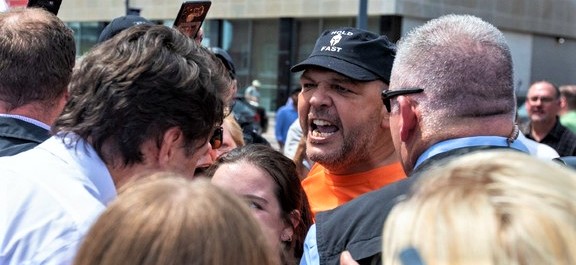
They rise among us, predominantly—but by no means exclusively—white, male, overweight, bewhiskered, rural, racist, ostensibly-straight, conservative, angry, and occasionally violent.  They are frequently accompanied by others who don’t fit this profile exactly, but who express the same rage, the same fear, the same desire to take Canada back.

It’s unclear where they want to take us back to, but I suspect it might be back to the ‘50s—a decade most of them are too young to have lived through—a time when, in their fevered imaginations, men were men, women knew their place, children spoke only when spoken to, and nobody—including elected governments—told anybody else what to do.

Redneck heaven, to borrow a phrase.

According to the messages these folks spew unrelentingly on social media, marriage back then was between one man and one woman—born male and female, respectively.  Every child lived in a nuclear family.  Racialized and Indigenous people were not part of the established fabric, nor for the longest time were women, the poor, Jews, immigrants, or differently-abled people.

And it goes without saying, the LGBTQIA+ community was non-existent.

Previous decades have seen lots of protests in support of many causes—the ‘60s and ‘70s come to mind for this old-timer, but every era has known them.  Most of those were peaceful, yet often effective; some involved civil disobedience; still others degenerated into violence, with consequences visited upon those who violated the law.  The majority were mounted in the name of advancing more liberal, progressive movements—universal suffrage, socialized medicine, civil rights, end-the-war, the women’s-lib movement, and Indigenous reconciliation, to name but a few.

And that marks a major difference with today’s oft-inchoate protests, striving noisily to take us back to ‘the good old days’.  Today’s aggrieved zealots behave as if our country always belonged exclusively to them—more accurately, their predecessors—and not to everyone who inhabited it then, and does so to this day.

Populists, bigots, and white-supremacists have ever been part of Canada’s demographic, of course, and many of us, I suspect, knew some of them back in the day.  As a child born in the ‘40s, growing up in the ‘50s, I well remember the use of such loathsome slurs as kike, wop, dyke, fag, nigger, Paki, d-p, and others even more vile.  As I was part of the white middle-class, they were never used against me, but more than a few of my white schoolmates hurled them—perhaps unwittingly, parroting their elders, but hurtfully, nonetheless—at those on the receiving end.

Another difference between those long-ago times and today is the opportunity the bigots now have to spread their hateful rhetoric.  Social media, for all the benefit it has brought to much of society, has enabled the haters and ragers to amplify their message across the internet.  In their posts, we find no trace of the civility that once characterized public discourse, even among those whose political ideologies and points of view conflicted.

When did it start to be okay, I wonder, to ignore the fundamental tenets of good manners?  Of respect for other people?  Of common sense?  Perhaps it’s cantankerous of me to bewail their passing, or maybe I’m being overly pernickety in complaining about it.  After all, as I’ve previously written, some folks consider me an unrepentant curmudgeon.  Perchance, I am.  Still, was respectful consideration for others not always a hallmark of civilized behaviour? 

Today’s unruly mob weeps and wails loudly, profanely, about their loss of freedom, even as they enjoy the freedom to assemble and protest it.  To me, it’s as though they believe this coveted freedom means unfettered license to do whatever they wish, unencumbered by the rule of law.  Thus arises anarchy.

In Canada, citizens elect a federal Parliament every four years or so; then, with the ritual approval of the Governor-General, that Parliament chooses a government based on votes of confidence among elected members.  The Prime Minister is the elected leader of the party chosen by Parliament to govern.  Occasionally, one party wins a majority of seats in a given election, and thereby becomes the governing party by default.

For citizens either enamored of, or disappointed by, the actions of the PM and governing party, there is a means of re-electing or turfing the incumbents—the next election.  Responsible civil engagement and voting are the tools.  Increasingly, however, today’s fervid protesters crowding the nation’s public venues revert to intimidation, bullying, and threats of violence to overturn the will of the majority, to impose their values and beliefs on everyone.

If they win, democracy—imperfect though it may be—loses.

By their works, we shall know them.

I Dreamed…

A recent prompt from my Florida writers’ group was to use the phrase, “I dreamed last night…”. This was my submission—

A reminder to those who receive my complete posts in your email, rather than just a link—if you click on the title, you’ll be able to read the post in its proper format on my actual website, rather than in the body of your email.

I dreamed last night of a universe vast,
Extending the future from some unknown past,
Throbbing, emitting, exploding in heat,
Its energy vibrant, its fate incomplete
As onward it rushed, this dream in my head
Rendering me rapturous, there in my bed.

I dreamed last night.  And I wondered if I
Might perhaps be a part of that darkened sky,
From genesis unto eternity,
Unceasing, undying, the infinite me---
My spirit indwelled with life, and a mind
Pushing e’er forward from a past left behind,
Seeking out answers as questions unfold,
Traversing the nothingness, fearless and bold.
I dreamed last night I was mounted astride
A life-force impelling its own suicide.
For how could I, a mere mortal, defend
A beginning without eventual end?
How could we persons, predestined to die
Believe in a universe beyond the sky?

I dreamed last night.  When I wakened again
To face the day’s dawning, the truth appeared plain.
There’s no need for proof of life after death,
For we do not die after our final breath.
We’re integral to that miasmic cloud,
That cosmos of energy, bursting and loud.
We’ll live evermore, just not in this state--- 
We need but to trust, let our faith not abate.

Yes, I dreamed last night of a universe vast,
Informing our future through present and past,
Accepting us gladly, just as we are,
Propelling us forward from near and afar.
Mortality ends, but life still goes on,
And we shall be part of it, unto anon.

But He Didn’t!

The Gulf Coast Writers Association in southwest Florida recently announced the winners of their 2023 writing contest. I’m pleased to say I won First Place in the fiction section with this piece, But He Didn’t!

The GCWA provides a forum for fellowship, education, and information for writers, and its well-regarded contest draws a wide-range of authors.   Based in Fort Myers, the organization attracts members from throughout Southwest Florida, including published as well as unpublished writers, and professional editors, agents, and publicists.  The literary genres run the gamut from poetry, adult fiction and nonfiction, to children’s and young adult, historical fiction, romance, mystery/thriller, memoir, essays, and screenplay.  Members include full-time writers, as well as corporate professionals, teachers, and business owners, all still working or retired. GCWA’s website is https://gulfwriters.org/ 

I hope you’ll enjoy But He Didn’t!

* * * * * * * * *

After the wife died, I started talkin’ to myself.  Not ‘cause I’m some crazy coot who’s lost the cream-fillin’ outta his Twinkie, but just so’s the house wouldn’t be so quiet.

I got in the habit when I’d hike myself onto the barstool in the rec room downstairs an’ see myself in the mirror.  I’d pour a shot, raise it high, an’ say, “Here’s lookin’ at you, kid!”

Not that I was a kid.  I was in my early-sixties when the wife died, an’ my reflection looked every bit of that.  For the longest time, I was the only one doin’ the talkin’, but at some point the guy in the mirror joined in. Lookin’ back, I think it was when I told him the wife had always been a nagger, but now I sorta missed her constant yammerin’.  “She’d rattle on an’ on,” I said, “but that was okay ‘cause if I got mad, she’d know to shut up.”

Mine, too.  Had a nasty mouth when she set her mind to it, but every now an’ then, I’d drop the hammer.

His voice sounded like mine, maybe flatter on account of it was bouncin’ offa the mirror.  The more we talked, the better we got to know each other; an’ the better we got to know each other, the more we talked.  Turns out, he was retired, like me, an’ we told each other funny stories ‘bout the jobs we worked, an’ the jerk-off bosses we had.

“I sometimes miss the job,” I said after a long swallow.  “But not the bosses!”

Me, too!  I actually punched one out after he got on my case for somethin’.  Got fired, but it was worth it!

He told me his name was Michael—which is my name, too, what the wife used to yell in capital letters every time she got teed off.  I told him I’d call him Mike.

Both of us enjoyed our drinkin’ time, which started around four in the afternoons.  Mike was left-handed, which I noticed when we poured our shots, an’ whenever we raised our glasses. 

He always arrived when I did, an’ got up to leave every time I headed back upstairs.  I always turned at the stairs for one final glance in the mirror, an’ we’d wave.  Mike was real good company, an’ I didn’t feel so alone anymore.

“I got two kids,” I told him one day.  “But I ain’t seen neither of ‘em since the wife died.  It’s like they blame me for her dyin’.”

That’s exac’ly like my kids!  You think I ever hear from ‘em?  Not a freakin’ word!  I used to call ‘em, but never once heard anythin’ back!

Sometimes we’d sit quiet for the longest time, nursin’ our drinks, thinkin’ our own thoughts.  Neither of us ever offered to buy a round ‘cause we always had our own bottle. 

We had other stuff in common, too.  He was fightin’ with the IRS, like me, over back taxes.  He liked the Rollin’ Stones, an’ we both thought the Beatles were fairies.  He loved the Red Sox, but neither of us could afford tickets to Fenway.  We both still saluted the flag an’ stood up for the anthem, but neither of us went to church anymore.

“I gave that crap up after the wife died,” I said.  “Between the church an’ the undertaker, I shelled out more’n a thousand bucks for her funeral!  Nothin’ but bloodsuckers, all of ‘em!”

You got that right!  I had the wife cremated, an’ I still hadda fork out for a casket.  An’ all’s I got at the end of the whole thing was a little cardboard box, sealed up tight, s’posed to have her ashes inside.  How do I know if it does or not?  I sure as hell ain’t gonna open it!

“I got the same thing,” I said.  “Plus, my kids got twisted in a knot over the whole cremation thing.  Said their mother should be buried whole, like she wanted.  I hung tough, though, an’ still got stiffed for the dough.”

The only thing I regret is the wife an’ me had a fight the day she died.  Real shame!

“What were you fightin’ ‘bout?”

Nothin’ really.  When I came into the kitchen, she started yappin’ at me, so I told her to stifle herself.  She said somethin’ back, wavin’ her wooden spoon in my face, an’ a piece of whatever she was cookin’ landed on my cheek.  Hurt like hell!  So, without thinkin’, I hit her.  Not hard, but she staggered back, caught her foot in the floor-mat, an’ fell backwards.  Hit her head on the countertop when she went down.  I heard the crunch, an’ then she just lay there.

“Holy crap!  Was she dead?” I asked.

Stone dead, just that quick.

“So…you killed her?” I said.

No, don’t be stupid!  Wasn’t me that killed her, it was the granite countertop. 

“Yeah, but you hit her…”

I know, but by mistake.  She tripped on the floor-mat! 

“So, what’d you do?” I asked.  I was completely…memorized, or whatever the word is.

 I called 9-1-1, told ‘em my wife was on the kitchen floor, said I couldn’t wake her up.  I started bawlin’ my eyes out, was still doin’ that when the ambulance arrived.

“What’d you tell ‘em?” I asked.

Told ‘em I’d been sleepin’ while she was cookin’ dinner, woke up when I could smell the food burnin’, found her on the floor.

“An’ they believed you?”

Yeah, no reason not to.  I hadda talk to the cops a coupla times, but everythin’ I told ‘em added up, so they called it…death by missed adventure…somethin’ like that.

I poured myself another shot, as did Mike.  “Yeah, but still…”

The whole house stunk like burnt food, an’ that’s what I said woke me up, so that prob’ly helped.

“Lucky you,” I said, takin’ another swallow, watchin’ him do the same.  Like I said, we both liked our drink.

Yeah, but I never could get those pots clean.  Hadda throw ‘em all out. 

I didn’t sleep much that night, thinkin’ ‘bout what Mike had told me.  I ‘preciated that he trusted me, but I couldn’t shake the idea that what he did was wrong.  I mean, it’s one thing to do somethin’ bad, even like an accident, but it’s a whole other thing to cover it up.  I think they call that rationin’…some word like that.

Anyways, I didn’t go downstairs for a drink the next day, but while I was gettin’ my supper ready—baked beans on toast an’ a slice of fried ham—I thought some more ‘bout what he’d said.  An’ because I wasn’t payin’ attention, my toast got burnt an’ the beans stuck to the bottom of the pot.  I pictured myself in Mike’s kitchen on account of the smell, got sick to my stomach, an’ couldn’t finish my supper.  Couldn’t get the burnt beans offa the bottom of the pot, neither, so the whole thing went in the trash.

I was on my barstool the next afternoon, though, got there just as Mike did.  We poured ourselves a shot, like usual, an’ raised our glasses.  After a good, long sip, I said, “You’re gonna hate me, Mike, but before I came downstairs, I called the cops, told ‘em what you told me ‘bout how your wife died.  They’ll prob’ly be gettin’ here soon.”

Why’d you do that?  I thought I could trust you.

“Yeah, I’m real sorry,” I said, takin’ another sip.  “But after you told me what you did, I figured I couldn’t live with knowin’ what really happened.  You shoulda kept it buried inside your head, y’know?  But once it was out there, I figured I hadda do somethin’, right?  So, I told the cops everythin’.”

We stared at each other without talkin’ for awhile, an’ then I saw two policemen enter the rec room, move up behind Mike, put his hands in cuffs behind his back.  I got up to leave when he did, feelin’ like they were leadin’ me away, too.

Like always, I paused at the bottom of the stairs, peered over my shoulder at the mirror, saw my friend lookin’ back at me, a cop on each side of him.  “Sorry, Mike,” I said sadly.  “I enjoyed knowin’ you.”

I’m not Mike, you poor sod!  You are!  I’m just your reflection!  You’re the one who killed your wife!

“Don’t be crazy!” I cried.  “You’re the killer!”  But even as I spoke,  my wrists were chafin’ from the cuffs, my shoulders hurtin’ under the grasp of the two big cops.  As they manhandled me out of view of Mike, I shouted desperately, vainly, “You’re not my reflection!  You killed your wife!”

But he didn’t.

Cogito, Ergo Sum

Cogito, ergo sum—I think, therefore I am. 

So opined René Descartes in 1637, in his famous work, Discourse on Method, demonstrating what he regarded as the first step in the acquisition of knowledge.

Of course, we don’t know that he was right, but because enough of us have come to believe his posit, it is almost universally accepted.  Left unanswered is the question as to whether other living organisms are sentient, whether they also can think.

Some people believe they can—that creatures such as elephants, whales, and dogs are capable of thought—and they cite observed actions by these animals as proof of their belief.  But what of other animals, or fish, and what of plants and rocks?  To my knowledge, no one has as yet been able to prove (or disprove) the thesis that any lifeform other than human is capable of thought.

Regardless, it does seem likely that no form of life on our planet has attained the same level of high-order thinking that the human species has.  And if any have, they have hidden it from us remarkably well.  With physical brains somewhere between the largest and smallest in size among all living creatures, we humans appear to have outstripped them all in our capacity to think rationally.

The capacity to think is what allows many of us to read widely, listen to diverse sources of information, and weigh the relative merits of differing schools of thought before deciding on a course of action—critical thinking.  Alas, it is also what allows us to read narrowly (if at all), listen carelessly, and reject schools of thought that do not reflect our own preconceived notions.

Either way, thinking broadly or narrowly allows us to form opinions.  And those opinions, whether supported by evidence or not, often morph into staunch beliefs if we don’t continue to think about them, to test them against emerging information.  And inference plays a big role in that.

For example, if I waken one morning to the sound of thunder, and if I see flashes of lightning illuminating the drawn curtains of my bedroom, I might well infer that it’s raining outside.  But I have no proof of that until I actually see (or feel, or smell, or taste) the tangible rain.  I might throw open the curtains to discover there is no rain falling, despite the harbingers of storm; merely hearing and seeing those from inside my room would have drawn me into a false conclusion, yet one I believed until faced with proof of the opposite.

It points out the danger of choosing to believe everything we think, at least before we have evidence to support (or deny) our premises.  As sentient beings, we are compelled to seek answers to the baffling phenomena we observe around us, to find reasons why situations unfold as they do, to explain the arcane mysteries that bedevil us—like where we came from and where we’re going.

Our world is replete with examples of how we have gone about this—in religion, science, engineering, medicine, music, literature, and so many other fields.  The list of human accomplishments over the millennia is long and laudable.  Errors have been made along the way, and corrections applied, but the steady march of knowledge-acquisition has been relentless.

Many of our ancestors, for instance, once believed (and some still do) that the earth was flat, that any who got too close to the edge would topple off the edge, fall into the void, and be lost forever.  We know now, of course, that belief was untrue.  As an amusing aside, the Flat Earth Society still boasts today in its brochures of having chapters of believers around the globe!

Still other folks believed once upon a time that our planet was at the centre of the known universe, that the moon and sun revolved around us; those people’s skills of observation, primitive by today’s standards, and their earnest thinking about those observations, led them to that conclusion. Yet, it was also not true.

Nevertheless, despite our many errors and missteps along the way, our capacity to think rationally—and to forever question our thinking—has allowed us to advance our collective knowledge.  A key factor in continuing that progress is to avoid investing complete faith in any one thesis, regardless of its appeal at any given time; we must retain an appropriate level of skepticism in order to keep from falling into the acceptance of rigid dogma and blind ideology. 

As George Carlin is reputed to have said, “Question everything!”

Another key is to continue testing theses to reinforce their viability, to find evidence of their truth (or falsity).  But at the same time, we must remember that an absence of evidence of truth in the moment does not mean the same thing as evidence of an absence of truth.  In other words, just because we don’t have the facts to prove the legitimacy of a thesis right now does not mean that thesis is untrue; it may mean simply that we haven’t as yet discovered the facts to validate it.

The advance of knowledge is, to paraphrase Hemingway, a movable feast.

An exception to prove the truth of any thesis can always be found, of course—something that demonstrates the general truth of a thing by seeming to contradict it.  For instance: most of the teachers in that elementary school are female, and the one male teacher on staff is the exception that proves the rule.  The thesis is factual.

We also know the true merit of any pudding is put to the test in the eating.  But with one person’s taste being different from another’s, whose opinion is to be accepted as the truth?  Any decision there must be regarded as opinion, not fact.

It is interesting to note that Descartes did not write, Cogito, credo quod cogitare, ergo non est recta—I think, I believe what I think, therefore it is right.  Apparently, he understood that because we think something, even to the point of believing it, that does not necessarily make it true.

He also wrote, Non satis est habere bonum mentem; Pelagus res est ut bene—It is not enough to have a good mind; the main thing is to use it well.

Quaestio, semper quaestioquestion, always question!

Platitudes and Attitudes

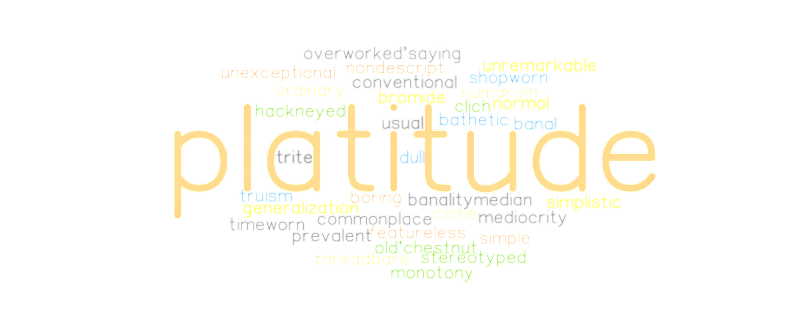
Platitudes are trite, banal, or hackneyed statements, timeworn clichés people use because they allow us to sound like we know what we’re talking about, sometimes providing us a polite way to avoid difficult conversations.

Most of them are overused phrases or expressions that have lost their originality and power.  But because they’re expressed in a formulaic manner, their meaning is usually recognizable instantly.

While all of us probably resort to using clichés at one time or another, there are those among us for whom platitudes are the standard form of conversation.  We would be likely to hear phrases such as the following when we encounter these folks: it is what it is; it’s a no-brainer; it ain’t rocket science; time will tell; that’s life; or everything happens for a reason.

Such glib folks might themselves be described in cliché-form: all hat, no cattle; the blind leading the blind; or ignorance is bliss.

Beyond the simplistic ones, I find some platitudes to be downright cringy: all you need is love; love makes the world go round; if it’s meant to happen, it will; patience is a virtue; no pain, no gain; or good things come to those who wait.

I do enjoy many platitudes, though, if for no other reason than they give me the opportunity to counter them with snappy, little rejoinders of my own, reflecting attitudes perhaps better left undisturbed.  For example—

God helps those who help themselves; okay, but I hope God also helps those who get caught helping themselves!

Practice makes perfect; yeah, but only if it’s perfect practice!

Don’t criticize a man ‘til you’ve walked a mile in his shoes; right, because by then you’ll be a mile away and have his shoes!

What doesn’t kill you makes you stronger; except if it doesn’t!

You’ll find love when you’re not looking for it; maybe, but good luck with that if love isn’t also looking for you!

Absence makes the heart grow fond; perhaps, but fond of whom?

Stop and smell the roses; great idea, unless bees are gathering rose-pollen where you stick your nose in!

Better late than never; unless, that is, you weren’t invited in the first place!

One person’s trash is another person’s treasure; sure it is, if it’s not already a rotting pile of garbage!

He’s at his wit’s end; or on the other hand, he may just be halfway there!

It’s not what you know that matters, it’s who you know; perhaps, unless you don’t know anyone important!

Curiosity killed the cat; true, but satisfaction brought…well, you know!

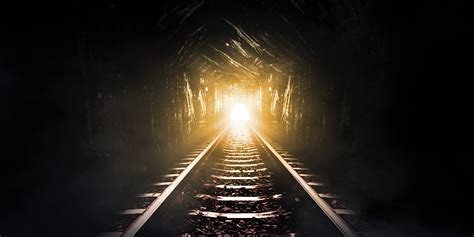
There’s always light at the end of the tunnel; there is, but it might be an oncoming freight-train!

Beauty is only skin-deep; that’s alright, I’m thick-skinned!

Two heads are better than one; fine, as long as they aren’t attached to the same torso!

There’s someone for everyone; and you would know this…how?

It is better to be by yourself than engaged in bad company; in that case, please excuse me!

Ah, those last two are a tad unkind, I must admit, but they tickle my funny-bone, anyway.  It has been said by someone far wiser than I that an idle mind is the devil’s workshop.  So, to foil that maleficent demon, I often occupy my idle mind with such trivial pursuits as this, and then write them down. 

I hope you have enjoyed some of the results.   

The Railwayman

Again this year, I know I’ll receive warm hugs and kisses from my daughters in recognition of yet another Father’s Day, the fifty-first such occasion.  It never grows old.

We fathers grow old, however, despite our best efforts.  And in so doing, we lose our own fathers as they board the last train to glory, to borrow from Arlo Guthrie.  My dad departed the station twenty years ago, but he remains with me almost daily in my reveries.  And never more so than on Father’s Day.

When I was a young boy, he would take me to local railroad crossings to watch the big steam locomotives and their endless caravans go storming by.  I treasured those occasions because I would have his undivided attention, a not-so-frequent circumstance in a family that eventually numbered five children. I’ve often wondered if, during those times with me, he might have been fondly remembering standing by the rails with his own father. 

He enjoyed the time with me, too, I’m sure; but he loved those trains even more than I did, a boyhood fascination he never lost.  If he could have been anything else in life but an insurance executive, I believe he’d have been an engineer on one of those behemoths. He was truly a railwayman, if only in his dreams.

https://s-media-cache-ak0.pinimg.com/736x/23/67/c0/2367c020ad92968a83fc8070d32a375d.jpg

At the time of his passing, I wrote these lines to commemorate what he meant to me, to express my love for him, and they comfort me still—

The Railwayman

You’d take me down beside the rails to watch the trains go storming by,

And tell me all those wond’rous tales of engineers who sat on high,

In cabs of steel, and steam, and smoke; of firemen in their floppy hats,

The coal they’d move, the fires they’d stoke, as o’er the hills and ‘cross the flats

The locomotives huffed and steamed, their whistles blowing long and loud.

And one small boy, he stood and dreamed beside his daddy, tall and proud.

Terrifying monsters were they, bearing down upon us two, who

Felt their force on that steel highway, hearts a-racing---loving, true.

I’d almost flinch as on they came toward us, with their dragon-face

A-belching, spewing, throwing flame and steam and smoke o’er ev’ry place.

But you’d stand fast beside the track, and, oh! the spectacle was grand.

So, unafraid, I’d not step back, ‘cause you were there holding my hand.

Oh, Railwayman, oh, Railwayman, I’m glad you knew when you grew old,

How much I loved you---Dad, my friend---who shared with me your dreams untold.

Oh, Railwayman, oh, Railwayman, if I, beside you once again,

Could only stand safe in your hand, awaiting with you our next train.

All aboard, Dad…all aboard!

And Happy Father’s Day to all who, like me, are both fathers and sons.  We are blessed.

[Slightly different versions of this tale have been published here twice before.]

The Sandbox

Over a period of years a long time ago, on my daily walks to and from work through a local community park, I used to watch groups of pre-schoolers playing in a very large sandbox.  I was always struck by their singular focus on the primitive sculptures and projects they were building.  Oblivious to events going on around them in the park, they directed all their energy towards the activities in the sandbox.

A few of the kids looked to be cooperating with each other, working diligently in pursuit of whatever objective they had settled on.  Their interactions were punctuated by short bursts of conversation, lots of smiles, and the occasional whoop of glee when something came to fruition.

Most of the others in the group played alone, apparently unconcerned with the endeavours of their companions—typical of that age and stage of development.  Quick flares of temper occasionally gushed forth, and angry exchanges, when one person’s endeavours somehow impinged upon another’s, but on the whole, the mass of children in the sandbox managed to coexist.

Their mothers—no fathers, alas—watched with a mix of pride and bemusement as their offspring played, secure and happy in the park.

As time passed, those children got older and left the sandbox, but they were replaced by a seemingly inexhaustible supply of similar youngsters, and the pattern remained the same.  And everyone in the sandbox was concerned only with what was happening within its confines, no one with the goings-on in the rest of the park.

I noticed changes in the park at large, however.  In the early years, it had been a sylvan haven for children and families—a place to gather with friends, to cool off under the trees on mid-summer weekends, to escape the pressures of the daily grind.  As time passed, though, I began to miss the family gatherings, as many of those parents, some of them working two jobs, were no longer able to come.  And at the same time, more and more older children began to frequent the area, not playing the sorts of games I was familiar with from my own childhood, but just hanging out.  Loud music could often be heard, smoke hung over many of the conclaves, and occasional fist-fights would erupt between different groups.  In time, the park became, not so much a family destination, as a place for the neighbourhood’s teenage kingpins to gather.

The children in the sandbox were affected by these changes, of course.  Now, they had to avoid issues with the older kids if they hoped to play their games.  But, for the most part, they were able to do that, and in their exuberance and innocence, they continued their childish pursuits, interacting with one another as their predecessors always had.  None of them cared that the de facto ownership of the park had been co-opted.

To be sure, it never became a dangerous place, one to be avoided.  I continued my daily walks with no fear, but I was aware of the changed dynamic, even if the sandbox urchins were not.

Today, long-since retired and no longer walking in that park, I think of it as an allegory of sorts to the present situation with our government.  When I watch Question Period, for example, whether federal or provincial, the elected denizens of Parliament focus so much of their energies and time on what seems to me nothing more than spurious activities, full of sound and fury, signifying nothing, as Shakespeare wrote.  As I watch and listen, I see again those pre-schoolers in their sandbox, engrossed in the small world they are occupying.

To be sure, legislation does get passed, much of it to the benefit of the country or province as a whole, even if never fully satisfying everybody.  And that’s good.  But I find it akin to the completion of those sandbox projects and sculptures that so pleased their creators—not insignificant, beneficial to their future growth and development, but accomplished only with such fuss and foofaraw as to be laughable.

A more serious situation, however, has developed outside the sandbox—the Parliament—in terms of who is really in control.  While elected officials busy themselves with their daily perambulations, much as those pre-schoolers did, private-sector interests are busy trying to take over the park, so to speak.  Be it wealthy, corporate entities, land-developers and real-estate companies, foreign-based media ownership, legal, banking, and financial firms, or myriad other lobbyist organizations, the environment around Parliament has undergone a radical change.

The ownership and culture of a local park are things to be gained or lost by the residents of the community in which it sits, according to their wishes and level of activism.  Depending upon how a community responds, their sandbox may be lost.

But the ownership and culture of our provincial and federal Parliaments are embedded in our constitutional rights—they belong to us, the citizens of this country.  Do we want to lose them?  Have we entrusted them to the finest possible stewards, our best and brightest?  Is there a fix for the encroaching, pernicious influence of the big-moneyed interests? What are we to make of foreign influence on our government?

More of us need to pay more attention to these questions, or all of us may end up losing our sandbox altogether.

Another New Book!

I’m really excited to announce the publication of my eighth anthology of tales—My Relentless Muse: Tales of a Vagabond Storyteller—a collection of more than fifty essays I’ve written as a member of the Pelican Pens writers’ group in southwest Florida.

I have long regarded myself as a storyteller, and the collection here is selected from more than one-hundred-and-fifty pieces I’ve shared with this group of talented writers.  Once a week, Pelican Pens members get together to read our stories aloud, and to offer helpful suggestions to one another.  At the end of each gathering, we go away with a prompt or two to guide us for the following week’s articles.   At the beginning of each story in this collection, just beneath the title, you’ll see the prompt that suggested the tale you’ll be reading. 

The relentless muse referenced in the title remains a mystery to me, even after a lifetime of writing.  I still find myself wandering like a vagabond, hither and yon, seeking after the story-ideas she holds out to me.  Yet most of the time, I never leave the chair in front of my computer because my elusive muse is so firmly embedded in my imagination.  

This newest book may be previewed and purchased at the publisher’s safe site— https://www.lulu.com/spotlight/precept   I hope you will take a few minutes to visit the site, where you will see all my books…..including my most recent crime novel, published just one month ago, Delayed Penalty.

The site is well worth visiting, even if I do say so myself!

Happy reading!

Simple?

There are most likely no simple answers to the myriad questions our world faces today, nor simple solutions to the plethora of problems confronting us.

Think of such issues as: sanctity of life, including abortion, cloning, and assisted-death; religious liberty; traditional vs. non-traditional gender roles, and how they affect such institutions as marriage and parenting; education, which determines what and how young people learn about their history; human rights, especially for the millions of displaced persons worldwide; or our right to free speech, and whether or not it includes hate-speech, pornography, and incitements to violence.

Being a somewhat simple person, I do wonder if there is a basic reason that might account for the rising discord and rancor all around us.  Would it be too simplistic of me to attribute the cause of such trials and tribulations to one fundamental factor—namely, the reluctance of so many of us to abandon the comfortable past we long for, to embrace the changes that imbue the inexorable forward march of history?

I was born in North America shortly before the end of WWII, too early to be considered a baby-boomer, too late to be thought a part of the greatest generation.  I was raised from boyhood to adolescence during a period from the late-40s to the early-60s, a time when all the so-called truths seemed self-evident.  Either that, or no one took the time to question them.

Such broadly-accepted truths have been encapsulated in Moral Foundations Theory1, which postulates five ethical categories, each with its own set of prized qualities and traits.  These are:

  • purity-based morality, anchored in sanctity and piety;
  • authority-based morality, valuing duty, deference, and social order;
  • fairness-based morality, the flip-side of authority-based, embracing equality, impartiality, and tolerance;
  • in-group-based morality, founded on loyalty to family, community, and nation; and
  • harm-based morality, embracing care, compassion, and safety.

For the purpose of my search for a simple answer in this essay, let’s assume that these categories encompass the range of behavioural virtues we live by.  Scholarly examinations of the Google Books database have shown that morality in general was a much more frequently-discussed issue of concern at the dawn of the twentieth century than it was by 1980, although that trend has slowly reversed since.

The purity-based category followed almost the same trajectory during that interval, and there was a noticeable increase in individualism-based values that placed greater emphasis on me than on us, reducing the impact of collectivism-based values.

Authority-based morality declined during the first half of that same century, rebounded dramatically when the established order was threatened in the late 60s, then resumed its decline during the 70s before levelling off.

In-group-morality charted upward throughout the twentieth century as people tended to cluster in like-minded groups, a trend that continues to this day, and is exacerbated when people feel threatened or challenged by new ideologies and practices, or by outsiders.

Harm-based morality, sometimes labelled the ‘bleeding-heart’ syndrome, has risen steeply since the 80s as moderation and tolerance have become more pronounced in daily life and, in many areas, in political ideologies.

Alone among the five categories, fairness-based morality with its egalitarian emphasis, demonstrated no significant increase or decrease during the same time period.

In my simple terms, this would indicate that, despite a general shift of viewpoint from the collective to the individual (the me-firsters), society in general has moved from routinely accepting authority to challenging it, and by so doing, has come to view the notion of wrongness in terms of suffering, maltreatment, and deprivation. There is a greater acceptance of ‘others’ among the majority, a more rational, irreligious, and scientific approach to how we confront matters of right and wrong.

In short, an evolving approach to communal society and those who populate it is underway.

There is, however, a contrary narrative embracing what has been called re-moralisation, a wish to go back to what many think of as a golden age, the ‘good-old days’.  Elements of our communal society are becoming increasingly censorious and defensive, more outraged by the changes confronting them, which is evidenced by the growing polarisation of political debate that highlights their oft-excessive self-righteous approach.

In short, the liberalizing changes to society are jeopardizing the inherent values and beliefs such people hold dear.  Hearken to the call we hear from many of them—You shall not replace us!

Simply speaking, then, fear of change is the greatest impediment to finding solutions to our problems—solutions that will satisfy the moral foundations of all of us, at least to the greatest extent possible.

Alas, despite my reading and thinking on the subject, my simple brain has yet to come up with an idea that might work.  How do we convince and reassure change-resistant people that moving with the times does not require them to bend their moral codes.  After all, in a free society, we are all at liberty to choose what to believe.

We are not, of course, free to impose our choices on those who believe otherwise, but surely there is room for all of us to co-exist.

Simple?  No, but, let us hope, not impossible.

Tick-tock!

  1. Haslam, McGrath, & Wheeler, University of Melbourne, 2007