Speaking Shakespeare

For some readers, this post will appear in its entirety as an email in your inbox. To access the post in its true blog-setting, click on the title to read it.

The challenge in this piece was to have the story’s characters speak only the words of Shakespeare.

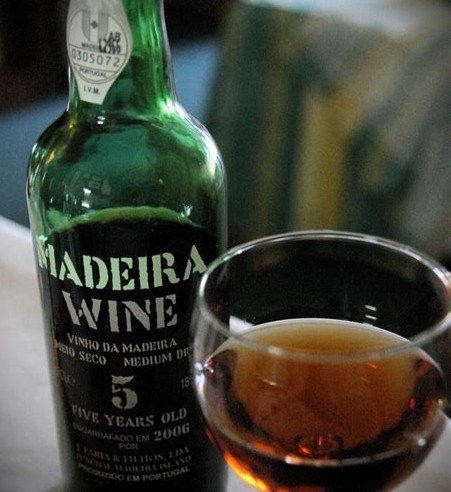
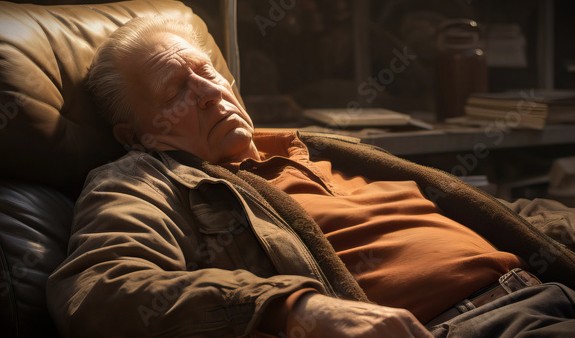
The three academics had been droning on in their usual fashion for more than an hour. Annabelle Fotheringham, widowed Professor Emeritus of the Classics, was still sipping daintily at her first glass of single-vintage Madeira. Her brother and colleague, Yorick Entwhistle, Dean of the College, was already on his third, yet mostly lucid. Arthur Wellesley, a great-great-great-grandson of the Duke of Wellington, and the College’s Distinguished Professor of English Literature for more than forty years, was savouring his second glass. All three friends appreciated the wine’s characteristic nuttiness, and its hints of caramel, toffee, marmalade, and raisins.

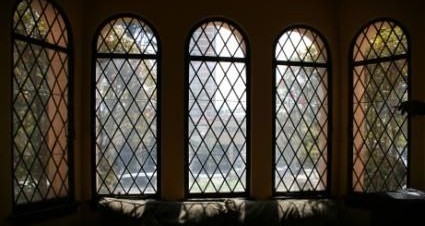
They were alone in the vaulted faculty lounge, each in a leather wingback chair in front of the stone fireplace that dominated the room. A dozen portraits of tweedy, long-since-departed faculty members gazed down austerely from musty portraits mounted on the walls between the leaded-glass windows that sheltered the lounge from a grey, drizzly, winter afternoon. Not one of the portraits was of a woman.

After packing his pipe with the fine Virginia tobacco he preferred, Wellesley struck a sulfurous match and puffed deeply, releasing plumes of bluish smoke into the cloistered air. Neither of his colleagues smoked, but they did enjoy the aroma that seemed to be soaked into the polished wooden walls of their surroundings.

“As flies to wanton boys are we to the gods,” Wellesley opined, replying to something Fotheringham had just said. “Lord, what fools these mortals be.”

“Misery acquaints a man with strange bedfellows,” Fotheringham said, nodding sagely. “Some are born great, some achieve greatness, and some have greatness thrust upon them.”

“Yes, but the devil can cite scripture for his purpose,” Entwhistle ventured. He lifted the decanter as he spoke, refilled his goblet. “There is a tide in the affairs of men, and we are such stuff as dreams are made on.”

The crackling fire was the only reply to that until Wellesley said, “We have seen better days, alas, but what’s done is done. When sorrows come, they come not as single spies, but in battalions.”

“For goodness’ sake, what a piece of work is a man!” Fotheringham scoffed. “To be or not to be, that is the question. All the world’s a stage, and all the men and women merely players.”

“Ay, there’s the rub,” Entwhistle replied. “But come what may, good men and true must give the devil his due.”

A blast of rain lashed the windows just then, followed by a thunderclap, as if the very devil he spoke of were seeking entry.  

“Knock knock! Who’s there?” Wellesley chuckled, tapping the dottle from his pipe into the burnished, brass ashtray-stand beside his chair. “Blow, winds, and crack your cheeks…full of sound and fury! Come what may, even at the turning of the tide, the lark at heaven’s gate sings.”

“Alas and alack,” Fotheringham cried, “indeed, you set my teeth on edge. Misery acquaints a man with strange bedfellows, ‘tis true, and now is the winter of our discontent. But this is much ado about nothing.”

Busily repacking his pipe, Wellesley had no reply to that. The rain continued to pelt the windows, but the contrapuntal crackle of the fire served as a soothing counterpoint to its bluster.

“As good luck would have it, we bear a charmed life,” Entwhistle murmured, his words slightly slurred from the effects of the wine. “We are more honoured in the breach than in the observance, more sinned against than sinning. But the short and the long of it is that we shall shuffle off this mortal coil, so we must stiffen the sinews.” Gesturing around the room with one arm, he finished, “Here is not the be-all and the end-all.”   

“’Tis neither here nor there,” Wellesley intoned, yellowed teeth clamped around his pipe-stem. “We have seen better days, but though this be madness, yet there is method in it.”

“A plague on both your houses!” Fotheringham declared, finishing her wine. “Come what may, ‘tis a foregone conclusion, cold comfort, a fool’s paradise. In my heart of hearts, I know all our yesterdays, filled with the milk of human kindness, will stand like greyhounds in the slips.”

Neither of her companions was entirely sure what she meant, and in truth, neither was she.

“The lady doth protest too much, methinks,” Entwhistle muttered as he added more Madeira to his goblet.

“Yorick, the better part of valour is discretion,” Wellesley cautioned him, afraid his friend might offend the lady. “The smallest worm will turn, being trodden on. Best you throw cold water on it.”

Entwhistle merely grumbled to himself, and his chin sagged onto his chest.

“Too much of a good thing!” Fotheringham said, pointing to Entwhistle’s goblet as he began to snore softly.

“Alas, poor Yorick! No more cakes and ale?” Wellesley smiled at his sleeping friend.

“And thereby hangs a tale, Arthur!” Fotheringham said archly as she rose to depart. “Such a sorry sight, my own flesh and blood!”

Wellesley got up, as well, and the two of them struggled to pull their inebriated colleague to his feet, his arms over their shoulders. “Once more unto the breach, dear friends, once more,” Wellesley sighed as they staggered with him to the door. “We cannot allow this to sully his spotless reputation.”

“Mum’s the word!” Fotheringham said. “The quality of mercy is not strained.”

“A ministering angel shall my sister be,” Entwhistle mumbled as they assisted him from the lounge.

Moments later, all that could be heard in the empty, cavernous room was the crackle of the fire and the relentless rain against the mullions.

All’s well that ends well, indeed.

Under the Lawn

IF YOU ARE RECEIVING THIS POST IN YOUR EMAIL INBOX, CLICK ON THE TITLE OF THE POST TO READ IT IN ITS NATURAL SETTING ON MY BLOGSITE.

The weekly prompt from my Florida writers’ group was “the lawn”, and this is my response. An additional challenge was to tell a story with a twist.

My daddy complained each time that it rained,
Soaking into our green, front lawn.
“The rain makes grass grow!” he’d curse, soft and low,
Wishing it just would be gone.
But when the sun came, it also got blame
For helping the grass to grow.
For that always meant my daddy got sent
Outside in the heat to mow.

He had a lawnmower with which he would lower
The height of each blade of grass,
But it took him hours, avoiding Mum’s flowers,
Or she would hand him his ass!
He’d curse and he’d moan, a tad overblown,
Back and forth across the lawn,
Cutting the grass down, his face in a frown,
Until at last he was done.

But then one sad day, he looked o’er my way,
Saw me lounging by the pool.
“It’s ‘bout time we shared this job,” he declared.
“You’re makin’ me look the fool!”
I wasn’t impressed at ending my rest
To take over his irksome task,
But I gave it a go if only to show
All he had to do was ask.

But Daddy was quick once I took a lick,
And soon the job was all mine!
I sweated and toiled while Daddy, well-oiled,
Got a tan in the warm sunshine.
And now it was him who went for a swim
While I pushed that mower hard,
Cursed the rain and sun, just like he had done,
For growing grass in our yard.

But now, I don’t mow the lawn when it grows,
I just let it go to seed.
And nobody’s there to utter a care
That everywhere there’s a weed!
I’m back by the pool, and everything’s cool,
For at long last, Daddy’s gone
To his final rest…and have you already guessed?
I buried him under the lawn!

That Was That!

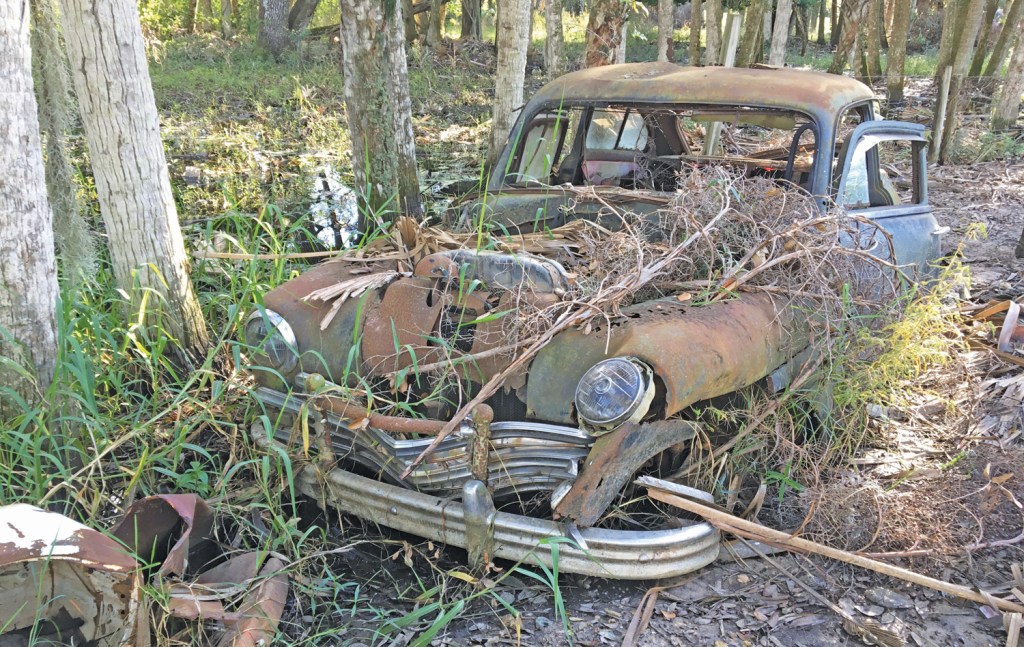
The following piece is my response to a prompt for the Florida Weekly 2025 writing contest, to write a story no more than 750 words, about the accompanying photo of an old car abandoned in the woods.

“Nosiree!  I plumb don’t b’lieve that, Jed!”  A trail of acrid smoke rose into the cool, autumn air from the pipe clenched in the old man’s mouth.

“I’m tellin’ ya, Ezra, it’s the honest-to-Jehosophat truth.  My daddy tol’ me hisself afore he passed.  That there vee-hicle’s been rottin’ in the woods since you an’ me was puppies!”

“Yessir, that part’s true, but all’s I can say ‘bout t’other part is your pappy was mistook!  That vee-hicle was built in Dee-troit city in the 1940s, ‘bout the time you an’ me come into the world.  Bonnie an’ Clyde was killed by revenooers back in the dirty-thirties, so no way they was gallivantin’ ‘round in that vee-hicle!”

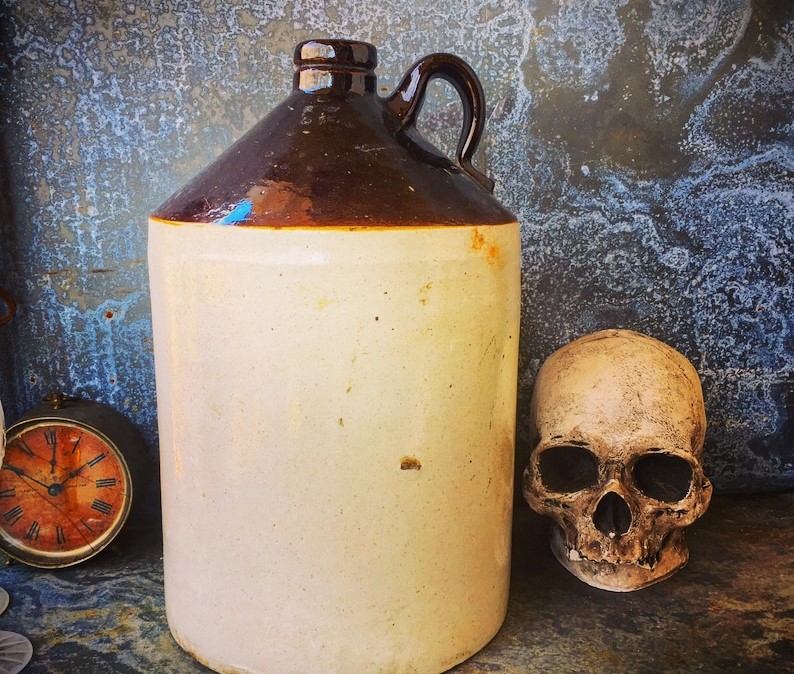
The old men were rocking in ancient chairs on the decrepit porch of Jed’s cabin, a jug of homebrew on the floor between them.  Idly watching leaves fluttering to the ground in the gentle breeze, they were chewing over a favorite topic of conversation in their backwoods community.

Jed took a deep draw on his own pipe.  “Well, if’n you’re so sure ‘bout that, what’s your story?  How else could that ol’ wreck come to roost in the middle of the woods?”

“Way I heard it,” Ezra opined, wiping his mouth after a swig from the jar, “some city-slicker come to town drivin’ ‘er, an’ he run afoul of ol’ man Jackson.”

“Sheriff Jackson?” Jed asked, reaching for the jug.  “Ol’ Hick’ry?  He was a mean ‘un, so’s I ever heard.  Not a boy to fool with!”

“My ol’ man thought so,” Ezra nodded, banging his pipe against the side of his chair.  Watching the dottle fall to the wooden floor, he waited a moment to ensure it was extinguished.  “Daddy got hisself locked up more’n once by that boy.”

“Yeah, my ol’ man, too!” Jed said with a toothless grin.  “But what ‘bout that there city-boy?  What happened to him?”

“You ever looked inside that vee-hicle?” Ezra asked.

“Nosiree!” Jed declared.  “Laid eyes on ‘er once or twice through the trees while huntin’, but never wanted to get close.  Word is, she’s haunted!  Way I heard it, Bonnie an’ Clyde is still inside!”

“Bullcrap!” Ezra exclaimed.  “I already tol’ ya, they was dead an’ gone afore that vee-hicle ever rolled off the Dee-troit line!  But you’re right, she is haunted, sure as I’m sittin’ here!  Way I heard it, that city-slicker’s still inside, sittin’ behind the wheel big as life…only dead as a doornail.”

“What in tarnation happened to him?”

“Like I said, he got hisself mixed up with Ol’ Hick’ry.  Folks say it was over messin’ with the ol’ man’s daughter, if mem’ry serves.  My daddy said she was a right pretty gal.”

“Messin’ with her?” Jed echoed, taking another swallow.  “Messin’ how?”

“Not sure,” Ezra shrugged as he repacked his pipe with low-country, natural Virginia.  Striking a match on the side of the rocker, he puffed deeply a few times, then finished, “But she was a right pretty gal, like I said.”

“Don’t ‘member her,” Jed said.  “Sounds like I mighta missed somethin’.”

“Nah, she was way older’n us, Jed.  When her an’ that city-boy was mixin’ it up, you an’ me woulda still been pullin’ girls’ pigtails in grade school.”

“I only got to grade eight,” Jed said, “but by cracky, I was pullin’ more’n pigtails by then!”

The lifelong friends laughed at that, then sat in silence for several minutes, puffing and drinking contentedly, happy in the autumnal forest they’d never left.

“You really think that city-boy’s still in that vee-hicle?” Jed asked finally.  “Be nothin’ much left by now, if’n he is.”

“Hard to say,” Ezra replied.  “I ‘spect all’s we’d find if we was to go lookin’ is a pile of old bones, maybe a skull grinnin’ at us.  But don’t matter, nohow.  My ol’ bones ain’t gonna skedaddle that far, not no more.”

“I hear ya,” Jed agreed.  “But listen, what happened to Ol’ Hick’ry’s daughter?  Where’d she get to?  Maybe she’s out there in the vee-hicle with him.”

“Dunno,” Ezra said, brushing a fly from his forehead.  “All’s I know is Bonnie an’ Clyde ain’t out there.  Not ‘less they rose up from the dead like Laserman…that guy in the Bible!”

“You sure?” Jed said.

“Yessiree!” Ezra said, smacking the arm of his chair.  “An’ I’ll tell ya why.  That there vee-hicle out there’s a Stoodiebaker, but Bonnie an’ Clyde drove ‘emselves a Dodger!”

And that was that!

Believe It Or Not!

The weekly prompt from my Florida writers’ group was ‘believe it or not’, and this humourous tale is what I came up with—

“I swear to yez all, I seen the whole shivaree with me own eyes.  Never woulda believed it otherwise!”

The statement was met with silence at first, and the big man’s two companions took a long swallow from the pints one of them, Rufus Mulaney, had added to his tab.

“Sure, an’ it don’t seem possible,” Mickey Finnerty said, wiping froth from his lip, the first to reply.  “It only ever happened once before, so they say.  An’ even that can’t be proved.”

“Don’t gotta prove it, me lad,” Sean O’Brien countered, savouring the bitter ale.  “I seen it with me own eyes!  Tha’s alla the proof I’ll be needin’.”

“Ye must think we’re all daft!” Mulaney declared.  “Yer sittin’ there tellin’ us ye seen Seamus O’Malley die an’ then come back to life?  Ye musta been well into yer cups!  Such a thing just ain’t possible.”

“All good for you to say,” O’Brien sneered.  “Ye were already passed out by then, breathin’ sawdust offa the floor when it happened.  Any boyo who can’t hold his drink oughta not be correctin’ one who can!”

“Yer tellin’ me Rufe was there when it happened?” Finnerty said, looking back and forth between the two men.

“Aye, that he was,” O’Brien laughed, “right there ‘longside me an’ Seamus O’Malley…that is ‘til he slipped offa his stool an’ landed on his noggin.  Lights out he was, ol’ Rufe.”

“That true, Rufe?” Finnerty said.  “Ye took a drunken header in front of the whole establishment?”

“That’s what Sean tells me,” Mulaney admitted sheepishly.  “I do remember spittin’ wood-chips outta me mouth when I managed to collect meself.  All’s I know fer sure is I never saw ol’ Seamus croak an’ then come back.”

“Ah, ye gombeen!” O’Brien cried.  “How could ye see anythin’ when ye was in a blackout?  I’m tellin’ yez both, sure as I’m sittin’ here, Seamus O’Malley died an’ resurrected hisself, right in front of me eyes!  Yez can believe it or not, I don’t give a shite.”

“Sure, an’ it’s wantin’ to believe ye I am,” Finnerty said, raising a hand to order another round for the group.  “Gimme the wee details so’s I can better picture the grand second comin’.”

O’Brien waited ‘til the three of them had drunk deeply from the refreshed pints in front of them before answering.  “Alright then, ye disbelievin’ dolts, here’s how it all went down.  Me, Rufe, an’ Seamus were sittin’ here in this very spot, knockin’ back a few drafts after church last Sunday.  Father Flanagan had been at his full-throttled best, talkin’ ‘bout how the good Lord raised his son from the dead on Easter Sunday, an’ just like always, the tale raised a considerable thirst in me an’ the lads.”

“Since when are you a church-goin’ man?” Finnerty asked.

“Since me good wife threatened to cut off me allowance,” O’Brien said.  “But that ain’t no never-mind.  The point is, we were just gettin’ the edge offa our thirst when who should come along but the Widow McGroarty, askin’ Seamus if he’d buy her a drink.”

“The Widow McGroarty?” Finnerty repeated.  “She’s a mighty fine-lookin’ lass!”

“Aye, that she is!” O’Brien agreed with a leering smile.  “O’Malley surely thinks so, too, an’ the word is him an’ her been…y’know, dancin’ the Irish jig, so to speak.”

“O’Malley?” Finnerty said, mouth agape.  “What’s a fair colleen like herself see in a gombeen like him?”

“Who’s to say?” O’Brien said.  “Anyways, right at that critical moment, good ol’ Rufe made a space for her at the bar by topplin’ offa his stool.  She stepped right over the lad an’ hopped up beside us.”

“So, that’s why I musta missed what happened next,” Mulaney said, followed by another sip from his pint.

“Aye, ye missed the best part!” O’Brien chuckled into his beard.  “Seamus ordered the Widow a shot an’ a beer-chaser, an’ after knockin’ ‘em both back, she leaned over an’ planted a smooch smack on his goober.”

“An’ that’s when he died?” Finnerty asked, caught up now in the story.

“Nah, that’s when he smooched her right back.  He didn’t die ‘til a few minutes later when his ol’ lady walked into the pub lookin’ for him.  We heard her voice callin’ his name afore she come through the door, an’ by then, Seamus was laid out flat beside Rufe, lookin’ for all the world like he was stone-cold dead!”

“Then what happened?” Finnerty asked.

“Me an’ the Widow McGroarty skedaddled outta the way,” O’Brien said.  “We both thought Seamus had bought the farm right then an’ there, scared to his very death that the good Mrs. O’Malley mighta seen him smoochin’ the Widow.”

“An’ did she?” Mulaney asked, sincerely regretting that he’d passed out and missed the whole shebang.

“Nah,” O’Brien said, finishing off his pint.  “All’s she saw was her husband lyin’ there on the floor.  She figured he was passed-out drunk, so she grabbed him by his collar an’ gave his head a shakin’, the likes of which I hope I may never see again.”

“An’ then what?” Finnerty asked, so enthralled now that he did the unthinkable and signalled for yet another round on his tab.

“An’ right then,” O’Brien said, relishing the moment, “is when the resurrection occurred.  Seamus scrambled to his feet, beggin’ forgiveness from the good woman, an’ allowed hisself to be dragged out the door by his ear.  Dead one minute, brought back to life the next, just like I been tellin’ yez.  Yez can believe it or not.”

“What about the fair Widow?” Mulaney asked.  “I musta missed what happened to her, too.”

“Spare no worries for the lovely Widow McGroarty, lads,” O’Brien said.  “Ever the gentleman, I made sure the lady got safely home to bed.”

“To bed?” Finnerty exclaimed.  “Did yez…did yez…?”

“Sure, an’ that’s another story for another time, me boyos!” O’Brien said.  “It’s thankful I am for the pints yez bought, but now I must be on me way.”

“He done it to us again, Rufe,” Finnerty said, watching as the big man left the pub.  “Why do we fall for his blarney every time?”

There was no answer from Mulaney, however, who had seized that very moment to pass out yet again on the sawdust-covered floor.

A Loss For Words

[NOTE: IF THIS COMPLETE BLOG-POST LIES IN THE BODY OF AN EMAIL, CLICK ON THE TITLE TO READ IT IN ITS NATURAL ENVIRONMENT ON MY BLOG-SITE. IF ONLY A LINK IS PROVIDED IN THE EMAIL, CLICK ON THAT.]

Most people who know me would likely tell you I am rarely, if ever, at a loss for words.  But they would also assure you, I trust, that I am far from being a blabbermouth.  My own opinion is that in most social situations, I can hold my own in conversation without becoming annoying or overbearing.

Most of the time, I listen; when appropriate, I ask questions.  If prompted, I will hold forth on a subject (if I know something about it), but not to the point of boring my friends to tears…I hope.

There is one situation, however, where all of the above is not true, perhaps the only circumstance where I find myself virtually unable to get a word in edgewise.  This unfortunate state of affairs occurs every time I find myself on a FaceTime call with my wife and daughters.  I hustle into the den with my iPad, leaving my wife with her screen in the living-room, so we won’t get feedback during the call.

When I say ‘unfortunate’, I mean for me, of course; for all I know, the ladies find it delightful when I sit, practically mute, at my end of the line.

The problem arises, not because my wife and daughters ramble endlessly on and on, not because they’re rude or inconsiderate, not because they delight in ignoring me, even politely.  Nothing could be farther from the truth.  In fact, they are all among the most considerate of creatures on the face of the earth, and they love me dearly.

No, the problem occurs almost every time we’re on a call because they appear to react faster than I do.  And to think faster, too, I suppose.  Regardless of the subject, I’m usually listening attentively as they express their various points of view, waiting for my brain to kick into gear as I consider an appropriate response.  The sad fact is that, by the time I have a response, one of them has already jumped back into the conversation ahead of me.

Another issue causing me a problem is their propensity to change subjects at the drop of a hat.  We might have spent five minutes batting a particular topic back and forth—the three of them talking while I listen—and Boom!  Without warning, one of them will introduce a brand-new thread, or ask about something entirely different from what we’ve been discussing. 

Even as my brain registers the change, a part of it is crying, silently and forlornly, that I haven’t yet kicked in my two cents’ worth on the first topic.

But they aren’t rude, as I have said, so at some point (perhaps noticing my silence), one of the girls might say, “What do you think, Dad?” 

“Ah…let’s see,” I reply, “can we go back to that first thing we were talking about?  I had a thought about that, but I couldn’t get in.”

The three of them laugh and roll their eyes at this, chide me to ‘keep with the tour’, then blithely resume their three-way conversation.  It’s probably just as well, I guess, because by the time I’m asked to chime in, I’ve often forgotten the point I wanted to make, anyway.

I must admit, though, all modesty aside, that I generally look surprisingly good on those FaceTime calls.  I sit up straight, look right into the camera (with an occasional peek at my own image), and keep myself centred in the screen.  They, by contrast, let the screen wobble all over the place as they walk from room to room tending flowers, picking up dirty clothes, starting early prep for supper, training their camera on their dogs.  It drives me crazy, but I can never worm my way into the conversation to ask them to stop.

I’ve explored various strategies to help, but none seems to.  I’ve tried holding up my hand, for example, when I want to cut in, but all I get is a return wave, as if they think I’m leaving the conversation.  “Bye, Dad!”

On more than one occasion, I’ve cut my video feed for a few seconds, hoping they’ll wonder if I’m okay, but all I hear is, “Looks like Dad has left the conversation!  Was it something we said?”

“No!” I want to shout, as I turn the video back on.  “It’s because I haven’t said anything!”  But they’re already talking about something else, so once again I can’t get in.

I recognize that the limitations of the FaceTime technology, marvellous though it is, play a part in exacerbating my dilemma.  The offset between audio and video transmission makes it difficult for me to pick the right moment to jump in—like watching a TV commentator interviewing someone far away, each of them experiencing a delay in hearing the other, resulting in dead air.  If I speak up too soon, while one of the girls is still talking, no one hears me; if I wait ‘til she’s finished, someone else has already started.

Still, I persist in taking part in these FaceTime calls, not only to hear what the girls have to say, but to look at them as they’re saying it.  And I console myself that, if ever I had anything pertinent and crucial to share with them, I probably did it years ago.  Whatever I might add now is probably just more of the same.

The ironic part of the whole thing, though, is after we’ve ended the call, I’ll wander back into the living-room and my wife will say, “Are you okay?  You didn’t have much to say today.”

And that always leaves me at a loss for words.

Alone Again!

[NOTE: IF THIS COMPLETE BLOG-POST LIES IN THE BODY OF AN EMAIL, CLICK ON THE TITLE TO READ IT IN ITS NATURAL ENVIRONMENT ON MY BLOG-SITE. IF ONLY A LINK IS PROVIDED IN THE EMAIL, CLICK ON THAT.]

Have you ever found yourself absolutely alone in a crowded room—at a family gathering, perhaps, or a business function, a party with friends, a community meeting?  It would seem hard to accomplish that when one is surrounded by so many people, but I manage it all the time.

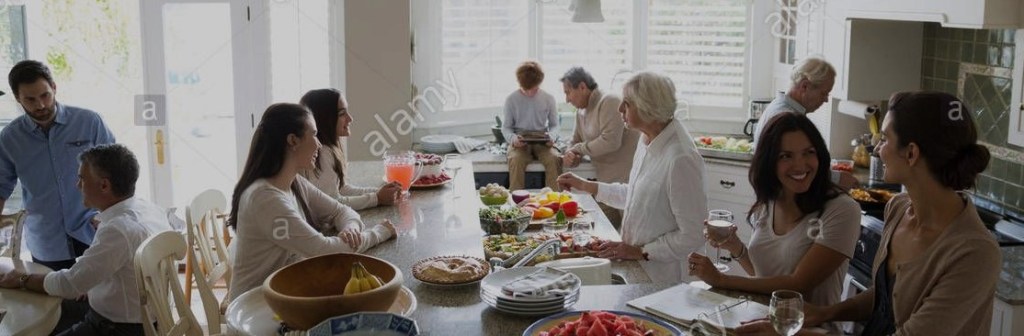
At a recent Mothers Day gathering with my two daughters, their husbands, my five grandchildren, two of their boyfriends, and my wife all in attendance, conversations were animated, exuberant, and loud.  I know, because there I was, perched on a stool around the large island in the middle of the kitchen (always our family’s favourite gathering place), surrounded by this multitude, yet strangely not involved in any of the conversations.  Nursing a glass of wine, I found myself eavesdropping on each different group in turn, quite interested in the latest news they all were sharing with one another about their work and school activities, yet not contributing a word myself.

But this is not a new phenomenon.  In fact, having become almost invisible on so many such occasions, I’m rarely even asked to contribute.

Over the years, I’ve often wondered if I’m naturally introverted, or maybe anti-social by nature.  From time to time, I’ve questioned my conversational skills or lack thereof.  I’ve even fallen prey every now and then to doubting my innate charm and charisma, and I’ve worried that perhaps no one holds me in high esteem.

Too many times, it seems, I’m at a restaurant with three or four couples, and I look up from my soup to find myself alone at our table.  I wonder if the others might be at the salad bar or in the washroom, perhaps—but all of them?  At the same time?

Or I might be at a dance, ten of us sharing a table, and I suddenly realize I’m sitting by myself again, while the others are up dancing or table-hopping.

The tedious jokes flow at these moments, naturally.  Seeing me alone, someone will ask in a loud voice if I’m dining tonight with all my friends.  Or someone will wonder if I said something to offend everyone in my party.

The problem is, I’ve never had an answer.

What I do know, however, is that I’m not one to blithely accept blame for my own perceived shortcomings.  I am a loving and capable person, after all—or so I want to believe—and I have choices.  For example, if people are ignoring me—or worse, don’t even realize I’m present—I can choose to consider it a flaw on their part, not mine.  The problem with that approach, however, is that many of them are people I love and admire, so it’s difficult to malign them, even secretly.

A better choice, I’ve discovered, is to adopt the stance that I am freely choosing to be alone in these various situations.  I’m doing it on purpose.  And why?  Well, because I’m a writer of fiction, and it’s a well-established fact that, to be effective, writers like me, who make stuff up, have to be keen observers of human nature.  After all, if we’re going to create believable characters out of whole cloth in our stories, we absolutely must possess a keen sense of what makes people tick in real life.  And the best way to do that, I’ve convinced myself, is by observing those around me, listening to them, getting a feel for them through what they do and what they say.

Interacting with people, I believe, is not good because I will inevitably corrupt the essence of who they are through my own conversational filters.  But by choosing to stand back, remaining aloof, I am better able to ascertain who they really are in their daily interactions.  They remain unblemished by any preconceived notions I might apply to them, and it is those untarnished attributes I will then bring to the creation of my own fictional characters, thereby improving the quality of my writing.

Or so I tell myself.

Nevertheless, I confess to a lingering and puzzling disappointment whenever I find myself alone again in large groups.  Recently, on the advice of someone I trust, I arranged to see a therapist renowned for helping folks like me.  My first appointment was yesterday, but to my surprise, it was a group-session—not something I had counted on.  After fetching the obligatory coffee, I took a seat in the circle and listened as each person in turn explained why he or she was there, what their last week had been like, how the others in their lives continued to let them down…and so forth and so on.  I found it fascinating, and was soon busy tapping notes surreptitiously into my phone.  I wasn’t sure that was allowed, but happily, no one seemed to notice what I was doing.

After an hour or so, I was fully-engrossed in reading over these notes, optimistic that I’d uncovered a gold-mine of observations I could use back at my writing-desk.  I looked up, eager to listen to whoever was next, and…well, you can probably imagine my shock when I discovered I was alone in the room.  The session had ended, the circle was broken, and no one had asked to hear from me.

Not knowing whether to laugh or cry, I chose the former.  These therapy sessions, I told myself, were going to prove a treasure-trove of inspiration for my writing.  And best of all, I was going to be able to gather whatever information I wanted with no one even knowing.  As in so many other instances, I was virtually invisible in the group.

No wonder I’m such a good writer!

Alone again! 

VANISH

The latest weekly prompt from my writers’ group was to write a story based on a picture from the Florida Weekly Writing Contest. This is my entry—

To call it an insignificant garret would be to flatter it, tucked high on the south side of the federal building.  From my desk, I can touch three walls if I stretch my arms, but I love my office.  And I love the building! 

Still visible on the frosted-glass door of my office are the words first inscribed fifty years ago: VULNERABILITY ASSESSMENT NATIONAL/INTERNATIONAL SECURITY HAZARDS.  Since the opening of the office, I’ve been its sole occupant, first appointed in my mid-twenties by a Senator who owed my father a favor.  Although our involvement in Vietnam had recently been suspended, the fear of security breaches in Congress was ever-present, so VANISH was established to monitor potential threats—a noble undertaking, though it never accomplished anything.

A longtime crony of the Senator was appointed as senior administrator, and I as his chief aide…his only aide, in fact.  I never did meet the man, although I frequently saw pictures of him in the press with important-looking people.  A portly, balding, bespectacled fellow, he occupied a prized, brightly-lit corner-office on the southwest corner of the third floor, two floors directly below my dormer-lit attic—a location whose door he never once darkened.  For no other reason than that, I deemed him a wonderful boss. 

In fairness, I never ventured into his office, either, our sole interface being the internal mail-delivery persons who moved around the building’s cavernous spaces like gray-clad ghosts.  One of them told me there were only a few people who even knew my office existed up under the rafters.

Packets of classified files arrived each day to my in-tray, sat there untouched for a week before I slapped a RETURN sticker on them and transferred them to my out-tray, whence they were returned to the boss’s office.  What happened next, or where they went from there, I had no clue; neither did I have any idea as to what I was expected to do with them whilst in my possession.  Like so many crises du jour, they came, lingered awhile, then quickly vanished.

At the time of our appointments, the property-management folks planted a small tree beside the sidewalk directly below our windows—a sapling, really.  Over the years, I’ve watched it burgeon to its current height of forty feet or more, where it now completely blocks the once-scenic view from the small balcony off the boss’s office.  Given the utter lack of work-product or vision emanating from VANISH, I’ve often chuckled wryly about the irony of that.

Of course, the original boss is long-gone…or so I’ve been told.  According to the security guard in the building’s lobby, a notice was distributed at the time of his leaving, but because I never opened files, I failed to see it.  Apparently, his office was subdivided and is now occupied by three senior analysts.  I don’t believe they know about me, though, as the files stopped coming to my garret some time ago.  It’s almost as if I’ve vanished, too. 

A decade back, I thought I might be required to surrender my sinecure, but the government changed the requirements for mandatory retirement, allowing me to linger on indefinitely.  My paychecks—which used to be hand-delivered by the mail-persons before the introduction of online banking—have continued to appear in my bank account, and in amounts much greater than fifty years ago.  I’m told I belong to a union, which perhaps explains that happy circumstance.

Happily also, I recently began to receive a generous pension check, along with a social security payment, deposited online each month.  Due perhaps to a bookkeeping error somewhere in the vast bowels of the building, I reckon I am listed in personnel records as both active and retired.  That, too, is ironic because, while never active in this job I love, I have never retired from it, either.

For years, I whiled away my working-hours playing chess-by-mail with other federal employees, or reading books borrowed from the large library in the basement, or chatting with window-washers and custodial staff who occasionally popped by.  Now, of course, I play chess and read online right from my desktop computer. 

Civil service work is so fulfilling!  I’ve served under nine administrations, beginning with Ford, and I’m still younger than the incumbent!  There’s something in the air, I think, that makes me eager to show up for work each day.

I love this old building!

And I love VANISH!

Thinking About Leap Year

The prompt from my Florida writers’ group was to write a short piece about Leap Year. This is what I came up with—

“Sometimes,” Gus says, “I think to myself this whole Leap Year thing is nothin’ but a boondoggle.”

“That’s redundant,” I say absently.

“What?” Gus says.

“I said what you said is redundant.  Repetitive, superfluous.  How else could you think, except to yourself?”

“What?

“Gus, think about it!  When you’re thinking, it’s just you communicating inside your brain.  Nobody else is privy to it.  If other people knew what you were thinking, it wouldn’t be thinking.  It would be talking.”

“You think so?” Gus says, brow furrowed.  “Yeah, I think you’re right.”

“Of course I’m right!” I say.  “So, it’s unnecessary to say you were thinking to yourself.  Needless, pointless.  All you have to say is, I think Leap Year is a boondoggle.”

“Yeah, that is what I think!” Gus says.  “You an’ me agree.”

“No, no,” I say, a tad exasperated.  “It’s you who thinks that, not I.”

“What?”

“It’s you who thinks Leap Year is a boondoggle!”

“Yeah, that’s what I said, an’ you wanta know why?  It’s them damn calendar-makers!”

“What?” I say.

“Think about it!” Gus says.  “Every seven years, the days of the month fall on the same date, like clockwork.  So, if it warn’t for them calendar-makers, after seven years, nobody would hafta buy calendars no more.  We could just recycle ‘em.  Them greedy SOBs up an’ stuck an extra day in Febeeary every four years to make sure we’d hafta keep buyin’ their products.” 

“Gus, Leap Year has nothing to do with calendar-makers!” I say.  “It has to do with Earth’s orbit around the sun, which takes three-hundred-and-sixty-five days, plus six hours, for a complete cycle.  After four years, that’s a whole extra day.  Your theory is poppycock!”

“What?” Gus says, forehead crinkling.

“Your theory is flawed, mistaken, incorrect.”

“Naw, I don’t think so,” Gus says.  “Leap year is just a marketin’ ploy.”

“No, it’s not!” I say.  “It’s a scientifically-proven manifestation.” 

“A what?”

“A manifestation, an occurrence, a fact!”

Gus stares at me for a long moment, then points a bony finger in my face.  “That’s redundant,” he says.  “An’ mark my words, Leap Year is nothin’ but a boondoggle!”  Then, with a sly grin, he adds, “A sham, a scam!  Leastways, that’s what I think!”

I smile weakly as he finishes, “To myself!”

On Thinking

The French philosopher, Rene Descartes, is remembered among other things for his thesis: I think, therefore I am.  The notion is most commonly expressed, not in French or English, but in Latin: Cogito, ergo sum.

His premise was not, as is widely believed, that he exists because he can think; rather, it is that he is aware he exists because he is able to think.  That assumption presupposes that so-called lower forms of animal life, being non-sentient as far as we know, exist without knowing they exist.

Descartes appears not to have considered the possibility that some humans may also exist without full awareness, largely because of their demonstrated inability or willingness to think rationally.  But I digress.

In conversation with other folks, I occasionally hear them offer their opinion by beginning with the phrase, So, I think to myself…  I find that phrase redundant, because I can contemplate no other way of thinking; by definition, all thinking is to oneself, is it not?  Unless, as some would have it, a person is thinking out loud, which strikes me as verbalizing, not thinking.  Better, I suggest, to think first, speak second.

But as a counterpoint to that, people might deem praiseworthy the ability some folks have to think on their feet—to offer an opinion, receive feedback, and modify that opinion, all in the course of one conversation.  That facility is admirable, I suppose, but it can happen, of course, only if they’re standing; if they were seated, they would surely be thinking…well, on their tush, right?  And somehow, blowing it out their…you know…doesn’t seem as impressive.

I’ve long thought of thinking as a fluid process, a constant progression, a multi-directional flow, rather than as a static, linear plod from point A to point B.  And if that is so, then a graphic tracing of my thinking pattern would appear, not as a straight line, but as a higgledy-piggledy, zig-zagging line—frequently interrupted and intercepted, but always arcing upward toward higher illumination, I would hope.

As a writer, it’s my thinking that takes me far from my physical surroundings, even to the point of forgetting all about time and place.  As I wrote in haiku verse some time ago—

my thoughts, unbridled,
take me to worlds I ne’er will see,
nor have ever seen

my boundless thoughts are
like hot air balloons, slipping
bonds that tie me down

I wander freely
throughout the universe, yet
never leave my chair

There are two adages on thinking that I try to hold to, at least presently, and they both grace the résumés and bios that appear on my online, social-media sites.  The first is, Certainty is the enemy of an open mind…I think.  And the second is, Don’t believe everything you think.  Regular readers of this blog will know whether or not I’m successful in living up to those.

Certainty plagues many people after they’ve thought a subject through—or even when they have not—and then adopt a position they think is accurate or true, and stubbornly cling to that opinion, come hell or high water.  But I think every opinion we hold should be subject to periodic, critical study, the more frequently the better, in order to test its validity in the face of facts and evidence that can change from time to time.  Being overly-certain about one’s opinion can stifle that sort of examination.

The irony with this adage, however, is that I can’t be certain it’s correct, for to be so would violate its basic premise.  Like every other opinion I hold, it requires my constant scrutiny…at least, I think it does.

The notion of believing everything we think, just because we think it, likewise can lead to cognitive stagnation.  In everyday interactions, our behaviours are governed by what we think we should say or do at any given time, and there’s nothing wrong with that.  Guidelines are preferable to social anarchy.  But if, for example, I believe it’s safe to jaywalk across a busy thoroughfare just because I think it’s safe, and if I persist in that belief, the consequences to me could be catastrophic.  Better, I think, to examine my thinking in the light of facts before committing it to belief-status.

The irony with this second adage is it presents a danger that one will never commit to believing in anything.  I think that, too, could present a problem.

For those who’ve read this far, let me finish with an anecdote about two people engaged in a mild argument over some inconsequential subject.  “So, is that what you really think?” the woman asks, a touch of incredulity tinging her tone.

“I don’t think!  I know!” the man replies smugly. 

With barely a pause, the woman smiles condescendingly and says, “You know what?  I don’t think you know, either.”

And that could well be the case for all of us.  Even when we think we know, even when we are absolutely certain of it, we still might be mistaken.  The wise carpenter’s advice—measure twice, cut once—could easily be adapted and applied to our thinking process: think, rethink, then act.

I’ve done just that in this post…I think.

What say you?

Ready For The Fall

The prompt from my Florida writers’ group this week was to write a piece about fall. Here is what I came up with, and I hope it will conjure memories for you, too—

A middle-aged woman I didn’t know smiled as she entered the elevator with me one day last week.  “Are you ready for the fall?”

I cringed, steeling myself for an unwanted mini-sermon from a dogged do-gooder, a holy-roller.  “I…I guess so,” I stammered.  “I mean, I pray, I try to do good…”

A look of bewilderment creased the woman’s face, followed quickly by one of amused pity.  “No, no,” she corrected me patronizingly, “you misunderstand me.  I meant the autumn, not the apocalypse!”

“Ah…of course,” I sighed, embarrassed by my mistake.  “Sorry…”

As the elevator doors opened on the eighteenth floor, the woman stepped out, still amused by my obtuseness.  “No need to apologize,” she said.  “At your age, I imagine it’s best to be ready for both!” The doors slid closed behind her before I could think of a suitably nasty retort.

Back in my apartment on the twentieth floor, I reflected on our conversation as I unpacked the groceries I’d been carrying.  It seemed to me an honest mistake to make, an understandable one, and the woman’s parting shot was likely good advice.  But why did she have to be so rude?

Later, relaxing with my wife over a cup of tea, I talked about what had happened, and about getting ready for the fall.  “Remember when we were kids, it seemed summers would never end?” I said.  “From the day school let out until the first fall-fair arrived, our days were blissful, carefree, limitless.  Eat breakfast and head outside to play; dash inside for lunch, then back outside; trudge home for supper, then out again ‘til the streetlights came on.”

“I remember,” my wife said.  “But things sure changed when we grew up, in spite of our best intentions.  We got married, started working, became parents.  Those summers suddenly became  a lot more finite.”

I nodded agreement.  The calendar tells us summer ends with the autumnal equinox in late September, but the end always came much sooner for us.  It was marked, not by an arbitrary calendar, but by the requirement to go back to school.  Both of us were teachers in those long-ago days, and felt we had to get back ahead of our students if we had any hope of being ready for their return after Labour Day.

For many folks, I guess—like the woman on the elevator—the coming of fall is a time of new beginnings, of anticipation.  They think in terms of flaming fall-colours, brisk autumn days, evenings spent curled up with a book in front of a cozy hearth.  They look forward to the change of seasons.

Not I, though!  I’ve always thought of it as a gloomy time—the conclusion of summer, and the close of so many pleasurable things that vanish with the coming of September.

For example, with the end of warm, sunny weather, there came an end to my carefree habits of dress.  No more swimsuits or running shorts; no more open sandals or ancient running shoes; no more tank-tops or faded team sweaters.  Instead, it meant a return to the straitjacketing drill of collars and ties, pressed slacks, knee-high socks, and polished dress shoes.

The end of summer put a stop to the treasured luxury of shaving every two or three days, depending upon what activities were planned.  And it called a halt to the wearing of old ball caps as an alternative to brushing my hair.

The inevitable onset of fall wrote fini to three or four leisurely cups of coffee with the morning paper, and an end to mid-morning breakfasts on the back porch.  It heralded, in their stead, the beginning of hurried showers and breakfasts-on-the-run.  It marked the re-entry into the exciting world of daily traffic reports, as I attempted to find the shortest, quickest route into and out of the city.

In short, summer’s end brought to a close the lazy, drifting vagaries of summer living I tried so vainly to hang on to.  Coming back to the real world always provided a jolt to my entire system.  It was like going from childhood to adulthood all over again!  Once was enough!

“You know, I never wanted to be the type of person who wishes his life away,” I commented to my wife, “always wishing for something to be different than it is.  But, in a sense, I guess I used to do just that.”

“Me, too,” my wife said wistfully.  “For me, the year was divided into two seasons, summer and not-summer. And not-summer was not good!”

“Remember we’d take the girls on one last camping trip up north?” I said.  “My cutoffs and hat would be in my bag, my shaving-kit left behind.  It was always one final fling in the glorious realm of summer.”

“I loved it,” my wife said, staring into the past.  “Hiking, swimming, paddling, exploring, picking berries, roasting marshmallows, singing our hearts out by the campfire, sleeping the sleep of the innocent in those old sleeping-bags—it was like being children all over again.”

“Even now,” I said, “when every day is like a Saturday, I still pretend summer will never end, that I’ll never have to grow up and give it up.  It still seems there’s always so much left to do.”

“At least we have Florida now,” my wife smiled.  “Year-round summer! Before the fall ever arrives, I’m already planning what I’ll pack.”

During the course of our happy reminiscing, I managed to forget my annoyance with the supercilious woman in the elevator.  But by chance, we happened to ride the elevator again yesterday, going down this time.  As she stepped aboard, I could tell she recognized me as the confused old fart from a week ago—but this time, it was I who spoke first.

“Before you ask, I’m ready for Ar’geddon!” I smiled.

“Our what?” she said, head cocked.

“Ar’geddon!” I repeated.  “I’m ready to go!”

The same pitying look as last time spread across her face, the same condescending smile.  “Sir, you mean Arma-geddon.  You’re mispronouncing the word.” She shook her head disdainfully, appalled by my lack of acuity. 

Waiting a beat to spring the trap I’d plotted, I said very quietly, “Whatever!  It’s not the end of the world!”

We rode the rest of the way in icy stillness, a long, silent fall from the eighteenth floor to the parking garage.