Free Speech? Free Press?

A cornerstone of democracy is the right to free speech, a principle perhaps best expressed in a 1906 work by the English writer, Beatrice Evelyn Hall, a statement often erroneously attributed to Voltaire:  I disapprove of what you say, but I will defend to the death your right to say it.

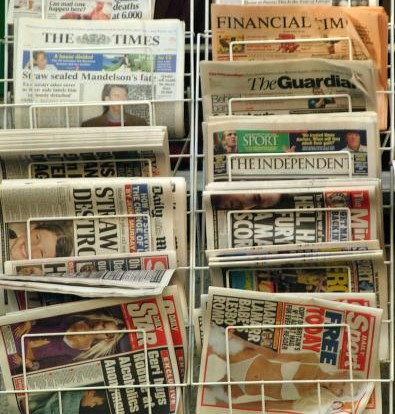
A second foundation of a democratic society, closely related to the first, is the right to a free press.  Newspapers as we know them made their first appearance in 17th century Europe, and in the mid-1700’s they were dubbed ‘the fourth estate’ by Edmund Burke, a British politician (the first three estates being those represented in parliament—the clergy, the nobility, and the common people).

Burke went so far as to describe this fourth estate as more important by far to the health of a nation than the other three, a sentiment echoed a hundred years later by Thomas Jefferson, author of the American Declaration of Independence, who wrote:  “…were it left to me to decide whether we should have a government without newspapers, or newspapers without a government, I should not hesitate a moment to prefer the latter.”
newspapers

The invention of the telegraph greatly enhanced the spread of news across nations, and around the world.  Thanks to technology, reporters could file their stories from anywhere (traditionally ending them with the rubric – 30 –  a shorthand for End), assured that they could be read everywhere.

But why is it so important to a free society that its citizens have the right to speak their minds, and the right to access a free press, unrestricted by government censorship?  Especially today, in this age of unlimited entrée to digital social media.

The answer lies in the fact that until very recently, we have been able to trust our news sources to deliver truthful accounts of events in the world around us.  Most reliable outlets reported the facts as they happened, based upon the best information available.  Serious journalists regarded accuracy and bias-free reporting as sacrosanct.  Editorial beliefs were confined, for the most part, to the opinion pages, and op-ed viewpoints were included to ensure balance in the presentation of the news.

Throughout my lifetime, it has been relatively easy in our democratic nation to educate and inform oneself about the world in which we live by reading, listening, and watching a variety of news outlets, their spectrum of viewpoints providing a balanced picture, as accurate and verifiable as it is possible to be.

Today, however, anyone can report the news through a variety of social media, regardless of their qualifications (or lack thereof), degree of impartiality, sense of right and wrong, education, or bigotries.

As an example, have a look at the headlines below, from different decades, and decide how many (if any) were actually reported:

Titanic Torpedoed by U-Boat; Tragedy Covered Up by Admiralty

FDR Knew About Pearl Harbor; Allowed Attack to Mobilize War Effort

JFK, Marilyn Buried at Arlington; Lovers Reunited Under Eternal Flame

Lennon Survived Murder Attempt; Lies in Coma in New Jersey Hospital

Chinese Colony Established on Moon; China Claims Lunar Sovereignty, Alarms West

Now, before deciding about that first group, check out the next list:

 Elvis Sighted; Rock Legend Living in Wax Museum

Microsoft Patents Ones, Zeroes; Computer Industry in Freefall

Pope Francis Shocks World; Endorses Donald Trump for President

Would You Rather Your Child Had Feminism or Cancer?

Gay Rights Have Made Us Dumber; Time to Get Back in the Closet

Which of the two groups is the more credible, which the more ridiculous?

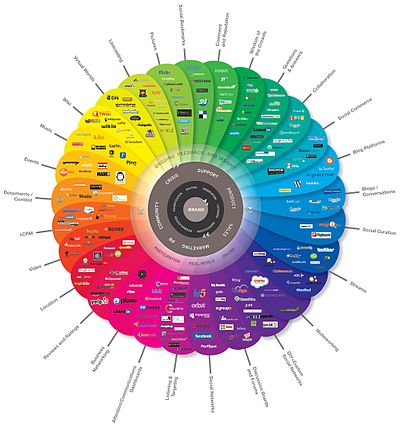
Well, as you may have guessed, none of the headlines in the first group ever surfaced in any news outlet; I made them up.  But, incredibly, every one of the second group has actually appeared in a newspaper or digital news source—many of which inhabit the social media universe.
social-media

That could strike one as funny, but there’s a serious consequence to the burgeoning glut of fake news stories.  Many readers, listeners, and viewers (let us hope most of them) have the wisdom and experience to differentiate between what’s real and what isn’t.  And to base their subsequent actions on those conclusions.

But increasing numbers of uneducated, unsophisticated, gullible consumers of information do not have the ability to separate truth from fiction in such stories.  They are, therefore, susceptible to the persuasive powers of those who purvey pernicious falsehoods, often for political or financial gain.

To one who is colour-blind, all the various hues may appear the same; to those who are media-illiterate, all news accounts may possess the same weight, the same degree of veracity.  And that being the case, which are paid the most attention?

Unfortunately, all too often the attention goes to the lurid, sensational, graphically-charged, and blatantly false packages, at the expense of the sober, dispassionate, accurate accounts a free society and informed citizenry needs.  And this is coming at a time when traditional newspapers are increasingly falling by the wayside, unable to financially survive in our digital communications world.

I see three possibilities if this trend continues, and two of them are alarming.  One is a persistent proliferation of fake news sources, many of which reap great financial rewards for their producers, and all of which contribute to the continued dumbing-down of our society.  Ignorance is greatly to be feared.

A second is the institution of censorship by governments worried about the loss of press freedom—or, more ominously, about the unbridled existence of propagandizing news outlets that would replace elected leaders with demagogues not concerned or constrained by democratic principles.  Censorship is also to be feared, for it is a death-knell for freedom of speech.

The best possibility, but less likely I fear, is a re-awakening on the part of citizens of countries such as ours to the importance of a free press; to the obligation we have to teach young people (and their media-illiterate elders) how to differentiate between the real and the fake; and to the absolute necessity of safeguarding both free speech and a free press if we are to preserve our democratic way of life.  No number of fact-checkers can ever substitute for an informed, discerning, and open-minded citizenry.

If we are unsuccessful, I believe, we shall arrive at the point where the last credible headline we shall ever see is:

– 30 –
People Who Know Everything

People who assume they know everything are annoying to those of us who do!

Thus spake a friend of mine (in jest I think) during a conversation about smarmy politicians who claim to have solutions to the ills that plague our society.  All we have to do is vote them into office and our worries will be over.  Or so they promise.

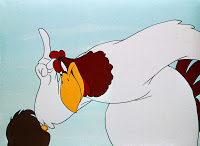
I confess I, too, become annoyed whenever someone presents as a know-it-all—not, as my friend joked, because I think I know everything, but because I think no one does.  Whenever I hear someone bloviating loudly on any subject, I remember a character from the Saturday morning cartoon shows of my childhood, Foghorn J. Leghorn.  I still picture him as a blustering, southern senator, speaking a mile a minute, pausing only intermittently to check with his listeners.

the-foghorn-leghorn-11

“Pay attention to me, boy!  I’m not jus’ talkin’ to hear my head roar!”

“I keep pitchin’ ‘em, son, an’ you keep missin’ ‘em!”

“Any o’ this gettin’ through to you, son?”

The theory, I suppose, is that no one can contradict you if you won’t allow them a chance to speak.

The problem is, the world is a complex place where almost any issue has more than one truth attached to it.  Draining a swamp, for example, might be considered a fine idea by a developer who wants to convert it to a new mobile home community, but not such a good thing for the alligators, herons, and muskrats who already make it their home.  One’s perspective always plays a part.

If the swamp denizens are afforded no chance to speak on their own behalf, if they’re out-shouted and overwhelmed by those who know everything, by those who have the financial and political wherewithal to dominate the conversation, they are doomed.  In such cases, although both sides of the argument may have merit, only one side gets heard.  And that side usually prevails.

My experience with know-it-alls is that they seldom want to be confronted with facts or evidence that might support a view contrary to their own.  The flat-earth society comes to mind.  When presented with the famous ‘blue marble’ photograph of our planet, shot from an Apollo spacecraft, the society’s response was, “It’s easy to see how a photograph like that could fool the untrained eye.”

the_earth_seen_from_apollo_17-1

There are numerous other situations where those claiming to know everything reject scientifically-based information in favour of pre-determined positions: holocaust deniers, global-warming skeptics, and tobacco users are but a few.  The staunch refusal of these deniers to entertain an opposing point of view effectively cuts off any possibility of meaningful discussion, and imposes their peculiar world-view on everyone.  In the words of the Borg, from the Star Trek television series, “Resistance is futile.”

It is instructive to reference Susan Glaspell, a Pulitzer Prize journalist and novelist, who wrote:  One never denies so hotly as in denying to one’s self what one fears is true…

I don’t know the ‘honest truth’ (if there is one) about any of these controversial issues.  But I instinctively doubt those who claim to know it, especially in the face of possibly-contradictory evidence.  Surely both sides of any argument (or however many sides there may be) should be weighed and assessed before conclusions are reached.

And in cases where such rigorous debate has occurred, the resultant conclusions should still remain open to further examination and challenge as new information comes to light.  But certainty is the enemy of an open mind, and an open mind is the enemy of those who claim to know everything.

I’m reminded of a snatch of dialogue from a long-ago film that illustrates the point.  While arguing about something, one character states his opinion in no uncertain terms, clearly brooking no challenge.

“You really think so?” his companion asks.

“I don’t think,” the first one declares.  “I know!”

After a meaningful pause, the second character says, “Good, ‘cause I don’t think you know, either.”

confused

Indeed.

The Quality of a Nation

According to St. Augustine, a nation is an association of reasonable beings united in a peaceful sharing of the things they cherish; therefore, to determine the quality of a nation, you must consider what those things are.

He wrote this in a monumental work of Christian philosophy, entitled The City of God, in the fifth century AD.  Fifteen-hundred years later, in 1951, the Canada Royal Commission on National Development in the Arts, Letters & Sciences used it as a preface to their report to parliament.

royal-commission

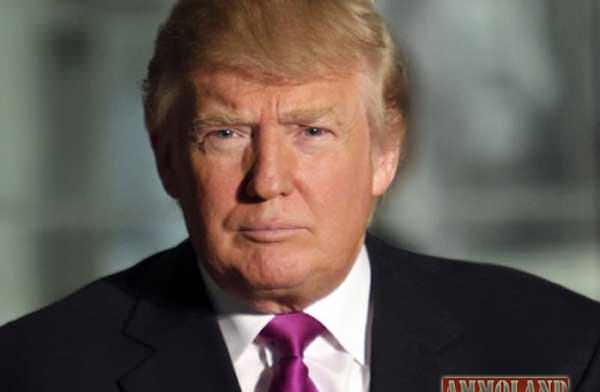
The recent triumph of Donald Trump in the US presidential election was one of two things that got me to wondering what a list of those qualities might be—not so much for the USA as for my own country.  What are the values that Canada, as a nation, truly cherishes?

The political opponents of the American president-elect have cast his ascension to power in the darkest terms, quite a difference to the sunny ways seemingly endorsed in our own federal election a year or so ago.  Words like racist, misogynist, bully, and xenophobic, used in reference to Trump by his foes, offer a stark contrast to words such as enthusiastic, transparent, optimistic, and leader, which have been applied to our prime minister, Justin Trudeau, by his supporters.

On the flip-side, Trump’s supporters have described him as strong, forceful, down-to-earth, and no pushover.  Trudeau’s detractors have used words and phrases like boyish, emotional, and not man enough in their descriptions.

Of course, political opinions, like beauty, are mostly in the eye of the beholders, and care should be taken not to believe everything one reads or hears about either of these gentlemen.  Still, the fact that both were elected to their country’s highest office by their respective citizens might say something about what is cherished by each nation.  At least at present, and by a sufficient number of those who voted.

But the critical thing about nationhood is that, despite these opposing viewpoints, each nation as a whole must accept and adhere to a basic set of values if it is to survive.

us-constitution

The second thing that prompted my curiosity about the qualities Canada might cherish was the proposal by a presumptive political-party leader, Kellie Leitch, to vigorously pre-screen potential immigrants for any trace of “anti-Canadian values”.  If they fail to measure up to the standard she will presumably establish, she will bar them from entry.

It makes sense, of course, to ban terrorists and criminals; it also makes sense to admit people with skills and training Canada needs, and people who are fleeing for their lives from oppressive regimes.  In fact, our current immigration practices and procedures do both of these things quite well.

But what are the values Leitch is looking for?  She has stated that the test will screen for anti-Canadian views that include intolerance toward other religions, cultures, and sexual orientations; violent and/or misogynist behaviour; and/or a lack of acceptance of our Canadian tradition of personal and economic freedoms.

I wonder, though, how she might define such concepts as intolerance (Sorry, but I will not eat poutine!) or personal freedoms (Okay, okay…I won’t pee on the golf course!).  Could it be so simple and light-hearted?

Likely not.  For example, if I were a prospective immigrant of a particular faith, say Catholic, would I be banned for not endorsing the notion of same-sex marriage?  If I were to vigorously protest the environmental policies of the federal government (perhaps a government she might be leading), thereby exercising  free speech, would I be expelled?  If I chose to wear a niqab during my citizenship swearing-in, would I be rudely escorted from the room?  And the country?

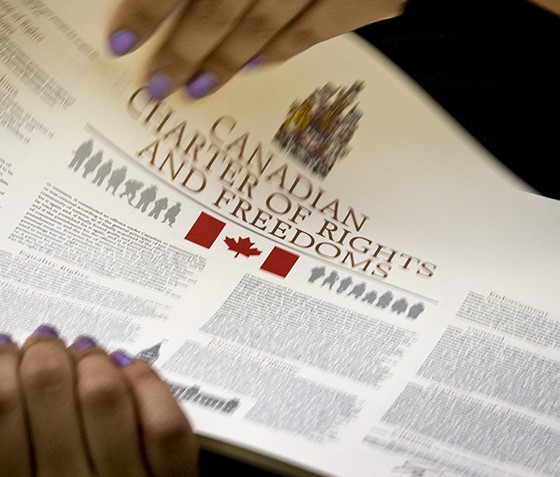
The Canadian Charter of Rights and Freedoms, adopted as part of the Constitution Act in 1982, pretty much lays out in its thirty-four sections the entitlements and responsibilities conferred upon, and expected of, every citizen.  By its very existence, it establishes many of the values our nation cherishes; for example:

  • the right to life, liberty and security of the person…
  • [equality] before and under the law and…the right to the equal protection and equal benefit  of the law without discrimination and, in particular, without discrimination based on race, national or ethnic origin, colour, religion, sex, age or mental or physical disability…
  • [these rights] shall not be construed as denying the existence of any other rights or freedoms that exist in Canada…
  • [these rights] are guaranteed equally to male and female persons.

canadian-charter

In effect, this means all citizens enjoy the right to cherish, and act in accordance with, whatever they believe—with the proviso that they must not harm anyone else.  No one, it seems to me, including a politically-motivated Kellie Leitch, can judge any of us on a set of arbitrarily-established Canadian values.

Perhaps John Stuart Mill said it best, in his 1859 essay, On Liberty, where he attempted to identify standards for the relationship between a nation’s authority and its citizens’ liberty:

          The maxims are, first, that the individual is not accountable to society for his actions, in so far as these concern the interests of no person but himself…

          Secondly, that for such actions as are prejudicial to the interests of others, the individual is accountable, and may be subjected either to social or to legal punishment, if society is of opinion that the one or the other is requisite for its protection.

If we were to accept the guidance offered in these two foundational sources, I don’t believe we would need a test to suss out anti-Canadian values.  To the contrary, our co-existence would exemplify those values, and allow us to live united in a peaceful sharing of the things we cherish.

And we would be proud of the quality of our nation, upholding it for all to see—from sea to sea to sea.

Everybody Knows

By now, I suspect, everybody knows that Leonard Cohen, an iconic Canadian poet and songwriter, died at the beginning of this week.  And of course, everybody knows that Donald Trump, an American entrepreneur and novice politician, won the US presidential race a day later.

I am struck by the awful asymmetry of these two events.

For many lovers of music, the passing of the artist, while distressing, allows us once again to celebrate and honour the memories his songs created for us.

For progressive, liberal-minded people, the election of an erratic demagogue foreshadows a period of pullback, retrenchment, and isolationism in America.  The nation’s motto, E pluribus unum—out of many, one—takes on an ominous tone.

I know of no one who is happy at the death of Cohen.

cohen

By contrast, millions upon millions of Americans are thrilled by the ascension of Trump.  And, despite my many misgivings, I could well be among them if all the actions he has pledged to take were similar to these, for example: impose term limits on all members of Congress; impose new restrictions on lobbying and lobbyists in Washington; allow vital energy infrastructure projects, like the Keystone Pipeline, to move forward; and fix America’s water and environmental infrastructure.  In my view, these are reasonable, wise moves.

Alas, he may also proceed with actions such as these: renegotiate NAFTA or withdraw from the deal altogether; lift the restrictions on the production of job-producing American energy reserves, including shale, oil, natural gas and clean coal; cancel billions in payments to U.N. climate change programs; repeal, rather than fix, the Affordable Health Care Act; appoint conservative judges to vacancies in the Supreme Court (who will, quite possibly, reverse Roe v. Wade affecting women’s rights with respect to abortion); and cancel funding to such organizations as Planned Parenthood and Sanctuary Cities.  I deem these actions to be backward-looking and regressive.

trump

For me—one of those liberal progressives favouring public policies of inclusion and social conscientiousness—it is interesting to consider some of the sobriquets bestowed on Cohen over the years, and to see how many of them might fit Trump:

∙ prophet of despair,

∙ gloom merchant,

∙ grinning reaper,

∙ world heavyweight champion of existential despair, and

∙ dark messiah.

In Cohen’s case, these phrases were intended as respectful descriptions of the songs he wrote and performed.  They are almost oxymorons, in that they combine positive and negative attributes in each phrase.

By contrast, for Trump they may bear no double-meaning; depending upon the actions he does choose to take during his first months in office, I fear they may have to be taken literally.

Consider these lines from Everybody Knows, one of Cohen’s most revered works; time will tell if they prove prophetic:

Everybody knows the war is over
Everybody knows the good guys lost
Everybody knows the fight was fixed
The poor stay poor, the rich get rich
That’s how it goes…                                                                                                                

Everybody knows that the boat is leaking
Everybody knows that the captain lied…

And if the worst does come to pass, keep in mind these lines, also from Cohen:

Ring the bells that still can ring
Forget your perfect offering
There is a crack in everything
That’s how the light gets in.

light

Cohen knew that, and we know that, too.

Everybody knows.


The Big Bad Wolf

It seems I’ve always been fascinated by wolves.  One of the earliest stories told me as a child was the Three Little Pigs, defending themselves from the big bad wolf at their door.  I can still see my father’s cheeks, distended and whiskery, as he huffed and puffed his way through the tale.  I feared the villainous wolf stalking Little Red Riding Hood, too, and was grateful to the brave woodsman who dispatched it.

My mother would tell me stories of visits to her grandparents’ farm when she was a young girl, and of the fearsome wolves that roamed the area.  I could see them in my mind’s eye as clearly as if I had been there with her.  I laugh now when I remember her trying to recreate their howls, but I never laughed then.

When I could read on my own, a story I went back to time and again—my first ‘favourite book’—was The Wolf King, by Joseph Wharton Lippincott, of the famed publishing firm, J.B. Lippincott Company, founded by his paternal grandfather.  As an aside, his maternal grandfather was Joseph Wharton, founder of the Wharton School of Business.

wolf-king

I, of course, knew nothing of those matters, but avidly devoured the story of a giant black wolf who became a legend in the Alberta wilderness he called home.  The illustrations, by Paul Bransom, contributed greatly to my enjoyment.  It was this book that changed my perception of wolves forever, and I regret that it is out of print.

On many a camping trip over the years since, some with my own two daughters, I sat in on ‘wolf howls’, group attempts to attract roaming packs of wolves by howling into the night sky.  On the rare occasions when we were successful, the shivers in my spine were as real as the eerie, floating ululations borne to us on the night breeze.

A sadder experience was visiting a wildlife zoo in the near north of Ontario, where two wolves—looking scraggly and worn, not at all as majestic as the Wolf King—paced endlessly around their enclosed compound.  The clear amber irises of their eyes, staring accusingly as if I were to blame for their captivity, haunt me still.  It mattered not that I knew they’d been rescued as orphan pups, and would likely die if released into the wild.  They were animals born to be free.

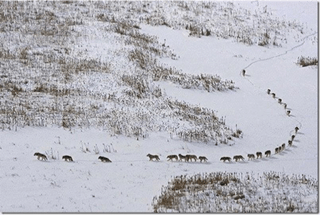
On the internet recently, I came across a picture of a large wolf pack (a photo taken by Chadden Hunter of the BBC), following a looping trail through the snow in Wood Buffalo National Park.

wolf-pack

The accompanying description told me—

…the first three are the old or sick, they give the pace to the entire pack. If it was the other way round, they would be left behind, losing contact with the pack. In case of an ambush they would be sacrificed. Then come five strong ones, the front line. In the center are the rest of the pack members, then the five strongest following. Last is alone, the alpha. He controls everything from the rear. In that position he can see everything, decide the direction. He sees all of the pack. The pack moves according to the elders’ pace and help each other, watch each other.

The picture and brief story fit perfectly with my boyhood memories of the alpha wolf in Lippincott’s book.  Unfortunately, the explanation seems not to be true.  I found a more accurate account on the Snopes website—

…the pack, led by the alpha female, travel single-file through the deep snow to save energy. The size of the pack is a sign of how rich their prey base is during winter when the bison are more restricted by poor feeding and deep snow.

…some researchers would nonetheless dispute the use of the term “alpha.” In David Mech’s 1999 paper “Alpha Status, Dominance, and Division of Labor in Wolf Packs,” he posited that the concept of an “alpha” wolf who asserts his or her dominance over other pack members doesn’t actually exist in the wild:

“Labeling a high-ranking wolf alpha emphasizes its rank in a dominance hierarchy. However, in natural wolf packs, the alpha male or female are merely the breeding animals, the parents of the pack…

“Thus, calling a wolf an alpha is usually no more appropriate than referring to a human parent or a doe deer as an alpha. Any parent is dominant to its young offspring, so “alpha” adds no information…Such a designation emphasizes not the animal’s dominant status, which is trivial information, but its role as pack progenitor, which is critical information.

“…the pack is not being led by the three oldest members and trailed by an “alpha” wolf, [but by] one of the stronger animals…in order to create a path through the snow for them.”

As a storyteller, I confess that I prefer the first explanation over the more accurate one.  It corresponds more closely to my mythologized (and avowedly romantic) opinion of wolves, one I am loath to surrender.  Nevertheless, even factual descriptions of wolves’ pack-behaviour acknowledge the deep commitment they have to one another, and the social cohesion we might sometimes wish for in our own communities.

This is, perhaps, my favourite description of wolves and the effect they have always had on me.  It was penned by a former poet laureate of Alaska, John Haines, in his book The Stars, The Snow, The Fire

Far across the tanana, a mile or two to the south of us, a group of wolves were singing. I call it singing, not howling, for that is what it was like. We could distinguish three, perhaps four voices – wavering, ascending in pitch, each one following the other, until they all broke off in a confused chorus. Their voices sank into distant echoes on the frozen river, and began again. A light and uncertain wind was blowing out there, and the sound grew and faded as the air brought it toward us or carried it away southward. It might have come across a thousand years of ice and wind-packed snow, traveling as the light of the stars from a source no longer there.

For me, the noble wolves will always be there.

wolves

Intelligence and Change

If the history of our planet and the existence of life upon it were to be displayed as a clock-face, with its beginning at twelve o’clock, the appearance of the first humanoid beings—our distant, distant precursors—would not occur until the hands had swept around to the merest sliver of time before twelve again.

clock-681645_960_720

Life itself, however, in its earliest, most basic form, would have begun much earlier, when the hands were approaching two o’clock.  The difference in real time is about four billion years, based on the fossil record so far uncovered.  Bacteria, for example, are a subset of prokaryotes, the earliest type of life on earth.

Life existed, in other words, for four billion years before the first hominim stood up on hind-legs, discovered oppositional thumbs, and (possibly) wondered who or what (s)he was.

All this time later, modern humans claim supremacy over the planet and everything living in its embrace.  Such foolhardiness, as we shall see.

We do so, I suppose, out of a belief that we are the most highly-intelligent life-form yet evolved.  Our basic intelligence—distinct from other species because of our imagination and curiosity, which allow us to ask such questions as Why?, How?, and What if…?—varies widely among individual humans, but is demonstrably more advanced than that of other species.

If the specie-specific intelligences of all life-forms, as we measure them, were arrayed on a graph, the human sort would be a tiny triangle at the very top of a much larger triangle, the lower intelligences of inferior life-forms spreading out below ours.

But that ranking may be misleading because of the definition of intelligence we apply in order to do the grading.  If the essential purpose of every known life-form is to perpetuate the species, to survive, and if each group’s success at doing so is the ultimate measure of intelligence, then our ranking would certainly be much different on the graph.

Very recently, a study undertaken at Indiana University posited that the earth might presently host almost one trillion distinct species, of which less than one-thousandth of one percent have been identified.  We might imagine that we are one of the very few species among them to possess an awareness of the others’ existence, but that awareness may not matter much.

A parasite life-form, firmly attached to a host, may not be cognitively aware of its host, but it thrives and reproduces because of their symbiotic relationship—even as the host dies.  The trillions of bacteria that live on our bodies, most of them in the intestinal tract, may have no cognitive awareness of us, but they are essential to our survival, and they reproduce exponentially.

In fact, it has been argued that our human bodies are nothing more than carrying-cases for our microbiome, a coalition of genes from several different species, only one of which is human.

silhouettes-of-man-and-woman_23-2147505840

Most bacteria are beneficial to us, but certain types, pathogenic or disease-carrying, can be harmful.  They exist in three main forms—cocci, bacilli, and spirilla—and reproduce so quickly that they can overrun an otherwise-healthy organism, causing illness and even death.

Another species posing a threat to us, perhaps the smallest and simplest life-form of any on earth, is the virus.  By themselves, viruses are inanimate, requiring a host in which to multiply and grow—which they do by invading a host-cell, causing it to produce infected cells that attack other cells, and eventually killing the host.

The drive to survive among bacteria and viruses is relentless.  Human intelligence has inspired the development of methods to combat them—antibiotics, such as penicillin, amoxicillin, and tetracycline for bacteria; vaccinations and antiviral drugs, among them acyclovir and interferon, for viruses.  For a long time, these have been effective.

There is some evidence, however, that pathogenic bacteria and viruses are evolving into organisms with an immunity to the drugs we administer.  This comes as no surprise, really, because all living things evolve over time through a process of random mutation and selection.  The alarming thing is that these ‘superbugs’ may be outstripping our ability to develop new drugs to combat them.

Imagine, for instance, if all our defenses against bacterial infections and viral illnesses were to be rendered useless.  Which species would survive, the highly-intelligent one of which we are a part, or the simple, ruthless ones that have existed for the better part of four billion years?

And if not us, then which of the species is truly the most intelligent?  The human one that spawned Newton and Marie Curie, Mozart and Dylan, Indira Gandhi and Mother Teresa?  Or the simple ones that have ensured their survival over billions of years on the planet?

As Einstein once wrote, “The measure of intelligence is the ability to change.”

But history tells us that, although humans are not naturally resistant to every bacterial and viral infection that might assail us, we are naturally resistant to change.

That is a problem.


Presidential? Or Preposterous?

As a resident of a country bordering the economic, military, and political colossus that is the United States of America, and as a highly interested, but mostly-unaffected, observer of its 2016 presidential election process, I have some thoughts about the current contenders as they portrayed themselves in the first televised debate recently.

debate-in-the-ring

But let me begin with some context.

First, the American dream, as popularly understood, is that everyone who works hard will achieve prosperity and upward social mobility, unfettered by such barriers as racism, religious persecution, gender bias, and other obstacles of that ilk.  Private enterprise and capitalism will provide the means, and every citizen will provide the ambition.

This worked reasonably well for the educated, dominant white landowners and merchant class in the largely-agrarian country that emerged in the two centuries following the founding of the republic.  It worked less well for the working class (including both slaves and freemen, and immigrants), and scant thought was given to assisting those who didn’t prosper, and who fell into radical poverty.  They, it was assumed (if, indeed, anyone even considered their plight), constituted collateral damage, and could move west to pursue their dream.  Or die unnoticed.

Today, in a population approaching 325 million, inhabiting a largely urbanized country, there are too many of these unsuccessful achievers of the American dream to ignore.  The private sector tries its best to do that, however, in its endless pursuit of profit.  Getting rich has become the yardstick for whether or not one has achieved the American dream, and capitalists pursue that goal without regard for the widening income disparity between the wealthiest and poorest.  Consider the insurance conglomerates, the big banks, and the pharmaceutical industry as examples of this.

So who will look to the needs of the poor, the disenfranchised, the homeless, if not corporate America?  It would appear the government cannot.  Socialism is a bad word in America, ‘big government’ is anathema, and any candidate espousing an increase in taxes may be committing political suicide.  How, then, can government institute a general sharing of the wealth, drawing from those with means, and giving to those with needs?  Such a radical notion runs contrary to the American ethos on which the whole experiment in nationhood was based.  We’re not commies, son!

But somebody needs to figure out an answer, and soon, before an American Robespierre arises—angry, ambitious, and armed.

Second, the mainstream media portray (or, at best, do not question) the ‘imperial presidency’ as an office where the person occupying the role is omnipotent.  The average American voter—unaware or forgetful of the three branches of federal government, or of the separation of powers that governs their functions—tends to see the president as one who can singlehandedly fix everything that’s wrong with the country, one who can make America great again.  And the media, including the unconstrained social media, perpetuate this misconception because of their endless fascination with ratings and readership numbers—the profit motive.

As informed citizens must know, the presidency is the executive function, intended to manage the government’s functions, enforce the laws, and serve as commander-in-chief.  Congress—the bicameral, legislative branch, comprising the Senate and House of Representatives—is charged with making the law.  And the Supreme Court, the judicial branch, is supposed to ensure that the laws and their execution are constitutional.

If all voters knew this, they would be, perhaps, less likely to fall for the pitches of pretenders to the presidency.

us-capitol

The two candidates for the office in 2016 present a striking contrast, and it was evident in the first debate we watched.  Voters will have to decide which of the two will be best able to manage the economy, address the issues of poverty and racism, combat terrorism to ensure the security of the nation, and deal rationally and firmly with other world leaders.

The economy is nowhere near as healthy as reported by the media—rigged numbers supposedly representing the growth rate, the inflation rate, the unemployment rate.  The only rate with any plausibility is the interest rate, and it’s so low that people (except for the very wealthy) have no incentive or wherewithal to invest or save.  They sure do borrow, though.

The poverty gap is not going to lessen dramatically, regardless of who is elected.  In an increasingly-technological society, low-skill jobs are gone forever.  State-of-the-art education and innovative entrepreneurship are of utmost importance if the situation is ever to improve.  Racism is pervasive and, it sometimes seems, part of the national DNA; there is no quick fix for that, only generational change brought about by relentless pressure and, unfortunately, oft-violent protests.

Terrorism is part of our world, like it or not, and (whether foreign or home-grown) unlikely to be eradicated; there are too many disenfranchised people in the world, with too many grievances, too much hatred, and too many weapons.

The leaders of other nations, allies and foes alike, are not so much interested in American greatness as in their own national aspirations.  And it is they, not just the next president, who will exert a large influence on the state of international relations.

So it’s obvious that neither Mr. Trump nor Ms. Clinton can ‘fix’ America’s problems, make her great again, just by virtue of being elected president.  Were I an American voter, unimpeded by party affiliation, I would try to suss out which of them is best-positioned to make the best stab at it, imperfect though both may be.

Is either of them presidential, or are they both preposterous?

I would want to know which of them (even if neither is truly altruistic) is more interested in my plight; in helping me to achieve my own American dream; in advancing the prospects of every citizen, regardless of race, religion, gender, sexual orientation, or socio-economic status.  Which of them best appreciates the differences between federal and state government functions, and has the skills to foster productive relationships between and among them?  Which of them has the most comprehensive understanding of the sacrosanct Constitution?  Which of them has the ability to talk with, and listen to, other world leaders?

In short, which of them has the experience, the patience, the gravitas to faithfully execute the onerous obligations of the office most effectively?

Given the limited choices in 2016, I know which of them I’d be voting for.

ballot-box


And the Beat Goes On

Away back when, wiggling in my mother’s womb, I listened to her loving heartbeat.  In that steady, reassuring cadence, I heard the most intimate murmurings of her soul—the fears and doubts she harboured, the hopes and aspirations she nurtured.

Many of those, of course, were focused on me, her firstborn child.

Will I deliver a healthy baby?  Will I be a good mother?  Will I give him a happy, successful start to his life?  Will I make him proud of me?

She couldn’t know the answers to those questions, of course.  Not then, not yet.  But she was an extraordinary woman, my mother, and she turned her formidable mind and powerful will to the shaping of our lives together.  To make it so.

mother-and-childIn time, four more children followed, my siblings, and I hope they, too, were attuned to the musings and melodies she would have had for them.  I heard her refrains for me, echoing and resonating in that remembered, rhythmic beating of her heart, until the day she died.  Even now, whenever I’m confronted with challenges and doubts, a quiet, firm voice speaks to me from deep inside, offering care, counsel, and courage.  Her voice.

So the beat goes on.

When my two daughters were born, I strove from the beginning to insinuate myself into their wee hearts, yearning to know the singing of their souls.  I imagined I could hear it, modulated by their intrepid heartbeats, and my own soul sang back to them, every chance I got, conveying my doubts and fears, my hopes and aspirations.

Will I be here for you when you need me?  Will I make you proud of me?  Will you love me unconditionally, as I already love you?

I proudly watched as they grew from infancy to adulthood, strong, independent, and loving.  And I was humbled time and time again, realizing I was the nexus between these remarkable women, my mother and my daughters.  A biological bond, and more, I hoped—a protector, a guide, and ultimately an unabashed admirer.

My wife—a fiercely-loving mother in her own right—had as great an influence as I, perhaps greater, on our girls.  But it is I who connects them with my mother.

And now our daughters are themselves mothers—five wonderful grandchildren for Nana and me.  Their hearts beat now in harmony with the hearts of their children, their souls connect with the same passion we once shared.  I cannot know for certain, but I imagine these young mothers sing the same heart-songs, straight from the soul, that I first heard from my mother.

Will I always be your friend?  Will I live up to what you expect of me?  Will I be the mother you would have me be?

Knowing my daughters as I do, I believe they will answer those eternal questions affirmatively and beyond doubt, just as I witnessed with my mother.  For they possess the very same hearts—beating the very same rhythms for those same good reasons—forever crooning the songs of the soul I first heard in the womb.

And the beat goes on.

Tyrants

Herewith, four definitions—

  • sociopathic: personality disorder manifesting extreme antisocial attitudes and behaviour, and a lack of conscience;
  • psychopathic: chronic mental disorder manifesting amoral and antisocial behaviour…extreme egocentricity…an inability to feel guilt;
  • psychotic: severe mental disorder in which thought and emotions are impaired to the point where contact is lost with external reality; and
  • zealous: fanatical and uncompromising pursuit of religious, political, or other ideals.

Tyrants the world over, since the dawn of history, have displayed one or more of these characteristics in dealings with their contemporaries.  A catalogue of infamous names might illustrate the point.  Caligula; Genghis Khan; Attila the Hun; Ivan the Terrible; Robespierre; Stalin; Hitler; Pol Pot; Amin—all deserving of the wonder, fear, and loathing they inspire even today.  Under their regimes of terror, countless people suffered and died as a consequence of their perverse aspirations.

tyrant

Interestingly, this small list of tyrants contains no names of leaders of the so-called civilized world.  There is, for example, no Cromwell, no Elizabeth I, no Bolivar, no Lincoln, no Churchill, no Gandhi, no de Gaulle, no Roosevelt, no Mandela—no one, in fact, who is thought to represent the ideals we enlightened peoples cherish.  Ideals such as liberty, peace, prosperity, and good government.

But could any of these worthies have been tyrants, too?  Benevolent tyrants, perhaps, pressing forward their own ambitions, convincing us of their correctness?  And do such tyrants exist in our world today?

We live on a planet fraught with peril, both in our local communities and globally.  Granted, many dangers result from natural phenomena—earthquakes, floods, droughts, pollution, and epidemics.  And for the most part, there is a cooperative, international effort to cope with these.

Too many of the perils, however, are brought on by foolish actions in the face of consequences we know to be severe, perhaps even catastrophic—

  • the deliberate despoiling of our environment and atmosphere, knowing such actions are unsustainable;
  • antagonistic expansion of national borders, provoking states of war and massive displacements of people;
  • premeditated acts of terror, often visited upon innocents; and
  • a relentless, worldwide drive to acquire ever greater wealth, enriching the few at the expense of the many.

Insanity, it has been said, is doing the same thing over and over again and expecting different results.  To that I would add:  insanity is purposely doing something in the face of overwhelming evidence that the outcome will be ruinous; insanity is wielding power over others, for our own benefit, without regard for the effects it may have on them; insanity is living on a small, blue orb floating in a vast interstellar sea—a lifeboat, so to speak—and deliberately engaging in actions that will inevitably capsize it.

And insanity is the purview of tyrants.

Tyrants pursue their ends without regard for truth, careless of consequences, without attention to moral imperatives that govern most of us, never doubting the rectitude of their delusions.  Uncompromising in their beliefs, they seek to foist them on the world they inhabit.  As do sociopaths, psychopaths, psychotics, and zealots.

But an interesting thing about tyrants is that their actions are judged, not objectively, but through ethnocentric filters we all employ.  We hold, many of us, a belief that the groups to which we belong—be they racial, religious, gender-based, age-related, economic, nationalistic, political—are superior to groups to which other people belong.  It is all too tempting, therefore, to label the motives and actions of other groups’ leaders as tyrannical, even if suspiciously similar to those of our own leaders.

Tyranny, it might be said, is in the eye of the beholder.

aphorism_by_aesop_ancient_greek_poet_and_fabulist_any_cg1p45800971c_th

With respect to the first list of tyrants referenced earlier, it is likely that consensus exists among much of the world’s peoples as to the evil of their deeds.  Most of us share an abhorrence of certain actions—genocide, for example, or murder and rape.  These are obvious and odious.  But what of the smaller, less noticeable acts of tyranny we put up with?  What are the checks and balances in place to restrain the leaders to whom we grant governing power?

When I look at the state of our planet, and at the people who have brought us to where we are, I wonder if they are all not tyrants of a sort.  Whether elected, appointed, or self-installed, do our leaders act in the best interests of us, the people?  Or do they pursue their idiosyncratic crusades, heedless of potentially harmful outcomes?  Are there fifty, or more, shades of grey in the spectrum between insanity and rationality?  Between tyranny and altruism?  And if so, where on the scale do our current leaders fall?

I despair of the answers when I observe the follies they subject us to.

Benevolent tyrants are tyrants, still.

Don’t Confuse Me!

Our high-rise community participated in a neighbourhood garage sale recently, and we were all asked to donate items to the cause.  Several residents worked very hard to collect, label, and affix prices to the assorted contributions.

Most people donated cheerfully, but one elderly man offered his two cents’ worth about the enterprise when he, somewhat grudgingly, dropped off his items.

“It’s not right, y’know,” he said.  “Rich folks selling stuff to raise money for themselves.”

grumpy old man

The volunteer who accepted his goods might have wondered why he was donating, given his point of view.  But rather than question it, she chose to explain the endeavour.

“Actually, the money raised from the sale is going to a number of good causes,” she said.   “It will buy wood for the woodworking club to make toys for kids at Christmas; it will buy paint for the artists’ club to paint them; it will buy wool for the knitters’ group to make mittens, hats, and sweaters for kids; and a cash contribution will be made to the local battered-women’s shelter.”

“Oh,” was all he said before shuffling away, unmollified.  Presented with the facts—details that contradicted his preconceived notions—he had no comeback.  There were no further questions, no requests for additional information, no expression of greater understanding.  Nothing.

As a witness to this exchange, I couldn’t help but compare it to the same phenomenon we see in the broader public sphere.  How many of us, convinced of the legitimacy of opinions we may have formed on any subject, are resistant to evidence that proves us wrong?

“I think…” we might say, as preface to a harangue on some subject or other.  “In my opinion…” we may begin, before embarking on a diatribe of some sort.  “Everybody knows…” we might say, before expounding on whatever is the topic at hand.

And when we do, we are usually sincere and convinced in our viewpoint.  Even if that viewpoint is based on little reflection, born of a subjective opinion, or informed by a group mentality.

There is an election taking place right now in the USA, the country to the south of us, a presidential contest that is rapidly (if not already) attaining farcical status.  As an interested onlooker, I am astounded by the shallowness of the debate over issues, the venality of the personal attacks, and the ignorance of large swaths of the electorate.

Lest I be accused of self-righteousness, let me concede that elections in our own country are not models of decorum and honour.  But, so far as I can determine, we have never had a candidate for the highest office in the land who appealed, deliberately and recklessly, to the basest elements of our populace.

There is a burgeoning movement in the USA, labelled the alt-right, which festers mostly in the social-media universe.  Although loosely-organized (if at all), its proponents focus on a number of major themes, among them:  race, gender, immigration, self-reliance and individualism, and small-government.  Their major grievance appears to be a sense of disentitlement, a belief that they’re losing their historic, God-given rights to a post-modernist, liberal elite.

Their vociferous body-politic includes racists and white-supremacists, misogynists, homophobes, anti-Semites, and xenophobes.  A large segment of their ranks consists of disaffected white men (and perhaps the women over whom they exercise control)—an alienation founded in the shrinking of the middle-class, disappearing jobs and income, a perceived increase in crime and terrorism, and an assault on their ‘inalienable rights’.  They want someone to restore what they have lost.

Trump hat

The alt-right movement, for the most part, has aligned itself behind Donald Trump, a billionaire candidate, who has at various times claimed that:

  • the current president was not born an American, and may in fact be Muslim;
  • Hispanic immigrants from Mexico are criminals and rapists, expelled from their own country;
  • thousands of Muslim-Americans cheered as they watched the Twin Towers fall on 9/11;
  • an American-born judge of Mexican heritage is not qualified to sit on the bench because of his ethnicity; and
  • most white homicide victims in the USA are killed by African-Americans.

Major media organizations have looked into these statements—and myriad others of the same ilk—and debunked them as lies, citing credible data to support their findings.  Nevertheless, alt-righters continue to believe them and repeat them, relying on their gut-level intuition rather than evidence.

“Don’t confuse me with facts!” they appear to be saying.

These deluded devotees remind me of the elderly gentleman who brought donations to our neighbourhood garage sale—unconvinced by the truth, unlikely to change his mind, determined to remain in a state of blissful, self-righteous ignorance.

It’s true, I suppose, that all of us could be seduced by a particular version of the truth that resonates with us, whether personal, political, religious, or simply comforting.  But to any of us who find ourselves in that situation, I have one piece of advice—

Don’t believe everything you think!