I Can Help With That!

Well into middle-age, I would often ask my parents questions about our family’s history.  Most of the time, those questions were based on simple curiosity, but occasionally they’d be prompted by something more important, like the medical history of family members that might impact me or my children.  Aging aunts and uncles were also a source of information, and always seemed happy to reminisce about such things.

Old photo albums were a rich source of material, too, as were scrapbooks and journals, and I remember poring over them as a child, eager to soak up the ethos and culture of my family.  Alas, when I look at some of those monochrome snapshots now, I find I recognize hardly anyone.

But now, of course, there’s no one to ask.  Both my parents and all my aunts and uncles are long departed, and I am the eldest of my family.  My three younger sisters will sometimes remember events from our shared past quite differently than I, but now we have no arbiter to call upon.

My two daughters, in their fifties now (Egad!), have taken to asking me and my wife the same sort of questions about our respective families that I used to ask my elders.  We answer them to the best of our memories, but our memories aren’t the best anymore.  I come away from some of those conversations with the uneasy feeling that I might have made stuff up to fill the gaps.

One of our daughters suggested recently that we sit down for a few interview sessions with her, where she could record our recollections.  We’ll be happy to do that, but the suggestion prompted another idea, one I immediately acted on.

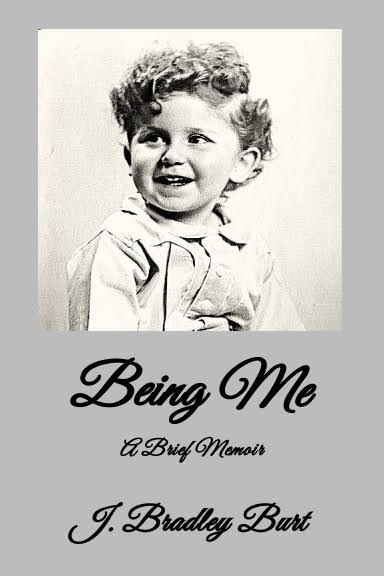
I’ve written a memoir, a brief history of my life intended for family only—my wife, my daughters and their husbands, my five grandchildren, and my three sisters—plus one friend of almost seventy years.  The book, a mere 135 pages in length, is titled Being Me, and is not meant to be an exhaustive examination of my life to date.  Rather, it’s a glimpse at who I was as a boy, who I became as a husband, father, and educator, who I am well into a blissful retirement, and who I strove to be throughout my life. It deals with those events I deem significant, things that might be of interest now or in future to my limited audience.  The challenge I faced was not trying to decide what should be included, but what should be left out.

I’d love to think there’ll be enough yet to come to justify a sequel, but that seems rather unlikely.  Dying holds no fear for me, but I will harbour a sizable amount of regret if that grim reaper lurches in too soon, for I’m having too much fun to want to leave.

It’s been said no one is ever truly dead to the world until the last person who remembers her or him is gone, and I think there’s something to that.  My paternal grandfather died just before Christmas 1948, when I was five years old.  But because I still remember him, vaguely—the only one in my family who does—he’s still alive in a way.  When I finally pass, so, too, will he.

But I’m hopeful I’ll live on, as he has for me, in the memories of those precious ones I leave behind.  And I pray those memories will be fond ones, at least for the most part, and that they’ll evince more laughter than tears.

I have more yesterdays now than tomorrows, but the inevitability of aging is but one aspect of life.  If we so choose, we can relegate aging to a mere physical phenomenon, not one that has to affect our emotional outlook.  The person looking out on the world from behind my eyes today is not the man whose image I see in the bathroom mirror every morning; rather, he is still the boy I always was—

from my aging eyes,
the boy I once was looks out---
hardly changed at all.
the sails of my youth,
once hoist, are often furled now,
‘though the winds still blow.

The winds do still blow, and I welcome them and am inspired by them, even if I can no longer respond as once I did.  My children and grandchildren, thankfully, are caring enough to include me in their lives; my next adventure with Donna is always just over the horizon; my next book is already forming in my febrile  imagination.  These are the winds I speak of, and the physical frailties that age sends to plague me are unable to fully constrain me.

Prompted by our daughter’s interview idea, my wife also decided to write her memoir, titled My Story, and has asked me to help.  As I read her recollections, I find many of the events she deems significant are those I also considered important.  That shouldn’t be surprising, I suppose, considering we’ve been a couple since our first date in 1963, and married for fifty-seven years.

Neither memoir, of course, will answer all the questions our daughters or their families may ask about their heritage.  But with any luck, they’ll go some way to filling in a few of the blanks.  And who knows? Maybe on some far-off day in the future, long after I’ve gone on to my next adventure, one of my grandchildren—or perhaps one of their children—will want to know something about the old-timer who preceded them by a generation or two.  No one will likely remember, but they’ll have my memoir to refer to for the answer.

I like to think it will be as if I’m still there to hear the question.  And to answer by responding, “I can help with that!”

Love, Through Their Eyes

The weekly prompt from my Florida writers group was to write a piece about seeing things ‘through their eyes’, and this is my offering—

Two short poems, each exquisitely written, capture exactly—exactly—how I feel about this brief moment in time I know as my life, about the relationship I have with the love of my life, and about what will happen when I am gone.

The first, When You Are Old, by William Butler Yeats, the greatest of the Irish poets, portrays a woman through the eyes of her departed husband, as he speaks of his love for her, even beyond death, and where she might find him—

When you are old and gray and full of sleep
And nodding by the fire, take down this book
And slowly read, and dream, of the soft look
Your eyes had once, and of their shadows deep.

How many loved your moments of glad grace,
And loved your beauty with love false or true,
But one man loved the pilgrim soul in you,
And loved the sorrows of your changing face.

And bending down beside the glowing bars,
Murmur, a little sadly, how love fled
And paced atop the mountains overhead,
And hid his face amid a crowd of stars
.

I find that sentiment so uplifting, so reassuring, that love, triumphant over death, is waiting ‘midst a crowd of stars.

I no longer believe, as I did as a child, in life eternal, in the idea of earth and heaven, the now and hereafter.  Rather, I believe the life-force presently empowering me—what I might call a soul—is but a fragment of the energy that fuels our expanding universe, a spark of light presently encased in my mortal being.  And when I, the shell that hosts the spark, will have finished my course, when I have expired, that life-force animating me will simply rejoin the universe.  It will be as if I am carrying on beyond death, but with no memory of my life—just as I have no memory now of what came before my birth.

The mortal I shall die, but my life-force will not, for if it did, the universe would shrink at the loss of that fragment of energy.  Science tells us, however, the universe is expanding, not shrinking, so it must be that no energy is ever lost.

But where will my immortal life-force go, and in what form, I wonder?  And what of my love whom I will have left behind?  Happily, I find an answer to these questions in the second of the poems I number among my favourites.  Written by David Jones, a Liverpool poet, from his collection titled Love and Space Dust, I find it moving and profound—

And in the end
I will seek you
Out amongst the stars.

The space dust
Of me will
Whisper ”I love you”
Into the infinity
Of the universe.

So, no life eternal, but something better—love eternal.  According to these two poets, as seen through their eyes, the pilgrim soul who shares this life with me will find my spark of energy—my soul—waiting somewhere in the stars for her, calling I love you into the void until she hears me.

And I choose to believe she will hear me.

David Jones: https://www.goodreads.com/author/quotes/5241391.David_Jones

W. B. Yeats: https://www.poetryfoundation.org/poets/william-butler-yeats

The Loss of What, Now?

The weekly prompt from my Florida writers’ group was to pick a famous saying or quote, and write a story about it. This is my offering—

“You can take it from me!” the old man says forcefully.  “Gettin’ old ain’t for sissies!”

“Yeah,” his middle-aged son says, scarcely looking up from his phone screen.  “Beats the hell out of the alternative, though.”

‘“Very funny,” the old man says, “an’ easy for you to say.  You’re too young to know the thing ‘bout gettin’ old is dealin’ with loss.  With nary a warnin’, we start losin’ all the things we always took for granted.”

“Like what?” his son says.  He’s sitting in the small suite the old man occupies in the retirement home, his father propped up in bed beside him.

“Everythin’!” the old man declares emphatically.  “Just lookit my skin, f’rinstance.  Used to be smooth an’ tight, now it’s all loose an’ wrinkled.  I look like a cheap suit!”

“That’s to be expected, Pop,” the son says distractedly, eyes still on the phone.  “You’re not a young buck anymore.”

“That’s what I’m sayin’!” the old man replies.  “An’ I’m also losin’ all my muscle underneath the skin.  I’m nothin’ but a bag of bones!”

“You look fine, Pop,” the son says, reaching to pat the old man’s arm reassuringly.  “Just older, that’s all.”

“Exac’ly!  An’ speakin of bones, I’m losin’ all the flex I used to have in ‘em.  All’s I got now is pain an’ stiffness.  Every time I look at myself, all’s I see is me losin’ more an’ more of what I had.”

“So then, don’t look at yourself so often,” the son says.  “Read your magazines, read the books I brought you.”

“Bah!  Easy for you to say!  I don’t see so good anymore, neither.  Vision loss is another thing I’m dealin’ with, an’ it ain’t nothin’ to celebrate, b’lieve you me!”

“Where are your glasses?” the son asks, thumbs busy on the tiny keyboard in front of him.

“Danged if I know!” the old man spits.  “Can’t ‘member where I put things the way I used to, neither!  Doc says it’s just normal mem’ry loss, caused by old age.  I used to prop ‘em up in my hair when I wasn’t wearin’ ‘em, but now that I lost all my hair, they just keep slippin’ off.”

“So, watch TV then.  There’s always something on the movie channels.”

“Yeah, I can still see the TV,” the old man concedes grumpily.  “It’s the up-close stuff I can’t see!  But nobody in them old movies talks loud enough!  I can’t hear a blessed thing ‘less I turn the volume way, way up.  But then the nurse comes in an’ switches it back down.  Gettin’ old means I got hearin’ loss, too!”

“Where are your hearing aids?” the son asks, putting his phone in his pocket.

“Where d’ya think they are?” the old man says.  “In my ears is where they are!  But they’re not workin’ right!  I gotta read lips to know what people are sayin’ half the time!”

“Have you checked the batteries?” the son asks, reaching for his father’s ear.

“Don’t touch me!” the old man says, flinching away.  “All’s I got anymore is pain everywhere.  Nurse says it’s just inflammation, it’ll go away.  But it doesn’t, dagnab it!  Pain is the only thing I don’t seem to be losin’!”

“Okay, Pop, don’t take this the wrong way, but maybe you should change your attitude a wee bit.  Try to focus on the things that make you happy, the things that are going well.”

“Like what?” the old man says, somewhat miffed by the suggestion. 

“I don’t know,” the son replies, checking his phone again.  “There have to be some things that are going right for you.  Mark Twain once said, Getting old is an issue of mind over matter.  If you don’t mind, it doesn’t matter!  Try that on for size.”

When the old man doesn’t  answer right away, his son glances up from the phone, thumbs frozen in mid-stroke.  His father’s eyes are closed, his mouth drooping open, his arms still at his side.

“Pop!  Pop!” he yells, leaping from his chair.  “Pop!  Wake up!”  As he stands over his father, phone forgotten, he realizes how aged and frail the old man looks. 

Before he can do anything, however, the old man opens one eye.  “Got ya this time, didn’t I?” he chuckles, a rheumy sound from deep in his chest. 

“Jee-zus, Pop,” the son exclaims.  “You scared the crap out of me!”

“Yeah, well it’s your own damn fault, sonny-boy!  Tellin’ me to change my attitude?  Focus on good stuff happenin’ to me?  At my age?  I may be losin’ a lotta things, but I ain’t never lost my sense of humour!”

“You got me, Pop, I have to admit,” the chagrined son says.  Switching off his phone, putting it in his pocket, he adds, “So, besides your sense of humour, what else haven’t you lost yet?  I’m all ears!”

The old man smiles.  “Ain’t lost you,” he said, “an’ that’s the biggest thing!”

Happy Pilgrim

The weekly prompt from my Florida writers’ group was “AI and I”, and my offering is these two poems, five stanzas each. One was written by me, the other by AI (Copilot); can you guess which is which?

Happy Pilgrim

I am a happy pilgrim wand’ring down the road of life,
I’m loved by both my daughters and the gal who is my wife.
I first began my journey back in nineteen-forty-three,
And have spent the intervening years seeking to be me.

My travels haven’t been too hard, nor have they all been smooth,
They’re slower now, though, than they were when I was but a youth.
I make more time to look around than I ever used to do,
Far less concerned with making haste than soaking up the view.

My tomorrows---fewer now than my many yesterdays---
Still unfold themselves quite wondrously to my open gaze,
And I’m astonished there’s so much that’s new along the way,
As I continue down my path, loving each new day.

I know for ev’ry journey there will always be an end,
But it would be a long, long road that never takes a bend,
And so, I wend my pilgrim’s way, that end not yet in sight,
Trusting that my steps are sure, and my destination right.

I am a happy pilgrim wand’ring down the road of life,
And my age is not an issue, nor yet a source of strife.
In fact, it is a gift that I’ve been blessed to call my own,
And I give thanks for loved ones dear, for I am not alone.

Happy Pilgrim

I am a happy pilgrim wand'ring down the road of life,
With dreams as my companions, and hope to ease my strife.
Through sun-kissed meadows and moonlit fields I just love to roam,
Guided by the stars above, finding solace far from home.

In fields of laughter, I gather mem’ries like wildflowers,
Each petal a moment, fragrant with love's gentle powers.
The winding path unfolds, a tapestry of joy and tears,
And I dance to the rhythm of life, banishing all fears.

Beneath the silvery moon, I find solace in the night,
Whisp’ring secrets to the stars and their pure, distant light.
The road ahead may wind and twist, but I'm sure to persist,
For ev’ry step’s a story, every moment a sweet kiss.

Beneath the ancient oaks, I uncover wisdom's sweet sway,
Their roots anchored deep in earth, their leaves a verdant display.
The road may lead to distant lands, where mysteries unfold,
And I'll follow its winding path, with heart that's brave and bold.

The road may turn or waver, but my heart remains steadfast,
For ev’ry twist reveals a truth, each bend a chance to last.
So let me be this pilgrim, with wonderment in my eyes,
Embracing life's adventure, under ever-changing skies.

To Make An End

For last year’s words belong to last year’s language.  
And next year’s words await another voice.
And to make an end is to make a beginning.
                                                                    - T. S. Eliot

As another year draws to an end, and with it the approaching close of my eighth decade on this journey, I know I am among the most fortunate of my fellow-travellers.  For sixty years of my passage, I’ve been accompanied by the wonderful young woman I first met when she was but sixteen.  She is young no more, of course, but as W. B. Yeats wrote in When You Are Old (almost as if he had her in mind)---

How many loved your moments of glad grace,
And loved your beauty with love false or true,
But one man loved the pilgrim soul in you,
And loved the sorrows of your changing face.

I still do.

Also with me for fifty-plus years of my journey have been the two magnificent daughters who have graced their mother and me with their love, their friendship---and increasingly now, their protection against the failings of age.  When they were little, we made a pact to hug them close for as long as we could, then let them go when time dictated.  As you might expect, the hugging was easy; the letting-go was hard.

But it has been written that when we love someone, we should set them free, and if they come back, then their love is ours forever.  That has certainly been the case for us, for which I’m eternally grateful.  Our girls are women now, but as I’ve often told them, although they are no longer children, their mother and I will never stop being parents.

In due time, those women brought two wonderful men into our lives, and with them produced five wonderful babies of their own---four granddaughters and a grandson for us.  It was as if the cycle started up again, but with my wife and I one step removed this time---loving them, wishing the best for them, but somewhat distant from the immediacy of their lives.  We strive to remain relevant, of course, and they, in return, take pains to make it so.

Kahlil Gibran wrote of that in his meditation, On Children---

You may give them your love but not your thoughts,
For they have their own thoughts.
You may house their bodies but not their souls,
For their souls dwell in the house of tomorrow, 
Which you cannot visit, not even in your dreams.
You may strive to be like them, but seek not to make them like you.
For life goes not backward nor tarries with yesterday.

And in that last line lies the very essence of the joy and sadness, both, that are implicit in our lifelong journey.  Things begin.  Things end.  Things begin anew.  Or so it has always been for me, and will be for some time to come, I fervently hope.  But there will eventually come a moment, I know, when no next beginning will follow the final end.  Despite my reluctance to face that day, I do not fear it.  My approach to its inevitability is summed up in this final stanza from one of my own poems, I Haven’t the Time--- 

I haven’t the time for anger or rancor, or grumbling, self-pity, or frown.
Life’s about living, getting and giving full measure before it winds down.
When that day is nigh, as ‘twill be by and by, I hope it will be widely said,
That as man and boy, I strove for the joy of living until I was dead.

My closest companions along the way have certainly brought that hope closer to reality than it might otherwise have been.  To paraphrase the late Queen Elizabeth II, my dear family have been my strength and stay the entire way.  As we enter into 2023, I hope for all of you who read these posts that you will feel as blessed as I, and that the ending of this old year, no matter its triumphs or tragedies, will be a new and happy beginning for you.

To make an end is to make a beginning.

Happy New Year! 

One Leg At a Time

Several of the well-meaning coaches with whom I interacted across several years of playing hockey and baseball as boy and man were fond of telling me and my teammates not to fear our opponents because “they put on their pants one leg at a time, same as we do.”

I’m remembering that now because, alas, it seems I am no longer able to do that simple task while standing up unsupported.  And I’m pretty sure aging has something to do with that.

My dressing ritual each morning now begins by sliding one leg after the other into my undershorts while leaning against the bed.  If I try to do that without supporting myself, one of two things happens—either I lose my balance before finding the target, or my leg misses the target completely.  The first few times I missed, I forgot to let go of the briefs and fell over onto the carpet.

I now sit down to put on my socks—on those few occasions I wear them—and remain sitting to slide my legs, one at a time, into my pants.  I’m still able to stand, thank goodness, to hitch them up to my waist and cinch my belt.

It’s also necessary, I’ve discovered, to sit down to put on shoes, and to tie the laces.  As a result, I’ve defaulted to wearing sandals whenever I can.  But I have to lean one arm on something as I lift each foot to slide into the sandals.

Donning anything I have to pull over my head—such as a T-shirt, a golf shirt, a sweater—used to be relatively simple.  I’d slide my head through the neck opening first, then push one arm after the other through the sleeve openings.  Whether worn outside the waistband of my pants or tucked in, I was quite adept at completing the sequence.

No longer.  Those sleeve openings have for whatever reason become almost impossible to find once my head is through the neck opening.  And when I’ve repaired to the mirror to get a better look, I find myself confused between right and left.  I’ve resorted now to inserting one arm into a sleeve opening first, followed by the other arm into its opening, which makes it easier for some reason to then pull the article of clothing over my head.  Perhaps it’s because, at that critical juncture, I have only one head and one opening left.

On a few cursed occasions, I’ve even discovered I’ve put on the shirt or sweater inside-out or back-to-front, which means…well, you know.

On cool spring or autumn days when warmer clothing is needed, I have a mid-length squall jacket I like to wear, but lately I’ve been encountering a problem.  It’s fitted with a two-way zipper, so that when I’m driving (or sitting down anywhere) while wearing it, I can open the zipper from the bottom to accommodate man-spread.  That simple feature has been a blessing, but when I’m donning the jacket, it requires that I fit the zipper’s nub into, not one, but two pull-tab receptors at the bottom of the zipper—one that will slide up to zip the jacket, the other that will remain at the bottom to allow opening from that end.

Sounds easy, and it is when those two receptors are perfectly lined up.  My problem lately is that I never seem able to get them aligned, which leaves me struggling like a kindergartner to zip up.  Why, just the other day, a young hostess at a restaurant asked me if I needed help as I was getting ready to leave.  She even referred to me as “Dear”!  My bemused wife tells me I should be glad it isn’t another zipper I frequently use that’s causing the problem.

Egad!

Anyway, I hope you can appreciate the tussles I’ve begun to have when dressing myself.  I won’t even try to list the issues at the other end of the day, when I’m struggling sleepily to undress and get into my pyjamas.

It seems apparent to me, however, that these vexing problems have nothing to do with the onset of my senior years—after all, my age is way beyond the onset-stage.  The troubles I’m experiencing have everything to so with the persistence of aging, the relentlessness of aging, the unforgiving advance of aging.  For as long as I have left, my age is only going to increase, even as the utility of everything else about my mortal self is decreasing. 

It’s as if I’m running into myself on a mathematician’s graph—my age-axis on a parabolic rise, my abilities-axis crossing it on a precipitous decline. 

It ain’t pretty, and never more so than when I’m trying to get dressed in the morning.  All I can do, I suppose, is keep trying to get those pants on, one leg at a time.

One. Leg. At. A. Time.

The Ins and Outs

Some friends were chatting recently in the park about the ins and outs of aging, a not-unusual activity for a group of greying septuagenarians, I suppose.  After listening for awhile, I excused myself from that rather depressing conversation, preoccupied by the thought that there seem to be far more ins than outs as one grows older.

Warming-the-Bones

It’s as if the in-words are in, and the out-words are out.  In roughly alphabetic order, I’ve identified some of those nasty in-things we were talking about.

The first was the inability to do many of the things we used to take for granted—running up the stairs, for example.  It’s more likely now that we’ll fall down those stairs.

There is the foreboding spectre of incontinence lurking, an affliction that has already befallen some of my comrades—leaving them, to their chagrin, in-diapers.

Ailments such as that—and others too numerous to count—can be the source of a profound sense of indignity unless one is possessed of a massive sense of self-worth.  We are lessened, somehow, when we lose our pride in self.  As we read in Ecclesiastes, Vanity of vanities, all is vanity!

With some of us (and I do concede for me, too), there can be a greater tendency toward infantile behaviour as we age, particularly when we don’t get our way—in a domestic disagreement, perhaps.  Whenever I discover I am moving in that direction, I try to remind myself that my wife is not my mother, and so I should abjure childish behaviour.

temper

That’s not always easy.

In many such situations, I find myself adopting a gratingly ingratiating manner in order to convert, or perhaps cajole, my wife to my way of thinking.  Prostrating myself, as it were, to attain my desires.

Hah!  Never happens.

So, when it doesn’t, and because I have fewer inhibitions now about my deportment, I occasionally fall into a visible funk, sink into a sulk, and refuse to talk further.  I just clam up.  But my silence, I’ve found, is always more appreciated by my wife than by me!

However, I am never so injudicious as to remain non-communicative for very long.  Dinner-time inevitably rolls around, and my wife—the head-chef to my sous-chef/clean-up guy—is long-past the stage of guessing what I’d like for supper.  If I don’t speak up, I could well be fasting ‘til dawn.

That possibility is at-all-costs to be avoided, for during the course of my seventy-plus years, I have learned that failure to eat leads my body to a virtually inoperative state, placing me indeed in-peril.

Despite all these puerile behaviours, I am quite a nice person (or so I’ve been led to believe by folks who are still my friends).  Therefore, I try not to present as insufferable to those around me, lest they will no longer be.

Intransigence on my part—on any subject, at any time—is more likely to lead to a parting of the ways with my friends than to any kumbaya coming-together.  So, I make every effort to remain amenable and open-minded.  It kills me sometimes.

lonely (1)

Perhaps the most difficult of the in-words as one ages is the realization that we risk becoming ever-more invisible—overlooked by the younger generations as they rush pell-mell through their daily routines.  No one ever wants to think (s)he has become unimportant in the world we still inhabit, but many of us come to fear it is so.

Anyway, the next time I’m chatting with those same greybeards whose conversation prompted these gloomy contemplations, I think I’ll try to present them with some out-words that might lend a more optimistic tone to our stage of life.

Words like—outgoing, outlaughing, outliving, outplaying, outspokenness, outstretching, outperforming, outworking.

And outrageous.  We greybeards need to be more outrageous.

We need more outs than ins!

Another Birthday

As it has every year since first I made my entrance into the world, another birthday is creeping up on me.  In the dim, long-ago past, I suppose that was quite exciting—the anticipation, the suspense, the thrill of growing older.

For some time, however, the prospect of celebrating one more year added to the total has held no joy for me.  I’d have been quite happy to stop observing birthdays way before now.  On the big day, I don’t feel the slightest bit different than on the previous day, yet I’m supposed to feign happiness at reaching another milestone.

In truth, I feel neither happiness nor sadness about it.  Relief, maybe, or gratitude, for still being around.  But the actual number is of no concern.

geezer 2

Fortunately, my adult family members know how I feel, so the day is long past when they unveil a surprise party, or present me with airline tickets to a destination of my choosing, or arrange for me to be serenaded by a cadre of bored, atonal servers in a fancy restaurant.

Even my five grandchildren lost interest when they realized there’d be no goodie bags—such as they receive at their friends’ birthday parties—if they came for dinner to honour the completion of another year along my journey.

As I said, I’m not unhappy about any of this, nor am I fearful of growing older.  Aging is just the way of things, after all.  I prefer to think of life as an uninterrupted voyage from womb to…wherever.  The fact that I travel ever more slowly as the years unwind is immaterial; the crossing continues until it doesn’t.

One of my pals is fond of saying, “I plan to live forever.  So far, so good!”  I love his optimism.

Other friends who might have espoused the same sentiment are gone, however, perhaps surprised by the ending of their travels, perhaps relieved.  An analogy I’ve heard expressed is that of riding a train, being joined along the way by fellow-travelers, some of whom will disembark ahead of me along the way, some of whom will still be aboard when, at some point, I shall have to get off.

The best part of getting older is the humour that accompanies it, some of it self-deprecating, some of it kindly (I choose to think) foisted on me by family and friends.

laughing 4

It’s better to be over the hill, Dad, than buried under it!

I agree wholeheartedly.  I welcome each day on top of the grass.

Growing up is inevitable.  Growing old is optional.

Well, in spirit, anyway.

Studies show that people who keep having birthdays live longer!

I’ll drink to that!

You’re pushing eighty, my friend!  Isn’t it getting heavy?

Only if I’m not going downhill!

You could ask for a recount!

Not sure they could count this high!

Not sayin’ you’re old, but if you were milk, I’d smell you before pouring a glass.

Okay then, think of me as a fine wine.

You’re only as old as you remember you are!

That’s the problem!

Getting old is like living in a haunted house…lots of unexplained noises and smells!

Ah, that explains it.

Keep your chins up, old pal!

Ha.  Ha.  Ha.

Getting older isn’t so bad, Dad.  Consider the alternative!

Getting younger?

If you haven’t grown up by now, Gramps, you don’t have to!

Amen to that!

Laughter certainly helps to cope with aging, even if only because I can claim my wrinkles are laugh-lines.  In fact, one of my sisters-in-law has a plaque on her wall declaring, If you don’t have wrinkles, you haven’t laughed enough!

young

Anyway, my upcoming birthday will be quietly spent with the special someone who has already shared fifty-six of them with me, dating back to high school, and then we’ll continue on our merry way.

It really does come down to this—even if I didn’t enjoy growing older, I wouldn’t want to stop!

‘Though the Winds Still Blow

Reflections are imperfect, it’s true, but instructive, nonetheless.  They allow us to look back over those roads we followed in our youth, with a mind to mapping the ones we have yet to encounter.  Here are a few of mine, in haiku form—

from my aging eyes,

the boy I once was looks out—

hardly changed at all

portrait-of-boy1

Or so it can seem.  I know he’s with me, although I encounter him less frequently now in my daily pursuits.  Perhaps he struggles, as do I, against the inexorable weight of the years—

the boy is within

the man, still, but hard to find

as age o’ertakes him

boy 3

Despite that, however, the persistent, exuberant boy I once was still urges me forward on his youthful quests, unfettered as he is by the physical restraints enshrouding the me who is me now—

the sails of my youth,

once hoist, are often furled now,

‘though the winds still blow

sailing-ship

Do I regret that I can no longer join that boy to play as once I did, that I cannot oblige him as he coaxes me onward?  Of course!  But, do I regret the choices I made, whether wise or foolish, when I was him those many years ago?  Well, I have scant time to dwell on that—

regrets?  some, maybe—

but I can’t go back to change

the pathways I’ve trod

two-roads-diverge

It’s the mapping of the road ahead that is most important to me now, however short or long it may prove to be, and the welcoming of each new adventure that awaits—

the uncertainty

of finishing pales next to

the joy of starting

fear 2

So, in spite of my inability now to cavort and engage in those many pursuits I all too often took for granted, I still search out that boy each day—hoping he will not tire of my company, welcoming his encouragement, remembering how I loved being him—

now well beyond my

diamond jubilee, the

man is still the boy

images


Something I Said?

It happens sometimes at a restaurant where three or four couples are dining together.  I look up from my soup to find myself alone at our table, the others at the salad bar or in the washroom, perhaps.

alone

Or it could be at a dance, nine or ten of us sharing a table, and I’m suddenly sitting by myself while the others are up dancing, or maybe table-hopping.

The tiresome jokes flow at these moments, naturally.  Some wise guy will ask in a loud voice if I’m dining tonight with all my friends.  Or some other wit will wonder if I did something to offend everyone in my party.

I laugh, of course, perfunctorily—but somewhat puzzled, too—for it is curious that this crops up with me so frequently.  Was it something I said?

It may happen to others, too, I suppose, but hardly ever when I’m around.  And although the jokes are stale from repetition, they do take my mind away from a somewhat more sombre realization—that someday, we know not when, one of us in our gang will, indeed, be left alone.

We’re at an age where many of the things we used to take for granted are likely not in the cards for us anymore.  How many of us will purchase a new house, for example, with a twenty-year mortgage?  Do we really care if the 2040 Olympic Games are held in this city or that?  Are hair transplants or facelifts really such an attractive option now?  How many more new cars will we buy?

how-to-get-a-discount-on-new-car_orig

We’re not yet at the stage where we won’t buy green bananas (another old joke) or make plans for some holiday cruise two years from now.  But those days are coming.

Aging is a simple, yet so mysterious a process.  Simple, because it creeps up on us without any conscious intent on our parts.  We start school, we graduate, we marry and become parents.  We raise our children, sadly (or not) bid them adieu when they embark upon the world, and exult in the joys of grandparenthood when they begin their own families.  Eventually, we retire and reach out for new and exciting pastimes.

Granted, it took years for me to do all this, and the work was palpable while I was doing it.  But when it finally hit, my seventy-fifth birthday seemed to have materialized out of nowhere.  Getting there was a simple matter of waiting.

But aging is mysterious, too, because so many odd things transpire.  For instance, although I feel like the same person I always was, my friends are obviously getting older.  Occasionally, when I happen to spy one of them unexpectedly, I see first an old man or woman—only to realize belatedly it’s my friend.  I suspect the same thing might be true in reverse when they have a chance encounter with me.  We’re all too polite to tell each other that, though.

A lyric from the musical, Fiddler on the Roof, seems to capture it:  I don’t remember growing older, when did they?

fiddler

A few years ago, I underwent some serious surgeries, not necessarily age-related, and spent several months in follow-up visits with the medical people who treated me.  When reading my files one day, I was quite surprised to discover a letter from a referring physician to a specialist who had treated me.  After the usual introductory paragraph, the letter stated, “This elderly gentleman presents with symptoms congruent with…”

My attention was riveted on those first three words.  I thought I had opened someone else’s file!  Elderly?  Surely not I!  And yet, at the tender age of sixty-four, it was true—at least from the perspective of those young professionals.

And so, here we are, I and all my friends, firmly ensconced in our senior years.  None of us talks morbidly about the inevitable end of our lives; more likely, we’re comparing our golf scores, sharing the latest stock market activity, or showing off pictures of our grandchildren.  We’re a pretty happy lot, all told.

One of us, a retired funeral director, jokes that he used to sign his letters Yours eventually.  “They’re gonna get us in the end,” he says with a wink.

hearse2

I do think about the end-stages of life, however.  Like finding oneself left alone at the table in the restaurant, or at the dance.  A close friend from boyhood never got to experience that aloneness, dying before his time just over a year ago, surrounded by family and embraced in the thoughts of his many friends.

My parents, on the other hand, lived well into their nineties—not a guarantee of longevity for me, I grant you, but a pretty good genetic gift.  At the end of her life, my mother had outlived her husband, all her siblings, and all her friends.  Despite the visits from children and grandchildren, I know her final years were painfully lonely.

We cannot know the hour or manner of our own passing, so it’s futile to fret about it.  Yet I occasionally ponder whether it would be best to go first, before everyone else has passed, or be the last one standing (or sitting, or lying down…whatever).  So much of the joy of life comes from those around us, family and friends, and so much would be missing without them.

I’m unable to decide with any certainty which option I’d prefer.  I waver from one to the other, depending on my mood.  Vacillation can be a comfort.  Truth be told, there is no definitive answer to be found; what will be, will be.

old man dying

But honestly?  I don’t think I want to be the last one at the table, wondering in vain if it was something I said.