On the Horizon

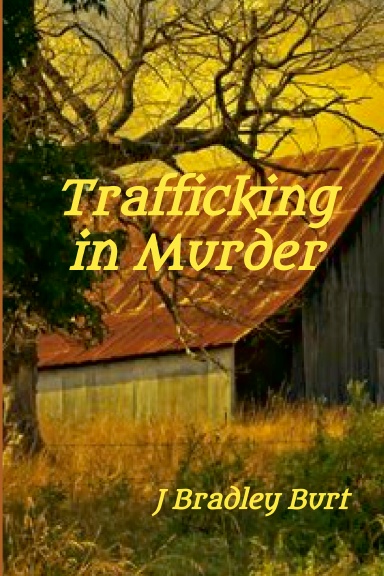
Two new books are on the horizon that you, as a regular (or even occasional) reader of this blog, are sure to enjoy.  The first is the twelfth novel in my crime-fiction series featuring two engaging, dynamic characters—Maggie Keiller and Derek Sloan.

Trafficking In Murder is set for release this coming fall, and it will take you on a similar tension-filled, as-it-happens journey that readers of the previous books in this mystery-thriller series have experienced.

The story is set against an all-too-true backdrop of human-trafficking—the smuggling and exploitation of vulnerable asylum-seekers hoping for a new life in Canada.

It all begins when an immigration Judge is attacked by an illegal refugee in her courtroom, and the violence spreads quickly into the community with assaults on innocent bystanders, a kidnapping scheme, and finally murder.

Because of their support for two innocent asylum-seekers embroiled in the turmoil that follows, Maggie and Derek become involved.   As events threaten to spiral out of control, they are drawn further into the local police investigation, which is tied into a broader investigation at the national level by the RCMP and Canadian Security Intelligence Services (CSIS).

Over a tumultuous two-week period, both Maggie and Derek are physically attacked, which only increases their determination to protect the people depending on them.  Working closely with retired and active police investigators, they work diligently to bring the evildoers to justice.

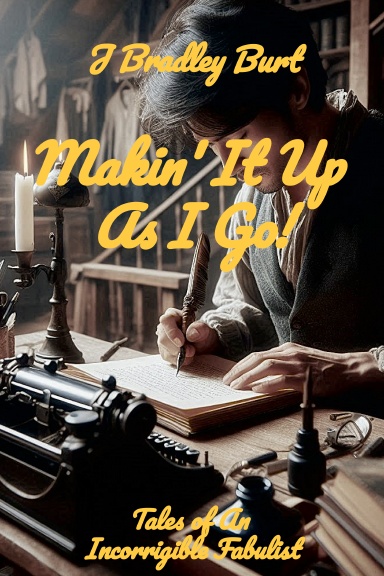
The second book on the horizon, Makin’ It Up As I Go: Tales of An Incorrigible Fabulist, is my tenth collection of short stories and poetry, all of them whimsical, humourous, or pointed in their outlook.  The book is scheduled to drop later this year or early in 2025.

The forty-plus tales are based on weekly prompts from my Florida writers’ group, the Pelican Pens, an eclectic gang of people who enjoy the creative outlet we share.  Four of our number have won awards from the Gulf Coast Writers Association for our work, and three of my winning pieces are included in this anthology.

If you enjoy reading the selections published here in TallandTrueTales, I know you will like both these books.  Once available, they may be found and purchased with all my other published works at this safe site—

https://www.lulu.com/spotlight/precept

Happy reading!

Alone Again!

[NOTE: IF THIS COMPLETE BLOG-POST LIES IN THE BODY OF AN EMAIL, CLICK ON THE TITLE TO READ IT IN ITS NATURAL ENVIRONMENT ON MY BLOG-SITE. IF ONLY A LINK IS PROVIDED IN THE EMAIL, CLICK ON THAT.]

Have you ever found yourself absolutely alone in a crowded room—at a family gathering, perhaps, or a business function, a party with friends, a community meeting?  It would seem hard to accomplish that when one is surrounded by so many people, but I manage it all the time.

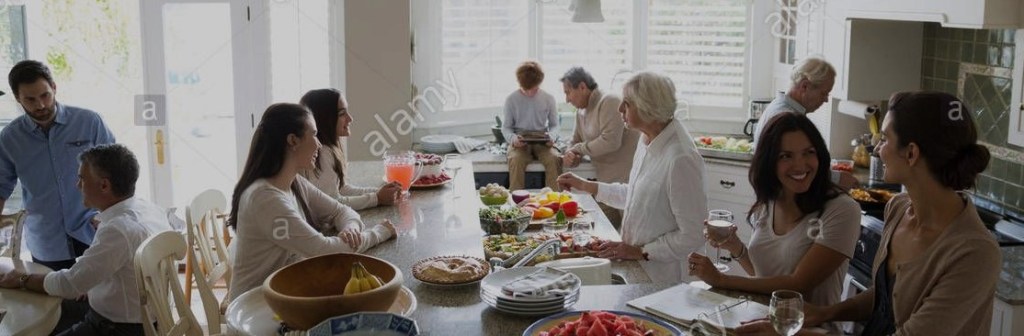
At a recent Mothers Day gathering with my two daughters, their husbands, my five grandchildren, two of their boyfriends, and my wife all in attendance, conversations were animated, exuberant, and loud.  I know, because there I was, perched on a stool around the large island in the middle of the kitchen (always our family’s favourite gathering place), surrounded by this multitude, yet strangely not involved in any of the conversations.  Nursing a glass of wine, I found myself eavesdropping on each different group in turn, quite interested in the latest news they all were sharing with one another about their work and school activities, yet not contributing a word myself.

But this is not a new phenomenon.  In fact, having become almost invisible on so many such occasions, I’m rarely even asked to contribute.

Over the years, I’ve often wondered if I’m naturally introverted, or maybe anti-social by nature.  From time to time, I’ve questioned my conversational skills or lack thereof.  I’ve even fallen prey every now and then to doubting my innate charm and charisma, and I’ve worried that perhaps no one holds me in high esteem.

Too many times, it seems, I’m at a restaurant with three or four couples, and I look up from my soup to find myself alone at our table.  I wonder if the others might be at the salad bar or in the washroom, perhaps—but all of them?  At the same time?

Or I might be at a dance, ten of us sharing a table, and I suddenly realize I’m sitting by myself again, while the others are up dancing or table-hopping.

The tedious jokes flow at these moments, naturally.  Seeing me alone, someone will ask in a loud voice if I’m dining tonight with all my friends.  Or someone will wonder if I said something to offend everyone in my party.

The problem is, I’ve never had an answer.

What I do know, however, is that I’m not one to blithely accept blame for my own perceived shortcomings.  I am a loving and capable person, after all—or so I want to believe—and I have choices.  For example, if people are ignoring me—or worse, don’t even realize I’m present—I can choose to consider it a flaw on their part, not mine.  The problem with that approach, however, is that many of them are people I love and admire, so it’s difficult to malign them, even secretly.

A better choice, I’ve discovered, is to adopt the stance that I am freely choosing to be alone in these various situations.  I’m doing it on purpose.  And why?  Well, because I’m a writer of fiction, and it’s a well-established fact that, to be effective, writers like me, who make stuff up, have to be keen observers of human nature.  After all, if we’re going to create believable characters out of whole cloth in our stories, we absolutely must possess a keen sense of what makes people tick in real life.  And the best way to do that, I’ve convinced myself, is by observing those around me, listening to them, getting a feel for them through what they do and what they say.

Interacting with people, I believe, is not good because I will inevitably corrupt the essence of who they are through my own conversational filters.  But by choosing to stand back, remaining aloof, I am better able to ascertain who they really are in their daily interactions.  They remain unblemished by any preconceived notions I might apply to them, and it is those untarnished attributes I will then bring to the creation of my own fictional characters, thereby improving the quality of my writing.

Or so I tell myself.

Nevertheless, I confess to a lingering and puzzling disappointment whenever I find myself alone again in large groups.  Recently, on the advice of someone I trust, I arranged to see a therapist renowned for helping folks like me.  My first appointment was yesterday, but to my surprise, it was a group-session—not something I had counted on.  After fetching the obligatory coffee, I took a seat in the circle and listened as each person in turn explained why he or she was there, what their last week had been like, how the others in their lives continued to let them down…and so forth and so on.  I found it fascinating, and was soon busy tapping notes surreptitiously into my phone.  I wasn’t sure that was allowed, but happily, no one seemed to notice what I was doing.

After an hour or so, I was fully-engrossed in reading over these notes, optimistic that I’d uncovered a gold-mine of observations I could use back at my writing-desk.  I looked up, eager to listen to whoever was next, and…well, you can probably imagine my shock when I discovered I was alone in the room.  The session had ended, the circle was broken, and no one had asked to hear from me.

Not knowing whether to laugh or cry, I chose the former.  These therapy sessions, I told myself, were going to prove a treasure-trove of inspiration for my writing.  And best of all, I was going to be able to gather whatever information I wanted with no one even knowing.  As in so many other instances, I was virtually invisible in the group.

No wonder I’m such a good writer!

Alone again! 

A Better Story

Can bad decisions lead to better stories?

Let us suppose for the purpose of crafting an entertaining story that your lead character’s dotty, old Aunt Hilda—whom he hasn’t seen in forty years, and who recently died at the impossibly-old age of 103—left him, her only heir, the sum of twenty-five million dollars, all in bearer-bonds, and twenty-five cats who shared her last abode.

Your protagonist is elated, of course, and only mildly sorry he hadn’t taken time to visit the old gal from time to time.  After placing the cats out for adoption and depositing one million of those dollars in his personal chequing account to cover immediate lifestyle changes, he now needs to decide how to properly invest and grow the remaining twenty-four million.

To whom does he turn for advice?

He could enlist the help of reliable, established bankers, investment counsellors, financial gurus, and market analysts, all of whom would be eager to serve.  He knows he could safely rely upon these learned and experienced people, whose profession it is to help other people make money—being handsomely reimbursed for their efforts, naturally.  Let us call this the elite option.

But if he has never considered himself an elite, he might decide to call on twenty-five of his closest friends who—in return for the chance to celebrate (and perhaps share in) his great, good fortune—tell him they will devise a sure-fire strategy to determine how he will invest the bulk of his new-found wealth.  That strategy, in order to be enacted, need only be approved by a simple, majority vote of 13–12, swayed perhaps by the most voluble, the most persuasive of the group, rather than by the most knowledgeable.  

Let us call this the populist option, and if your protagonist deems himself a man of the people, he might well choose this second course.

Or, let us suppose for the purpose of creating another entertaining story that your lead character has been recently diagnosed with a life-threatening illness, out of the blue, and that she has very little time to decide on the best medical option that might save her life—although there are no guarantees, of course, from any of them.

To whom does she turn for advice?

She could, in addition to talking with her loved ones, consult with her physician and the specialists to whom the physician refers her, all experts in their field.  Before choosing her treatment plan, she might seek second, third, even fourth opinions from people who have studied their entire lives to deal with critical situations such as hers.  Let us call this, again, the elite option.

But let us suppose again, if she does not reckon herself among the elite, she might gather together concerned family members and friends, all of whom love her and wish her only the best, to ask, by majority vote, which treatment plan they believe she should follow—the established medical option, a naturopathic or homeopathic approach, or maybe an experimental route (which might require travel to a foreign country for procedures not approved in her home and native land). 

Let us call this, again, the populist option, and if she fancies herself of the people, she might choose this second course.

In these examples (deliberately simplistic, I know), there are dilemmas confronting these two characters and the decisions they would have to make.  To whom would they turn in such critical situations, the elites or the populists?

The authors of such stories, too, face these same dilemmas, these same decisions.  Which path should they choose for their protagonists to follow in order to compel their readers to stay locked in to the story?  And will those decisions prove good or bad?

In one telling of the first example, the lucky heir to the twenty-five million dollars might turn to the wise counsel of the investment community, prosper as his fortune grows, and live in a cloistered castle to a ripe, old age.  End of story.

But in another telling, he might seek the advice of his friends, invest and lose his entire inheritance based on their advice, realize belatedly the error of his ways, embark on a driven quest to recoup his lost fortune, clash and joust with pillars of the financial community, rise and fall again and again, only to triumph at the end—a true Horatio Alger story.  Or perhaps, in a cruel twist of fate, he might lose it all yet again and die miserably in an abject state of poverty.

Only the author can decide.

In one telling of the second example, the stricken person might rely upon the medical establishment and, after a period of treatment and rehabilitation, survive to live a long and happy life.  End of story.

But in another telling, the person might turn to family and friends for a decision, choose unwisely, see her condition worsen unto the point of death, only to be miraculously saved by the last-minute intervention of a handsome, dedicated doctor who refuses to be rebuffed by quackery.  The patient’s health improves dramatically, she marries her saviour, and goes on to live well into her nineties.  Or perhaps, in a cruel twist of fate, she is assailed by a recurrence of her disease, against which she vies valiantly, time and again, only to succumb in the end—a true Shakespearian tragedy.

Only the author can decide.

In either example, which do you suppose might offer the more entertaining story, the first version or the second?  The authors make their decisions in the initial writing, of course, but in the end, it is the readers who decide if those decisions are good or bad.

So, can bad decisions lead to better stories?

You tell me.

On Thinking

The French philosopher, Rene Descartes, is remembered among other things for his thesis: I think, therefore I am.  The notion is most commonly expressed, not in French or English, but in Latin: Cogito, ergo sum.

His premise was not, as is widely believed, that he exists because he can think; rather, it is that he is aware he exists because he is able to think.  That assumption presupposes that so-called lower forms of animal life, being non-sentient as far as we know, exist without knowing they exist.

Descartes appears not to have considered the possibility that some humans may also exist without full awareness, largely because of their demonstrated inability or willingness to think rationally.  But I digress.

In conversation with other folks, I occasionally hear them offer their opinion by beginning with the phrase, So, I think to myself…  I find that phrase redundant, because I can contemplate no other way of thinking; by definition, all thinking is to oneself, is it not?  Unless, as some would have it, a person is thinking out loud, which strikes me as verbalizing, not thinking.  Better, I suggest, to think first, speak second.

But as a counterpoint to that, people might deem praiseworthy the ability some folks have to think on their feet—to offer an opinion, receive feedback, and modify that opinion, all in the course of one conversation.  That facility is admirable, I suppose, but it can happen, of course, only if they’re standing; if they were seated, they would surely be thinking…well, on their tush, right?  And somehow, blowing it out their…you know…doesn’t seem as impressive.

I’ve long thought of thinking as a fluid process, a constant progression, a multi-directional flow, rather than as a static, linear plod from point A to point B.  And if that is so, then a graphic tracing of my thinking pattern would appear, not as a straight line, but as a higgledy-piggledy, zig-zagging line—frequently interrupted and intercepted, but always arcing upward toward higher illumination, I would hope.

As a writer, it’s my thinking that takes me far from my physical surroundings, even to the point of forgetting all about time and place.  As I wrote in haiku verse some time ago—

my thoughts, unbridled,
take me to worlds I ne’er will see,
nor have ever seen

my boundless thoughts are
like hot air balloons, slipping
bonds that tie me down

I wander freely
throughout the universe, yet
never leave my chair

There are two adages on thinking that I try to hold to, at least presently, and they both grace the résumés and bios that appear on my online, social-media sites.  The first is, Certainty is the enemy of an open mind…I think.  And the second is, Don’t believe everything you think.  Regular readers of this blog will know whether or not I’m successful in living up to those.

Certainty plagues many people after they’ve thought a subject through—or even when they have not—and then adopt a position they think is accurate or true, and stubbornly cling to that opinion, come hell or high water.  But I think every opinion we hold should be subject to periodic, critical study, the more frequently the better, in order to test its validity in the face of facts and evidence that can change from time to time.  Being overly-certain about one’s opinion can stifle that sort of examination.

The irony with this adage, however, is that I can’t be certain it’s correct, for to be so would violate its basic premise.  Like every other opinion I hold, it requires my constant scrutiny…at least, I think it does.

The notion of believing everything we think, just because we think it, likewise can lead to cognitive stagnation.  In everyday interactions, our behaviours are governed by what we think we should say or do at any given time, and there’s nothing wrong with that.  Guidelines are preferable to social anarchy.  But if, for example, I believe it’s safe to jaywalk across a busy thoroughfare just because I think it’s safe, and if I persist in that belief, the consequences to me could be catastrophic.  Better, I think, to examine my thinking in the light of facts before committing it to belief-status.

The irony with this second adage is it presents a danger that one will never commit to believing in anything.  I think that, too, could present a problem.

For those who’ve read this far, let me finish with an anecdote about two people engaged in a mild argument over some inconsequential subject.  “So, is that what you really think?” the woman asks, a touch of incredulity tinging her tone.

“I don’t think!  I know!” the man replies smugly. 

With barely a pause, the woman smiles condescendingly and says, “You know what?  I don’t think you know, either.”

And that could well be the case for all of us.  Even when we think we know, even when we are absolutely certain of it, we still might be mistaken.  The wise carpenter’s advice—measure twice, cut once—could easily be adapted and applied to our thinking process: think, rethink, then act.

I’ve done just that in this post…I think.

What say you?

So Far, So Good!

I have a friend who claims his goal in life is to live forever.

“How’s it going so far?” I ask him.

“So far, so good!” he replies with a grin.

As I approach my eightieth year—having been alive for all or parts of nine different decades, the first being the 1940s—I don’t share that lofty goal, to be an eternal Methuselah.  I confess, though, my friend does have me wondering about my chances.  So far, I have lived out more years than three grandparents, three uncles, two of five aunts, and all four of my younger siblings (one of whom has already passed).

I’m currently the eldest of my surviving birth-clan, which includes three sisters, two daughters, and five grandchildren.  My wife, almost four years my junior (strictly speaking, not a birth-relative), is also with us.

If I am destined to live longer than anyone in my family so far, I’ll have to make it through another fifteen years, which will leave me just five shy of my centenary.  One grandmother made it to ninety, three aunts lived into their early-nineties, mostly intact, as did both my parents, so my genetic coding bodes well.

One goal I do have, perhaps more realistic than my friend’s, is to spend more years in retirement than I spent during my professional career.  I worked for thirty-two years and retired at fifty-five, leaving me eight years to go before attaining that goal when I reach eighty-eight.  So far, so good!

Back when I was a young thirty-ish man involved in several athletic pursuits, I used to joke that, if I had to die anytime soon, the best exit would come while sliding into third base, the game-winning run scoring ahead of me, with the last words I hear being the umpire bawling, “He’s safe!”

Older now, and less-inclined to make light of matters mortal, I’m pleased to say that goal was never realized.  I’m still alive, no longer playing ball, and so far, so good!

As an aside, one of my more ribald teammates claimed his goal—never one of mine—was to die in bed, shot to death by an irate husband.  To my knowledge, absent a willing bed-mate, he also never attained his dream.  But I digress.

Baseball is not the only pursuit I have forsaken as the years have mounted up.  Badminton, curling, cycling, golf, ice-hockey, in-line skating, and tennis are also sports I have abandoned in recent years.  The main reason, given that I wish I could still partake in all of them, is that I came to fear major physical damage if I should come a-cropper.  The risks began to outweigh the rewards, and I became determined not to end my life as an invalid. 

These sacrifices notwithstanding, I certainly had no wish to finish my time on earth as a couch-potato, either.  So, I still visit the gym to engage in low-impact activities such as rowing, weightlifting (low weights/high reps), and stretching exercises.  I walk the corridors and stairs of my high-rise condo, and I still swim, although not as many laps as once I could manage.  My goal is to stay active and limber, and so far, so good!

Paying attention to my personal health is a much greater priority now, too.  I still remember an occasion (again, in my feckless thirties), when I called my doctor’s office to make an appointment for a physical exam.  The receptionist couldn’t find my records for the longest time, and when she came back on the line, she said, “Okay, we’re good.  I found them in the dead file.”

“The dead file!” I exclaimed.  “What made you think I’d died?”

With a chuckle, she explained the dead file was the repository for records of patients who had not made an appointment during the previous five years.  Five years!  I was shocked to be informed it had been that long.

These days, of course, having lived into my ninth decade, I see my doctor much more regularly.  My goal is to stay ahead of ailments that might slow me down, or put a crimp in the comfortable lifestyle I now enjoy. 

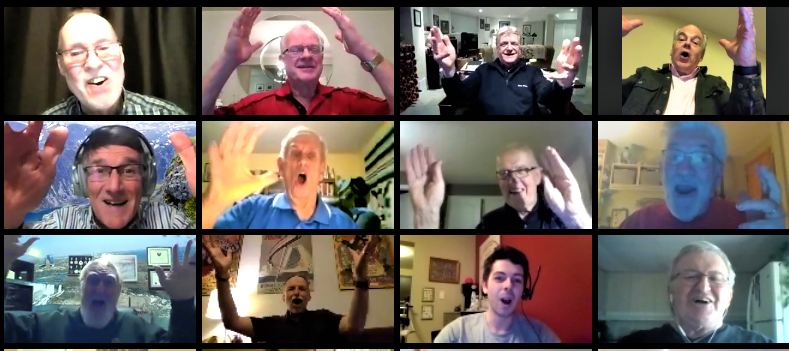
That current, comfortable existence includes singing in a men’s a cappella chorus, a most enjoyable experience, still part of a team.  It includes spending hours each day writing essays and poems for a regular blog, tales for a number of published anthologies, and stories for a series of published crime-fiction novels.  I’m having the time of my life right now, as a matter of fact, and hope I can go on doing these things for a long time to come.  So far, so good!

My wife and I are fortunate to be able to split our time between a home in Ontario and another in Florida.  Each autumn, and again each spring, as our time in one draws closer to its end, we begin to look forward to our return to the other.  Aside from the normal concerns associated with home-ownership, we find it’s an idyllic way to live, and we eagerly anticipate each change of the season. 

In the unlikely event it turns out my friend is able to realize his own goal to live forever, I know he’ll bid me a fond farewell when my time comes, as it surely will.

But you know what?  So far, so good! 

My Helping Tree

Here in Florida, the holiday season is full upon us with the advent of American Thanksgiving.  In keeping with the spirit of the occasion, I have set up my Wonderful Life Tree of Help once again, something I have been doing during every Christmas season since childhood. 

My helping tree is festooned with ornaments celebrating the many ways I have helped people throughout my life.  With all the modesty you have come to expect from me, I must tell you it is a magnificent display, and I am still adding to it.

Each ornament speaks to a person or group of folks whom I have helped along their way.  Some asked for my assistance, others were the unknowing beneficiaries of my kindness, and although things did not always pan out as intended, I’m pretty sure every one of them would have been appreciative of my good intentions.

Mind you, the ornaments are the reason I think that, as no one has ever actually bothered to thank me directly.

That aside, I have a beautiful ornament commemorating the first time I realized I had this compelling need to be of assistance to others.  In grade seven or eight, I saw two kids beating up another kid in the schoolyard, so I immediately stepped in to help.  The kid never had a chance against the three of us.

Another ornament celebrates the time I helped one of my friends who was really upset because, rather than kissing him during spin-the-bottle games, the girls always preferred to give him the nickel penalty and go on to the next boy.  I showed him how to open a bank account.

I have ornaments from my teenage years, too.  Once, when I was re-stocking shelves in a supermarket, a woman asked me which brand of toilet-tissue was best.  I was very helpful and told her on the whole, they’re all pretty good.

On another occasion, I was dragooned into helping my boss at a formal reception for his important suppliers.  My job was to stand at the entrance to the ballroom, like a doorman, and call the guests’ names as they arrived in all their finery.  They were quite astonished at the names I called them, and I awarded myself a beautiful ornament celebrating that occasion.  Lost my job, though.

Later, as a young married man, I was hiking a wilderness trail with my first wife when we saw a huge grizzly ahead of us in the path.  Although I knew I couldn’t outrun an angry bear, I was sure I could outrun my wife, so I told her I was going for help.  She’s not with me anymore, but there’s a lovely ornament on my helping tree to remember her by.

Around that same period, I offered two pieces of advice to a friend having marital troubles of his own.  With typical male smugness, I advised that the secret to a happy marriage was, first, to always let his wife think she was having her own way.  The second bit, I told him, was even more important—always let her have her own way.

Eventually, I became a father, and that’s when my propensity to help others really bloomed.  There’s a particularly lovely ornament on my tree marking the time I counselled a friend debating if he wanted to have children.  I reminded him of how he used to wonder why his parents were always in a bad mood.

I also have an ornament on my tree in honour of the time I told a particularly harried father that it’s not enough to put a loving note in his kids’ lunchboxes—he has to put food in there, too.

Lest you think I neglected my own parental responsibilities, let me assure you that I helped myself become a better parent by always finding out in advance what my daughters wanted to do, then advising them to do that exact same thing.  I earned so many ornaments for my tree by doing that simple thing.

– by Vickie Wade

All in all, my helping tree is a splendid sight, festooned with so many brilliant ornaments.  My favourite might be the one celebrating all the lost strangers who have asked me for directions over the years, directions I made up on the spot.  I wonder where they ever ended up?

Or perhaps it’s the ornament marking the time I helped my second wife with typing capital letters when she had her broken arm in a sling—I called it shift work.

Even now, at my advanced age, I find I’m still trying to help people, and I’m forever creating new ornaments to adorn my helping tree.  For example, I’ve lately been counselling aspiring writers who get frustrated when they run into blocks by telling them they’re not good enough to get mad.

More recently, I explained to a younger friend despairing about his lack of success in life that the two things holding him back are an abundance of witlessness and a justified dearth of confidence.  I’m not sure that cheered him, but I gave myself props for trying—and another ornament.

And just this morning, I earned my latest ornament by listening to a friend ramble on about his crackpot political leanings, then telling him I’d agree with him except that would make both of us wrong.

I confess it has become more difficult as I’ve gotten older to be of assistance to others.  I’m finding that most folks tend to look away when I approach, or even scurry away in unseemly haste.  To paraphrase Oscar Wilde, it seems I now bring happiness and support to people, not wherever I go, but whenever I go.

Nevertheless, I persist in my relentless efforts to help whomever I can.  And to that end, may I suggest to you, dear reader, that if you find my advice tiresome and irrelevant, just stop reading!

No, no, wait…I mean…

Time-Travel Time

As a response to the weekly prompt from my Florida writers’ group, to write about incongruity, I have penned this haiku verse to describe the joys and wonders of the writing process.

Haiku is poetry of Japanese origin, written in English as seventeen syllables in three lines of five, seven, and five. It is unusual to string a number of them together to form one poem as I have done here.

through time I travel 
unrestrained, unimpeded,
here at my keyboard

imagination
carries me from here to there
through tapping fingers

fixed by mortal coil
though I am, my mind runs free
through the universe

in tales tall and true,
from realm to realm I wander,
unfettered, unbound

never knowing where
my next destination is,
or where I shall land

my relentless muse
pushes and pulls me along
the paths she chooses

compelling me to
explore her capricious whims,
to write what she sees

telling her stories
discovered along the way---
prose and poesy

unable to quell
her relentless siren-call,
nor desiring to

I follow my muse---
yet, incongruously, I
never leave my chair

I Fixed ‘Em All!

An important objective for writers, so I’m told by those who are good at it, is to avoid clichés in one’s writing.  Clichés are used by a lot of us in normal discourse because they provide a verbal shorthand when we are engaging in conversation.  If our goal is to avoid confrontation when we want to express a strong opinion, for example, using a cliché can be just the ticket.

In writing, though, especially if we aspire to be original, clichés are to be avoided.

Clichés may be defined as: phrases or opinions that are overused and betray a lack of original thought; trite or stereotyped phrases or expressions; or expressions that have become overused to the point of losing their original meaning or effect, especially when at some earlier time they were considered meaningful.

As a means to improve my own writing, I have been attempting to purge it of clichés.  The best judge of my success will be my readers, of course, but here are some of the efforts I’ve made:

  • I’ve cleaned all the writing off the wall;
  • I’ve wiped up the spilt milk;
  • I’ve placed my eggs in two different containers in the fridge;
  • I’ve removed all the covers from my books;
  • I now make sure I’m reading on the lines;
  • I make sure my knickers are neatly folded; and
  • I don’t own a grindstone.

Thanks to my efforts, the characters I write about in my books no longer sleep on the wrong side of the bed, they’ve stopped circling back or leaning in, and I’ve made sure there is no thorn in their sides, no mote in their eyes.  They know that at the end of the day, it gets dark, but it’s not necessarily darkest just before the dawn.

Although many of my characters do drink, I make sure they never end up three sheets to the wind, nor do I allow them to put new wine into old bottles.  They know nothing smells like a rose, regardless of its name, although that conclusion was not something they would have jumped to without me.

In fact, because of me, they never jump at all—not down your throat, not in with both feet, not onto the bandwagon, and not with a hop and a skip.  Nor do they ever jump the gun, because that might give away the ending of the story.  Being my heroes, I never let them throw in a towel, grind an axe, bend over backwards, or get down and dirty.

I’ve worked hard to ensure my characters are neither brave enough nor stupid enough to grab a bull by its horns, burn a candle at both ends, bite a bullet, burn a bridge, or endure trial by fire.  Those things can bring a load of hurt! 

Instead, thanks to me, they are far more likely to avoid dealing with loose cannons, rocking anyone’s boat, barking up someone’s tree, sneezing at nothing, or opening a can of worms.  They are not lazy by any means, but they certainly would never work like a dog, attempt to leave no stone unturned, or go an extra mile (or even the whole nine yards).

In my books, I make sure the heroic characters are unafraid of their own shadows.  They are smart enough not to wait for cows to come home, they do not turn over random stones, they avoid yanking anyone else’s chain, they never get down and dirty, and they avoid anything resembling a plague.

So as you can see, dear reader—and it doesn’t go without saying—I have worked my fingers…well, not to the bone, I guess, to rid my writing of clichés.  For what it’s worth, push no longer comes to shove for me, nor do I ever consider going back to some mythical drawing-board.  Whenever I’m seized by an annoying urge to employ a cliché, I try to nip the urge…umm, somewhere other than in the bud, so to speak.  And in my proofreading, rather than attempting to weed them out, I simply expunge them.

In fairness to myself, I must point out that the struggle to eliminate clichés is a never-ending one.  I’ve discovered that being original in my writing is much more fun than being banal or hackneyed, but it’s ever so much harder. 

So in closing, let me just quote this piece of doggerel from an online commentator, a sentiment to which I heartily subscribe—

For what it’s worth,
At the end of the day,
It is what it is:
A cliché’s a cliché.

Metaphysically

During this pandemic lockdown in which we all are bound, it is all too easy to surrender to despair.  But, always, there are pathways to freedom we can find if we look hard enough.  Here are a few of mine, in haiku form—

physically bound,

but metaphysically

I wander freely

metaphysical 1

on wings of sweet song,

I rise above the earthbound

shackles of my life

singing 2b

my literary

scribblings whisk me to a world

that I alone know

writing 2

phantasmical dreams—

delights from which I awake

most reluctantly

dreams 2

omnipresent, too,

the love, which for sixty years

has sustained my soul

love 1

physically bound,

yes; metaphysically,

I am ever free

waiting-and-watching-a-sunset


By Myself

No one, I don’t think, would ever mistake me for a recluse, a loner, a solitary wayfarer along the road of life.  I am, generally speaking, among the Hail fellow, well-met! sorts of people, one who enjoys lively conversations and adventures with friends and family.

But I must admit, there do come those times when I like to get off the well-trod path and retreat into a little world of my own.  It may be that you, too, enjoy doing the same thing, so mine may not be a completely unique peccadillo.

However, the things I prefer to do when I’m by myself may be different from what others choose.  For me, the top three include riding my bicycle, playing my harmonicas, and writing all manner of things—poetry and prose, articles, blogs, and books.

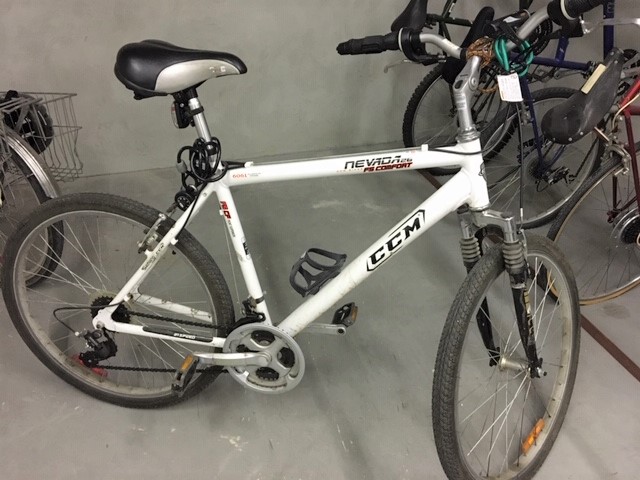
I got my first bike, brand-new, when I was ten years old—for forty dollars, of which my parents paid half.  Within a month, it was stolen!  I remember being outraged and heartbroken, both.  But the worst insult was learning that, if I wanted to replace it, I’d have to save up half the cost again.  Life seemed particularly unfair at that point.

I did it, though, and purchased an identical bike—maroon, coaster-brakes, a new lock.  During the next half-dozen years, until driving the family car became an option, riding my bike opened up new worlds for me.  I could ride forever, it seemed, miles further than I could ever have walked, in and out of places no larger vehicle could navigate.

That bike served as my horse when we were playing cowboys in the park; a motorcycle when we were playing drag-racers in the schoolyard (complete with stiff cardboard cut-outs clipped to the rear fork to make a loud, chattering noise as the spokes battered them); and a tow-truck to pull my cartload of newspapers on pre-dawn deliveries.  I loved my bicycle.

Different bikes over the years served me just as well, especially as a young father when one or the other of my wee daughters would ride in the seat attached behind me.  Up hills and down, my wife and I spent many hours cycling with our girls on their own bikes, well into their teenage years.
bike

Today, long into retirement, I still love to ride, mostly by myself now, able to go as slow or as fast as I like—or whatever my body dictates.  Lost in thought, I ride the roads, the trails, even cow-paths sometimes, marvelling at the changing surroundings, enjoying the peace and solitude.  It’s one of my favourite things to do by myself.

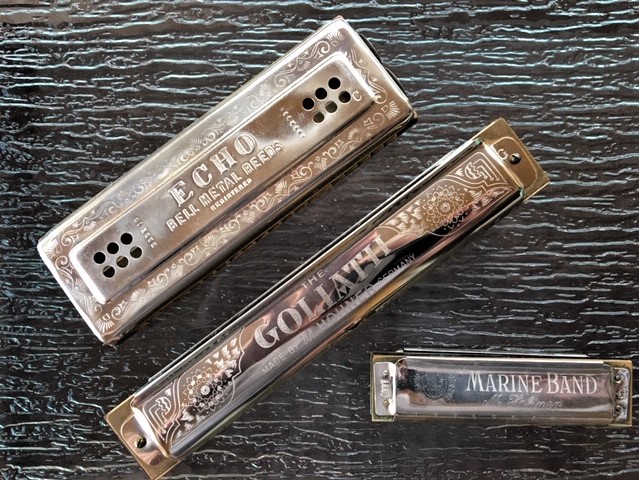
It’s the same when I play my harmonicas—my mouth organs, my harps.  I started playing when I was about the same age as when I got my first bike.  I remember asking Santa for a Hohner Marine Band, the small one, and was overjoyed to find it beside my stocking one Christmas morning.

I still have it, the very same one.  Some of the reeds are damaged, of course—that Christmas was about sixty-five years ago—but I’ll never let it go.  I still play recognizable songs on it (recognizable to me, at least), even if some of the notes are audible only to me.  Do you know O, Susanna?

Other harmonicas followed as time went on, all Hohners—a couple of which I still have.  They’re dented here and there, discoloured in spots, but the sound is almost as good as ever.  I spent many a frustrating hour trying to learn how to play a chromatic harmonica well, eventually resigning myself to an acceptance of mediocrity.  And I listened whenever I could to such giants of the instrument as Toots Thielemans, Little Walter, and Big Mama Thornton.
harmonicas

Abraham Lincoln reportedly said, Two of my favorite things are sitting on my front porch smoking a pipe of sweet hemp, and playing my Hohner harmonica.  I’ve done the very same thing many, many times—but not with Abe, and without the hemp.

I do it still today, usually when no one is home.  The music sounds as sweet to me while I’m playing as ever it did, but I’ve learned that, to the ears of others, it may not be quite as pleasurable.  And so, to spare them, playing the harmonica by myself is one of my favourite things to do.

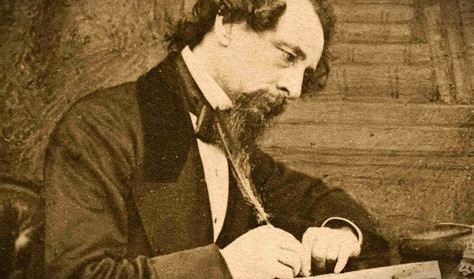
The third, of course, is writing—an example of which you’re reading right now.  Writing is, almost by definition, a solitary endeavour, even selfish, thanks to its exclusion of others and the distractions they bring.  Ideas spring into my head at any time, anywhere, even in the dead of night.  On more occasions than I care to remember, I’ve staggered to the keyboard in a pre-dawn darkness, so as not to lose the next brilliant idea.

Writing fiction is like playing God.  After something has been recorded in an early chapter, let us say, but then overtaken by a contrary (and better) idea in a later chapter, it is nothing to go back and erase the original draft, to revise the very history I’ve created.  I can change people’s names, their appearance, the things that happen to them, all at a whim.  It’s a form of omnipotence—albeit, very limited.

I usually write with music playing softly in my earbuds, almost always from the classical repertoire.  It serves to mask ambient noise from elsewhere in the house, focus my thoughts on the subject at hand, and free my imagination for long stretches at a time.  I wonder sometimes if Mozart might ever have envisioned this solitary writer listening to his symphonies and sonatas, creating a literary piece that has never existed before, just as he did with his music.

I know.  Probably not.

author2

But that doesn’t matter.  It’s the freedom and peace I enjoy, whether riding, making music, or writing.  I don’t believe I’d like being lonely; but I do appreciate having the opportunity to be alone now and then, able to engage in my favourite things.

By myself.