Testicle

One of my great preoccupations, as readers of this blog might assume, is playing with words.  Spending a couple of hours with the NY Times Sunday crossword is a regular part of my week.  Figuring out the theme of each one can be frustrating, of course, and I sometimes seek out help with individual squares or words.  But for the most part, I find it immensely entertaining and satisfying.

I have long been an aficionado of the iconic word game Scrabble—and in recent years, with the similar online game Words With Friends.  The first is played with the traditional board and tiles, which lends a pleasing tactile element to the game.  The second is played on the internet, sometimes with actual friends, other times with complete strangers.

My online handle is anagramps, coupled with a photo of a Mesopotamian oracle, to identify me to opponents.  The handle is intended to convey both my status as a grandpa, and my affinity for anagrams, an essential skill if one is to play the games successfully.

anagramps

The photo is meant to be intimidating.

There is a feature in the online game to allow players to converse with each other via messages, but in my experience, that doesn’t happen very often.  I’m sometimes tempted, when I’ve dropped a bombshell-word on an opponent, to type Sorry! with a rueful-looking emoji accompaniment (although I’m never actually sorry on those occasions).

rueful 2

Or, when my opponent has produced something similar against me, I occasionally have the urge to message a mock-angry Grrr!

I rarely do, however.  Mercy is seldom shown on either side.

Over the years, I have become quite good at these games (if I may be permitted so immodest a claim).  My winning percentage online is in the high .600’s, roughly double a high, major-league baseball batting average.  I fully expect to win each game I play—although, in the interests of full-disclosure, I must confess I sometimes sulk when I do not.

06_CP1453_GRUMPY-OLD-MAN

It’s not pretty, that, but there it is.

In my own defense, I never gloat when I win.  If it’s been a particularly close game, I often send a message of congratulations/condolences to my opponent, and a request for a return match.  When I’ve won by a wide margin, I wait diplomatically to see if my opponent wants to challenge me to another match.

There are a very few players out there who bedevil me, winning matches with annoying frequency.  One of those is my wife, another my daughter.  It seems they draw especially good, high-scoring tiles when we oppose one another (or so I tell myself).  Because the online game is based on algorithms, not random chance, I can occasionally convince myself the system is deliberately trying to take me down a peg or two.

My wife and daughter merely laugh.

It was with my wife, however—or rather, against her, and against her mother—that I had my greatest moment.  I, a callow youth of nineteen, assiduously courting the lass who would become my life-partner, was playing a game of Scrabble at their home.  Late in the game, I discovered a word I might play, using all seven letter-tiles, which would come with a fifty-point bonus.  Not only that, but because there was already a letter on the board in the lower, left-side column I planned to use (an S from one of their earlier words), I would be able to start and end my word on a triple-word square.  In my head, I totalled the score I was about to receive—558 points!  Oh!  My!  Stars!

There was a problem, though.  My future mother-in-law was still getting to know me, and I her.  This was a critical sizing-up period for me.  It was important that I not do anything to offend her, thus dooming my chances with her daughter.  I had to think long and hard about whether to use the word, for fear of blowing everything.

mother

The word was TESTICLE.

In the end, I seem to remember convincing myself that there were other girls in the world, but such a high-scoring opportunity might never come my way again!  I’m sure I didn’t really think that, but it’s how I tell it these many years later.

In any case, I played the word, trying mightily to be nonchalant.

“What’s that?” my mother-in-law-to-be said.  “Is that a word?”

Flustered by the questions, and fearing the loss of my points if the word was not deemed acceptable, I sputtered, “Yeah, of course.”

“What does it mean?” she said.

“What does it mean?” I repeated stupidly.

“Yes, what does it mean?”

I was too nonplussed in the moment to realize she was playing me.  “It means…it means…you know…the private parts of a man’s…you know…reproductive system.”  Sweat was beading on my forehead.

reproductive

And then she broke into laughter, joined quickly by my future wife.  “Okay,” she said, “as long as you know what it means.”

My immense relief and towering sense of accomplishment were short-lived, however.  The two of them told me the rules were clear—the fifty-point bonus for using all seven tiles had to be added after, not before, the point-total of the word was tripled and re-tripled.  Thus, my true total was 158, a colossal 400 short of my expectation.

But by then, I didn’t care.  My status with my future in-laws was preserved, I had managed to play my perhaps-once-in-a-lifetime word without forsaking my betrothed, and…oh, yes, I won that game.

Anyway, if you are a devotee of Words With Friends, and if you care for an online game sometime, look for me—anagramps.  I promise no R-rated words!

The Great Rivers

Rivers of all sizes have always beguiled me, captive on the shore, watching their waters flow endlessly past—waters bursting from far-distant sources upstream, rushing inexorably downstream to distant lakes and oceans.

As a boy, I sometimes wished I could float away on their currents to discover what lay beyond my sight.  And just as often, I wanted to journey against their flow, longing to view what those rivers had already seen.

Those daydreams were continually thwarted, however, by my greater desire to be home in time for supper.

The first great river I learned about was the mighty Mississippi, described so lovingly in the first two novels I ever read, written by Mark Twain—Tom Sawyer and Huckleberry Finn.  I think my first hero was Tom, although I couldn’t imagine getting into the scrapes he did.  But it was Huck—as fine a character as you’ll find in the literary canon—whose presence stayed with me as I morphed into adolescence.

It was the Mississippi, though, that I truly focused on, that immense receiver of waters from its many tributaries—including the Arkansas, Illinois, Missouri, Ohio, and Red Rivers, each collecting water from their own tributaries—draining more than forty percent of the continental USA into the Gulf of Mexico.  In my youthful imagination, it was a river of romance and song, a gateway to the future.

huckfinn 2

In time, I came to know of other great rivers, and snippets of their history:

  • the Nile, for example, and the tales of derring-do by British imperial forces at Khartoum that fired my imagination;
  • the Amazon, with its claims of pygmy head-hunters, and Theodore Roosevelt’s near-fatal trek on one of its tributaries, now named for him;
  • the Danube, so blue in my boy’s mind, the inspiration for one of the greatest Strauss waltzes;
  • the Yangtze, summoning images of the mysterious east, and Marco Polo’s exotic adventures;
  • the Ganges, that sacred river emptying into the Bay of Bengal, worshipped by devout Hindus as a goddess;
  • the Zambesi, which tumbles 108m at Victoria Falls, evoking heroic stories of Livingstone and Stanley in the darkest regions of Africa; and
  • the Volga, Europe’s longest river, conjuring romantic visions of Peter the Great and Catherine the Great, and their czarist empire at its height.

Given this rich history and my romanticizing of the world’s great rivers, imagine my shock when I read recently about what some of them are doing now to our environment.

According to a study completed in 2017 by the Helmholtz Center for Environmental Research in Leipzig, Germany, and first reported in Environmental Science & Technology, a peer-reviewed, scientific journal covering research in environmental policy, a staggering eight million metric tons of plastic pours into the world’s oceans every year.

Of that amount, several of the world’s great rivers are responsible for up to 2.75 million metric tons.  Ninety-three percent of that volume emanates from ten major rivers, all in Asia and Africa, including some of those mentioned above.  The Yangtze alone dumps as much as 1.5 million metric tons of plastic waste into the Yellow Sea.

Every.  Single.  Year.

plastic

Credit: Amanda Montañez; Source: “Export of Plastic Debris by Rivers into the Sea,” by Christian Schmidt et al., in Environmental Science & Technology, Vol. 51, No. 21

There are clean-up attempts underway, of course, and new technologies to assist them emerging all the time.  But is it already too late?  With the flow of waste only increasing around the world, can any effort match the magnitude of the task?

The so-called Great Pacific Garbage Patch has an estimated 1.8 trillion pieces of floating plastic, which by the end of last year had coalesced into a field of debris twice the size of Texas.  But that may be just the tip of the waste-berg, so to speak.

Micro-particles from plastics used in consumer products such as disposable bottles, packaging, and textiles have been found beneath the ocean’s surface, even in the Mariana Trench (estimated depth, 11,034 metres below sea level).  These particles are being consumed by animals on the lower end of the food-chain, which in turn are eaten by those higher up the chain—and eventually by humans, the apex predators at the very top.

According to a current World Wildlife Fund study, each of us is now inadvertently consuming about five grams of plastic a week on average, the equivalent of a credit card’s worth of plastic.

The cause of the problem does not lie with our great rivers, of course.  They are simply doing what they have always done—draining and flushing the land surrounding them, carrying the detritus out to sea.  It is the producers, consumers, and disposers of plastics who are at fault.  In a word, us!

ruined 3

But I must confess, I no longer look at rivers with the same romantic eye I did once upon a long time ago.

We have ruined them.

The Ins and Outs

Some friends were chatting recently in the park about the ins and outs of aging, a not-unusual activity for a group of greying septuagenarians, I suppose.  After listening for awhile, I excused myself from that rather depressing conversation, preoccupied by the thought that there seem to be far more ins than outs as one grows older.

Warming-the-Bones

It’s as if the in-words are in, and the out-words are out.  In roughly alphabetic order, I’ve identified some of those nasty in-things we were talking about.

The first was the inability to do many of the things we used to take for granted—running up the stairs, for example.  It’s more likely now that we’ll fall down those stairs.

There is the foreboding spectre of incontinence lurking, an affliction that has already befallen some of my comrades—leaving them, to their chagrin, in-diapers.

Ailments such as that—and others too numerous to count—can be the source of a profound sense of indignity unless one is possessed of a massive sense of self-worth.  We are lessened, somehow, when we lose our pride in self.  As we read in Ecclesiastes, Vanity of vanities, all is vanity!

With some of us (and I do concede for me, too), there can be a greater tendency toward infantile behaviour as we age, particularly when we don’t get our way—in a domestic disagreement, perhaps.  Whenever I discover I am moving in that direction, I try to remind myself that my wife is not my mother, and so I should abjure childish behaviour.

temper

That’s not always easy.

In many such situations, I find myself adopting a gratingly ingratiating manner in order to convert, or perhaps cajole, my wife to my way of thinking.  Prostrating myself, as it were, to attain my desires.

Hah!  Never happens.

So, when it doesn’t, and because I have fewer inhibitions now about my deportment, I occasionally fall into a visible funk, sink into a sulk, and refuse to talk further.  I just clam up.  But my silence, I’ve found, is always more appreciated by my wife than by me!

However, I am never so injudicious as to remain non-communicative for very long.  Dinner-time inevitably rolls around, and my wife—the head-chef to my sous-chef/clean-up guy—is long-past the stage of guessing what I’d like for supper.  If I don’t speak up, I could well be fasting ‘til dawn.

That possibility is at-all-costs to be avoided, for during the course of my seventy-plus years, I have learned that failure to eat leads my body to a virtually inoperative state, placing me indeed in-peril.

Despite all these puerile behaviours, I am quite a nice person (or so I’ve been led to believe by folks who are still my friends).  Therefore, I try not to present as insufferable to those around me, lest they will no longer be.

Intransigence on my part—on any subject, at any time—is more likely to lead to a parting of the ways with my friends than to any kumbaya coming-together.  So, I make every effort to remain amenable and open-minded.  It kills me sometimes.

lonely (1)

Perhaps the most difficult of the in-words as one ages is the realization that we risk becoming ever-more invisible—overlooked by the younger generations as they rush pell-mell through their daily routines.  No one ever wants to think (s)he has become unimportant in the world we still inhabit, but many of us come to fear it is so.

Anyway, the next time I’m chatting with those same greybeards whose conversation prompted these gloomy contemplations, I think I’ll try to present them with some out-words that might lend a more optimistic tone to our stage of life.

Words like—outgoing, outlaughing, outliving, outplaying, outspokenness, outstretching, outperforming, outworking.

And outrageous.  We greybeards need to be more outrageous.

We need more outs than ins!

Toot Your Roots

I was told once upon a time by a spinster great-aunt who disapproved of my adolescent exuberance (and, perhaps, my apparent irreverence for traditions she held close) that in our vast family-tree, with its roots stretching back to highland-hills across the sea, I was surely the sap running through the branches.  The sap!

I probably smiled gamely, unsure about the implications of the comparison, although doubtless certain I’d been disparaged.  But, interestingly enough, her comment did prompt me to find out more about my family-tree.

roots 3

That lady and her sister, my grandmother, were first-generation Scots-Presbyterian, born into a family of nine to an austere, eastern-Ontario farmer and his wife—my maternal great-grandparents, dead long before I appeared as a bud on the tree.

Sometime in the early 1900’s, my grandmother married a Catholic suitor with a French name, whose family had emigrated to Canada from Ireland.  From the time I first learned to speak, I was told not to address him as Grandpa or Grandfather, not Poppa or Gramps (my preferred sobriquet now with my own grandchildren), but instead by his first name.  So, I did.

This worthy couple had five children, my mother being second in line.  She—in concert with my father, of course—eventually had five children of her own.  One of her siblings had one child only, the others none at all, so I and my sibs grew up with one first-cousin on the maternal side of the family-tree.

My paternal grandparents—he born in Canada to English émigrés, she born in Canada to parents of Irish descent—had three children, only one of whom, my father, had children.  Thus, I had no first-cousins on that branch of the tree.

family 1

Interesting, at least to me, was the discovery that, after my grandfather had married my grandmother, his brother had wed her sister.  They also gave birth to three children, so my father and his two sisters grew up with three double-double-first-cousins—a somewhat unusual occurrence on a family-tree.

Long after my disapproving great-aunt had passed to greater glory, I married a young woman whose family had similar roots to mine—Irish, Scottish, and English.  My wife has three siblings, and two first-cousins.  Her sibs have produced five children who are first-cousins to our own two daughters.  Our girls also have ten first-cousins on my side of the family, the children of my sisters,  for a total of fifteen!

As I delved into the history of our family-tree, I learned about the nomenclature and relationship of cousins—considered complex by some, incomprehensible by others.  I think it’s straightforward, however, so let’s see if I can explain it simply.

cousinsThe children of my first-cousin are my first-cousins-once-removed, as are my children to her.  Her children are second-cousins to mine.  That pattern is repeated unto the third, fourth, and all subsequent generations of cousins.  Easy, no?
We are now at the stage in our extended family where second-cousins (great-nieces or -nephews to me) are just beginning to have children.  Eventually, I expect this will lead to multiple sets of third-cousins, most of whom (due to constraints of time and location) will probably never even meet one another.

Two generations on from me, two of my five grandchildren—each with her own maternal and paternal branches of a family-tree—have a total of five first-cousins from both sides of their family.  The other three of my grandchildren, likewise growing from two branches of a family-tree, have two first-cousins.  None of those cousins has, as yet, had children.

Years ago, a good friend of mine, an artist and out-of-the-box thinker, developed a prototype for what would today be marketed as a family-tree app, which he called Toot Your Roots.  It didn’t catch on, although the digitized world we live in now might make it a feasible product.  As I recall, it had spaces in which to enter surnames in flowing script as each new family-tree melded with the others.

roots 1

If I were to attempt entering those names today—back to the time of my great-grandparents, forward to my great-nieces and -nephews, including both my and my wife’s branches, and those of our daughters’ families, and the families of their cousins, and so forth—I confess I could not do it.  Not without a lot more research.

Even now, having benefited from the endeavours of like-minded extended-family members, I can list only twenty-five surnames.  Descending across the years, they are:  Burt, Thompson, Smythe, Duck, McKinnon, Roche, Colquhoun, Fife, Dunleavy, Eaton, Eckert, Cherry, Rowsell, Whittington, Wigglesworth, Lansi, Moss, Curtis, Sweezey, Tiller, Tucker, Dunn, Fiorino, Guthrie, and Grant.

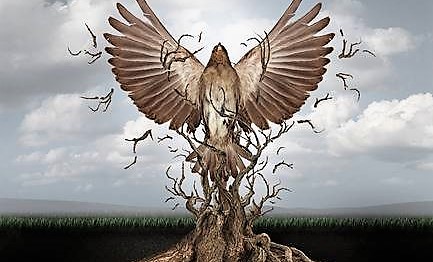
Given this partial list, and aware there are many more surnames I do not know, I envisage my family-tree looking like one of these—this dragon-blood tree on the island of Socotra (left), or this large banyan tree in Florida (right), one tree at root, despite its many appendages.


The thing is, I’m not sure where to look for myself on either of them.  My family-tree is just too vast, its roots and canopy too extended.

But I do know one thing for sure.  I am not the sap!

Being the Same

The highlight of the last spring-break holiday for two of our granddaughters was, unquestionably, a week-long visit from a friend of theirs.  They hadn’t seen each other since her family moved from their old neighbourhood more than two years ago, to one of the middle-east oil states where her parents are both employed.

Iraq oil facility AFP

The visit had been arranged months in advance—a period of time which passed like centuries, I’m sure, for our granddaughters.  During the weeks leading up to the arrival, the girls became quite concerned about something, and it simmered inside for a while.  Nana and I happened to be with them when they decided to talk about it.

“Gramps,” the youngest began, “do you think when Susie gets here, she’ll be just the same as she was?”

I tried to respond honestly, but without causing undue concern.

“No, I don’t think she’ll be exactly the way you remember her, because she’s been gone for quite awhile.  She’ll probably be a little different, just as you guys are a bit different than you were then.  You’re older now, you’ve experienced things without Susie, and all of that has changed who you used to be.  And remember, she’s had a whole lot of different experiences, too, since you last saw her.”

“But, Gramps,” declared the eldest, “I don’t want her to be different!  I want her to be the same!”

It’s an old dilemma, one I recognize from my own life.  I often find myself wishing something could be the same as it used to be.  Usually, it’s something nostalgic, and generally, I’m remembering it more fondly than I should.  The arc of the universe, for me, seems to curve towards rose-coloured glasses.

nostalgia 2

My memories frequently play tricks on me, and I tend to believe things were better way back when.  But in fact, I probably had more things to worry about, and not as many blessings to be thankful for, as I have at present.

“Why don’t you wait ‘til Susie gets here,” I suggested to our granddaughters, “and see for yourself if anything’s changed with her?  I bet you’ll find everything’s okay.”

Their apprehensive faces told me they weren’t feeling reassured, but they gamely accepted my counsel.

Well, the big day finally arrived.  According to their mother, our granddaughters’ worries seemed to evaporate in the heat of joy and excitement when they met Susie and her parents at the airport.  There was a good deal of kissing and hugging, some surreptitious sizing-up on the part of all three girls, and a great deal of nervous giggling.

Their first few hours together were spent asking and answering questions—the questions tumbling out almost more quickly than the ensuing answers.  My daughter told us later that, at first, the questions appeared to focus on similarities, the things the kids still had in common.  Only later, after these had been confirmed—a comfort level established—did the questions turn to what Susie’s new home was like, what was different about her school, and who her new friends were.

friends 2

By the second day, apparently, they were thick as thieves, just as they had always been.

The next time I saw our granddaughters, I asked how the visit had gone, and how they felt, now that they’d seen their old friend again.  I wondered aloud if they felt their fears had been warranted.

“You were right, Gramps,” the eldest replied.  “Susie was different than she used to be.  But she was sort of the same, too.”

“Yeah,” her sister chimed in.  “And she thought the two of us had changed, too.  But, that’s okay.”

“We figure it’s like this, Gramps,” the eldest said.  “Always being the same isn’t so important when you’re still friends.”

I liked that observation.  And I told them so.

friendship-day

I Won’t Go Back Again

On the day I visited Venice, the city was flooding—a precursor, I fear, of what is to come.  Some of the streets alongside the canals were underwater, deep enough that I couldn’t venture into them without rubber boots.

In the Piazza San Marco, the main square of the city, raised boardwalks had been erected to allow tourists to pass from one side to the other.  Outdoor cafes, their tables waiting for customers, were untended because they sat in several inches of water.  A few children romped and splashed in the accidental lake that covered much of the square, their squeals of delight piercing the general hubbub.


I wondered, sadly, how much longer tourists would be allowed to visit the legendary city.

I made a point of visiting the famed Rialto Bridge spanning the Grand Canal—to say I’d been there, of course, but also because my youngest daughter accepted a marriage proposal on that very spot several years ago.  I found it quite romantic, despite the crowds.

venice 10

Until, all of a sudden, it wasn’t!

I had stopped to take pictures at the top of a staircase from the bridge to the street below, when I was roughly jostled from behind.  I almost dropped my cellphone.

“Outta the way!” a voice growled.  “You’re blocking the way!”

The speaker, about my age, held the hand of a little girl, perhaps six or seven, and they started down the steps past me.

More out of surprise than belligerence, I said, “Yeah, I guess I am.  Too bad!”

The man stopped, turned, and came back towards me, the little girl drawn along.  Standing one or two stairs below, he had to look up as he spoke to me.  He appeared to be somewhat younger than I, but old enough that I assumed the child was his granddaughter.

“What did you say?” he demanded, his English accented but fluent.  And angry.

“I’m taking pictures,” I said.  “You should watch where you’re going.”

“You shouldn’t even be allowed to come here!” he exclaimed.  “You’re spoiling our city, all you people!”  He was quite excited by then.

“Why don’t you calm down?” I said, wondering where this was headed.  “Before you frighten your granddaughter.”  The little girl was clutching his hand tightly.

600-00038982

“I’ll calm down when I punch you in the nose,” he said, still looking up at me.

“You won’t do that,” I said, slipping my phone into my pocket, bracing, wondering if he would.

There was a momentary pause.

*  *  *  *  *  *  *

I say momentary because an awful lot of thoughts were flashing through my mind at that precise moment.

Who is this guy?

Why’s he so mad?

What if he takes a swing?

If he does, I’ll push him, and he’ll fall down the stairs.

Yeah, but what about the little girl?  What if she gets hurt?

And what if the police come?

How do I get into these messes?

*  *  *  *  *  *  *

The man apparently thought twice about it.  Turning away abruptly, he started down the stairs, the little girl in tow.  “We can’t even walk around our own city anymore,” he complained loudly, one arm gesticulating.  “All you people, you come here, you block the streets, you ruin everything.  You should stay home, stay wherever you come from…”

His voice faded away, and within seconds he and the little girl were swallowed up in the crowded street, lost to sight.  No one else seemed to have noticed the altercation.

venice 4

I was shaken, of course, although convinced I had done nothing wrong.  After a few minutes, I resumed my walking tour of the remarkable city.

Later that evening, reflecting over a glass of wine, I wondered if the man’s anger was not so much with me, as with the fact that I was but one of hordes of tourists overrunning his city, even as the marshy land it sits on sinks into the sea.  In fact, more than 30 million people visit Venice each year, a city with a population of approximately 50,000 souls.

In his anger, I heard echoes of complaints from people in nations all over the world—people opposed to the influx of immigrants and asylum-seekers to their countries, people afraid their jobs will be taken, their culture destroyed, their language lost.  Their fear is real and their resentment palpable.  Politicians cater to it.

And I wondered if those same fears had been voiced, in vain, by the indigenous peoples whose homelands had been invaded by the rapacious colonizers who appeared on their shores four centuries ago.  

Plus ça change, plus c’est la même chose.

I’m awfully glad I visited Venice when I did, and I’m happy I stood where my daughter did almost twenty years ago when her beau proposed to her.  It is an indelible memory for us both.

venice 12

But I won’t go back again.

Odes of Joy

I would wager the family farm (if I owned one) that not one in ten of you, dear readers, will know the meaning of this acronym:  SPEBSQSA.

It stands for the original, and still official, name of the Barbershop Harmony Society (BHS), founded eighty-one years ago, in 1938.  Since that time, loads of odes of joy have rung out across the world as men and women of all persuasions have come together in harmony.

quartet

The acronym translates as: Society for the Preservation and Encouragement of Barbershop Quartet Singing in America.  Quartets still flourish, but barbershop singing has since expanded to include large choruses.

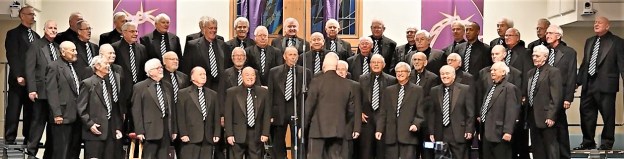
I mention this because a few years ago, a friend introduced me to the joys of singing in a men’s chorus—Harbourtown Sound, of Hamilton, Ontario.  Eighty-five men strong, HTS is a competition chorus that was ranked twenty-fourth in the world in 2018, out of more than a thousand barbershop choruses worldwide.

Harbourtown_2nd_Half Cropped(1)

The jubilant music the chorus produces can make the listener shiver with delight.

Just this past winter, that same friend invited me to join a second chorus—the Suncoast Statesmen, of Punta Gorda, Florida.  This great group, comprised almost equally of American stalwarts and Canadian snowbirds, is a performance chorus, eschewing the competitive experience in favour of a more relaxed approach.

snapshot2

Nevertheless, the music the chorus creates is both joyous and memorable.

I’ve written before in these pages about Harbourtown Sound, and one of those posts may be found at this safe link—

If you missed it, or even if you’d like to enjoy a reprise, check it out.  You’ll hear some wonderful music selections within the post.

The chorus, which this year is celebrating its fifteenth anniversary, will present its annual spring show, Making Great Music and Great Friends, on 12 May at the Burlington Performing Arts Centre.

The Suncoast Statesmen recently performed their annual spring show, Harmony Showcase, held in a large church in the area, before a sell-out crowd.  The chorus sang nine songs altogether, five in the first act, four in the second.  Between sets, a number of quartets and local high school student ensembles performed.

If you’re in the mood to hear some brilliant harmony, have a listen to these five songs, which may be found at this safe link—

Much has been written about the joys and benefits of singing, either alone or in an ensemble.  For me, it’s a little bit like rainfall—once it starts, it’s hard to stop.

choir2

Making Babies

“Gramps,” says she, almost absently, “you and Nana made babies, right?”

“Ahh, that’s right,” says I, a tad taken aback by her question—out of the blue from an early-teen granddaughter.  “Two of them, beautiful sisters.”

sisters

We’ve been sitting on a swing-chair in the lanai, each of us tapping on our phones, together yet apart.  I turn my attention from mine, but she is still engrossed in hers.

“Like Mum and Dad did with us, right?”

“Exactly,” I reply, wondering where this is going.  “Like they did for you and your sister.  But we did it first.”

She smiles to herself.  “Did you ever make babies with anybody else?”

I shake my head.  “No, the only one we made babies with was each other.  Your mum and aunt are the only babies we ever had.”

“Did you ever try with anybody else?”

Another shake of the head, this one to clear the surprise I’m feeling.  “Nope.  I didn’t want babies before I met Nana.”  I’m trying hard to answer the questions as asked, without offering anything extraneous.

“Was she your first girlfriend?”

“No, I went out with other girls before we met.  But she was my last girlfriend,” I say with a chuckle.

steady

Eyes and thumbs still on her phone, she smiles at that.  “How did you guys know you were the ones you wanted to make babies with?”

I pause, gazing skyward, taking myself more than fifty years back.  “Well, I guess it was because we sort of clicked right off the bat.  After going out with her a couple of times, I didn’t really want to date anyone else.  Lucky for me, she felt the same way.”

“Yeah, but how did you know that?”

I laugh quietly again, buying time.  “I’m not sure we really did know, not right away.  I think it was something that grew slowly, the more time we spent together.”

“And that didn’t happen with any other girlfriends?”

I shake my head yet again.  “It was different with Nana.  She had a wonderful smile, and I guess she liked mine.”  I flash her a Cheshire grin for effect.  “We both loved sports and played a lot of them, so that helped.  Plus, we knew a lot of the same friends.  After a while, we just didn’t want to be with anyone else.  And before we knew it, we figured out we were in love.”

 “But you didn’t try to make babies?”

“Okay,” I say, screwing up my courage, “you know how babies are made, right?  Sort of?”  I pray that she does.

conception

She nods and blushes slightly, looking at me now.

“Well, Nana and I both wanted to graduate from university, meaning we wouldn’t be able to get married for a few years.  Back in those days, most people didn’t have babies before they were married, and birth control—you know what that is, right?—wasn’t available the way it is today.”

“Lots of people have babies today without being married,” she says.

“They do,” I acknowledge.  “But think of the enormous responsibility that can be, being a mother or father of a baby.  It’s like a full-time job, so any plans you have for school or a working career could be delayed a long time.”

“You think it’s wrong to do that before you’re married?”

I pause again, thrust without warning into the role of a reluctant life-coach, caught unprepared for this conversation.  But not disposed to dodge it.

“So-o-o,” I venture, “I wouldn’t call it wrong or right in a moral sense, like a sin or anything.  Not if two people are sure they love each other.  But I do think making babies could be an unwise decision for them, depending upon the circumstances.  If two people consciously want to be parents, if they know what that will entail, and if they believe they’re equipped to raise a child, then at least they’re going into it with their eyes open.  But even then, I think there’s a problem with that logic.”

“Which is?” she says, all in now.

“In my limited experience,” I say, smiling self-deprecatingly, “making love with someone is an emotional act—as it should be probably.  But emotions can often push common-sense aside in those situations, so people might end up doing something that seems exactly right in the moment, only to realize in retrospect that it was exactly the wrong thing to have done.  And if their actions result in a baby coming along, the consequences of that one mistake can be life-altering.  Especially if they’re young.”

lovemaking3

She nods, brows furrowed.  “How many girlfriends did you have before Nana?”

I’m tempted to reply, jokingly, that the number was in the dozens, but her manner is quite intent now.  “Boy, that’s a long time ago,” I say.  “I think there were probably three or four girls I really liked before Nana.  We’d tell everybody we were going steady, meaning we couldn’t date anybody else.”

“But you did, though, right?”

“Yeah, eventually,” I concede.  “With all of them except Nana.  She’s the last girl I went steady with.”

“And the only one you made babies with,” she affirms.

“Yup.”

She leans close to plant a kiss on my whiskery cheek.  “Okay, Gramps.  Thanks for telling me about you and Nana.”

And off she goes, phone in hand—curiosity apparently satisfied—leaving me alone on the swing-chair in the lanai, wondering if I’d answered her questions wisely, thinking I might know the reason for them, and hoping her innate common-sense would prevail.

It’s all so long-ago for me, and so achingly right-now for her.

Those Were the Days

Let me list some life-threatening things that have befallen us, my wife and me, along our way together through these many years—

  • a head-on collision that totalled our car, from which we walked away shaken, scathed, but alive;
  • a diabolical attempt on our lives by an unhinged assailant, foiled only by the most fortunate of circumstances;
  • a last-minute, lifesaving operation in the wee dawn hours by a dedicated surgeon who removed my colon before the disease ravaging it could snuff me forever;
  • the onset of cancer, that most insidious of diseases—once for me, twice for her—held successfully at bay, so far, by equally dedicated doctors;
  • a severe lacunar stroke that struck her without warning, treated as quickly as possible, from which she has recovered to the point of resuming her tennis and golf endeavours.

OR2

It’s a grim list, to be sure, not one we enjoy recalling.  And yet, here we are, still alive, still able to remember each and every event.

Let me cite now another list, this one of life-altering blessings we have been allowed to experience together on our journey—

  • two amazing daughters and their loving husbands, who love and esteem us beyond what we deserve;
  • five loving grandchildren, only just awakening to the limitless possibilities dawning before them;
  • siblings, six in total now, whom we have known and loved for more years than seems possible;
  • fast and faithful friends, both new and old—as the children’s song says, the one silver, the other gold;
  • a beautiful home on a lake in Ontario, another on a freshwater pond in Florida, each a place of inspiration and respite;
  • a creative penchant that allows us the opportunity to craft things where there was nothing before—pottery and glass-sculpting for her, music and writing for me.

This is a much happier list than the first for so many reasons, the most important being that, where the first comprises things from our past—never to be revisited, we hope—the second embraces blessings we continue to enjoy.  And that enjoyment follows from a belief that, as Robert Browning wrote, …the best is yet to be.  Through the hardships, it is that belief that sustained us.

An old Russian folk-tune (for which English lyrics were composed several years ago) speaks to the reminiscences of people my age upon their vanished youth, and recalls their once-cherished romantic idealism—

Those were the days, my friend, / We thought they’d never end…

I’m happy to say that, so far, they haven’t.  We’re still singing and dancing.

days

Five Cousins

Longer ago than I care to think, the final one of our five grandchildren made her entrance into the family.  She joined an older sister and brother, and two cousins, both girls.  Because the five of them live close to each other in the same town, they’ve spent a lot of time together and have grown quite close.

Ranging in age from seventeen to eleven, Ainsley, David, Alana, Naomi, and Abbey were the subjects of a book I published some years ago, a collection of poetry for and about them.  Titled Five Cousins, the book spun tales of their adventures at the various stages of life they had by then attained.

3 Cousins cover

Each of them received a copy from me one long-ago Christmas—signed, of course, with a suitable inscription.  At the time, the younger ones enjoyed having the poems read to them more than reading them themselves, but either way, their peals of laughter warmed the author’s heart.

Each of them had a section of the book, titled with their name, containing half-a-dozen or so poems with such titles as:  Ainsley Starting School; It’s David’s Day; Alana’s in Florida; Oh, Naomi, You’re the One; and Little Abbey’s Walking Now.

Over the years, these five cousins have seen a good deal of us, their Nana and Grandpa, often at our retirement home in Florida.  In one of life’s everlasting mysteries, they have grown older by leaps and bounds each year, while we elders have hardly aged at all!

[pause for muffled snickers of disbelief from amused grandchildren]

Regardless, it is a fact that three of them are now taller than we are; the eldest is off to university this fall; the second one will join her next year; the next two are halfway through high school; the youngest will soon enter junior high; and every one of them eats gobs more than we do!

As they have grown, their lives have gravitated less toward us and more to their friends; their interests have shifted away from us to their myriad interests and activities; the time we spend with them now is less than it used to be.  They face their futures now, rather than focusing back on what has been.

IMG_3292

Happily for us, they visited us in Florida this year—perhaps for the last time all together, as their lives will increasingly take them along paths diverging from ours.

That is natural, of course, and as it should be.  But their inexorable journey to their own destiny has me thinking I must write another collection of poems about them, and for them, before they leave the sanctuary of childhood for the last time.

I could do it for each of them separately, beginning with the eldest, and follow up for each succeeding one as they reach the age she is now.  Or I could do it as I did the first time, with poems about all of them, suitable to the stage each finds her- or himself at right now.

I think I favour the second option, given my own age.  Time, I increasingly find, is not to be taken for granted.

Anyway, here are five short pieces I have already written about them, collectively rather than individually, in haiku form.  The poems attempt to express my love for these five cousins, my hopes for them, and my unabashed pride in them.

smiling photographs

on the refrigerator—

loving grandchildren

*  *  *  *  *  *  *

grandchildren, our hope

for the future—as we were

once upon a time

*  *  *  *  *  *  *

free your grandchildren,

hug them close, then let them go—

they’ll e’er be with you

*  *  *  *  *  *  *

more yesterdays now

than tomorrows, but it’s the

tomorrows that count

grandchildren

Five Cousins e-book – http://www.lulu.com/spotlight/precept