April

Geoffrey Chaucer, in the late 1300’s, wrote about April in his Canterbury Tales, praising its rains and warm winds for the restoration of life and fertility after the endless winter—

Whan that Aprille with his shoures soote/ The droghte of March hath perced to the roote…

But T. S. Eliot, another British poet, took quite a different view in 1922, in The Waste Land, where he savaged the month—

April is the cruellest month, breeding/ Lilacs out of the dead land, mixing/ Memory and desire, stirring/ Dull roots with spring rain…

The same month, two opposing points of view, left to the reader to determine which is the most apt.

My own outlook varies from time to time, depending, I suppose, upon my mood, the weather, and the company I keep.  I have often longed for the coming of April with its showers sweet, its promise of spring, only to be disappointed by its refusal to let go of winter.

Poetry is one means I employ to give voice to my feelings, sometimes optimistic, full of hope, and other times doubtful and despairing.  I find the Japanese haiku form especially appropriate—three lines of five, seven, and five syllables, respectively—to convey my conflicted state of mind.

By way of example, here are five haiku I have written dealing with April, each with a picture in harmony with my outlook.  I, too, leave it to you, the reader, to decide which of my moods is being conveyed by each—

peekaboo

sun plays peekaboo,
dancing ‘cross the wint’ry lake—
heralding the spring

peekaboo

teasing

april is cruel—
so the poet says—teasing
us falsely with spring

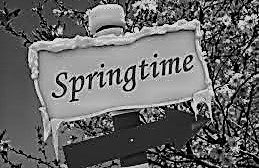
springtime

spring

joining in our walk,
tentatively, yet warmly—
sweet spring has returned

pring walk2

april fool

april can’t fool me,
that false harbinger of spring—
may is the gateway

rainy april

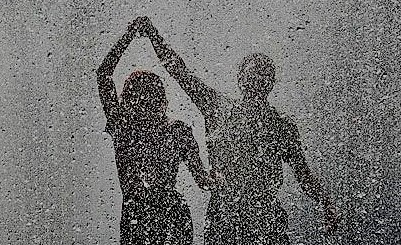
in the rain

dancing in the rain,
neither of us wet or cold—
warmly wrapped in love

in the rain

May the spring blossom anew for you…..in April, or whenever it arrives!


Where’s Your Winker?

When our eldest daughter was not yet four years old, we had a shared babysitting arrangement with the couple across the street from us.  Their young son would stay overnight with us when they were away, and they would reciprocate when we needed help.

At our place, we often put the two kids in the tub together at bedtime and watched them splash around for awhile before bathing them.  They were good pals, used to playing together, and the bathroom was always filled with squeals of delight and happy splashing.

two-little-kids-boys-playing-together-bathtub-happy-siblings-twins-children-water-taking-bath-home-kid-having-fun-80132107

We were surprised one evening, though, when the little boy had a new question for our daughter.  “Where’s your winker?” he asked.  We understood immediately what he was enquiring about (in all innocence), but she didn’t.

We had to stifle our laughter when she began scrunching up her face in an attempt to wink at him.  He kept asking, and she kept winking, first one eye, then the other.

I don’t recall now if he ever got an answer to his question, but what my wife and I realized was that his parents had chosen not to use anatomically-correct terms for his sexual body-parts, at least not at that age.  We had no problem with that—he was their son, after all—but we had deliberately opted to do it differently.

Unlike some of our friends, we began almost immediately with both our daughters to use correct terminology for all their body-parts.  Nose wasn’t sniffer, for example, nor hands feelers.  Their stomachs weren’t tubbies, nor their toes piggies—except in the nursery-rhyme they came to love.

In the same way, their anus wasn’t a poo-poo bum, and their urethral opening wasn’t a pee-hole.  A bowel movement was just that, or a BM, but never a shit.  And they always used a toilet, never a toidy—even when they had their own mini-version.

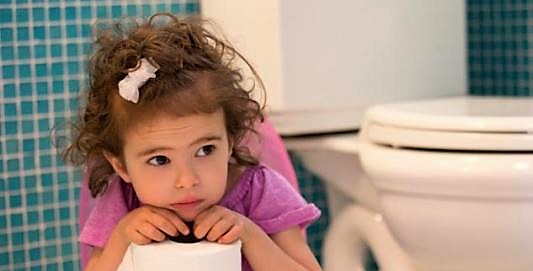
toilet-training

By the time both our daughters were in mid-elementary school, they knew the correct names, and were aware of the differences between female and male anatomies.  They knew, for instance that Daddy had a penis, but they and Mummy had vaginas instead; that all of us had breasts and nipples, but theirs, unlike mine, would grow larger as they got older; that pubic hair was normal for everyone beyond a certain age.

As time went on, as it became appropriate for them to know, they learned other terms, too—testicles, scrotum, clitoris, vulva—and were unembarrassed about them.  That was a critical point for us, that they would not giggle nervously, or be mortified to ask us, when they began to have questions about their burgeoning sexuality.

Even after a certain, respectful distance had developed between me and them as they matured into young women, they remained unafraid to engage both of us in their conversations on sexual matters.

Along the way, we tried to ensure they understood that certain body parts were private—whatever is covered by your bathing-suit, we told them.

We didn’t ignore the fact that people often use different terminology, however.  In order that our girls not appear unduly geeky to their friends, we made sure they knew about various slang-terms they might hear for female parts, even as we encouraged them not to use them.  Such terms included: vajayjay, muff, pussy, beaver, hooters, knockers, or jugs.  We wanted them to be, not shocked or judgmental when they heard these words, but aware and prepared.

619-06468194

The sex curriculum in schools today, at least in progressive districts, uses correct terminology.  In the jurisdiction we live in, the objective is to promote physical and emotional health and safety, wholesome relationships, and mutual respect among the learners.  The curriculum deals with such issues as:  stages of childhood development, naming body parts accurately, puberty, personal hygiene, the reproductive system, sexual orientation, choosing wisely about sexual activity, STD’s, pregnancy prevention, relationships and intimacy, consent and personal limits, and mental health.

Many parents today believe that schools are not the places where such instruction should be given.  The child’s parents should be the ones to do that, they say, and in the child’s home.  Some of our politicians, vying for election, are pandering to such folks by threatening to rescind the curriculum.

The problem with that, as I see it, is that too many parents would not provide their children with an adequate sex education—perhaps because it contradicts their beliefs, perhaps because they find it embarrassing, or perhaps because they, themselves, don’t know how.  But their children will learn of these things, regardless, and their instructors will be schoolmates, video-games, internet porn purveyors, or other unscrupulous parties.

girls-at-computer

How is that better for children?

And that is the question that should always be at the forefront.  Too often, we make decisions on behalf of children for reasons that are not in their best interest, but instead, to justify our own opinions and beliefs.

From the vantage point of a grandfather now, I can agree that home might be the best place for children to learn what they need to know about their sexual beings, just as I believed—and put into practice—when I was a young father.  But what of those homes where it will not happen, and what of the children who live in those homes?  Do they not deserve the opportunity to acquire the same knowledge, the same self-respect, the same appreciation of others’ circumstances granted to those in homes where the information is provided?

Do they not deserve the same opportunity to protect themselves and their bodies from those who would prey upon them?

My daughter still laughs when we recall the winker story, even though she doesn’t really remember the bathtub encounter.  But never once in their lives has either of our girls had to plead ignorance or embarrassment when conversations of a sexual nature have arisen among their friends.  They’ve always known the truth.

And now, thanks to their parenting, so do our grandchildren.

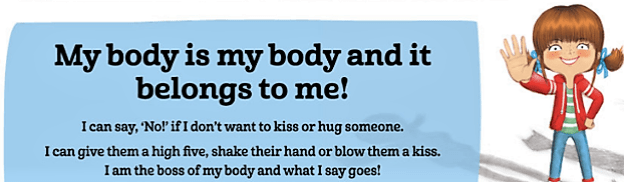
body-safety

Silly-gisms

The current occupant of the White House in Washington has stated on more than one occasion that Mexican immigrants are rapists and criminals.  If true, it would logically follow that, if your father was an immigrant from Mexico, he was, unarguably, a rapist and criminal.

This is an example of a faulty, nonsensical syllogism, an illogical construct I like to call a silly-gism.

A bona fide syllogism is defined as a formal argument in logic, comprised of two statements—a major and a minor premise—followed by a conclusion.  If the two statements are true, the conclusion must also be true.  Take this Socratic example: all women are mortal; my sister is a woman; therefore, my sister is mortal.  Or another: all daffodils are flowers; I am holding a daffodil; therefore, I am holding a flower.  Because both premises in each example are indisputably true, both examples are authentic Socratic syllogisms.

socrates3

However, if I were to alter that second example—all daffodils are flowers; I am holding a flower; therefore, I am holding a daffodil—the conclusion would not necessarily be true.  The flower I am holding might very well be a rose.

True syllogisms abound in literature, in public discourse, and in everyday conversations.  Alas, so, too, do false ones, the silly-gisms.

Some of these can sound almost logical, given our habit of reading with a non-critical eye.  To wit: all crows are black; the bird in my cage is black; therefore, I have a crow in my cage.  Or this one:  I ride a bicycle; I am a man; therefore, all men ride bicycles.

Silly-gisms are bandied about by all and sundry, particularly on social media, and especially when controversy surrounds them.  The problem, as I see it, is that far too many people fail to distinguish between what is truly logical and what is patently absurd, blindly accepting whatever they read as true.  Individuals who are untrained in critical thinking skills—who are used to being told what to do, say, and think—tend to accept what they hear or read from a source they trust.

Major news organizations report the facts accurately; Breitbart is one such major news organization; therefore, Breitbart is reporting the news accurately.  In this example, only the second premise is demonstrably true, so the conclusion cannot be relied upon.  Nevertheless, it is Breitbart reporting that provides many citizens their news, and it is amazing how many people buy it.

breitbart

The same might be said of other news disseminators (CNN, Fox News, the Wall Street Journal, the Toronto Star, et al) —that they pander to their audience’s predilections, aiming their reporting squarely at those who automatically believe anything that matches their preconceived opinions on a subject.  Except that, responsible news organizations deliberately present opposing points of views in their broadcasts and in their pages, striving for fair balance in these op-ed pieces.  The question is, how many viewers and readers actually take the time needed to explore alternative viewpoints?

Given the ubiquitous social media presence in our lives, and given the relative non-regulation of these online sources, it is scarcely surprising that so many of us get our daily dose of news from Facebook or Twitter.  And too often, that news is so unverified, uncorroborated, and unsubstantiated, that it might better be called un-news!

The real problem, as far as I am concerned, is not that these silly-gisms proliferate; rather, it is that they are deliberately broadcast and published by unscrupulous agents seeking to influence the public.  If I am repeatedly told by an automobile company, for example, that beautiful, young women are attracted to men who drive luxury cars, and if that becomes my primary reason for purchasing such a car, I may (more likely, will) be extremely disappointed with the result.  Nevertheless, no lasting harm is being done to anyone but me, and no one else is to blame for my lack of critical reflection before buying.  It is a matter of caveat emptor—the buyer must be wary.

model2

As the old saying has it:  Fool me once, shame on you; fool me twice, shame on me.

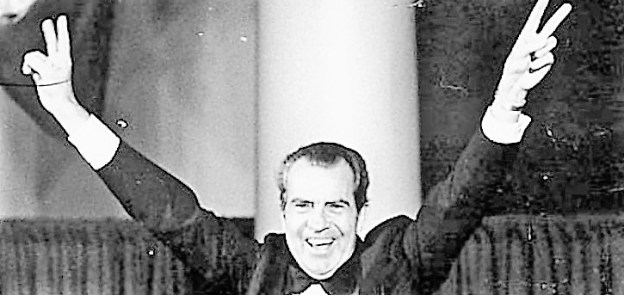
However, when the silly-gisms are widespread and malevolent, maliciously intended to mislead, great harm can be done.  Consider this blast from the past, before the advent of social media:  people elected to high office are above chicanery and corruption; Richard Nixon was elected U.S. president; therefore, Nixon was not a crook.  How did that work out?

But if Nixon were president today, how many people would choose to believe he was above reproach if they read it over and over again on media they trust?  Can anyone doubt that would be the message his acolytes would be spreading?

nixon2

Here is a silly-gism from the current president:  Our country used to be great; it is broken now, so badly that no one knows what to do; therefore, only I can fix it!

Only I can fix it!  How many times have we heard that mantra from his followers, and from media outlets that support him?  More importantly, how many of his country-men and -women believe it?  Do they have evidence to support his claim?  Do they even seek it?  Or, like lemmings to the sea, do they blindly follow the leader?

Here is another example:  governments derive their just powers from the consent of the governed; in the last presidential election, the people consented to be governed by this man; therefore, he has the mandate to fix it any way he sees fit.

Syllogism or silly-gism?  Time will tell, I suppose.

In the meantime, it behooves us all to try not to believe everything we are told.  For there is increasingly the distinct possibility that the people can, indeed, be fooled all the time.


1-800-GET-LOST

One of the most annoying things in life—ranking right up there with unsolicited calls from telemarketers—is having to call a service provider to report a problem.  No matter who it is, the cable provider, the bank, or the phone service itself, their customer-service department never seems able to take my call immediately.

I find myself pressing button after button in response to a robotic voice guiding me, supposedly helpfully, through a menu of confusing choices—when all I want is to talk to a live human being.  By the time I’m able to do that, sometimes as long as forty minutes later, I am yelling angrily, almost incoherently, at the person unlucky enough to have drawn me.

angry2

It bothers me because I resent being rendered inchoate.

So, out of frustration, and because I harbour a latent evil streak, I have recently begun to fight back.  But, like all good generals, I fight on a battlefield of my choosing—and that field is not when I have called them, only to end up stuck on IGNORE…or, as the service-providers call it, HOLD.

No, the ground I fight on is when they call me.  And believe me, they’re always calling—the cable service with a new package of channels they feel I won’t want to miss; the bank with an incredible savings opportunity, offering, for a limited time only, 0.05% with a minimum $5000 deposit; the duct-cleaners, promising they can rid my home of the nasty critters living in the HVAC system, poisoning the very air I breathe; the hucksters telling me in tones of barely-suppressed excitement that I’ve won a free trip to Hawaii, if I will first agree to attend an investment seminar.

call-center

They are omnipresent, these people, lurking on the other end of every solicitation call I receive.  But they have finally met their match in me.  Once I realize it’s a sales rep on the line, the ensuing conversation goes something like this—

REP:  Good afternoon, sir…

ME:  Excuse me, before you begin, would you prefer English, français, or Español?

REP:  Ahh, English please.  Are you…

ME:  Are you calling with regard to existing accounts, bill payment, customer service, technical assistance, sales, or some other service?

REP:  I’m calling to interest you in…

ME:  Okay, sales.  Before you go further, let me place you on HOLD for a brief moment.  I have someone on my other line, but I can assure you your call is important to me, so please don’t go away.

hold

I then go away for as long as two or three minutes, leaving the caller dangling on the line.  When I come back, if he or she is no longer there, I gently end the call.  On occasion, however, the unfortunate caller has chosen to wait, and so the conversation resumes.

ME:  With whom am I speaking, please?

REP:  Me?  Ahh, I’m Hector, and I’m calling to…

ME:  Before we continue, Hector, I have to inform you that this call is being recorded to ensure quality service and customer satisfaction.

REP:  Recorded?

ME:  Of course.

REP:  Sir, that is highly unusual…

ME:  Yes, I’m sure.  Also, I must ask you a couple of questions to confirm your identity.  What is the name of your firm, what is your employee number, and at what number may I reach you on a call-back?

REP:  Sir, we don’t give out that…

ME:  You don’t?  But you will ask for similar information from me, will you not?

REP:  Yes, of course, but that’s for your own…

ME:  Hector, I know you have something very important to tell me about, but before you do, I want to let you know about my brief survey.

REP:  Survey?

ME:  At the end of this call, when you’ve finished your sales pitch, I’m going to ask you five short questions, each of which will have a choice of three answers.  For each question, you will choose either A, B, or C, whichever best describes your experience on this call with me today.  Do you agree to take this survey?  Please answer yes or no.

REP:  [frustrated] Sir, I think we have a misunder…

frustrated call center man

ME:  [impatient] I’m sorry, Hector, was that a yes or a no?

REP:  [desperate] Sir, we don’t respond to…

ME:  [hectoring]  Ex-cuse me!  You do remember that this call is being recorded, right?  Is it not important to you that our conversation reflect a high level of satisfaction on my part?

REP:  [whimpering]  Sir, please, this is…

ME:  [pityingly]  Hector, do you know what number you’ve called?

REP:  [thoroughly cowed]  No, sir, I’ve called so many today…

ME:  [wickedly]  This is 1-800-GET-LOST.  Now, is there anything else I can help you with today?

REP:  ~click ~

My wife tells me this sort of curmudgeonly behaviour on my part is unbecoming a man of my supposed intelligence.  She tells me it’s unfair to take advantage of someone who is trying to earn an honest living.  And, somewhat reluctantly, I concede that she is, as usual, probably right.

Anyway, I’ve told her I’ll stop doing it after the next time I have to call in to a service provider for help with a problem, and I’ll stop immediately, but only on one condition—that I manage to get a real, live person on the line on my first try.

What are the chances, do you suppose?

on hold

Scratching My Back

As I creep up on my seventy-fifth birthday, somewhat apprehensively, I have discovered I can’t scratch my own back anymore.  It used to be that I could get at any itch, anywhere, with a few grunts and gyrations.  But now, my arms are no longer able to reach those remote regions where I itch the most.

backscratch

Over my shoulder, with either hand, I manage to get no more than one hand-span below my neck.  Pushing down on my overhead elbow with the other hand doesn’t help much; in fact, it usually brings on a muscle cramp.

Reaching behind to stretch a hand up from my waist isn’t any better.  The itch I’m itching to scratch is always just above my outstretched fingers, lying irritatingly in that band of skin that connects between my shoulder blades.

I’ve noticed other things, too, that I used to be able to do, none of which comes as easily anymore.  Getting out of bed in the morning, for instance, can sometimes be quite a chore.  My back might be aching, for example, though for what reason I’m unable to say.  Our mattress is comfortably firm, and relatively new.

On other days, my knees might be stiff, or my neck could be kinked.  This, despite the fact I sleep with a small pillow between my knees for proper alignment, and have tried the so-called natural-shape pillows.  Perhaps it’s my natural shape that’s misaligned.

elderly-man-sitting-on-bed

It seems on mornings like these—most mornings, in fact—I have to stand slowly, uncurling myself, moving ever so carefully, just to give everything a chance to jiggle and drop back into its accustomed place.  There isn’t any pain, really—although it hurts to hear the clicking and popping sounds my body makes.

Even on those days when there isn’t any discomfort, I find I’m exercising more than I used to—exercising more caution, that is.  I don’t run downstairs two-steps-at-a-time anymore.  In fact, I don’t even run up the stairs with the same reckless abandon I once displayed.  I’ve learned from experience that doing so now is just…well, reckless.  My toes seem to nick the edge of one of the steps at the most inopportune moment.

It strikes me as too ridiculous that I’m falling up the stairs!

There are other minor tasks, acts requiring only the simplest degree of motor coordination, that I can’t handle anymore, either.  Pulling on a sweater, for example, has become a major endeavour.  It seems a short time ago that it was a relatively smooth operation—both arms into the sleeves, up and over the head, then down around the waist.  Increasingly now, I seem to become trapped inside the sweater enfolding me like a cocoon, a helpless larva struggling to get free.  On more than one occasion, I’ve even had to call for help.

It’s the same with tying my shoelaces.  For more than seventy years, I’ve been tying bows with flair.  Lately, I fume and fumble with fingers that don’t seem to flex and follow my poor brain’s instructions.  I haven’t yet resorted to wearing shoes with velcro tabs, but I fear the day is nigh at hand.

And don’t get me started on buttonholes!

Once upon a not-so-long-ago time, I could read the smallest print while sitting in semi-darkness, and never feel the strain.  Now, even with the three-way lamp turned to its highest setting, I find the words are invariably out of focus—with my reading glasses on!  I’m forever leaning in closer to the page, or to the laptop screen, trying for a better angle.  It’s even become a problem in the bright, outdoor light!

KONICA MINOLTA DIGITAL CAMERA

Other changes abound, as well, both subtle and insidious.  I’d mention them here, but—most alarmingly, perhaps—I can’t always remember what they are; I forget things much more often than I used to.

At least, I think I do—when I remember to think about it at all.

Of course, I’ve tried out various measures to compensate for all these lapses.  For example, whenever something important is decided by my wife and me, I write little notes to myself so I won’t forget.  The trouble is, I often forget where I stored the notes.

I do try not to let myself become too upset by all these changes.  After all, one’s golden years are supposed to bring freedom from stress and anxiety.  Getting older is a natural process, and I remind myself of that repeatedly—repeatedly, because I usually don’t remember that I’ve already reminded myself.  Alas, there’s nothing to be done about that.

But fortunately, if I really try, I can look at it all as rather amusing.  It’s kind of fun, occasionally, to step outside my skin (figuratively speaking) and look at myself as an objective bystander might.

And what do I see?  I see a reluctantly-elderly gentleman, a grandfather, often bespectacled, striving to stay erect and trim, who, in his heart, wants to believe he still feels and acts like a young man, able to do all the things he used to do.

Problem is, he can’t remember how!

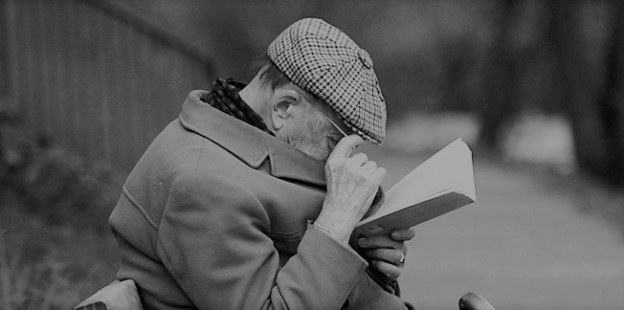
Anyway, if you’re out for a stroll in the park one day and chance to run into an old man sitting on a park bench, and if you notice he’s shimmying manically side to side, as if demented, please don’t be dismayed.  It’s probably just me, trying to scratch that infernal itch in the middle of my back!

Man sitting on a bench under a tree


Of the People

Ranking at or near the top of any list of definitions of democracy is this one from Abraham Lincoln:  …government of the people, by the people, for the people.

The phrase was part of his dedicatory remarks at the Soldiers’ National Cemetery in Gettysburg, Pennsylvania in 1863, when twenty-five states of the Union were locked in a great civil war against eleven states that had seceded to form the Confederacy.  It was a short speech, ten sentences in length, forever after regarded as a plea for true equality for all people of the American nation.

One problem with the definition, however, is that it also aptly described the government of the enemy, which was elected in 1861—presumably of the people, by the people, and for the people of the Confederate states.

flags-of-the-union-and-confederacy-vector-1460707

And complicating the case further, under both governments, almost without exception, only white males were deemed citizens with full voting rights.  Where was equality for all?

The lesson I take from this is that any definition of democracy is only as legitimate as the people who profess it.

No one anywhere ever said that democracy is a form of government imposed upon a people whose traditions run to the autocratic, totalitarian model, for that would betray the very notion espoused by Lincoln, that democracy is of the people—that is, arrived at through the exercise of their own free will.

Nevertheless, many nations have tried over hundreds of years to do that very thing, and many still do so today.  It rarely takes. Until those under the yoke of oppression decide of their own volition to rise up, to throw off that yoke, and to determine their own form of self-government—as it was with the signing of the Magna Carta—there will be no democracy for them.

magna-carta-signing_0

Look at it this way.  If you tell me that your objective is to help me learn how to think for myself, and if together we are successful, what will happen when you realize that my independent thinking leads me to a different end-point than yours leads you on substantive issues?  Will you applaud, despite our contrarian viewpoints?  Or will you seek to correct me, to bring my thinking in line with yours?

If the latter, you will likely succeed if you are more powerful than I.  But by forcing me back into your own thinking, will you not have failed in your original objective?

Democracy is like that.  If it is truly of the people, it almost certainly will not look the same in every society claiming to embrace it—because people, despite our biological similarities, are shaped by our environment, our experiences, our learning, and our culture.  And those are distinct from place to place to place.

flags-of-the-world-collection_1057-351

Even within one democracy—our own, for example, or that of the great republic of Lincoln—there are differences among the governed people.  Because majority rules in democratic elections, there will always be those happy with their government, and those in opposition.

Joseph de Maistre, a nineteenth-century writer and diplomat, wrote that, in every democracy, people get the government they deserve.  I suspect that is true, even more so today, given the woefully-low voter turnout in our elections.

He also wrote, …false opinions are like false money, struck first of all by guilty men and thereafter circulated by honest people who perpetuate the crime without knowing what they are doing.  In our democracy, we can choose what we want to believe, and we are free to espouse it.  Many of us, alas, have no idea of the origin or veracity of the so-called truths we champion.  We simply echo them, as if truth can be created through the repetition of a lie.

Being intellectually lazy, many of us choose to accept, with no critical reflection, what we are told by our democratically-elected leaders.  Or, if we don’t like the sound of that, we opt for what we are told by those who democratically oppose our leaders.  A few of us choose neither, opting instead to believe what we hear from demagogues and the lunatic fringe.

demagogue

And so, we find ourselves in a metaphorical darkness—facing each other in a circle of sorts, hunkered around the fire of our democracy—chanting our respective mantras back and forth, as if in a ritual war-dance, none of us listening to the other.  To those lurking in the dark, beyond the flickering light cast by the fire, our chants must sound like caterwauling—loud, nonsensical, and pointless.  And if those lurkers mean us harm, our brayings must also sound welcome.

In 1944, Winston Churchill said, …[the people] together decide what government, or…what form of government, they wish to have in their country.  When the people of any democracy, including our own, decide through their actions—through the exercise of their civic responsibilities, one of which is to become informed—the majority will rightfully have its way.

But we can also decide not to act, thereby abrogating our democratic opportunity to choose the government we prefer.  And when we do that, we leave the right to choose in the hands of others—others whose opinions and beliefs we may not agree with.  In that case, we have no right to bewail the government we end up with.

In the end, I suppose, it comes down to one simple truth.  If we are to get the government we deserve, we had better be sure we represent the sort of people we want to be choosing it.

voting


From My Aging Eyes

from my aging eyes,

the boy I once was looks out—

hardly changed at all

portrait-of-boy1

I was born before D-Day, before V-E Day, before V-J Day.  If you don’t recognize those occasions, you’re most likely younger than I.  World War II was the single biggest event in the lives of the generation before mine, and the year I entered the world, it was still raging on.

When I was born, I joined almost 2.5 billion other souls on the planet.  In North America, the average cost of a house like the one we eventually lived in was $3600, and the average annual wage was only $2000.  My future father-in-law, then a callow twenty-one-year-old, earned $800 that year, the first time he filed an income tax return.  A new car, for those who could afford one, cost about $900, and the gasoline to fuel it cost fifteen cents per gallon.  A bottle of Coca-Cola cost five cents.

1943_ford_coupe

Among the people born in the same year as I (and you’ll recognize their names more readily than mine) were Arthur Ashe, Robert de Niro, John Denver, Bobby Fischer, George Harrison, Mick Jagger, Janis Joplin, John Kerry, Billie Jean King, Peter Marsh, Jim Morrison, and Lech Walesa.  Seven of them are no longer with us.

Major world leaders included William Lyon Mackenzie King here in Canada, Winston Churchill, Adolf Hitler, Benito Mussolini, Franklin Roosevelt, Jan Christiaan Smuts, and Joseph Stalin—many of whom didn’t like each other at all.

Among the popular films my parents went to see in the year I was born were For Whom the Bell Tolls, Heaven Can Wait, Lassie Come Home, The Titanic, and the winner of the Academy Award, Mrs. Miniver.  Frank Sinatra and Glenn Miller were music icons of the day, and Oklahoma opened on Broadway.

oklahoma2

Some of the most popular books published that year included A Tree Grows in Brooklyn by Betty Smith, Being and Nothingness by Jean-Paul Sartre, The Little Prince by Antoine de Saint-Exupéry, The Fountainhead by Ayn Rand, The Ministry of Fear by Graham Greene, and Thirty Seconds Over Tokyo by Ted. A. Lawson.  My favourite (which, of course, I was not able to read until six or seven years later) was Thunderhead by Mary O’Hara.

The New York Yankees won the World Series that year, the Detroit Red Wings won the Stanley Cup, and Count Fleet won the Kentucky Derby, but both the U.S. Open in golf and Wimbledon in tennis were cancelled because of the war.

Invention, spurred on by the wartime effort, saw the development of the aqualung, the Colossus computer used to decode the German Enigma encryption, the ever-popular Slinky toy, and silly putty.  The Manhattan Project to develop the atomic bomb, which cost almost two billion dollars, was well underway.

atom bomb3

Nachos were invented the year I was born, and remain popular to this day.  The ABC radio network began broadcasting that year, launched by the founder of the Life-Savers candy company.  The Philip Morris tobacco company unveiled an ad that, for the first time, acknowledged smokers’ cough, although they blamed it on other cigarette brands.  The chairman of IBM conceded that “…there is a world market for maybe five computers.”  And a Swiss chemist discovered the hallucinogenic properties of LSD—presumably on a trip.

I was born well before the following technological marvels we take for granted today became commonplace:  duct tape, television, Tupperware, credit cards, waterproof diapers, transistors, defibrillators, supersonic aircraft, cat litter, the Zamboni, crash-test dummies, aerosol paint, teleprompters, airbags, barcodes, heart-lung machines, WD-40, zipper storage bags, automatic sliding doors, radar guns, computers, hard disk drives, silicon chips, videotape, lasers, spandex, artificial turf, the Pill, LED’s, Buffalo wings, 8-track tapes,  CD’s, space travel, personal computers, the internet, and smartphones.

I was not, however, born before the Wright brothers first took flight (as my sons-in-law are wont to claim).

brothers-wright3

But hey, lest this looking-back convey the impression that I long for the good old days, whatever they were, let me assure you that such is far from the truth.  In fact, as I approach my seventy-fifth birthday, I look forward to the changes yet to come—just as I marvelled at those occurring during my life so far—and with the same boyish enthusiasm as ever.

As Dylan so memorably wrote and sang, the times they are a-changin’.  But somewhere inside this gnarly old man, there still resides the precocious boy who spawned him, surprised he has not changed.

closing in on my

diamond jubilee, the

man is still the boy

man and boy1

          Have a happy birthday, old man!


Secret Valentine

(first posted 12 February 2016)

In a recent telephone conversation, one of my granddaughters reminded me that Valentine’s Day is coming round again.

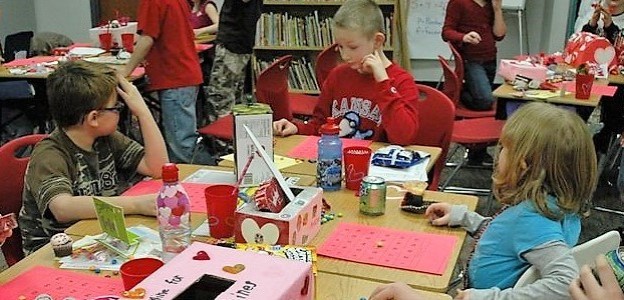
She didn’t ask if I would be her valentine again this year, as I have been for most of her six years, which would have been nice.  No, instead she mentioned that she’d be giving a valentine to every one of her classmates at school.

“Every one of them?” I exclaimed, mildly astonished.  “Don’t you have, like, one special valentine?”

“No, Gramps,” she replied.  “That’s not how it works.  In grade one, you give everybody a valentine.  All the kids do.”

galore_valentines_kids

I wondered how many youngsters there were in her class for whom she was planning to buy a valentine card.  After all, how many valentines can a six-year-old handle?

“How can one person have so many valentines? I protested.  “Being somebody’s valentine is supposed to be a special thing.  Won’t people wonder why you’re giving everyone a card?”

“Gramps! You don’t understand!  They won’t know who gave the valentines to them.  Mummy’s going to help me print ‘Guess Who?’ on all of them.  My name won’t be there.”

“Okay, wait a minute, l’il guy,” I said.  “Let me get this straight.  You’re going to give valentines to every kid in your class…”

“And my teacher,” she cut in.

“And your teacher,” I continued.  “But, you’re not going to put your name on them, so nobody will know that you gave them a valentine.  I don’t get it.”

“Oh, they’ll know, Gramps.  Everybody knows.  They just won’t know which valentine I gave them.  That’s the fun of it.”

That’s the fun of it?  Back when I was a kid, the fun of it was in deciding whom I would ask to be my special valentine.  To which little girl would I dare to offer a valentine card?  And who would accept it without laughing?  Or worse, not accept it at all?

shy boy

There was a certain delicious risk involved back then, a risk that made the whole exercise worthwhile.  After all, asking someone to be your special valentine meant you were sort of sweet on her (or him, if you were a girl).

But, times change, and so do valentine cards.  Now, they don’t ask someone to be your valentine; instead, they proclaim ‘Happy Valentine’s Day’!  They’ve become indistinguishable from birthday cards, for goodness’ sake.

Anyway, I wished my granddaughter well with her plans.  I harboured the faint hope that perhaps I’d still receive one from her—with her name on it!

Afterwards, I kept thinking about our conversation.  Anonymous valentine cards made no sense to me.  But, my granddaughter had stated, “They’ll know…”

Well, who’s to say?  Maybe they will.  It occurred to me that I’ve always sent anonymous, loving wishes to my own two daughters—back when they were growing up, and even now, as they raise their own children.  I never thought of that as silly.

good night

At night, after they were asleep, I had the habit of whispering in their ears, to tell them how much I loved them.  They hardly stirred as I did it, and they never mentioned it the following day.  And, every day now, when thoughts of them cross my mind, I still send little messages of love their way.  I always believed that, somehow, they would know I was telling them.  Anonymously, as it were.

So, maybe my wee granddaughter is right.  Perhaps it isn’t such a ridiculous notion.  In fact, I’m even hoping to receive a valentine this year from ‘Guess Who?’

I’ll know.

guess who

Write Lots

write, write, and rewrite—

write until it doesn’t sound

like writing at all

writing

Haiku is a very short form of Japanese poetry, altered over time to fit the demands of the English language.  The essence of haiku is represented by the juxtaposition of two images or ideas and a break between them, a kind of verbal punctuation mark that signals the separation, and colours the manner in which the juxtaposed elements are related.

Traditional haiku consist of seventeen syllables, rendered in English in three phrases of five, seven, and five syllables, respectively.  The lines usually do not rhyme, although many haiku composers try to rhyme the first and last phrases as an additional challenge.

A three-word haiku poem is extremely difficult, but a lot of fun to attempt.

Here are some more samples by me, a keen neophyte, accompanied by pictures for my own pleasure—

nightmares waken me,

phantom fears that something lurks—

banished by the dawn

IMG_1015

comes dawn, the new day,

rising full of hope unspoiled,

banishing the night

IMG_1411

shoulder to shoulder,

a capella voices raised—

united in song

IMG_1449

shore birds by the pond

visible in dawn’s first light—

stalking careless fish

IMG-7850

unrelentingly

under-appreciated—

mediocrity

mediocrity

And a final one—

write lots and often,

share most of it with readers—

prose and poetry

Creative-Writing-Tips-9918

Addressing Sexual Misconduct

Over the past several months, it appears the floodgates have opened on revelations of sexual misconduct, some reaching into the highest corridors of power.

But these are revelations only.  The actual offenses have been going on, largely unreported, for longer than any of us would care to admit.  And that makes it all the more important to take action whenever such allegations surface.

metoo

Some twenty years ago, during the last decade of my working career, I held three senior positions:  superintendent of personnel in a large school board, and then chief executive in two different school jurisdictions.  During that time, I had to deal with a dozen cases of reported sexual misconduct by employees.

The range of offenses included sexual harassment, sexual interference, sexual assault, solicitation of sexual favours, and the exploitation of students in the making and distribution of child pornography.

All the perpetrators were men, either teachers or business/operations employees.  Their victims included adults and children of both genders.  In all but two cases, those children were under the age of seventeen.

Of course, that number of offenders constituted but a tiny fraction of the total of dedicated and professional staff we employed.  But any number is too many.

64156147-sexual-assault-word-cloud-concept

Four of the situations resulted in criminal charges being laid against the wrongdoers by police, and all went to trial.  The remaining situations were dealt with internally, involving an array of sanctions ranging from formal reprimand to outright dismissal.  In two cases, after investigation by police and child welfare authorities, the accusers subsequently retracted their allegations and the accused parties were absolved—although with some collateral damage to their public reputation.

In all three jurisdictions we had clear policies in place to affirm the right of every student and every employee to a safe learning and work environment.  Those policies included a reporting mechanism available to any persons who felt they were victimized, or on whose behalf a report was made by a concerned third party.  They also spelt out procedures by which designated managers would shepherd each case to its conclusion.  In every case but two, proper procedures were followed.

Both those situations involved mistakes by two school principals (both of whom were acting in what they believed to be the best interests of their students, who were minors), who decided to investigate the reports of sexual misconduct themselves.  The policy clearly stated—in accordance with provincial law—that, in such situations, it is the duty of the responsible official to contact the police or child welfare authorities, who will handle the investigation.  The principals, whose performance records to that point were unsullied, erred badly.  They were subsequently charged, found guilty, and fined.  Duly reprimanded, they were eventually reinstated to their positions, presumably much the wiser.

One of the perpetrators in those two cases, a teacher, was subsequently cleared of wrongdoing.  The other, a custodian, was eventually charged by police and found guilty at trial.

The sexual harassment situations were investigated internally by my staff, and all parties were given the right to state their cases—although not face-to-face, unless the victims so chose.  In every case, the accused parties admitted to their actions, professed not to realize they had caused offense, expressed remorse, apologized, and vowed not to re-offend.  I issued formal, written reprimands to them and, following a suspension, they were also reinstated.  To my knowledge, there was no repeat of their behaviours.

mediation

In three of the criminal cases, one perpetrator pled guilty, two (a teacher and the aforementioned custodian) were found guilty at trial, and jail sentences were imposed on all of them.  In each case, the school board terminated their employment and I reported the two teachers’ names to the ministry of education, which revoked their teaching certificates.

The fourth criminal case was dismissed by the judge at trial, where he deemed the Crown had failed to prove its case under the law.  That teacher, however, was dismissed by the school board even before the trial, because we had sufficient evidence to determine that he had behaved unprofessionally, without regard for the welfare of the seventeen-year-old student with whom he had engaged in sexual relations.  Whether or not the criminal justice system regarded him as a predator who should not be near vulnerable young people, the school board certainly did.

I subsequently reported that case to the provincial college of teachers (which, by then, had taken over the professional disciplinary role from the ministry).  The college did not revoke the teacher’s certificate—perhaps because he had been found not guilty of a criminal offense.  Those are two decisions I disagree with to this day.

In the two cases where accusers recanted—after sensitive counseling sessions with child welfare authorities—the accused teachers were returned to duty after having been assigned to a central-office work-site during the investigations.  The publicity surrounding their cases, however, had the unfortunate result of leaving them unfairly tarred by the brush of public opinion.

In the wake of the recent spurt of allegations of sexual misconduct against prominent men—and based upon these experiences of mine—it strikes me that we must, indeed, pay attention to every accuser’s claims.  Yes, some may be spurious, some even outright false, but there is no question that such abuses do exist in our schools and workplaces.

victim

It seems to me, as well, that there is a difference between the exposure of such misbehaviours, with a concomitant imposition of suitable, punitive measures (call that the ethical bar, to protect the most vulnerable among us), and the higher standard required for criminal prosecution (call that the legal bar of guilt beyond a reasonable doubt).  Everyone is entitled to his or her day in court if charges are laid.  But sadly, some predators are never charged.

Even more importantly, everyone is entitled to personal safety in their schools and workplaces.  People in authority must listen and give a voice to those who feel abused and disempowered.  Under my watch, some perpetrators, even if not guilty of offenses under ‘black letter’ law, were indeed guilty of sexual misconduct.  And so, the employer had to act, even if the courts did not.

I’m not sure we did everything right in the situations I encountered those many years back.  Despite our best intentions, people got hurt.  But the one thing we did not do is ignore the pleas for help.

rape-victims

Nor should any of us now at this watershed moment in time.