Tracks in the Sand

One long-ago February, when winter’s white enveloped the north, one of our daughters came with her family to visit us in Florida.  The favourite activity for our grandson and granddaughter (the third of the clan being still an infant, unable to express her opinion) was going to the ocean, to the beach.

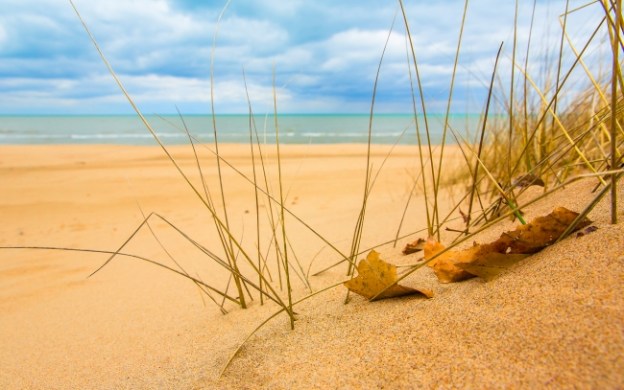
Our usual routines were fairly standard.  We’d park and unpack the car, each of us carrying the beach necessities according to our age and abilities.  We’d trudge the access path, through the dunes adorned with sea oats, pass through the rickety snow fence, and pick a spot that suited us all.

In short order, the umbrellas would be unfurled, the chairs unfolded, the blankets spread, and the toys strewn across the sand.  Peace would reign for Nana and Grandpa, watching the sleeping baby while her parents and older siblings hit the water.
beach-sand-grass-sunshine_tn2

On one such occasion, a small incident occurred which didn’t have much significance at the time.  In retrospect, however, it has become quite meaningful for me.

My daughter, my wife, and I embarked on a walk along the beach after the kids had finished splashing in the ocean.  Their dad stayed with them, helping build grand castles in the sand.

We decided to hike through the dunes on the way out, and come back along the shoreline.  I led off, sinking ankle-deep into the soft sand, feet clad in sandals to protect from the heat and the sandspurs.  After a few minutes, we came upon tracks in the sand, apparently made by some small creature, perhaps a mole.

What made the discovery unusual was that they suddenly stopped in a small depression in the sand, as if the mole had simply vanished.  The tracks ended without a trace.

My daughter suggested what might have happened.  The mole, she reckoned, had been taken by a predator, likely one of the falcons that frequent the area.  Indeed, on closer inspection, we could detect brush-marks in the sand, caused by the beating of a bird’s powerful wings.

We wended our way slowly, backtracking along the poor victim’s trail.  It occurred to me that, a scant few yards before the depression in the sand, the mole would have had no inkling it was about to die.  It was alive until it wasn’t.

Apparently, though, it knew it was under attack, for we found another, earlier depression in the sand where the bird had struck unsuccessfully.  The mole had jumped sideways, scurried under the protection of some sea-oats, then emerged again to flee along the sand.

Our backtracking ended when the trail curled away from the beach, into dense, long grasses, whence the mole had come.  We soon forgot about it as we continued our stroll, eventually heading back along the water’s edge to our grandchildren.

A few days later, I chanced to hear someone on the radio airily proclaiming that, if we all discovered the world was to end tomorrow, telephone lines everywhere would be jammed by people calling home to say all those things they had forgotten to say while there was still time.  Social media sites on the internet would crash from the traffic.  It made me think again of the mole whose tracks we had seen in the sand.

When it left its burrow for that final time, did it have its life in order?  Had it said all those things that matter to those who matter?  Or were there things it had left undone that should have been looked to sooner?

And I thought of myself.  Does my journey through life leave tracks in the sand for some other eye to see?  Am I subject to a mortal strike from some hidden foe?  And if, or when, it happens, am I prepared and at peace with those who care about me?

When I got right down to it, I didn’t see much difference between that mole and me.  Except one.  I’m still making tracks in the sand.  I still have time to ready myself for whatever is to come, and to be at peace with all who matter.

Such are the thoughts that arose as a result of a stroll along a sunny beach in Florida.

Fathers, Sons, and Trains

Again this year, I know I’ll receive warm hugs and kisses from my daughters in recognition of yet another Fathers’ Day, my forty-fifth such occasion.  It never grows old.

We dads grow old, however, despite our best efforts.  And in so doing, we lose our own fathers as they board the last train to glory, to borrow from Arlo Guthrie.  My dad departed the station more than a dozen years ago, but he remains with me almost daily in my thoughts.  And never more so than on Fathers’ Day.

When I was a young boy, he would often take me to local railroad crossings to watch the big steam locomotives and their endless caravans go storming by.  I treasured those occasions because I would have his undivided attention, a not-so-frequent circumstance in a family that eventually numbered five children.  He enjoyed the time with me, too, I’m sure; but he loved those trains even more than I, a boyhood fascination he never lost.  He was truly a railwayman, if only in his dreams.

https://s-media-cache-ak0.pinimg.com/736x/23/67/c0/2367c020ad92968a83fc8070d32a375d.jpg

Not once did it occur to me as a lad to ask him if his own father had taken him to see the trains, so caught up with the spectacle was I.  I’ve often wondered since if he might have been fondly recalling such times with his dad, even as he was standing beside his son.

At the time of his passing, I wrote these lines to commemorate what he meant to me, and they comfort me still—

The Railwayman

You’d take me down beside the rails to watch the trains go storming by,

And tell me all those wond’rous tales of engineers who sat on high,

In cabs of steel, and steam, and smoke; of firemen in their floppy hats,

The coal they’d move, the fires they’d stoke, as o’er the hills and ‘cross the flats

The locomotives huffed and steamed, their whistles blowing long and loud.

And one small boy, he stood and dreamed beside his daddy, tall and proud.

Terrifying monsters were they, bearing down upon us two, who

Felt their force on that steel highway, hearts a-racing—loving, true.

I’d almost flinch as on they came toward us, with their dragon-face

A-belching, spewing, throwing flame and steam and smoke o’er ev’ry place.

But you’d stand fast beside the track, and, oh! the spectacle was grand.

So, unafraid, I’d not step back, ‘cause you were there holding my hand.

Oh, Railwayman, oh, Railwayman, I’m glad you knew when you grew old,

How much I loved you—Dad, my friend, who shared with me your dreams untold.

Oh, Railwayman, oh, Railwayman, if I, beside you once again,

Could only stand safe in your hand, awaiting with you our next train.

Now, all aboard, Dad…all aboard!

Happy Fathers’ Day to all who, like me, are both fathers and sons.  We are blessed.


Mothers’ Day Again

Another Mothers’ Day has passed, the sixth since my own mother passed away.  The living mothers in my family number nineteen in all: my wife, two daughters, three sisters, two sisters-in-law, ten nieces, and one grand-niece.  All were recognized and honoured by their children, many on social media, and it was lovely to witness.

But I still miss being able to pay homage to my own mother each year—to hear her voice, see her smile, smell her perfume; and mostly, to feel her arms around me.  We knew each other for sixty-seven years, with nary a breach in the trust and love we shared, and my world is emptier without her.

On her ninetieth birthday, four years before she died, I wrote this poem to convey what she had meant to me for so long.  I likened her to a tree that sheltered me until I dared to strike out on my own, and even thereafter.

At the time, I thought I had written it for her; but now, I suspect, I wrote it for me.


Mum April 04

My Tree

For ninety years and more, my tree has spread her boughs across my yard,

Festooned with leaves providing shade, standing tall and proud, on guard.

When I was young, and climbed up high into my tree, carefree and fleet,

Her branches hugged me safe and close, held fast my hands, secured my feet.

As I grew braver, I would stray beyond the fence that kept me in.

But at day’s end, I’d rush back home to settle ‘neath my tree again.

Her boughs would gently bend and blow about my head, and whisper soft,

And tell me of the wide world they had seen from high aloft.

Sometimes she’d bend, tossed by storms that raged around us, blowing fierce,

Yet, ne’er a storm could match her strength, nor through her loving shelter pierce.

Then, all too quickly, I was gone to seek a new yard, far away.

Yet always I’d return to hug my tree, and feel her gentle sway.

Too big by then to climb once more her branches, high o’erhead,

I still found comfort there, among the fallen leaves my tree had shed.

 ~  ~  ~  ~  ~

Past ninety years, yet still she stands, her canopy now drooping low,

Creaking, bending, in the winds that shake her branches, to and fro.

As spring and summer fast have fled, and fall has turned her leaves to gold,

My tree displays a majesty that can be neither bought, nor sold.

And I’ll remember all my days her love, like ripples in a pond,

Because I’m sheltered now by younger trees—the seeds she spawned.

For ninety years and more, my tree has spread her loving boughs each day

Above my head, to nurture me, and gently send me on my way.

Love in the Morning

Sunlight,

Slowly streaming, peering, through tree branches

Seeming reaching up and out to touch it

And be touched.

Dark shadespots, never-lasting, shift on forest-run

And up the stretching trunks,

To dance ‘cross leaves turned up to see the sun.

Water,

Reflecting morning back to bluing sky

Above, from fiery diamond-dance of light

Atop the waves.

The lake awakes as light turns trees of green to gold

And traps their images

In mirrored mere, quicksilver, green and cold.

Mist,

Wet, wraithlike trails of dew that do not seek

The morn, but rather gather, clutched, and drift,

And look to hide

Until, discovered by the sun’s relentless rays,

Surrender to the light

That thrusts elusive phantoms from its gaze.

Breezes,

Approaching shyly, coming on to shore,

From jigging o’er the watertops and waves

That lap the land.

With sighs they softly rise to stir the trees awake,

Then us, through mesh that screens

The out from in, and stubborn sleep from wake.

I stir,

And lying on the bed in my repose,

With eyes still closed, I draw a morning breath

Into my soul.

And then, eyes opening to the world dawning anew,

I also turn to see the morning sun…

And it is you.

Life and Death

Just what is it that makes life worth living, anyway?  Is there a universal, one-size-fits-all answer, or is the answer situational, dependent upon the circumstances in which we each find ourselves?

And what might that answer be?  Is it happiness?  Good health?  Sex?  Wealth?  Perhaps the ultimate aphrodisiac, power?  Or some combination of these?

The existentialists among us might claim the answer is personal fulfilment, harmony with the world around us, inner peace.  Alone though we are, they might say, we are nevertheless connected to others, but on our own terms.

The religious among us might declare life’s significance arises from a meaningful relationship with one’s creator, in whatever form that creator might be rendered.  At this point in time, however, they seem unable to reconcile their competing visions with everyone else’s.

The afflicted and dispossessed peoples of the world might proclaim that life, being an endless procession of hunger, thirst, and terror, is not worth living at all.  And who is any of us, never having experienced their realities, to disagree?

But let us suppose, cheerfully, that everyone we know has found ample reason to live, to carry on, to survive.  In the face, sometimes, of personal tragedy, severe illness, serious setbacks of whatever ilk, they have persevered, even prospered, and gladly proclaim life to be the greatest gift of all.  They are, from all appearances, joyful, optimistic, and strong.

I recognize myself among this happy crew.  Wanting for none of the necessities of life, surrounded by family who love me, blessed with friends who are supportive and caring, I rise each day with a positive outlook, sure this blissful state will continue for years to come.  To state the obvious, life is to be lived.

So what do I make of the current debate swirling around us about a person’s right to an assisted death when the time comes?  How do I square my belief in the meaning of life with a possible wish to end that life at some point?  Are these two concepts even compatible?

For me, it comes down to a fundamental, primal instinct that life exists beyond this earthly planet we inhabit.  The vast universe in which we float is, itself, alive—a pulsating burst of energy, ever-expanding, interminably large.  And an infinitely small fragment of that energy, in whatever form it manifests itself, is what powers life in me.  It is my life-source.  Some, more religious than I, might call it a soul.

So when my time is up, as surely it will be someday, I take it as an article of faith that my spark of life will rejoin the universe from which it sprang—still alive, still burning, but in a vastly different form.

universe1

Comforted by this belief, I do not fear death’s inevitability.  I do, however, harbour apprehensions about the manner in which that death might transpire.  Having been blessed, so far, to live a life worth living, I have no wish to spend whatever number of months or years in a diminished state, waiting helplessly for my life-source to reattach itself to that whence it came.

Perhaps I shall die suddenly one fine day.  Here one moment, gone in the next instant, no assistance required.  Still alive in the universe, to be sure, but departed from this realm.  I’d be happy about that—but not too soon, of course.

Lingering on, however, past the stage where my mortal coil can function properly, holds no attraction.  So I have come to the conclusion that I should be allowed and empowered to facilitate the escape of my spark of life from my failing body, and set it once again on its eternal journey in the universe.

The true meaning of life for me, it turns out, is the power, not to end it, but to release it from a failing, earthly body—freeing it to roam, as the poet, W. B. Yeats, once wrote, “…among a cloud of stars.”