Brown Paper Bags

My wife and I will soon be off for our annual, six-month sojourn in Florida, where we will join with our American friends on Veterans Day, 11 November, to honor the women and men who have sacrificed themselves in defence of freedom. This poem, published here once before, is intended as an homage to those brave souls. It can be read silently, read aloud, or sung to the chorus of the old, Irish ballad, ‘Black Velvet Band’.

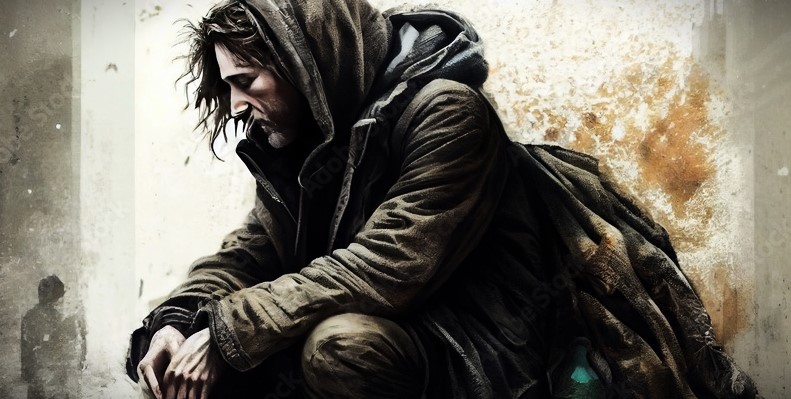
His hair hung down to his shoulders,
His shirt was a tattered old rag.
Faded chevrons adorned both his worn, torn sleeves,
And his hands clutched a brown paper bag.

Gunny was the name we all called him,
A veteran, ‘though he never did brag.
He’d wander the streets of the neighborhood,
Snatching sips from his brown paper bag.

His only true friend was old Jarhead,
A mongrel with no leash or tag.
When he died, he left Gunny alone again,
Alone with his brown paper bag.

We never saw Gunny get angry,
He was never a scold or a nag.
When we passed him by, he would nod a sad smile,
And drink from his brown paper bag.


In the summers we often would see him,
With the kit-bag that held all his swag,
On a park bench alone in the warm sunshine,
Holding tight to his brown paper bag.

Then last winter with snowstorms a-swirling,
And temperatures starting to sag,
Gunny died forlorn in the homeless camp,
He’d drunk his last brown paper bag.

When they opened his kit, they discovered
A folded American flag,
And a Congressional Medal of Honor,
Sealed tight in a brown paper bag.

They tried hard to find Gunny’s family,
But their efforts all hit a snag.
So, they buried him with full honors,
With his Medal and brown paper bag.

Gunny rests now with his fallen comrades
‘Neath a cross in a field filled with flags.
UNKNOWN BUT TO GOD and those warriors—
Free at last from those brown paper bags.

Semper Fi, Gunny!

Young Fella

Around the world, it’s variously known as Armistice Day or Remembrance Day, but stateside we call it Veterans Day.  It honours the memory of those who sacrificed their lives defending freedom, commemorating what was intended to be a lasting peace, signed at the eleventh hour of the eleventh day of the eleventh month in 1918.

I’m here today with almost a thousand of my fellow-vets for a luncheon to remember the fallen.  We’re gathered in a mess-hall similar to those we knew in long-ago days in far-away lands, but under happier circumstances now.  We range in age, I would guess, from mid-forties to late-eighties, drawn from the full military spectrum—dogface, swabbie, flyboy, grunt—jealously proud of our own branch of service, but united by our sworn allegiance to our nation.

Most of us are in uniform, some resplendent in dress whites or blues, others less splendid in khaki or camo fatigues.  But in nearly every case, the clothing strains to contain bodies once in fighting-trim, now overfed and flabby.  Insignias of rank and medals awarded adorn almost every uniform, but no one pays undue attention to either, having long ago taken them for granted.

What is never taken for granted, however, is the privilege of being here today, when so many of our former comrades cannot.  The cash-bar, which had opened an hour before lunch, had been well-used, and many a story of glory and despair had been shared over a pint or two, as has become the custom at our yearly gatherings.

The ample lunch buffet we finished before the speeches began was leagues better than the swill we’d all had to choke down in mess-halls similar to this one back in the day.  And even the speeches…well, let me just say, the speeches were a vast improvement over what we used to be subjected to from the brass in the field.  Today’s remarks from a few of our ranking members were more reflective, halting and poignant almost, as if we all knew this would be the last parade for many of our number.

We’re on our feet now for the national anthem, to be played by a band of eager, young cadets.  None of us sings it aloud, of course, as if to do so might constitute an unacceptable breach of discipline in the ranks.  But we know the words by heart. 

As we raise our arms in salute, a movement catches my eye at a table to my left.  An old soldier, a man I hadn’t noticed earlier, has struggled to his feet, is saluting with difficulty.  He’s dressed in an olive-drab tunic, too big now for his shrunken frame, a beret tucked under one of his epaulets, his blouse drooping from sagging shoulders.  I figure he has to be in his late-nineties at least.  His body sways as the anthem swells, and he trembles as if palsied.  I wonder why the men on either side of him, officers both, do not offer assistance, but they appear not to notice his distress.

I turn my attention back to the band at the front, unwilling to bear witness if the old man should fall.  When the anthem’s final notes die away, a lone bugler steps forward, a young woman immaculate in dress grays, and with divine precision, she raises the instrument to her lips to play The Last Post.

As its first plaintive, mournful notes sound forth, I turn to see if the old soldier is bearing up.  To my surprise, he is gone, and a much younger man stands in his place.  Clad similarly in olive-drabs, he is taller, stronger, more steadfast—a marked contrast to the older man who, I assume, had been assisted from his place at the table.  Unlike the rest of us, our arms still raised in salute, our chins held as high as we can bear, the younger man’s head is bowed, his right hand clasped to his heart.

When the bugler finishes, when the last horn has sounded, the room is suffused in silence for a few moments.  But then the slow hum of conversation begins again as people make ready to leave, and the air is filled with raucous laughter and shouted farewells.  As might be expected, our retreat is anything but militarily precise.  Rather, the withdrawal is hesitant, rambling, reluctant, each of us adopting a slow shuffle to delay our departure. 

On impulse, I detour on my way toward the door to walk behind the table where I’d seen those two soldiers.  All the place-name cards that had been propped on small stands on the table are gone, of course, purloined by their namesakes as souvenirs of another fine get-together—all save one, that is, the one I was hoping to find.  It sits right where the two soldiers had been standing, embossed in flowing script, black letters crisp against the white cardboard background.

Adjusting my glasses on my nose, I lean closer to find out who those men were.

HERE MAY SIT AN UNKNOWN SOLDIER
A FALLEN COMRADE KNOWN BUT TO GOD

I straighten slowly, breath seeping from my lungs as I realize the enormity of the vision I’d been privileged to see.  With all the strength and grace I can muster, I brace to full attention and salute the dead, as respectfully as I can manage in my aged state.

“Thank you, old man!” I whisper, tears stinging the backs of my eyes. 

But then, suddenly aware of my misunderstanding, I correct myself.  Not a single one of our unknown comrades had died as an old man.

“Thank you, young fella!” I say out loud this time.

And not until I am alone in the cavernous mess-hall do I lower my salute.

Ciao For Now

A recent prompt from my Florida writers’ group asked us to make up a story about a person whose time is running out. This is my make-believe offering—

In all the years I knew him, I never heard my father use the word goodbye.  Not to anyone, not ever.  At every point of farewell, he’d offer up a substitute or synonym for the word—Pip-pip!  So long!  Good night! Cheerio!  ‘Til next time!  Toodle-oo!  See you later!  Take care!

Occasionally, he’d venture a foreign language—Adieu!  Auf Wiedersehen!  Adios!  Sayonara!  Towards the end of his life, he came to favour Ciao for now!  But he’d never use the word goodbye, and I used to wonder why.

He tried to explain it once to a mildly-curious, teenaged son.  “The word is too permanent, that’s all.  It implies the end, the finish, that there’ll be nothing to follow.  I prefer to think I’ll be meeting the other person again.”  But I confess, I didn’t really see the difference, callow as I was.

Although born and raised in Canada, my father was an Oxonian—a graduate of Oxford University, Balliol College, class of 1932, a member of the rowing club—and among his lecturers were C.S. Lewis and the great J.R.R. Tolkien.  Gainfully employed back in Canada with a PhD in Literature, he was one of the earliest to enlist after Canada went to war in 1939.  He served as a medical orderly until demobbed in 1943, when he returned home in time for my birth.

“Despite our best efforts to save them, we lost a lot of good fellows,” he would reflect from time to time in his later years.  “We knew their time was running out, but I never said goodbye to any of them.  I wanted them to believe there was still more to come.”

Somewhere over there, with his comrades at Oxford or in the obscene battlefields, he learned a nonsensical, British ditty about farewells, not goodbyes, and he used to sing it to me and my siblings from time to time, usually when we balked at having to go to bed.  He was an enthusiastic, if somewhat undisciplined, singer, but we came to love that song.

Eventually, of course, the fateful day arrived, as it does for all of us, that my father’s own time was running out.  Home from hospital for the last time in the deep mid-winter, he was with my mother and their five children and our spouses—the ‘dirty dozen’, as we had long styled ourselves.  We all knew the end was nigh, though none acknowledged it, and small talk prevailed until my father raised a frail hand.  We waited, breath bated, and in a faltering voice between short gasps for breath, he sang that song one final time—his way of letting us know this was not goodbye.

Most of us, I suspect, did not believe that, but no one let on.

A few months later, when the frost had left the ground, we gathered again at the family’s burial plot for my father’s interment, joined this time by his grandchildren, his sister, his nieces and nephews, and a few cousins.  In keeping with his wishes, it was a simple ceremony, and two of us spoke on behalf of the group before his ashes were lowered into the grave by his eldest grandchildren.  And then we all stood around, staring awkwardly at the ground, as if reluctant to leave.

At that point, with an exquisite sense of timing, my younger brother stepped forward and began to sing our father’s farewell nonsense-song, his voice soft but firm.  Before he could finish the first line, all of us who knew it had joined in—a sad farewell, yet a joyous acknowledgment that this was not goodbye.

Pip! Pip! Toot-toot, Godspeed,
Toodle-oo, toodle-oo, toodle-oo,
Ta-ta, old bean, Ting-ting, old thing,
Chuckeroo, Chuckeroo, Chuckeroo!
This parting brings us sorrow,
We hate to say adieu,
So, we’ll say Ting-a-ling, old tin of fruit,
Cheerio, cheerio to you!

Now, within hailing-distance myself of the age at which he died, I think of my father often, and I hear that little ditty echoing in my mind, just as he sang it so many years ago.

Cheerio, Dad,” I murmur each time.  “Ciao for now!”

Who Counts?

[ ED. NOTE: If you are an official FOLLOWER of this blog, you are receiving my posts fully displayed in the body of the email notifying you of each new post. To read the post in my actual blog-site format, click on the title at the top of the story in your email, and you will find it a much more enjoyable experience.]

Like many of you, I suspect, I was raised by a mother generous in the love she gave, and wise in her ways.  My four siblings and I benefited greatly from her counsel, and agree to this day that she was right about almost everything.

Whenever I was angry with my brother or one of my sisters, for example, she would caution me, If you have nothing good to say, don’t say anything at all.

Many of our relatives in my mother’s large, extended family were gregarious, well-informed on most subjects, opinionated, and frequently argumentative, so holiday gatherings occasionally became loud and disputatious.  At such moments, my mother would advise me, Sometimes it’s better to say nothing, even if they might think you don’t understand, than to open your mouth and prove it.

Occasionally, I would arrive home from school with some juicy bit of gossip, and she would say, If your friends are talking about other people behind their backs, you can be sure they talk about you when you aren’t there.  And when I would nod as if I understood, she would add, It’s always best to stick up for people who aren’t there.

Decades later, I encountered that last advice again in a landmark book by Stephen Covey, who exhorted his readers: Defend those who are absent—one of my mantras to this day.

A good number of my mother’s admonitions were homespun, she having been raised by descendants of  Scots/Irish farming-stock who had emigrated to eastern Ontario in the mid-nineteenth century.  It’s a long road that has no turning, she would tell me when I’d recount a tale of woe, feeling sorry for myself.  If I’d had a quarrel with a schoolmate, she would say, The road to a friend’s house is never long.  Or if I was sad and blue when things weren’t going well, she’d tell me, When things are dark, try to be the light that someone else can turn on.

I think of my mother often these days, and I miss her wisdom.  I wonder what she’d have to say about this world we live in now, with all its strife and turmoil. 

No one in our family was ever subjugated by an invading people, exploited and dispossessed of our native land.  None of us has ever been despised and disenfranchised because of our nationality, our ethnicity, our skin-colour, our religious beliefs, our gender orientation, our political preferences, our wealth or lack of it, our age, or any perceived disability.  Throughout our lives, in fact, we have been among the privileged of the earth.

Such is not the case for the human species as a whole, however.  Worldwide, a huge number of people are victimized by war, famine, drought, disease, and genocide, some to the point of death.  And for many of those who survive, barely, there is scant relief offered by others of our species.

The product of a random, evolutionary progression over millennia, we human beings at our most primal level are forever a tribally-oriented species.  We seek to be with our own, and are suspicious of any who are different.  We are intelligent, yes, but also egocentric, selfish, aggressive, predatory, manipulative, superstitious, and too often unforgiving.  And because these character traits often override the intelligence factor, is it any wonder we currently find ourselves in such a mess?

Many of the several wars consuming the planet right now, for instance, are the result of clashes among opposing superstitious beliefs—what we sanctimoniously call religion—where each protagonist claims there is no god but our own.  And as if that doesn’t constitute folly enough, consider that many historic wars were waged by our predecessors who claimed allegiance to the same god, even as they prayed to that deity by different names. 

Such foolishness, when earthly power was truly the false god they all desired!

We humans have allowed ourselves—perhaps through a callous disregard for our collective well-being, or maybe due gross ignorance of the consequences we soon shall face—to approach a point of no return.  We seem not to realize that the civilization we profess to admire is but the thinnest of veneers, perched precariously atop the baser instincts of our species.

My mother used to say, The circle is not complete until everybody is inside.  We should always try to make the circle wider, so that everyone can come in.

Decades later, I chanced upon remarkably similar advice, this time in one of Michael Connelly’s crime-novels, spoken by one of his fictional characters, Harry Bosch:  Everybody counts, or nobody counts.

Would our current state of world-affairs be better, I wonder, if we humans could ever adopt that premise?  If we could set aside our preoccupation with the many issues differentiating and separating us, and instead take up the humanistic character-traits we share that might bring us together?

I mean, who counts?

For Always

A number of years ago, my grandchildren were visiting their Nana and me when November 11th rolled around.

“What’s ‘Membrance Day, Gramps?” the oldest asked.

Re-membrance Day,” I replied.  “It’s the day when we remember the soldiers who fought in the wars.”

“What are wars, Gramps?” the youngest asked.

I found it astounding, and heartbreaking, that they were still so innocent.  And I wished they could be so for always.

It was difficult to explain the premise of warfare to them—the sheer gall and hubris and stupidity of humankind in seeking to settle what are sometimes legitimate grievances by killing each other in remote fields of mud and gore.

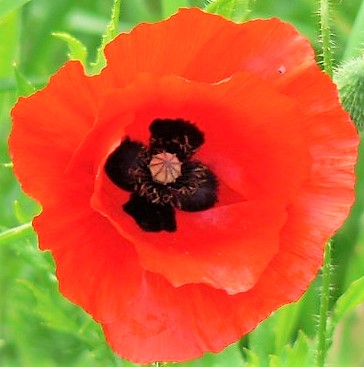
I couldn’t convey the sense of awe that washed over me, when I had stood years before in one of the cemeteries where poppies blow, between the crosses, row on row—scarcely able to believe the enormity of the carnage.  Nor could I explain to them how I was brought to tears by the simple inscription on too many of those markers—

Here Rests in Honored Glory, A Comrade in Arms, Known But To God

unknown soldier

Despite the fact that they couldn’t really understand, I told them we try now to remember the men and women who gave up their lives in defense of our country and its values, in all the wars in which our soldiers took part.

“Why do we hafta remember them?”

“Well, I guess it’s because we hope we won’t ever have to fight a war again,” I said.

Even as I talked about it, the thought occurred to me that the war with the most significance for me is one I don’t really remember at all.

My parents did, though.  For them, it was the war, one of the most significant events in their lives, an event that shaped many of their attitudes and beliefs forever.

My recollection of that war has come through them, formed as impressions and feelings, prompted by bits of memorabilia, by oft-repeated stories, or by the singing of wartime songs.

320px-Andrews

I have a picture in an old family album, a now-faded snapshot with large white borders and scalloped edges.  It was taken at Christmas time in my grandparents’ living room during the winter of ’44.  I’m in the picture, right in front on my mother’s lap, not yet two years old.  The whole family is gathered around us beside the Christmas tree.

My mother’s parents are there, and her three sisters.  Her sister-in-law and two of her cousins complete the group.  With the exception of my grandfather (and me, I suppose), there are no male persons in the picture…no sons, no brothers, no husbands.

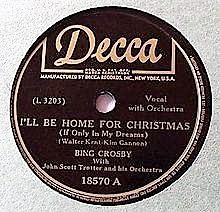
Whenever I look at it, I try to imagine what that Christmas must have been like for my family, most of them younger than my own children now.  I think about a song that became popular around that time, a young soldier’s promise that, “I’ll be home for Christmas…if only in my dreams.”

I'll_Be_Home_for_Christmas_Bing_Crosby


So, when my young grandchildren asked about Remembrance Day, I tried to convey those same feelings to them.  Not what war was really like, because I don’t know.  Rather, how I still feel when I hear that song at Christmas time, or when I look again at that old snapshot.

I told them about my aunt who married her beau mere days before he shipped out, and that they didn’t see each other again for more than three years.  How he met her brother—his new brother-in-law—for the first time while they were both stationed in England.

brothers

Not one of my family’s young soldiers was home for Christmas that year.  One of them, an uncle I might have grown to love, never did come home.

I remember hearing my parents talk of them long afterwards.  I’d hear words and phrases that prompted my recollections—words like wartime and overseas, or phrases such as V-E Day and killed in action.

“If Jimmy had come home from overseas,” they’d say, “he’d be almost eighty now.  Can you imagine!”

Together, they’d sit quietly, thinking back, I guess—remembering how it was.

I knew my grandchildren would not be able to comprehend a war that ended more than half a century before they were born, or even understand what their great-grandparents went through.  But, in hearing about it from me, I hoped they would develop some sense of the meaning of freedom and democracy, and of the sacrifices that were needed and made.

poppy

And I hoped that, once they knew, perhaps they’d understand why we remember.

For always.


The Supreme Power

Rudyard Kipling wrote these lines in 1902, the beginning to a small poem about his daughter:

I keep six honest serving-men/(They taught me all I knew);/Their names are What and Why and When/And How and Where and Who…

Five of those interrogative words, whether rendered in English or any other language, enable us to ask the fundamental questions of all mankind.

What is the meaning of life?  Why are we here?  When did life begin?  Where are we headed?

And the most fundamental of all:  Who created us?

Throughout the millennia, mankind has striven to find meaningful answers, and has codified those answers in various constructs: dogma, commandment, or science.  The first of these forms the basis for religious belief, the second for a stable, civil order, the third for progress.

One may ask, however, whether the answers so far obtained have been beneficial to our understanding of our existence.  It might be argued, for example, that the plethora of religious beliefs espoused by so many have led us, not to an utopian bliss, but into almost-endless warfare as we seek to establish the predominance of our own set of beliefs.  Think of wars fought in the name of Judaism, Christianity, or Islam, either to preserve or spread those creeds.

wars

Or consider the nearly-numberless dictators and rulers over the ages who have demanded fealty and obedience from their subjects, only to have their empires crumble into disarray: Persia, Athens and Sparta, Egypt, Carthage, Imperial Rome, the Ottoman Empire.  Their names are legendary—Cyrus the Great, Leonidas, Rameses the Great, Hannibal, Augustus Caesar, Suleiman the Magnificent—but their legacies are reduced to historical footnotes.

And what of more modern empires, be they economic or military—the British Commonwealth, America, Russia, China?  Are they truly stable models of order and good government, destined to last forever?

Even science, that bastion of fact-based evidence, can mislead us.  At various times in history, scientific evidence demonstrated conclusively (at least to some) that the world is flat, the earth is at the centre of the solar system, there are canals on Mars, and life as we know it would end on Y2K.  So, who is to say the theories we espouse today are any more reliable—that evolution, not creation, has brought us to our present state; that our very existence is imperilled by global warming; or that the universe we inhabit is endlessly expanding?

The most fundamental question (Who created us?) can be deconstructed into two oppositional queries.  The first:  were we, in fact, created by some supreme power?  And the contrary second:  did we create the notion of a supreme power to help explain our existence?

Worldwide, the answer from untold billions of people to the first of these is Yes!  And, perhaps not so strangely, the answer to the second, from different people, is also Yes!

Truth be told, I have offered up affirmative answers to both queries at various points in my life, believing each at the time.  I have flip-flopped on many occasions.  But even as I answer, more questions form in my mind.

If there is a supreme power (variously portrayed paternalistically in different religions as Yahweh, Jehovah, Allah, Krishna, and so many more), why did it create us?  Is there some magnificent purpose behind it all?  Were we put here to love and nurture one another, in a grand homage to our creator?  Or were we created to murder each other, providing a somewhat cruel spectacle for the amusement of our maker?  Was there, perhaps, no purpose at all, just a random experiment quickly forgotten by a supreme power that is, at one and the same time, our initiator and destroyer?

god 3

Conversely, if there is not a supreme power—if, in fact, mankind created that notion to soothe our fears and protect us from our most base instincts, lest we annihilate ourselves—then what?  Are we alone in the universe, left to our own devices?   Are we nothing more than a tiny fluke in the cosmic sea?

Religious folk, theists, profess to both adore and fear their maker, as well they might in their longing for life-eternal, rewarding their faithfulness.  Non-religious folk, atheists, proclaim no god (though some may fear an unknown afterlife).

And those in the middle—the ones too sophisticated to fall for the charade of a supreme power, yet too fearful to deny its existence—what of them?

I do not know the answers to any of these questions.  But I favour the idea that there is a creator, that we and our universe could not have sprung spontaneously from nothing.  That’s not provable, mind you.  It’s faith.

This much, however, I do know to be true.  As I survey the world around me—with its endless stream of callous and fervent punishments inflicted on some of us by others of us, and with the threat of nuclear or environmental destruction looming ever more forbiddingly in our future—I despair.

If there is a supreme power, but one uncaring toward, and indifferent to, our plight, (s)he must be laughing hysterically at our hapless ways.

Equally, if a supreme power exists as a loving and compassionate being, (s)he must look upon us with pity and sorrow.  And weep.

And most frightening of all:  what if there really is…..nothing?

nothing


Cruisin’ Down the River

Cruisin’ down the river/On a Sunday afternoon…

That old song has been running through my mind this past week as my wife and I, in the company of good friends, have been cruising the rivers of Belgium and The Netherlands. Aboard a luxurious riverboat, we’ve visited several ports—Amsterdam, Hoorn, Arnhem, Antwerp, Rotterdam—all of which have offered up their unique charms.

History is everywhere around us, in town squares dating back to the 15th century, in cathedrals still calling the faithful to worship, in castles forlornly standing watch over long-lost fiefdoms. Even the cemeteries have their tales to tell to any who care to stroll their grounds, reading epitaphs on crumbling headstones.

More recent history is in evidence at Arnhem, site of a failed offensive against Nazi forces by the Allies in 1944 (and subsequently portrayed in the 1977 film, A Bridge Too Far). The famous John Frost bridge, destroyed by the Germans to disrupt the Allies’ supply lines, once more spans the Nederrijn River, testament to the resilience of the Dutch people who welcomed the liberating forces in 1945.

It is Kinderdijk, however, that has proven the most fascinating. Nineteen windmills, most constructed during the 1700’s, one in the 1400’s, still perform their essential function of pumping water from canals draining the countryside into sluices that take it over the dikes and into the Lek River. The land here is four metres below sea level.

image

Each windmill is inhabited and operated by a family selected from a waiting list of more than two hundred. Someone must be on site to monitor the operation whenever the vanes are turning, but many of the residents have day-jobs in addition to their windmill duties. Accessibility to each structure is by boat, or via narrow footpaths, so cars are left in a communal parking lot when people come home.

Quarters are cramped inside, with very steep, narrow stairs leading up from level to level. Were I to live there, I’d need a hard hat to protect my head from the many protrusions and low sills. Windows are small, so much of the interior is dark, although electric lighting has improved the situation. In the olden days, before the installation of running water and sewage capabilities, residents shared their accommodation with rats, and shaved their children’s hair to counter lice.

Each of the four vanes, or wings, is a latticework structure, with fabric sails attached. When the wind is slight, the operator must climb the wings to unfurl the sails, in order to increase the velocity of the spinning wings; when the wind increases, the sails must be furled again. Each wing is stopped when it’s pointing to the ground, in order that it may be climbed. It is not a quick process.

The wings must also be rotated around the windmill to take advantage of the direction of the wind. A complicated construct of chains and pulleys allows the operator to do that, turning the thatched-roof cap of the windmill through 360 degrees until the optimal position is found. The procedure is virtually the same as that performed in the 18th century.

Up close, the structures look ungainly, ridiculous even. If function matched form, they’d have been abandoned long ago. But they’re still here, and still doing the job of keeping the sea at bay, as they’ve done for almost 300 years.

Even so renowned a warrior as Don Quixote could not shut them down.