An Easter Haiku

The weekly prompt from my Florida writers’ group was to write a story or poem on the theme, “I’m not here!”. This is my response to that prompt—a haiku of three-line stanzas, the lines comprised of 5 – 7 – 5 syllables.

It is adapted from an earlier poem I wrote, titled ‘Love in the Morning’, which won a prize in the SouthWest Florida Writers’ Group contest a year ago, and which is #10 in the list of previous posts in this blog.

“I’m not here,” I say
to those who stand above me,
on top of the grass.

“I’m not here, below
where you gather to mourn me,”
I cry joyously.

“I am in breezes
that blow gently in the night,
rustling your curtains.”

“I am the soft rain
that wakes you in the morning,
whispering your name.”

“I’m not here,” I say
to those who weep at my grave,
lamenting my soul.

“I’m not here, below
this hallowed ground you stand on,”
I shout happily.

“I am dawn’s first beams---
diamonds dancing on water,
bright angels of light.”

“I am shade on trees,
shape-shifting ‘cross leaves turned up
to welcome the sun.”

“I’m not here,” I say
to dear ones who believe I’m
in the cold, cold ground.

“I’m not here as if
I’ve died and left forever,”
I call blissfully.

“I am the music
we listened to together
that stirs in your souls.”

“I am the laughter
you hear from children playing,
just as we once played.”

“I’m not here,” I say
to you---especially you, 
who miss me so.

“I’m not here, apart 
from you, loving hearts sundered,”
I declare raptly.

“I am every thought,
every prayer, every promise
you have ever made.”

“I am part of each 
breath you draw, each step you take.
I’m with you always.”

“I’m not here,” I say
to all at my sepulchre. 
hoping they will heed.

“I’m not here!” I cry---
a joyous, rapturous shout;
“I dwell in you now.”

I Have Never

I am a straight, white, elderly, married man.  In all my years, I have never had a friend who is anti-Semitic.  I have never had a friend who is racist or homophobic.  Nor have I ever had a friend who is misogynistic or xenophobic.

In all my life, I have never had a friend who is regressive or punitive.  I have never had a friend who is a bully or cruel.  Nor have I ever had a friend who is narcissistic or egomaniacal.

From time to time, I’ve encountered people who exhibit some of these attributes, of course, but I’ve always and quickly exiled myself from their presence.  Except when I’ve had no recourse, I have steadfastly abjured their company.

Throughout my life, I have had friends who are religious—and from several faiths—or atheist, even agnostic.  I have had friends who espouse differing political sentiments than I, but never aggressively so.  I have had friends with points of view different from mine on such issues as pro-life/pro-choice, gender equity, capitalism/socialism, green energy, global warming, pandemic mitigations, famine, warfare/diplomacy, the likelihood of life eternal after death, and more besides.

I have even had friends who disagree with me about my lifelong support of the Toronto Maple Leafs hockey team, for goodness sake!

But never have such disagreements interfered with our friendship because those I consider friends have at no time lowered themselves to crude, ignorant, or abusive rhetoric and behaviour in our discussions and encounters.  Nor have they ever resorted to violence to advance their views.

Rather, they have relied on logic, facts, and persuasion to win the day—as I have always tried (sometimes unsuccessfully) to do.

That’s less easy today, though, because of a problem we face with our global society—the unprecedented proliferation of supposed facts presented across the wide range of media outlets available to us.  Some of these deliberately masquerade as the truth, which promotes confusion and conflict—forcing us to question what is information, what is misinformation, what is disinformation—and as a result, to begin to query our own values and principles.  Critical thinking skills have never been more crucial, it seems to me—and in many quarters, alas, more lacking.

Healthy skepticism has always been a positive thing, I think, a part of those very critical thinking skills.  But noxious skepticism, knowingly force-fed to a naïve public by pernicious purveyors of media in pursuit of their own, oft-malign agendas, has the effect of reducing the level of societal discourse to the lowest common denominator.  Loud, vituperative, violent acts against each other and our governing bodies are increasingly the result.

In any free society founded on the people’s faith that their government will act in the public interest, such discord cannot be good.  Because when the public loses faith in our civil institutions, those institutions will crumble from within.  And they will take down with them the very foundations upon which they have been built and thrived—citizens’ rights and responsibilities, the rule of law, equality of opportunity for all.

There is little doubt that, as a collective, we could do a better job of acknowledging our responsibilities (rather than just demanding our rights), and of ensuring equality of opportunity for the dispossessed and marginalized among us.  But lacklustre performance aside, the bedrock values are legitimate.

In recent times, unfortunately, I have seen people elected to public office— ostensibly to serve the citizenry—speak and behave in ways that are definitely anti-Semitic, racist, homophobic, misogynistic, xenophobic, regressive, punitive, cruel, and narcissistic.  I have witnessed their acolytes and followers, to no one’s surprise, then ape them.  And they are all doing so—increasingly, it seems—in more extreme language and deed. 

Disturbingly, I no longer believe I can respectfully disagree with those folks about their points of view, as should be the norm in any democracy; instead, I fear I would be shouted down, verbally abused, perhaps physically attacked.

Such people are not my friends.  Nor, in my opinion, should they be yours.  We should be electing and supporting the very best from among us, not the opportunists, grifters, and self-seekers.  But to do that, we must bestir ourselves and, at the very least, engage in the process and cast our votes on election days.

Plato wrote, The heaviest penalty for refusing to engage…is to be ruled by someone inferior to yourself.

I have never wanted that.

From This Moment On

Some folks worry about getting old.  And they bemoan the passage of time.

But once upon a very long time ago, nobody kept track of the years.  People in their nomadic, tribal clusters got up when the day dawned and went to sleep when it got dark.  They did it every day, over and over again, until, inevitably, they didn’t awaken from their final sleep.  Nobody ever worried about getting old; they just lived until they died, and the tribe moved on without them.

Even today in this wide world of ours, there are still countless numbers of people who don’t worry about aging.  They live in unforgiving climes where their every effort is bent toward eking out a subsistence-level existence.  Or they’re driven from their homes by ravaging armies—persecuted for their beliefs, their skin colour, their ethnic origins, and often enslaved by their captors.  They, too, live only until death frees them, far too burdened to worry about the realities associated with getting old.

Yet here are we, inured from such extreme conditions—secure, some of us, in our developed, civilized world, inundated by the availability of all the essentials and luxuries we might desire—and what do we do?  We worry about getting old.

Not all of us, of course.  Many young people appear to have the same nonchalant, carefree attitude I probably had at their age—back when immortality was a given.  The halcyon days of youth seemed destined to last forever.  Only old people were old. 

Others of us, the more elderly, have learned a sterner truth.  Youth lasts only until it’s over, only until our bodies begin to betray us.  The rosy morning of youth gives way, grudgingly, to a more austere noontime of life, and then, inexorably, to a deepening dusk we all are destined to enter. 

Some folks accept that truth more gracefully than others, some more stoically, some more fatalistically.

But some, of course, do not accept it at all.  In the words of the poet, they rage, rage against the dying of the light.  Nips and tucks; silicone, botox, collagen, and dye; enhancements and reductions; diets and purging; even exercise—all undertaken by men and women in a fruitless pursuit of everlasting youth.

Why is this so, I wonder, here in our world of plenitude?  Well, perhaps it’s because we have become obsessed with measuring time.  After all, time’s passing itself is neither our friend nor our enemy.  It’s just there, it’s always been there, and it will forever be there.  So, I’ve come to believe it’s the keeping track of time that plagues us, wreaking havoc on our youth, eventually forcing us to an acceptance of the stark reality that we are going to get old.  And we are going to die.

But remember, we are the first cohort of people since the dawn of time who has ever had the luxury of worrying about that.

From this moment on, perhaps we shouldn’t.

To Make An End

For last year’s words belong to last year’s language.  
And next year’s words await another voice.
And to make an end is to make a beginning.
                                                                    - T. S. Eliot

As another year draws to an end, and with it the approaching close of my eighth decade on this journey, I know I am among the most fortunate of my fellow-travellers.  For sixty years of my passage, I’ve been accompanied by the wonderful young woman I first met when she was but sixteen.  She is young no more, of course, but as W. B. Yeats wrote in When You Are Old (almost as if he had her in mind)---

How many loved your moments of glad grace,
And loved your beauty with love false or true,
But one man loved the pilgrim soul in you,
And loved the sorrows of your changing face.

I still do.

Also with me for fifty-plus years of my journey have been the two magnificent daughters who have graced their mother and me with their love, their friendship---and increasingly now, their protection against the failings of age.  When they were little, we made a pact to hug them close for as long as we could, then let them go when time dictated.  As you might expect, the hugging was easy; the letting-go was hard.

But it has been written that when we love someone, we should set them free, and if they come back, then their love is ours forever.  That has certainly been the case for us, for which I’m eternally grateful.  Our girls are women now, but as I’ve often told them, although they are no longer children, their mother and I will never stop being parents.

In due time, those women brought two wonderful men into our lives, and with them produced five wonderful babies of their own---four granddaughters and a grandson for us.  It was as if the cycle started up again, but with my wife and I one step removed this time---loving them, wishing the best for them, but somewhat distant from the immediacy of their lives.  We strive to remain relevant, of course, and they, in return, take pains to make it so.

Kahlil Gibran wrote of that in his meditation, On Children---

You may give them your love but not your thoughts,
For they have their own thoughts.
You may house their bodies but not their souls,
For their souls dwell in the house of tomorrow, 
Which you cannot visit, not even in your dreams.
You may strive to be like them, but seek not to make them like you.
For life goes not backward nor tarries with yesterday.

And in that last line lies the very essence of the joy and sadness, both, that are implicit in our lifelong journey.  Things begin.  Things end.  Things begin anew.  Or so it has always been for me, and will be for some time to come, I fervently hope.  But there will eventually come a moment, I know, when no next beginning will follow the final end.  Despite my reluctance to face that day, I do not fear it.  My approach to its inevitability is summed up in this final stanza from one of my own poems, I Haven’t the Time--- 

I haven’t the time for anger or rancor, or grumbling, self-pity, or frown.
Life’s about living, getting and giving full measure before it winds down.
When that day is nigh, as ‘twill be by and by, I hope it will be widely said,
That as man and boy, I strove for the joy of living until I was dead.

My closest companions along the way have certainly brought that hope closer to reality than it might otherwise have been.  To paraphrase the late Queen Elizabeth II, my dear family have been my strength and stay the entire way.  As we enter into 2023, I hope for all of you who read these posts that you will feel as blessed as I, and that the ending of this old year, no matter its triumphs or tragedies, will be a new and happy beginning for you.

To make an end is to make a beginning.

Happy New Year! 

You’re So Vain

This week’s prompt from my Florida writers’ group is to write a story, fewer than five hundred words, for STROLL, a local publication.

A friend I met sixty-five years ago in high school will soon celebrate his eightieth birthday, as I will shortly afterwards.  We stood up for each other at our weddings, and I did that again at his second wedding, a few years after his first wife passed.  He named his first son after me.  I have two daughters, neither of whom is named for him, but they love him dearly.

A long-since retired art teacher, he is a painter of some renown, with water-colours hanging in the homes of several distinguished collectors, including the recently-crowned King Charles III.  Likewise retired, I am the author of eighteen books of fiction, with worldwide sales numbering…I don’t know, in the hundreds?  Maybe?  Anyway, both of us garner numerous hits on various search-engines.

My friend was always a personable and handsome man, and he knew it.  In our younger years, it used to be said of him that he never met a looking-glass he didn’t like.  Mutual friends would joke that he’d never be alone as long as he could find a mirror.  When we’d stroll downtown together, I’d laughingly reproach him for constantly checking his reflection in storefront windows.

“It’s never going to get any better,” I’d chide.  “Gravity wins!”

He’d flash his trademark crooked smile.  “Yeah, but we don’t have to let it pull us down, right?”  And he’d steal another quick glance at the window.

I met my friend for coffee at The Forum the other day, and as I was parking, I saw him waiting on the sidewalk for me, studying his image in the restaurant’s plate-glass window.  Indeed, I saw myself growing larger in that same reflection as I walked over to join him.

Clapping an arm around his stooped shoulders, I crooned an off-key variation on a Carly Simon hit from days gone by—You’re so vain, you prob’ly think you look amazing…

Leaning into me, he chuckled ruefully.  “Yeah, once upon a time, I guess.  But d’you know what I was thinking just now, watching you come up behind me?”

“Let me guess,” I ventured.  “You were probably hoping this weird-looking old guy approaching you would spring for coffee today.”

“Not a bad idea,” he laughed.  “But no, I was actually thinking how happy I am to see you.  The day is coming when one of us will be staring at a reflection like this, and the other one won’t be there.”

“There’s a happy thought,” I said.  But, alas, I knew it to be true.

For several moments, both of us examined our images in the glass—slightly bent, frailer than we’d like, each leaning a little on the other.  When we turned to hug one another, it was a long hug.  A moist-eyed hug.

And then we went for coffee.  My treat.

Lilt and Flow

There are few things I find more pleasurable than hearing the lilt and flow of poetry read aloud, especially if read by a skilled orator or by a loving family member.

My father was both, and it was he who read one of my abiding favourites, The Night Before Christmas, a classic tale by Clement Moore, on every one of the sixty Christmas times we shared before his death. Here are the beginning stanzas—

My siblings and I would lie in our beds, literally quivering with anticipation as we listened to that familiar tale, and I miss hearing my Dad read it to this day.

Another favourite poetic tale is The Highwayman by Alfred Noyes, which I first heard read aloud by a high school English teacher who loved her calling.  Here is the first stanza—

The final stanza before the coda sent shivers up and down my spine as I sat listening in the classroom, and so it still does—

That same teacher also introduced me to one of my favourite poets, Robert Service, whose rhythmic cadences entrance me even now, especially The Cremation of Sam McGee.  Here are the first two stanzas—

So enamored am I of that rhythm and rhyme scheme that I have even written similar poems of my own, pale comparisons, but still a joy to read aloud.  Here is a stanza from one example, I Haven’t the Time—

As a young father, I would often read this excerpt from Kahlil Gibran’s poem, On Children, to my own daughters as I tucked them into bed.  Although too young to grasp its full meaning, they seemed to enjoy the sound of my voice as I pondered the deeper implications of the verse—

I think my all-time favourite poem is When You Are Old, penned by my all-time favourite poet, William Butler Yeats. It speaks of the eternal nature of love and loss, and evokes in me both sadness and an abiding happiness each time I hear it—

I think I shall die before I am finished discovering more and more poetry whose lilt and flow lifts my soul, and I wonder if doing so will still be possible in the afterlife.  What joy I would find meandering the roads of eternity while listening to symphonic music from the maestri, and hearing great poetry from the masters read aloud.

And who knows, perhaps that is the way it will be, as this stanza from J.R.R. Tolkien’s poem, Roads Go Ever On, might imply—

Whether it will be so or not, I have always loved the lilt and flow of the spoken word. I hope you do, too.

The Issue

A sage once opined that when we persist in arguing over and over again with a stupid person, we reveal ourselves as the stupid one.  Nevertheless, I have long engaged in fruitless discussions with an old-time friend, to the point where I’m beginning to suspect the adage is true.  I’m the stupid guy.

The problem I have is that this friend always strays from the issue at hand, deflecting my well-reasoned arguments by taking us off topic.  For instance, if I were to suggest to him that it’s raining outside, a fact easily verified by looking out the window, he might well claim he sees no one with an umbrella.

“That’s not the issue!” I would protest.  “You’re changing the subject.  Whether or not you spy an umbrella has nothing to do with whether it’s raining or not.”

He would probably just smile and ignore my argument.

Or if I were to offer an opinion that wages for the working-class haven’t kept pace with rising costs, his comment might be to tell me he has more money at hand now than he’s ever had.

“That’s not the issue!” I would probably object.  “You might well be better off than ever, but that doesn’t change the fact that costs are rising.”

He’d likely smile again, placidly this time, and not concede my point.

Perhaps I wouldn’t find this habit of his so maddening if it didn’t seem to me that he blithely assumes he’s had the better of me when these discussions happen.  Without ever directly rebutting something I’ve said, he inevitably counters with a peripherally-related argument, thereby appearing to satisfy himself that the matter is settled.

And yet, stupid me, I keep arguing with him.

A while back, we were talking about whether or not the scarcity of cold and ‘flu medicines on drugstore shelves is a problem.  “I’m told it’s a supply-chain issue,” I stated.  “And that’s exacerbated by a heavier-than-usual demand for the stuff because of the prevalence of illness now that school is back.  So, it’s a real problem right now.”

“I don’t use over-the-counter remedies,” my friend said.

“Yeah, but that’s not the issue,” I replied.  “The issue is that there’s a shortage of those products at a time when people need them.  That’s a problem!”

Another casual shrug was all I got.  And that smug smile.

We’re both aged athletes with an abiding interest in sports, and while watching a televised ballgame together a few nights ago, I said, “Boy, the Blue Jays look really good tonight.  It’s only the fourth inning, and they’ve already got seven hits and four runs in.  They’re hot!”

My friend replied, “Yeah, but they’re not playing the Yankees!”

“That’s not the issue,” I exclaimed, maybe a bit heatedly.  “So what if they’re not playing the Yankees?  They could be playing Casey at the bat in Mudville, for all I care.  They’re playing really well tonight.”

My friend shrugged as if it didn’t matter.

More recently, we were talking about the government’s removal of masking requirements for air-travel.  “I think they must consider the pandemic over,” I complained.  “They figure no mitigations are needed now, but I think that puts all of us at risk.”

“I don’t fly,” my friend said.

“That’s not the issue,” I fired back.  “Lots of people don’t fly.  But for those who do, the issue is they’re being placed in harm’s way.”

My friend shrugged off my assertions.  “But not if they don’t fly,” he said.

“That’s not the issue…” I began, before giving up.  How stupid can I be?

Yesterday, over a couple of beers and Reuben sandwiches, I decided to tell my friend why, during many of our conversations, his continual diversions from the subject at hand are bothering me.  “It’s almost as if you’re ignoring my point,” I said, “as if what I’m saying doesn’t matter to you.”

“Why would you think that?” he asked, squarely on point.  It caught me by surprise because I’d expected him to offer one of his usual non sequiturs.

“Well…you never seem to respond directly,” I stammered.  “You usually mention something only superficially related to whatever I’ve said, and then assume you’ve won the argument.”

“Argument?” he repeated.

“Well, not argument,” I demurred.  “More like discussion.  And you ignore the points I’m making.”

“And you think I’m doing that in order to win…what, exactly?”

“The…the argument.”  I smiled weakly over my beer at the absurdity of it all.

My friend smiled back.   “Did it ever occur to you that I might be conceding your point in these discussions, agreeing with you, and simply offering up another thought to keep the conversation going?”

Drawing a deep breath, I said, “Oh!  I guess not, no.  I sort of assumed you were just trying to one-up me and win…you know, the argument.”

“Well maybe, that’s the issue then,” he said.

And at that point, we ordered another beer and moved on to a much less-stupid, more pleasant conversation, all issues set aside.

Get the Message?

“So, lemme get this straight,” my companion says.  “If your phone rings, doesn’t matter where you are, you don’t answer it?  Not even if you know who it is?”

“Right,” I reply, “most of the time, anyway.  Unless it’s my wife or kids, or grandkids.  For them, I always answer.”

We’re walking along the lakefront on a sunny late-afternoon, enjoying the scenery, the other strollers, the kids flashing by on bikes and scooters, the sailboats out on the water.  A light breeze keeps us comfortable enough in the heat.

“So, what if it’s an emergency?” my friend asks.

“I figure whoever it is will call right back,” I say, “or leave a voicemail message.  Robocalls don’t do that, but people calling in an emergency will.  If nobody answers a bot’s call, it just moves on to the next random number.”

“You always check your voicemail?”

“I do,” I say.  “Maybe not immediately after the call, but frequently enough.”

“What if it’s a relative or close friend?”

“Same drill,” I tell him.  “I mean, I may choose to answer, but it depends on what I’m doing at the time.  I figure the phone is my servant, not the other way around.  It’s a tool that does its thing when I say so, but I don’t jump to its bidding.”

“Yeah, but it’s not the phone demanding your attention,” my companion protests.  “It could be a friend!”

“That’s right,” I nod.  “But if another friend called me right now, I wouldn’t ignore you to answer the call.  Why should you play second-fiddle when you’re right here with me?”

“Yeah, I can see that,” he concedes, before adding, “So, I imagine you never answer unknown callers, either.”

“Right.  Same logic.  But if they leave a message, I’ll soon know if I need to return the call or just forget about it.”

“Seems like an imperious attitude to me,” my companion says.  “What if everybody did that to you when you’re calling them?  How’d you like it?”

“Actually,” I say, “I wouldn’t mind.  Far as I’m concerned, it works the same both ways.  If my reason for calling is urgent, I’ll leave a voicemail message.  If it’s an emergency, I’ll still do that, but I’ll also keep calling—twice, three times, four, one right after the other.  I figure in that case, the person I’m calling will realize she or he should answer, that the calls aren’t random.”

“And if they don’t?”

I shrug.  “Well, some things are beyond my control,” I say.  “The important thing in cases like that is I try to get through and leave a message.”

“Seems like it’d be easier if everybody just answered every call,” my companion says.  “That way there’d be no wasted time.”

I shrug again.  “Depends, I guess.  Some people—like me, for instance—would think answering every call is a waste of time.  Every call?  C’mon!”

We walk in silence for awhile, pausing to let a flock of geese cross our path on their way from the water to the park lawn.

“So, if I call you, I won’t get an answer, right?” my companion says, still thinking about our conversation.  “And then, I hafta leave a message and wait for you to get back to me.  But what if I’m the one who’s busy when you do that?  Then what?”

“Then I can leave a message for you,” I argue, “which I’d do if my call was important.  But if I were just calling to touch base, I might not leave a voicemail at all.  No problem.  Either way, the ball’s in your court at that point.”

“And this works for you?”

“So far,” I grin, gently edging my friend to one side to let a couple of bicycles flash past, bells ringing loudly.

“Maybe I should give it a try,” he says uncertainly.  “I get a lotta calls, and sometimes I really wanta let ‘em go, y’know?  You think it could work for me?”

“You won’t know if you don’t try,” I reply.  “I had to work at it when I first…”

I’m interrupted by the insistent jangling of my companion’s phone.  With a stricken look on his face, he pulls it from his pocket, checks the screen, then puts it to his ear, turning his back as he does so.

I walk on, unperturbed, leaving him in privacy to deal with the call.  A hundred metres or so further along, I hear him call my name.  Turning, I see him, phone still fixed to his ear, motioning for me to wait.

In response, I put my hand to my own ear, pinkie and thumb cocked in the universal signal for Call me!, then carry on my merry way. 

I know I’ll get his message.

Uneasy Lies the Head…

Uneasy lies the head that wears a crown.  So mused Henry IV in William Shakespeare’s eponymous play, after he had seized the throne from Richard II.  Being ruler of an Empire had proven more wearisome than he had reckoned.

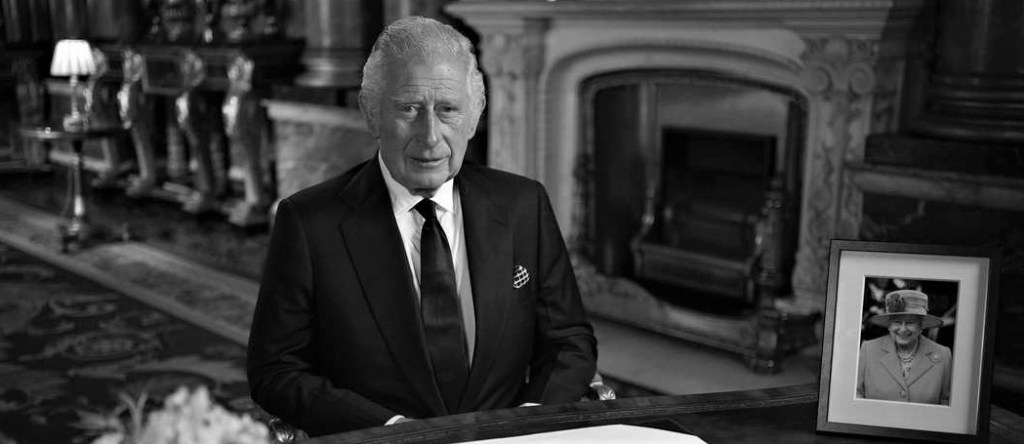
I thought of his quandary upon hearing the news that Prince Charles has succeeded his deceased mother, Queen Elizabeth II, to the British throne, and will henceforth be known as His Majesty Charles the Third, by the Grace of God, of the United Kingdom of Great Britain and Northern Ireland and of His other Realms and Territories King, Head of the Commonwealth, Defender of the Faith.

That is a mouthful, and may prove to be more than he can chew.

For the first nine years of my life, I pledged allegiance to a King every morning in school—and to the flag, the Empire, and my country—but I had scant appreciation of what those actually were.  To me, the King was a framed portrait of a uniformed man hanging on the wall of my classroom; the flag was an attractive array of red, white, and blue crosses, draped below the portrait; the Empire was made up of the pink areas on a Mercator projection wall-map prominently displayed nearby; and my country, Canada, was for a long time defined by the few square city-blocks I could traverse on my tricycle before being corralled by a frantic mother.  But it was pink!

Indeed, as we were taught, the sun never set on the British Empire.  We sang the national anthem every day with great gusto: God save our gracious King, Long live our noble King, God save the King… 

It took a while for us to master the switch to God save our gracious Queen… upon the death of George VI in 1952.   And eventually, we stopped singing the song at all, in favour of our own national anthem, O Canada, officially adopted in 1980—long after I had left my schoolboy days behind.

It never occurred to me back then that those glorious pink areas on the map were the result of rampant, colonial conquest of the original inhabitants of those lands.  And in fairness, how could I have known?  I was raised to believe in right vs. wrong, truth vs. falsity, morality vs. depravity, religiosity vs. atheism, generosity vs. selfishness, civility vs. rudeness, the rule of law applied to all equally vs. anarchy—all admirable virtues in and of themselves, but all defined, of course, by the privileged White authority represented by the Crown.  The triumphant.

…Send him victorious, Happy and glorious…

I was brought up in the bosom of the Anglican Church, a colonial version of the Church of England, and taught to believe that sin was inevitable, repentance essential, and forgiveness attainable.  And those, too, I came to understand, were defined from on high.  Sin was anything the clergy might from time to time, in their great, Christian wisdom, determine it to be; repentance was adjudged sincere or not by their strict standards; and forgiveness was beneficently granted by the Lord through them—or not, as they deemed appropriate—often requiring mandatory acts of atonement.

To be sure, I enjoyed a privileged childhood, for which I am grateful.  But my upbringing rendered me an absolutist well into my adult years, fully invested in the values and tenets I had been taught.  That I am today something of a relativist may, I suppose, be attributed to my advancing years and a questing mind, more than to any great, moral awakening.

It seems to me now that, although might should never make right, the definition of right vs. wrong is still determined by those who can enforce their interpretation.  Truth vs. falsity is defined and re-defined by those who are winning the culture-wars at any particular moment.  Ernest Hemingway wrote a memoir, published posthumously, the title of which—A Moveable Feast—describes perfectly the relativism of the definitions of virtues we still profess to believe.

What constitutes selfishness today, as opposed to self-interest?  And who gets to decide?  What is regarded as moral vs. depraved behaviour?  And by whom?  Where is the boundary between civility toward one another vs. rudeness and hate?  And who sets that boundary?

Is adherence to a set of liturgy-bound, religious beliefs more legitimate than a self-imposed regimen of acceptable, generous-of-spirit behaviour?  And who is to decide if the adherents of either viewpoint are upholding and demonstrating their professed beliefs, as opposed to merely paying lip-service.  Hypocrisy is never pretty.  

In the diverse, multicultural world in which we live, there are many who would answer those questions. And there are many more, alas, who will not listen to any but their own.

A major advantage of being an absolutist is that one need never question one’s own motives or actions.  For the acquiescent, it is enough to act within the boundaries of the commonly-accepted virtues proscribed from on high, or profess to be doing so.  For the scofflaws, it suffices to act in opposition to that, based upon their own set of contradictory values.  Each side sees itself as right, the other wrong.  And they are absolutely certain of their positions.

Relativists, on the other hand, are forever doomed to uncertainty, questioning the validity, the relevance, the wisdom of their beliefs and actions, no matter what they do.  Theirs is the age-old question—why?

King Charles III strikes me from afar as one who, though bound by centuries of absolutist tradition and ritual, will prove to be something of a relativist, a King who will question many of those very institutions and sacraments surrounding him, with a view to modifying them.  I want to believe he realizes that, even as the monarchy is steeped in pomp and circumstance, it cannot stand still.  There is no such thing as stasis.  Just as our world is ever evolving, so, too, must its institutions.

Charles now wears the crown I pledged allegiance to on the head of his grandfather during my long-ago school-days, and I pray it will not lie uneasy upon him.  I hope it will inspire him to critically examine his reign relative to the world around him, to lead his monarchy to a strengthening of ties with his subjects, and toward reconciliation with those whom the Empire has harmed.

…Long to reign over us, God save the King.

A Boomer No More!

Shortly after the end of my seventh decade, I made a dramatic discovery.  One of my basic beliefs, one of my most treasured tenets, turned out to be untrue.  Indisputably incorrect.  Not founded upon fact.

Contrary to my lifelong assumption, I learned I was not a baby-boomer!

Perhaps this seems less than a momentous finding, given the plethora of problems and disappointments we face every day in our troubled world.  Nevertheless, it left me somewhat in limbo, wondering where I fit in, if not where I had always assumed.

Conventional wisdom in the western world, I learned, defines boomers as those born between 1946 and 1964.  Sadly, I came along, the firstborn of my generation, in early 1943, a full three years before my next oldest sibling.  Upon my birth, I became the seventh living person in my three-generation family, and the youngest. 

Today, I am the eldest of my own three-generation family, one of eleven people.  This diminutive dynasty of mine has increased in number by a meagre four souls across a span of more than seventy years.  We are not exactly a fecund family! 

My brother and three sisters, born between 1946 and 1954, are legitimate baby-boomers.  We’ve never talked about that, though, most likely because they take it for granted.  Just as I always did prior to learning the truth.  As I aged—reluctantly, grudgingly, but inevitably—it was comforting to know that I would never become irrelevant, inconsequential, or ineffectual.  By virtue of my inclusion in such a huge, influential, demographic cohort, I was hopeful of being ever important, pertinent, and significant.

“I am a boomer!” I would proudly declare to one and all.  Alas, that hope has been forever dashed. 

It was only in the last century, apparently, that people began to think in terms of generations, and to label them.  Prior to 1900, presumably no one had the time or inclination to pursue such frivolous thoughts.  After World War I, however, when almost sixteen million soldiers and civilians were killed, and after the Spanish flu outbreak in 1918, when perhaps fifty million people perished, the term lost generation sprang into use, denoting those born before the turn of the century.  It is generally credited to the writer and critic, Gertrude Stein, and it came to define the cohort of that era.

The people born between 1900 and 1924—who came of age during the great depression of the 1930’s, many of whom served or fought in World War II—are often referred to as the greatest generation, a phrase first coined by another writer, Tom Brokaw.  After the baby-boomers’ years, along came generations X, Y, and Z, roughly spanning the years between 1965 and the present.  My two daughters are gen X-ers.

Generation Y, or millennials—born roughly between 1980 and the late 1990s, the children of boomers—are sometimes referred to as echo-boomers.  One of my grandchildren falls into this cohort.  The other four are of the gen Z group, which means my family spans five generational cohorts.

Anyway, my place in this grand scheme appears, sadly and irrefutably, to be wedged ignominiously between the greatest generation and the boomers, born between 1925 and 1945, a span that encompassed a period of rapidly-declining birth-rates in the western world.  In the United States, for example, population fell by almost 1.8 million in the five years before 1945, whereas it grew by 19.4 million in the five years following.  My generational cohort, the waning product of that decline, was dubbed the silent generation in a 1951 Time magazine article.

Can you imagine how I feel?  I’m part of the silent generation?  I went from being a boomer, a member of that iconic group responsible for much of the economic, cultural, and technological growth in the western world, to being a nobody—the product of a flagging era, dwindling and diminishing in comparison to the years surrounding it.  It was disheartening, it was frustrating, and it was humbling to learn I was a member of a marginal, mute minority.

But, you may ask, why do I care?  Why is this of such import?

Well, in times past—from feudal fiefdoms to Victorian villas—younger sons were often banished from their noble fathers’ mansions, sent off to the army or the church where they would succeed or fail on their own.  The eldest son, however, was to the manor born, and was never treated in the manner of his younger siblings.  Not for him the shame of exile or exclusion from the elegant elites.  Male primogeniture reigned.

Therefore, when I eventually became old enough to understand my status as the eldest grandson in my somewhat-Victorian grandfather’s family, I more or less assumed I would benefit in a fashion similar to those earlier first-born scions of society’s finest families.  Not only that, but in addition to my favourable birth-rank, I stood poised (I thought) at the leading edge of the greatest population boom in modern times, the boomers.  The world would be there for our taking; none could stand against us.

[An aside: it occurs to me as I write this that perhaps, as a child, I was too steeped in Victorian delusions of grandeur.  Ah, well…]

In any case, here I sit today, silenced, stifled, and insignificant, gloomily appraising my paltry position on the generational flowchart—not riding the crest of a great wave as I had assumed, a triumphant shout upon my lips—but rather receding slowly and soundlessly into a forgotten fragment of twentieth-century demographic distribution, the silent generation.

There is a painting, The Scream, completed in 1893 by Edvard Munch, himself the eldest son in his family.  Famously considered to represent the universal angst of modern man, it portrays the artist at a particularly anxious time in his life.  Since my banishment from the boomer ranks, I have looked at it closely and repeatedly, wondering what it sounded like, that scream.  In similar torment, I have tried to copy it, tried to unveil my own scream of protest at the unfairness of it all.

“Let me in!” I open my mouth to cry, but no sound emerges.  Oblivious to my silent suffering, the boomers tramp on, adhering to their own imperatives, a wholly-engrossed horde of humanity resolutely heading who knows where.  Without me.

And so, ‘tis true.  I am a boomer no more.