Going Beddy-Bye

For the better part of seventy-eight years, I’ve gone beddy-bye every night—but I’ve been alone for only the first twenty-three of those.  In those early years, I slept atop an inexpensive mattress, twin-bed size, identical to the one occupied by my brother.

On my wedding night, no longer alone, I slipped under the covers on a similarly-inexpensive mattress, double-size now, which sat on a metal spring supported by three wood slats running between the sideboards of the antique bedframe we had inherited from my grandparents.  Those slats had the nasty habit of slipping off the lip they rested on whenever my wife and I were, shall we say, not exactly resting quietly.  Matrimonial merriment became a challenge, to see how frisky we might get without wrecking the bed.

Every night since that honeymoon eve—with a few exceptions due to travel, illness, or similar unusual circumstances—I have gone beddy-bye with the woman I married.

By the time we welcomed our first daughter some five years on, we had bought a more expensive box spring/mattress combo, double-size, but still resting on those same slats—reinforced now by two additional slats, all five screwed into the sideboards.  No longer did we fear capsizing while…..well, you know, canoodling.

Our second daughter arrived twenty months after her sister, and it seemed no time at all before we began waking to find four of us in our double bed.  With those two wee urchins snuggling between us, I remember being pushed so close to the edge of the bed that I would almost fall out.  It was about then that my wife and I, for decorum’s sake, began to wear pyjamas…..and to consider buying a larger mattress.

We graduated, eventually, to a queen-size bed, the mattress set on its own free-standing base.  The old double-size bedframe was stored away, except for the headboard, which we continued to use, propped at the head of the bed to match the rest of my grandparents’ suite.  Even with the girls growing bigger by the day, the space was more than adequate, as if we were sleeping in the wide-open spaces.

During all this time, I slept on the right side of the bed, to the left of my wife.  The only reason for this, as I can recall now, is that in all the homes we lived in, the bathroom was closer to her side.

Not long after the girls had left our happy little family to start their own, we began to suffer hitherto-unknown aches and stiffness in the morning.  Thus began a period of frequent mattress-turns and flips, seeking to stop the sag.  Eventually, after some consideration of the alternatives (and the cost), we opted to purchase a king-size, memory-foam mattress.  We found ourselves at that point, just the two of us, sleeping on a bed that would easily have accommodated our little family of four. 

For the most part, at least in the beginning, we gravitated to the middle, close enough to reach each other, and to feel each other’s warmth.  And there were no sags—not in the mattress, anyway.

But lo and behold, into this blissful beddy-bye there came an insidious intrusion that negated the benefits of the mattress—to wit, snoring.  Increasingly, in the wee, small hours, one of us would waken to the other’s snorts and gurgles, toss and roll fitfully for what seemed like hours, unable to recapture sleep, and finally retreat to the recliner-chair in the den.  It was intolerable.

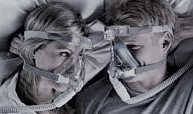
The cure arrived when we went, first I and then my wife, to be tested for sleep apnea—a condition where one stops breathing, sometimes for a minute or longer, thereby placing great pressure on the heart and other vital organs.  And when breathing  resumes, it’s often with loud gasps and splutters—AKA snoring.  Alas, both of us were diagnosed with apnea, which led to our acquiring CPAP machines (Continuous Positive Airway Pressure) to combat it.

We feel now as if we’re sleeping with Darth Vader, each of us with a mask over our mouth and nose, flexible hoses running to the machines on our bedside tables.  And we’ve moved away from the middle of the bed so the hoses won’t be stretched beyond their six-foot length.  To anyone unfamiliar with CPAP machines, this must sound like a horror show.

Thankfully, however, the machines work!  After a short period of adjustment, they have put an effective stop to our snoring, allowed us to sleep more deeply, and longer, and to waken more refreshed.

So now—more than fifty years after I moved from my single-size twin bed to that double-size marital mattress, still sharing my bed with the love of my life, close enough on our current king-size mattress to reach out and touch—I find myself looking forward every night to going beddy-bye.

I am blessed.

Beginnings and Endings

A haiku reflection—stanzas of three lines of 5, 7, and 5 syllables—as the year we have labelled 2020 draws to a close—

why we measure time

is a mystery to me—

for time knows no bounds

beginning a year

or ending one at some point—

what changes for us?

the calendar is

nothing but a vain attempt

to measure our lives

but life is more than

mere beginnings and endings

to which we pay heed

life is a journey

from there to here, whence to hence,

uninterrupted

imposed beginnings

and endings do not change our

eventual route

they turn us perhaps

hither and yon on our way

to our destiny

for we are born, then

we die; from start to finish,

naught begins or ends

rather, life just flows

from this to that, to the next,

bearing us forward

when new year begins,

and old year ends, we don’t stop—

we simply move on

and so, it must be

that beginnings and endings

mean nothing at all

It’s Tolling for Them

COVID-19 is a killer, an indiscriminate killer.  And it is a determined despoiler.  Among those who fall victim to it, many who survive are assailed by debilitating after-effects that might last for the rest of their lives.

COVID-19 doesn’t care who you are, exalted or humble, although it targets most virulently, and disproportionately, those who are more vulnerable—the elderly, the frail, those with co-morbidities, and the economically-disadvantaged, especially those living in crowded conditions.

It doesn’t care about your religious or political affiliations, your gender or sexual identity, your ethnicity or colour, your marital status, your nationality.  COVID-19 is an equal-opportunity predator.  You might be the nicest person anyone has ever known, or the most vile, but that doesn’t matter to the virus.  You are nothing more than prey.

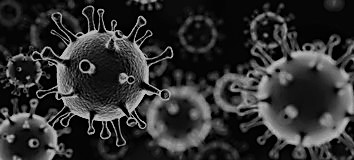
The virus is not a living thing.  Like all parasites, it relies on a living host to propagate.  And to achieve that end, it is a relentless invader, ruthless, uncaring, insensate—in short, a perfect killer.  The human immuno-suppressant system, in most cases, is no match for it.  Although the reasons are so far unclear, some people are infected but suffer no sickness; others are infected, become ill, then recover; and still others are infected, fall seriously ill, and succumb.  All of them, however, are spreaders of the virus at some point along the continuum.

There is no known cure for COVID-19.  The promised vaccines hold the hope that we may, at least temporarily, disrupt the link between infection and illness—although, for how long, no one yet knows.  Repeated vaccinations may be a fact of life going forward if we hope to protect ourselves from its ravages.

Up to now, the mitigation measures prescribed by various governments to fight the menace—masking, social-distancing, handwashing—have proven ineffective, not because they, themselves, are ineffectual, but because we have not assiduously adhered to them.  As it turns out, as a species, we are not the most dedicated warriors.

And, unfortunately, there exist among us the pro-hoaxers, the anti-maskers, and most recently, the anti-vaxxers, all of whom present a clear and present danger to the rest of us. They appear to adhere unwaveringly to their denials that COVID-19 is a worldwide pandemic, to their disavowals of science, to their claims that government edicts are an infringement on their God-given freedoms. They contradict the laws of physics, chemistry, and biology with their strident, pre-conceived opinions.

The problem is that they are relying on idiosyncratic belief systems, where science relies on immutable, though constantly-evolving, evidence.

In Canada, for example, the number of COVID-related deaths among the overall population nine months ago was inconsequential, fifty-three in a population of 37.6 million (although those deaths were immensely consequential to the families of those who died).  As of this writing, the number of deaths is exponentially higher, 14,000+ and rising.

In the United States, the number of COVID-related deaths in a population of 328.2 million was reported nine months ago at 493; today that number sits at almost 310,000, a wildly-exponential increase.  

And in both countries, these are only the deaths reported; the actual numbers are widely deemed to be much higher.

Even before the onslaught of COVID-19, I had never been seen as a noted risk-taker.  The risk-reward scales have, for me, invariably tilted to the safer side.  Although I am not an overly-cautious person, I have always preferred to rue a golden opportunity I might have missed, than to suffer a major blow as a result of a miscalculation.

Consequently, as you might expect, I have adhered as closely as possible to the mitigation measures set forth by the government, and have encouraged others to do so as well.  That being said, I do respect the right of others to determine their choices—but, only so far as those choices do not impinge upon my right to a safe existence.

Suppose, for example, that a gang of armed thugs was roaming through your neighbourhood, breaking into homes, raping and pillaging, claiming it was their right to do so.  And if you dare ask them why, they reply, “Because we can!”

I don’t know about you, but I’d be terrified.  And I would expect the authorities to put a stop to their depredations in order to protect the law-abiding citizenry.  No one in a free society should have to live in fear of scofflaws who carry on as if there are no consequences for lawless behaviour.

Increasingly, I feel the same way about the pro-hoaxers, the anti-maskers, and the anti-vaxxers whose actions threaten the rest of us.  Normally charitable toward others with whom I disagree, willing to listen to and consider their points of view, I nevertheless find I am increasingly hostile to these covidiots, who endanger, not only themselves, but potentially everyone with whom they come in contact.

It is difficult for me, I now find, not to wish them ill.

In my ruminations, I have affixed a name to COVID-19, a name with which you are probably familiar—Quasimodo, Q for short.  And I picture Q in a lonely bell-tower, pulling stolidly on a rope, sounding the solitary bell.  Hearing it, I wonder for whom that bell is tolling.

Regrettably, but undeniably, I realize I am beginning to hope it’s tolling for the disavowers.

Two Christmas Stories

Episode 6 in my series, Reading Out Loud, is ready for viewing, this time featuring two Christmas stories—one a short essay, the other a meaningful poem.

The essay was written some years back, the poem just a month or so ago, but the similarity in theme is quite stark. The episode is slightly more than 10 minutes in length, and I hope you will enjoy it.

Please feel free to share this post with anyone you think might be interested. And if you feel so inclined, leave a comment in the space below.

What’s Heaven Like?

Avoiding contemplation of my own mortality was easy, as I recall, when I was a young man.  It has become increasingly difficult to do that as I grow older—especially when in discussion with an inquisitive granddaughter.

“Do you say prayers, Gramps?”

“Prayers?  Ah, yes, sure, I say my prayers.”

“Every night?”

“Actually, I do it in the morning, before I get out of bed.”

We were alone in the house, I reading a book, she playing with her Lego set.  Music was playing softly in the background.  I wasn’t sure if she was just making conversation, or whether this was a significant moment.

“Do you pray to God or to Jesus?”

“Well,” I began, “aren’t they really the same?  I guess I pray to both.”

“Do you believe in Jesus, Gramps?”

I put my book down on the table beside my chair.  She kept building her blocks, but I could tell she was listening for my answer.

“I believe in the things Jesus taught us,” I said. “That we should love each other and try to be good.” I was hedging a bit, because I have long had difficulty with a literal reading of the Bible.

“If we’re good, we go to heaven when we die, right?”

“That’s right!” I said, on firmer ground now.  “That’s one of the things Jesus taught us.”

After a few moments, she said, “Old people die before kids die, right?”

“That’s right,” I repeated.  “Most of the time, old people die first.”

“What do you think heaven is like, Gramps?”

I wanted to tell her that heaven, for me, was having this opportunity to talk with her, listen to her, and feel the love swelling in my chest.  But that wasn’t what she was after, so I tried a reply I’d heard years before when my father-in-law, shortly before his death, was asked the same question by my wife.

“I don’t know,” he’d said, a sly twinkle in his eye.  “Nobody’s ever come back to tell me.”  His sense of humour had never left him.

My granddaughter gave that some thought as she continued connecting block to block, building I knew not what.  It was colourful, though.

“I know nobody comes back, Gramps.  But what do you think heaven is like?”

“Hmm,” I said, trying to figure out how I might answer that.  I have never thought of heaven as a streets-paved-with-gold sort of place where I’ll meet up again with every person I ever knew—assuming they would also make it there.  My own perception has been evolving over many years, more urgently as those years have mounted, and now my granddaughter was asking me to explain it.

Deep down, I think I believe that heaven is bound up in the vast universe we all inhabit—an ever-expanding universe if science is to be credited.  And I think I believe that every living thing is, in and of itself, already a part of the creator that, in several different languages, we have called God.  So in that sense, we are inhabiting heaven now, wending our way on an eternal voyage through the stars.

I think I believe that every living thing, including each of us, is animated by an inextinguishable spark of energy—I might call it the soul—that enlivens us during our mortal journey.  And when my own journey ends, blotting out my conscious existence as one little girl’s grandpa, I think I believe that my soul will carry on, perhaps to animate some other form of life somewhere in the universe.

I’m as certain as I can be (which, I suppose, is not so certain at all) that my soul, that unquenchable amalgam of light and heat, will live eternally, for if it were not so, if that energy were to dissipate and die, the universe, rather than expanding, would surely be shrinking, bit by bit by bit.

But every time I ponder these things, I remember the admonition I constantly remind myself of—not to believe everything I think.

“Gramps?” my granddaughter said, looking up from her blocks, waiting for my answer.

“Hmm,” I said again, realizing I was out of time.

“It’s okay if you don’t know,” she said, standing up from her Lego endeavours.  As she climbed onto my lap, she added, “I just don’t want you to die.”

It was several moments before I could speak again, so I held her close, offering a silent prayer.

And in that moment, I knew what heaven was like.

You’ll Never Know

“You’ll Never Know” is the Academy Award-winning song from way back in 1943. Now, seventy-seven years later, it’s also the title of a story from my latest book—-“I Haven’t the Time: Tales of a Woke Wayfarer”.

If you have ten minutes or so, you can hear me read the story in the attached video—-and sing the song—-on the latest edition of “Reading Out Loud”,

You’ll find it at this YouTube link—-

If you enjoy the video, please feel free to pass it along to others who may appreciate it.

Earlier Reading Out Loud videos may be found under the List of Posts button at the top of this page.

I Haven’t the Time

If you have ten minutes or so, I think you’ll enjoy watching the latest episode of my video-series, Reading Out Loud.

In this episode, I am reading three short poems from my latest collection of tales, I Haven’t the Time: Tales of a Woke Wayfarer, which will be published later in November.

https://youtu.be/XrPol4C76KE

If you like the poems, please feel free to pass along the video link to others who may appreciate them.

Earlier Reading Out Loud videos may be found under the List of Posts button at the top of this page.


It’s My Right!

In the midst of the global COVID-19 pandemic, the worst such event in more than a century, a prominent political leader recently told her constituents, If you want to wear a mask, go ahead.  You are free to do so.  If you don’t want to wear a mask, don’t be shamed into it.  That is your right.

Really?  In the middle of the pandemic, does this not seem illogical?  The best scientific evidence indicates pretty clearly that, by wearing a mask while around other people, we can severely limit the transmission of the virus—thereby protecting those around us, our family, friends, and fellow-citizens.

For comparison’s sake, I’ve modified the woman’s statement to apply to other situations, to see if they would make sense—to see if they might impinge on another person’s rights.  You be the judge.

If you want to stop your car at a red light, go ahead.  You are free to do so.  If you don’t want to stop, don’t be shamed into it.  That is your right.

Can you imagine the potential carnage?

If you want to wear seatbelts while driving, go ahead.  You are free to do so.  If you don’t want to wear them, don’t be shamed into it.  That is your right.

Can you imagine the increase in personal injury?

If you want to drive while sober, go ahead.  You are free to do so.  If you want to drive while impaired by alcohol or drugs, don’t be ashamed about it.  That is your right.

Can you imagine the inevitable devastation?

If you don’t want to smoke in a public setting, that’s fine.  You are free not to do so.  If you do want to smoke there, don’t be shamed by it.  That is your right.

Can you imagine the outcry?

If you want to use the store’s escalator to go up one floor, go ahead.  You are free to do so.  If you want to push your way back down on the up-escalator, don’t be ashamed to do it.  That is your right.

Can you imagine the confusion and anger?

Of course, there are all manner of situations where an individual person’s choice to do something, or not do it, will engender no meaningful effect on others.  For example, If you want to wear winter boots after a heavy snowfall, go ahead.  You are free to do so.  If you don’t want to wear boots, don’t be shamed into it.  That is your right.

Another example:  If you want to study for your final exams, go ahead.  You are free to do so.  If you don’t want to study, don’t be shamed into it.  That is your right.

And a third:  If you don’t want to wear a paisley tie with a striped shirt, plaid jacket, and check slacks, just don’t.  You are free not to do so.  But if you do want to, don’t be ashamed about it.  That is your right.

None of these three personal decisions is likely to have a profound effect on someone else’s autonomy, unlike the first statement and its five adaptations.  And that, of course, is the whole point.

A familiar maxim, first promulgated by an obscure legal philosopher, Zechariah Chafee, Jr., holds that a person’s right to swing his arms freely ends where the other person’s nose begins.  In other words, your personal rights are not allowed to impinge on mine.

John Stuart Mill, in his famous work, On Liberty, postulated:  The maxims are, first, that the individual is not accountable to society for his actions, in so far as these concern the interests of no person but himself. Advice, instruction, persuasion, and avoidance by other people if thought necessary by them for their own good, are the only measures by which society can justifiably express its dislike or disapprobation of his conduct.

Secondly, that for such actions as are prejudicial to the interests of others, the individual is accountable, and may be subjected either to social or to legal punishment, if society is of opinion that the one or the other is requisite for its protection.

I have long been of the opinion that Mill’s work provides us with a near-perfect definition of the boundary between our individual rights and our societal obligations.  And when I apply that definition to the exhortations of public health officials during the pandemic that we all wear a mask when out and about in the company of others, I find their pleas to be eminently logical.

It seems to me, therefore, that if government determines the actions of some people are, in Mills’s words, prejudicial to the interests of others—in this case, the general health and welfare of the citizenry—the wearing of masks in public places should be mandated by government officials.  I further believe that scofflaws who flout the requirement should, also in Mills’s words, be subjected…to legal punishment.

The same controversy will arise, I’m sure, when vaccines against COVID-19 become available to the general populace.  Some of us will line up eagerly to get it; others will dig in their heels, perhaps proclaiming, If I don’t want to get vaccinated, that’s my right.  I am free not to do so. 

To them, I would say, If you don’t want to get vaccinated, that’s fine.  That is your right.  But if you want to present yourself in community settings where people congregate—such as malls, schools, churches, or city parks—don’t be surprised when you are denied access.  That is our right.

Like any chain, our society is only as strong as its weakest link.

The Resurrectionists

The sudden death and subsequent resurrection of Riley Moynes—-more a serendipitous circumstance than a major miracle—-unfolded an hour before dusk under a cloudless sky on an empty stretch of northern Ontario highway.

So begins the seventh novel in my Maggie Keiller/Derek Sloan crime-thriller series, a story that will capture and hold your attention from beginning to end.  The book is intended for a mature audience, and is available online now from my author spotlight page—http://www.lulu.com/spotlight/precept

If you haven’t had a chance to read the free previews I sent out of the first two chapters—or watched my video-reading of them—they may be found at these safe links—

https://tallandtruetales.blog/2020/09/29/the-resurrectionists-ch-1/

https://tallandtruetales.blog/2020/10/04/the-resurrectionists-ch-2/

I hope you will check out the previews, and I hope you will visit my author spotlight page as you consider purchasing the book.  In addition, please share this note with anyone you think might be interested.  I know I’m biased, but The Resurrectionists is a heck of a good story!

The Resurrectionists – Ch 2

Here is a preview of the second chapter of my new book, The Resurrectionists, which is slated to appear by the end of this month. The book is intended for a mature audience.

If you would prefer to hear me reading the chapter aloud, a video preview may be found by scrolling to the bottom.

2

final week of april, saturday afternoon

Sincerity oozed from every pore, as obvious as the sheen of sweat on her forehead, although not nearly as genuine.

“I keep tellin’ you,” she said.  “I don’t know ‘bout the money, I don’t   know ‘bout the drugs.  The guns, yeah, I knew Beau had guns.  Far’s I know, he bought ‘em legally.”

Dani Austin was practiced at shaping the truth to fit any situation, but the detectives facing her in the squalid interview room were accomplished at recognizing lies.  The big guy was Barnett, early-fifties, tie loosened, ogling her obviously and unapologetically.  The woman was Lavery, a wiry brunette, mid-thirties, eyes narrowed as she appraised Austin.  Neither seemed impressed with her story.

“You know a wife can’t be forced to testify against her husband, right?” Lavery said.  “Whatever you tell us here can’t be used in court, and Beaumanoir never has to know.”  She was leaning back, one arm tossed carelessly over the back of her chair, acting cool.  Austin could see a holstered gun nestled against the side of the woman’s breast.

“Me an’ Beau aren’t married,” Austin said.

He says you are,” Barnett said.  “Says you been together two years now.”

“Together, yeah,” Austin said, “but not married.  I been stayin’ with him, havin’ a good time, waitin’ ‘til somethin’ better comes along.”

“An’ now it has, right?” Lavery said.  “You and this guy, Dylan O’Toole?”

“Tool-man?” Austin said.  “What about him?”

“Beaumanoir says you and O’Toole been doing the dirty behind his back,” Barnett said.  “Says he found out a few days ago.  Says the money and drugs we found in the house must belong to O’Toole.  Or you.”

Austin forced a laugh.  “Are you kiddin’?  If Beau thought Tool-man was screwin’ me, the guy would be dead.  Same as you would, Detective, if Beau saw how you been lookin’ me up an’ down for the past hour.”

Might as well let him know I know.

“Don’t flatter yourself, Ms. Austin,” the detective said, shifting in his chair, miffed at being confronted.  “I wouldn’t fuck you with someone else’s dick.”

“Yeah, you would,” Austin shot back.  “You an’ your dyke partner, both.  But I don’t swing her way.”

The detectives couldn’t resist a sidelong glance at each other, each knowing the truth of the jibe, but neither willing to acknowledge it in front of Austin. 

Leaning forward, not so cool now, Lavery said, “O’Toole lives with you and Beaumanoir, right?”

“Wrong, Detective,” Austin said, sure she’d hit the mark about the woman’s sexual preference.  “Me an’ Beau live together, just a regular twosome.  Tool-man lives downstairs, rents the basement apartment.”

“That’d be the same basement where we found the drugs and money?” Lavery said.  “And the guns?”

With a shrug, Austin said, “The guns, yeah.  In a cupboard in the furnace-room.  Drugs an’ money?  Beats me.  Beau musta had somethin’ goin’ on the side.”

“He says it was O’Toole’s stash,” Barnett said.  “Swears you and O’Toole were screwing each other, and both of you were screwing him by dealing drugs without him knowing.”

“Yeah, well he would say that, wouldn’t he?” Austin said.  Placing

both hands flat on the table, she said, “Think about it!  It’s Beau’s house, not mine.  It’s him who belongs to a biker-gang, not me.  You really think me an’ some numb-nuts renter are dealers?  Puh-leeze!”

“Okay, you’re trying to convince us you weren’t boinking O’Toole, right?” Lavery said, leaning back, trying for cool again.  “And even though both of you lived in the house, neither of you knew anything about what was going down.  That the story you’re trying to sell us?”

“I’m not sellin’ you anything, Detective,” Austin said, imparting a double-meaning to her words.  “I’m givin’ it to you for free.”

When Lavery’s eyebrows lifted querulously, Austin added, “The truth, that is.  Nothin’ else!”

Barnett cut through the sexual undertone.  “So why should we believe you over Beaumanoir?”

“Up to you, I guess,” Austin said, eyes still on Lavery.  “I’m a law-abidin’ girl.”  Her gaze switched back to Barnett.  “Ask Tool-man if Beau’s tellin’ the truth.”

“We would if we could find him,” Barnett said.  “Nobody’s seen the guy in almost a week.  We figure he took a powder after Beaumanoir discovered you and him fucking each other.  But I’m thinking you already know that.”  He leaned in, daring her to contradict him.

Austin did know that.  Beaumanoir had surprised them in O’Toole’s bed by coming home early last Tuesday, and a brief fight had ensued.  O’Toole got the better of it, and when Beaumanoir had retreated, shouting threats, vowing retribution, Austin had convinced her lover to take off.  He’d been reluctant to leave her alone, but had finally agreed when she swore she’d join him as soon as it was safe.  He’d promised to call her when he got settled somewhere. 

She’d fled to a friend’s place to escape Beaumanoir’s wrath, staying a couple of nights with Debbie and her dogs.  When she went back, it was only to pack a few essentials, but Beaumanoir had been waiting, disconsolate, and pleaded with her not to leave.  Despite her unfaithfulness, he really was smitten. 

She’d agreed, reluctantly, to stay, not knowing yet where O’Toole might have landed, and the next three days had passed mostly uneventfully—although Beaumanoir, prone to mood-swings, had hit her a couple of times when anger and frustration got the best of him.  To protect herself, she’d protested that O’Toole had forced himself on her, but Beaumanoir wasn’t buying it.

The prospect of further physical violence bothered her, knowing his volatile nature firsthand.  But it had bothered her more that O’Toole was gone, and she waited anxiously to hear from him.

At dawn this morning, she and Beaumanoir had been awakened by the unexpected police raid and taken in separate vehicles to the downtown detachment.  Shortly before noon, Austin had been offered doughnuts and lukewarm coffee before being brought to the interview room.  She hadn’t seen Beaumanoir since the raid.

“Look, I got no idea where Tool-man is,” Austin said, responding to Barnett’s assertion.  “Me an’ him were not gettin’ it on, period, end of story.  Beau’s makin’ all this shit up ‘cause he knows you got him cold.  I never saw the money, I never saw any drugs.  He knows I’ll tell you the truth, so he’s spinnin’ you like a kid’s toy to save his own skin.  You think he cares about me?  Look what he did to me.”

Both detectives had noticed the bruising and cuts.  They marred a pretty face, framed by curly black hair, cut short in a page-boy.  Her eyes were mesmerizing—almond-shaped, with clear, brown irises—although one was blackened.  Even clad in a track-suit, her figure was unmistakable.  She reminded Lavery of Betty Boop.

“I got bruises all over me,” Austin continued.  “You’re gonna hafta take my word for that, though.”  She glanced again at Lavery.

“Yeah, my heart bleeds for you,” Lavery said, wishing a strip-search could be authorized.

What-ever,” Austin said.  “So listen, I got places to be an’ people to see.  You gonna charge me or let me go?  If you’re chargin’ me, I want a lawyer.”

The detectives checked wordlessly with each other, and Barnett said, “We’re releasing you for now, but don’t leave Thunder Bay.  We’ll probably need to talk again, once we have a few more chats with Beaumanoir.  Could be you’ll be charged with living off the avails of crime.”

“I don’t live off Beau,” Austin said.  “Got my own job.  I’m a PSW over at the seniors’ centre.  My money’s my own!”

“Yeah, and you’re still a virgin,” Barnett scoffed.  “I get it.”

Switching gears, Austin asked, “Beau gonna make bail?” 

Both detectives shrugged.

“He gets out, he’s gonna come lookin’ for me,” Austin said. 

 “Like I said before,” Lavery smirked, “my heart bleeds for you.”

*  *  *  *  *  *  *

Austin never went back to Beaumanoir’s house.  After her release, she took a cab to a nondescript strip-mall in the east end.  In a garbage-littered laneway behind the stores was a row of garages, one of which was locked.  With a glance up and down the lane, Austin unlocked it, flicked the light-switch, and rolled the door down behind her.  

Two motorcycles sat in the middle of the floor, covered by tarps, assorted socket wrenches lying beside them.  An array of junk littered the rest of the space, but Austin paid it no attention.  Kneeling in front of a large, cluttered workbench at the rear, she pulled a couple of cardboard boxes from underneath.  A third box, smaller than the others, was at the rear.  From this box, she removed a manila envelope, heavy in her hands, and dumped its contents on the floor—a dozen bundles of currency, each held together by large elastic bands.

Oh yeah!  I knew this would come in handy.

Counting it quickly, ensuring the total was the same as she remembered, eighteen thousand dollars, she stuffed eleven of the bundles back in the envelope, then shoved it into her small backpack.  The remaining bundle went into her pocket.

She then took a smaller envelope from the box.  Inside was her passport, a copy of her birth certificate, and a provincial certificate entitling her to work as a PSW, a personal support worker.  The most important thing  right now, though, was an expired Secure Certificate of Indian Status in her mother’s name, identifying her as a member of the Odishkwaagamii band, a First Nations community near Port Huntington.  That certificate was her ticket to disappearing so Beaumanoir could never find her. 

Christened Daniis Tabobundin, she’d been born on the reserve twenty-eight years ago to Marjorie Tabobundin and the charming Irishman who’d fathered her, Sean Austin.  They’d married a few months later, changed their surname to his, and left the reserve for Thunder Bay.  But the new husband and father was gone before two years were out.  Too ashamed to go back to Odishkwaagamii, her mother had stayed on in the Lakehead, working multiple jobs to make ends meet. 

After completing high school, Austin had worked a minimum-wage job in order to help.  When her mother died, she’d enrolled in a part-time course at Confederation College to obtain her diploma as a PSW.  With her certificate, a job soon followed at a seniors’ centre that had seen better days, providing a boost to her income.  But nowhere near the level she wanted.  Hence, her relationship with Beaumanoir.

Today was a day she had planned for, knowing Beaumanoir’s luck would eventually run out.  The leader of the Midwich Bloods, he’d been peddling fentanyl and cocaine since before she met him, and had been happy to lavish money and good times on her. 

‘Til I met Tool-man.  That was the end of me an’ Beau.

Over several months, she had squirrelled away money she skimmed from the large sums of used bills he’d bring home in his saddlebags, proceeds from his illegal dealings.  After they’d been lovers for awhile, he’d trusted her to do the counts for him, never imagining she’d try shorting him.  She made regular deposits to his account, even purchased GIC’s in his name, and never took too much at any one time.  Beaumanoir had no idea.

Not too swift..  Mean, though.  He’ll come lookin’ for me.

Her time with Beaumanoir, enjoying no shortage of money, was the first time she’d been able to live anywhere close to the manner she had long desired.  But she considered him a bottom-feeder, and herself better than that.

Before leaving the garage, she took a long look around—wondering if there was something else she could use, ensuring there’d be no trace of her left behind.  On impulse, she opened one of the drawers in the tall, portable tool-stand belonging to Beaumanoir.  As she’d expected, three handguns were inside, each wrapped in a hand-towel. 

One of them, a small S&W Bodyguard .38 Special, was perfect for what she wanted, and she’d actually fired it before, at the gun-range with Beaumanoir.  It, too, went into the backpack, still in the towel, along with a box of shells.

After relocking the door, the key found its way into a sewer grate.  And after a few seconds’ deliberation, so, too, did her phone.

Can’t risk Beau trackin’ me, usin’ the phone.  If the cops find this place, tough luck for him.  If they don’t, their bad.  Either way, I got no link to it now.

A second cab took her to the city’s main bus terminal, where she bought an overnight ticket to Toronto.  With a few hours before departure, she visited a couple of clothing stores, paid in cash, packed her purchases and envelope of money into a larger backpack she bought, and had a light supper in the terminal diner.

By midnight, she was sleeping soundly on the half-empty bus, but with no intention of riding all the way to Toronto.  With Thunder Bay in the rearview mirror, Beaumanoir was already a fading memory, and Dani Austin was about to die, to vanish completely.  With the resurrection of Daniis Tabobundin, she would return as a prodigal daughter to her birthplace at Odishkwaagamii.

It didn’t occur to her until later that, having ditched her phone, there was no way now for O’Toole to contact her.