Whose Lives Matter?

Black Lives matter!  So claims a vocal, concerned group of citizens here in the West, who believe their safety—indeed, their very lives—are at risk in the frightened, suspicious society we are quickly becoming.

All Lives matter!  So comes the response from other groups of concerned folks who believe their traditional culture and way of life are under siege from racial and ethnic groups whose appearance and customs are often quite different.

So who is right?  Are these two positions antithetical, as many would have us believe?

Perhaps, rather than making declarative statements, we should be asking more questions of each other.  The question I ask is, whose lives matter?  Anyone’s?  As I survey the daily news reports of exploitation, forced migration, and ethnic slaughter, I truly wonder.

To whom does my life matter, for example?  Do the nameless powers-that-be who head up multinational corporations, relentlessly extracting and harvesting the resources of our planet, really care about me?  Even as a consumer, one among millions?

Do the presidents, premiers, and overlords of so many autonomous nation-states genuinely care about me?  Even as a voter and citizen of a sovereign country, one among more millions?

Do fanatical extremists of whatever political or religious persuasion actually care if I live or die, so long as their own frenzied ends are met?

I think not.  My life and death are of supreme indifference to all of them.  I am too small to count.

Individual lives do matter, I believe, to one’s immediate spheres of influence—families, friends, neighbours, and the like.  And, thankfully, to the number of altruistic people and organizations who dedicate their time and energy to relief efforts in areas of crisis around the globe.

Consider the indigenous peoples of every continent whose way of life was essentially exterminated by ruthless invaders in the name of empire, religion, and profiteering.  Did their lives matter?

Consider the hundreds of thousands of refugees fleeing their homelands to avoid terrorist activities that have killed so many of their compatriots, a number many fear will overrun the safe-haven nations to which they flock.  Do their lives matter?

Consider the millions who have died from famine, drought, and genocide in so many third-world regions, people whose plight was known but for whom so little could be done.  Did their lives matter?

And then think about the population explosion that threatens to outpace the ability of the planet to sustain itself.  According to a 2014 Living Planet Report from the World Wildlife Federation, the current global rate of consumption, if continued, will require 1.5 planet Earths to support us.

If everyone were to live like the British do, however, that number would rise to 2.5 earths; and if everyone lived like we North Americans, the number would jump to four!  Untenable!

In such a global context, it seems unlikely to me that individual lives matter.  Either mankind must dramatically slow its rate of reproduction, or (as unpalatable as this sounds) individuals must perish in order that the collective may survive.  Hideous to contemplate, yet the human race continues to take each other’s lives, anyway—savagely, often indiscriminately, and remorselessly.

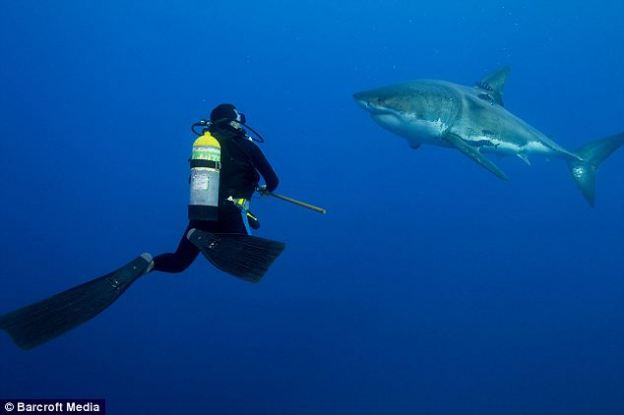
I saw a photo-shopped picture recently, a scuba diver swimming near a huge Great White shark.  The caption read: This is the most feared killer on the planet, murdering millions of people a year.  Beside it, a shark swims peacefully.
shark

So I ask myself—in the overall scheme of things, on our current path—whose lives matter?

We need to answer that question together, not separately.

And soon.

The Iron(y) Lady

Many will remember the Iron Lady, Margaret Thatcher, Prime Minister of the United Kingdom from May 1975 – November 1990.  Her sobriquet, originally bestowed by a Russian journalist, alluded to her obdurate political views and leadership style.

Perhaps the best encapsulation of this approach was delivered in a speech in 1980, when many in her conservative party were calling for a policy U-turn because of a looming recession.  “You turn if you want to,” she declared.  “The lady’s not for turning!”

Nor did she.  Seven years later, when the general economic conditions in the country had turned for the better, she was re-elected.  Uncompromising to the end, she narrowly lost a leadership vote in her party in 1990 and resigned the premiership.

westminster

Now, twenty-six years on, there enters from stage right the second female Prime Minister in the long history of the UK, Theresa May, succeeding David Cameron as party leader after his hapless (mis)management of the Brexit crisis.  She has publicly agreed with a commentator’s description of herself as a bloody difficult woman, yet at the same time, has claimed to be a real Goody Two Shoes in her approach.

On first glance, those two self-appraisals would appear to be at odds.  And much of her political performance also demonstrates this same antithetical nature.  For example, she campaigned for the ‘remain’ side in the recent Brexit referendum, although somewhat tepidly, yet has already signalled that she will get on with the job of exiting the EU posthaste.

“Brexit means Brexit,” she has said, “and we’re going to make a success of it.  There will be no attempts to remain inside the EU, there will be no attempts to rejoin it by the back door.  As Prime Minister, I will make sure we leave the European Union.

This, despite presumably voting to remain.

Although a long-time conservative party member, and Home Secretary for the past six years, her approach has been defined as more liberal than many in her party, almost non-ideological in its pragmatic approach to dealing with issues of governance.  In her recent leadership campaign (unexpectedly ended when her last rival dropped out), she clearly enunciated policy directions that one mainstay of the media described as going further than the Labour Party’s own positions.

Might that be a strategic move to stage left?

At the same time, another media pillar declared the new PM to be staunchly more conservative, more anti-immigration, and more isolationist than Boris Johnson (he being, admittedly, a moderate liberal conservative), a once-presumed rival for the party leadership, who campaigned aggressively for the ‘leave’ side.

Perhaps this dichotomy in the perceptions of the new leader demonstrates nothing more than the long-standing shibboleth that successful politicians, whether campaigning from the right or left, govern from the middle once elected.

We shall see with Theresa May whether that will be so.  But wouldn’t it be the epitome of British irony if, instead, we see a leader who picks and chooses her own path, regardless of that prevailing belief.  If such proves the case, given her shifting positions and statements on key issues and policies to this point, Prime Minister May may, mayhap, earn her own sobriquet, echoing Thatcher’s own—

The Iron(y) Lady.


The Games

The Olympic Games in Rio de Janeiro will soon be upon us, that quadrennial gathering of the world’s best athletes.  But we are hearing from so many of them that they plan not to attend, citing a host of reasons—their health, fear of terrorist activity, unfair competition because of doping, or the unpreparedness of the host country.

I remember a different set of games, played by girls and boys in the schoolyards we frequented.  No one was obliged to take part but nearly everyone did, in one fashion or another, because it was fun.

There weren’t a lot of specific rules involved because the games varied tremendously from one day to the next.  There were always a few standard guidelines that everyone was familiar with, but usually nobody bothered much with them—unless, of course, someone violated the sense of fair play that was commonly shared.  Whenever that happened, which wasn’t too often, arguments would flare up, each side would proclaim its case, and finally—perhaps so as not to waste too much of the playing time—a consensus would emerge and the games would continue.

Winners predominated, but only because the games allowed more opportunity to win than to lose.  And since nobody made any effort to keep track of scores and points once the contests ended, every kid in the schoolyard could be a winner in retrospect, a champion in classroom reverie.  Every participant could find some measure of satisfaction in the play, some joy in the sport of it.

kids-playing

After a while, though, those games changed.  Some of the adults in the schoolyard, for the purest of reasons, decided to contribute their time and energy to help the kids organize.  They offered the advice and assistance that comes with experience; and out of the chaos the adults thought they observed in the schoolyard, they brought order.

The vague and tenuous rules that previously governed the games were sharpened and recorded.  And all the girls and boys were made to learn them.  No disagreements were tolerated, and some of the adults volunteered to serve as game officials to ensure fair play.  Many of the games—those that didn’t lend themselves easily to such organization—were dropped in favour of those that did.

A lot of the kids were dropped, too, because there were no longer as many opportunities to compete for those whose game-playing abilities were not as fully developed.  These children were kept in the schoolyard, but off to the side where they could watch and cheer the others at play.  They became onlookers, hero-worshippers, only able to enjoy the experience vicariously.  And gradually, the games became The Games.

The Games, remember?  They were played by the very best girls and boys in every schoolyard.  But because there weren’t enough top-calibre kids in any one yard to sufficiently challenge their skills, the adults arranged for them to play against girls and boys from other schoolyards.

They played hard.  They did themselves proud.  In their various sweaters and uniforms, decked out in colours unique to their own schools, they vied with one another to see who was truly the best.  The purpose was not just to compete, but to win.  Records became increasingly important, first to establish and then to shatter.  And over a period of time some schools gained reputations as powerhouses in the competitions.

Winner, Winning Stairs, Olympic Games, Silver Medal

In order to attain such heights, or to remain on top once there, some schoolyard teams resorted to additional measures.  They enticed the best of the younger children to attend the big-name schools; they lobbied for changes to the rules of the contests to favour their own talents and skills; and they began to heap criticism on other schools who engaged in the same sort of tactics.

Eventually, one schoolyard team had had enough.  Perhaps because of an inability to compete at the highest level, or a sense of futility when playing the better school teams, a decision was taken to stop competing in The Games.  The other schools protested loudly, but to no avail; the boycott held.  And then more of the smaller, less successful schools made their decision to drop out, too.  In just a short time, The Games were reduced to a shadow of their former glory.

The kids, of course, were rather confused by it all.  After being told by the officious adults to work and train and practise, and just as they were beginning to take their exalted status for granted, they discovered that it had all been in vain.  There would be no more competition.  The Games were finished.

So they returned to their respective schoolyards, disheartened, disillusioned, downcast.  And there, to their surprise, they found that no one else in the schoolyard cared.  All the other girls and boys had long since lost interest in what the more skilful of their peers were doing in their more highly-organized competitions.

Back in the schoolyard, the other kids, the ones  left behind, had begun to play on their own again.  Free of the interference and regulation of the over-zealous adults, they had rediscovered their games.  There weren’t a lot of specific rules involved because the games varied tremendously from one day to the next.  There were always a few standard guidelines that everyone was familiar with, but usually nobody bothered much with them.  They just played to the best of their abilities, and enjoyed the freedom and the exhilaration of being included.

The games.  Nobody was obliged to take part but nearly everyone did.

Because it was fun.

Tracks in the Sand

One long-ago February, when winter’s white enveloped the north, one of our daughters came with her family to visit us in Florida.  The favourite activity for our grandson and granddaughter (the third of the clan being still an infant, unable to express her opinion) was going to the ocean, to the beach.

Our usual routines were fairly standard.  We’d park and unpack the car, each of us carrying the beach necessities according to our age and abilities.  We’d trudge the access path, through the dunes adorned with sea oats, pass through the rickety snow fence, and pick a spot that suited us all.

In short order, the umbrellas would be unfurled, the chairs unfolded, the blankets spread, and the toys strewn across the sand.  Peace would reign for Nana and Grandpa, watching the sleeping baby while her parents and older siblings hit the water.

beach-sand-grass-sunshine_tn2

On one such occasion, a small incident occurred which didn’t have much significance at the time.  In retrospect, however, it has become quite meaningful for me.

My daughter, my wife, and I embarked on a walk along the beach after the kids had finished splashing in the ocean.  Their dad stayed with them, helping build grand castles in the sand.

We decided to hike through the dunes on the way out, and come back along the shoreline.  I led off, sinking ankle-deep into the soft sand, feet clad in sandals to protect from the heat and the sandspurs.  After a few minutes, we came upon tracks in the sand, apparently made by some small creature, perhaps a mole.

What made the discovery unusual was that they suddenly stopped in a small depression in the sand, as if the mole had simply vanished.  The tracks ended without a trace.

My daughter suggested what might have happened.  The mole, she reckoned, had been taken by a predator, likely one of the falcons that frequent the area.  Indeed, on closer inspection, we could detect brush-marks in the sand, caused by the beating of a bird’s powerful wings.

We wended our way slowly, backtracking along the poor victim’s trail.  It occurred to me that, a scant few yards before the depression in the sand, the mole would have had no inkling it was about to die.  It was alive until it wasn’t.

Apparently, though, it knew it was under attack, for we found another, earlier depression in the sand where the bird had struck unsuccessfully.  The mole had jumped sideways, scurried under the protection of some sea-oats, then emerged again to flee along the sand.

Our backtracking ended when the trail curled away from the beach, into dense, long grasses, whence the mole had come.  We soon forgot about it as we continued our stroll, eventually heading back along the water’s edge to our grandchildren.

A few days later, I chanced to hear someone on the radio airily proclaiming that, if we all discovered the world was to end tomorrow, telephone lines everywhere would be jammed by people calling home to say all those things they had forgotten to say while there was still time.  Social media sites on the internet would crash from the traffic.  It made me think again of the mole whose tracks we had seen in the sand.

When it left its burrow for that final time, did it have its life in order?  Had it said all those things that matter to those who matter?  Or were there things it had left undone that should have been looked to sooner?

And I thought of myself.  Does my journey through life leave tracks in the sand for some other eye to see?  Am I subject to a mortal strike from some hidden foe?  And if, or when, it happens, am I prepared and at peace with those who care about me?

When I got right down to it, I didn’t see much difference between that mole and me.  Except one.  I’m still making tracks in the sand.  I still have time to ready myself for whatever is to come, and to be at peace with all who matter.

Such are the thoughts that arose as a result of a stroll along a sunny beach in Florida.

Dilemmas and Decisions

Let us suppose for the sake of argument that your father’s dotty old Aunt Hilda—whom you haven’t seen in forty years, and who recently died at 103—left you, as her only heir, the sum of twenty-five million dollars, all in cash, and twenty-five cats who shared her last abode.

And let us further suppose that, after placing the cats out for adoption and depositing one million of those dollars in your personal chequing account to cover immediate lifestyle changes, you now needed to decide how to properly invest and grow the remaining twenty-four million.

To whom would you turn for advice?

Firework of dollars

Would you enlist the help of reliable, established bankers, investment counsellors, financial gurus, and market analysts, perhaps?  Learned and experienced people whose profession it is to help other people make money, even while being reimbursed for their efforts?  Let us call this the elite option.

Or would you call on twenty-five of your closest friends who, in return for the chance to party with you and celebrate your great, good fortune, would come up with a plan as to how you should invest the rest?  That plan could be approved by a majority vote of 13–12, swayed perhaps by the most persuasive of the group, rather than by the most knowledgable.  Let us call this the populist option.

Another example: suppose you have been recently diagnosed with a life-threatening illness, out of the blue, and that you have very little time to decide on the best course of action from a number of medical options that might, possibly, save your life, although there are no guarantees.

To whom would you turn for advice?

or picture

Would you, in addition to talking with your loved ones, consult with your physician, specialists to whom (s)he refers you, and other experts in the field?  Would you seek second, third, even fourth opinions from people who have studied their entire lives to deal with critical situations such as yours?  Let us call this, again, the elite option.

Or would you gather together concerned family members and friends, all of whom love you and wish the best for you, to ask, by majority vote, what treatment plan you should follow—the established medical option, a naturopathic or homeopathic approach, or maybe the experimental route (which would require travel to a foreign country for procedures not recognized in your home and native land)?  Let us call this, again, the populist option.

In these examples (deliberately simplistic, I know), there are dilemmas confronting you and decisions you would have to make.  To whom would you turn in such critical situations, the elites or the populists?

Two major countries are currently dealing with such dilemmas.  The United Kingdom recently voted, in a simple-majority referendum, to leave the European Union, of which it has been a member for the past forty-three years.  The long-term ramifications of this decision have not yet been clearly enunciated, much less experienced by the people who voted.  But ramifications there will be, socially, politically, and economically.  For generations to come.

uk flag

To whom did the UK turn to make such a momentous decision?  To their elected members of Parliament, who might know a thing or two about the issues, presumably their ‘best and brightest’?  Or, as they have been described, sometimes disparagingly, the elites.

Or did they opt to leave it to the people at large, the ‘great unwashed’, to use a phrase coined by Edward Bulwer-Lytton?  Or, as they are often referred to, usually reverently, the populists.

As we know, the populist approach was chosen, the people spoke (even though many of those who voted had no clear notion of what the EU is, how it has affected their country since 1973, and what its future benefits might have been), and a decision was irrevocably determined.  And it is left now to the elites, the people’s duly-elected representatives, to deal with the aftermath.

The second major power, the United States of America, is currently in the throes of a presidential election, a grotesque carnival showcasing democracy as it has come to be practiced in the twenty-first century.  Two candidates have been, or are about to be, nominated for the final run-off a few months from now.

us flag_206832

One is disparaged by her opponents as being from among the elite—kow-towing to wealthy, influential financiers, interested only in lining her own pockets, favouring big-government policies and programs, and inherently untrustworthy.

The other is mocked and ridiculed by his opponents as self-aggrandizing, narcissistic, and catering to the populists—seeking to capitalize on the worst instincts and fears of those who consider themselves to be, perhaps with some justification, downtrodden, ignored, and oppressed by the wealthy and powerful.

It is, indeed, a dilemma that faces the American republic.  Should the right to decide be restricted to citizens who are intelligent enough, sufficiently informed, and suitably engaged in the process to be trusted with such a critical matter?  The elites?

Or should everyone have the inalienable right to vote, regardless that a sizable number may be ill-informed to the point of ignorance of the issues, isolationist to the point of xenophobia, and armed (many of them) to the point of absurdity?  The populists?

In a faraway time when the world was comprised of isolated nation-states, interacting only minimally and infrequently with each other, a form of democracy that enfranchised every citizen might have seemed a good idea.  Government of the people, by the people, for the people, to quote Abraham Lincoln.  Few decisions made by such nations would have impacted severely on any others.

Today, however—when no nation is an island, when every nation is inextricably bound up with every other nation, when every hiccup and sneeze on the international stage has consequences—can the world afford to leave major decisions in the hands of those who know nothing of the potential aftermaths of their actions?  To those who take no steps to learn, to become informed citizens, to engage with the issues facing their country?

I confess, I do not know.

To preserve and enhance your multi-million-dollar windfall, to whom would you turn, the elites or the populists?

To perhaps cure your illness and save your life, to whom would you turn?

To preserve a peaceful, live-and-let-live world for all of us, to whom would you turn?

Dilemmas.  Decisions.

And consequences.

The Message and the Medium

In 1964, long before the advent of the internet, Marshall McLuhan coined a phrase that has become iconic—or as it might be termed in today’s online environment, gone viral.

The medium is the message.

Today, more than fifty years after the publication of his book, Understanding Media: The Extensions of Man, it is amazing how prescient he was.  As I understand his thinking, he was positing that the form or method of communication was more significant to our evolution than the content being communicated.

The content is the easy part, that which our minds tend to focus on as we listen to, watch, or read something that sparks our interest.  It could be the latest album from a pop star, a television program, or a new book we’ve picked up.

The medium, and there are many examples—smartphones, tablets, televisions, movies, print media, recordings, to cite but a few—is the structure or framework in which the content is couched.  The medium is how, not what, we learn.

To see how important the medium can be, imagine learning about a massive earthquake, for instance, in one of three ways: by hearing the news on the radio, by watching video on a nightly TV newscast, or by witnessing live events as they happen on your mobile device.  Which would have the greatest impact on you?

It might be argued that the advent of television was one of the most unifying forces the world has ever seen, allowing populations from every corner of the globe to see everyone else.  It was the dawn, perhaps, of the notion of a worldwide village.  If that is so, then the emergence of the internet with its worldwide web immediacy has surpassed even that.  This medium, with its instantaneous online access, has brought far-flung peoples as close as next-door neighbours.

images.duckduckgo.com

All good, right?  For the closer we are, the better chance we have of understanding each other, of allowing for each other’s differences, of adapting to each other’s unique ways of living.  Or not.

In 1961, well before the publication of McLuhan’s book, the chairman of the Federal Communications Commission in the USA, Newton Minow, criticized commercial television as a vast wasteland.  He was referencing both the calibre of programming available (the content), and the failure of the industry to utilize television (the medium) to its best effect.

A letter writer to a newspaper recently remembered how, in his childhood, he and his friends slew dragons, conquered armies, practiced games of skill, and played at sundry other activities, just as children today do.  But, he wrote, they did it without computers.  And they did it, for the most part, outdoors.

Those activities (the content), and the environment in which they pursued them (the medium), influenced their cognitive, social, and bodily development.  It made them, for better or worse, who they are today.

But what of tomorrow?  What effects will the media of today have on the intellectual and physical growth of young people?  There has never been more content to share, to learn from; yet it remains secondary to the manner in which it’s delivered.  Just as McLuhan stated.

How often I have seen when I’m out and about—at a restaurant, let us say—two people sitting opposite each other, each with attention focused solely on their smartphones.  Are they texting each other, I wonder, rather than talking?  Are they so disenchanted with their present company that they’d rather be with someone else, if only vicariously?  Or is it that the lure of the technology (the medium) has persuaded them away from human interaction (the content)?

Human brains are evolving organisms, constantly adapting to conditioning stimuli from the environment.  Hence, the brain of the indigenous New World person who spied the first European sail on the distant horizon more than five hundred years ago, and the brain of the erstwhile seafaring explorer, would have functioned quite differently than that of today’s urban dweller.  None of them would likely survive for long in the others’ world.

Yet we, the people who descended from both aboriginal and interloper groups, do survive today, proof that the brain has responded to the information discovered by subsequent generations, and to the forms in which that information was presented.

Should we despair that future learning, and the means in which it’s delivered, will be different than the past learning with which we are familiar?  Or should we celebrate the change as progress?

Should we criticize the infernal internet, that vast wasteland, and its array of technology that seems to isolate people from one another, even as it brings us together?  Or should we embrace it as the surest way to advance our global civilization?

In search of answers, I decided to consult a medium.  Alas, she had no message of comfort for me.

Perhaps I’ll do a Google search.

Fathers, Sons, and Trains

Again this year, I know I’ll receive warm hugs and kisses from my daughters in recognition of yet another Fathers’ Day, my forty-fifth such occasion.  It never grows old.

We dads grow old, however, despite our best efforts.  And in so doing, we lose our own fathers as they board the last train to glory, to borrow from Arlo Guthrie.  My dad departed the station more than a dozen years ago, but he remains with me almost daily in my thoughts.  And never more so than on Fathers’ Day.

When I was a young boy, he would often take me to local railroad crossings to watch the big steam locomotives and their endless caravans go storming by.  I treasured those occasions because I would have his undivided attention, a not-so-frequent circumstance in a family that eventually numbered five children.  He enjoyed the time with me, too, I’m sure; but he loved those trains even more than I, a boyhood fascination he never lost.  He was truly a railwayman, if only in his dreams.

https://s-media-cache-ak0.pinimg.com/736x/23/67/c0/2367c020ad92968a83fc8070d32a375d.jpg

Not once did it occur to me as a lad to ask him if his own father had taken him to see the trains, so caught up with the spectacle was I.  I’ve often wondered since if he might have been fondly recalling such times with his dad, even as he was standing beside his son.

At the time of his passing, I wrote these lines to commemorate what he meant to me, and they comfort me still—

The Railwayman

You’d take me down beside the rails to watch the trains go storming by,

And tell me all those wond’rous tales of engineers who sat on high,

In cabs of steel, and steam, and smoke; of firemen in their floppy hats,

The coal they’d move, the fires they’d stoke, as o’er the hills and ‘cross the flats

The locomotives huffed and steamed, their whistles blowing long and loud.

And one small boy, he stood and dreamed beside his daddy, tall and proud.

Terrifying monsters were they, bearing down upon us two, who

Felt their force on that steel highway, hearts a-racing—loving, true.

I’d almost flinch as on they came toward us, with their dragon-face

A-belching, spewing, throwing flame and steam and smoke o’er ev’ry place.

But you’d stand fast beside the track, and, oh! the spectacle was grand.

So, unafraid, I’d not step back, ‘cause you were there holding my hand.

Oh, Railwayman, oh, Railwayman, I’m glad you knew when you grew old,

How much I loved you—Dad, my friend, who shared with me your dreams untold.

Oh, Railwayman, oh, Railwayman, if I, beside you once again,

Could only stand safe in your hand, awaiting with you our next train.

Now, all aboard, Dad…all aboard!

Happy Fathers’ Day to all who, like me, are both fathers and sons.  We are blessed.


Playing Catch

It’s been a long time since I’ve thrown a baseball around.  I used to do it all the time as a child, playing catch with anyone who would consent to chase after my wild throws.  Even as a younger man—into my mid-forties, actually—I tossed the ball back and forth with a myriad of teammates, all of us chasing visions of grace and glory.

My father was one of my earliest playmates, out on the back lawn.  Struggling to balance my oversized glove on my hand, I marvelled that he could catch the ball barehanded.  Whenever I tried that, it hurt my hands.  So instead, I’d make a stab at each toss with my glove, only to have the ball more often than not bounce off and hit me in the forehead.  That hurt, too, but I was determined to at least look like a ballplayer.

We spent a lot of hours playing catch, my dad and I, but never too long at any one time.  When he wanted to quit, he’d start throwing harder and harder until I suggested we take a rest.  After all, I only had one forehead.  My early school pictures show me with a round, red mark above my eyebrows.

ï÷

My neighbourhood pals were faithful playmates, too.  Two of us could while away a whole afternoon, just throwing and catching, often fantasizing that we were making remarkable plays on some distant major-league outfield.  If there were three or four of us, we’d play “running bases”, where the runners would attempt to steal from one base to the other without being tagged out.  It was not allowed to have two runners on one base, so when one guy took off, the other had to hotfoot it in the other direction.  Once in a while, there’d be a tremendous collision in the middle of the base-path.

If five or more of us were gathered, a favourite game was “500”, usually in a park or schoolyard.  One player would toss the ball in the air and strike it with his bat, while the rest of us would mill around in the outfield trying to catch it.  Fifty points were awarded for successfully fielding a grounder, seventy-five points for a one-hopper, and one hundred for catching a line-drive or fly ball.  The first guy to reach five hundred points would take over at bat.  The batter who didn’t want to yield his spot too quickly always tried to hit a lot of grounders.

Collisions in the outfield were a hazard, particularly on long flies.  For self-preservation we took to calling for the ball, as in “I’ve got it!  It’s mine!”  Anyone who called off the other players, but then missed the catch, lost the equivalent points.  I think that’s where I first learned the concept of negative numbers.

Younger kids could play this game with us, but only if we were shorthanded.  Generally, they just weren’t good enough.  I remember to this day the first time my younger brother played.  I patiently explained (as patiently as an older brother can) that he’d have to call for the ball so as to avoid potential injury.  When the first fly ball came his way, looming ever larger as it dropped out of the sky toward him, he settled under it, planted his feet…and then, to my horror, turned away from it.

“Yours!” he shouted.  The ball bounced to a stop on the grass.  And my brother decided he didn’t want to play anymore.

playing 500

Another game we played a lot was “Work-ups”.  When we got to school in the morning, we’d race for the ball diamond, grabbing our positions in the sequence we arrived.  The pecking-order ran from batter, four of them, all the way down to last-outfielder.  There could be as many as seven of those.  As each batter made an out, he’d trot to the outfield while everyone else moved up one position.  Third base was the first infield slot, followed by shortstop, second base, first base, pitcher, and catcher.  It often took a long time to become one of the batters.

 When the bell sounded to start classes, someone would instantly yell, “Same positions at recess!”  This was usually one of the guys who had worked his way into the infield, and didn’t want to risk losing his spot if he was late getting back to the diamond.

Although I was far from being a gifted athlete, I was good enough to play with guys a year or two older.  Guys who were bigger and faster.  Guys who got to the diamond to stake their positions before I did.  Consequently, I spent a lot of time patrolling the outfield in these schoolyard games, only rarely making it to the infield, and almost never to the batter’s box.

But I think that paid off for me in the long run.  As many of us began playing for real teams, both hardball and fastball—all the way to middle-age for many of us—I became a pretty good centre-fielder.  I was fast and could track a ball right off the bat.  I was never much of a hitter, though, so it was my defensive prowess that kept me in the line-up.  Secretly, I would have preferred to play second-base, mainly because I didn’t have a strong throwing arm.  If a fly ball got past me, the batter could scamper a good way around the bases before I got the ball back to the infield.

Nobody ever said about me, “Watch this kid’s arm!  He’s got a gun out there!”  Instead, I was known as a ball-hawking centerfielder with a second baseman’s arm.  I got fairly good at three-bouncing the ball to my cut-off man.  On one ignominious occasion, my throw actually rolled to a stop on the grass before it reached my guy.

But as I said earlier, it’s been a long time since I threw a baseball anywhere.  The teammates I once played with are boys no more.  My wife, who used to play shortstop for a women’s team, is into golf now.  The broken nose she suffered on a bad bounce those many years ago helped convince her to take up another sport.  My two daughters are grown and gone.  Four of my grandchildren are old enough to play with me, but their game is soccer.  They can do more with a ball using their feet than I can with my hands.

I miss it, though.  There’s something about the feel of a baseball, the smell of the leather glove, the satisfying thok! as the ball smacks into the webbed pocket.  It evokes wonderful memories of long-ago days.  Perhaps it’s just an older man’s yearning for his youth, but it’s real, nonetheless.  Watching baseball on television is no substitute; it’s the playing of the game that counts.

Recently I decided to get out there, even if by myself, and re-live the experiences I treasure.  Alone on the grass, I tossed the ball high in the air, over and over again.  Joyously at first, I settled under each ball as it came back down, deciding whether to try the basket-catch made famous by Willie Mays, an over-the-shoulder catch such as I used to make routinely, or even a behind-the-back catch.

But I had to quit when my forehead got too sore.

Too Late Smart

Too Late Smart

I once had a large beer stein, embossed with this statement in a mock German/English hybrid: Ve grow too soon oldt, und too late schmart!  Many a lager or ale was quaffed from that stein with not much thought to the import of those words.

beer stein 4

Predictably, I have grown old too soon, at least for my liking.  And that particular stein has long since vanished.  But strangely, the significance of the inscription has stayed with me.  In my wry moments, I apply it to the world at large, our planet, and to how we humans both inhabit and desecrate it.

There are various theories as to when the so-called new world was discovered by the Norse and European peoples; consensus has it somewhere between 500 and 1100 years ago—a not inconsiderable difference of 600 years, during which the indigenous new world inhabitants must have had scarce premonition of what was to befall them.

If I were to sum up the future they faced in one word, it would be exploitation.  If I added a word, it would be extinction, at least for many of them.  I’m reminded of the famous boast attributed to Julius Caesar:  I came; I saw; I conquered!  Just imagine that from your perspective if you were one of the indigenous new world peoples: they are coming, they see us, and they will conquer us!

Victor venit ad spolia!  To the victor went the spoils.

When one contemplates the imperial expansion of the old world into the new, there are several ex- words that come to mind:  exploitation and extinction, the two already referenced; extermination; expulsion; extraction; excision; expurgation; extortion; extrusion; exclusion; execution; exporting; expunging; extradition.  And exile, of course, for many who resisted.

Imperialism and all it entails seems to have been the motivation for such unbridled acquisition of new world territories.  In life, nothing is in stasis; organisms are either growing or dying.  And the great European colonizer-nations were most definitely organisms of a particular sort:  social, political, economic, and militaristic.  They either competed against each other for dominance or faded into irrelevance.

From today’s perspective, we can look back on all that has unfolded as a result of the aggressive outreach of those nations.  Depending upon our viewpoint, we can praise it or decry it.  Descendants of indigenous peoples displaced and overthrown might be forgiven if their outlook differs from that of the progeny of the invaders.

Wars among nations have been fought almost endlessly over the millennium, many in the name of the same acquisitional drive:  the Thirty Years War, the Seven Years’ War, the Anglo-Spanish War, the Napoleonic Wars, and of course WW I and WW II, to name but a few in the European sphere.  What have they resolved?  And what have we learned?

Are nation-states still expansionist?  Are militant religious factions still agitating?  Are the world’s peoples better off for all the strife?  Are we any smarter, or are we just older?

If only we could embrace different ex- words to drive international discourse over the next decades:  expiation; examination; exculpation; exemplary; exponent; excellence; exhortation; extolling.  Surely then, exaltation would arise among all of us, forever freed from conquest and suppression by others.

But sadly, we are likely too late smart.

Condoms or Condos?

As a virtuous, young man—newly-married, not ready yet for children, and still naïve about worldly pleasures of the flesh—I had occasion to consult a pharmacist about the purchase of a certain safe-sex item for use at home.  Sheepishly, in a voice so low the white-coated gentleman had to lean over the counter to hear me, I asked him for a box of what I needed.

“Condos?” he repeated, much too loudly for my comfort.  “I think you mean condoms, sir!”

Embarrassed by the amused attention his declaration drew from nearby customers, I was forced to endure a short tutorial on the difference between condos (profitable investments) and condoms (prophylactic vestments).  I never forgot the distinction, a lesson that served me well when my wife and I eventually purchased a condominium apartment.

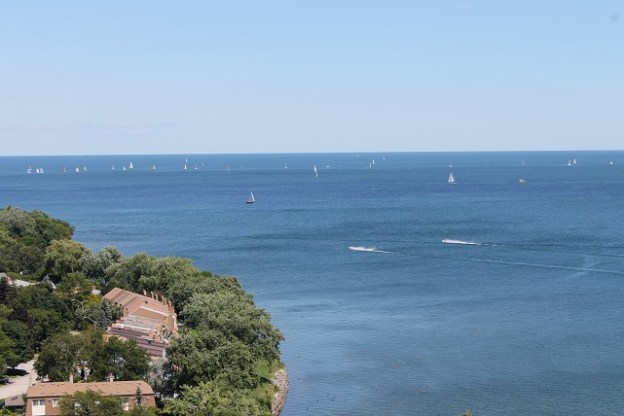
No longer young now, nor nearly so naïve, I am living high over our shoreline neighbourhood, looking out on Lake Ontario, one of 328 suites in two towers that comprise our community within the larger community.  To the east of us, the city’s glass-plated skyscrapers gleam like coppery fire at sundown each day, a testament to the vibrant metropolis we border.

Balcony View5

We, too, are a vibrant community, with so much to offer those who care to emerge from their cliff-dwellings to engage with their neighbours.  The towers share a club facility with amenities including:  an exercise wing, featuring separate gyms for women and men, separate saunas, a yoga studio, a squash court, an indoor golf range, a large swimming pool under massive skylights, a communal hot tub, and a tennis court; a sizable art room for painters of all persuasions; a woodworking facility, complete with enough power tools to make a carpenter envious; a large lounge, enclosed along one entire side with outsized windows affording a magnificent view of the lake, with a massive fieldstone fireplace at one end; a billiards room; and magnificent grounds, shaded by mature trees, with gardens and ponds galore.

Gatherings in the lounge are frequent for many club activities, including bridge and euchre clubs, book clubs, a choral group, coffee klatches, knitting groups, readers in the library—and lots more besides.  In many ways, the club is a social centre for the two towers.  At least, it is for those who choose to take part.

One of our favourite activities is the Friday late-afternoon gathering, where residents and guests congregate for an informal cocktail party before dinner.  It used to be called Happy Hour, but is known now as After Five, and everyone brings their own libations downstairs.  In the winter, a roaring fire crackles in the hearth; in summer, doors are thrown open to the lake breezes.  We find it a happy time, my wife and I, a lovely way to keep in touch with friends and neighbours.  And nobody has to drive home!

Apparently, however, not everyone agrees with us.  On our way to the lounge one day we encountered a couple in the corridor, obviously returning from grocery shopping.  We didn’t know them, but it’s our habit here to offer a polite hello to all and sundry.  The man merely nodded curtly in reply.  His wife, pulling a laden bundle-buggy several paces behind him, must have seen the wine bottle case hanging from my shoulder.

“Oh, right,” she sniffed, “it’s the drinking night again!”

We were too nonplussed to reply and carried on to our destination, struck by the tone of disapproval in her voice.  I’ve since thought of many a response I might have made, but I know the opportunity is gone.  And I’ve wondered what it is that makes some people so judgmental.

On another occasion, not too long ago, we were returning from After Five, and were joined in the elevator by neighbours from our floor, people we rarely run into.  They keep pretty much to themselves, but we see them out walking from time to time.

“Greetings, neighbour,” the man said, pointedly checking to make sure I’d pressed the right button for the elevator.

“Hello,” I replied.

“I see you’ve been downstairs drinking,” he continued.  “We’ve been out for a long walk, our second of the day, I might add.”  His wife stared at the floor.

“Wow!” I replied, feigning admiration.  “We were out earlier, too.  But I don’t try to walk when I’m drinking.  Afraid of falling down.”  It was the first retort that sprang to mind.

Silence accompanied us to the twentieth floor where we went our separate ways.

“That was childish,” my wife chided gently as we entered our suite.  “But I loved it!”

It mystifies me as to why people are like that.  And I can never understand why they don’t take part in the myriad activities and events offered here.

“It was childish,” I conceded.  “But people like that bug me.  Instead of being con-do’s, like we are, they’re con-don’ts.  Where’s the fun in that?  And why do they condemn us for taking advantage of what’s here?”

For some reason, these incidents reminded me of my long-ago confusion about condoms and condos, and the linguistic lesson I suffered through.

“You know what?” I said to my wife.  “People like that aren’t living in a condo, or a condominium.  They’re living in a condo-minimum!

And on that note, we had another glass of wine with dinner.