I Can Help With That!

Well into middle-age, I would often ask my parents questions about our family’s history.  Most of the time, those questions were based on simple curiosity, but occasionally they’d be prompted by something more important, like the medical history of family members that might impact me or my children.  Aging aunts and uncles were also a source of information, and always seemed happy to reminisce about such things.

Old photo albums were a rich source of material, too, as were scrapbooks and journals, and I remember poring over them as a child, eager to soak up the ethos and culture of my family.  Alas, when I look at some of those monochrome snapshots now, I find I recognize hardly anyone.

But now, of course, there’s no one to ask.  Both my parents and all my aunts and uncles are long departed, and I am the eldest of my family.  My three younger sisters will sometimes remember events from our shared past quite differently than I, but now we have no arbiter to call upon.

My two daughters, in their fifties now (Egad!), have taken to asking me and my wife the same sort of questions about our respective families that I used to ask my elders.  We answer them to the best of our memories, but our memories aren’t the best anymore.  I come away from some of those conversations with the uneasy feeling that I might have made stuff up to fill the gaps.

One of our daughters suggested recently that we sit down for a few interview sessions with her, where she could record our recollections.  We’ll be happy to do that, but the suggestion prompted another idea, one I immediately acted on.
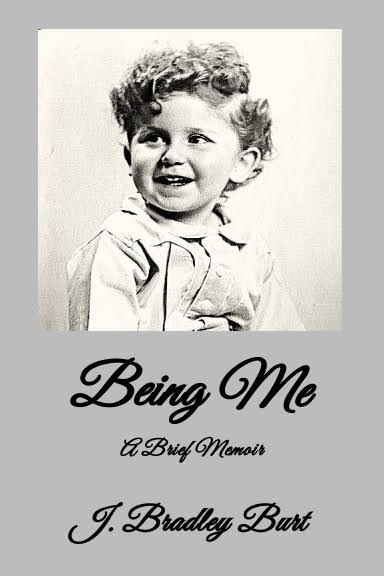
I’ve written a memoir, a brief history of my life intended for family only—my wife, my daughters and their husbands, my five grandchildren, and my three sisters—plus one friend of almost seventy years.  The book, a mere 135 pages in length, is titled Being Me, and is not meant to be an exhaustive examination of my life to date.  Rather, it’s a glimpse at who I was as a boy, who I became as a husband, father, and educator, who I am well into a blissful retirement, and who I strove to be throughout my life. It deals with those events I deem significant, things that might be of interest now or in future to my limited audience.  The challenge I faced was not trying to decide what should be included, but what should be left out.

I’d love to think there’ll be enough yet to come to justify a sequel, but that seems rather unlikely.  Dying holds no fear for me, but I will harbour a sizable amount of regret if that grim reaper lurches in too soon, for I’m having too much fun to want to leave.

It’s been said no one is ever truly dead to the world until the last person who remembers her or him is gone, and I think there’s something to that.  My paternal grandfather died just before Christmas 1948, when I was five years old.  But because I still remember him, vaguely—the only one in my family who does—he’s still alive in a way.  When I finally pass, so, too, will he.

But I’m hopeful I’ll live on, as he has for me, in the memories of those precious ones I leave behind.  And I pray those memories will be fond ones, at least for the most part, and that they’ll evince more laughter than tears.

I have more yesterdays now than tomorrows, but the inevitability of aging is but one aspect of life.  If we so choose, we can relegate aging to a mere physical phenomenon, not one that has to affect our emotional outlook.  The person looking out on the world from behind my eyes today is not the man whose image I see in the bathroom mirror every morning; rather, he is still the boy I always was—

from my aging eyes,
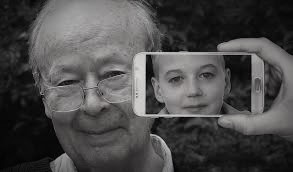
the boy I once was looks out---
hardly changed at all.
the sails of my youth,
once hoist, are often furled now,
‘though the winds still blow.

The winds do still blow, and I welcome them and am inspired by them, even if I can no longer respond as once I did.  My children and grandchildren, thankfully, are caring enough to include me in their lives; my next adventure with Donna is always just over the horizon; my next book is already forming in my febrile  imagination.  These are the winds I speak of, and the physical frailties that age sends to plague me are unable to fully constrain me.

Prompted by our daughter’s interview idea, my wife also decided to write her memoir, titled My Story, and has asked me to help.  As I read her recollections, I find many of the events she deems significant are those I also considered important.  That shouldn’t be surprising, I suppose, considering we’ve been a couple since our first date in 1963, and married for fifty-seven years.

Neither memoir, of course, will answer all the questions our daughters or their families may ask about their heritage.  But with any luck, they’ll go some way to filling in a few of the blanks.  And who knows? Maybe on some far-off day in the future, long after I’ve gone on to my next adventure, one of my grandchildren—or perhaps one of their children—will want to know something about the old-timer who preceded them by a generation or two.  No one will likely remember, but they’ll have my memoir to refer to for the answer.

I like to think it will be as if I’m still there to hear the question.  And to answer by responding, “I can help with that!”

Makin’ It Up!

Here is a poem from my latest anthology of prose and poetry, a collection of more than forty whimsical and topical essays and poems I’ve written as a member of the Pelican Pens writers’ group in South Florida.

Just released today, the book is entitled—

Makin’ It Up As I Go! Tales of a Flagrant Fabulist

It Just Isn’t Fair!
[prompt: the unfairness of life]

“It’s not fair!” I declare, disgruntled and mad,
“Why’s everything good now thought to be bad?
I’m angry about it, but what can I do?
How can I hang on to what I once knew?

“Why doesn’t Santa Claus still come to town,
With his reindeer and elves and fat belly round?
What’s wrong with allowing this old man to think
That he’ll bring me my toys, then be gone in a blink?

“And where’s the tooth fairy, who came in the night
To check ‘neath my pillow, but stayed out of sight,
And left a wee gift in exchange for my tooth?
Why doesn’t she come, now that I’m not a youth?

“What’s happened to Cupid, the elf with the bow
And his love-dipped arrows all ready to go?
Oh, where is he now each Valentines Day?
Did someone nefarious take him away?

“And how ‘bout the bunny with powerful legs
Who came every Easter with my favourite eggs?
It’s like he’s been cancelled by somebody vile,
For I haven’t seen him in such a long while.

“And whence the wee people, their shamrocks so green,
Hiding their gold in pots all unseen
At the end of the rainbows, their colours agleam?
Are leprechauns now nothing more than a dream?

“And last but not least, the sandman so wise,
Who came every night to shut down my eyes,
Is no longer part of my oft-sleepless night.
Have they taken him, too, out of sheer spite?

“It’s not fair!” I exclaim, both sad and chagrined,
“That somebody somewhere chose to rescind
My wonderful friends of childhood back there.
I hate it!” I cry. “It just isn’t fair!”

The book is available for purchase at this safe website—

https://www.lulu.com/spotlight/precept

A Cottage Christmas

Since retiring, my wife and I spend every Christmas at our Florida home.  Usually, one or both of our daughters will come down, with husbands and children in tow, to spend the holiday with us.

Friends often ask us if we miss Christmas in the snowy north.  I offer a vigorous, “No!”, and when they ask why, I tell them the story of our ill-fated Christmas at the cottage.

Our daughters were eleven and ten that year, when friends, who had decided to spend their traditional twelve days on a sunny, southern beach, invited us to use their cottage for our celebration—preparing for Santa’s arrival, skiing and skating in a winter wonderland, and just relaxing.  We jumped at the chance, little realizing what lay in store for us.

I should have known all would not be idyllic when our friends gave us five pages of notes, detailing what we’d have to do when we arrived at the retreat in the woods.  There were instructions for opening and closing the place, turning on the water system when we arrived, draining it when we left, using the fireplace, enjoying the snowmobile, shoveling snow off the roof, removing the occupied mousetraps—in short, a whole lot of things that could go wrong.

They left us their car to use, much larger than our own, a fully-equipped but much-travelled station wagon that had been around the track more than a few times.  On the day of our departure, I discovered that the rear tailgate, the sort that was supposed to open two ways, down like a truck tailgate or out like a car door, wouldn’t open at all.  Consequently, I had to load all our gear, including skis and poles, through the rear window, which could still be powered down.  As each armload went in, I had to clamber over the rear seat to pull the stuff forward.  I was delighted, as you might imagine, with the challenge.

We took to the road, full of anticipation for our family Christmas at the cottage, on the very day that the first freezing rainstorm of the season hit the area.  That cheered me immensely.

With the six of us aboard—I, my wife and two daughters, plus two dogs in the rear, trampling and drooling on all the packed items—the car windows steamed up almost immediately.  They remained that way for the duration of the four hours it took us to complete the two-hour drive.  Nobody spoke out loud during the final hour!

We arrived, finally, to be greeted by a winter wonderland.  The deep snow, now covered in a slippery mantle by the freezing rain, sparkled and glinted in the twilight.  As promised in our five pages of instructions, the driveway had been plowed just far enough off the township road to allow us to park the car.  The walk from there to the cottage was just what we had expected—arduous, but exhilarating.

The snowmobile was right where the notes said it would be.  But to my chagrin, it wouldn’t start!  In spite of my repeated (and somewhat profane) encouragement, it would not come to life.  Thus, we had to lug in all our gear by hand, twelve trips back and forth between the cottage and the car, dragging the heavy items behind us in a large snow-scoop, toboggan style.

Oh, what fun we had!

Once inside, with everyone unpacking and sorting our supplies, I turned my attention to turning on the water.  The notes our friends had left me were very detailed on this particular chore.  The pumphouse in the basement was a tangle of pipes and faucets—my friend does his own plumbing—all tagged and colour-coded to ensure compliance with the proper way of operating the system.  Without my notes, I’d have been totally lost; with them, I was merely overwhelmed.  Nevertheless, I followed the steps as written, praying fervently all would go as planned.  And it did….at least at first.

Some twenty minutes after our initial rejoicing over running water, the dishwasher sprang a raging leak from somewhere underneath.  I was able to turn off its feeder-faucet before too much damage was done, and I even managed to find the source of the problem—a burst pipe.  Because I was unable to fix the leak, the dishwasher remained inoperable for the duration of our stay.

Eventually, everything was done.  The food was safely stored away, our bags were in the proper bedrooms, the deck and walkway were shovelled clear of snow, and the Christmas tree that had journeyed north on the roof of the car was standing, fully decorated, in the living room.  At last, we began to enjoy our Christmas holiday. 

Of course, we couldn’t ski because the rain that accompanied us north continued to fall, washing most of the snow away in one day.  Nor could we go skating on the lake, because the milder temperatures that came with the rain turned the ice to slush.

If it hadn’t been for the decorations strung around the interior of the cottage, and the sound of the old, familiar carols, we wouldn’t have known we were enjoying a Christmas interlude.  With all the mud, it was like a spring holiday—until the last day, that is.  Then, about five hours before we’d planned to pack the car for home, the snows returned with a vengeance.

So again, thanks to the immobile snowmobile, we had to trudge through knee-deep, new-fallen snow, from cottage to car, packing up everything we had to take home.  I cursed every step!

I could hardly wait until the next time our friends offered us the use of their cottage when they weren’t going to be there.  I planned to torch the place.

Alone Again!

[NOTE: IF THIS COMPLETE BLOG-POST LIES IN THE BODY OF AN EMAIL, CLICK ON THE TITLE TO READ IT IN ITS NATURAL ENVIRONMENT ON MY BLOG-SITE. IF ONLY A LINK IS PROVIDED IN THE EMAIL, CLICK ON THAT.]

Have you ever found yourself absolutely alone in a crowded room—at a family gathering, perhaps, or a business function, a party with friends, a community meeting?  It would seem hard to accomplish that when one is surrounded by so many people, but I manage it all the time.

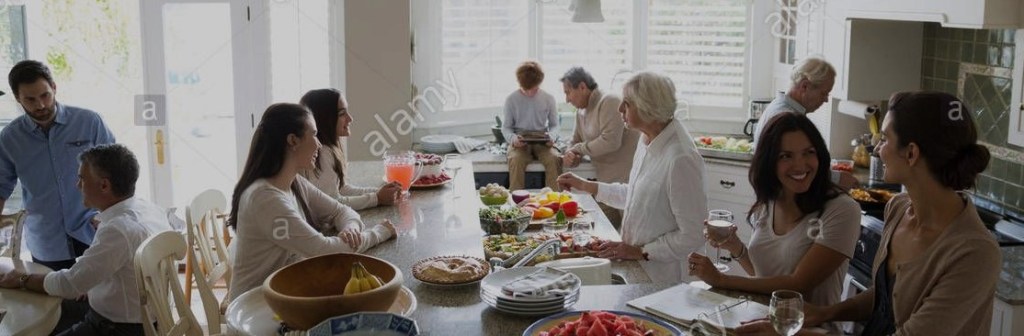
At a recent Mothers Day gathering with my two daughters, their husbands, my five grandchildren, two of their boyfriends, and my wife all in attendance, conversations were animated, exuberant, and loud.  I know, because there I was, perched on a stool around the large island in the middle of the kitchen (always our family’s favourite gathering place), surrounded by this multitude, yet strangely not involved in any of the conversations.  Nursing a glass of wine, I found myself eavesdropping on each different group in turn, quite interested in the latest news they all were sharing with one another about their work and school activities, yet not contributing a word myself.

But this is not a new phenomenon.  In fact, having become almost invisible on so many such occasions, I’m rarely even asked to contribute.

Over the years, I’ve often wondered if I’m naturally introverted, or maybe anti-social by nature.  From time to time, I’ve questioned my conversational skills or lack thereof.  I’ve even fallen prey every now and then to doubting my innate charm and charisma, and I’ve worried that perhaps no one holds me in high esteem.

Too many times, it seems, I’m at a restaurant with three or four couples, and I look up from my soup to find myself alone at our table.  I wonder if the others might be at the salad bar or in the washroom, perhaps—but all of them?  At the same time?

Or I might be at a dance, ten of us sharing a table, and I suddenly realize I’m sitting by myself again, while the others are up dancing or table-hopping.

The tedious jokes flow at these moments, naturally.  Seeing me alone, someone will ask in a loud voice if I’m dining tonight with all my friends.  Or someone will wonder if I said something to offend everyone in my party.

The problem is, I’ve never had an answer.

What I do know, however, is that I’m not one to blithely accept blame for my own perceived shortcomings.  I am a loving and capable person, after all—or so I want to believe—and I have choices.  For example, if people are ignoring me—or worse, don’t even realize I’m present—I can choose to consider it a flaw on their part, not mine.  The problem with that approach, however, is that many of them are people I love and admire, so it’s difficult to malign them, even secretly.

A better choice, I’ve discovered, is to adopt the stance that I am freely choosing to be alone in these various situations.  I’m doing it on purpose.  And why?  Well, because I’m a writer of fiction, and it’s a well-established fact that, to be effective, writers like me, who make stuff up, have to be keen observers of human nature.  After all, if we’re going to create believable characters out of whole cloth in our stories, we absolutely must possess a keen sense of what makes people tick in real life.  And the best way to do that, I’ve convinced myself, is by observing those around me, listening to them, getting a feel for them through what they do and what they say.

Interacting with people, I believe, is not good because I will inevitably corrupt the essence of who they are through my own conversational filters.  But by choosing to stand back, remaining aloof, I am better able to ascertain who they really are in their daily interactions.  They remain unblemished by any preconceived notions I might apply to them, and it is those untarnished attributes I will then bring to the creation of my own fictional characters, thereby improving the quality of my writing.

Or so I tell myself.

Nevertheless, I confess to a lingering and puzzling disappointment whenever I find myself alone again in large groups.  Recently, on the advice of someone I trust, I arranged to see a therapist renowned for helping folks like me.  My first appointment was yesterday, but to my surprise, it was a group-session—not something I had counted on.  After fetching the obligatory coffee, I took a seat in the circle and listened as each person in turn explained why he or she was there, what their last week had been like, how the others in their lives continued to let them down…and so forth and so on.  I found it fascinating, and was soon busy tapping notes surreptitiously into my phone.  I wasn’t sure that was allowed, but happily, no one seemed to notice what I was doing.

After an hour or so, I was fully-engrossed in reading over these notes, optimistic that I’d uncovered a gold-mine of observations I could use back at my writing-desk.  I looked up, eager to listen to whoever was next, and…well, you can probably imagine my shock when I discovered I was alone in the room.  The session had ended, the circle was broken, and no one had asked to hear from me.

Not knowing whether to laugh or cry, I chose the former.  These therapy sessions, I told myself, were going to prove a treasure-trove of inspiration for my writing.  And best of all, I was going to be able to gather whatever information I wanted with no one even knowing.  As in so many other instances, I was virtually invisible in the group.

No wonder I’m such a good writer!

Alone again! 

Good News…and a Preview

As many of you know, I recently published my ninth collection of stories and poems, something I’m very pleased about.

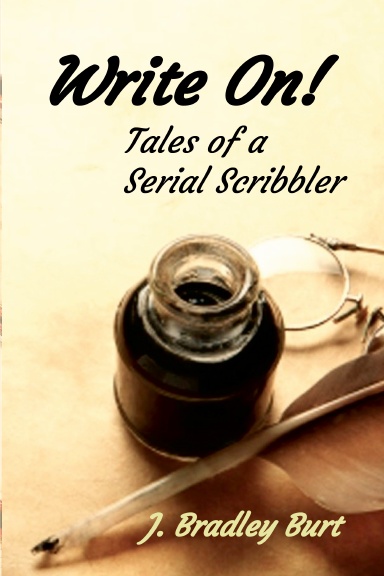
Titled Write On! Tales of a Serial Scribbler, it holds a trove of more than forty pieces I’ve written for the Pelican Pens, a group of enthusiastic writers here in southwest Florida. Each week, we meet to read our work to each other, to offer friendly encouragement, and to devise prompts to guide our creative juices for the following week.

After sending out my announcement the other day, it occurred to me that readers of this blog might like to read one of the short tales included in the book.  Titled And Off We Go, it’s founded on the prompt—embarking on a fateful journey.

I’ve entered this tale in the Gulf Coast Writers Association 2024 writing contest, a competition where I was fortunate enough to take home first-place a year ago with a piece titled But He Didn’t!

I hope you’ll enjoy this preview of what lies in store for you in Write On! Tales of a Serial Scribbler. You can see more of the book, and my other published books, at this safe link—https://lulu.com/spotlight/precept

And Off We Go

“Shall we go?”  The sepulchral voice is solemn, portentous, and it reverberates ominously in my ears.

Not yet…not yet!  I’m not ready…

I hear other voices, too, softer voices…my daughters, named for our favourite flowers so many years ago.  They’re talking quietly over me as I lie in a bed I cannot feel in a hospital room I cannot see, unable to speak or move.

“He can’t open his eyes,” Veronica says, “but I can see them moving behind his eyelids.”

“Yeah, I see that,” Jasmine agrees.  “I think he can hear us.”

“Can you, Dad?” Veronica asks softly.  “Can you hear us?”

Yes, yes, yes!  I’m right here…

“He can’t answer you, Vee,” Jasmine says sorrowfully.

She’s right, I can’t.  Everything was fine until…until…whatever day it was, I can’t remember…and that red wave washed over me, collapsing me on the floor for I don’t know how long.  And now here I am, wherever this is.

“Shall we go?” the voice resounds in my ears again, a honeyed basso-profundo, not at all impatient, yet determined nonetheless.

No, not yet!  It’s too soon…

“Keep stroking his hair, Jazz,” Veronica says.  “He always liked that.”

I did always like it, but I can’t feel a thing now.  I can only imagine how it feels, and the thought warms my heart.  I laugh inwardly, knowing my hair must be all askew.

“I love you, Daddy,” Jasmine whispers.  “I hope you know that.”

“He knows we love him, he knows,” Veronica says, and I imagine she is holding my arthritic hands in hers, gently massaging them, terribly weakened now when once they were so strong.  But I can feel nothing.

I lifted you high in these hands, Vee, high up over my head.  And Jazz, too!  And now…and now…

“Shall we go?”  The voice asks again, persistent though not offensive.

Not yet!  No!

“You don’t have to worry about us, Dad,” Veronica whispers.  “We’ll be fine.”

“She’s right, Daddy,” Jasmine adds.  “You and Mummy were the best, and we’ll be just fine.”

I know, I know…but I don’t want to go…

They’re right, of course, they will be fine, both with their own wee families now.  The little ones were here earlier with their daddies…at least I think they were…maybe not…but I’m sure I heard those four tiny voices telling me they love me.  I wanted to say it back to them, to wrap my arms around them, but…

“And don’t forget, Dad,” Veronica continues, “Mum said she’d be waiting for you to find her, remember?  She’ll be watching for you.”

Ah, their mother, my wife, my lifelong love…how I’ve missed her.  Despite a valiant struggle against the disease that wasted her, she left us a few years ago.  And yet, she never truly left us, you know?  I wonder if Vee is right, if she really will be waiting there, wherever there is…my darling Clementine…

“Shall we go?”  The voice is insistent, though not unkind.

No, please!  Not yet…

“I’m sure Mummy’s been missing you, Daddy,” Jasmine murmurs, and I can hear the sob catching in her throat.  “You were meant to be together for all time.”

“Exactly!” Veronica says, trying to lighten the mood.  “Like apple pie and cheese!  Like mustard and relish!”  She laughs softly as she gropes for more examples.

Jasmine joins in her sister’s laughter, and my heart dances to the sounds of their lilting voices.  “Yeah, or like Abbott and Costello!” she says.  “Like Jack and Jill!”

“Lady and the Tramp!” Veronica offers, and the laughter grows louder.  “Romeo and Juliet!”

“Omigod!” Jasmine gasps, their laughter rolling freely now.  “Tweedledum and Tweedledee!  Lancelot and Guinevere!  Sweet and sour!”

“Yin and yang,” Veronica says, and they stop on that one, as if it’s the perfect one to describe me and Clemmie.

“Shall we go?” a voice asks again…but it’s a different voice this time.  Frozen inside my immobile body, I cannot move, but I feel as if I’m turning around and there is Clemmie…as young and as fair as the first rose of summer.  She’s standing in the midway at the State Fair, pointing at the Tunnel of Love attraction, the one where we had our first, tentative kiss, where the sense we’d found something special first dawned on us.

“Shall we go?” she asks again, and her eyes are sparkling, her smile warm and welcoming.

“It’s okay, Dad,” Veronica whispers, “it’s okay to go.”

“Goodbye, Daddy,” Jasmine breathes.  “We love you.”

Goodbye, goodbye…I love you both…

And I reach for Clemmie’s hand, and off we go.

Ciao For Now

A recent prompt from my Florida writers’ group asked us to make up a story about a person whose time is running out. This is my make-believe offering—

In all the years I knew him, I never heard my father use the word goodbye.  Not to anyone, not ever.  At every point of farewell, he’d offer up a substitute or synonym for the word—Pip-pip!  So long!  Good night! Cheerio!  ‘Til next time!  Toodle-oo!  See you later!  Take care!

Occasionally, he’d venture a foreign language—Adieu!  Auf Wiedersehen!  Adios!  Sayonara!  Towards the end of his life, he came to favour Ciao for now!  But he’d never use the word goodbye, and I used to wonder why.

He tried to explain it once to a mildly-curious, teenaged son.  “The word is too permanent, that’s all.  It implies the end, the finish, that there’ll be nothing to follow.  I prefer to think I’ll be meeting the other person again.”  But I confess, I didn’t really see the difference, callow as I was.

Although born and raised in Canada, my father was an Oxonian—a graduate of Oxford University, Balliol College, class of 1932, a member of the rowing club—and among his lecturers were C.S. Lewis and the great J.R.R. Tolkien.  Gainfully employed back in Canada with a PhD in Literature, he was one of the earliest to enlist after Canada went to war in 1939.  He served as a medical orderly until demobbed in 1943, when he returned home in time for my birth.

“Despite our best efforts to save them, we lost a lot of good fellows,” he would reflect from time to time in his later years.  “We knew their time was running out, but I never said goodbye to any of them.  I wanted them to believe there was still more to come.”

Somewhere over there, with his comrades at Oxford or in the obscene battlefields, he learned a nonsensical, British ditty about farewells, not goodbyes, and he used to sing it to me and my siblings from time to time, usually when we balked at having to go to bed.  He was an enthusiastic, if somewhat undisciplined, singer, but we came to love that song.

Eventually, of course, the fateful day arrived, as it does for all of us, that my father’s own time was running out.  Home from hospital for the last time in the deep mid-winter, he was with my mother and their five children and our spouses—the ‘dirty dozen’, as we had long styled ourselves.  We all knew the end was nigh, though none acknowledged it, and small talk prevailed until my father raised a frail hand.  We waited, breath bated, and in a faltering voice between short gasps for breath, he sang that song one final time—his way of letting us know this was not goodbye.

Most of us, I suspect, did not believe that, but no one let on.

A few months later, when the frost had left the ground, we gathered again at the family’s burial plot for my father’s interment, joined this time by his grandchildren, his sister, his nieces and nephews, and a few cousins.  In keeping with his wishes, it was a simple ceremony, and two of us spoke on behalf of the group before his ashes were lowered into the grave by his eldest grandchildren.  And then we all stood around, staring awkwardly at the ground, as if reluctant to leave.

At that point, with an exquisite sense of timing, my younger brother stepped forward and began to sing our father’s farewell nonsense-song, his voice soft but firm.  Before he could finish the first line, all of us who knew it had joined in—a sad farewell, yet a joyous acknowledgment that this was not goodbye.

Pip! Pip! Toot-toot, Godspeed,
Toodle-oo, toodle-oo, toodle-oo,
Ta-ta, old bean, Ting-ting, old thing,
Chuckeroo, Chuckeroo, Chuckeroo!
This parting brings us sorrow,
We hate to say adieu,
So, we’ll say Ting-a-ling, old tin of fruit,
Cheerio, cheerio to you!

Now, within hailing-distance myself of the age at which he died, I think of my father often, and I hear that little ditty echoing in my mind, just as he sang it so many years ago.

Cheerio, Dad,” I murmur each time.  “Ciao for now!”

A Crowd of Stars

The youngest of my brothers-in-law died recently, following a long period of worsening, physical incapacity and illness.  He was the second of my generation to go, my younger brother having passed three years ago, and I suspect his death brought the spectre of the end-times somewhat closer to us all.

In addition to my sister, he left behind four children, three of whom are married, giving him three grandsons and two wee granddaughters.  At his private interment, his daughter and three sons spoke of him as a loving and beloved father, and there is no greater tribute I can imagine.  Eighteen of us exchanged reflections and prayers that day, spoken to each other and to him, designed to bring a sense of closure and peace to us all.  We were saddened, of course, by his passing, but relieved that his suffering was ended.

He was married to my sister for forty-five years, a loving union that brought credit upon them both.  I still remember dancing at their wedding, when none of us—so young and brash and full of piss-and-vinegar—could have imagined this day coming.  But it has now for him, as it must someday for all of us.

Deliberate and intentional in word and deed, especially as he grew older, my brother-in-law was rarely intemperate or harsh in his dealings with others.  A man of deep faith, he was loving and giving, and forgiving of others’ shortcomings.  Throughout his tribulations, he was confident that, as he approached the final crossing, he would meet his saviour on the other side.  I hope he has.

In her remarks, my sister said something I thought perfectly summed up his life and faith—from Matthew 25:23, “Well done, good and faithful servant; thou hast been faithful over a few things…enter thou into the joy of thy Lord.”

My wife shared many of those same understandings about what is to come with him, and I remember them engaged in deep conversation over the years, communicating their ideas and beliefs, their hopes for the hereafter.  By contrast, given my differing views, the exchanges I had with him tended to be temporal more than spiritual, though always sincere and affectionate.  He had a way of thinking before he spoke, and I constantly found myself leaning in to be sure not to miss what he might have to say.

The day after he passed, I wrote the following note to my sister—

When we get old, as some of us have, we think differently about death than when we were younger.  I won’t say we ever look forward to it, but we perhaps stop fearing it.

We think of death as a companion on our journey through life—way back in the throng at the beginning, but gaining on us as we begin slowing down.

We think of death, not as a spectre that will end things, but as an usher who will open the next door and allow us in.

Just as life ushered us in at the beginning of our journey through the here and now, death ushers us into the beginning of our next journey.  None of us knows what that journey will look like, but faith sustains us.

When I think of him now, and where he is, I think of these lines, adapted from the poem High Flight, by John Gillespie Magee, Jr.—

Oh!  he has slipped the surly bonds of earth
And dances the skies on laughter-silvered wings…
He has topped the wind-swept heights with easy grace…
Put out his hand and touched the face of God.

With that note, I also included one of my favourite poems, When You Are Old, by William Butler Yeats, the greatest of the Irish poets.  I imagine it as the song my brother-in-law might be singing now to my sister from wherever in this vast universe he finds himself, and I hope it comforts them both—

When you are old and grey and full of sleep,
And nodding by the fire, take down this book,
And slowly read, and dream of the soft look
Your eyes had once, and of their shadows deep;
How many loved your moments of glad grace,
And loved your beauty with love false or true,
But one man loved the pilgrim soul in you,
And loved the sorrows of your changing face;
And bending down beside the glowing bars,
Murmur, a little sadly, how Love fled
And paced upon the mountains overhead
And hid his face amid a crowd of stars.

Tell ‘Em I’ll Be There

In my dream on this midsummer evening, I hear the harmonies wafting through the screen door and open windows, a ricky-tick piano accompanied by exuberant voices, men and women, some a tad off-key, but all in on the song—

In the cool, cool, cool of the evening,

When you’re lovin’ the summer air,

In the cool, cool, cool of the evening,

Save your boy a chair,

When the party’s gettin’ a glow on, and singin’ fills the air,

In the shank of the night, when the doin’s are right,

Well, you can tell ‘em I’ll be there.

I enter the familiar house—not as the twelve-year-old I was then, but the eighty-year-old I am now—and I move freely and unseen among the gathered throng.  All of them are there, as they always were, and I start in the kitchen where I see my mother, Dorothy, and her mother, Pearl, refilling bowls of snacks, washing and drying glasses, emptying and cleaning ashtrays.  The kitchen table is littered with mickey-bottles, partially-empty bottles of soda and ginger ale, and empty beer bottles.  But I remember from experience, it will be properly set for breakfast by morning.

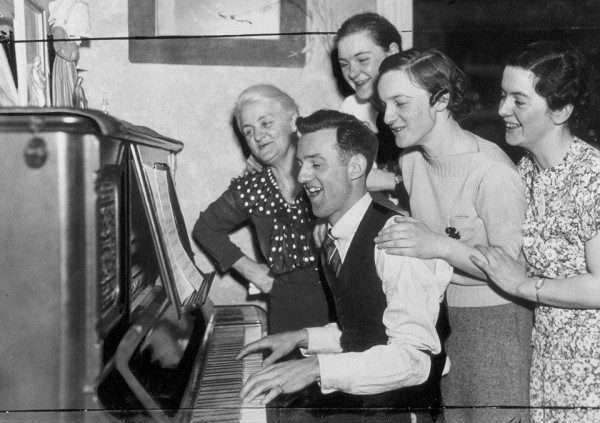
I wander into the dining-room where the assembled singers are sitting or standing near Mike, the next-door neighbour, who is perched on the stool in front of the upright piano, tickling the ivories, as Dad calls it.  Dad says he plays by ear, which always struck me funny because it’s his fingers that dance across the keyboard, responding to every shouted request for a song.  To keep him going, Dad makes sure he always has a bottle of Black Horse Ale by his right hand.

Mike’s wife, Claire, a tiny French-Canadian gamine, sits beside the piano, smiling shyly and swaying to the rhythms her husband is pumping out.  She speaks halting English, always has a drink in her hand which she rarely sips, and reminds me now of Leslie Caron.

Beside her is my mother’s father, Gordon, and his voice is among the loudest and truest in the raucous chorus.  The son of a banty Irishman, one of five boys, he is proud of still being welcome at any party with his own five children and their spouses.

Almost everyone is smoking, and the muggy air is redolent of cigarette and cigar, which I don’t mind, although I’ve never been a smoker.  A hazy, bluish pall hangs up near the white, popcorn ceiling, and will eventually yellow it, but no one is thinking about that right now.

It occurs to me that, except for my mother and father, every one of these people will die before they reach the age I am now, most in their seventies, some sooner.  But no one save I ponders that right now, either, and the songs keep a-coming.

I’m gonna buy a paper doll that I can call my own,

A doll that other fellows cannot steal.

And then the flirty, flirty guys with their flirty, flirty eyes

Will have to flirt with dollies that are real…

My mother has three sisters, Marie, Eunice, and Irene, and a brother, Jim, all of whom, like my mother, regale in the spotlight.  All of them are attractive, they all fancy themselves singers, and they are competitive with each other—although loving, of course.  But none wants to take a backseat, so they forever try to outdo each other.

Eunice is the best of them, I think, referred to more than once in a local newspaper as ‘the songbird of the north’, and her preferred style is like Peggy Lee or Connie Boswell—whispery, cool, seductive, sophisticated.  I think she’s enamored of a friend of my parents, Jack, and I watch as she purrs one of her songs to him—

You made me cry and walk the floor,

If you think I’ll crawl back for more,

Big Daddy. you’ve got a lot to learn…

Jim thinks of himself as Sinatra, not only in his style of singing, but in his expressions, how he dresses, how he carries himself, how he relates to others.  And I must admit, he does do more than passing justice to some of the classics, one of which I’m listening to now in the dining-room—

It’s quarter-to-three,

There’s no one in the place ‘cept you and me,

So set ’em up, Joe, I got a sad story you oughta know…

So make it one for my baby, and one more for the road.

It goes without saying, however, there are no solos in this crowd, not for long.  One person may have the floor for a few seconds, but only until the others recognize the song, and then the chorus begins anew.  Irene, she of the dancer’s legs, sings quietly, mostly to her husband, Bev, and he bestows his crooked grin on her as he listens—

Gonna take a sentimental journey,

Gonna set my heart at ease,

Gonna make a sentimental journey

To renew old memories…

I realize that’s what I’m doing, too, as I wander through the house, taking it all in.  The hallway between the kitchen and the dining-room has a closed door leading to the second-floor bedrooms, and I know if I open it, I’ll see my younger self seated on the stairs beside my brother, Allan, and my younger sister, Colleen—chins in hands, elbows propped on knees, listening to the music.  My other two sisters, Dale and Martii, both much younger, will doubtless be abed and asleep despite the din.  But I choose not to open the door.

Marie has the floor now, if only briefly, and in the imperious manner of the eldest child, the athletic one, she tells Mike the next tune he must play.  And as always, she sings it to Bob, her husband, and just like every other time she’s tried, she isn’t able to finish before choking up in tears—

You’ll never know just how much I love you,

You’ll never know just how much I care,

And if I tried, I still couldn’t hide my love for you,

Surely you know, for haven’t I told you so a million or more times…

When she stops, I find myself finishing it for her in my head, for it’s one of my favourite songs, and they are my favourite aunt and uncle.

…If there is some other way to prove that I love you,

I swear I don’t know how.

You’ll never know if you don’t know now.

Mike heads for a bathroom break, so Dad takes his place at the piano.  If he could be anything in life other than what he is, I imagine it would be a concert pianist.  But he isn’t, and so he limps through a very limited repertoire, concluding with his truncated version of the finale of Gershwin’s Rhapsody in Blue—which is decidedly not rhapsodic as he pounds it out.  And because it has no lyrics, it requires him to improvise in his boisterous baritone—

Da da da dah!

Da-da da-da da da da dah,

Da dah!

Da da da,

Da-DAH!

Mercifully, Mike comes back, beer in hand, with another for my father.  I watch in remembered awe as air bubbles dance inside the green, long-necked bottle they tip back for long swallows.  When Mike is seated again, the first song called for is Jack’s, and his gravelly bass rings out the familiar lyrics—

Chi-ca-go, Chi-ca-go, that toddlin’ town,

Chi-ca-go, Chi-ca-go, I’ll show you around.

Bet your bottom dollar you’ll lose the blues in Chi-ca-go,

The town that Billy Sunday could not shut down…

But I discover suddenly that the party I am so enjoying is beginning to shut down, at least for me.  I’m still there—this eighty-year-old apparition, unseen by anyone—but the scene around me is growing dimmer, the music fainter. And then I spy my mother, back from the kitchen, whispering to Mike at the piano, and everyone stops to listen as she sings a piece she has sung to me for as long as I can remember—

I wonder who’s kissing her now,

I wonder who’s showing her how…

I wonder if she ever tells him of me,

I wonder who’s kissing her now?

And when she is finished—as all around her slide away into the deepening fog of long-ago, all these people I loved and whose lives I enjoyed being part of—I sidle over to her and plant a lingering kiss on her cheek.

I used to ask her when she sang the song to the infant me what that now was, the now that was being kissed; in my childish innocence, I didn’t understand the word as a temporal reference, thought of it as a thing, like a nose or a forehead.  She would simply smile and kiss both of mine.

So now, on the cusp of waking—just before I find myself alone again in my dream, outside that house of yesteryear in the warm, summer night—I wonder if I might be allowed to join that party myself in some not-too-distant-future.  And in hopeful anticipation, I offer my own version of one of the songs to my mother and father—

In the cool, cool, cool of the evening,

Save your boy a chair…

In the cool, cool, cool of the evening,

I’ll find you anywhere,

When the family all ask about me, askin’ if I care,

If they’re wonderin’ if I will join ‘em on high—

Well, you can tell ‘em I’ll be there.

A Party? No Thanks!

Another birthday, the eightieth since my actual day of birth, is looming.

If I have my way, there will be no party celebrations to mark the occasion—no gathering of friends, no gifts, and most mercifully, no public rendition of that ubiquitous birthday song by a bored, yet dutiful, cadre of restaurant servers.  Rather, the occasion will be marked by a fond embrace from the one who has been alongside for all but the first twenty of those eighty anniversaries.

For me, the party tradition has gone on too long.  It’s not only over now, it’s overrated.

The last big celebration I remember was on my twenty-first birthday, when my parents planned a party to honour the passage of their firstborn from boyhood to manhood—as if it had happened all at once on that given day. 

In 1802, Wordsworth memorably observed, The child is father of the man…, and so it has always seemed to me.  But truth be told, in all the years spent being a man since then, I don’t believe I ever left the boy behind.  He lurks behind the adult mask, only rarely emerging, as though fearing he’s no longer welcome.  But I still search him out sometimes, if only to reassure him.

I don’t really remember that twenty-first birthday party, of course, it having occurred almost sixty years ago.  But I do have photographs to remind me of the momentous occasion—washed-out Kodachromes of people who meant the most to me back then—some gone now to their spiritual reward, others, like me, to lingering adulthood.

My mother and dad grace several of the photos, beaming with parental pride (I’ve always chosen to assume), both of them decades younger than I am now.  How can that be, I wonder, and where did those years go? 

My siblings—a brother and three sisters—all stand with me in other pictures, our arms around each other, full of that relentless, youthful optimism that has not yet encountered the eroding onslaught of time.  It did assail us eventually, of course, but so far, all but my brother have survived.

A couple of close friends were present at that party, too, both mere weeks older than I, and eminently wiser (or so I imagined, given their earlier entry into manhood).  Both remain  fast and true friends to this day—and they, too, like me now, have reached the end of their eighth decade.  Imagine!

Most dear of all in those faded photos is my high school sweetheart, smiling happily, if a tad uncertainly, still getting to know the large, somewhat strange family whose son she was keeping company with. 

On that day, we were still two years removed from the moment when she would accept my offer of marriage, and she, I’m sure, had no idea right then that such a fate awaited her. Even I, it must be said, had only begun to suspect she might be the one. That longed-for wisdom prevailed, I suppose.

Anyway, that’s the last big celebration I recall.  There have been many so-called milestone birthdays along the way—the thirtieth (Never trust anyone over thirty!), the fortieth (Forty is the new thirty!), the fiftieth and sixtieth (the golden years, so dubbed by those who couldn’t avoid them), and even the seventieth (entry point to the last of the three stages of life: youth, adulthood, and You’re Lookin’ Good!). 

But the milestone birthdays never impacted momentously on me.  Each was just one more marker in a so-far-endless progression of years, gratefully attained, yet no more important than any of the others.

Among the most special greetings I receive on every birthday are those from my two daughters, both of whom endearingly insist that I’m not old, I look terrific, and I’m every bit as good as I once was.

“Hmm,” I tell them, “maybe I’m as good once as I ever was!”

For the past twenty-one years, I’ve been further blessed to hear from a younger set, my grandchildren, five in number now, who cannot for the life of them understand why there won’t be a big party on my special day, with balloons, and cake, and lots of presents.  Not to mention the goodie-bags they used to get at their friends’ birthday parties when they were younger.

“Don’t you like parties, Gramps?” one of my granddaughters once asked.

“Don’t you have any friends, Grandpa?” my grandson chimed in.

But I always told them I’ve had more birthdays than I have friends and family combined, and that on my birthday, I’m more than content just to have my grandchildren loving me.

“Oh, we love you, Gramps,” they affirm.  “But grown-up goodie-bags might still be a good idea, y’know.”

I do know.  My goodie-bag has been overflowing for eighty years.

To Make An End

For last year’s words belong to last year’s language.  
And next year’s words await another voice.
And to make an end is to make a beginning.
                                                                    - T. S. Eliot

As another year draws to an end, and with it the approaching close of my eighth decade on this journey, I know I am among the most fortunate of my fellow-travellers.  For sixty years of my passage, I’ve been accompanied by the wonderful young woman I first met when she was but sixteen.  She is young no more, of course, but as W. B. Yeats wrote in When You Are Old (almost as if he had her in mind)---

How many loved your moments of glad grace,
And loved your beauty with love false or true,
But one man loved the pilgrim soul in you,
And loved the sorrows of your changing face.

I still do.

Also with me for fifty-plus years of my journey have been the two magnificent daughters who have graced their mother and me with their love, their friendship---and increasingly now, their protection against the failings of age.  When they were little, we made a pact to hug them close for as long as we could, then let them go when time dictated.  As you might expect, the hugging was easy; the letting-go was hard.

But it has been written that when we love someone, we should set them free, and if they come back, then their love is ours forever.  That has certainly been the case for us, for which I’m eternally grateful.  Our girls are women now, but as I’ve often told them, although they are no longer children, their mother and I will never stop being parents.

In due time, those women brought two wonderful men into our lives, and with them produced five wonderful babies of their own---four granddaughters and a grandson for us.  It was as if the cycle started up again, but with my wife and I one step removed this time---loving them, wishing the best for them, but somewhat distant from the immediacy of their lives.  We strive to remain relevant, of course, and they, in return, take pains to make it so.

Kahlil Gibran wrote of that in his meditation, On Children---

You may give them your love but not your thoughts,
For they have their own thoughts.
You may house their bodies but not their souls,
For their souls dwell in the house of tomorrow, 
Which you cannot visit, not even in your dreams.
You may strive to be like them, but seek not to make them like you.
For life goes not backward nor tarries with yesterday.

And in that last line lies the very essence of the joy and sadness, both, that are implicit in our lifelong journey.  Things begin.  Things end.  Things begin anew.  Or so it has always been for me, and will be for some time to come, I fervently hope.  But there will eventually come a moment, I know, when no next beginning will follow the final end.  Despite my reluctance to face that day, I do not fear it.  My approach to its inevitability is summed up in this final stanza from one of my own poems, I Haven’t the Time--- 

I haven’t the time for anger or rancor, or grumbling, self-pity, or frown.
Life’s about living, getting and giving full measure before it winds down.
When that day is nigh, as ‘twill be by and by, I hope it will be widely said,
That as man and boy, I strove for the joy of living until I was dead.

My closest companions along the way have certainly brought that hope closer to reality than it might otherwise have been.  To paraphrase the late Queen Elizabeth II, my dear family have been my strength and stay the entire way.  As we enter into 2023, I hope for all of you who read these posts that you will feel as blessed as I, and that the ending of this old year, no matter its triumphs or tragedies, will be a new and happy beginning for you.

To make an end is to make a beginning.

Happy New Year!