Philosophy 101

Philosophy 101 posed an interesting question:  If a tree falls in the forest, and no one is there to witness it, does it make a noise?

“Of course it does,” one person might answer.  “Noise is governed by the laws of physics, regardless of human presence.”

“Not so fast,” another person might argue.  “Sound waves from any source emit no noise on their own.  It is only when they are received that those waves generate noise.”

Which, if either, is the correct answer?  I’ve heard persuasive arguments mounted on both sides of the question, but I’ve always been struck by the impossibility of being able to prove either position.  One cannot be simultaneously there and not-there when the tree falls in order to determine if it makes a noise.

And it probably doesn’t matter, anyway.  The tree fell.  Who cares?

tree

Here’s another question:  If a person is unaware that (s)he is doing wrong, does the action still constitute wrongful behaviour?

“Of course it does,” one person might say.  “The concept of right and wrong is an absolute, and ignorance of the wrongfulness is no excuse.”

“Not so fast,” another person might argue.  “The concept and definition of right vs. wrong are not universally-accepted.  They are ethnocentric, based upon cultural and religious teachings, only some of which might overlap.”

Here once again, as with the first question, one might shrug off the relevance or importance of the answer.  We already know bad things often happen to good people, so what difference does it make if they are the result of unknowing wrongdoing or merely random happenstance?  The result is the same.  Who cares?

Well, the answer to this second question, I believe, does matter, indeed.

I’ve been thinking a good deal about this since beginning work on a novel, my fifth, which has as its backdrop the national inquiry into missing and murdered Indigenous women and girls currently underway in Canada.  Researching the subject leads, inescapably, to a list of similar situations—the forced sterilization of Indigenous women, and the forced relocation of Indigenous children and their enrollment in residential schools, to cite but two examples—both undertaken as official government policy well into the twentieth century.

res school

Most Canadians now, I think, see these actions for what they are: atrocities.  To those who don’t, I would simply ask, “What if they were to come for you, or your children, tomorrow?  Because of your skin-colour, perhaps.  Or your religious beliefs, your sexual orientation, or your political stance.”

Governments today, federally and provincially, are apologizing and attempting to make amends to the descendants of those who were victimized.  Some Canadians, it is true, believe such efforts are unwise and unnecessary, given that it was not we who committed the deeds, but our predecessors.

It begs another question:  Why should we be held accountable for the actions of people who died long before we were even born?

In answering this question, it’s instructive, I think, to try to determine if those actions were wilful or merely misguided.

Did those in authority in that earlier time think they would somehow improve the Anglo-Saxon bloodlines of our populace by sterilizing Indigenous women to prevent the birth of what some of them termed defectives?

Did our predecessors know—even as they did it—that they were wrong to uproot children from their families, to send them far away, to inflict the terrors of residential schools upon them?

Or, were they just trying to do the right thing, what the orthodoxy of those imperialistic times demanded, the assimilation of conquered, native peoples into the colonial mainstream?

“Of course they were right,” one person might claim.  “They weren’t monsters!  Many of them were clergy, nuns, teachers, all doing what they believed to be right.”

“Not so fast,” another person might say—especially a person of Indigenous descent.  “They were rapacious invaders who took everything from our forebears—their land, their culture, their language, and their children.  Would they have considered it right and just, had the tables been turned?”

I suspect the truth lies, to some extent, in both answers.  Surely there were good and faithful people among the newcomers who believed they were doing God’s will, just as there were avaricious adventure-capitalists, determined to seize the riches of the new land for king and country (and their shareholders).
But the fact is, most Canadians today have come to a realization that those actions were wrong, regardless of motive.  Even if the best among our predecessors were unaware they were acting wrongfully, their actions still constitute wrongful behaviour by today’s standards.  And, they were knowingly carried out with government approval under the banner of Canada—under an authority that endures from generation to generation.

kid

So, here is a fourth question:  If hundreds of thousands of Indigenous people who lived in territory under the jurisdiction of Canada were severely mistreated by their government, and if no one alive today was there to witness it, does it matter, and should the government of today be held to account for those misdeeds?

The answer to this last question will not be found in Philosophy 101.  But I choose to believe you and I, if we seek the truth, will find it.

Within ourselves.

Curmudgeon!

Curmudgeon! 

Such a wonderful word to roll around on your tongue.  It has a solid, satisfying sound when spoken aloud, dropping weightily into a conversation like a bag of sand thumping a wooden floor.  It is defined as somebody who is bad-tempered, disagreeable, or stubborn.

Not at all the person I believe myself to be!

Yet, according to several of those closest and dearest to me, I am becoming something of a curmudgeon.  They tell me it has to do with my rather determined efforts to hold fast to the social dicta instilled in me by my mother.

etiquette

Although it’s been seventy years since first that grand lady began educating me on the social niceties—and despite my knowing that the customs and mores of our changing society have altered since then—I cannot stop bemoaning the loss of what I consider to be simple etiquette.

Let me provide a few examples, taken from experiences we had with folks in the community where we used to spend our winters.  And, I don’t mean to give you the wrong impression of them; they were all lovely people, good-hearted, gracious, and kind.  It’s just that they didn’t necessarily subscribe to the things I learned at my mother’s knee.

When my wife and I would invite a few couples for a dinner party, for instance, and specify an arrival time of five-thirty, I didn’t appreciate when everyone would arrive, fashionably late, some twenty minutes past the expected time.  We’d be sitting anxiously alone, wondering if everyone forgot—worrying that the hot hors d’oeuvres would be cooled and soggy by the time we got to eat them.

hors d'oeuvres

“Oh, we just wanted to be sure you were ready,” our guests would say when I’d make a supposedly-offhanded comment about their lateness.

But you see, we were always ready when we said we’d be.  Always.  If we’d thought we needed more preparation time, we’d have set a later arrival target for everyone.  My mother believed it was proper to arrive when your hosts asked you to.

“There’s nothing fashionable about being late,” she would say.  “It’s just rude.”

Hospitality gifts were another example.  Although they weren’t de rigueur, it became the thing to do as we visited back and forth at each other’s homes.  A favourite gift was a bottle of wine, nicely encased in a gift bag designed for the purpose—but never of the same vintage as might have been previously received from the same couple.

“Thank you,” I would say fulsomely as I pulled the bottle from the bag and set it to one side.  “We haven’t tried this one.  I’m sure we’ll enjoy it.”

“Aren’t you going to open it?” they’d ask.

“Uhh…no,” I’d reply, “not just now.  We have wine already selected for tonight.”

Their disappointment would be palpable as I proceeded to pour them a glass from the decanted wine I’d already planned for the evening.  And I was somehow made to feel as if I were offering a second-rate product, when sometimes, it was better than what they’d brought.

“How rude is that!” I’d rail at my wife after everyone had departed.  “And you know what’s even worse?  They took home the gift bag they brought their wine in!  Can you believe it?”

wine gift bag

My wife would tell me not to get so worked up, but it just didn’t seem right.

Here’s another case in point.  The day after our dinner party, some people would phone to thank us for the evening, graciously commenting on the food, the company, or the conversation among friends.  That’s exactly what my mother told me to do.

“Always call the following day to thank your hosts once again.”

But, increasing numbers of people don’t think to do that anymore.  Or perhaps they do think of it, but can’t be bothered.  Either way, it’s a classic breach of etiquette.

“Don’t worry about it,” my wife would say when I’d rail on about it.  “They thanked us several times at the door before they left.”

“It’s not the same,” I would respond, still miffed.

Now, lest you think I’m overly critical when I have no right to be, let me assure you that I tried to practice all these niceties when we were on the other side.  I’d ensure that we arrived on time, as specified by our hosts, never more than a minute out either way.

“Oh!  You’re here!” they’d say, lifting an eyebrow in surprise as they opened the door.

“Five-thirty,” I’d reply, with an exaggerated glance at my watch.  “That’s what you said, right?”

On one occasion, our hostess was still in the shower when we got there, at the appointed hour, and her husband wasn’t sure whether or not to let us in.

Of course, we always brought along a gift, usually the ubiquitous bottle of wine.  I’d proffer it unassumingly to our host, and often, to my great surprise, he’d open it immediately to pour us each a glass.  I found that mind-boggling.  It made me wonder if he didn’t have enough of his own, and was dependent on his guests for the evening’s libations.

“What if we’d brought flowers?” I’d rage later to my wife.

flowers2

And, so many times, when my wife or I would phone the following day to thank our hosts again for their hospitality, they would always sound bemused.  As if we shouldn’t have bothered.  As if they didn’t care, one way or the other.

“Don’t these people know any better?” I’d rant, scarcely coherent.  “Doesn’t anybody have any manners?  Why can’t they just do things right?”

“You mean your way?” my wife would reply sweetly.

“Yeah,” I’d say forcefully.  “The way my mother used to.”

But it would fall to my wife to have the last word in these discussions, and it’s a word that would always shut me up—at least temporarily.

“Curmudgeon!” she’d say.

curmudgeon


Expletive Deleted!

Neither a borrower nor a lender be!”  Sage advice from the English Bard, advice which I unsuccessfully tried to impart to my daughters as they were growing up.

shakespeare

Borrowing is an art, I used to tell them.  It’s very unlike lending, which is a straightforward act requiring nothing more than an assenting response to another’s request.

Anyone can lend something to someone.  No particular talent is needed, no marked intelligence, no difficult decisions.  A simple yes is all that’s necessary, and it’s done—just like that!

But borrowing is another thing entirely.  As a borrower, one has to know what’s needed and where it might be found.  One has to make certain decisions and offer certain guarantees to the lender.  It’s essential that one be able to make the request in such a manner as to elicit agreement from the other party.  And, of course, one must return the borrowed article in reasonable condition within an acceptable length of time.

Alas, it was that last condition that gave me a lot of trouble.  I’m a borrower, and always have been, which is why my daughters didn’t take my advice too seriously.  Yet, I never fully mastered the art of it.

I always knew what I needed and where to find it; there was no problem there.  And, I generally found other people quite agreeable in allowing me the use of whatever it was I asked for.  But returning what I borrowed in the same condition in which I received it always seemed next to impossible.

Mind you, I never took something back in a worse state than I found it.  That wouldn’t be ethical—and besides, I knew I’d soon run out of people who would agree to my borrowing their things!

No, my problem was that I ended up spending money to repair or replace the borrowed item, because, while in my tender care, the infernal thing would fall apart, get misplaced, or simply cease to operate.

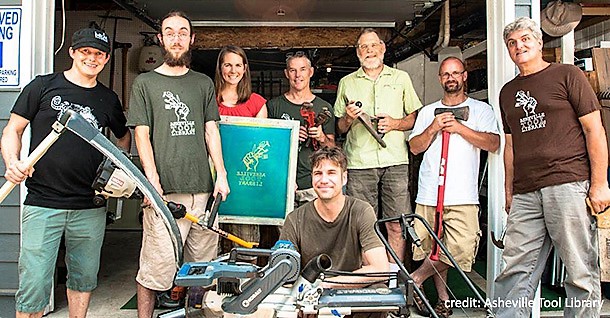
The people from whom I borrowed stuff could hardly wait to see what wonderful surprises I’d be bringing back to them.  They actually came to my house, carrying things they wanted me to borrow!

toolsharing-01

One neighbour, for example, received a brand-new outdoor extension cord from me.  I ran over his with the electric mower I borrowed from him when my own gave up the ghost.  It was on that same occasion that his mower had a new on/off power switch installed—at my expense, naturally, since it cracked and broke while I was using the mower.

The same neighbour, on other occasions, had free repairs made to his electric barbecue starter, his circular saw, and the front fender of his car, all paid for by me before returning the borrowed items to him.

When his firm transferred him out west, the poor fellow literally cried at having to leave me!  As a going-away gift, I presented him with a new camera—to replace his old one, which I had dropped overboard on a canoeing expedition.

Given my track record, it was no wonder most of my friends knew that I never mastered the fine art of borrowing.  When people dropped by to see if there was anything I’d like to borrow from them, they also brought along a list of replacement items they’d be glad to receive when the usual misfortune befell me.

Eventually, however, I started cutting way back.  I discovered that I just couldn’t afford to keep borrowing other people’s things, upgrading or replacing them, then returning them.  With my daughters’ encouragement, I resorted to borrowing something only when I really, absolutely needed it.

There was the time, for instance, when I had to borrow my sister’s electric typewriter—this, in the days before computers.  I had a writing deadline, and my own, heretofore-dependable Underwood had expired.  Hers worked perfectly for the first few hours, and then, to my horror, I discovered the last line I had typed read:  Thx summary conclusions prxsxntxd bxlow arx furthxr xxplainxd in thx sxvxn appxdicxs attachxd to thx rxport.

typewriter-210640_960_720

My sister was not amused when I tried to return the defective machine with only a new ink ribbon to offset the problem.  Were I to tell you what she said, using her typewriter, it would have read:  xxplxtivx dxlxtxd!

So, before you ask—No!  I don’t need to borrow a thing, thank you.


Really? It Was the Dog?

“Honest, sir!  The dog ate my homework.”

In my youthful years as a grade seven teacher, I bet I heard that timeworn cliché from a student a dozen times.  My two daughters, themselves teachers now, tell me they, too, have heard the ridiculous excuse more than once.

Irony of ironies, then, that my youngest daughter recently tried to make that same claim, or one very similar, on her own behalf.  The girls were flying to New York City, with two friends, to celebrate the end of another school year.  My daughter’s airfare was paid by her older sister, a birthday gift, but they were on separate flights.

The night before, the younger gal was online, printing her boarding pass, when she was called away for a few minutes.  When she came back to her computer, she claims, she found her passport on the floor, mangled and torn by the family dog.

When such calamities strike, my daughter usually exhibits a good deal of forbearance (unlike her father), and so it was this time.

“It was my fault,” she told me later.  “I’m always telling the kids not to leave stuff lying around.  I can’t blame the dog.”

Upset, but undeterred, she set about to repair the damage, carefully piecing the torn pages together with transparent tape.  It was a well-used passport, lots of pages stamped from previous trips, and she hoped that fact would override any challenges she might face from border agents.  When closed, it looked almost normal; opened, however, not so much.

passport

As a seasoned traveler myself, I’ve had lots of experience with the U.S. Customs and Border Patrol.  These men and women have enormous authority to deny entry to their country, with no recourse to appeal for those turned away.  So, it’s a testament to my daughter’s charm, megawatt smile, and persuasive powers that she actually managed to convince the CBP agent in the pre-clearance area at the airport to approve her entry and stamp her passport.

Safely admitted to the lounge, she spent the next six hours dealing with repeated flight-delays and changes to boarding gates, wandering to and fro through the airport.  Unbelievably, her flight was eventually cancelled, the only alternative being a flight leaving early the following morning.  So, there she was, forced to go home overnight, before a pre-dawn taxi-ride back to the airport.

That, of course, meant another encounter with a tough-as-nails CBP agent, proffering the same mangled passport and same shaky story.

“Honest, sir!  The dog ate my passport!”

Wonder of wonders, that staunch defender of Trumpian immigration policy believed her, and she was once again granted entry.

The gals finally met up in the Big Apple later that morning, and proceeded to have the time of their lives for the next few days.  All the trouble was worth it, my daughter told me later.

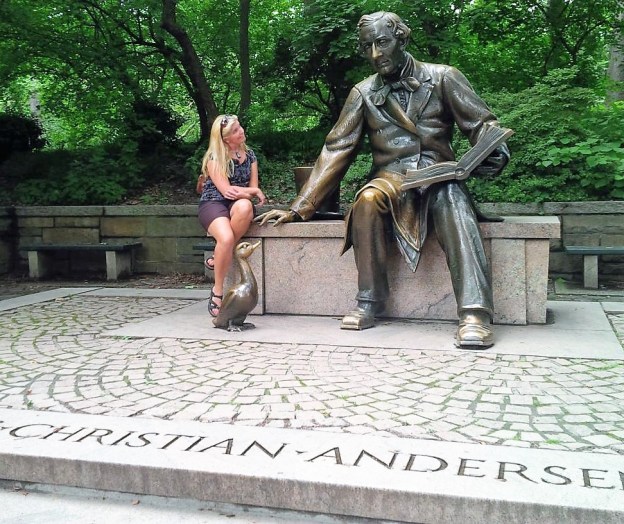
“It was like one of those fairy tales from Hans Christian Andersen.”

megan in nyc

On the final day, they were scheduled to fly home on the same flight.  But, when they arrived to check in, my daughter was denied permission to board the aircraft.

“Why?” she asked, dismayed and disbelieving.  “What’s the problem?”

“Your passport,” she was told.  “It’s not acceptable.  You should never have been let into the country.”

Despite pleading her case, using the fact of her Canadian citizenship as suitable reason to let her go home, she could not get on that plane.  My older daughter, in a gesture that brought tears to my eyes (although it was no surprise to me), refused to abandon her sister.  Their two friends reluctantly bade them farewell and left on their flight home, while my two girls—ever bright, assertive, and resourceful—plotted their next moves.

After a few face-to-face conversations with airline staff, and some phone calls, they were promised a refund for the cost of their flights (in the form of credits to be used within the next twelve months).  They booked a rental car, negotiating a reduced rate, and phoned their husbands to tell them they were driving to Buffalo.  My sons-in-law, gentlemen of the first order, immediately drove together to Buffalo to fetch their wives and bring them home.

Of course, the four of them had to clear Canadian border security on the return trip.  In my own experience, the agents with the Canada Border Services Agency are among the friendliest, most helpful, and welcoming to be found anywhere.  Not so this time, however.

The four travelers were pulled aside so my daughter could attempt to explain the sad state of her passport, and convince the skeptical CBSA people that she truly was a citizen, just trying to re-enter her home and native land.  After what must have seemed an interminable wait, she was finally granted permission—with a stern warning to replace the offending passport.  The girls (and their gallant guys) finally arrived home in the wee, small hours of the morning after they left the airport in New York City.

“Was it worth it?” I asked my daughters the next time I spoke with them.  “All that hassle?”

“For sure, Dad!  We had a blast!”  the older one replied.

“I agree,” her sister chimed in.  “The problems were really my fault, when you think about it.”

Far be it from me to point a finger of blame. But, when I do think about it, I agree with her.  That passport couldn’t have been damaged the way she said.

I mean, what kind of dog eats passports?  That’s the most ridiculous excuse I’ve heard since…well, since I was a teacher.

Dogs get a bad rap!

macca


Unreal, Baby!

Virtual reality.  The term itself is an oxymoron.  How can something be virtual—that is, not physically existing—and at the same time real—that is, actually existing?

In the techno-world we inhabit, however, such a dichotomy is not only possible, it is pervasive.  Today, we can slip behind a high-tech, VR mask and subject ourselves to almost any experience we desire.

Examples might include free-falling from a bungee-platform without the cord, performing magic alongside Harry Potter, or doing open-heart surgery on a patient who is thousands of miles away.

None of these things is really happening, but you feel as if they are.

vr

Artificial intelligence—another contradiction of terms.  How can something that is artificial, not genuine, be mistaken for intelligence, an innate, genuine ability to discover and utilize knowledge and skills?

Yet today, we know of many tasks being performed by AI machines that were formerly the sole purview of human beings.

Smartphone banking, Siri or Alexa speaking to us from our computers, and the genius of Pandora in predicting our musical tastes are but three examples.

We know these robots and techno-bots are not really human, but they do many of the things only we could do, once upon a time.

check_600

Augmented reality.  This is a somewhat more easily-understood concept, where the elements of a real-world environment are supplemented by computer-generated sensory input—sound, video, graphics, or GPS data—almost as an overlay to the reality being observed.

Anyone who has played Pokemon Go, or who has modified a facial selfie with the addition of a dog’s ears and nose, has experienced AR.

pokemon

Quantum computing—based on quantum theory, the nature and behaviour of matter at an atomic and sub-atomic level—is still in an embryonic stage, but it’s what enables these modern-day paradoxes.  Quantum computers, once fully developed, will function in multiple states, and perform tasks using all possible permutations, simultaneously.  Like the human brain can do.

The difference between that and the technology we know today dwarfs the span between the abacus of ancient times and today’s supercomputers by many-fold.

A revolution is upon us.

fractal-1240898__340

So, what do we do, we mere mortals, as the transformation hurtles toward us?  Do we resist, as Luddites of old?  And if we tried, would it make any difference?  Would we be drowned by the waves of change?

Or, do we embrace the onslaught, strive to understand it, seek to control the extensive influence it will have on us?  Do we even know how we would do that?

Perhaps a third alternative—chill out and accept whatever change is approaching.  Will it be a saviour to humankind, taking us in spite of our shortcomings to a more perfect state of existence, a Valhalla?

Or might it be more akin to what W. B. Yeats, the great poet, called, a…rough beast, its hour come round at last, [slouching] towards Bethlehem to be born?

Much depends, I think, on our continuing, collective will to exert control over our environment, a hallmark of human beings since first we stood upright on two legs.  We have unfailingly stridden toward our future, determined to overcome (or, failing that, to adapt to) the challenges we have faced.  We have never shirked from that reality.

But in a VR world—where reality is virtual and nothing is authentic—how do we continue to do that?  Blind to the physical world around us, and to its authenticity, enslaved behind our masks to the make-believe worlds we will have chosen, we will be tossed like so much flotsam and jetsam on the seas of change.

quantum-mechanics-1525470__340

Will we collectively continue to assert our dominance over the world in which we live, or will we succumb to the comforts of AI entities we have created, with their false promises and reassurances?

Of all the pestilences that might afflict our world over the next decade—nuclear war, pandemic disease, mass starvation, lack of potable water, catastrophic climate change—the most likely, in my view, is the ascension of artificial intelligence in all its forms, and the threat they will pose to humankind.

Dictators of the past, to consolidate and expand their power over their citizens, adhered to an ancient Roman maxim, postulated by Juventus:  panem et circenses[Give them] bread and circuses.  Distract the rabble, entertain them, and they will leave you alone to work your will.

Is that we have today—VR, AI, AR, and their ilk—a techno-version of the circus?  Will quantum computing spell the end of our human autonomy as it quickly subverts our will to compete?

A decade ago, the question would have been unthinkable.  Now, not so much.

Unreal, baby!

nature-laptop-outside-macbook

The Solitary Sign

Last summer, in the company of friends, my wife and I went hiking along an old railway line in the Ontario north country.  The right-of-way—a narrow slash through the bush, now largely overgrown—cut and curved its endless path ahead of us.  Still visible in the grass were chunks of pitch-blacked ties, no longer lying in perfect file, but strewn hither and yon, as if by some careless hand.  No trace of rails remained, for it’s a hundred years and more since last a timber train huffed along that route.

logging train2

Near the lake, a trail intersected the line, a logging road unused for years before we came, a route from nowhere to no place.  Young trees, waist-high, stood randomly where once the creaking wagons rolled, weighed down by wood for the insatiable logging trains.

One sign remained, a solitary sentry through all the years—a St. Andrews cross, no longer white if ever it was, clinging to a pitted post to warn of trains that come again no more.  Its comrades on other lines proclaim, in stark, black letters:  STOP! LOOK! LISTEN!  But this sign stood mute, alone, forsaken.  And yet, steadfastly on guard.

I reached out my hand to it as we passed by, feeling the rough-hewn wood of its ancient post, and I was touched by its devotion to duty.  An apt sentiment from a source I couldn’t quite pinpoint  came to mind:  They also serve who only stand and wait.

Further on, close by the lake, the abandoned line sat high on gravel banks.  And there we stopped, to rest, to read, to paint, to write.  We scrabbled down through scrub and dust to water’s edge, beneath an end-of-summer sun that skipped and danced its way across the calm, cooling water.

We lingered awhile in silence, content simply to be looking at what was there to see.  The trees that rimmed the lake reached tall to the sky—but also, reflected as in glass, plunged down to the depths—each greener than the others.  Waterbugs, countless little boatmen, skittered atop the surface, for all the world like shooting stars across the roof of night.  Dragonflies went blitzing by, blue-green-bottle bodies darting and shimmering like liquid fire.  And there, against the cobalt sky, a great blue heron winged its way from view.

Killarney-Provincial-Park-Ontario

No one spoke.  We sat and listened, for there was much to hear.  The water lapped,  embracing the shore, then rolled back on itself.  A loon called, hauntingly, from far down the lake, and a bullfrog added in his thrumming call.   A breeze sighed softly through a stand of silver birch and maple.  Behind us, in the bush beyond the rail line, a branch or tree came crashing down.

Later on, we swam, the water closing round us like a satin veil.  Frothy trails of foam flowed behind us, quicksilver tails, as we thrashed along, spurred by fantasies of monstrous fishes down below.  And each of us, in our own way, celebrated our being there in that place and time.

On our way back out along the right-of-way, we paused once more by the old logging road.  No wagon rolled, no bullwhip cracked, no whistle sounded its mournful call.  The warning sign seemed out of place at first, a superfluous relic from a once and distant age.

And yet…and yet, it served us still, for didn’t we pay heed?  Nary a train would ever pass this way again, the last one long-since consigned to the halls of history.  But that old sign had helped us, nevertheless, to find what we might easily have missed.  The wonders of a world were there, but wonders that too often go unseen, unheard in our pell-mell rush to…to where exactly?

It’s only when we stop, to look, to listen, that we can truly see, that we can really hear.

That solitary sign, stalwart against the march of time, still showed the way.

trail2


Happy Birthday, Eh?

Six syllables, sliding sibilantly over the tongue—ses-qui-cen-ten-ni-al.  One-hundred-and-fifty years as a nation, a vision struggling hesitantly to life on 1 July 1867.  Christened the Dominion of Canada, we were four provinces united against the manifest-destiny expansionism of the mighty republic to the south, but nestled still in the colonial arms of the imperial British embrace.

330px-Fathers_of_Confederation_LAC_c001855

The first priority of this new nation?  To fulfil the calling of its soon-to-be-adopted motto: Ad Mari usque ad Mare—from sea to sea, the Atlantic on the east, the Pacific to the west.  And eventually, a third sea, the Arctic to the north.

And so it happened, the inevitable northward and westward reach, propelled and supported by the building of a transcontinental railway.  After the original four provinces—New Brunswick, Nova Scotia, Ontario, and Quebec—there followed: Manitoba, 1870; British Columbia, 1871; Prince Edward Island, 1873; Saskatchewan and Alberta, 1905; and Newfoundland, 1949.

Along the way, three massive territories joined the mix: Northwest Territories, 1870; Yukon, 1898; and Nunavut, 1999.

Now, here we sit in 2017, Canada, the true north, strong and free.

And what exactly is it we celebrate on this sesquicentennial?  What have we accomplished as a nation?  What are the values we stand for?  How do our actions and behaviours, both collectively and individually, demonstrate those values?

What does our country do for us?   Even more importantly, what do we do for our country?

It has been noted by critics, perhaps jealous of our good fortune to be situated on the northern half of the North American continent, that too many of us are apathetic about the affairs of our country—to which, in response, some of us simply shrug our shoulders.  Others, though, rally to the causes of the day, to try to influence the course of events, the outcomes, the future.

There is a long list of accomplishments of which we might be justifiably proud.  In the realm of medicine, the discovery of penicillin, insulin, and stem cells; in the sciences, the first light bulb, the telephone, Canadarm, and IMAX; on the world stage, international trade agreements, endeavours to control the deleterious effects of industrialization on climate, efforts to support peacekeeping initiatives around the world, a robust military response in defence of freedom during several major wars, and our welcoming of refugees displaced by global conflicts, regardless of their ethnicity, religion, or skin colour; and in a more frivolous vein, the invention of peanut butter, the WonderBra, basketball, and Superman.

Of course, there are chapters in our history that might, with today’s sensibilities, bring a sense of shame: the exploitation and displacement of Indigenous peoples, and the horrors of residential schools; the trivialization and suppression of women’s rights; the mistreatment of Chinese and black immigrants; the expulsion and internment of Japanese-Canadians; and the continued exportation of asbestos to developing nations, even after it was banned in Canada.

None of these might happen today because of a singular document: the Canadian Charter of Rights and Freedoms, adopted in 1982.

charter

Governments of the day, to be fair, have apologised for the worst of these past crimes, and have established commissions and inquiries to seek a better way going forward.  But it is questionable, still, how much influence their reports and recommendations have had, or will have, on the future; witness the Truth and Reconciliation Commission, or the Missing and Murdered Indigenous Women and Girls Commission, and assess for yourself their lasting effects on national affairs.

As in everything, actions speak more loudly than words.

Still, when I ask myself if there is any country in the world I would prefer to live in, rather than in Canada, my answer is a resounding No!

canada

Despite the tumult and the shouting perpetually foist on us by the lunatic-left and rabid-right of the political spectrum, we are a people that wants leadership to govern from the centre.  We favour moderation, not extremes; tolerance, not xenophobia; dialogue, not diatribe; ideas, not ideology.

Do these tendencies render us apathetic?  I hope not.  Rather, I choose to think of us as slow to anger, quick to forgive, strong in the face of adversity, proud of what we have accomplished, and determined, not only to rectify the errors of the past (even if all too slowly at times), but to avoid similar mistakes in the future.

Canada has had one-hundred-and-fifty years of practice with the concept of nationhood now, and still she carries on—both because of and in spite of, the behaviour and attitudes of her citizenry.  Count me as one who is proud to be called Canadian.

Happy Birthday, eh?


Honk If You Love Jesus!

As my grandchildren grew from infancy into young childhood, we enjoyed playing word games together.  Challenging them to spell different words, come up with rhyming words, find words with opposite meanings, and other such contests have always been a source of pleasure for me.  And for them, too, I think.

One of the great places to play such games was while travelling in the car.  Classics—such as spotting out-of-province license plates, finding misspelled words on billboards, and watching for funny bumper stickers—were some of our favourites.

Sometimes, though, the games had unintended consequences.  For example, on a rush-hour street one afternoon, we were behind a car with a bumper sticker exhorting all who might read it to Honk If You Love Jesus.  My first reaction was to scoff, wondering who would be crazy enough to start bearing witness on the horn of an automobile.

sticker5

“Grandpa,” exclaimed my eldest granddaughter, “we love Jesus, right?  You should honk your horn.”

I demurred, but her sister insisted.  And their sincerity made me wonder what harm there could be in responding to such a simple invitation to show my beliefs.  In fact, if I chose not to respond, could that be construed as a subconscious rejection of my religious convictions?  In front of impressionable little ones?

So, somewhat abashedly, and in order not to jeopardize my granddaughters’ faith, I did honk—a long and loud affirmation of Jesus.  The reaction of the driver in front was immediate, and rather unexpected.  His car jumped ahead momentarily in the clogged traffic, quickly followed by the flash of his brake lights.  His arm jacked out of his window, and he began to gesture in what I hoped my granddaughters would think was an attempt to point out the direction of heaven…with his middle finger.  Luckily, they appeared not to notice.

sticker4

On another occasion, while driving to my grandson’s soccer game one Saturday morning, we overtook a car with a brightly-coloured bumper sticker asking us to Buy From a Breeder.

“What’s a breeder, Gramps?” my grandson asked.

“Well, that’s someone who brings animals together so they can have babies,” I answered carefully.  “Those people want us to buy babies from someone who breeds them.”

A few minutes later, we passed a car whose bumper sticker advised, Caution. Baby On Board.  My grandson craned his neck to catch a glimpse of the baby as we flashed by.

“Those people are breeders, right?” he asked.

I confess I nodded in the affirmative.

One of the funniest bumper stickers I ever saw was on the back of a black hearse, but my grandchildren didn’t really understand the humour.  In flowing, black script, it proclaimed, Yours Eventually.

One I admit I wasn’t too fond of, but which my grandson thought might apply to me, was stuck on the back of an old, copper-coloured Nash Rambler, driven by a white-haired codger:  I Used to be Cool!

That was a bad day because, a short while later, we saw another that declared, Watch Out for the Idiot Behind Me!

sticker1

“That’s you, Gramps, right?” my grandson asked.  Innocently, I choose to believe.

We’ve occasionally had close calls in the car, trying to read bumper stickers with print so small that it’s impossible to decipher from a reasonable distance.  The first time we saw one, it took five minutes of white-knuckled bursts of speed to get close enough.

“What does it say, Gramps?  Get closer!”  Two little girls were peering avidly through the space between the front seats.

Grammatically incorrect, it nevertheless smugly stated, If You Can Read This, You’re Following Too Close!

You’re too close!” my wife was yelling by then, her arms locked rigidly on the dashboard to brace herself.  “Slow down, or we’ll be a bumper sticker!”

The girls giggled, but I didn’t dare.

I was much fonder of the message we saw another day, in living colour on the mud-flaps of a huge eighteen-wheeler we were following.  Impossible to miss.  My youngest granddaughter recognized the cartoon character immediately—a short, red-haired, moustachioed gunslinger with a huge sombrero and two smoking pistols pointing at us.

sticker3

BACK OFF! was all it said.  No ambiguity there.

But the most sensible bumper sticker we ever saw was plastered squarely in the middle of the rear bumper of a large recreational vehicle.  It sported two bright red arrows, one pointing left, the other right.

“The left arrow says Passing Side,” my granddaughter declared.

“And the right arrow says Suicide,” her brother replied worriedly.

We had come up on that camper in a great hurry, so, as my grandchildren spoke, I stole a glance at my wife, who was staring pointedly at me.

Smiling reassurance, I slowed right down and backed right off, heedless of the traffic piling up behind me.

And, with all the honking that began to blare behind me, I figured those drivers must really love Jesus.

So, I was glad for the sticker I had on my own rear bumper—

sticker2


The Pickup

During the years we owned a home in Florida, we used to comment on how fortunate we were to live in a retirement community where so many services were close at hand.  It truly was remarkable.

We benefited from facilities and utilities that we could have taken for granted.  We had running water, electric power, telephone and cable service, and internet availability.  We were close to medical and dental services, supermarkets and convenience stores, a volunteer emergency corps, and a fire department.

We had ready access to libraries, recreational facilities, and churches.  We were served by a thriving post office, a conscientious sheriff’s department, and many other organizations too numerous to mention.

We lived near five golf courses, all of which we could drive to in our own golf cart.

pg_golf_cart003

We were, indeed, very fortunate.

However—there’s always a ‘however’ in these cases—there was one public service that caused me a great deal of difficulty.  It probably wasn’t their fault; in fact, it likely wasn’t anybody’s fault.  But it was one of those little vexations of life that seemed, at first, to be beyond fixing.

I’m speaking of the problems I had with my garbage.  The pickup never worked for me.  It used to be terrific to drop the plastic bags at the end of my driveway every Friday morning and forget about them.  A short time later, a big truck would crawl slowly and noisily down the street, swallowing the assorted bags that were tossed into its churning maw.  And the whole thing would be over for another week.

But then things changed, and I began to have a lot of trouble.  It started when the pickup service was moved to an earlier time of day for my street.  That truck began to show up before I woke up!

To solve that issue, I hit upon the idea of putting the bags out the night before.  That, I figured, would solve my dilemma with the early hour.  To my chagrin, it was just the beginning of a whole host of problems.

Whenever I put the garbage out the night before pickup, the scavengers got into it.  Four-legged critters, like coons and possum; two-legged critters, such as crows and seagulls.  When I would saunter to the street the next morning, after the truck had been and gone, I’d find remnants of the week’s malodorous garbage strewn across my grass.

worlds-cutest-raccoons-22

I tried all manner of schemes to put a stop to this.  It was amazing how ingenious, and devious, an old guy like me could become when I had to stoop over to scoop up garbage that I had already packed up for pickup!

In order to foil the two-legged critters, I began to wait until just before my bedtime to put out the garbage, after they were safely in their nests.  To prevent the four-legged critters from continuing their raids, I scattered pellets, sprayed foam, and sprinkled red pepper around the bags—but all to no avail.

Once, to my undying shame, and well after dark, I even resorted to putting my garbage bags across the street, on my neighbour’s driveway.  The next morning, there was half the load, spread across his grass.

And it didn’t really change anything, anyway, because when I went over to clean it up, I encountered him in the middle of the street.  He was on his way to pick up the spillage from the bags he had left on my driveway!  The bounder.

After a bothersome few months, I reached the stage where I realized I wasn’t putting out garbage; rather, I was making an offering to the critters from hell!

But, wonder of wonders, I eventually solved the riddle.  Looking back on it, I can’t believe it took me so long to come up with such a creative solution.  It certainly would have relieved me of a bunch of worry.

It finally dawned on me that on every warm, Florida Friday morning, garage sales and yard sales were endemic to our community—every neighbourhood, every street.  And hundreds of people—rich, poor, young, old, women, men—prowled the area in their vans and station wagons.

garage sale

So, from that point on, I would clamber out of bed every Friday at a reasonable hour, tie off my garbage bags with pretty, colorful ribbons, and drop them at the end of my driveway, with a big sign on them: FREE.

The bags were gone before I could finish my first cup of coffee!


The Reach of a Father’s Love

Friends of ours lost their only child several years ago, the victim of a relentless disease.  He left behind a grieving wife, two young children, and a sparkling future.

In the years since, our friends have doted on their grandchildren, taking great delight in watching them grow from infants to toddlers, and onward to adolescence.  They’ve invested time with them, knowing they can never make up for the loss of a father, but determined to keep his memory alive.

A while after their son’s death, I wrote a piece to commemorate his life and the legacy he left behind.  I post it here now, adapted somewhat, to mark the advent of another Fathers’ Day

The little boy is eight-years-old, and loves to visit his grandparents at the family cottage.  For him, every day is an adventure, a surprise, a delight, as he wanders the woods, swims in the lake, and fishes the waters in the old, wooden skiff.

For the older folks, these activities hearken to an earlier time with another fair-haired lad, and they treasure the memories, even as they create new ones.

A while back, the little boy was in the musty basement of the cottage with his grandpa, when he made a great discovery.  “Grampy, what’s this?” he cried, pointing to a bright-yellow model boat.

Sitting astride its pedestal on top of an old workbench, the craft was almost three feet long—a racing boat, bred for speed, its tall sails still unfurled.  Three small passengers huddled in the cockpit, as if awaiting the starting gun for an impending race.

sailboat5

“Oh, that?” his grandpa replied.  “That’s a boat your daddy built a long time ago.  He used to race her on the lake with his remote control.”  He lifted a dusty metal box down from an overhead shelf.  Two toggle switches protruded from the top, and a long antenna jiggled slightly as he set it down.  “This is how you make the boat go where you want it to.”

“Can I make it go, Grampy?”

“Mmm, I don’t think so, l’il guy.  I don’t think she works anymore.”  Together they lifted the cowling off the boat, behind the drivers, and peered at the mysteries of the small motor inside.

“It smells funny,” the little boy said.

“That’s oil you smell,” his grandpa replied.  “Your daddy always made sure he kept her cleaned and oiled.  He really liked this boat.”

“What’s her name?”

“Your daddy called her The Yellow Flash.  Here’s her name on the back, just the way he painted it.”

“Can I make her go, Grampy?” the little boy asked again.

The old man shook his head.  “The batteries are probably dead,” he said, “and look at these wires.  They’re corroded at the junction plates.  The sails are pretty ratty, too.”

“Well, can we fix her?” the little boy said.

His grandpa stared at him for a few moments, a faraway look in his eye.  “Y’know,” he said finally, “maybe we can.  Shall we give it a try?”

sailboat

Over the next couple of weeks, the two of them dismantled the boat in order to clean every part, separating the batteries and wires that would need replacing.  They opened the remote box and cleaned it out as best they could, removed the sails for a gentle cleaning.  On his next trip to the city, the old man took the hull and box to a hobby-shop, where the owner walked him through the steps needed to restore the boat to operation.

On the little boy’s next visit to the cottage, they began the rebuilding process.  As they soldered new wires in place, the little boy was fascinated.  His grandpa let him set the new batteries in their proper slots, showing him how to ensure the contacts were touching.  He watched as the little boy lovingly polished the hull, restoring it to its original gleaming glory.

Together, they replaced the sails, and tested the remote box, working the toggles to control the boat’s tiny propeller and rudder while it still sat on its dry-dock pedestal.

“She works, Grampy!  She works!”

“I think she does, l’il guy.  Shall we put her in the water?”

And so they did.  Carrying her gingerly down the slope to the dock, they lowered her carefully into the lake.  From a silent vantage point on the rocks, I watched them—a grandfather and his son’s son, with his son’s boat, launching their labour of love.

“Which one is the driver?” the little boy asked, pointing to the three small figures in the cockpit.

“Well, this one is you,” his grandpa said, indicating the figure in the middle.  “You’re the skipper.”

“Okay,” said the little boy.  “Then this one on the right will be you, and this can be my daddy over here.”

The old man had to look away for a moment to collect himself.

“What if the waves tip her over?” the little boy asked, suddenly apprehensive.

“Well, it’s pretty calm right now, l’il guy.  I think she’ll be okay.”

“But what if she goes way out there and we can’t bring her back?”

“She’ll come back,” his grandpa said.  “She’ll come back.”

sailboat3

As they perched on the dock, legs dangling over the water, the old man gave the boat a push away from shore.  The little boy, the remote box between his knees, began to steer her—hesitantly at first, with fitful starts and stops, over-correcting erratically.  But in moments he was sure, and the boat skimmed atop the surface, speeding and curving gracefully, immediately responsive to his commands.

I watched the boat for awhile, then turned my attention to the old man and the boy.  Their faces were split with grins, happily alight, as they raced The Yellow Flash to and fro along the shoreline.

“Take a turn, Grampy,” the little boy yelled, handing the remote box to his grandpa.  And he squealed with delight when the old man almost capsized her, righting her just in time.

“Grampy?” the little boy said after a while.

“Mmm?” his grandpa replied, seeming lost in reverie.

“I love my daddy’s boat!”

“I love her, too,” the old man said, leaning in close to his grandson.  “And I love you, l’il guy, very much.”

I left them on the dock, locked in silent communion.  And it may only have been my imagination, but when I stole a glance back, I could swear I saw a third person there—ephemeral but real, lovingly watching them both.

At once apart from, yet a part of, the old man and the boy.

And I marveled at the reach of a father’s love.

father-son-and-grandfather-fishing