Warning! Discretion is Advised

Many cable television programs my wife and I watch are preceded by a statement like this, usually delivered in a weighty baritone as the words appear on the screen:

WARNING

The following program may contain scenes of violence,

nudity, strong language, and adult themes.

It is intended for mature audiences only.

Viewer discretion is advised.

The warnings are so prevalent, we hardly notice them.  As adults of reasonably sound mind, we’re confident in our ability to choose what to watch, based on our own sense of what is acceptable.

But there is no question that these programs are not appropriate for children.

kids-and-tv

Similarly, among the books I’ve written and published, there are four novels, crime thrillers, that are not suitable for children, given the graphic nature of some of the situations depicted.  Such scenes are not presented for gratuitous reasons; they are necessary to the stories’ authenticity and credibility.  Consequently, I include the following statement on the copyright page of each book:

This book contains adult language and mature themes.

Reader discretion is advised.

Time was, such warnings would have been unnecessary.  Not because there were no programs or books unsuitable for children; those have always been around.  But there were rules and boundaries designed to protect youngsters from exposure to them—sometimes established and enforced by parents, sometimes by government edict, sometimes by purveyors and sellers of the material.

I can remember there being ‘prime-time programs’ that aired only after I had gone to bed.  And I remember books on high shelves in libraries, for adults only.  I understood and rarely questioned why those were not for me.

Of course, there were loopholes.  Just as enterprising children have always found ways to obtain cigarettes, or to sneak into movie theatres, so also were they able to gain exposure to off-limits programs and books.  Some parents were more lax than mine, so staying overnight with a friend whose folks were out for the evening, for example, might allow an exploration of forbidden territory.  I was amazed to discover how many of my friends’ fathers had stashes of Playboy magazine, supposedly securely hidden from eager, adolescent eyes.

But for the most part, we were sheltered from violence, nudity, and profane language by the social safety-net around us.  We were allowed to discover the adult world in our own good time; and when it confused us, as it often did, we had parents or older friends to help us make sense of it all.

The advent and exponential growth of the global internet over the past three decades has wrought quite a change.  Today’s children (at least those in the developed world) have easy access to e-mail, instant messaging, social networking sites, online games, blogs and forums, interactive video calls, and everything else the worldwide web has to offer.  And it offers a lot, including all the mature-theme stuff that once upon a time was shielded from impressionable minds.

As a writer, I am immensely grateful for the plethora of knowledge the internet makes available to me at the keyboard I haunt—most of it free, accurate, and up-to-date.  I am my own researcher, able to pick and pluck knowledge from an endless number of sources, information which informs the stories I write.  I am nowhere near as intelligent or informed as a reading of those books might imply; but the internet allows me to appear that I am (or so I hope my readers might believe).

The internet, therefore, is not an evil empire in my opinion.  Yes, it’s a living entity, in that it evolves and adapts to the world around, but it has no sentient ability.  It’s just there.  In Latin, hoc est, ideo est—it exists; therefore, it is!

internet

So no, my worry is not that the internet has become an integral part of our lives.  Rather, my concern is with its accessibility to young people who are singularly unprepared to deal with everything it offers.  One doesn’t need to visit the so-called dark web in order to find examples of unspeakable violence, including torture and murder; or graphic pornography, including misogyny and bestiality; or blatant xenophobia, including racism and bigotry.  It’s all available through home computers for anyone to access.

If you doubt that, try surveying the video games that are offered to anyone with access to a credit card.  Many are educational and fun, it’s true; but so many others are extremely violent, the pain and consequences of which are not felt by the gamer who is experiencing the mayhem vicariously.  Don’t like that guy?  Blow him away!

Or take a digital stroll through online blogs and websites that espouse all manner of intolerance and hatred, spewing vitriol and calls-for-action against targeted groups.  Don’t like those people?  Lock ‘em up!

And after you’ve looked at these sites, consider the effect that repeated exposure to them might have on the pliable mind of a ten-year-old, for example.  We hear too often these days about ‘home-grown terrorists’ who attack innocent people, including children in schools and worshippers in churches and mosques.  And in so many cases, they are exactly that—home-grown, shaped and motivated by their insidious and lonely online pursuits.

So how can this exposure of children to the unsavoury aspects of the internet be stopped?  What is the answer?  Censorship?

In our democratic society, with its sacrosanct belief in free speech, censorship is a dirty word.  And how could it be accomplished, anyway?  Would issuing warnings like this have any discernible effect?

WARNING

The internet contains sites featuring extreme violence, including

murder; hateful language, including racist and religious pejoratives;

misogyny, including rape and mutilation; xenophobic representations, including

torture and enslavement; and other similar depictions intended to titillate and amuse.

It is intended for mature, autonomous, and socially well-adjusted audiences only.

User discretion is advised.

I think not.  In fact, I believe it must come back to what it’s always been—the nurturing of young minds by caring and conscientious parents, family and friends, and teachers.  And these guardians of children (and the children themselves) need to know that it’s okay to impose limits, to set boundaries, and to refuse permissions.  Not forever, and not to the point of stifling curiosity and the desire to learn.  But for long enough to allow children’s brains to experience childhood and adolescence before being exposed to the more unsavoury aspects of adulthood.

kids

In his poem, The Rainbow, William Wordsworth wrote, “The Child is father of the Man…”, widely interpreted to mean that who we become as adults is irrevocably determined by how we are shaped as children.

I often consider who today’s youngsters, children of the internet and all it proffers, will be when they are grown.

And I wonder, if I were still here, whether I would like them.

Tell It Like It Is

Tell it like it is!

Grammatically incorrect ‘though it may be, that sentence succinctly describes the prime duty of every responsible journalist.  Consumers of our many print and digital mainstream media (MSM) outlets have the right to expect balanced, accurate reporting from them.  How else will we citizens learn about events transpiring in the world around us?

There are currently several threats confronting trustworthy journalism, however.  The first centres on how we are to define the words responsible, balanced, and accurate.  Each of us may have our own definition, but ours might well differ from someone else’s.  Who is to say whose version is correct?  In an environment where media entities range from the far-right of the political spectrum (eg. Breitbart or Sean Hannity) to the far-left (eg. New Yorker or Slate), woe betide the consumer who does not comprehend the disparity in the balance and accuracy of their reporting.  Each of them defends their coverage of the news as responsible, balanced, and accurate, so it falls to us to ensure we are knowledgeable of their respective stances.

Almost every media outlet has its own bias; the responsible ones make their position clear to their followers, who can then interpret what they’re receiving through that filter—thus becoming informed citizens.  But those outlets that mask their editorial stances encourage a rising mistrust of all MSM among the citizenry, who, as a consequence, begin to paint every one of them with the same brush.

Both dishonest journalism and a widespread mistrust of journalism are bad for the survival of democracy.

Another threat to be taken seriously arises from the deteriorating economic conditions facing segments of the industry.  With the rise of digital platforms across the internet, and with almost-universal access available to so many people, the established print outlets are faced with declining revenues from shrinking advertising and circulation.  These losses are resulting in layoffs of journalists and closing of newspapers, with a concomitant reduction in comprehensive coverage of local issues so important to us.

It is at the local level where much of what we citizens need to know is reported.  If all media outlets were global in scope, such as those found on the internet, who would inform us of problems facing us in our own communities and neighbourhoods?  One of the most important, yet undervalued, roles of local media is investigative journalism, inquiring on our behalf into questionable practices by government and private enterprises.

Who, other than those directly affected, would have known of the tainted-water scandals in Walkerton, Ontario or Flint, Michigan, for example, if local media had not persevered in their probes?  Who would be reporting chemical spills or pipeline leaks, if not responsible journalists?  Who else can rouse governments to action around contraventions of regulatory inspections of dairy- or meat-manufacturing facilities, for instance, that result in danger to the public?  Who will rail against the delays in bringing accused felons to trial in an overcrowded, underfunded court system—delays that result in the staying of charges and release of those persons because their rights have been violated?

Concerned citizens’ groups can’t do any of these things if they are not first made aware of the issues by the journalists who find and pursue them.  If we don’t have responsible investigative journalism at the local level, who will watch the watchers on our behalf?

Toronto Telegram (front page).jpg

A third threat, perhaps the most serious, is posed by government.  The threat may arise from a well-intentioned, but misguided, attempt to bolster the media by subsidizing them through the public purse in order to maintain local coverage.

Or, more ominously, it may come from an unbridled attempt by government to discredit or even censor media outlets that don’t adhere to an ideological, doctrinal line.

The subsidizing of MSM outlets from public tax dollars, which at first blush could be seen as helpful in this era of declining revenues, is a two-edged sword.  While an infusion of revenue might well enable local media outlets to remain viable, thus allowing them to continue their reporting of the news, that support could come with strings attached.

What happens, for example, when the reporting of an issue is contrary to the government’s position on that issue?  Does the funding suddenly dry up?  Or does the coverage change?  Either option is a blow to a healthy democracy.

It’s a well-established maxim, after all, that (s)he who pays the piper calls the tune.  It would take a highly-ethical party on either side to resist the temptation to bully the other, or to refrain from caving in.

Censorship or assaults on the integrity of the media are equally evil, if not more so.  And even in prospering democracies, both can raise their ugly heads.  Just the other day, a highly-placed official in the recently-installed American government referred to the MSM as “the opposition party”, and said they should “keep its (sic) mouth shut.”  Although that official is the founder of one of those far-right news outlets (Breitbart)—which might lead one to expect such a stance—the tacit threat from one so close to the seat of power is chilling.


     [Photo Credit: Copyright © 2013 Universal Press Syndicate]


As I’ve written in previous posts, it is one of the expectations of the MSM that they must act as guardians of perhaps the most precious of all our rights, the right to free speech.  And a closely-related tenet in a democratic society is citizens’ right to a free press, unconstrained by government interference or intimidation.

When a government claims that media outlets disagreeing with the party line are dishonest, fake, and disgraceful, publishing deliberately false information, and involved in a running war with the government, there is a clear and present danger to those cherished rights.

In the face of such attacks, it is incumbent upon citizens to defend the media, lest we lose them—whether for economic reasons or other, more insidious, pretexts.  And we must defend all of them, far-right, far-left, and every outlet in between, because they all contribute to the dialogue that generates and nourishes a flourishing democracy.

Additionally, it is every citizen’s responsibility to make him- or herself aware of the widely-discrepant editorial leanings of those outlets in order to make sense of what they are reporting.  Otherwise, the media will be rendered unable to fulfil their essential mandate, which is—

Tell it like it is!

Alternative Facts? Really?

The sky is falling!  The sky is falling!

So proclaimed Chicken Little on her hysterical run about the barnyard, a story I first heard as a child.  Fortunately for us all, she was wrong, and the sky stayed where it’s supposed to be, high o’erhead.

chicken-little-2

I remember being terrified at the time, wondering if the sky actually could fall in upon us.  Later on, I imagined that the poor hen was either lying or profoundly deluded.  Now, though, I wonder if she may have merely been asserting an ‘alternative fact’—something she truly believed despite reliable evidence to the contrary.

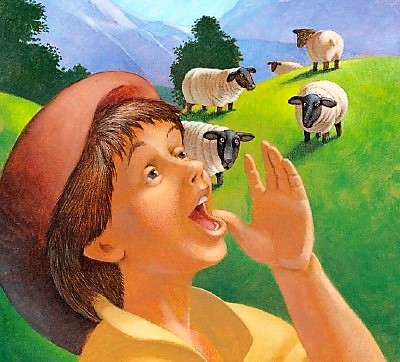
Another childhood tale concerned the shepherd boy who cried wolf.  Perhaps bored by his lonely work, or maybe seeking attention to satisfy a needy personality, he repeatedly roused the neighbouring villagers with his false alarms.

Wolf!  Wolf!  The wolf is attacking my sheep!

The villagers, of course, rallied to his rescue each time, only to discover they had been fooled, not just once but again and again.  Predictably, when the wolf really did attack, the boy’s alarms went unheeded by his protectors, unwilling any longer to believe what they were hearing.  And the boy lost his sheep to the ravenous wolf.

boy-who-cried-wolf

I wonder if he might have tried to explain his behaviour afterwards by claiming, despite evidence to the contrary, that he had not been lying; that, indeed, the wolf really had been lurking on each occasion—an ‘alternative fact’ not apparent to the villagers, but truly believed by the boy.

It was accepted by most people, once upon a long-ago time, that lying was just that—lying.  Untrue.  False.  Not supported by rational analysis of available evidence.  And, most importantly, wrong.

Both Chicken Little and the shepherd boy appeared not to subscribe to that tenet.  But their stories are fables, intended as moral teachings—much like the likely-apocryphal story of George Washington’s declaration after cutting down a prized cherry tree: I cannot tell a lie!  There was no actual harm done to real people by either of them.

Alas, in our world today, immersed to the point of drowning in a sea of social media and instant news, we are in danger of being sorely harmed by those who would deliberately lie to us.  Or, as they might claim, present us with ‘alternative facts’.

In 1905, in his book, The Life of Reason, George Santayana wrote, “Those who cannot remember the past are condemned to repeat it.”

George Orwell, in his 1949 opus, 1984, presented a society that not only did not remember the past, but actively sought to eliminate it through newspeak—defined by Merriam-Webster as: a language…designed to diminish the range of thought…characterized by the elimination or alteration of certain words, the substitution of one word for another…and the creation of words for political purposes.

Ah, yes—the creation of words for political purposes, and the use of those words to craft phrases and pronouncements designed to bamboozle the common folk naïve enough to trust their leaders.  Does that sound familiar?

conway-2

It is as if a strategy from the past has resurrected itself (from a psychological profile composed by the U.S. Office of Strategic Services, describing Hitler’s rules of political conduct and media coverage):

…never allow the public to cool off; never admit a fault or wrong; never concede that there may be some good in your enemy; never leave room for alternatives; never accept blame…people will believe a big lie sooner than a little one… [and] will sooner or later believe it.

And if these big lies are called ‘alternative facts’, well so much the better for the tellers of tall tales, the snake-oil salespeople of our modern era.  It is as if the wolf has returned to the shepherd boy’s flock, this time disguised in sheep’s clothing.  And who among the villagers will hear the anguished cries for help, and respond before it is too late?

Après nous, le deluge!  This phrase, attributed to Madame de Pompadour, courtesan to Louis XV of France, might be interpreted as—After us, let the flood come; we don’t care what happens when we’re gone.  No one in power today utters such thoughts so baldly, of course, but their actions speak more loudly than words ever could.

Those who are left behind will certainly care what happens, however.  But sadly, it may be much too late for them to restore what they will have lost.  How does one go about putting the sky back in the…..well, in the sky?

Beware the demagogue who claims that only (s)he knows what’s wrong, and only (s)he can fix it.  Resist the temptation to believe the easy, convenient, so-called truths (s)he presents.  And protest—long and loud and disbelievingly, with evidence to back you up—whenever those falsehoods are presented as bona fide.

Alternative facts?  Really?

Survival-Skiing

Every winter for quite a number of years, my wife and I used to head north, without the kids, for a weekend of cross-country skiing.  But as I think back now on those long-ago days, for the life of me I can’t figure out why.

In the first place, we weren’t off to a palatial, resort lodge with all its pampering amenities.  Rather, it was one of the provincial government’s natural resources centres, a rather Spartan setting in the deep woods.

ski-centre

We shared a bedroom there, in one wing of a large dormitory where thirty other couples inhabited bedrooms of their own.  Our room, approximately three metres wide, had a narrow cot mounted on each side wall.  There was room for only one person on each bed—not exactly conducive to second-honeymoon flights of fancy.

On the outside wall, there was a large, frosted window; light leeched in, but no one could see out.  At the end of each bed, near the window, a number of ill-fitting drawers were built into the wall.  There was no closet.

I had lived in student residences that were more luxurious.

One large bathroom, complete with three shower stalls, served all the men on our floor, as well as the men from upstairs.  A similar bathroom, designated for the women, was situated on the second floor.  Woe betide the morning-drowsy lodger who mixed up the two.

Consequently, unlike the apres-ski gatherings at luxurious ski-lodges, our social exchanges tended to occur early in the morning and late at night, as we passed everyone else on the way to and from the bathrooms.

Our friends used to wonder why we kept going back.  And we’d tell them it was because of the excellent skiing; however, that’s only partially true.

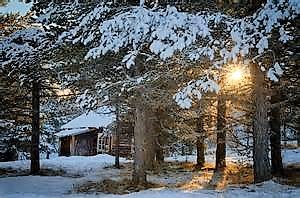
The skiing was very good—endless groomed trails curving through boreal forests, the sun streaming through skeletal trees, casting crooked, blue-grey shadows across the pristine snow.

winter-woods

As a skier, though, I left a little to be desired.  My problems always started in the waxing-room, where everybody gathered after breakfast to prepare their skis for that day’s snow conditions.

Each of the four or five people I’d check with would be using a different colour of wax.  So, to be on the safe side, I’d use them all, resulting in a rainbow of colours on the bottom of my skis.  Occasionally, someone would call out that we should be using klister.  Assuming that klister was a preparation for use on one’s blisters from the previous day’s outing, I always chose to ignore that advice.  I was no sissy!

While the others laboured away indoors, I would head outside and plant my feet securely into the harness on my skis.  Stamping impatiently in the cold, waiting for the others while watching my breath dissipate in frosty wisps, I’d often experiment a bit.  For example, I would try to turn around in place by lifting one ski over the other, and setting it down in the opposite direction.  The manoeuvre could then be completed by pushing the second ski back and out to one side, toe down, to bring it around in line with the first.  It looked so cool when other people did it.

Predictably, however, I usually lost myself in this complicated operation and found I was unable to move my feet because of the skis they were trapped in, one facing forward, the other backward.  Powerless to extricate myself, I’d resort to falling face-forward into the snow from a standing-still position.

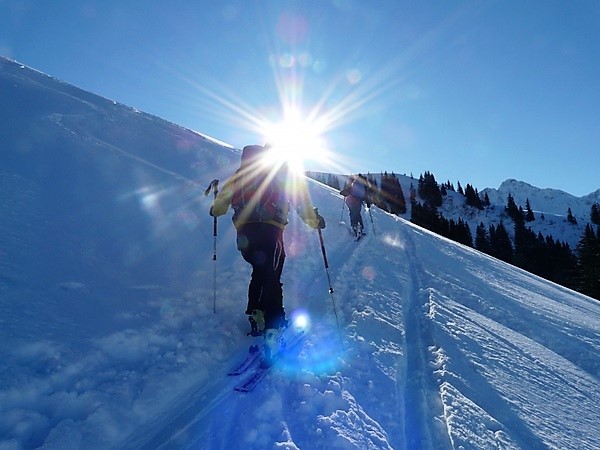
Once rescued and set upright, my adventures would continue on the trails, where, thanks to the plethora of wax I had applied, I could find no purchase.  On downhill slopes, I bounced and careened, verging on the out-of-control, until a friendly sapling would reach out to embrace me, interrupting my headlong rush to oblivion.  My companions always insisted I go first on these downhills, which I interpreted as a testament to my intrepid spirit.  Those sharp turns at the bottom were brutal, though.

ski_tour_winter_hike_hike_222031

The cohort began to refer to me (flatteringly, I wanted to think) as a bushwhacker.

On uphill stretches, I would slide inexorably into the folks skiing behind me, my once-but-no-longer-friendly comrades.  When they eventually demanded I go last on the uphills, I blithely assumed they wanted me there to be of assistance to any who faltered.

My eventual return to the dormitory was always heralded by one and all as a triumph of random chance over probability.

So, as you can see, it wasn’t the austere accommodation or my skiing prowess that brought me back each year to that wilderness outpost.  I may have been inept [ed. note: was definitely inept], but I was never an ascetic masochist!

I suppose it was the other things we found there that kept us coming—things like good friends (they’re the ones who hadn’t yet skied behind me), bountiful and delicious food, and a time to be alone with one another—even if in separate beds.

I always looked forward to going on those survival-skiing trips—although I must admit I was equally glad when it came time to head home.  I sometimes wish I could still strap myself in to those fibreglass wings and fly away, happy once again to lose myself on the wintry forest trails.

Alas, I fear now that the only thing I’d lose would be my life!

Whither Humanity?

The word humanity is a noun, defined thusly:

  • a collective name for all human beings;
  • the state of being human; and
  • the quality of benevolence, kind-heartedness, or magnanimity.

The first may be illustrated by the sentence, That invention will benefit all humanity; the second by, We are united in our common humanity; and the third by, The good Samaritan showed such humanity through his actions.

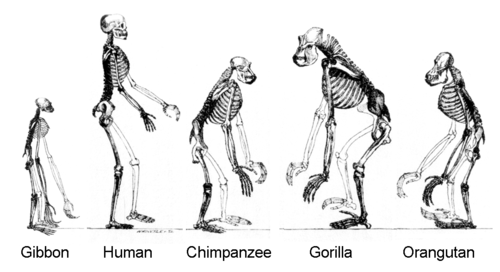
In the first definition above, humanity—of which you and I as human beings are a part—had its origins in the dim recesses of time past, perhaps 200,000 years ago, when archaeological studies posit the emergence of Homo sapiens.  These studies have demonstrated that several precursors to that species existed, including Homo habilis and Homo erectus, all of which displayed characteristics quite distinct from apelike creatures.  But human beings as we know us today (referred to now as Homo sapiens sapiens) evolved distinctly and irrevocably away from our earliest ancestors, perhaps 50,000 years ago.

It has been estimated by the Population Reference Bureau that more than 108 billion such ‘people’ have lived on our planet since then.  The PRB, founded in 1929, is a non-profit organization that studies issues related to population, health, and the environment.  Its work pegs the number of people living today at something greater than seven billion, which constitutes approximately 6.5% of the total of every human who has ever lived.

Two major demarcations, among many others, distinguish us from the earlier versions of Homo species.  One is the growth of brain size, the other the shrinking of some physical attributes, including brow prominence, mid-face projection, and skeletal structure.  Both eventually enabled the acquisition and refinement of speech, and thus the possibility of sharing thoughts and feelings among each other—the earliest manifestation of humanity in its second definition.

It would be possible, I imagine, to express affinity, empathy, or insight with respect to the emotional or physical well-being of another, even if we were unable to communicate them verbally.  Possible, too, I think, to convey anger, resentment, or disappointment to someone.  Body language and non-verbal gestures could convey such messages adequately.  But it is through speech that we can most accurately articulate our feelings, be they positive or negative, without resorting to physical demonstrations.

The ability to speak depends on both physical and neural capabilities, which we, alone among animals, possess.  And language, which developed from this unique ability, is what has made possible every significant intellectual accomplishment along the path of our development as a species—including both the ability to save lives and prolong them beyond the wildest expectations of a century ago; and the ability to wage war unto death on those we fear or loathe, to the point of wiping them from the face of the earth.

So, at the dawn of another year, the two-thousand-and-seventeenth of the modern era (and maybe the fifty-two-thousand-and-seventeenth of our existence as a modern species), I ask this question:  Whither humanity?

We have a good idea whence we came, thanks to the innumerable studies of our history and development.  The state of humanity all humanity enjoys is well and truly established.  But where are we going?  And what of our inner humanity—our benevolence, kind-heartedness, magnanimity—toward our co-habitants of the planet?  Could it be that our brains are indeed dualistic—in the sense that we want to create and destroy, build up and tear down, co-exist and dominate—at one and the same time?  If so, that is an horrific equation, one that is perhaps the result of centuries of struggle to survive as a species, in order to perpetuate humanity.

But now, we live in an age where the baser half of that equation can have disastrous results, not just for those we choose to see as our enemies, but for us all.  And if we allow fear to draw us back into protective enclaves of our own kind—those who look, think, and act like us—to the exclusion of those who don’t, we risk diminishing our fundamental humanity.  At a time of great peril to our entire race, surely it is better to reach out, to join hands, than it is to lash out and smash humanity asunder.

We belong to numerous nations inhabiting this long-suffering planet, each of which harbours its own patriotic aspirations.  But every one of those nations depends upon the same planetary host, and all humanity is travelling on the same interstellar vessel.  Will we collectively steer our ship to safe harbour, or scuttle it with all hands on board?

I have long admired these words from the second inaugural address of Abraham Lincoln, which I excerpt here—

          With malice toward none, with charity for all, [let us] achieve and cherish a

just and lasting peace among ourselves and with all nations.

Happy New Year—free of malice, full of charity—to all humanity!

On Top of the Grass

Almost a decade ago, I was seized by a medical emergency with very little warning.  After a frantic day of searching for an available hospital to perform a needed surgery, I was wheeled into the operating room in the wee small hours of the following morning—in the very nick of time I subsequently learned, due to a severe case of blockage in my colon, caused by diverticulitis.

During the endless days of recovery in hospital afterward, I consoled myself in the lonely nighttime hours by composing a poem in my head, one stanza at a time.  On each following morning, my wife would write the stanza down as I recited it from a sometimes drug-addled memory.

writing

Once home, I tweaked the poem somewhat, then used it as a foreword to a book of tales I was about to publish.  It centered on a sentiment my golfing pals used to joke about in our retirement community—that, no matter what might be ailing us on any given day, at least we were still standing on top of the grass, rather than resting beneath it.

While I was composing it, the poem provided a promise of hope for me that my recovery would be complete.  Later, it became a source of inspiration to do whatever it would take to make that happen.

As things turned out, the hopefulness expressed in the final stanza—written before a second surgery restored me half-a-year later—did bear fruit.  And almost ten years on, the poem still resonates for me with its message of faith and optimism.

On Top of the Grass

It struck with a rush, and hit full-flush,

The pain that would not end.

It twisted my gut until it was shut,

And made my belly distend.

It took fierce hold of my abdominal fold

As I lay on the emergency bed.

I feared I would die, and the question of “Why?”

Kept banging around in my head.

~ 0 ~

My angels of life—my daughters and wife—

Were there from beginning to end.

A sense of their touch meant ever so much

Through pain I could not comprehend.

From dusk until dawn, I thought I was gone

As we raced through the city’s grim gloom,

With siren and lights, we searched the dark night

For an available surgery-room.

~ 0 ~

In the back of the van with the ambulance man,

Sedated, but dogged by the pain,

I yearned for relief, though it was my belief

That I’d never be normal again.

I knew that I should make myself understood,

And tell him I was sinking down fast.

Then he gave me some slugs of painkilling drugs,

And oblivion quickly slipped past.

~ 0 ~

Some hours anon, the doctors had gone,

And I wakened, my girls at my side.

How fair they did seem, my loveliest dream,

Their smiles of relief beaming wide.

They stroked my poor head as I lay in my bed,

And together we gave thanks for life,

The four of us there, reliving the scare,

Just me, and my daughters and wife.

~ 0 ~

The details were grim, but I wanted them,

So I’d know what had happened to me.

They gave me the scoop on my colonic loop,

And I learned it was taken, you see.

But enough does remain, they’ll connect me again,

Just as soon as they figure out why—

And what—caused the block, caused my system to lock,

And laid me so low I could die.

~ 0 ~

I’m home now, it’s great, and so I just wait

For my good health and strength to return.

Then I’ll journey back down to the city’s downtown,

Where the doctor’s next steps I will learn.

A scope and a scan, MRI if I can,

Will give her a plan to pursue,

Then under the knife, I’ll get back my life,

And that life I shall gladly renew.

~ 0 ~

What does it all mean, and why have I been

A victim, or so it appears?

I’m not sure I know, but I’ll go with the flow,

With more smiles than pitying tears.

I know this for true, and I’m telling you,

That all of this sickness shall pass.

When all’s said and done, at each dawn of the sun…

I’ll be standing on top of the grass!

top-of-the-grass

I hope you, too, will be standing there for many years to come.


My Emergency Room Visit

I had occasion recently to visit a friend in hospital, a spanking-new facility in our community.  I had no trouble parking, finding the elevators, or locating his room, and we enjoyed a half-hour or so of conversation before I left.

It was quite a contrast to what I had experienced a year or so earlier, when I paid an unexpected visit to the emergency department of the old hospital, a facility reminiscent of the dark ages of medicine.

emergency-room_265898

My wife was away for the weekend with friends, and I was home alone.  That in itself is never a good idea.

While attempting to open a can with our idiot-proof can-opener, I managed to slice my index finger rather badly.  When my muddling efforts to stanch the bleeding were unsuccessful, I decided—very reluctantly, mind you—to drive myself to the hospital to have the injury stitched.

With a gauze wrapping the size of a small fist encasing my finger, I managed to make the trip without incident.  Not having needed emergency care for quite some time, however, I’d forgotten how long such a simple first-aid procedure could take.

The first clue that I might be in for a long stay came when I had to wait for a spot in the emergency parking lot.  The guard on duty wouldn’t let me in until a metered space opened up, despite my wagging my mangled finger at him.  That word—emergency—takes on a whole new meaning when one enters upon hospital property; Hurry up and wait might best describe what I was about to endure.

Once I finally got the car parked, I had to find the parking meter (at the far end of the lot from where I was, of course!), fumble some coins into it, then trudge back to the car to place the parking pass on the dashboard.  I might have been whimpering softly by this point, although I can’t be certain.  I next proceeded to the emergency room entrance, following the brightly-coloured signs with their pointing arrows, and limped up to the reception desk.

I’m not sure, looking back, why I was limping; after all, it was my finger I had injured.  Perhaps I was subconsciously trying to influence the admissions staff to whisk me right through.  I could almost hear the PA system blaring forth:

Prep the O.R. immediately!  This patient has a severe digital incision requiring prompt attention.  Alert the trauma unit!  We’re on our way up!

Hah!  Faint hope!  I leaned on the reception desk, moaning strategically, waiting for the receptionist.  She was on the telephone, apparently fighting to get off, but losing.  Finally, to my delight, another woman came behind the counter, set down the coffee and bun she was carrying, and approached me.

“Last name?” she inquired.

“Burt,” I responded.  “I’ve cut my finger pretty badly on a tin can, and I can’t get the bleeding…”

“Take a seat,” she interjected, indicating a row of chairs to my left with a jerk of her head.  I meekly joined the other eight or nine folks already sitting there—none of them, to my eye, as much in need of help as I.  Every few minutes, just to emphasize that point, I groaned audibly.

During the next forty-five-or-so minutes, every one of them was called into one of two small cubicles, behind a curtain.  I never saw anyone emerge.  But I was impressed with the efficiency of it, even ‘though I had to wait quite a while to be included.

When I finally heard my name, I smugly entered a cubicle ahead of the people who had arrived after me, every one of them fixing me with a malevolent stare for having the nerve to think I was in greater need than they.  Inside, I was told to sit down in front of a large computer screen.  A different woman sat opposite me.

“Proof of health insurance?” she asked.  “Been treated here before?”

“Yes,” I whined, “but it’s out in the car.  In my wallet.  I don’t think I’ve been in here before.”

“We’ll need it,” she said.

Slowly and somewhat resentfully, I carried my sore finger all the way back to the parking lot to fetch my wallet.  Then I trudged back to the cubicle.  By now I was limping even more noticeably.  Of course, someone else was now inside with the woman and her computer, so I had to wait my turn once more.

At long last, I made it through the data collection process and was ushered through the rear door of the cubicle to what I hoped was the treatment room.  Alas!  It was another, larger, waiting-room, and the whole world, it seemed, was ahead of me.  Including some of the people who had apparently resented me earlier, now happy they had passed me in line.

96-waiting_room_hospital

Three magazines, two washroom breaks, and one half-cold cup of coffee later, I was called into an honest-to-goodness treatment room.  After sitting on the padded table for a quarter-hour, trying not to wrinkle the protective paper pulled over top of it, I finally decided to lie down.  Precisely at that point, a doctor (I greatly hoped) bustled in, scanned my data sheet, donned her latex gloves, then removed the sodden wrapping I had been clutching around my wound.

“Do you need this finger?” she asked abruptly.

“Do….do I need it?” I croaked in horror.

“No, no, no.  I mean, do you need it for your work?  What sort of work do you do?  We can freeze it and stitch it if you need your finger; otherwise, we’ll clean it, glue the skin, and tape it for you.”

My relief was palpable.  All my anger and frustration at having waited an eternity vanished in a flash.  I was so grateful she was going to save my finger, I was seized by an impulse to hug her.

But she wasn’t there long enough for me to act on it.  In not much more than five minutes from the time she’d entered, I was all taped up.  And the bleeding had stopped.

“Good to go,” she said, “unless that limp is a problem.”

“Uh, no, it’s not,” I quickly replied.  “It’s really nothing.”

In no time at all, I was outside on the way to my car.  And to the parking ticket on the windshield, reminding me that I had stayed too long!


A Panhandler’s Christmas

After we retired to Florida some years ago, we discovered that Christmas there is as jolly a season as any we enjoyed up north, enveloped by snow.  It was especially joyous when our grandchildren come to visit.

One evening during our last Christmas season in the sunny south, we all went out to dinner—my wife, our daughter and her husband, and three of our grandchildren.  We’d spent the afternoon shopping at a large, regional mall, and were looking forward to enjoying the cheer of the season and the pleasure of each other’s company.

During dinner, we talked of our plans for their holiday with us.  Unlike the north, where tobogganing, skating, snowball fights, and warm fires were the order of the day, in Florida the beach, the pool, and the golf course were all on the agenda.  We were looking forward to an old-fashioned holiday with lots of singing, plenty of fresh air and exercise, good food, and family to enjoy being around the tree with.

By the time we finished dinner, sharing our happy plans, we were all feeling very fine—warm, full, comfortable.  We left the restaurant, chatting amiably, and began the walk back to the parking lot where we had left the car.

As we waited to cross the intersection, guided by flashing green and red traffic lights that added to the festive Christmas air, we were accosted by a stranger.  He meant us no harm, but his sudden approach startled us out of our contented state.

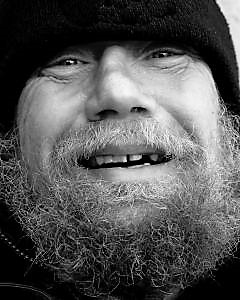
He was tall and quite thin, and his face jutted out from under a worn cap.  His beard was unkempt, his eyes red and rheumy.  He wore faded jeans, tattered and patched, and an old, plaid shirt with the collar turned up.  The children huddled behind their parents, afraid of being so close to such an apparition.

smiling-homeless_21165970

When he spoke to me, I could hardly hear him in the hum of the passing traffic.  He mumbled through that scraggly beard, through missing teeth, his words coming in disjointed phrases.

“Hey, can you….you got anything….any change?  A bus ticket, maybe….got any…?”

He was clutching a misspelled sign on a scrap of corrugated cardboard that read:

Vetran  homeless everthing helps

“No, sorry,” I muttered, watching for the green light that would allow us to escape.  And we walked away, slightly embarrassed, but relieved to leave him behind.

“Who was that guy, Daddy?” one of the kids asked.

“Did he wanna hurt us?” another chimed in.

Their parents reassured them that he had meant no harm.  He was just a man asking for money.

“Is he sick, Mummy?  Will he be alright?”

None of us could really answer.

When we reached the car, we clambered in silently, each of us lost in our own thoughts.  The kids soon put the episode behind them, immersing themselves in their gaming devices.  As I drove back through the intersection, heading home, the stranger was still on the corner, huddling around himself, approaching passers-by.  He looked pathetic, and utterly alone.  I hoped he didn’t see me staring at him.

Later that night, after everyone was in bed, I thought of him again.  At first, I chastised myself for not giving him something to help him out.  From somewhere, the scrap of a Bible verse teased a corner of my mind—Whatsoever ye do unto the least of these, ye do also to me—something close to that, I think.

But then I rationalized that a token from me would not likely have helped him anyway.  He was obviously past the point where a solitary handout was going to make much of a difference in his life.  He’d probably have wasted whatever we might have given him on booze or drugs, I told myself self-righteously.  At one point, I got angry that he had put me in such an uncomfortable position.

Still, underneath it all, I felt a nagging guilt.  ‘Tis the season to care for one’s fellow-creatures; yet we, so full of the Christmas spirit, had kept on walking.  Because we were fearful, because we hadn’t known how to respond…or because we didn’t care.

Was it best to have ignored him and walked on, I wondered?  Or would it have been better to have given him something, in the spirit of Christmas and with the hope that it would have helped him?  I didn’t know.

As I think about it even now, almost a year later—sitting warm and safe at home at the onset of another Christmas season, surrounded by people who love me—I wonder where that stranger is and whether he’s okay.

And I wish I knew what I should have done.

https://i0.wp.com/www.christmasgifts.com/clipart/merrychristmas1.jpg


Music Has Charms

front

As a famous Paul Anka lyric has it, …Regrets, I’ve had a few/But then again, too few to mention…

I do frequently mention one regret, however, an abiding sorrow that I didn’t study music when I was in high school.  Having been raised in a family where music was an ever-present part of our daily lives—to the point where I and my siblings to this day get a sing-song going whenever we’re together—it’s almost incomprehensible to me that I eschewed the opportunity to acquire formal training.

All the more so when I remember that the lead music teacher at our high school would go on to become one of the country’s leading choral directors—Elmer Iseler, conductor of the Toronto Mendelssohn Choir, founder of the Festival Singers of Canada and the Elmer Iseler Singers.  What a doofus I was!

iseler

With a stunningly callow arrogance, I suppose I dismissed the music students, some of whom were good friends, as too effete for the teenage machismo I was probably trying to cultivate.

I regret that.

As a youngster, I often found myself surreptitiously curled up, late at night, on the landing of the stairs in our home, listening to the singing of my parents and their friends from the parlor where the piano sat.  One of our neighbours was a gifted pianist, and he knew all the oldies—Frivola Sal, After You’ve Gone, What’ll I Do, Rose of Tralee, Sweet Georgia Brown, Rockabye Your Baby, Danny Boy, Sonny Boy, For Me and My Gal—and so many more.  Even fifty-plus years on, I know all the lyrics to dozens of their repertoire (sometimes now with a little prompting), and my favourite singer is still Al Jolson.

My mother loved the torch songs, and she’d vamp a little when she sang, a woman born to be a headliner.  My father favoured the oldies, and was very good with the harmonies (although he occasionally had to be reminded of the decibel level).  He absolutely loved barbershop quartets.

So many times there were that he would find me fast asleep on the landing after the last chorus had been sung.  For a long time, I never knew how I drifted off on the stairs and awakened in my bed.  I only knew that I loved the singing of the songs, and the singers who sang them.

The only singing I have done since those childhood days (other than alone in the shower) is at family gatherings, or occasionally at karaoke parties (with beer).  But the music gene was definitely passed along to my two daughters, both of whom have been singing, together and on their own, since their pre-school days.  They’ve even written songs together, ballads mostly, which I hum along to.

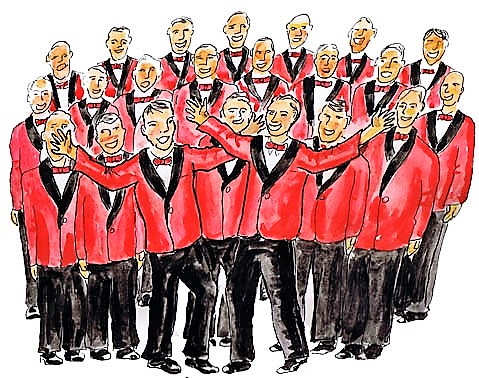
Recently, my wife and I attended a concert mounted by a local men’s chorus, a 108-man, traditional barbershop harmony group, but one that branches out into a cappella jazz, swing, soft rock, pop, traditional, and inspirational music.  The concert was superb, and we were fortunate to be invited to an after-party by one of the members (not-so-coincidentally, a golfing friend).

choir

And guess what!  Some of the choristers at that party gathered ‘round each other to sing some of the oldies, an impromptu concert.  And guess what else!  I sidled over, inched close to their circle, and joined my voice to theirs.  Tentatively at first, not wanting to spoil the beauty of their chorus, but then more confidently when two of them parted to make room for me.  I knew all the words, of course, and we belted out a few classics—When You Wore a Tulip, Daddy’s Little Girl (a personal favourite), Oh! You Beautiful Doll, and That Old Gang of Mine.  I could almost hear my father joining in beside me.

My wife told me later that I fit right in.  In fact, she said, some of the others at the party told her they assumed I was part of the chorus.  I stared at her, sure she was having me on, but she was apparently telling the truth.  And that was music to my ears (if you’ll pardon the pun).

Even better, however, was an invitation from several of the chorus members to try out for the group.  Attendance at three rehearsals, where I would be assessed to find my voice part placement, would be followed by an audition performance with three of the established singers as part of a quartet.  And then I’d either be in, or out.

I’ve never been part of a quartet in the shower, where my best solos have been rendered, so this public audition would be somewhat intimidating.  Plus, I have never been much of a joiner in groups of any sort, so making a commitment to this would be quite a change.

Still, I do regret passing up my first chance those many years ago.  All those yesterdays when I could have been singing joyously with like-minded choristers are gone forever.  But I do have a few tomorrows ahead of me.  And I do like to belt them out.  So, we shall see.

More than three hundred years ago, in his comedy of manners, The Mourning Bride, William Congreve wrote this—Musick has charms to soothe the savage breast…

Well, I am no savage, but it may well be that music could soothe the sadness I have carried with me since high school.

I’ll have to warn them, though, that I cannot hit the high C!


Free Speech? Free Press?

A cornerstone of democracy is the right to free speech, a principle perhaps best expressed in a 1906 work by the English writer, Beatrice Evelyn Hall, a statement often erroneously attributed to Voltaire:  I disapprove of what you say, but I will defend to the death your right to say it.

A second foundation of a democratic society, closely related to the first, is the right to a free press.  Newspapers as we know them made their first appearance in 17th century Europe, and in the mid-1700’s they were dubbed ‘the fourth estate’ by Edmund Burke, a British politician (the first three estates being those represented in parliament—the clergy, the nobility, and the common people).

Burke went so far as to describe this fourth estate as more important by far to the health of a nation than the other three, a sentiment echoed a hundred years later by Thomas Jefferson, author of the American Declaration of Independence, who wrote:  “…were it left to me to decide whether we should have a government without newspapers, or newspapers without a government, I should not hesitate a moment to prefer the latter.”

newspapers

The invention of the telegraph greatly enhanced the spread of news across nations, and around the world.  Thanks to technology, reporters could file their stories from anywhere (traditionally ending them with the rubric – 30 –  a shorthand for End), assured that they could be read everywhere.

But why is it so important to a free society that its citizens have the right to speak their minds, and the right to access a free press, unrestricted by government censorship?  Especially today, in this age of unlimited entrée to digital social media.

The answer lies in the fact that until very recently, we have been able to trust our news sources to deliver truthful accounts of events in the world around us.  Most reliable outlets reported the facts as they happened, based upon the best information available.  Serious journalists regarded accuracy and bias-free reporting as sacrosanct.  Editorial beliefs were confined, for the most part, to the opinion pages, and op-ed viewpoints were included to ensure balance in the presentation of the news.

Throughout my lifetime, it has been relatively easy in our democratic nation to educate and inform oneself about the world in which we live by reading, listening, and watching a variety of news outlets, their spectrum of viewpoints providing a balanced picture, as accurate and verifiable as it is possible to be.

Today, however, anyone can report the news through a variety of social media, regardless of their qualifications (or lack thereof), degree of impartiality, sense of right and wrong, education, or bigotries.

As an example, have a look at the headlines below, from different decades, and decide how many (if any) were actually reported:

Titanic Torpedoed by U-Boat; Tragedy Covered Up by Admiralty

FDR Knew About Pearl Harbor; Allowed Attack to Mobilize War Effort

JFK, Marilyn Buried at Arlington; Lovers Reunited Under Eternal Flame

Lennon Survived Murder Attempt; Lies in Coma in New Jersey Hospital

Chinese Colony Established on Moon; China Claims Lunar Sovereignty, Alarms West

Now, before deciding about that first group, check out the next list:

 Elvis Sighted; Rock Legend Living in Wax Museum

Microsoft Patents Ones, Zeroes; Computer Industry in Freefall

Pope Francis Shocks World; Endorses Donald Trump for President

Would You Rather Your Child Had Feminism or Cancer?

Gay Rights Have Made Us Dumber; Time to Get Back in the Closet

Which of the two groups is the more credible, which the more ridiculous?

Well, as you may have guessed, none of the headlines in the first group ever surfaced in any news outlet; I made them up.  But, incredibly, every one of the second group has actually appeared in a newspaper or digital news source—many of which inhabit the social media universe.

social-media

That could strike one as funny, but there’s a serious consequence to the burgeoning glut of fake news stories.  Many readers, listeners, and viewers (let us hope most of them) have the wisdom and experience to differentiate between what’s real and what isn’t.  And to base their subsequent actions on those conclusions.

But increasing numbers of uneducated, unsophisticated, gullible consumers of information do not have the ability to separate truth from fiction in such stories.  They are, therefore, susceptible to the persuasive powers of those who purvey pernicious falsehoods, often for political or financial gain.

To one who is colour-blind, all the various hues may appear the same; to those who are media-illiterate, all news accounts may possess the same weight, the same degree of veracity.  And that being the case, which are paid the most attention?

Unfortunately, all too often the attention goes to the lurid, sensational, graphically-charged, and blatantly false packages, at the expense of the sober, dispassionate, accurate accounts a free society and informed citizenry needs.  And this is coming at a time when traditional newspapers are increasingly falling by the wayside, unable to financially survive in our digital communications world.

I see three possibilities if this trend continues, and two of them are alarming.  One is a persistent proliferation of fake news sources, many of which reap great financial rewards for their producers, and all of which contribute to the continued dumbing-down of our society.  Ignorance is greatly to be feared.

A second is the institution of censorship by governments worried about the loss of press freedom—or, more ominously, about the unbridled existence of propagandizing news outlets that would replace elected leaders with demagogues not concerned or constrained by democratic principles.  Censorship is also to be feared, for it is a death-knell for freedom of speech.

The best possibility, but less likely I fear, is a re-awakening on the part of citizens of countries such as ours to the importance of a free press; to the obligation we have to teach young people (and their media-illiterate elders) how to differentiate between the real and the fake; and to the absolute necessity of safeguarding both free speech and a free press if we are to preserve our democratic way of life.  No number of fact-checkers can ever substitute for an informed, discerning, and open-minded citizenry.

If we are unsuccessful, I believe, we shall arrive at the point where the last credible headline we shall ever see is:

– 30 –