Whither Humanity?

The word humanity is a noun, defined thusly:

  • a collective name for all human beings;
  • the state of being human; and
  • the quality of benevolence, kind-heartedness, or magnanimity.

The first may be illustrated by the sentence, That invention will benefit all humanity; the second by, We are united in our common humanity; and the third by, The good Samaritan showed such humanity through his actions.

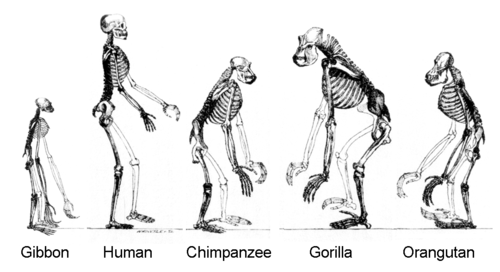
In the first definition above, humanity—of which you and I as human beings are a part—had its origins in the dim recesses of time past, perhaps 200,000 years ago, when archaeological studies posit the emergence of Homo sapiens.  These studies have demonstrated that several precursors to that species existed, including Homo habilis and Homo erectus, all of which displayed characteristics quite distinct from apelike creatures.  But human beings as we know us today (referred to now as Homo sapiens sapiens) evolved distinctly and irrevocably away from our earliest ancestors, perhaps 50,000 years ago.

It has been estimated by the Population Reference Bureau that more than 108 billion such ‘people’ have lived on our planet since then.  The PRB, founded in 1929, is a non-profit organization that studies issues related to population, health, and the environment.  Its work pegs the number of people living today at something greater than seven billion, which constitutes approximately 6.5% of the total of every human who has ever lived.

Two major demarcations, among many others, distinguish us from the earlier versions of Homo species.  One is the growth of brain size, the other the shrinking of some physical attributes, including brow prominence, mid-face projection, and skeletal structure.  Both eventually enabled the acquisition and refinement of speech, and thus the possibility of sharing thoughts and feelings among each other—the earliest manifestation of humanity in its second definition.

It would be possible, I imagine, to express affinity, empathy, or insight with respect to the emotional or physical well-being of another, even if we were unable to communicate them verbally.  Possible, too, I think, to convey anger, resentment, or disappointment to someone.  Body language and non-verbal gestures could convey such messages adequately.  But it is through speech that we can most accurately articulate our feelings, be they positive or negative, without resorting to physical demonstrations.

The ability to speak depends on both physical and neural capabilities, which we, alone among animals, possess.  And language, which developed from this unique ability, is what has made possible every significant intellectual accomplishment along the path of our development as a species—including both the ability to save lives and prolong them beyond the wildest expectations of a century ago; and the ability to wage war unto death on those we fear or loathe, to the point of wiping them from the face of the earth.

So, at the dawn of another year, the two-thousand-and-seventeenth of the modern era (and maybe the fifty-two-thousand-and-seventeenth of our existence as a modern species), I ask this question:  Whither humanity?

We have a good idea whence we came, thanks to the innumerable studies of our history and development.  The state of humanity all humanity enjoys is well and truly established.  But where are we going?  And what of our inner humanity—our benevolence, kind-heartedness, magnanimity—toward our co-habitants of the planet?  Could it be that our brains are indeed dualistic—in the sense that we want to create and destroy, build up and tear down, co-exist and dominate—at one and the same time?  If so, that is an horrific equation, one that is perhaps the result of centuries of struggle to survive as a species, in order to perpetuate humanity.

But now, we live in an age where the baser half of that equation can have disastrous results, not just for those we choose to see as our enemies, but for us all.  And if we allow fear to draw us back into protective enclaves of our own kind—those who look, think, and act like us—to the exclusion of those who don’t, we risk diminishing our fundamental humanity.  At a time of great peril to our entire race, surely it is better to reach out, to join hands, than it is to lash out and smash humanity asunder.

We belong to numerous nations inhabiting this long-suffering planet, each of which harbours its own patriotic aspirations.  But every one of those nations depends upon the same planetary host, and all humanity is travelling on the same interstellar vessel.  Will we collectively steer our ship to safe harbour, or scuttle it with all hands on board?

I have long admired these words from the second inaugural address of Abraham Lincoln, which I excerpt here—

          With malice toward none, with charity for all, [let us] achieve and cherish a

just and lasting peace among ourselves and with all nations.

Happy New Year—free of malice, full of charity—to all humanity!

On Top of the Grass

Almost a decade ago, I was seized by a medical emergency with very little warning.  After a frantic day of searching for an available hospital to perform a needed surgery, I was wheeled into the operating room in the wee small hours of the following morning—in the very nick of time I subsequently learned, due to a severe case of blockage in my colon, caused by diverticulitis.

During the endless days of recovery in hospital afterward, I consoled myself in the lonely nighttime hours by composing a poem in my head, one stanza at a time.  On each following morning, my wife would write the stanza down as I recited it from a sometimes drug-addled memory.

writing

Once home, I tweaked the poem somewhat, then used it as a foreword to a book of tales I was about to publish.  It centered on a sentiment my golfing pals used to joke about in our retirement community—that, no matter what might be ailing us on any given day, at least we were still standing on top of the grass, rather than resting beneath it.

While I was composing it, the poem provided a promise of hope for me that my recovery would be complete.  Later, it became a source of inspiration to do whatever it would take to make that happen.

As things turned out, the hopefulness expressed in the final stanza—written before a second surgery restored me half-a-year later—did bear fruit.  And almost ten years on, the poem still resonates for me with its message of faith and optimism.

On Top of the Grass

It struck with a rush, and hit full-flush,

The pain that would not end.

It twisted my gut until it was shut,

And made my belly distend.

It took fierce hold of my abdominal fold

As I lay on the emergency bed.

I feared I would die, and the question of “Why?”

Kept banging around in my head.

~ 0 ~

My angels of life—my daughters and wife—

Were there from beginning to end.

A sense of their touch meant ever so much

Through pain I could not comprehend.

From dusk until dawn, I thought I was gone

As we raced through the city’s grim gloom,

With siren and lights, we searched the dark night

For an available surgery-room.

~ 0 ~

In the back of the van with the ambulance man,

Sedated, but dogged by the pain,

I yearned for relief, though it was my belief

That I’d never be normal again.

I knew that I should make myself understood,

And tell him I was sinking down fast.

Then he gave me some slugs of painkilling drugs,

And oblivion quickly slipped past.

~ 0 ~

Some hours anon, the doctors had gone,

And I wakened, my girls at my side.

How fair they did seem, my loveliest dream,

Their smiles of relief beaming wide.

They stroked my poor head as I lay in my bed,

And together we gave thanks for life,

The four of us there, reliving the scare,

Just me, and my daughters and wife.

~ 0 ~

The details were grim, but I wanted them,

So I’d know what had happened to me.

They gave me the scoop on my colonic loop,

And I learned it was taken, you see.

But enough does remain, they’ll connect me again,

Just as soon as they figure out why—

And what—caused the block, caused my system to lock,

And laid me so low I could die.

~ 0 ~

I’m home now, it’s great, and so I just wait

For my good health and strength to return.

Then I’ll journey back down to the city’s downtown,

Where the doctor’s next steps I will learn.

A scope and a scan, MRI if I can,

Will give her a plan to pursue,

Then under the knife, I’ll get back my life,

And that life I shall gladly renew.

~ 0 ~

What does it all mean, and why have I been

A victim, or so it appears?

I’m not sure I know, but I’ll go with the flow,

With more smiles than pitying tears.

I know this for true, and I’m telling you,

That all of this sickness shall pass.

When all’s said and done, at each dawn of the sun…

I’ll be standing on top of the grass!

top-of-the-grass

I hope you, too, will be standing there for many years to come.


My Emergency Room Visit

I had occasion recently to visit a friend in hospital, a spanking-new facility in our community.  I had no trouble parking, finding the elevators, or locating his room, and we enjoyed a half-hour or so of conversation before I left.

It was quite a contrast to what I had experienced a year or so earlier, when I paid an unexpected visit to the emergency department of the old hospital, a facility reminiscent of the dark ages of medicine.

emergency-room_265898

My wife was away for the weekend with friends, and I was home alone.  That in itself is never a good idea.

While attempting to open a can with our idiot-proof can-opener, I managed to slice my index finger rather badly.  When my muddling efforts to stanch the bleeding were unsuccessful, I decided—very reluctantly, mind you—to drive myself to the hospital to have the injury stitched.

With a gauze wrapping the size of a small fist encasing my finger, I managed to make the trip without incident.  Not having needed emergency care for quite some time, however, I’d forgotten how long such a simple first-aid procedure could take.

The first clue that I might be in for a long stay came when I had to wait for a spot in the emergency parking lot.  The guard on duty wouldn’t let me in until a metered space opened up, despite my wagging my mangled finger at him.  That word—emergency—takes on a whole new meaning when one enters upon hospital property; Hurry up and wait might best describe what I was about to endure.

Once I finally got the car parked, I had to find the parking meter (at the far end of the lot from where I was, of course!), fumble some coins into it, then trudge back to the car to place the parking pass on the dashboard.  I might have been whimpering softly by this point, although I can’t be certain.  I next proceeded to the emergency room entrance, following the brightly-coloured signs with their pointing arrows, and limped up to the reception desk.

I’m not sure, looking back, why I was limping; after all, it was my finger I had injured.  Perhaps I was subconsciously trying to influence the admissions staff to whisk me right through.  I could almost hear the PA system blaring forth:

Prep the O.R. immediately!  This patient has a severe digital incision requiring prompt attention.  Alert the trauma unit!  We’re on our way up!

Hah!  Faint hope!  I leaned on the reception desk, moaning strategically, waiting for the receptionist.  She was on the telephone, apparently fighting to get off, but losing.  Finally, to my delight, another woman came behind the counter, set down the coffee and bun she was carrying, and approached me.

“Last name?” she inquired.

“Burt,” I responded.  “I’ve cut my finger pretty badly on a tin can, and I can’t get the bleeding…”

“Take a seat,” she interjected, indicating a row of chairs to my left with a jerk of her head.  I meekly joined the other eight or nine folks already sitting there—none of them, to my eye, as much in need of help as I.  Every few minutes, just to emphasize that point, I groaned audibly.

During the next forty-five-or-so minutes, every one of them was called into one of two small cubicles, behind a curtain.  I never saw anyone emerge.  But I was impressed with the efficiency of it, even ‘though I had to wait quite a while to be included.

When I finally heard my name, I smugly entered a cubicle ahead of the people who had arrived after me, every one of them fixing me with a malevolent stare for having the nerve to think I was in greater need than they.  Inside, I was told to sit down in front of a large computer screen.  A different woman sat opposite me.

“Proof of health insurance?” she asked.  “Been treated here before?”

“Yes,” I whined, “but it’s out in the car.  In my wallet.  I don’t think I’ve been in here before.”

“We’ll need it,” she said.

Slowly and somewhat resentfully, I carried my sore finger all the way back to the parking lot to fetch my wallet.  Then I trudged back to the cubicle.  By now I was limping even more noticeably.  Of course, someone else was now inside with the woman and her computer, so I had to wait my turn once more.

At long last, I made it through the data collection process and was ushered through the rear door of the cubicle to what I hoped was the treatment room.  Alas!  It was another, larger, waiting-room, and the whole world, it seemed, was ahead of me.  Including some of the people who had apparently resented me earlier, now happy they had passed me in line.

96-waiting_room_hospital

Three magazines, two washroom breaks, and one half-cold cup of coffee later, I was called into an honest-to-goodness treatment room.  After sitting on the padded table for a quarter-hour, trying not to wrinkle the protective paper pulled over top of it, I finally decided to lie down.  Precisely at that point, a doctor (I greatly hoped) bustled in, scanned my data sheet, donned her latex gloves, then removed the sodden wrapping I had been clutching around my wound.

“Do you need this finger?” she asked abruptly.

“Do….do I need it?” I croaked in horror.

“No, no, no.  I mean, do you need it for your work?  What sort of work do you do?  We can freeze it and stitch it if you need your finger; otherwise, we’ll clean it, glue the skin, and tape it for you.”

My relief was palpable.  All my anger and frustration at having waited an eternity vanished in a flash.  I was so grateful she was going to save my finger, I was seized by an impulse to hug her.

But she wasn’t there long enough for me to act on it.  In not much more than five minutes from the time she’d entered, I was all taped up.  And the bleeding had stopped.

“Good to go,” she said, “unless that limp is a problem.”

“Uh, no, it’s not,” I quickly replied.  “It’s really nothing.”

In no time at all, I was outside on the way to my car.  And to the parking ticket on the windshield, reminding me that I had stayed too long!


A Panhandler’s Christmas

After we retired to Florida some years ago, we discovered that Christmas there is as jolly a season as any we enjoyed up north, enveloped by snow.  It was especially joyous when our grandchildren come to visit.

One evening during our last Christmas season in the sunny south, we all went out to dinner—my wife, our daughter and her husband, and three of our grandchildren.  We’d spent the afternoon shopping at a large, regional mall, and were looking forward to enjoying the cheer of the season and the pleasure of each other’s company.

During dinner, we talked of our plans for their holiday with us.  Unlike the north, where tobogganing, skating, snowball fights, and warm fires were the order of the day, in Florida the beach, the pool, and the golf course were all on the agenda.  We were looking forward to an old-fashioned holiday with lots of singing, plenty of fresh air and exercise, good food, and family to enjoy being around the tree with.

By the time we finished dinner, sharing our happy plans, we were all feeling very fine—warm, full, comfortable.  We left the restaurant, chatting amiably, and began the walk back to the parking lot where we had left the car.

As we waited to cross the intersection, guided by flashing green and red traffic lights that added to the festive Christmas air, we were accosted by a stranger.  He meant us no harm, but his sudden approach startled us out of our contented state.

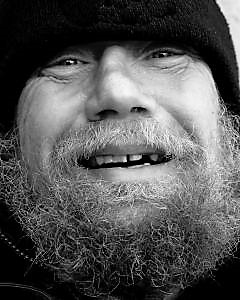
He was tall and quite thin, and his face jutted out from under a worn cap.  His beard was unkempt, his eyes red and rheumy.  He wore faded jeans, tattered and patched, and an old, plaid shirt with the collar turned up.  The children huddled behind their parents, afraid of being so close to such an apparition.

smiling-homeless_21165970

When he spoke to me, I could hardly hear him in the hum of the passing traffic.  He mumbled through that scraggly beard, through missing teeth, his words coming in disjointed phrases.

“Hey, can you….you got anything….any change?  A bus ticket, maybe….got any…?”

He was clutching a misspelled sign on a scrap of corrugated cardboard that read:

Vetran  homeless everthing helps

“No, sorry,” I muttered, watching for the green light that would allow us to escape.  And we walked away, slightly embarrassed, but relieved to leave him behind.

“Who was that guy, Daddy?” one of the kids asked.

“Did he wanna hurt us?” another chimed in.

Their parents reassured them that he had meant no harm.  He was just a man asking for money.

“Is he sick, Mummy?  Will he be alright?”

None of us could really answer.

When we reached the car, we clambered in silently, each of us lost in our own thoughts.  The kids soon put the episode behind them, immersing themselves in their gaming devices.  As I drove back through the intersection, heading home, the stranger was still on the corner, huddling around himself, approaching passers-by.  He looked pathetic, and utterly alone.  I hoped he didn’t see me staring at him.

Later that night, after everyone was in bed, I thought of him again.  At first, I chastised myself for not giving him something to help him out.  From somewhere, the scrap of a Bible verse teased a corner of my mind—Whatsoever ye do unto the least of these, ye do also to me—something close to that, I think.

But then I rationalized that a token from me would not likely have helped him anyway.  He was obviously past the point where a solitary handout was going to make much of a difference in his life.  He’d probably have wasted whatever we might have given him on booze or drugs, I told myself self-righteously.  At one point, I got angry that he had put me in such an uncomfortable position.

Still, underneath it all, I felt a nagging guilt.  ‘Tis the season to care for one’s fellow-creatures; yet we, so full of the Christmas spirit, had kept on walking.  Because we were fearful, because we hadn’t known how to respond…or because we didn’t care.

Was it best to have ignored him and walked on, I wondered?  Or would it have been better to have given him something, in the spirit of Christmas and with the hope that it would have helped him?  I didn’t know.

As I think about it even now, almost a year later—sitting warm and safe at home at the onset of another Christmas season, surrounded by people who love me—I wonder where that stranger is and whether he’s okay.

And I wish I knew what I should have done.

https://i0.wp.com/www.christmasgifts.com/clipart/merrychristmas1.jpg


Music Has Charms

front

As a famous Paul Anka lyric has it, …Regrets, I’ve had a few/But then again, too few to mention…

I do frequently mention one regret, however, an abiding sorrow that I didn’t study music when I was in high school.  Having been raised in a family where music was an ever-present part of our daily lives—to the point where I and my siblings to this day get a sing-song going whenever we’re together—it’s almost incomprehensible to me that I eschewed the opportunity to acquire formal training.

All the more so when I remember that the lead music teacher at our high school would go on to become one of the country’s leading choral directors—Elmer Iseler, conductor of the Toronto Mendelssohn Choir, founder of the Festival Singers of Canada and the Elmer Iseler Singers.  What a doofus I was!

iseler

With a stunningly callow arrogance, I suppose I dismissed the music students, some of whom were good friends, as too effete for the teenage machismo I was probably trying to cultivate.

I regret that.

As a youngster, I often found myself surreptitiously curled up, late at night, on the landing of the stairs in our home, listening to the singing of my parents and their friends from the parlor where the piano sat.  One of our neighbours was a gifted pianist, and he knew all the oldies—Frivola Sal, After You’ve Gone, What’ll I Do, Rose of Tralee, Sweet Georgia Brown, Rockabye Your Baby, Danny Boy, Sonny Boy, For Me and My Gal—and so many more.  Even fifty-plus years on, I know all the lyrics to dozens of their repertoire (sometimes now with a little prompting), and my favourite singer is still Al Jolson.

My mother loved the torch songs, and she’d vamp a little when she sang, a woman born to be a headliner.  My father favoured the oldies, and was very good with the harmonies (although he occasionally had to be reminded of the decibel level).  He absolutely loved barbershop quartets.

So many times there were that he would find me fast asleep on the landing after the last chorus had been sung.  For a long time, I never knew how I drifted off on the stairs and awakened in my bed.  I only knew that I loved the singing of the songs, and the singers who sang them.

The only singing I have done since those childhood days (other than alone in the shower) is at family gatherings, or occasionally at karaoke parties (with beer).  But the music gene was definitely passed along to my two daughters, both of whom have been singing, together and on their own, since their pre-school days.  They’ve even written songs together, ballads mostly, which I hum along to.

Recently, my wife and I attended a concert mounted by a local men’s chorus, a 108-man, traditional barbershop harmony group, but one that branches out into a cappella jazz, swing, soft rock, pop, traditional, and inspirational music.  The concert was superb, and we were fortunate to be invited to an after-party by one of the members (not-so-coincidentally, a golfing friend).

choir

And guess what!  Some of the choristers at that party gathered ‘round each other to sing some of the oldies, an impromptu concert.  And guess what else!  I sidled over, inched close to their circle, and joined my voice to theirs.  Tentatively at first, not wanting to spoil the beauty of their chorus, but then more confidently when two of them parted to make room for me.  I knew all the words, of course, and we belted out a few classics—When You Wore a Tulip, Daddy’s Little Girl (a personal favourite), Oh! You Beautiful Doll, and That Old Gang of Mine.  I could almost hear my father joining in beside me.

My wife told me later that I fit right in.  In fact, she said, some of the others at the party told her they assumed I was part of the chorus.  I stared at her, sure she was having me on, but she was apparently telling the truth.  And that was music to my ears (if you’ll pardon the pun).

Even better, however, was an invitation from several of the chorus members to try out for the group.  Attendance at three rehearsals, where I would be assessed to find my voice part placement, would be followed by an audition performance with three of the established singers as part of a quartet.  And then I’d either be in, or out.

I’ve never been part of a quartet in the shower, where my best solos have been rendered, so this public audition would be somewhat intimidating.  Plus, I have never been much of a joiner in groups of any sort, so making a commitment to this would be quite a change.

Still, I do regret passing up my first chance those many years ago.  All those yesterdays when I could have been singing joyously with like-minded choristers are gone forever.  But I do have a few tomorrows ahead of me.  And I do like to belt them out.  So, we shall see.

More than three hundred years ago, in his comedy of manners, The Mourning Bride, William Congreve wrote this—Musick has charms to soothe the savage breast…

Well, I am no savage, but it may well be that music could soothe the sadness I have carried with me since high school.

I’ll have to warn them, though, that I cannot hit the high C!


Free Speech? Free Press?

A cornerstone of democracy is the right to free speech, a principle perhaps best expressed in a 1906 work by the English writer, Beatrice Evelyn Hall, a statement often erroneously attributed to Voltaire:  I disapprove of what you say, but I will defend to the death your right to say it.

A second foundation of a democratic society, closely related to the first, is the right to a free press.  Newspapers as we know them made their first appearance in 17th century Europe, and in the mid-1700’s they were dubbed ‘the fourth estate’ by Edmund Burke, a British politician (the first three estates being those represented in parliament—the clergy, the nobility, and the common people).

Burke went so far as to describe this fourth estate as more important by far to the health of a nation than the other three, a sentiment echoed a hundred years later by Thomas Jefferson, author of the American Declaration of Independence, who wrote:  “…were it left to me to decide whether we should have a government without newspapers, or newspapers without a government, I should not hesitate a moment to prefer the latter.”

newspapers

The invention of the telegraph greatly enhanced the spread of news across nations, and around the world.  Thanks to technology, reporters could file their stories from anywhere (traditionally ending them with the rubric – 30 –  a shorthand for End), assured that they could be read everywhere.

But why is it so important to a free society that its citizens have the right to speak their minds, and the right to access a free press, unrestricted by government censorship?  Especially today, in this age of unlimited entrée to digital social media.

The answer lies in the fact that until very recently, we have been able to trust our news sources to deliver truthful accounts of events in the world around us.  Most reliable outlets reported the facts as they happened, based upon the best information available.  Serious journalists regarded accuracy and bias-free reporting as sacrosanct.  Editorial beliefs were confined, for the most part, to the opinion pages, and op-ed viewpoints were included to ensure balance in the presentation of the news.

Throughout my lifetime, it has been relatively easy in our democratic nation to educate and inform oneself about the world in which we live by reading, listening, and watching a variety of news outlets, their spectrum of viewpoints providing a balanced picture, as accurate and verifiable as it is possible to be.

Today, however, anyone can report the news through a variety of social media, regardless of their qualifications (or lack thereof), degree of impartiality, sense of right and wrong, education, or bigotries.

As an example, have a look at the headlines below, from different decades, and decide how many (if any) were actually reported:

Titanic Torpedoed by U-Boat; Tragedy Covered Up by Admiralty

FDR Knew About Pearl Harbor; Allowed Attack to Mobilize War Effort

JFK, Marilyn Buried at Arlington; Lovers Reunited Under Eternal Flame

Lennon Survived Murder Attempt; Lies in Coma in New Jersey Hospital

Chinese Colony Established on Moon; China Claims Lunar Sovereignty, Alarms West

Now, before deciding about that first group, check out the next list:

 Elvis Sighted; Rock Legend Living in Wax Museum

Microsoft Patents Ones, Zeroes; Computer Industry in Freefall

Pope Francis Shocks World; Endorses Donald Trump for President

Would You Rather Your Child Had Feminism or Cancer?

Gay Rights Have Made Us Dumber; Time to Get Back in the Closet

Which of the two groups is the more credible, which the more ridiculous?

Well, as you may have guessed, none of the headlines in the first group ever surfaced in any news outlet; I made them up.  But, incredibly, every one of the second group has actually appeared in a newspaper or digital news source—many of which inhabit the social media universe.

social-media

That could strike one as funny, but there’s a serious consequence to the burgeoning glut of fake news stories.  Many readers, listeners, and viewers (let us hope most of them) have the wisdom and experience to differentiate between what’s real and what isn’t.  And to base their subsequent actions on those conclusions.

But increasing numbers of uneducated, unsophisticated, gullible consumers of information do not have the ability to separate truth from fiction in such stories.  They are, therefore, susceptible to the persuasive powers of those who purvey pernicious falsehoods, often for political or financial gain.

To one who is colour-blind, all the various hues may appear the same; to those who are media-illiterate, all news accounts may possess the same weight, the same degree of veracity.  And that being the case, which are paid the most attention?

Unfortunately, all too often the attention goes to the lurid, sensational, graphically-charged, and blatantly false packages, at the expense of the sober, dispassionate, accurate accounts a free society and informed citizenry needs.  And this is coming at a time when traditional newspapers are increasingly falling by the wayside, unable to financially survive in our digital communications world.

I see three possibilities if this trend continues, and two of them are alarming.  One is a persistent proliferation of fake news sources, many of which reap great financial rewards for their producers, and all of which contribute to the continued dumbing-down of our society.  Ignorance is greatly to be feared.

A second is the institution of censorship by governments worried about the loss of press freedom—or, more ominously, about the unbridled existence of propagandizing news outlets that would replace elected leaders with demagogues not concerned or constrained by democratic principles.  Censorship is also to be feared, for it is a death-knell for freedom of speech.

The best possibility, but less likely I fear, is a re-awakening on the part of citizens of countries such as ours to the importance of a free press; to the obligation we have to teach young people (and their media-illiterate elders) how to differentiate between the real and the fake; and to the absolute necessity of safeguarding both free speech and a free press if we are to preserve our democratic way of life.  No number of fact-checkers can ever substitute for an informed, discerning, and open-minded citizenry.

If we are unsuccessful, I believe, we shall arrive at the point where the last credible headline we shall ever see is:

– 30 –

People Who Know Everything

People who assume they know everything are annoying to those of us who do!

Thus spake a friend of mine (in jest I think) during a conversation about smarmy politicians who claim to have solutions to the ills that plague our society.  All we have to do is vote them into office and our worries will be over.  Or so they promise.

I confess I, too, become annoyed whenever someone presents as a know-it-all—not, as my friend joked, because I think I know everything, but because I think no one does.  Whenever I hear someone bloviating loudly on any subject, I remember a character from the Saturday morning cartoon shows of my childhood, Foghorn J. Leghorn.  I still picture him as a blustering, southern senator, speaking a mile a minute, pausing only intermittently to check with his listeners.

the-foghorn-leghorn-11

“Pay attention to me, boy!  I’m not jus’ talkin’ to hear my head roar!”

“I keep pitchin’ ‘em, son, an’ you keep missin’ ‘em!”

“Any o’ this gettin’ through to you, son?”

The theory, I suppose, is that no one can contradict you if you won’t allow them a chance to speak.

The problem is, the world is a complex place where almost any issue has more than one truth attached to it.  Draining a swamp, for example, might be considered a fine idea by a developer who wants to convert it to a new mobile home community, but not such a good thing for the alligators, herons, and muskrats who already make it their home.  One’s perspective always plays a part.

If the swamp denizens are afforded no chance to speak on their own behalf, if they’re out-shouted and overwhelmed by those who know everything, by those who have the financial and political wherewithal to dominate the conversation, they are doomed.  In such cases, although both sides of the argument may have merit, only one side gets heard.  And that side usually prevails.

My experience with know-it-alls is that they seldom want to be confronted with facts or evidence that might support a view contrary to their own.  The flat-earth society comes to mind.  When presented with the famous ‘blue marble’ photograph of our planet, shot from an Apollo spacecraft, the society’s response was, “It’s easy to see how a photograph like that could fool the untrained eye.”

the_earth_seen_from_apollo_17-1

There are numerous other situations where those claiming to know everything reject scientifically-based information in favour of pre-determined positions: holocaust deniers, global-warming skeptics, and tobacco users are but a few.  The staunch refusal of these deniers to entertain an opposing point of view effectively cuts off any possibility of meaningful discussion, and imposes their peculiar world-view on everyone.  In the words of the Borg, from the Star Trek television series, “Resistance is futile.”

It is instructive to reference Susan Glaspell, a Pulitzer Prize journalist and novelist, who wrote:  One never denies so hotly as in denying to one’s self what one fears is true…

I don’t know the ‘honest truth’ (if there is one) about any of these controversial issues.  But I instinctively doubt those who claim to know it, especially in the face of possibly-contradictory evidence.  Surely both sides of any argument (or however many sides there may be) should be weighed and assessed before conclusions are reached.

And in cases where such rigorous debate has occurred, the resultant conclusions should still remain open to further examination and challenge as new information comes to light.  But certainty is the enemy of an open mind, and an open mind is the enemy of those who claim to know everything.

I’m reminded of a snatch of dialogue from a long-ago film that illustrates the point.  While arguing about something, one character states his opinion in no uncertain terms, clearly brooking no challenge.

“You really think so?” his companion asks.

“I don’t think,” the first one declares.  “I know!”

After a meaningful pause, the second character says, “Good, ‘cause I don’t think you know, either.”

confused

Indeed.

The Quality of a Nation

According to St. Augustine, a nation is an association of reasonable beings united in a peaceful sharing of the things they cherish; therefore, to determine the quality of a nation, you must consider what those things are.

He wrote this in a monumental work of Christian philosophy, entitled The City of God, in the fifth century AD.  Fifteen-hundred years later, in 1951, the Canada Royal Commission on National Development in the Arts, Letters & Sciences used it as a preface to their report to parliament.

royal-commission

The recent triumph of Donald Trump in the US presidential election was one of two things that got me to wondering what a list of those qualities might be—not so much for the USA as for my own country.  What are the values that Canada, as a nation, truly cherishes?

The political opponents of the American president-elect have cast his ascension to power in the darkest terms, quite a difference to the sunny ways seemingly endorsed in our own federal election a year or so ago.  Words like racist, misogynist, bully, and xenophobic, used in reference to Trump by his foes, offer a stark contrast to words such as enthusiastic, transparent, optimistic, and leader, which have been applied to our prime minister, Justin Trudeau, by his supporters.

On the flip-side, Trump’s supporters have described him as strong, forceful, down-to-earth, and no pushover.  Trudeau’s detractors have used words and phrases like boyish, emotional, and not man enough in their descriptions.

Of course, political opinions, like beauty, are mostly in the eye of the beholders, and care should be taken not to believe everything one reads or hears about either of these gentlemen.  Still, the fact that both were elected to their country’s highest office by their respective citizens might say something about what is cherished by each nation.  At least at present, and by a sufficient number of those who voted.

But the critical thing about nationhood is that, despite these opposing viewpoints, each nation as a whole must accept and adhere to a basic set of values if it is to survive.

us-constitution

The second thing that prompted my curiosity about the qualities Canada might cherish was the proposal by a presumptive political-party leader, Kellie Leitch, to vigorously pre-screen potential immigrants for any trace of “anti-Canadian values”.  If they fail to measure up to the standard she will presumably establish, she will bar them from entry.

It makes sense, of course, to ban terrorists and criminals; it also makes sense to admit people with skills and training Canada needs, and people who are fleeing for their lives from oppressive regimes.  In fact, our current immigration practices and procedures do both of these things quite well.

But what are the values Leitch is looking for?  She has stated that the test will screen for anti-Canadian views that include intolerance toward other religions, cultures, and sexual orientations; violent and/or misogynist behaviour; and/or a lack of acceptance of our Canadian tradition of personal and economic freedoms.

I wonder, though, how she might define such concepts as intolerance (Sorry, but I will not eat poutine!) or personal freedoms (Okay, okay…I won’t pee on the golf course!).  Could it be so simple and light-hearted?

Likely not.  For example, if I were a prospective immigrant of a particular faith, say Catholic, would I be banned for not endorsing the notion of same-sex marriage?  If I were to vigorously protest the environmental policies of the federal government (perhaps a government she might be leading), thereby exercising  free speech, would I be expelled?  If I chose to wear a niqab during my citizenship swearing-in, would I be rudely escorted from the room?  And the country?

The Canadian Charter of Rights and Freedoms, adopted as part of the Constitution Act in 1982, pretty much lays out in its thirty-four sections the entitlements and responsibilities conferred upon, and expected of, every citizen.  By its very existence, it establishes many of the values our nation cherishes; for example:

  • the right to life, liberty and security of the person…
  • [equality] before and under the law and…the right to the equal protection and equal benefit  of the law without discrimination and, in particular, without discrimination based on race, national or ethnic origin, colour, religion, sex, age or mental or physical disability…
  • [these rights] shall not be construed as denying the existence of any other rights or freedoms that exist in Canada…
  • [these rights] are guaranteed equally to male and female persons.

canadian-charter

In effect, this means all citizens enjoy the right to cherish, and act in accordance with, whatever they believe—with the proviso that they must not harm anyone else.  No one, it seems to me, including a politically-motivated Kellie Leitch, can judge any of us on a set of arbitrarily-established Canadian values.

Perhaps John Stuart Mill said it best, in his 1859 essay, On Liberty, where he attempted to identify standards for the relationship between a nation’s authority and its citizens’ liberty:

          The maxims are, first, that the individual is not accountable to society for his actions, in so far as these concern the interests of no person but himself…

          Secondly, that for such actions as are prejudicial to the interests of others, the individual is accountable, and may be subjected either to social or to legal punishment, if society is of opinion that the one or the other is requisite for its protection.

If we were to accept the guidance offered in these two foundational sources, I don’t believe we would need a test to suss out anti-Canadian values.  To the contrary, our co-existence would exemplify those values, and allow us to live united in a peaceful sharing of the things we cherish.

And we would be proud of the quality of our nation, upholding it for all to see—from sea to sea to sea.

Everybody Knows

By now, I suspect, everybody knows that Leonard Cohen, an iconic Canadian poet and songwriter, died at the beginning of this week.  And of course, everybody knows that Donald Trump, an American entrepreneur and novice politician, won the US presidential race a day later.

I am struck by the awful asymmetry of these two events.

For many lovers of music, the passing of the artist, while distressing, allows us once again to celebrate and honour the memories his songs created for us.

For progressive, liberal-minded people, the election of an erratic demagogue foreshadows a period of pullback, retrenchment, and isolationism in America.  The nation’s motto, E pluribus unum—out of many, one—takes on an ominous tone.

I know of no one who is happy at the death of Cohen.

cohen

By contrast, millions upon millions of Americans are thrilled by the ascension of Trump.  And, despite my many misgivings, I could well be among them if all the actions he has pledged to take were similar to these, for example: impose term limits on all members of Congress; impose new restrictions on lobbying and lobbyists in Washington; allow vital energy infrastructure projects, like the Keystone Pipeline, to move forward; and fix America’s water and environmental infrastructure.  In my view, these are reasonable, wise moves.

Alas, he may also proceed with actions such as these: renegotiate NAFTA or withdraw from the deal altogether; lift the restrictions on the production of job-producing American energy reserves, including shale, oil, natural gas and clean coal; cancel billions in payments to U.N. climate change programs; repeal, rather than fix, the Affordable Health Care Act; appoint conservative judges to vacancies in the Supreme Court (who will, quite possibly, reverse Roe v. Wade affecting women’s rights with respect to abortion); and cancel funding to such organizations as Planned Parenthood and Sanctuary Cities.  I deem these actions to be backward-looking and regressive.

trump

For me—one of those liberal progressives favouring public policies of inclusion and social conscientiousness—it is interesting to consider some of the sobriquets bestowed on Cohen over the years, and to see how many of them might fit Trump:

∙ prophet of despair,

∙ gloom merchant,

∙ grinning reaper,

∙ world heavyweight champion of existential despair, and

∙ dark messiah.

In Cohen’s case, these phrases were intended as respectful descriptions of the songs he wrote and performed.  They are almost oxymorons, in that they combine positive and negative attributes in each phrase.

By contrast, for Trump they may bear no double-meaning; depending upon the actions he does choose to take during his first months in office, I fear they may have to be taken literally.

Consider these lines from Everybody Knows, one of Cohen’s most revered works; time will tell if they prove prophetic:

Everybody knows the war is over
Everybody knows the good guys lost
Everybody knows the fight was fixed
The poor stay poor, the rich get rich
That’s how it goes…                                                                                                                

Everybody knows that the boat is leaking
Everybody knows that the captain lied…

And if the worst does come to pass, keep in mind these lines, also from Cohen:

Ring the bells that still can ring
Forget your perfect offering
There is a crack in everything
That’s how the light gets in.

light

Cohen knew that, and we know that, too.

Everybody knows.


The F-Word

Years ago, when our two daughters were still in elementary school, my wife and I encountered a moment of truth with them—one of those things that never seems to arise in the privacy and sanctity of one’s own home.  Children are too diabolical to let that happen.

We were out for dinner, treating them to a white-tablecloth dinner in a fine restaurant in our neighbourhood.  Part of our strategy to introduce them to the niceties of life, we hoped it also would serve as an opportunity to educate them in the proper manners and etiquette such occasions demanded.  No other children were present, and I smugly complimented myself on the loving family picture we must have presented.

family-eating

Our table sat amidst several others, nicely spaced, but close enough to require moderated tones while speaking.  We all had ordered, the girls speaking directly with the server, being sure to say please and thank you as required, and the evening was going splendidly.

Then my eldest daughter dropped the bomb.

“Daddy,” she said (more loudly than necessary, it seemed to me), “what does the f-word mean?”

Even as the blood rushed to my ears, it couldn’t drown out the sound of dropped cutlery clattering on plates from the tables around us.  I resisted the urge to check how many pairs of eyes must be staring at us.

“What?” I said, stupidly, since the last thing I wanted was for her to repeat her question.

“I said, what does…”

“I heard you, I heard you,” I interrupted.  “Please lower your voice.”

No one spoke for a moment or two.  Our fellow-diners appeared to resume their own conversations, though hoping, I was sure, to hear how I might respond.

My wife was the first to break the silence.  “What f-word?” she asked.  “There are a lot of words starting with ‘f’.”

I stared at her, aghast.  What could she be thinking?  Surely she didn’t want our daughter to say the word out loud in a crowded restaurant.

The two girls glanced sidelong at each other, almost furtively, nervous smiles on their faces.  The youngest shrugged her shoulders slightly.

“Umm, I guess I forget the word,” the eldest replied.

“That’s okay,” my wife said nonchalantly.  “But if you think of it another time, you can ask us again.”

I breathed a sigh of relief, grateful for my savvy wife’s realization that such a sweet child would be unwilling to actually utter the word.

Emboldened by her success, I added bravely, “Yeah, and when you tell us the word, we’ll tell you what it means.”  I immediately winced from my wife’s kick under the table.

The rest of the meal passed in peace as we engaged in casual conversation, laughed at the girls’ stories of their activities at school, and discussed our choices for dessert.  But just as our selections were served, my daughter spoke up again.  Too loudly again.

“Daddy, I remember the f-word!”

I dropped my spoon, splattering chocolate pudding on my tie.

“The…the what?” I uttered lamely, dabbing at the stains with my napkin, spreading them wider.

“The f-word,” she repeated.  “You said if I could remember it, you’d tell us what it means.”

My wife smiled sweetly, abandoning me to the course I had set myself.

Stalling for time, I surveyed the room around us, noting how people quickly averted their gazes.  One or two appeared to be laughing into their napkins.

“Yeah, okay,” I finally said.  “I guess I did.  But when you tell me, talk quietly.  We don’t want to bother other people, right?”

She nodded solemnly.

“So, what’s the word?” I heard myself ask, confident now that I could handle this.  I was beginning to feel like SuperDad.

superdad

With another glance at her sister, my daughter blurted out, “Fart!”

“Fart?” I echoed, hearing the now-audible laughter from other diners.  My relief about the choice of word was immense, given the alternative, but not for long.  “Where did you hear that word?”

“At school,” she replied.  “Lots of kids say it.”

I realized that now my wife, too, had her face buried in her napkin.

“Oh,” I said, trying to maintain some semblance of control of the situation.  “Well, fart is not a word that nice people like us use.”

“Yeah, but what does it mean?” my daughter persisted.

“Well…it refers to…to the gas…you know…the smell that sometimes comes from your bottom.  When you’re sitting on the toilet, for instance.”

With a shriek of laughter, my youngest daughter cried, “Oh, I get it!  When you do it, it makes a loud noise, and you call it a tinkie, Daddy.  Right?”

Blushing furiously now, I said, “Right, right.  But that’s just what we call it in our family.  Not everybody calls it a tinkie.  Probably every different family has their own word for it.”

There followed another few moments of silence at our table, save for my wife’s choked chuckles into her napkin.

“But Daddy,” my eldest daughter said, “if we say tinkie to anybody else, they won’t know what we mean.  Does that mean we should say fart?”

“No,” I replied firmly, “you should not say fart.  You should probably not talk about it at all.  But if you have to say something, just say passing gas.  That’s all it really is, anyway.  Nice people don’t say fart.”

And that was the end of it.  Both girls seemed satisfied, and it didn’t come up again.

On the way out—with me clutching my jacket closed to hide the chocolate smear on my tie—we passed a table where a neighbour from our street was sitting with his wife.  I nodded politely, hoping to avoid any embarrassing conversation.  But I had to stop momentarily when he held up his hand, then beckoned me closer.

“Tinkie?” he said.

I fled.