Not a Joiner

The American humorist and actor, Groucho Marx, once declaimed, “I refuse to join any club that would have me as a member.”

I don’t feel quite as strongly as he did about the issue, but still, I am not a joiner.

Not that I have dozens of invitations arriving weekly from various clubs or organizations, mind you.  In truth, almost all the offers I receive come from parties wanting my money.  There are blandishments from book clubs, reward-card companies, seniors’ affinity groups, travel clubs, and more, all promising the time of my life if I respond to their enticements.

I invariably decline.

I suppose it wasn’t always this way.  I do remember, in my pre-teen days, being a Wolf Cub, part of the Boy Scout movement.  And I still remember the motto we memorized, taken from The Law for the Wolves, a poem by Rudyard Kipling—the strength of the pack is the wolf, and the strength of the wolf is the pack.

Akela_Head_2

The problem, as I recall, was that I never saw my pack-mates from one weekly meeting to the next, they being from different schools than I.  So I never felt particularly strong, and my ties to the pack were, at best, tenuous.

In my teens—indeed into my mid-fifties—I belonged to several different hockey and ball teams, and I faithfully practiced and played to the best of my abilities.  But these were never local, neighbourhood teams, so I rarely saw my teammates away from the arena or diamond.  I did enjoy the feeling of belonging, and missed it when I gave it all up, but that sense of loss has not prompted me to seek out similar experiences.

During my career, I was a nominal member of professional organizations and federations, but not in any active way.  I attended business meetings as expected, but usually eschewed the social gatherings that followed them.  Consequently, I was largely unknown by most other members.  In fact, when a coveted promotion that came my way was publicly announced, the most commonly-heard reaction from my provincial colleagues was a sincere, “Who?

Throughout these years, it might be said I embodied the timeworn declaration, “He’s not exactly a household name…even in his own household!”

Fortunately for me, the last part of that statement was untrue.  My wife and daughters always welcomed me into the most exclusive club of all, our family.

Now, in my retirement years, my most enjoyable pursuits are solitary by choice:  reading and writing.  I belong to no book clubs, no writers’ workshops, no arts organizations.  It could be assumed, therefore, that I am somewhat isolated and lonely, a curmudgeonly hermit, but such is not the case.  I regularly participate in a variety of group activities with friends and neighbours—golf, snooker, bridge, cycling, dinners, weekend escapes, wintertime travels—all of which come with no strings attached.  There’s no club to join.  People seem happy to see me when I’m there, and unperturbed when I’m absent.

I occasionally wonder if this proclivity for solitude defines me as selfish—uncommitted, unconcerned with the needs of others, aloof and cold.  But honestly, I don’t think so.  In my interactions with others, I try to exemplify the GAGA principle:  go along or go away.  And I certainly harbour no ill-will for those who do enjoy being members of a club or association, part of an inner-circle, safely ensconced in a cocoon of camaraderie.

But I’ve always appreciated the sentiment of the German theologian, Paul Tillich, who wrote:  Our language has wisely sensed the two sides of being alone.  It has created the word loneliness to express the pain of being alone.  And it has created the word solitude to express the glory of being alone.

alone

I am, happily for me, not a joiner.

Now He’s Yours

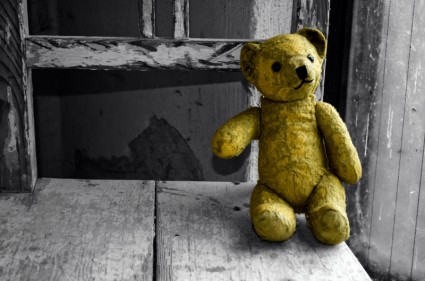
When he was nine or ten months old, our grandson made a new friend.  Although quite small at the time, he was nevertheless much bigger than his friend—a little brown teddy-bear, stuffed with cotton-fill, hand-crocheted by his Nana.

Our little boy was troubled at night during his first several months, restlessly tossing in bed when he was supposed to sleep.  Colic, wetting, and unnamed fears conspired to keep him awake in spite of his obvious fatigue.

Yet, within a couple of weeks of meeting his new friend, he began sleeping much more soundly.  He would hold his teddy-bear tightly in his arms when he was tucked into bed.  Hours later, one might find the two of them, still closely snuggled, apparently a source of comfort and peace to each other.

As infancy gave way to boyhood, the pattern didn’t change.  The two friends, parted during daylight hours, would never fail to meet again at nightfall, falling asleep in each other’s company.

In due time, our grandson was old enough and eager to trundle off to school.  Over the course of his first two years, he formed strong relationships with new-found friends.  He learned to play with them, to share the same experiences, to discover the wonders of the wider world around them.

But always, at day’s end, when all his other friends were home, our grandson came back to his teddy-bear.  And the teddy-bear was his faithful friend.

old_teddy_bear_

One day, a schoolmate came for an overnight visit.  Our grandson—somewhat abashedly, I think, now that he was eight years old—put his teddy-bear aside, out of sight of his visitor.

“Don’t you want your teddy?” his mother whispered quietly before turning off the light.

“Not tonight,” came the muted reply.  So the teddy-bear was placed in the back of the closet.  And forgotten.

Some months later, in the company of other friends who were visiting, our grandson came across the teddy-bear while searching in the closet for another toy.

“Hey!” exclaimed one of the other boys, picking it up curiously.  “Is this your teddy-bear, or what?”

“Nah,” our grandson said.  “It used to be mine when I was just a kid.”  He took it from his friend and tossed it carelessly back in the closet.

A few days later, his mother asked him about the teddy-bear when he came home from school with his friends in tow.

“I’m packing up some stuff for the church bazaar this coming weekend,” she said.  “I thought I’d throw in your teddy-bear, unless you still want it.”

With a quick glance at his friends, our grandson said, “I don’t want it.  You can give it away.”

So, the friendship died.  And our grandson didn’t seem to miss his oldest friend; not, at least, until the day of the bazaar.

bazaar2

Wandering among the rows of tables with his Nana and me, idly fingering his only dollar, he heard a woman nearby, scolding her toddler son.

“No!” she told him firmly.  “I told you we can’t buy it.  Now stop your crying!”

Our grandson moved closer.  And there on the table, all but reaching out to the crying child, was his old teddy-bear.  Alone, without his friends around, our grandson looked almost ashamed that the teddy-bear should even be there.  He stared at his old friend for several moments, until, seized by impulse, he proffered his dollar to the saleswoman behind the table, grabbed up the teddy-bear, and took it to the little boy.

“Here,” he said, gruffly.  “He used to be mine, but now he’s yours.  Hold on to him.”

The youngster did.  And the teddy-bear, resurrected, wrapped his arms around his new little friend.

As we walked away, our grandson looked at me.  “What’s wrong, Gramps?  Have you got tears in your eyes?”

I lied and said no.

Revolution

A friend told me a while back about a financial planning seminar he’d attended, where the wealth management advisers waxed enthusiastically about growth and value stocks, citing several examples of corporations and enterprises that met their criteria for each category.

Not satisfied with their explanations, he asked them where a company such as Amazon, with its vast, online distribution network, would fit in their scheme of things.  Or Google.  Or Facebook.  Would such companies be considered growth or value stocks?

The answer surprised him.  Neither.  And the reason?  None of those ventures had any tangible ‘product’.  To the financial advisers, they were too impalpable to be categorized.  Their core business exists in the ether, as it were.  It’s just technology.

stock ticker

My friend considered this ludicrous.  When one looks ahead to the next decade, one must be impressed by the role technology will play in what some have described as a fourth industrial revolution—the first occurring when machines were developed to supplant manual labour in the early nineteenth-century; the second when mass manufacturing methods appeared later in that century and into the next; and the third when digital technology began to overtake mechanical and analog processes in the late twentieth-century.

And what will this fourth revolution look like?  How will it affect, not people of my generation so much, but our children and grandchildren?  I recently read a summary of issues discussed at a conference sponsored by Singularity University, a consortium of information-technology innovators and providers, and it gave me pause.  If these leading-edge thinkers are to be believed, the revolution will encompass a period of exponential growth unmatched in previous history.

Consider the following, gleaned from the aforementioned online summary.  Computer software and operating systems will discombobulate traditional business models, as we are already seeing with such companies as Uber, which owns no cars, and Airbnb, which owns no properties.

Computers will become ever more powerful, as demonstrated by the IBM Watson, which is able to offer basic legal advice within seconds, to a greater degree of accuracy than its human counterparts, and which can diagnose cancer more accurately than doctors.  What need will there be for generalist lawyers or doctors in a few more years, as computers become arguably more intelligent than humans?

Smartphones will be available and affordable to almost three-quarters of the world’s population within the next five years.  That means everyone will have access to the same information, to the same teaching, to the same outcomes in learning, and in the language of their choice.  Education will become not only affordable, but entertaining.

A medical device will soon be beta-tested to work with smartphones; it will analyse more than four-dozen bio-markers deduced from retina scans, blood samples, and breath tests, and identify diseases threatening our health.  Within a few years, the technology will become inexpensive enough that almost everyone alive will have access to effective, low-cost medicine.

Efficient, green-energy solutions will develop much more quickly than has heretofore been the case.  Solar energy, for example, will drive traditional fossil-fuel providers out of business as it becomes less and less costly.  With the cheap electricity it generates, desalination efforts will expand, providing the world with an increase in the amount of potable water available for its ever-increasing population.

solar power

Electric and self-driving cars are already here.  When they become more prevalent and affordable—and they will—entire industries will be disrupted.  Who will need a car when a ride can be summoned as needed via smartphone?  No maintenance costs.  No insurance costs.  No parking costs.  In fact, no need for the vast tracts of urban land that are given over to parking lots.  Perhaps most importantly, a dramatic reduction in the number of people who die every year in automobile accidents.

What will happen to the Fords, the General Motors, the Volkswagens of the automobile industry when the Teslas, Apples, and Googles begin to market vehicular computers for the masses?  And what of the large insurance companies?  With fewer accidents, not to mention the medical advances cited earlier, their medical and car insurance lines will wither and die.

For young people about to enter the workforce, what does all this mean?  It is anticipated that up to 80% of the jobs we count on now will become obsolete in the next twenty years.  Will there be enough new jobs to replace them?  And if so, what sort of jobs will they be?  With the increase in longevity we witnessed during the twentieth-century expected to grow more rapidly, there is an obvious need to develop vocational and avocational pursuits for the escalating population.

So, for my friend and me, and for anyone who is thinking about financial planning for the future, where is the growth, and where is the value, if not in the technology-driven industries driving the revolution?

If you doubt these trends, please call me and make an offer on the once-valuable Kodak and Fujifilm stocks I still have in my portfolio!

Weighed and Measured

I was weighed the other day, and measured.  And to my great surprise, I was found wanting.

There I stood, like a lamb for the slaughter—clad in undergarments and socks, a paper gown hanging ignominiously from my slumping shoulders—facing the long arm of the weigh scale, its pendulous weights being moved unrelentingly to the right by an unsympathetic nurse.

weighed2

Another arm, this one perpendicular to the weigh bar, lay atop my head.

“No tiptoes!” the nurse said.  “Heels down.”

So I raised my chin as high as I dared, and stretched my torso skyward, straining for every fraction of height.  I’m sure I heard my spine decompressing…ouch!

I sucked my stomach in when she wrapped a tape around my waist, and held my breath as the gown crinkled against me.  I swear she took her time to read it, waiting to see if I’d have to let go.  Mercifully, she released me before I expired.

All my efforts were to no avail, however.  The results spoke for themselves.  Well, actually, I had to ask for them.

“Okay, step down,” the nurse said.  “Sit up on the bed, the doctor will be in shortly.”

“What was I?” I asked, clambering up as directed, pressing the gown between my legs to keep from exposing my nether regions.  As if the nurse cared.  At my age, I’m not even sure why I did.

“Weight, seventy-nine kilos,” she said, placing the clipboard with my chart on a small table by the bed.  “Height, a hundred and seventy-three point seven centimetres.  Waist, ninety-one point four centimetres.”

“What’s that in pounds and inches?” I asked to her departing back.

“Don’t know,” she said.  “Don’t use those anymore.”

The doctor didn’t know, either, although she was much more forthcoming than the nurse.  “You’re a little above weight for your age,” she said, “and a tad too short for your weight.  But it’s the BMI we’re concerned with.”

“BMI?”

“Body-Mass Index.  It’s a measure of body fat, based on weight and height.  Ideally, you should fall somewhere between eighteen and twenty-five.”  She was busy typing who-knows-what into the computer on the table, its screen angled away from me.

“So what am I?” I asked.

“Let’s see,” she said.  “Hmm, slightly overweight.  Twenty-six point eight.  Nothing to worry about, but it would be good to get it inside the normal range.”

“I’m not fat!” I protested.  “I still wear the pants I wore ten years ago.  Thirty-four-inch waist.”

She looked at me—not unkindly, but quizzically—perhaps wondering why anyone would still be wearing clothes from a decade ago.  “You can’t go by the sizes on your clothing,” she said.  “The manufacturers fudge the numbers somewhat, likely to make us all feel better.”

“Really?” I said.  That was news to me, discouraging news, until I realized that, no matter the number, my old pants still fit.  “Okay, but they’re the same size they were…well, whenever I bought them.  I can still get into them.”  Even I could hear the tinge of desperation in my voice.

“I’m sure they do,” she said gently.  “But perhaps your BMI was high back then, too.  Or maybe you were taller.”

“Taller?” I repeated.  “You mean I could be shrinking?”

“I wouldn’t be surprised,” she said, rising from her chair.  “Gravity always wins, so most people shrink as they get older.”

“Older?” I repeated.

“Older!  Now, lie back on the bed,” she said, “and let’s have a look at you.”

I must have looked alright, even for an old guy, because twenty minutes later she let me go.  Dressed again in my familiar, old clothes, the crinkly paper gown gladly discarded.  As soon as I got home, I headed for the computer to do the conversions—kilograms to pounds, centimetres to inches.  I figured the metric units were bigger than the imperial ones—as in one metre is longer than one yard—so my real numbers would probably be smaller.  I was surprised by the results.

“A hundred and seventy-six pounds!” I said to my wife, disbelievingly.  “Five feet, eight inches!  Thirty-six-inch waist!  This is crazy!  I’m taller than that!  Their scales must be off.”

“As long as you feel good,” my wife said, “don’t worry about it.”

“I’m not worried,” I said, convincing neither of us.  “But these numbers can’t be right.  She told me I was overweight, for crying out loud.  My BMI.”

“What was the number?”  My wife obviously knew what BMI meant.

“Umm, twenty-six point eight,” I said, referring to the scribbles I’d made on the back of my appointment card.  “I’m going to calculate it with the imperial numbers, see if it’s lower.”

It wasn’t, though.  I was overweight metrically and imperially, it seemed.

In the Book of Daniel, chapter 5, there’s a passage depicting a judgement visited upon King Belshazzar, where a spectral hand wrote words of condemnation on a wall.  Those words have been translated as:  You are weighed in the balance and are found wanting.

That’s exactly how I felt after my visit to the doctor’s office.  I’d been weighed and measured, and found wanting.  Wanting to be lighter, wanting to be taller, wanting to be thinner!

weighed

I tried to imagine how the poor old king must have felt when he saw the handwriting on the wall, but our situations were quite different.  It had to have been worse for him.  He lost his kingdom, after all, and his life.

All I have to lose is some weight.

On Writing

It was and I said not but.

Huh?  Say again?  That statement doesn’t make sense.

Well, a long-ago English teacher wrote it on our classroom chalkboard one Monday morning, and challenged us to figure out how to make it intelligible.  It remained there all week, ignored by some, I’m sure; but it captivated my attention, and I couldn’t rest until her challenge was met.

This was the teacher who first told me I had the makings of a writer, who encouraged me to write every chance I got, who supported my naïve ambition to write the great Canadian novel.

Beyond the importance of having a good story to tell, she said, and the necessity to populate it with believable characters, there are some essential rules you must follow if you want readers to persevere with you.

once upon a time

Number one:  correct spelling and grammar are crucial.  No reader will long stumble through badly-written prose, full of misspelled words, misplaced commas, and mistakes in punctuation.  Sentences contain subjects and predicates, nouns and verbs, adjectives and adverbs, clauses and phrases; it is the good writer who knows the distinctions among them.

Number two:  an easy, flowing style may sometimes override basic grammar rules, but a discerning reader will know the difference between literary licence and literary incompetence.  Woe betide the author who does not.

Number three:  show, don’t tell.  Describe what’s happening in your story, rather than simply telling the reader.  My teacher provided this example, the opening stanza to a poem by Alfred Noyes, The Highwayman:

The wind was a torrent of darkness among the gusty trees,
The moon was a ghostly galleon tossed upon cloudy seas,
The road was a ribbon of moonlight over the purple moor…

Contrast that with this oft-parodied opening phrase from Paul Clifford, an 1830 novel by Edward Bulwer-Lytton:

It was a dark and stormy night…

The first example allows the reader to imagine the conditions, to see them, to hear them, perhaps even to feel them; the second removes that opportunity absolutely.  The first draws readers in, engages them; the second renders them passive receivers of the information.

Number four:  if you worry about what someone might think of you when they read your scribblings, my teacher said, you’ll never write a thing.  Many years later, I was pleased to read what Stephen King, in his book, On Writing: A Memoir of the Craft, had to say about that:

If you expect to succeed as a writer, rudeness should be the second-to-least of your concerns. The least of all should be polite society and what it expects. If you intend to write as truthfully as you can, your days as a member of polite society are numbered, anyway…

If you write (or paint or dance or sculpt or sing, I suppose), someone will try to make you feel lousy about it…

just write

The final example is one I devised for myself:  it’s impossible to actually finish a book.  The best I can do is to simply stop writing at some point, and bid goodbye to the people who inhabit the story.  For me, the process is initially about the writing; thereafter—endlessly if I were to allow that—it involves the rewriting.

And on that point, the wonderful American writer, Elmore Leonard, advised:

If it sounds like writing…rewrite it.

For me, the truest pleasure comes from the act of writing, of creating something that never existed before.  Ernest Hemingway, another superb American writer, put it this way:

Writing is something that you can never do as well as it can be done. It is a perpetual challenge and it is more difficult than anything else that I have ever done—so I do it.  And it makes me happy when I do it well.

My English teacher has long since passed away, but I still remember her admonitions, her inspiration, and her love of good writing.  As for that seemingly-nonsensical sentence she wrote on the chalkboard those many years ago, a sprinkling of punctuation made everything clear:

“It was ‘and’,” I said.  “Not ‘but’!”

Trusty Sidekick

As a young boy, I loved the Saturday afternoon matinees at our neighbourhood movie theatre.  Whenever I could earn or scrounge the twenty-five cents needed for admission, popcorn, and a soft drink, I’d be there, wide-eyed in the dark, lost for a couple of hours in the fantasies played out before me.

The matinees usually consisted of a serialized short, with a cliff-hanger at the end of every episode, a cartoon, and a main feature.  At some point along the way, all but the serials began to appear in colour.  Imagine!

My favourites were westerns—cowboys and Indians, as we thought of them in those innocent, bygone days—and I quickly developed a fondness for the rugged heroes who rode the purple sage.

In the early fifties, my parents acquired a television, black and white, of course, and Saturday mornings after breakfast became prime viewing time.  With a lineup of westerns and cartoons, it was almost as good as being at the movies.  I still remember my parents turning the TV off if I was still in my pyjamas, or if my bed wasn’t made, when I settled on the carpet to watch.

It wasn’t long ‘til I realized that every cowboy hero had a trusty sidekick.  And years before I became aware of such concepts as racism or ageism, those sidekicks were men of diverse ethnicity, many of them old enough to be grandfathers.  With perhaps one exception, there were no women.

cowboy pic

The Lone Ranger, my ultimate hero, had Tonto, an American Indian.  Hopalong Cassidy had ‘California’ Carlson, a bewhiskered, bowlegged geezer.  And the Cisco Kid had Pancho, both Hispanics with huge sombreros.

There were others, as well.  Gene Autry, with ‘Smiley’ Burnett, and later Pat Buttram; ‘Wild Bill’ Hickok, with ‘Jingles’ P. Jones; and Roy Rogers, with ‘Gabby’ Hayes, and later Pat Brady.  Rogers, the self-styled ‘King of the Cowboys’, also had the only female sidekick, Dale Evans (who, off-screen, was his wife).

The heroes were always the stars of their movies and TV shows, of course, while the sidekicks played supporting roles.  And for a long time, I—being impressionable and loving attention—imagined I was the star in a real-life ‘movie’ of my own, assuming all around me were my supporting actors.  Parents, siblings, friends—all trusty sidekicks, playing out their backup roles.

It never occurred to me back then that others might not feel the same way.  For a long time, I didn’t perceive myself as a supporting actor in someone else’s story.  Egocentricity, I learned years later, is one of the stages children pass through on their way to maturity; but apparently, I took my own sweet time on that journey.  I was blessed, I now realize, with family and friends who either didn’t care about my delusions of greatness, or simply tolerated my selfish illusions out of the goodness of their hearts.

Eventually, the truth dawned that it was a fallacy to suppose I was the lead actor in everyone else’s movies.  I came to realize that all of them were, legitimately, the stars of their own stories, and I, at best, a trusty sidekick—or, in some cases, merely a bit-player.

Getting married firmly cemented that truth for me, and becoming a father further reinforced it.  I came to know the importance of being there for those dear to me, in effect earning their support in return, rather than just expecting it.

My lingering love of movies has me glued every year to telecasts of the Academy Awards, when the year’s best performances and productions are honoured by the industry.  Oscars for Best Actor and Best Actress seemed to me the most coveted prizes when I first began to tune in.  But my perception has shifted over the years.

My grandchildren, five in all, are leading rich, exciting lives as they move from childhood to adolescence, discovering all life has to offer.  They love me, and I them, but I’m hardly relevant anymore to their everyday experiences.

My daughters are mature, liberated women, pursuing rewarding careers alongside their husbands.  They love me, too, but I orbit their stars now, not the reverse.

And my wife?  Well, she remains the epitome of an autonomous woman—secure enough to keep seeking new adventures, caring enough to reach a hand back for me, her trusty sidekick.

That egocentric world I once carelessly inhabited is gone forever.  At a point now where I have more yesterdays than tomorrows, I find security and an abiding comfort in being part of the cast in my loved-ones’ life-movies.

And I wonder how different a world we might have if every person on the planet—regardless of race, gender, religious belief, sexual orientation, political leaning—could win an award as Best Supporting Actor, or Best Supporting Actress, in the lives of everyone around them.

That’s an Oscar I would happily accept!

Oscar pic

Whose Lives Matter?

Black Lives matter!  So claims a vocal, concerned group of citizens here in the West, who believe their safety—indeed, their very lives—are at risk in the frightened, suspicious society we are quickly becoming.

All Lives matter!  So comes the response from other groups of concerned folks who believe their traditional culture and way of life are under siege from racial and ethnic groups whose appearance and customs are often quite different.

So who is right?  Are these two positions antithetical, as many would have us believe?

Perhaps, rather than making declarative statements, we should be asking more questions of each other.  The question I ask is, whose lives matter?  Anyone’s?  As I survey the daily news reports of exploitation, forced migration, and ethnic slaughter, I truly wonder.

To whom does my life matter, for example?  Do the nameless powers-that-be who head up multinational corporations, relentlessly extracting and harvesting the resources of our planet, really care about me?  Even as a consumer, one among millions?

Do the presidents, premiers, and overlords of so many autonomous nation-states genuinely care about me?  Even as a voter and citizen of a sovereign country, one among more millions?

Do fanatical extremists of whatever political or religious persuasion actually care if I live or die, so long as their own frenzied ends are met?

I think not.  My life and death are of supreme indifference to all of them.  I am too small to count.

Individual lives do matter, I believe, to one’s immediate spheres of influence—families, friends, neighbours, and the like.  And, thankfully, to the number of altruistic people and organizations who dedicate their time and energy to relief efforts in areas of crisis around the globe.

Consider the indigenous peoples of every continent whose way of life was essentially exterminated by ruthless invaders in the name of empire, religion, and profiteering.  Did their lives matter?

Consider the hundreds of thousands of refugees fleeing their homelands to avoid terrorist activities that have killed so many of their compatriots, a number many fear will overrun the safe-haven nations to which they flock.  Do their lives matter?

Consider the millions who have died from famine, drought, and genocide in so many third-world regions, people whose plight was known but for whom so little could be done.  Did their lives matter?

And then think about the population explosion that threatens to outpace the ability of the planet to sustain itself.  According to a 2014 Living Planet Report from the World Wildlife Federation, the current global rate of consumption, if continued, will require 1.5 planet Earths to support us.

If everyone were to live like the British do, however, that number would rise to 2.5 earths; and if everyone lived like we North Americans, the number would jump to four!  Untenable!

In such a global context, it seems unlikely to me that individual lives matter.  Either mankind must dramatically slow its rate of reproduction, or (as unpalatable as this sounds) individuals must perish in order that the collective may survive.  Hideous to contemplate, yet the human race continues to take each other’s lives, anyway—savagely, often indiscriminately, and remorselessly.

I saw a photo-shopped picture recently, a scuba diver swimming near a huge Great White shark.  The caption read: This is the most feared killer on the planet, murdering millions of people a year.  Beside it, a shark swims peacefully.

shark

So I ask myself—in the overall scheme of things, on our current path—whose lives matter?

We need to answer that question together, not separately.

And soon.

The Iron(y) Lady

Many will remember the Iron Lady, Margaret Thatcher, Prime Minister of the United Kingdom from May 1975 – November 1990.  Her sobriquet, originally bestowed by a Russian journalist, alluded to her obdurate political views and leadership style.

Perhaps the best encapsulation of this approach was delivered in a speech in 1980, when many in her conservative party were calling for a policy U-turn because of a looming recession.  “You turn if you want to,” she declared.  “The lady’s not for turning!”

Nor did she.  Seven years later, when the general economic conditions in the country had turned for the better, she was re-elected.  Uncompromising to the end, she narrowly lost a leadership vote in her party in 1990 and resigned the premiership.

westminster

Now, twenty-six years on, there enters from stage right the second female Prime Minister in the long history of the UK, Theresa May, succeeding David Cameron as party leader after his hapless (mis)management of the Brexit crisis.  She has publicly agreed with a commentator’s description of herself as a bloody difficult woman, yet at the same time, has claimed to be a real Goody Two Shoes in her approach.

On first glance, those two self-appraisals would appear to be at odds.  And much of her political performance also demonstrates this same antithetical nature.  For example, she campaigned for the ‘remain’ side in the recent Brexit referendum, although somewhat tepidly, yet has already signalled that she will get on with the job of exiting the EU posthaste.

“Brexit means Brexit,” she has said, “and we’re going to make a success of it.  There will be no attempts to remain inside the EU, there will be no attempts to rejoin it by the back door.  As Prime Minister, I will make sure we leave the European Union.

This, despite presumably voting to remain.

Although a long-time conservative party member, and Home Secretary for the past six years, her approach has been defined as more liberal than many in her party, almost non-ideological in its pragmatic approach to dealing with issues of governance.  In her recent leadership campaign (unexpectedly ended when her last rival dropped out), she clearly enunciated policy directions that one mainstay of the media described as going further than the Labour Party’s own positions.

Might that be a strategic move to stage left?

At the same time, another media pillar declared the new PM to be staunchly more conservative, more anti-immigration, and more isolationist than Boris Johnson (he being, admittedly, a moderate liberal conservative), a once-presumed rival for the party leadership, who campaigned aggressively for the ‘leave’ side.

Perhaps this dichotomy in the perceptions of the new leader demonstrates nothing more than the long-standing shibboleth that successful politicians, whether campaigning from the right or left, govern from the middle once elected.

We shall see with Theresa May whether that will be so.  But wouldn’t it be the epitome of British irony if, instead, we see a leader who picks and chooses her own path, regardless of that prevailing belief.  If such proves the case, given her shifting positions and statements on key issues and policies to this point, Prime Minister May may, mayhap, earn her own sobriquet, echoing Thatcher’s own—

The Iron(y) Lady.


The Games

The Olympic Games in Rio de Janeiro will soon be upon us, that quadrennial gathering of the world’s best athletes.  But we are hearing from so many of them that they plan not to attend, citing a host of reasons—their health, fear of terrorist activity, unfair competition because of doping, or the unpreparedness of the host country.

I remember a different set of games, played by girls and boys in the schoolyards we frequented.  No one was obliged to take part but nearly everyone did, in one fashion or another, because it was fun.

There weren’t a lot of specific rules involved because the games varied tremendously from one day to the next.  There were always a few standard guidelines that everyone was familiar with, but usually nobody bothered much with them—unless, of course, someone violated the sense of fair play that was commonly shared.  Whenever that happened, which wasn’t too often, arguments would flare up, each side would proclaim its case, and finally—perhaps so as not to waste too much of the playing time—a consensus would emerge and the games would continue.

Winners predominated, but only because the games allowed more opportunity to win than to lose.  And since nobody made any effort to keep track of scores and points once the contests ended, every kid in the schoolyard could be a winner in retrospect, a champion in classroom reverie.  Every participant could find some measure of satisfaction in the play, some joy in the sport of it.

kids-playing

After a while, though, those games changed.  Some of the adults in the schoolyard, for the purest of reasons, decided to contribute their time and energy to help the kids organize.  They offered the advice and assistance that comes with experience; and out of the chaos the adults thought they observed in the schoolyard, they brought order.

The vague and tenuous rules that previously governed the games were sharpened and recorded.  And all the girls and boys were made to learn them.  No disagreements were tolerated, and some of the adults volunteered to serve as game officials to ensure fair play.  Many of the games—those that didn’t lend themselves easily to such organization—were dropped in favour of those that did.

A lot of the kids were dropped, too, because there were no longer as many opportunities to compete for those whose game-playing abilities were not as fully developed.  These children were kept in the schoolyard, but off to the side where they could watch and cheer the others at play.  They became onlookers, hero-worshippers, only able to enjoy the experience vicariously.  And gradually, the games became The Games.

The Games, remember?  They were played by the very best girls and boys in every schoolyard.  But because there weren’t enough top-calibre kids in any one yard to sufficiently challenge their skills, the adults arranged for them to play against girls and boys from other schoolyards.

They played hard.  They did themselves proud.  In their various sweaters and uniforms, decked out in colours unique to their own schools, they vied with one another to see who was truly the best.  The purpose was not just to compete, but to win.  Records became increasingly important, first to establish and then to shatter.  And over a period of time some schools gained reputations as powerhouses in the competitions.

Winner, Winning Stairs, Olympic Games, Silver Medal

In order to attain such heights, or to remain on top once there, some schoolyard teams resorted to additional measures.  They enticed the best of the younger children to attend the big-name schools; they lobbied for changes to the rules of the contests to favour their own talents and skills; and they began to heap criticism on other schools who engaged in the same sort of tactics.

Eventually, one schoolyard team had had enough.  Perhaps because of an inability to compete at the highest level, or a sense of futility when playing the better school teams, a decision was taken to stop competing in The Games.  The other schools protested loudly, but to no avail; the boycott held.  And then more of the smaller, less successful schools made their decision to drop out, too.  In just a short time, The Games were reduced to a shadow of their former glory.

The kids, of course, were rather confused by it all.  After being told by the officious adults to work and train and practise, and just as they were beginning to take their exalted status for granted, they discovered that it had all been in vain.  There would be no more competition.  The Games were finished.

So they returned to their respective schoolyards, disheartened, disillusioned, downcast.  And there, to their surprise, they found that no one else in the schoolyard cared.  All the other girls and boys had long since lost interest in what the more skilful of their peers were doing in their more highly-organized competitions.

Back in the schoolyard, the other kids, the ones  left behind, had begun to play on their own again.  Free of the interference and regulation of the over-zealous adults, they had rediscovered their games.  There weren’t a lot of specific rules involved because the games varied tremendously from one day to the next.  There were always a few standard guidelines that everyone was familiar with, but usually nobody bothered much with them.  They just played to the best of their abilities, and enjoyed the freedom and the exhilaration of being included.

The games.  Nobody was obliged to take part but nearly everyone did.

Because it was fun.

Tracks in the Sand

One long-ago February, when winter’s white enveloped the north, one of our daughters came with her family to visit us in Florida.  The favourite activity for our grandson and granddaughter (the third of the clan being still an infant, unable to express her opinion) was going to the ocean, to the beach.

Our usual routines were fairly standard.  We’d park and unpack the car, each of us carrying the beach necessities according to our age and abilities.  We’d trudge the access path, through the dunes adorned with sea oats, pass through the rickety snow fence, and pick a spot that suited us all.

In short order, the umbrellas would be unfurled, the chairs unfolded, the blankets spread, and the toys strewn across the sand.  Peace would reign for Nana and Grandpa, watching the sleeping baby while her parents and older siblings hit the water.

beach-sand-grass-sunshine_tn2

On one such occasion, a small incident occurred which didn’t have much significance at the time.  In retrospect, however, it has become quite meaningful for me.

My daughter, my wife, and I embarked on a walk along the beach after the kids had finished splashing in the ocean.  Their dad stayed with them, helping build grand castles in the sand.

We decided to hike through the dunes on the way out, and come back along the shoreline.  I led off, sinking ankle-deep into the soft sand, feet clad in sandals to protect from the heat and the sandspurs.  After a few minutes, we came upon tracks in the sand, apparently made by some small creature, perhaps a mole.

What made the discovery unusual was that they suddenly stopped in a small depression in the sand, as if the mole had simply vanished.  The tracks ended without a trace.

My daughter suggested what might have happened.  The mole, she reckoned, had been taken by a predator, likely one of the falcons that frequent the area.  Indeed, on closer inspection, we could detect brush-marks in the sand, caused by the beating of a bird’s powerful wings.

We wended our way slowly, backtracking along the poor victim’s trail.  It occurred to me that, a scant few yards before the depression in the sand, the mole would have had no inkling it was about to die.  It was alive until it wasn’t.

Apparently, though, it knew it was under attack, for we found another, earlier depression in the sand where the bird had struck unsuccessfully.  The mole had jumped sideways, scurried under the protection of some sea-oats, then emerged again to flee along the sand.

Our backtracking ended when the trail curled away from the beach, into dense, long grasses, whence the mole had come.  We soon forgot about it as we continued our stroll, eventually heading back along the water’s edge to our grandchildren.

A few days later, I chanced to hear someone on the radio airily proclaiming that, if we all discovered the world was to end tomorrow, telephone lines everywhere would be jammed by people calling home to say all those things they had forgotten to say while there was still time.  Social media sites on the internet would crash from the traffic.  It made me think again of the mole whose tracks we had seen in the sand.

When it left its burrow for that final time, did it have its life in order?  Had it said all those things that matter to those who matter?  Or were there things it had left undone that should have been looked to sooner?

And I thought of myself.  Does my journey through life leave tracks in the sand for some other eye to see?  Am I subject to a mortal strike from some hidden foe?  And if, or when, it happens, am I prepared and at peace with those who care about me?

When I got right down to it, I didn’t see much difference between that mole and me.  Except one.  I’m still making tracks in the sand.  I still have time to ready myself for whatever is to come, and to be at peace with all who matter.

Such are the thoughts that arose as a result of a stroll along a sunny beach in Florida.